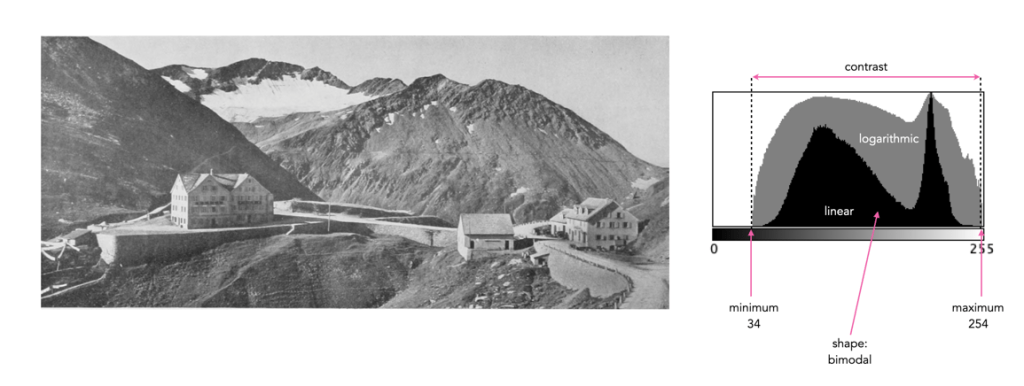
Sometimes a histogram is depicted logarithmically. A histogram will typically depict only large frequencies, i.e. histogram intensities with limited values will not be visualized. The logarithmic form helps to accentuate low frequency occurrences, making them readily apparent. In the example histogram shown below, intensity level 39 has a value of 9, which would not show up in a regular histogram given the scale, e.g. intensity 206 has a count of 9113.
Some of the most interesting vintage lenses are the sub-f/1.2 lenses, of which there are very few. In the 1950s Japanese lens makers wanted to push the envelope, racing to construct the fastest lenses possible. There were four contenders: the Zunow 50mm f/1.1, the Nippon Kogaku’s Nikkor-N.C 50mm f/1.1, Konishiroku (Konica’s predecessor) Hexanon 60mm f/1.2 and the Fujinon 50mm f1.2 LTM. This spurned research which led to the development of the Canon 50mm f/0.95 (1961), which at the time was the largest aperture of any cameras lens in the world. The other, which did not appear until 1976 was the Leitz (Canada) Noctilux-M 50mm f/1.0.
(Note that these lenses were made for 35mm rangefinder cameras.)
Why were these lenses developed?
The most obvious reason was the race to produce fast lenses. An article in the February 1956 issue of Popular Photography sheds more light on the issue. The article, titled “Meet the Zunow f/1.1” [1], by Norman Rothschild, described the virtues of the Zunow lens (more on that below), and concluded with one of the reasons these lenses were of interest, namely that it opened up new areas for the “available-light man”, i.e. the person who wanted to use only natural light, especially with slow colour films. This makes sense, as Kodachrome had an ASA speed of 10, and Type A’s speed was ASA 16. Even Kodachrome II released in 1961 only had a speed of 25 ISO. Conversely, black and white film of the period was much faster: Kodak Super-XX was 200 ISO, and Ilford FP3 was 125 ISO. Ilford HPS, introduced in 1954 pushed the ISO to 800. The newer Ektachrome and Anscochrome colour films were rated at ASA 32. In the patent for the Zunow f/1.1 lens [3], the authors claimed that objectives with apertures wider than f/1.4 were in more demand. In reality, the race to make even faster lenses was little different to the race to get to the moon.
Zunow 50mm f/1.1
The first of the sub-5/1.2 lenses was the Zunow 50mm f/1.1. Teikoku Kōgaku Kenkyūjo was founded by Suzuki Sakuta circa 1930 and worked for other companies grinding lenses. The company started working on fast lens around 1948, with the first prototypes completed in 1950, and the 50mm f/1.1 Zunow released in 1953. It made a number of lenses for rangefinder cameras, including slower 50mm lenses in f/1.3, and f/1.9, a f/1.7 35mm, and a 100mm f/2 lenses. In 1956 it became the Zunow Kōgaku Kōgyō K.K., or Zunow Optical Industry Co., Ltd., but closed its doors in early 1961. During the last years the company designed a couple of camera’s including a prototype of a Leica copy, the Teica, and the Zunow SLR, the first 35mm SLR camera with auto diaphragm, instant-return mirror, and bayonet mount interchangeable lenses (only about 500 were ever produced).
The Zunow 50mm f/1.1 was derived from the Sonnar-type f/1.5 lens. The patent for the Zunow f/1.1 lens [3] describes the lens as “an improved photographic objective suited for use with a camera that takes 36×24mm pictures”. Many of these fast lenses were actually manufactured for the cine industry. For example the company produced Zunow-Elmo Cine f/1.1 lenses for D-mount in 38mm and 6.5mm (and these lenses are reasonably priced, circa US$500, however not very useful for 35mm). The Zunow 50mm f/1.1 is today a vary rare lens. Sales are are US$5-10K depending on condition. The price for this lens in 1956 was US$450.
1953 – Zunow f/1.1 5cm, Leica M39 mount/Nikon S, 9 elements in 5 groups.
1955 – Zunow f/1.1 50mm, Leica M39 mount/Nikon S, 8 elements in 5 groups.
Nikkor-N 50mm f/1.1
Hot on the heals of Zunow was the Nikkor-N 5cm f/1.1 developed by Nippon Kogaku. Introduced in 1956, it was the second sub-f/1.2 lens produced. The lens was designed by Saburo Murakami, who received a patent for it in 1958 [5]. While the Zunow was an extension of the Sonnar-type lens, the Nikkor lens was of a gaussian type. It was also made using an optical glass made using the rare earth element Lanthanum in three of its optical elements. The lens was made in three differing mounts: the original internal Nikon mount (for use on Nikon S2, SP/S3 cameras), the external Nikon mount, and the Leica M39 mount. The original lens mount was an internal mount, and the heavy weight of the lens (425g) could damage the focusing mount, so it was redesigned in 1959 with an external mount. The lens had a gigantic lens hood with cut-outs for setting the focus with the rangefinder through the viewfinder.
1956 – Nikon Nikkor-N[.C] 50mm f/1.1, Leica screw mount/Nikon S, 9 elements in 6 groups (Nikon, 1200 units; M39, 300 units)
1959 – Nikon Nikkor-N 50mm f/1.1, Leica screw mount/Nikon S, 9 elements in 6 groups (1800 units)
A 1959 price list shows that this lens sold for US$299.50. Today the price of this lens is anywhere in the range $5-10K. Too few were manufactured to make this lens the least bit affordable. Nippon Kogaku also supposedly developed an experimental f/1.0 lens for the Nikon S, but it never went into production.
Canon 50mm f/0.95
In August 1961, Canon released the 50mm f/0.95, designed as a standard lens for the Canon 7 rangefinder camera. It was the world’s fastest lens. The Canon f/0.95 was often advertised attached to the Model 7 camera – the Canon “dream” lens. The advertising generally touted the fact that it was “the world’s fastest lens, four times brighter than the human eye” (how this could be measured is questionable). It is Gauss type lens with 7 elements in 5 groups. The lens was so large on the Canon 7 that it obscured a good part of the view in the bottom right-hand corner of the viewfinder, and partially obscured the field-of-view.
In a 1970 Canon price list, the 50mm f/0.95 rangefinder lens sold for $320, with the f/1.2 at $220. To put this into context, $320 in 1970 is worth about $2320 today, and a Canon 7 with a f/0.95 lens in average condition sells for around this value. Lenses in mint condition are valued at around $5K.
The verdict?
So why did these lenses not catch on? Cost for one. While f/1.2 lenses were expensive, faster lenses were even more expensive. For specialist applications, the development of these lenses likely made sense, but for the average photographer likely not. There were a number of articles circa 1950 in magazines like Poplular Photography which seemed to downplay their value, which likely contributed to their decline. It is notable that by the the early 1960s, Nikon stopped advertising its 50mm f/1.1 lens, and never produced another sub-f/1.2 lens. By the late 1960s even Canon had ceased production of the f/0.95.
There were probably more sub f/1.2 lenses created for non-photographic applications, in many different focal lengths. For example x-ray machines (Leitz 50mm f/0.75), D-mount film cameras (e.g. Kern Switar 13mm f/0.9), C-mount for film, medical and scientific imaging (e.g. Angenieux 35mm f/0.95), and aerial photography lenses (e.g. Zeiss Planar 50mm f/0.7). Not until recently have super-fast lenses once again appeared, likely because they are technologically better lenses, made much cheaper than they ever could have been in the 1950s and 60s.
References:
Norman Rothschild, “Meet the Zunow f/1.1”, Popular Photography, pp.126/128, February (1956)
Kogoro Yamada, “Japanese photographic objectives for use with 35mm cameras”, Photographic Science and Engineering 2(1), p.6-13 (1958)
U.S. Patent 2,715,354, Sakuta Suzuki et al., “Photographic Objective with Wide Relative Aperture”, August 16, (1955)
Hagiya Takeshi, Zunō kamera tanjō: Sengo kokusan kamera jū monogatari (The birth of the Zunow camera: Ten stories of postwar Japanese camera makers) Japanese only (1999)
U.S. Patent 2,828,671, “Wide Aperture Photographic Objectives”, April 1, 1958.
The term plastic is somewhat relative – it actually means any material that is moldable, shapable, ductile. At extremely high temperatures even rocks can become plastic. The most common use of the word is likely to describe a synthetic material made from a wide range of organic polymers. The first plastic made from synthetic materials was Bakelite, which was invented in 1907. It was used in the 1930s to make cameras such as the Kodak Baby Brownie, and Purma Special. Plastic materials such as methyl methacrylate, or acrylic (often better known by its trade names, e.g. Lucite, Plexiglas, Perspex), were developed in the 1920s, largely to make unbreakable eyeglasses.
There was little interest in the use of plastics as substitutes for optical glass until WW2. Many plastic materials were examined during the war period, but few were found to have the right optical characteristics for use in photographic lenses. After the war, research continued, and plastics replaced glass in a number of non-critical optical purposes. But in the realms of photography, few if any manufacturers gave up their dependence on glass, save perhaps for lenses in inexpensive box-cameras. In 1946 Andrew Hecht wrote an article on plastic lenses [1]. The first statement he made was “Plastic lenses are here, and they are here to stay…”. Hecht suggested they would only be economical in lenses of 2.5” or more in diameter. The article focuses on Thomas S. Curtis Laboratories, which produced thousands of lenses up to 18” in diameter for the US Army. These lenses were manufactured from large slabs produced in electric furnaces which is then cut, and shaped on lathes, ground and polished. The article seemed to focus on lenses for applications such as industrial magnifiers.
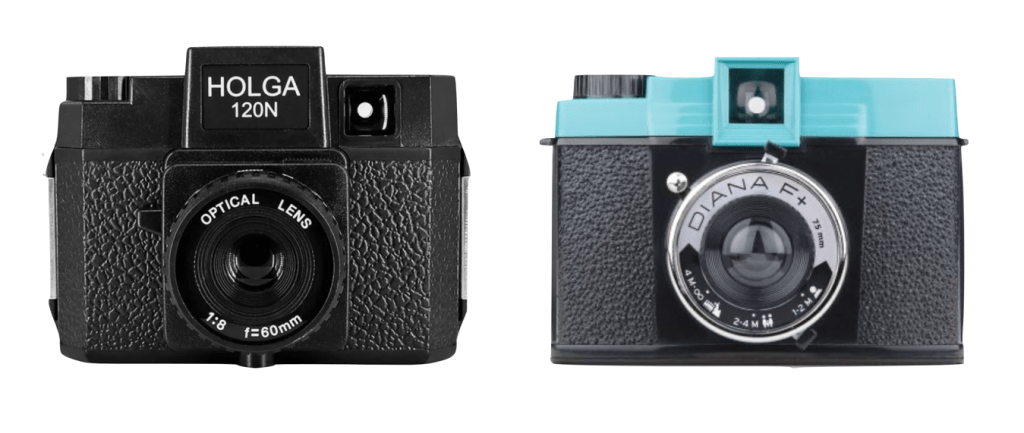
The HOLGA 120N and DIANA cameras with plastic lenses
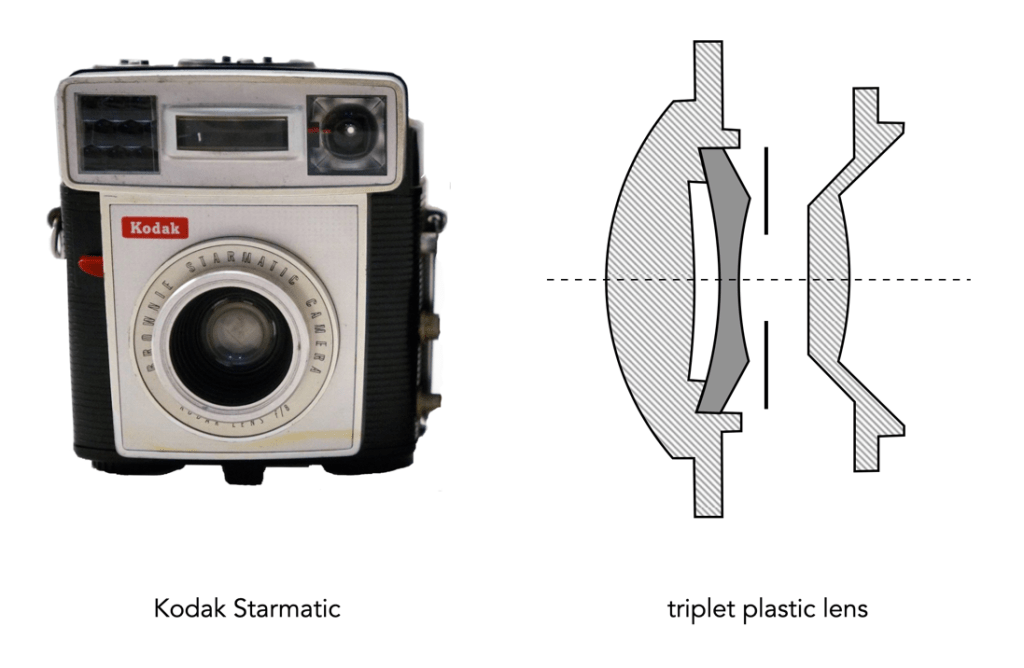
The 1950s saw a growing trend towards the idea of using plastics in cameras. In 1952 Kodak was experimenting with plastic viewfinders in its simple cameras, and by 1957 was making injection molded meniscus lenses for use in snapshot cameras. In 1959 it was using triplet lenses with an f/8 aperture in its Starmatic Brownie cameras. The March 1961 issue of Modern Plastics [2] had an article on plastic lenses, with a cover touting “Lenses – The Focus is on Plastics”. The article describes large plastic lenses made of acrylic, 4-30” in size, used in applications such as magnifiers and reflectors. The article described the many benefits of plastic lenses: reduced weight, more light transmission, impervious to thermal shock, and chip-proof. However of the varied applications it suggests the “prospects are not overly bright for injection molded methacrylate”, largely due to the refractive index. Doubts had already started to set in.
Lloyd Varden investigated plastic lenses in the August 1961 of Popular Photography [3]. He describes a long list of properties that glass had that made it superior to plastic: (i) range of refractive indexes, and dispersion values available, (ii) homogeneity, (iii) physical hardness, (iv) transparency, (v) selective absorption, i.e. absence of colour, (vi) light and atmospheric stability, (vii) freedom from excessive bubbles, (viii) thermal expansion, (ix) moisture absorption, (x) chemical reactivity and solubility, and economy in manufacturing. Unfortunately, plastics of the period could not match up to all these requirements. Plastics could have a high degree of transparency, a low selective absorption, and an absence of bubbles, but failed in other categories such as physical hardness, making them susceptible to scratches, or a high refractive index/low dispersive power.
In 1964 Leonard Lipton wrote Popular Photography article, again looking at plastic lenses: “Plastic Lenses: Good Enough!” [4], in which he said “we are already deep into the plastic lens revolution.” He estimated that in 1963 five million plastic lenses were manufactured, and good photographic objectives could be made up to f/8. He suggests that Kodak was reluctant to admit their inexpensive cameras contained plastic lenses, largely due to the perception that the public associated plastic with an inferior product. Kodak instead preferred to use the term “acrylic”. Many companies were at the time using plastic in products such as viewfinders, and slide viewers. Lipton’s article was a lengthly one, describing the virtues of plastic (over glass), how plastic has dealt with issues such as striation, and changes in temperature, the process of molding lenses, and their limitations.
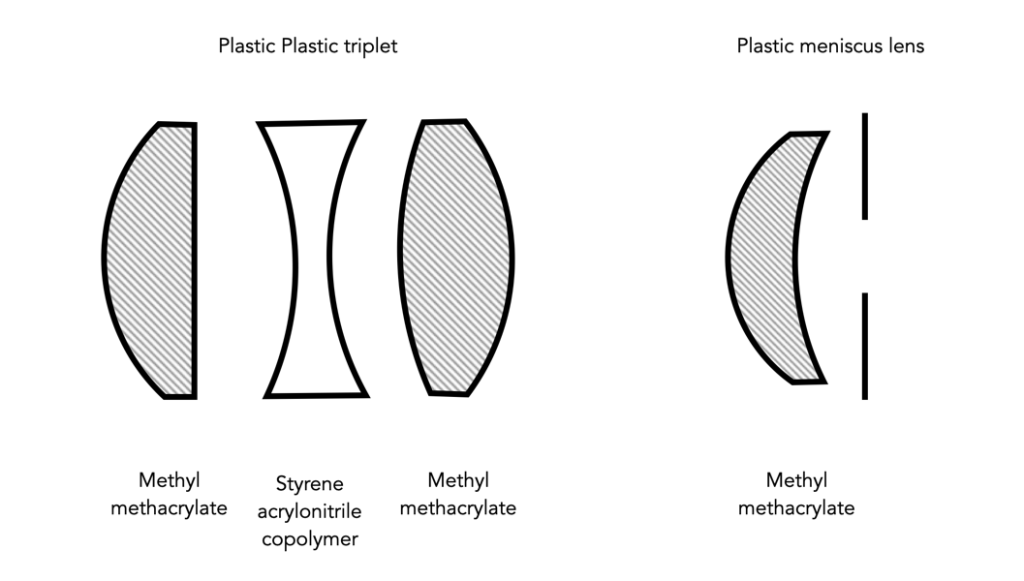
Plastic lenses are typically molded from polymers such as methyl methacrylate (MM), and styrene acrylonitrile copolymer (SAC). Optical glass is chemically nothing like optical grade plastic. Plastic has a definite molecular structure, whereas glass does not. Plastic is basically made from carbon, hydrogen and oxygen, whereas glass can contain a wide variety of materials, e.g. silicon dioxide, barium, boron, lead, and even thorium. The single biggest benefit of plastic is that it could be injection molded. Glass on the other hand, could not be injection molded as it would produce surface irregularities, which would then have to be ground and polished out (modern glass can be precision moulded). Injection molding allowed for complex shapes to be made easily, and inexpensively. Early plastic lenses suffered from something called “striation” whereby a lens has regions which with an index of refraction different from the rest of the lens, resulting in fuzzy pictures. It was caused by uneven cooling in the mold, but by the mid-60s this had been eliminated from lenses.
Plastics were said to suffer from defects, e.g. becoming pitted, or discoloured. However as they were usually used in simple, small lenses, this was hardly ever a real issue. Scratching (of the outer lens) was reduced through the use of plastics like Plexiglas V100, another acrylic which is very hard. The biggest issue with plastic lenses centred around the index of refraction (IR), which is a dimensionless number that indicates the light bending ability of a medium. The IR of plastics was (and is) rather low compared to optical glass. Acrylic has an IR of 1.49, and styrene acrylonitrile copolymer, 1.57. Compare this against modern glass of the period, at 1.52 to 1.89. Another problem was the fact that the IR of acrylics decreases as temperatures increases, changing the focus. Some plastic lenses were designed to automatically compensate for this. For example the plastic f/8 Cooke triplet, which used lens elements made from both acrylic and SAC. The focus of the acrylic elements (front and rear) increases, while the focus of the middle SAC lens decreases, balancing out any changes in focus.
The plastic lenses: Cooke triplet and the single lens
Lipton went a long way to describe the manufacturing benefits of plastic (and the drawbacks of optical glass) [4]. Optical glass is made by melting raw materials, which is processed when it cools into glass. Optical glass requires a number of steps including grinding, polishing, and testing, which made them expensive to manufacture. Plastic lenses on the other hand were simple to manufacture:
“Plastic lenses are made in air conditioned pressurized rooms, and in the case of Plexiglas or Lucite, the plastic, in powder form, is fed to a machine where it is heated and softened. It may be heated to a temperature of 400 to 500 degrees Fahrenheit. The softened plastic is then forced, under a pressure of at least 16,000 pounds per square inch, into a mold when it remains until it cools enough to retain the mold’s shape. The mold is then opened, and the lens is popped out, ready to be used as is, or assembled with other elements with no necessity for working to a finished size.”
Not that manufacturing optical plastics didn’t have its limitations. It was challenging to mold large diameter optical lenses, lenses with plane surfaces, and those with thick centres and thin edges. Lipton considered two stumbling blocks prohibiting the creation of high-speed 35mm lenses: low refractive indices, and the inability to mold large diameter lenses. In fact Dr. Rudolf Kingslake, director of optical design for Kodak, said of plastic objectives: “It’s the low indicies of refraction that are stopping us, it’s just a matter of substituting plastic for glass.”[4].
In 1972 Bob Schwalberg wrote an article describing why glass still reigned supreme [5]. He suggested SLR pentaprisms were a good candidate for conversion to acrylic which would reduce production costs. Schwalberg outlines five benefits:
Lower cost – Raw materials are cheaper, and less expensive to work.
Complete form freedom – Aspherical (non-spherical curvature) lenses are expensive to make in glass.
Exceptional clarity – Not all optical glass is perfectly colourless, the highest grades of optical plastics are quite colourless, and their clarity frequently superior.
Light weight – Plastic lenses are lighter.
High impact resistance – Glass is brittle, plastics are flexible.
and five counter-arguments:
Too limited range of optical specifications – i.e. The refractive index, and the dispersion. Refractive indexes for optical plastics are close to 1.5, optical glass ranges from 1.42 to 1.95.
Poor curve holdability – Accurate lens curvatures are critical for quality performance. Plastic lenses have poor curve conformity because of (3) below, and their inherent flexibility. Glass is stronger and more stable, it holds curvature much better in the face of external forces.
High temperature coefficients – The expansion and contraction of optical plastics is much greater than for optical glass. Muti-element plastic lenses have been developed with elements possessing opposing temperature coefficients. Unthinkable for precision camera lenses.
Clear plastics are hygroscopic – They absorb airborne moisture. Optical media must be isotropic, i.e. equal in all directions. The absorption of moisture destroys this homogeneity.
Low abrasion resistance – Plastics are softer and more prone to scratching than optical glass.
The Kodak Starmatic and its lens
Many of the cameras that use(d) plastic lenses are considered to be “toy” cameras. In 1959 Kodak introduced the Starmatic, the top of Kodak’s Brownie line. It had an 44mm f/8 three-element, plastic lens. The Lomography Diana appearing in the 1960s, and was made entirely of plastic (and in 1975 cost less than $2). The Polaroid Pronto Land camera (mid 1970s), also had a 116mm 3-element Polatriplet plastic lens. Most Holga cameras, had a 60mm f/8 plastic meniscus lens.
But the breakthroughs and sophisticated designs associated with plastic lenses never really materialized. In the end, low refractive indices, and the inability to successfully mold large diameter lenses may have been stumbling blocks to making 35mm lenses from plastic. There are some plastic optical materials [6] that have reached a refractive index of as high as 1.68, e.g. PolyEtherImide, but they often suffer from having a lower transmission rate (36-82% for PolyEtherImide, versus 92% for acrylic). Leica APO glass, on the other hand, has a refractive index of 1.9005.
Apart from their use in inexpensive cameras, there is another use of optical plastic, that is in hybridaspherics. A hybrid aspherical element is a lens element consisting of a glass base upon which plastic is glued, creating the desired aspheric shape. They are typically used in zoom lenses, e.g. the Nikon 28-70mm f/3.5-4.5 AF, first introduced in 1991. Companies like Tamron use hybrid aspherical lenses, likely to reduce the cost of the lenses. Lipton somewhat predicted this use in 1964 [4] when he suggested it would be difficult to grind an aspheric lens in optical glass, yet the manufacture of aspheric lenses in plastic would be no problem. Ironically, many smartphones have lenses which are actually plastic. This is not surprising considering the small size of the lenses required for mobile devices – it is less of a technological challenge, and hence costs less to manufacture (but as manufacturers don’t publish lens diagrams, it’s hard to know). For example the Leica lenses used in Huawei smartphones are plastic. Are there smartphones with glass elements? Sure, but they are usually quite expensive.
Ultimately the inability to derive high precision optics is one of the reasons we don’t see more plastic lenses. But there is another, human factor involved in companies shying away from the use of plastics – the perception of quality. Glass is more associated with quality that plastic, whereas plastic is considered “cheap”, and disposable. This is largely due to its use in inexpensive cameras, and the stigma attached to plastic itself.
Andrew B. Hecht, “And Now Plastic Lenses”, Popular Photography, 18(5) pp.72-74,128 (1946)
“Learn from Lenses”, Modern Plastics, 38(7), pp.90-93 (1961)
Lloyd E. Varden, “Plastic Lenses”, Popular Photography, 49(2) p.48,97,98 (August, 1961)
Leonard Lipton, “Plastic Lenses: Good Enough!”, Popular Photography, 55(2) p.44-45,100-101 (August, 1964)
Bob Schwalberg, “Plastic optics vs. glass, and why glass still reigns”, Popular Photography, 70(2) p.52,118 (1972)
Kingslake, R., Johnson, R.B., “The Work of the Lens Designer”, in Lens Design Fundamentals, 2nd ed. (2010)
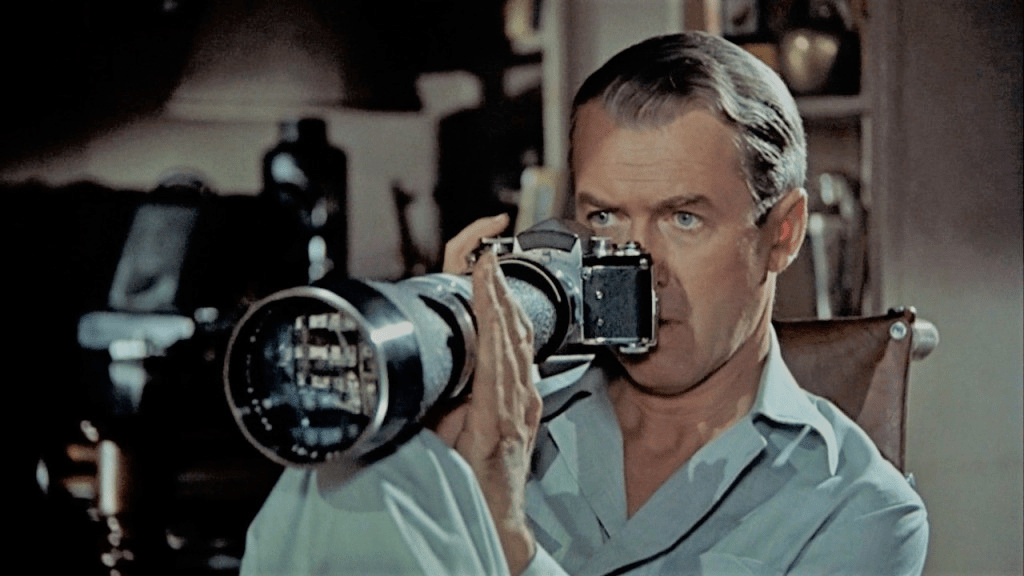
In a previous article, I discussed the Exakta VX camera used in Alfred Hitchcock’s “Rear Window”, suggesting that photojournalists of the period likely didn’t use super-telephoto lenses all that often (or at all). My view on this is based largely on articles I have read in magazines like Popular Photography during the 1950s.
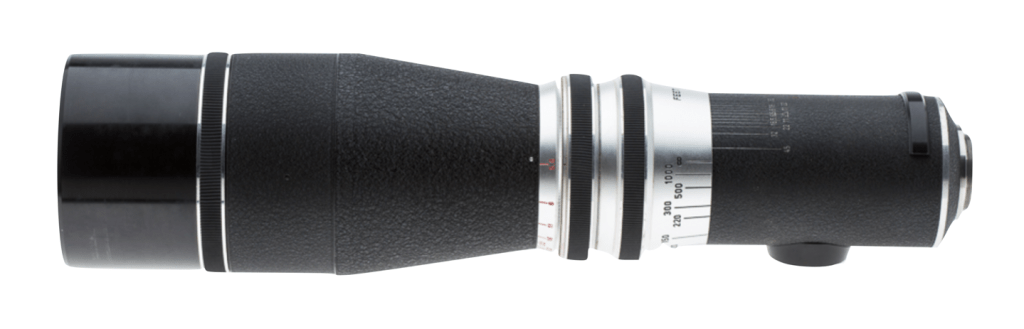
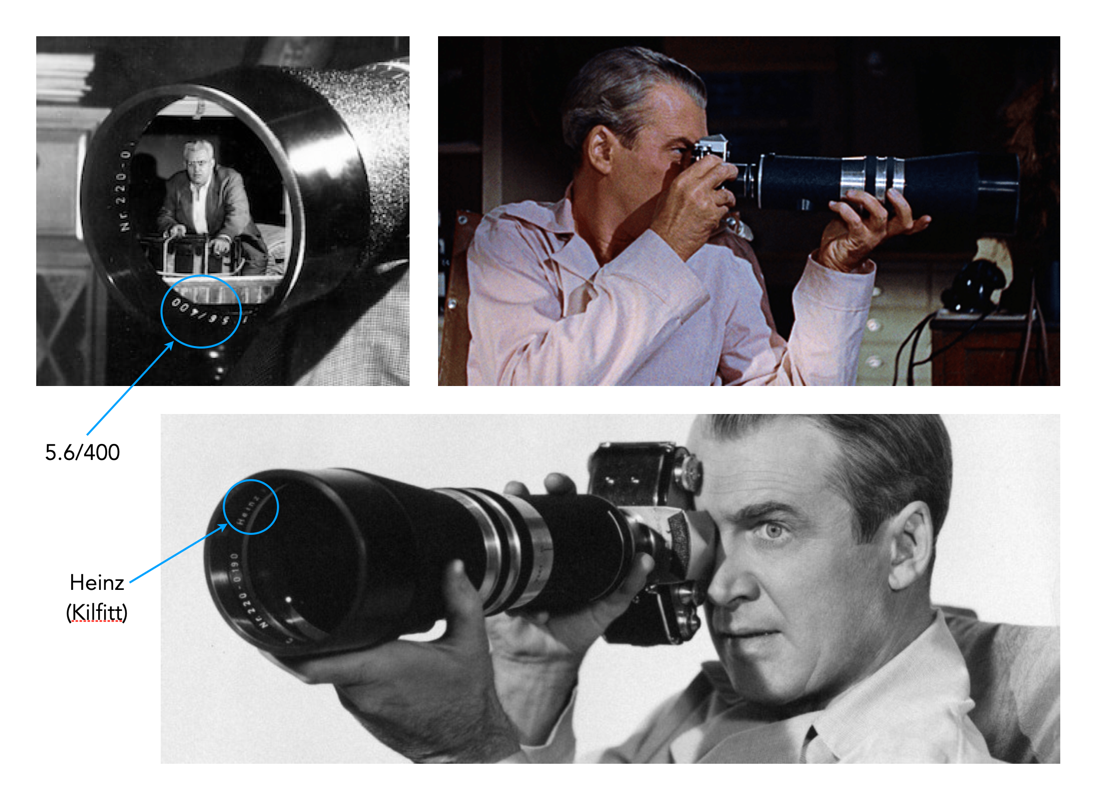
The telephoto lens used by Jefferies in the movie is the Kilfitt Fern-Kilar f/5.6 400mm lens. The lens fits into the category of super-telephoto lenses with focal lengths in the range of 300-600mm. A number of manufacturers produced these lenses, although in all likelihood they had a narrow market. One of the earliest ads for Kilfitt lenses in Popular Photography appears in 1953, advertising their KILAR lenses for “medium and long tele shots” – it includes the 300mm and 400mm lenses. A review of the ads section of Popular Photography in 1954 reveals that the Kilfitt 400mm was being sold alongside the f/5.5 Hugo Meyer-Goerlitz Tele-Megor (which was the lens promoted by Exakta as well), and the Astro f/5.
The Kilfitt-Fern-Kilar 400mm f/5.6
Literature from Heinz Kilfitt Optische Fabrik suggests the lens could be used for “nature and expedition photography“, and also for “special press and feature assignments“. It is then likely that these long lenses were used in situations where a large kit could be carried. Some may argue that Jeff used the lens for sports photography, but that is unlikely, as many photojournalists tended to focus their careers on a particular genre of photography. For example Robert Capa, upon who Jefferies character is loosely based, worked predominantly in war zones: the Spanish Civil War, WWII, Palestine, and the war in Indochina (where he was killed by a landmine). In 1951 Bruce Downes wrote an article in Popular Photography, describing David Douglas Duncan’s photo coverage of the Korean War [2]. He photographed the carnage of war using two Leica IIIc’s, “practical combat cameras” that were “…light, compact and could stand a beating.”. From the perspective of lenses, he used Nikkor lenses: a 50mm f/1.5, a 85mm f/2 and a 135mm f/3.5. No large telephoto lenses in sight.
A steady telescope
In addition, even sports-photojournalists did not generally use long-tele lenses. Jesse Alexander (1929-2021), a motor-sports photographer, reportedly did not use long telephotos lenses. At the start of his career in early 1950s (his first photographic assignment was the 1953 La Carrera road race in Mexico), he used a Leica with 35mm and 135mm lenses, and a Rolleiflex for close-ups and portraits. I would suggest that the 400mm lens was either something Jefferies used occasionally, perhaps for some hobby photography, or merely something added to meet the needs of film. The only real evidence of Jefferies taking sports shots is the motor racing shot that ended up with Jefferies stuck in his apartment with a broken leg. The camera used there was a large format camera (most likely a Graflex), as evidenced by the photo hanging on the wall, taken in the middle of the racetrack.
Identifying the lens
The biggest elephant in the room with these telephoto lenses is their weight. The f/5.6 400mm lens weighed 62oz, or 1.76kg in weight. The faster Sport-Fern-Kilar f/4 400mm lens was even heavier, at 3.1kg. These lenses were just too heavy for a photojournalist to carry and use effectively in an active situation, e.g. a war zone. Even in everyday settings, the length of the telephoto would require the use of a tripod, otherwise shake will be greatly exaggerated – “A slight jiggle that would not be noticed if the scene were filmed with a standard lens will look like something shot on a pogo stick when you use a long telephoto lens.” [1]. It might be okay to use as a de facto telescope and prop up on your knee.
The interesting thing about Exakta is that their literature touted the idea of attaching a telephoto lens to a camera and turning it into a telescope – “a telescope that gives you long-range viewing with high magnification“. A 400mm telephoto lens would provide an eight-power photo-telescope.
NB: Sometimes it is speculated that the lens was actually an Astro-Berlin, a German company that made some pretty cool lenses, especially for the super-super telephoto (we’re talking 2000mm, f/10). These telephotos were often seen on Exakta cameras, hence the association.
Herb A. Lightman, “Choosing and using lenses”, Popular Photography, 35(3), pp.107-117 (1954)
Bruce Downes, “Assignment: Korea”, Popular Photography, 28(3), pp.42-51, March (1951)
Understanding shape and tonal characteristics is part of the picture, but there are some other things about exposure that can be garnered from a histogram that are related to these characteristics. Remember, a histogram is merely a guide. The best way to understand an image is to look at the image itself, not just the histogram.
Contrast
Contrast is the difference in brightness between elements of an image, and can determine how dull or crisp an image appears with respect to intensity values. Note that the contrast described here is luminance or tonal contrast, as opposed to colour contrast. Contrast is represented as a combination of the range of intensity values within an image and the difference between the maximum and minimum pixel values. A well contrasted image typically makes use of the entire gamut of n intensity values from 0..n-1.
Image contrast is often described in terms of low and high contrast. If the difference between the lightest and darkest regions of an image is broad, e.g. if the highlights are bright, and the shadows very dark, then the image is high contrast. If an image’s tonal range is based more on gray tones, then the image is considered to have a low contrast. In between there are infinite combinations, and histograms where there is no distinguishable pattern. Figure 1 shows an example of low and high contrast on a grayscale image.
Fig.1: Examples of differing types of tonal contrast
The histogram of a high contrast image will have bright whites, dark blacks, and a good amount of mid-tones. It can often be identified by edges that appear very distinct. A low-contrast image has little in the way of tonal contrast. It will have a lot of regions that should be white but are off-white, and black regions that are gray. A low contrast image often has a histogram that appears as a compact band of intensities, with other intensity regions completely unoccupied. Low contrast images often exist in the midtones, but can also appear biased to the shadows or highlights. Figure 2 shows images with low and high contrast, and one which sits midway between the two.
Fig.2: Examples of low, medium, and high contrast in colour images
Sometimes an image will exhibit a global contrast which is different to the contrast found in different regions within the image. The example in Figure 3 shows the lack of contrast in an aerial photograph. The image histogram shows an image with medium contrast, yet if the image were divided into two sub-images, both would exhibit low-contrast.
Fig.3: Global contrast versus regional contrast
Clipping
A digital sensor is much more limited than the human eye in its ability to gather information from a scene that contains both very bright, and very dark regions, i.e. a broad dynamic range. A camera may try to create an image that is exposed to the widest possible range of lights and darks in a scene. Because of limited dynamic range, a sensor might leave the image with pitch-black shadows, or pure white highlights. This may signify that the image contains clipping.
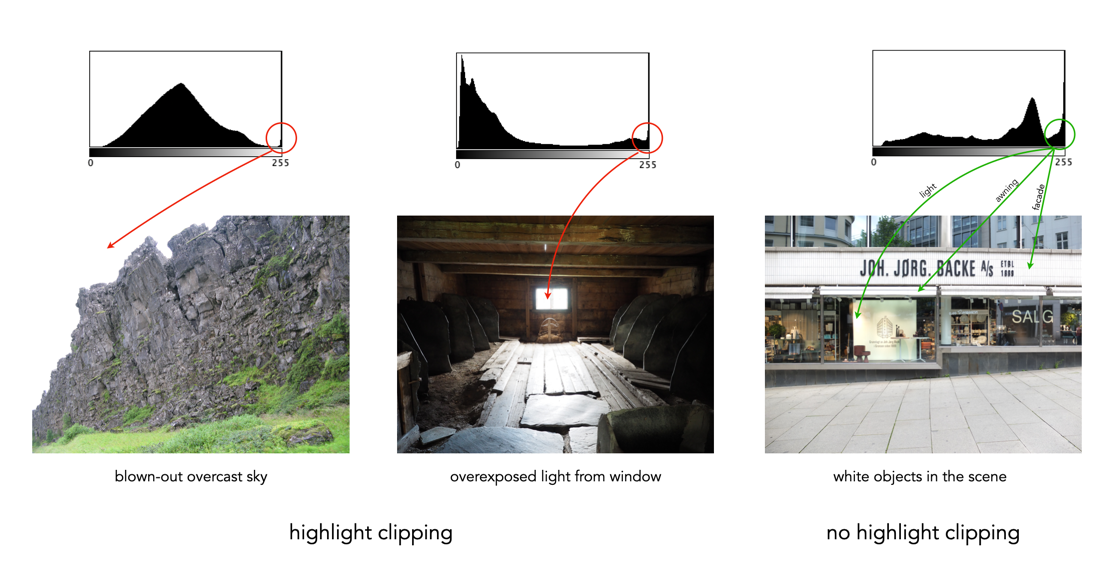
Clipping represents the loss of data from that region of the image. For example a spike on the very left edge of a histogram may suggest the image contains some shadow clipping. Conversely, a spike on the very right edge suggests highlight clipping. Clipping means that the full extent of tonal data is not present in an image (or in actually was never acquired). Highlight clipping occurs when exposure is pushed a little too far, e.g. outdoor scenes where the sky is overcast – the white clouds can become overexposed. Similarly, shadow clipping means a region in an image is underexposed,
In regions that suffer from clipping, it is very hard to recover information.
Fig.4: Shadow versus highlight clipping
Some describe the idea of clipping as “hitting the edge of the histogram, and climbing vertically”. In reality, not all histograms exhibiting this tonal cliff may be bad images. For example images taken against a pure white background are purposely exposed to produce these effects. Examples of images with and without clipping are shown in Figure 5.
Fig.5: Not all edge spikes in a histogram are clipping
Are both forms of clipping equally bad, or is one worse than the other? From experience, highlight clipping is far worse. That is because it is often possible to recover at least some detail from shadow clipping. On the other hand, no amount of post-processing will pull details from regions of highlight-clipping in an image.
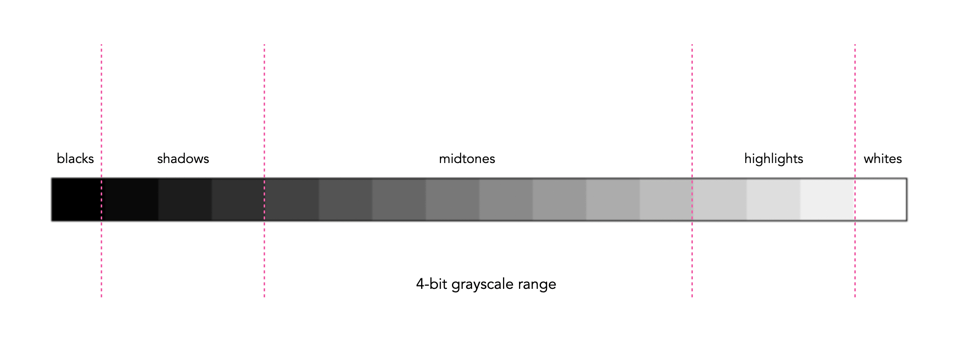
In addition to shape, a histogram can be described using different tonal regions. The left side of the histogram represents the darker tones, or shadows, whereas the right side represents the brighter tones, or highlights, and the middle section represents the midtones. Many different examples of histograms displaying these tonal regions exist. Figure 1 shows a simplified version containing 16 different regions. This is somewhat easier to visualize than a continuous band of 256 grayscale values. The histogram depicts the movement from complete darkness to complete light.
Fig.1: An example of a tonal range – 4-bit (0-15 gray levels)e
The tonal regions within a histogram can be described as:
highlights – The areas of a image which contain high luminance values yet still contain discernable detail. A highlight might be specular (a mirror-like reflection on a polished surface), or diffuse (a refection on a dull surface).
mid tones – A midtone is an area of an image that is intermediate between the highlights and the shadows. The areas of the image where the intensity values are neither very dark, nor very light. Mid-tones ensure a good amount of tonal information is contained in an image.
shadows – The opposite of highlights. Areas that are dark but still retain a certain level of detail.
Like the idealized view of the histogram shape, there can also be a perception of an idealized tonal region – the midtones. However an image containing only midtones tends to lack contrast. In addition, some interpretations of histograms add additional an additional tonal category at either extreme. Both can contribute to clipping.
blacks – Regions of an image that have near-zero luminance. Completely black areas are a dark abyss.
whites – Regions of an image where the brightness has been increased to the extent that highlights become “blown out”, i.e. completely white, and therefore lack detail.
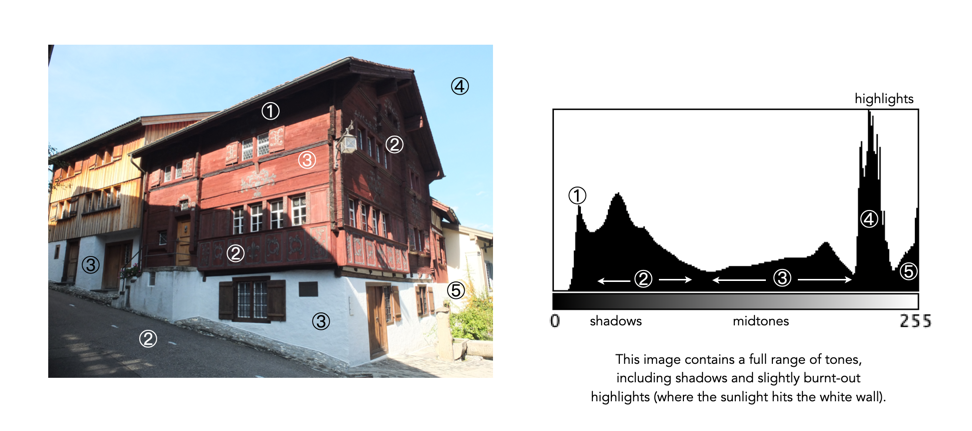
Figure 2 shows an image which illustrates nearly all the regions (with a very weird histogram). The numbers on the image indicate where in the histogram those intensities exist. The peak at ① shows the darkest regions of the image, i.e. the deepest shadows. Next, the regions associated with ② include some shadow (ironically they are in shadow), graduating to midtones. The true mid-tonal region, ③, are regions of the buildings in sunlight. The highlights, ④, are almost completely attributed to the sky, and finally there is a “white” region, ⑤, signifying a region of blow-out, i.e. where the sun is reflecting off the white-washed parts of the building.
Fig.2: An example of the various tonal regions in an image histogram
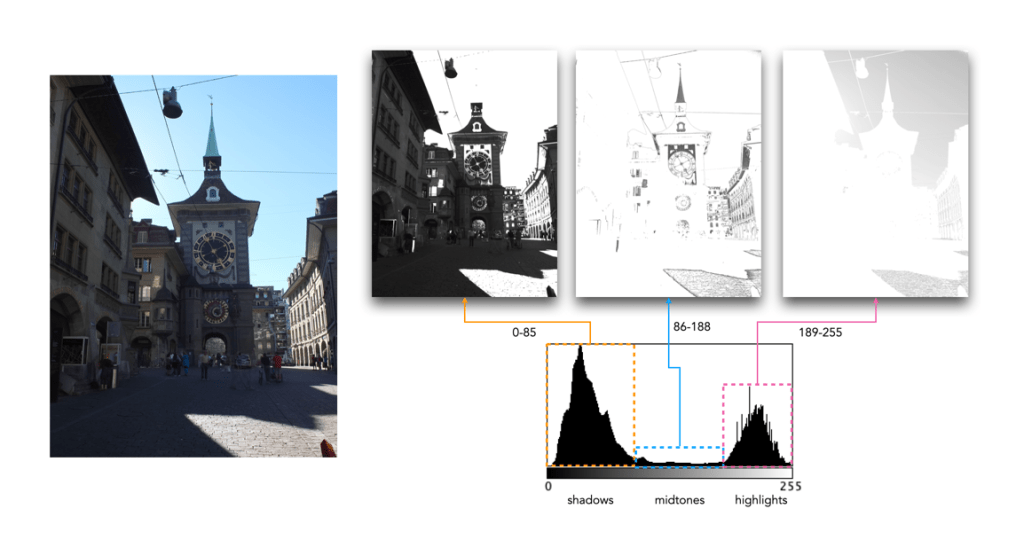
Figure 3 shows how tonal regions in a histogram are associated with pixels in the image. This image has a bimodal histogram, with the majority of pixels in one of two humps. The dominant hump to the left, indicates a good portion of the image is in the shadows. The right-sided smaller hump is associated with the highlights, i.e. the sky, and sunlit pavement. There is very little in the way of midtones, which is not surprising considering the harsh lighting in the scene.
Fig.3: Tonal regions associated with image regions.
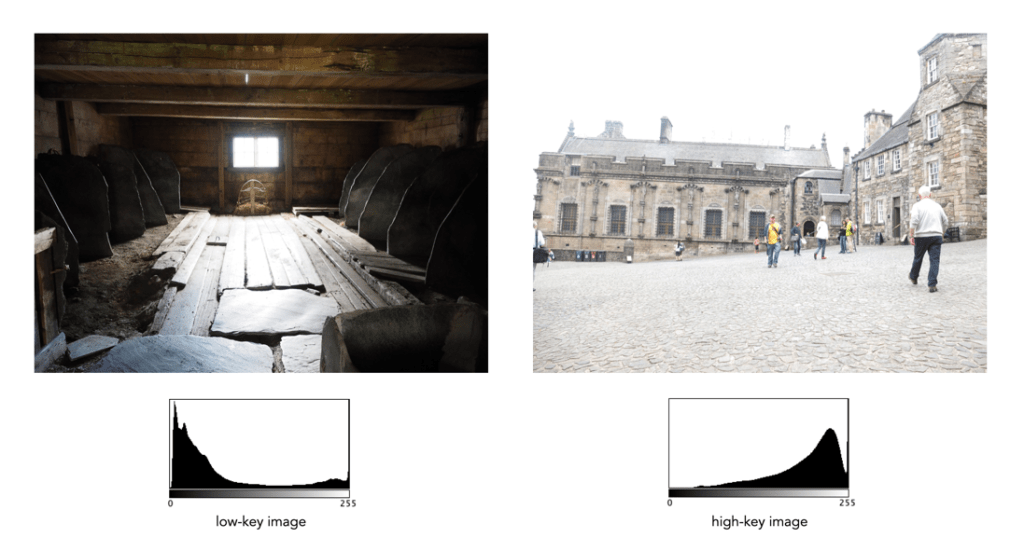
Two other commonly used terms are low-key and high-key.
A high-key image is one composed primarily of light tones, and whose histogram is biased towards 255. Although exposure and lightning can influence the effect, a light-toned subject is almost essential. High-key pictures usually have a pure or nearly pure white background, for example scenes with bright sunlight or a snowy landscape. The high-key effect requires tonal graduations, or shadows, but precludes extremely dark shadows.
A low-key image describes one composed primarily of dark tones, where the bias is towards 0. Subject matter, exposure and lighting contribute to the effect. A dark-toned subject in a dark-toned scene will not necessarily be low-key if the lighting does not produce large areas of shadow. An image taken at night is a good example of a low-key image.
Everything in modern digital photography seems to hark back to analogue 35mm. The concept of “full-frame” only exists because a full frame sensor is equivalent in size to the 24×36mm frame of 35mm film (which was only called 35mm because that was the width of the film). If we didn’t have this association, there would be no crop-sensor. Most early films for cameras were quite large format – introduced in 1899, 116 format film was 70mm wide. This was followed in 1901 by 120 (60mm), 127 (40mm) in 1912, and then 620 (60mm) in 1931. So there were certainly many film format options. So why did 35mm become the standard?
In all likelihood, 35mm became the gold standard because of how widely available 35mm film was in the motion picture industry – it had been around since 1889 when Thomas Edison’s assistant, William Kennedy Dickson simply split 70mm Eastman Kodak film in half. (I have discussed the origins of 35mm film in a previous post). Kodak introduced the standard 135 film in 1934, and was designed for making static pictures (rather than film) with the actual exposure frames being 36mm wide, and 24mm high, giving it a 3:2 ratio. In the 1930s, Leica brochures expounded the fact that the film used in their cameras was “…the standard 35mm cinema film stock, obtainable all over the world.“
A standard Leica with a 50mm f/3.5 ELMAR lens
There was much hype in the 1930s about the cameras that were termed “minicams”, or “candid cameras”, in effect cameras that used 35mm film. By the mid 1930s, Leica had been producing 35mm cameras for over a decade. A 1936 Fortune Magazine article titled “The U.S. Minicam Boom” described the Leica as a camera which “took thirty-six pictures the size of the special-delivery stamp on a roll of movie film.” There were those who did not think the miniature camera would survive, seeing their use as a form of candid camera craze. Take for example the closing argument of Thomas Uzzell, who wrote the negative perspective of a 1937 article “Will the Miniature Survive the Candid Camera Craze?” [1]:
“The little German optical jewels you carry in your (sagging) coat pockets make many experimental exposures expensive (though perhaps they would do better if they carefully made one good one!). Their shorter focal lengths make the ultra-fast exposures more practical (how many pictures are actually taken at these ultra speeds!). You can hop about quickly, minnie in hand, and take photos of children and babies at play with all the detail that “makes a picture pulse with naturalness and life” (though good pictures have never been taken by anyone hoping about). … I claim there is just one thing they cannot do, and apparently are never going to be able to do. They can’t make clear pictures.”
Uzzell claimed the art of the miniature was the art of the fuzzy picture. His challenger, Homer Jensen on the other hand described the inherent merits of 35mm over larger format cameras, namely that one could “…take pictures under the most unfavourable conditions, indoors and outdoors.”. Some people disliked the minicam because it made it too easy to take pictures (like anyone could take pictures).
One of the reasons 35mm was so successful was the small size of the camera itself. Their lightweight nature made them easy to carry, taking up very little room. This made them popular with both causal photographers and professionals such as photojournalists where the use of bulky equipment would be prohibitive. Another reason was the 35mm camera’s ability to work in existing light conditions. This was an affect of having ultra-fast lenses, something the larger format cameras could not practically achieve. The shorter focal lengths of 35mm cameras also allowed for greater depth-of-field at wide lens apertures. The inaugural issue of Popular Photography in 1937 described the advantages of using miniatures to capture fast action [4].
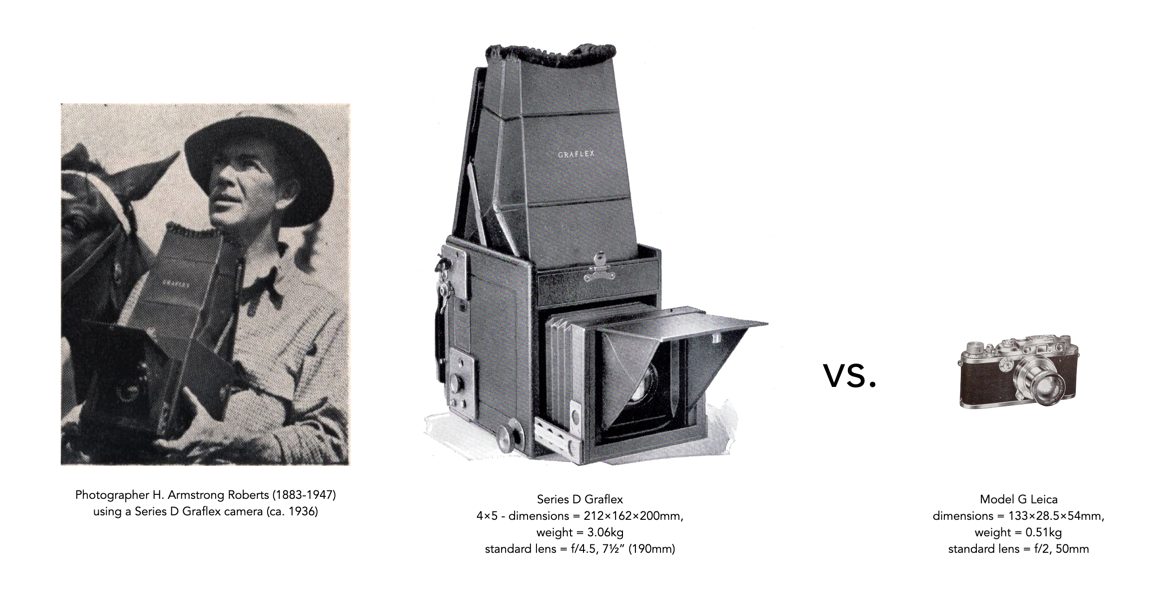
A large format Graflex camera versus a Leica “minicam”.
Large format cameras on the other hand, were sometimes referred to as “Big Berthas” due to their size [4]. The Series D Graflex, a quintessential 4×5″ press camera of the 1930s weighed 3.06kg, compared with the Leica G, which was one-sixth its weight, and roughly 1/30th its size. In a Graflex brochure from 1936, photographer H. Armstrong Roberts recalls a recent 14,000 mile journey where he took 3000 negatives using his Graflex camera, stating that “Certain I am that no other camera could have achieved the results which I have obtained with the GRAFLEX.”
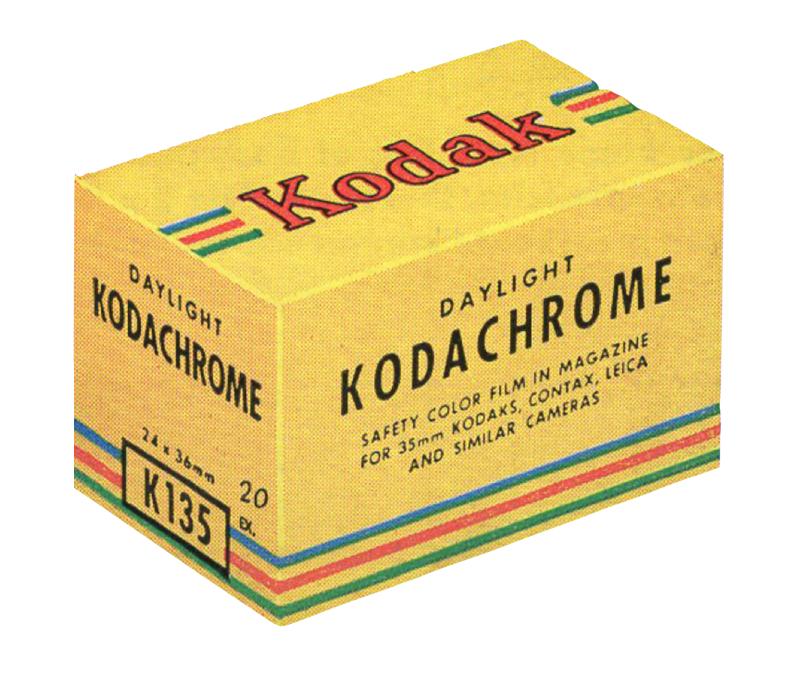
In 1935, another event foreshadowed the success of 35mm photography – Kodak’s introduction of Kodachrome colour film, followed shortly afterwards by Agfa’s Agfacolor Neu. This may have persuaded many a professional photographer to move to 35mm. Indeed, by 1938, H. Armstrong Roberts was also shooting in colour using a Zeiss Contaflex with a 50mm f/2 Sonnar lens [5] (so much for his belief in large format). The onset of WW2 brought a halt to the first minicam boom, but it was not the end of the story. By the early 1950s, the minicam was on the cusp of greatness, soon to become the standard means of taking photographs. More articles started to appear in photography magazines, enunciating the virtues of 35mm [3].
There are many reasons 35mm film became the format of choice.
Kodak’s 135 film single-use cartridge allowed for daylight loading. Prior to this 35mm film had to be loaded onto reusable cassettes in the darkroom.
The physical format of 35mm film made it very user friendly. The film is contained in a metal canister that reduces the risk of light leaks, and is easy to handle. Loading/unloading film is both intuitive, quick and easy. It’s compact size made it much easier to handle than larger format film.
35mm also allowed for more exposures per roll than typical large format films. The norm is 24 or 36 exposures. This provided a great deal of flexibility in the amount of shots that could be taken, because 35mm film was easier and cheaper to develop.
In the hey-day of film photography there was a huge selection of film types – B&W, colour, infrared, and slide.
Of course there were also some limitations, but these mostly centre on the fact that 35mm film was considered to have less resolving power than medium-format film – great for “snapshots”, but anyone that required large prints needed a large film format to avoid grainy prints.
The invention of the Leica started a new era in photography, spurned on by the introduction of Kodak’s 135 film. Post WW2, 35mm film spearheaded the photographic revolution of the 1950s. It became the format used by amateurs, hobbyists, and professionals alike. 35mm photography allowed for a light, yet flexible kit, which was ideal for the travelling amateur photographer of the 1960s.
Further reading:
Uzzell, Thomas, H., “Will the Miniature Survive the Candid Camera Craze? – No”, PopularPhotography, 1(4), pp. 32,66 (1937)
Jensen, Homer, “Will the Miniature Survive the Candid Camera Craze? – Yes”, PopularPhotography, 1(4), pp. 33,84 (1937)
“35mm: The camera and how to use it”, Popular Photography, pp.50-54,118, November (1951)
Witwer, Stan, “Fast Action with a Miniature”, Popular Photography, 1(1) pp.19-20,66 (1937)
“Taking the May Cover in Color”, Popular Photography, 2(5) pp.54 (1938)
There is a third difference between cameras and the human visual system (HVS). While some camera lenses may share a similar perspective of the world with the HVS with respect to the angle-of view, where they differ is what is actually in the area of focus. Using any lens on a camera means that a picture will have an area where the scene is in-focus, with the remainder being out-of-focus. This in-focus region generally occurs in a plane, and is associated with the depth-of-field. On the other hand, the in-focus region of the picture our mind presents us does not have a plane of focus.
While binocular vision allows approximately 120° of (horizontal) vision, it is only highly focused in the very centre, with the remaining picture being increasingly out-of-focus depending on how far a point is away from the central focused region. This may be challenging to visualize, but if you look at an object, only the central point is in focus, the remainder of the picture is out-of-focus. That does not mean it is necessarily blurred, because the brain is still able to discern shape and colour, just not fine details. Blurring it usually a function of distance from the object being focused on, i.e. the point-of-focus. If you look at a close object, distant objects will be out-of-focus, and vice versa.
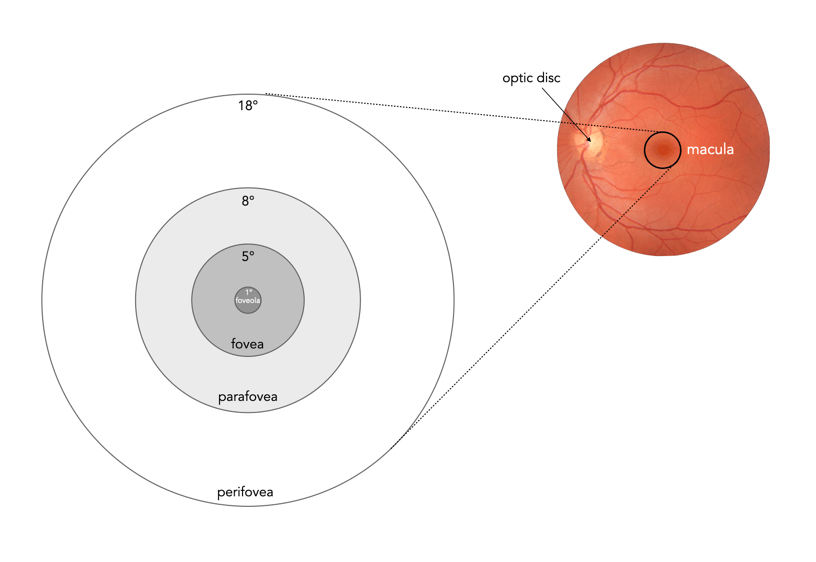
Fig.1: Parts of the macula
Focused vision is related to the different parts of the macula, an oval-shaped pigmented area in the centre of the retina which is responsible for interpreting vision, colour, fine details, and symbols (see Figure 1). It is composed almost entirely of cones, into a series of zones:
perifovea (5.5mm∅, 18°) : Details that appear in up to 9-10° of visual angle.
parafovea (3mm∅, 8°) : Details that appear in peripheral vision, not as sharp as the fovea.
fovea (1.5mm∅, 5°) : Or Fovea centralis, comprised entirely of cones, and responsible for high-acuity, and colour vision.
foveola (0.35mm∅, 1°) : A central pit within the fovea, which contains densely packed cones. Within the foveola is a small depression known as the umbo (0.15mm∅), which is the microscopic centre of the foveola.
Fig.2: Angle-of-view of the whole macula region, versus the foveola.The foveola provides the greatest region of acuity, i.e. fine details.
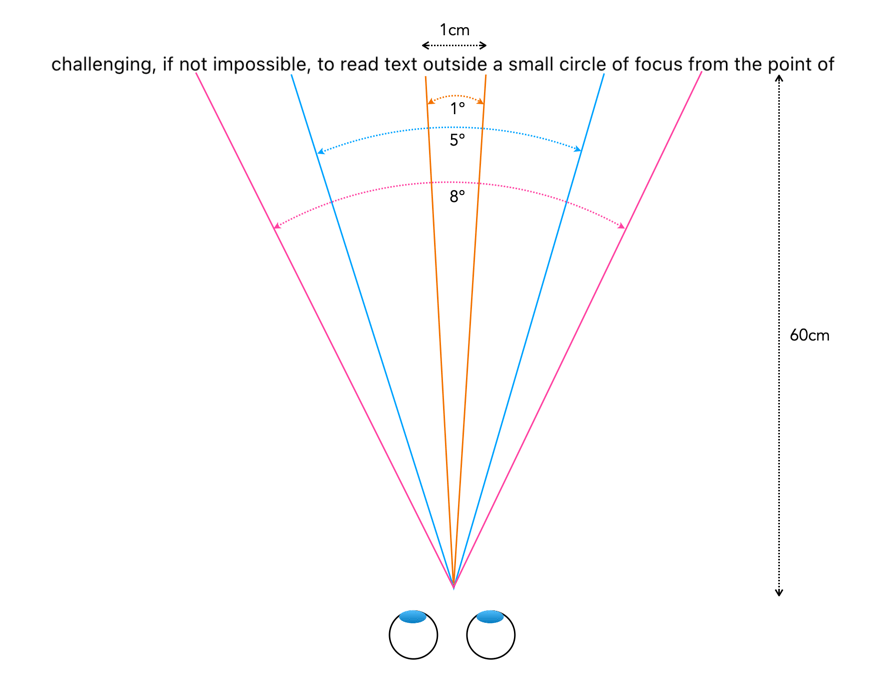
When we fixate on an object, we bring an image of that object onto the fovea. The foveola provides the greatest amount of visual acuity, in the area 1-2° outwards from the point of fixation. As the distance from fixation increases, visual acuity decreases quite rapidly. To illustrate this effect, try reading the preceding text in this paragraph while fixating on the period at the end of the sentence. It is likely challenging, if not impossible, to read text outside a small circle of focus from the point of fixation. A seven letter word, like “outside”, is about 1cm wide, which when read on a screen 60cm from your eye represents about an angle of 1°. The 5° of the fovea region allows for a “preview” of the words either side, and parafovea region, 8° of peripheral words (i.e. their shape). This is illustrated in Figure 3.
Fig.3: Reading text from 60cm
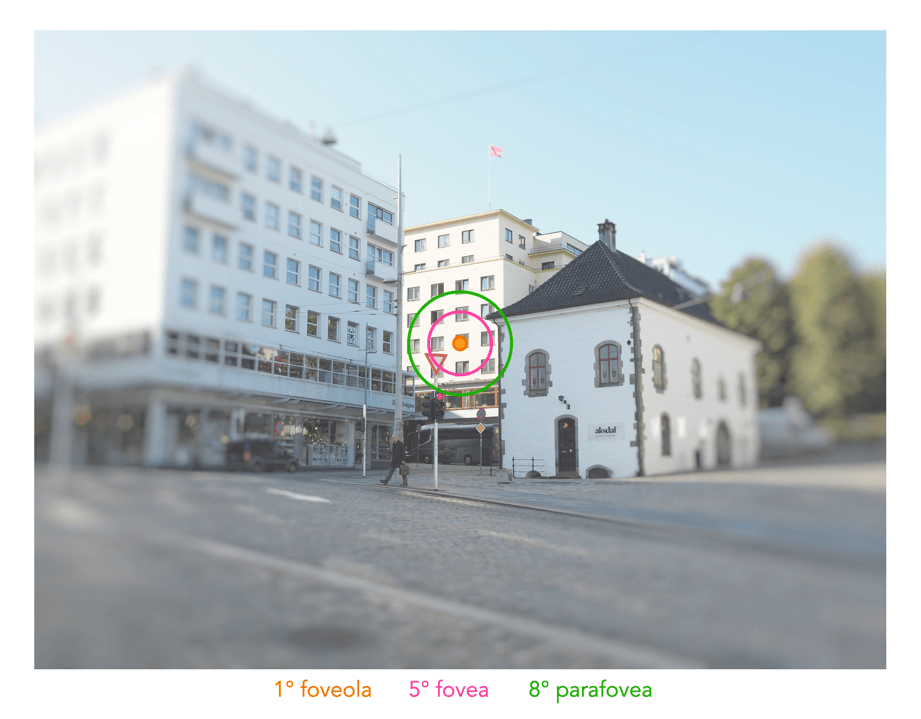
To illustrate how this differential focus affects how humans view a scene, consider the image shown in Figure 4. The point of focus is a building in the background roughly 85m from where the person is standing. This image has been modified by adding radial blur from a central point-of-focus to simulate in-focus versus out-of-focus regions as seen by the eye (the blur has been exaggerated). The sharpest region is the point of fixation in the centre – from this focus on a particular object, anything either side of that object will be unsharp, and the further away from that point, the more unsharp is becomes. The
Fig.4: A simulation of focused versus out-of-focus regions in the HVS (the point of fixation is roughly 85m from the eyes)
It is hard to effectively illustrate exactly how the HVS perceives a scene as there is no way of taking a snapshot and analyzing it. However we do know that focus is a function of distance from the point-of-focus. Other parts of an image as essentially de-emphasized, there is still information there, and the way our minds process it, it provides a complete vision, but there is a central point of focus.
Further reading:
Ruch, T.C., “Chapter 21: Binocular Vision, and Central Visual Pathways”, in Neurophysiology (Ruch, T.C. et al. (eds)) p.441-464 (1965)
One of the most important characteristics of a histogram is its shape. A histogram’s shape offers a good indicator of an image’s ability to tolerate manipulation. A histogram shape can help elucidate the overall contrast in the image. For example a broad histogram usually reflects a scene with significant contrast, whereas a narrow histogram reflects less contrast, with an image which may appear dull or flat. As mentioned previously, some people believe an “ideal” histogram is one having a shape like a hill, mountain, or bell. The reality is that there are as many shapes as there are images. Remember, a histogram represents the pixels in an image, not their position. This means that it is possible to have a number of images that look very different, but have similar histograms.
The shape of a histogram is usually described in terms of simple shape features. These shape features are often described using geographical terms (because a histogram often reminds people of the profile view of a geographical feature): e.g. “hillock” or “mound”, which is a shallow, low feature, “hill” or “hump”, which is a feature rising higher than the surrounding areas, a “peak”, which is a feature with a distinctly top, a “valley”, which is a low area between two peaks, or a “plateau” which is a level region between other features. Features can either be distinct, i.e. recognizably different, or indistinct, i.e. not clearly defined, often blended with other features. These terms are often used when describing the shape of a particular histogram in detail.
Fig.1: A sample of feature shapes in a histogram
From the perspective of simplicity, however histogram shapes can be broadly classified into three basic categories (examples are shown in Fig.2):
Unimodal – A histogram where there is one distinct feature, typically a hump or peak, i.e. a good amount of an image’s pixels are associated with the feature. The feature can exist anywhere in the histogram. A good example of a unimodal histogram is the classic “bell-shaped” curve with a prominent ‘mound’ in the center and similar tapering to the left and right (e.g. Fig.2: ①).
Bimodal – A histogram where there are two distinct features. Bimodal features can exist as a number of varied shapes, for example the features could be very close, or at opposite ends of the histogram.
Multipeak – A histogram with many prominent features, sometimes referred to as multimodal. These histograms tend to differ vastly in their appearance. The peaks in a multipeak histogram can themselves be composed of unimodal or bimodal features.
These categories can can be used in combination with some qualifiers (numeric examples refer to Figure 2). For example a symmetric histogram, is a histogram where each half is the same. Conversely an asymmetric histogram is one which is not symmetric, typically skewed to one side. One can therefore have a unimodal, asymmetric histogram, e.g. ⑥ which shows a classic “J” shape. Bimodal histograms can also be asymmetric (⑪) or symmetric (⑬).
Fig.2: Core categories of histograms: unimodal, bimodal, multi-peak and other.
Histograms can also be qualified as being indistinct, meaning that it is hard to categorize it as any one shape. In ㉓ there is a peak to the right end of the histogram, however the major of the pixels are distributed in the uniform plateau to the right. Sometimes histogram shapes can also be quite uniform, with no distinct groups of pixels, such as in example ㉒ (in reality though these images are quite rare). It it also possible that the histogram exhibits quite a random pattern, which might only indicate quite a complex scene.
But a histogram’s shape is just its shape. To interpet a histogram requires understanding the shape in context to the contents of the scene within the image. For example, one cannot determine an image is too dark from a left-skewed unimodal histogram without knowledge of what the scene entails. Figure 3 shows some sample colour images and their corresponding histograms, illustrating the variation existing in histograms.
Fig.3: Various colour images and their corresponding intensity histograms
There are a number of fundamental differences between a “normal” 50mm lens and the human visual system (HVS). Firstly, a camera extracts a rectangular image from the circular view of the lens. The HVS on the other hand is not circular, nor rectangular – if anything it has somewhat of an oval shape. This can be seen in the diagram of binocular field of vision shown in Figure 1 (from [1]). The central shaded region is the field of vision seen by both eyes, i.e. binocular (stereoscopic) vision, the white areas on both sides are the monocular crescents, seen by only by each eye, and the blackened area is not seen.
Fig.1: One of the original diagrams illustrating both the shape of vision, and the extent of binocular vision [1].
Figure 1 illustrates a second difference, the fact that normal human vision is largely binocular, i.e. uses both eyes to produce an image, whereas most cameras are monocular. Figure 2 illustrates binocular vision more clearly, comparing it to the total visual field.
Fig.2: Shape and angle-of-view, total versus binocular vision (horizontal).
The total visual field of the HVS is 190-200° horizontally, which is composed of 120° of binocular vision, and two fields of 35-40° seen by one one eye. Vertically, the visual field of view is about 130° (and the binocular field is roughly the same), comprised of 50° above the horizontal line-of-sight, and 70-80° below it. An example to illustrate binocular vision (horizontal) is shown in Figure 3.
Fig.3: A binocular (horizontal – 120°) view of Bergen, Norway
It is actually quite challenging to provide an exact example of what a human sees – largely because trying to take the same picture would require a lens such as a fish-eye which would introduce distortions, something the HVS is capable of filtering out.
Further reading:
Ruch, T.C., “Chapter 21: Binocular Vision, and Central Visual Pathways”, in Neurophysiology (Ruch, T.C. et al. (eds)) p.441-464 (1965)