When super-speed movie films started to appear in the 1950s, the industry began to yearn for super-speed lenses to match the advanced film speeds. The worlds first aspherical lens appeared in 1955, developed by a small American company, the Elgeet Optical Company of Rochester NY. The lens was the Elgeet Golden Navitar 12mm f/1.2 wide angle lens for 16mm movie cameras. It was a 9-element lens which incorporated aspheric lens elements in addition to using rare-earth elements. Its claim to fame may have been the fact that it was 66% faster than an f/1.5 lens (which were quite common in the cine industry), covered 4.5 times the area of a normal one-inch lens and delivered sharp images over a 60° AOV. If only spherical lenses had been used in the design extra element would have been required.
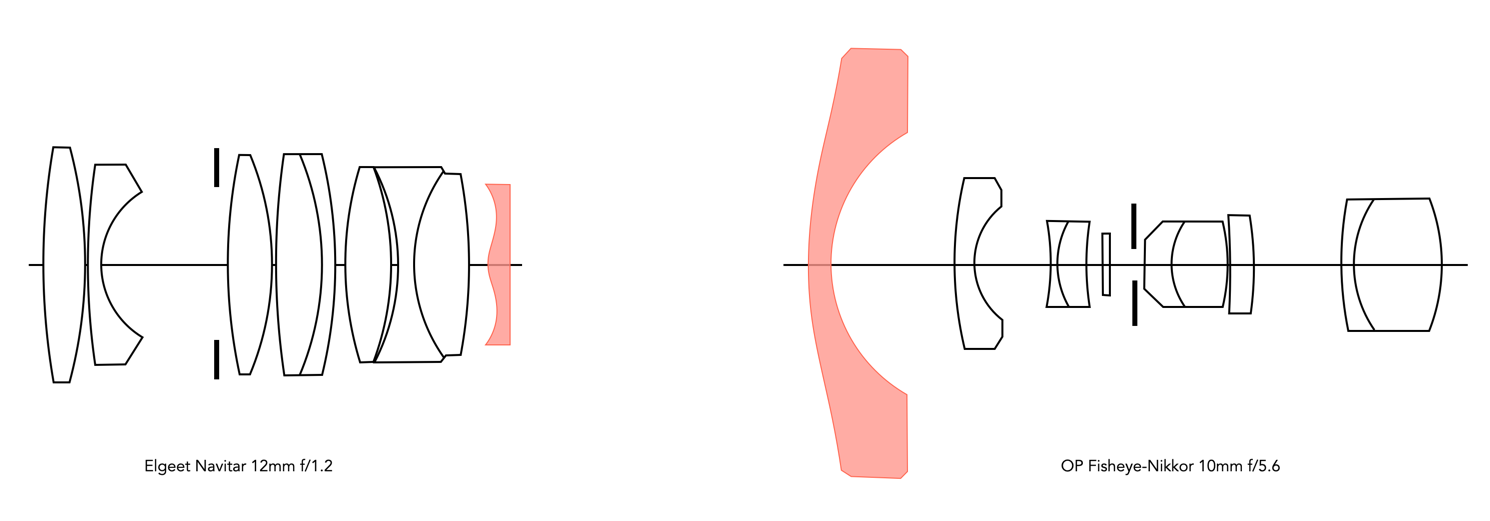
Now the honour of being the first aspherical lens for an SLR goes to OP Fisheye-Nikkor 10mm f/5.6. Introduced in 1968, it created a 180° circular field of view. This was a fisheye lens offering the first orthographic projection, which in simple terms means the lens has a larger central image and the image at the periphery is smaller. It is difficult to create this sort of a lens using spherical lenses, and so a aspheric lens is used in the front to provide an accurate projection.
Notes:
- The Elgeet Optical Company was founded in March 1946, and made interesting lenses for a long while. In 1962 they briefly acquired German company Steinheil (Munich), selling it on after two years to Lear Siegler. In 1972 the company was reorganized into Navitar, which still operates today. The name is an acronym for the founders: London, Goldstein, and Terbuska.
Further reading:
- Ginsberg, R.H., “Aspherics Promise Faster Cine Lenses”, American Cinematographer, 37(4), pp.246-249 (Apr. 1946)


The first I know of is the Carl Zeiss Jena ”Pancolar” f2.0 50mm of 1954…..
LikeLike
While the Pancolar 2/50mm is known as a test platform for aspherical lenses int he mid 1960s, it was never incorporated into the design on a permanent basis because it could not be produced economically in large numbers in the GDR. So no commercial lenses were produced.
LikeLike