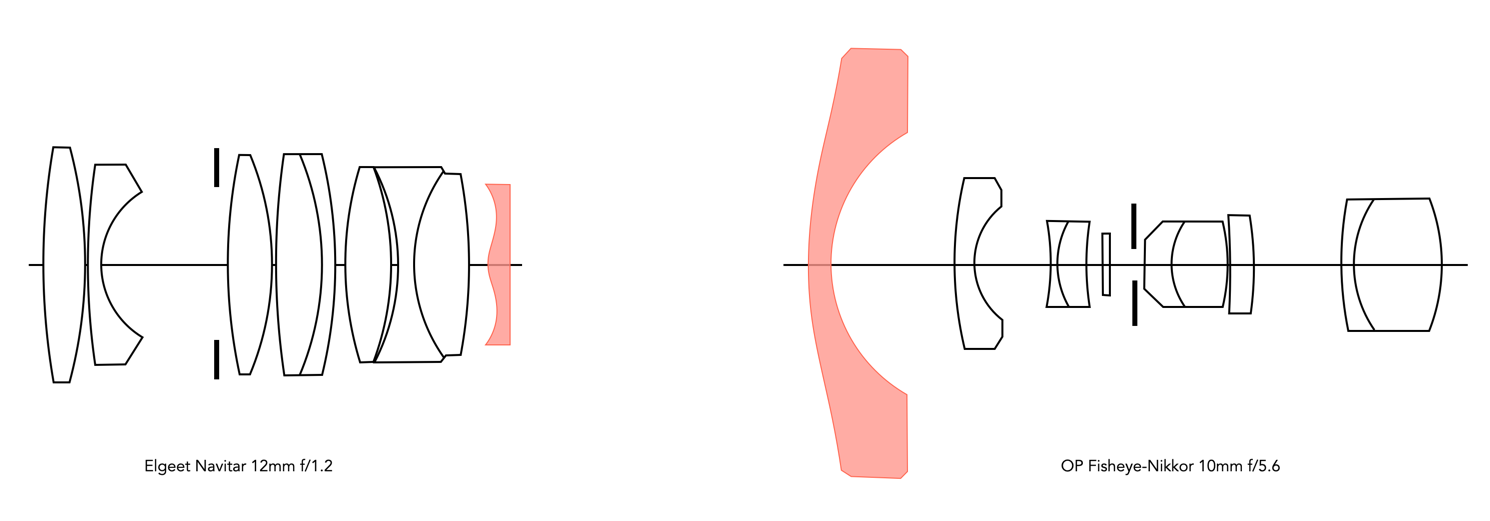
When super-speed movie films started to appear in the 1950s, the industry began to yearn for super-speed lenses to match the advanced film speeds. The worlds first aspherical lens appeared in 1955, developed by a small American company, the Elgeet Optical Company of Rochester NY. The lens was the Elgeet Golden Navitar 12mm f/1.2 wide angle lens for 16mm movie cameras. It was a 9-element lens which incorporated aspheric lens elements in addition to using rare-earth elements. Its claim to fame may have been the fact that it was 66% faster than an f/1.5 lens (which were quite common in the cine industry), covered 4.5 times the area of a normal one-inch lens and delivered sharp images over a 60° AOV. If only spherical lenses had been used in the design extra element would have been required.
Fig.1: The first of two very different aspherical lenses (aspheric lenses are shown coloured).
Now the honour of being the first aspherical lens for an SLR goes to OP Fisheye-Nikkor 10mm f/5.6. Introduced in 1968, it created a 180° circular field of view. This was a fisheye lens offering the first orthographic projection, which in simple terms means the lens has a larger central image and the image at the periphery is smaller. It is difficult to create this sort of a lens using spherical lenses, and so a aspheric lens is used in the front to provide an accurate projection.
Notes:
The Elgeet Optical Company was founded in March 1946, and made interesting lenses for a long while. In 1962 they briefly acquired German company Steinheil (Munich), selling it on after two years to Lear Siegler. In 1972 the company was reorganized into Navitar, which still operates today. The name is an acronym for the founders: London, Goldstein, and Terbuska.
Further reading:
Ginsberg, R.H., “Aspherics Promise Faster Cine Lenses”, American Cinematographer, 37(4), pp.246-249 (Apr. 1946)
When you look at modern lens literature there is often one thing that is often hyped up – the use of aspherical lenses. Or put another way, lenses that contain elements that are aspherical. But what are they, and why do they matter?
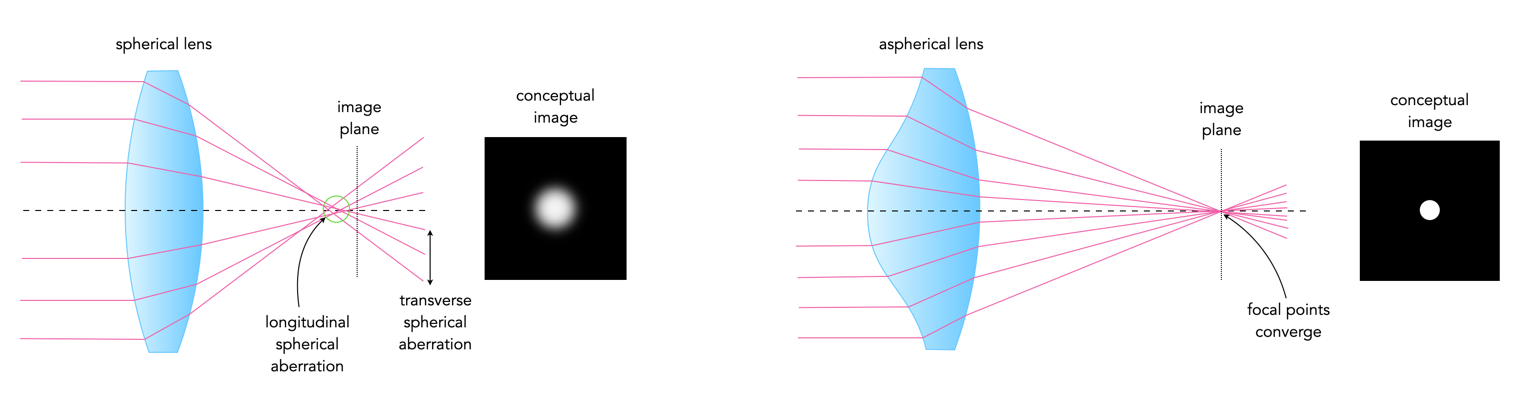
Due to its radius of curvature, a lens forms a real image on a certain plane. In the early days of photography, all lenses had a shape which was spherical. Spherical lens are the easiest shape to make, but they tend to disperse the rays of light passing through them so that they do not focus at the same point. This can lead to a lack of sharpness and clarity, particularly at the edges of an image, and with wider apertures. The use of spherical lenses can cause a deficiency known as spherical aberration. It was discovered that an aspherical lens shape would eliminate this type of aberration, owing to the fact that the curvature of the lens could be used to converge light rays to a single point.
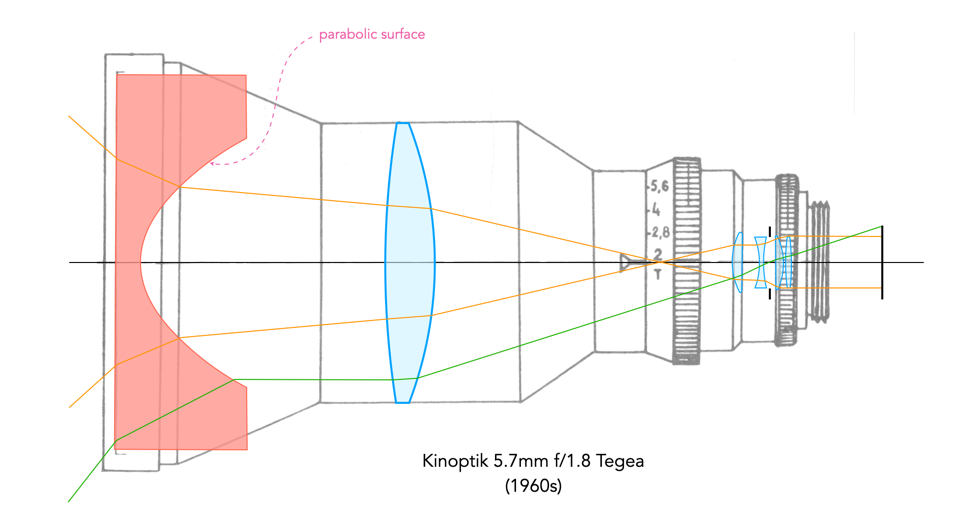
Fig.1: The Kinoptik 5.7mm f/1.8 Tegea – the inverted telephoto system of this lens for 16mm cameras uses a front component with a parabolic surface. Here an aspheric surface is used to control the higher order effects of astigmatism and distortion.
An aspherical lens is simply a lens that doesn’t have a spherical surface shape. Most standard lenses are composed of spherical elements, many of which aren’t really able to direct the light reaching the edges of the lens elements to the same focal point as the light reaching its centre. They were all the rage in the 1950s : “Aspheric lens elements are lenses of non-round shapes. Their non-spherical form allows them to reshape light rays which are normally distorted as they pass through a spherical lens system.” [1]. Essentially aspherical elements are used to help correct misalignment’s in the path of light as it traverses through the lens. They help compensate for spherical aberration and distortion which cannot be completely eliminated using conventional spherical elements alone.
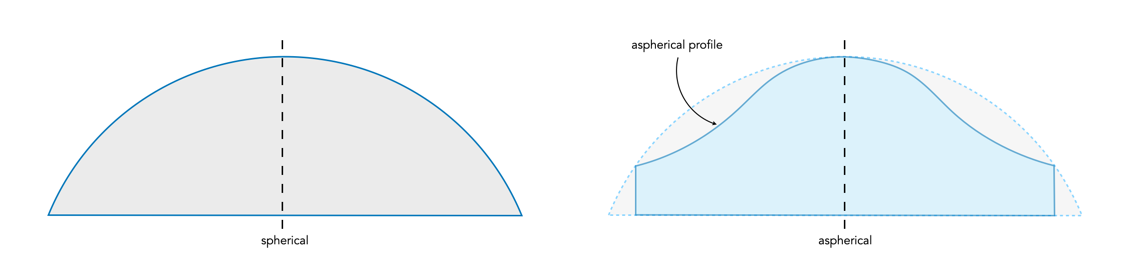
In an aspherical lens, the subtle curvature of the lens can be used to converge the rays of light and bring them to a sharp focus. The degree of asphericity is greatly exaggerated in the illustration (in Fig.2) – it is not visible to the naked eye in an actual aspherical lens element.
Fig.2: The difference between a spherical and aspherical lens
Aspherical lens elements help to compensate for distortion in wide-angle lenses, and reduce or even eliminate spherical aberrations in fast lenses (those with large maximum apertures). Aspherical lenses offer greater design latitude, raise performance, permit the use of fewer lens elements, and allow a more compact size. This is because traditional lens design involves complicated arrangements of different types of lenses to minimize optical deficiencies, but sometimes an aspherical lens can replace multiple lenses resulting in a lighter, more compact design (which is good for things like zoom lenses).
Fig.3: The effect of light rays passing through a spherical and an aspherical lens
However designing and manufacturing aspherical lenses is much more difficult than spherical ones. It’s one of the things that makes lenses containing aspherical elements more expensive than others. The problem is that the degree of asphericity is often super small, and so manufacturing tolerances can be within 0.1 microns. There are four core processes by which modern aspherical lenses are manufactured:
Ground − Individual lenses are ground and polished, typically for elements with large diameters. The most expensive manufacturing process, but also the most precise.
Plastic moulded − Formed by injecting optical-grade resin into an aspherical surface mould. They are light weight, and can be mass produced at a low cost. Good for improving the image quality of entry-level lenses.
Glass moulded − Formed by softening optical glass using high temperatures and then shaping it in an aspherical metal mould. More precise than plastic-moulded lenses, they are still less expensive than ground elements, making them optimal for consumer lenses.
Moulded polymers − A standard glass spherical lens is used onto which is moulded a thin layer of a photopolymer using an aspheric mould. Used for high-volume precision applications.
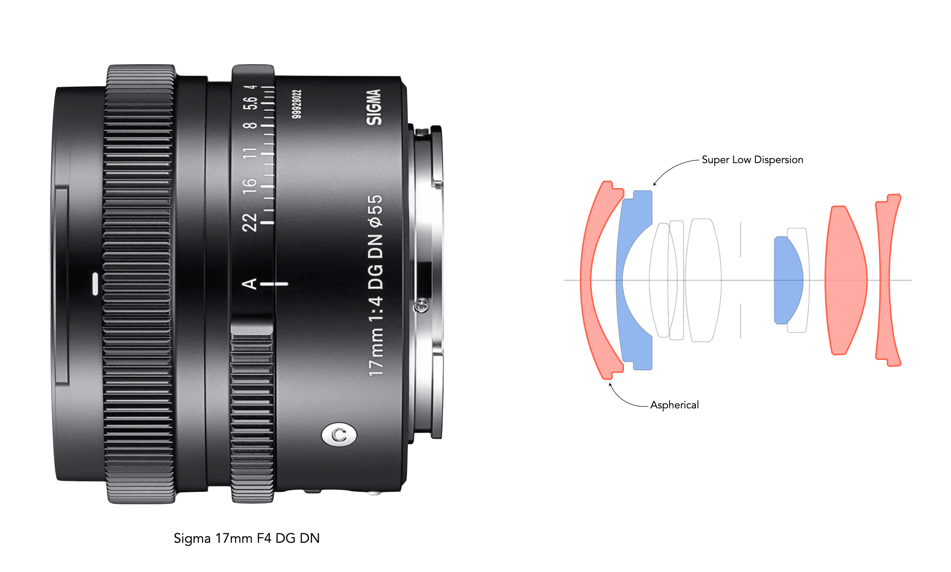
Fig.4: An example of a modern wide-angle lens with aspherical elements (Sigma 17mm F4 DG DN).
What are the downsides of aspherical lenses? One issue is that sometimes it can lead to non-uniform rendering of out-of-focus highlights. This effect usually manifests itself as an ‘onion-like’ texture of concentric rings, or a ‘wooly-like’ texture, and is caused by very slight defects in the surface of aspherical element. It is difficult to predict such effect, but usually it occurs when the highlights are small enough and far enough out of focus.
The first mass produced aspheric lens was introduced in 1955 by the Elgeet Optical Company, the Golden Navitar 12mm f/1.2 lens for 16mm film. The first interchangeable SLR lens to incorporate an aspherical lens element was the Nikon Fisheye-Nikkor 10mm f/5.6 (1968). The first Canon lens with an aspherical element was the FD 55mm f/1.2AL (1971).
Further reading:
Ginsberg, R.H., “Aspherics Promise Faster Cine Lenses”, American Cinematographer, 37(4), pp.246-249 (Apr. 1956)