What’s inside (and outside) a modern lens?

If you look at a advertising from a modern lens manufacturer you will notice that most lenses have offer a lens diagram outlining what the internal design of the lens is, and whether there are special lens elements in it. For most people what’s inside a lens is of little interest, as long as the lens does what it’s suppose to do, however it is a little interesting only because many modern lenses are quite complex inside. What often separates modern digital lenses from vintage film ones is the internal mechanics. While film lenses, and some less-expensive digital lenses had mechanical means of focusing, digital lenses are often auto-focusing, requiring small motors to drive the focusing mechanism. Some manufacturers also produce lenses that have image stabilization mechanisms inside. So there can be a lot going on inside a lens beyond the optical system.

So what features are associated with a modern lens? There are two types of modern digital lens per se. One is bristling with electronics, to deal with apertures, focusing and perhaps stabilization; the other is manual, in such that both focusing and aperture control and done by hand. Why manual? Because it allows lenses to be made in an expensive manner. Fully coupling a lens to a digital camera, which requires electronics, is an expensive venture.

First are the things that have always been on the outside of a lens, namely the aperture ring and focus ring. Now it should be mentioned that some lens makers, e.g. Sigma, produce lenses that are only auto-focus, and as such they don’t offer any sort of manual focus, because there is no focus ring and no ‘manual/auto’ switch. In addition to these are a bunch of features on the outside of a lens that won’t exist on analog lenses. These are usually features specific lens manufacturers have decided would be good for users.

  • focus range limiter (Sony) − saves time by limiting the focusing range, some are user specified range.
  • aperture click switch (Sony) − allows the aperture ring clicks to be engaged or not (smooth)
  • aperture/iris lock (Sony) − prevents unwanted exposure changes while shooting.
  • zoom rotation selection switch (Sony) − change zoom direction to match user preferences.
  • focus mode (Sony, Sigma) − switch between manual and auto focus
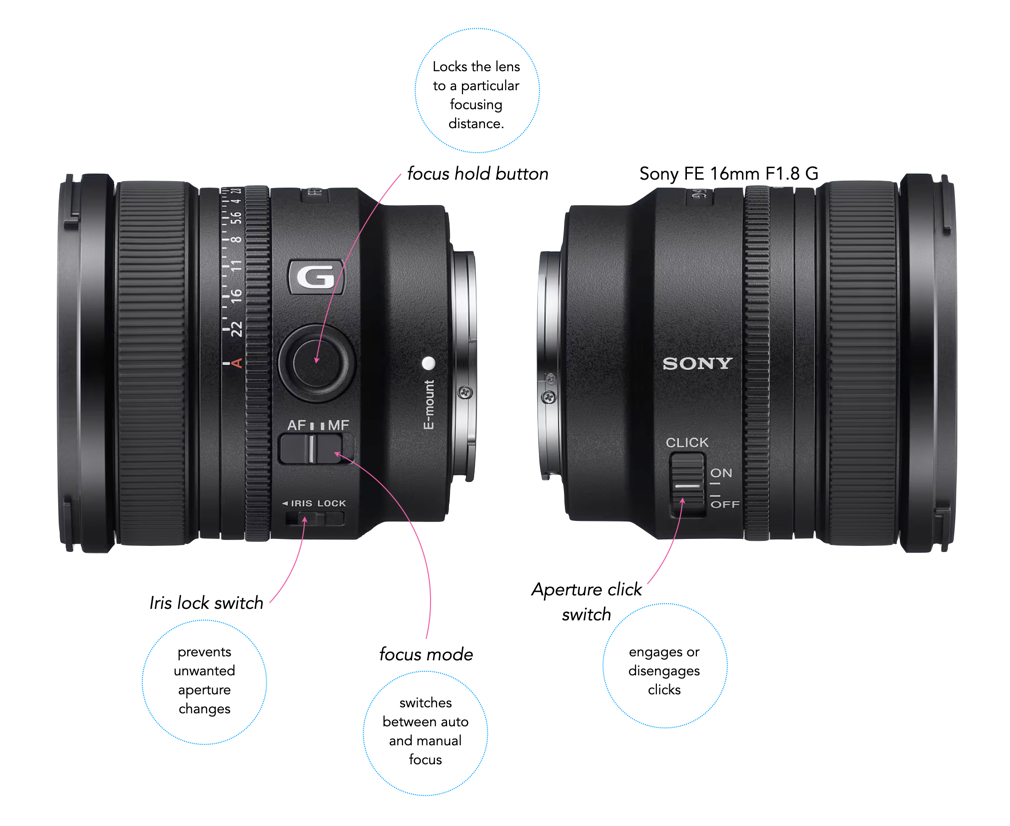
Fig.1: Some of the external accoutrements on a digital lens (Sony FE 16mm F1.8 G)

The next component, and perhaps one of the more interesting is the characteristics of the internal lens elements. Lens element diagrams have been a staple of lens brochures since the 1930s. They illustrate the shape of the lens elements, and how they are positioned inside the lens. The difference between digital and analog lenses is that it was very rare to describe the type of glass used for specific elements in vintage lenses. Now things are different. I honestly don’t know why the glass functionality has become so interesting for manufacturers to include, but there you have it.

Consider Figure 2, which shows the elements inside a Sigma 35mm f/1.4 DG DN lens. The diagram highlights four different types of glass lenses: one type is the aspherical (2 elements), and the remaining types are various forms of low dispersion lens (4 lenses in total). This can be a bit bewildering to the average user − what is the difference between “F” low (FLD), extraordinary low (ELD), and special low dispersion (SLD) glass? It’s almost like worrying about the physics behind an SLR sensor. Oh, by the way, FLD means the glass has optical characteristics that mimic flourite (which is low dispersion).
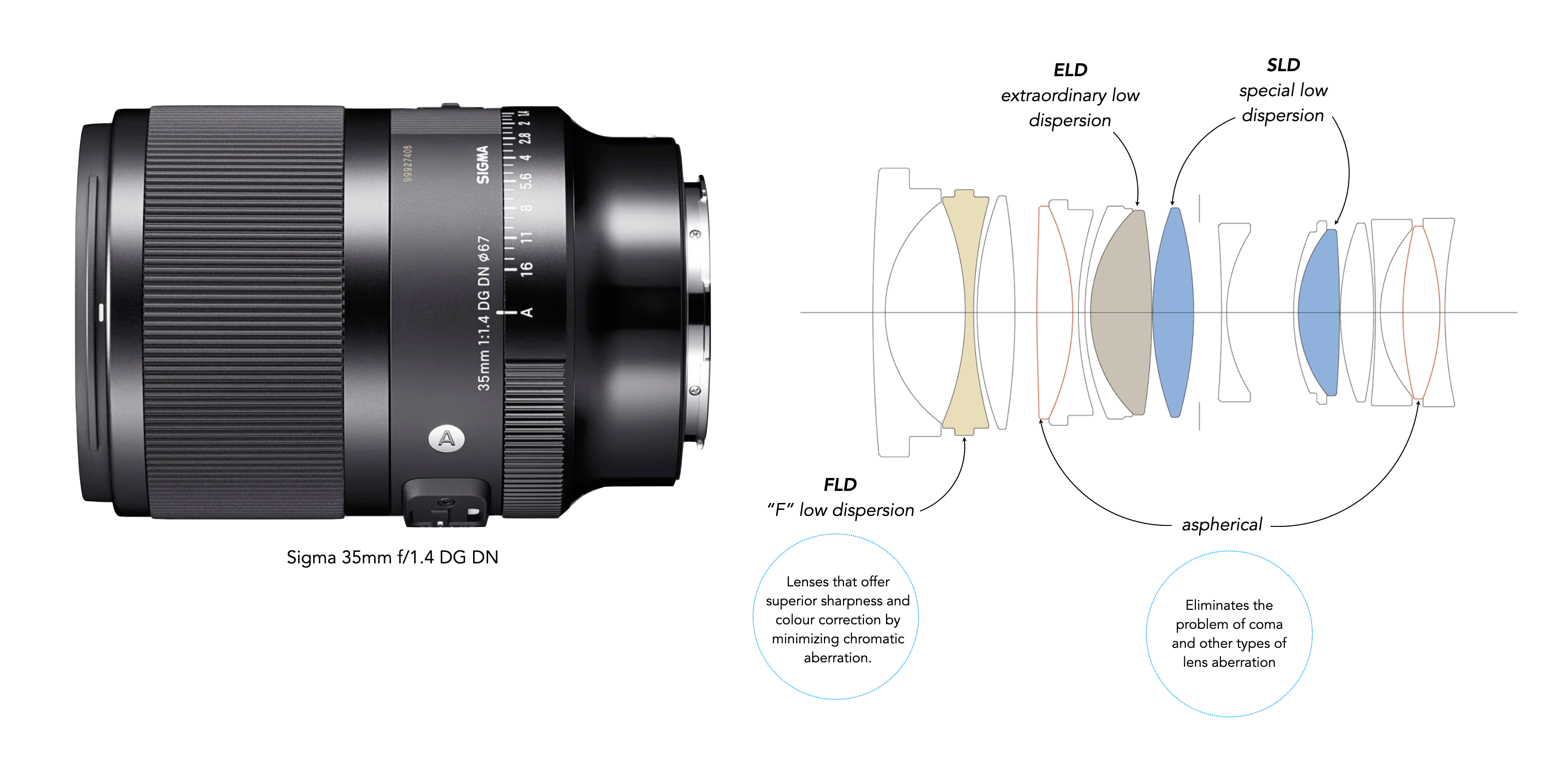
Fig.2: The elements inside a modern autofocus digital lens (Sigma 35mm f/1.4 DG DN)

Every manufacturer has its own potpourri of element glass types, it isn’t only restricted to low dispersion. For example Sony’s lenses use the XA Extreme Aspherical (XA) for high resolution and bokeh; Advanced Aspherical Lens (AA) and ED Aspherical Lens (ED Aspherical) made from Extra-Low Dispersion glass.

The simpler digital lens designs (and also the cheapest) are those that are manual, and really aren’t that different from their predecessors externally, except for perhaps interesting aesthetics. Internally there are no motors, but they often still have lens diagrams associated with them, albeit simpler, as they are simpler lenses. Consider the TTArtisans 35mm f/0.95 shown in Figure 3. The style of the outside somewhat mimics the “striped” German lenses of the 1960s. The only external artifacts are the aperture and focusing ring. Internally, the lens has two ‘high index’ lenses, to allow for the fast f/0.95 aperture.
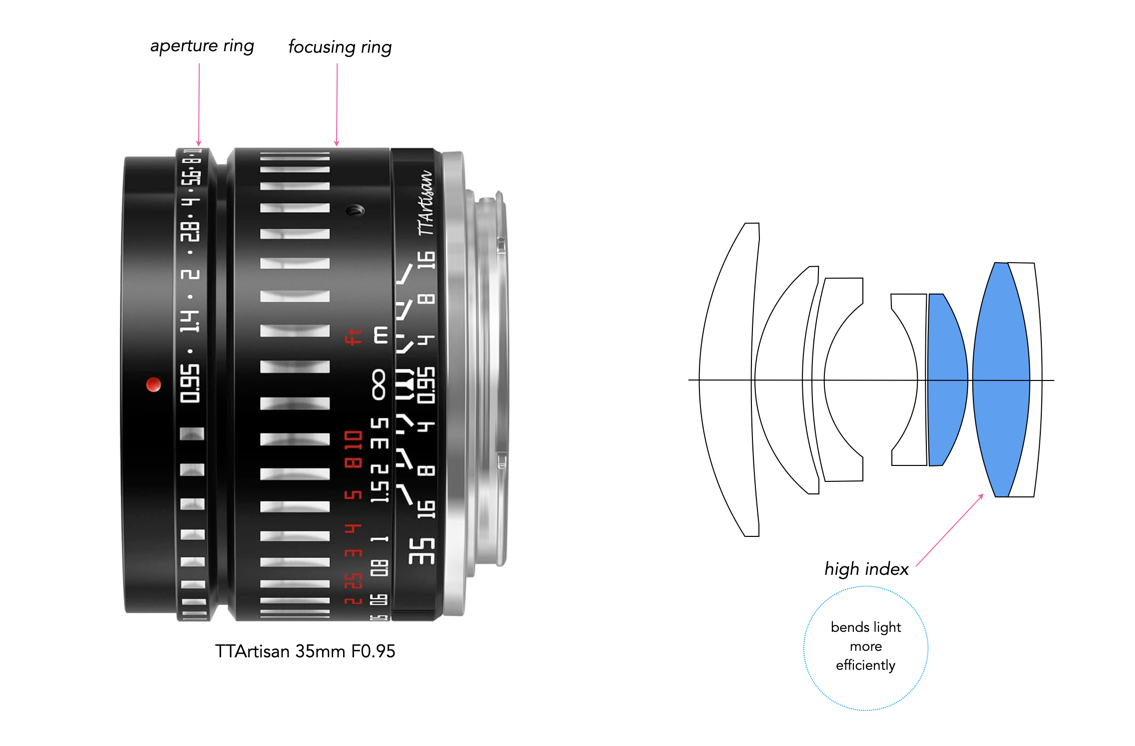
Fig.3: The elements inside a modern manual ‘digital’ lens (TTArtisan 35mm F/0.95)

There is also some interest in the type of motor driving the focusing mechanism. Why this is important I don’t really know. The Sigma lens above has a ‘Hyper-Sonic Motor’ (HSM), which is just a piezoelectric motor powered by ultrasonic vibrations (note not hypersonic, as in super fast). Every manufacturer has their own name for this. Canon calls it Ultrasonic Motor (USM), and Nikon Silent Wave Motor (SWM).

Finally some lenses also have built-in image stabilization, based on some form of optical stabilization. The technology uses internal gyro sensors to detect camera shake (pitch & yaw) and shifts lens elements in real-time to counteract it. Each manufacturer has their own name for Fuji OIS (Optical Image Stabilization), e.g. Sigma OS (Optical Stabilization), Tamron VC (Vibration Compensation), Sony OSS (Optical SteadyShot), Nikon VR (Vibration Reduction).

There is a lot of technology in a modern digital lens, but we shouldn’t let the tech overwhelm the aesthetic characteristics of a lens, because the image it helps produce is what really counts.

P.S. I will be covering the basics of aspherical and low-dispersion lenses in a future post.
Cartier-Bresson on landscapes

“For landscape, you often need a telephoto (I usually use the 135mm) so that you can rid of the uninteresting foreground. The depth of field of a telephoto lens in minimized for action pictures. I don’t work much with a wide-angle lens. There are so many things in the same plane that it makes it difficult to compose.”

‘Photography Is Very Difficult, Interview with Richard L. Simon (ca. 1952)’ in Henri Cartier-Bresson, Interviews and Conversations 1951-1998, p.22 (2017)

Ultrafast lenses − the ‘dream’ Canon 50mm f/0.95

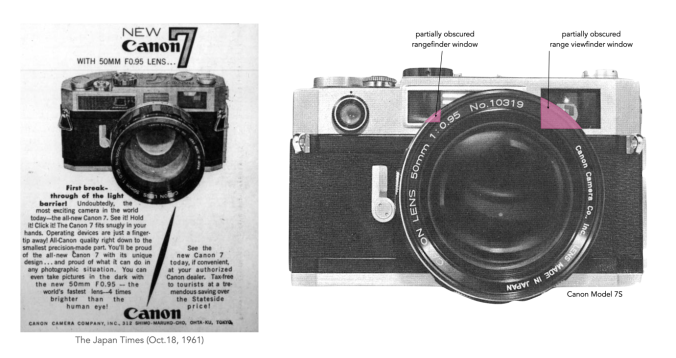
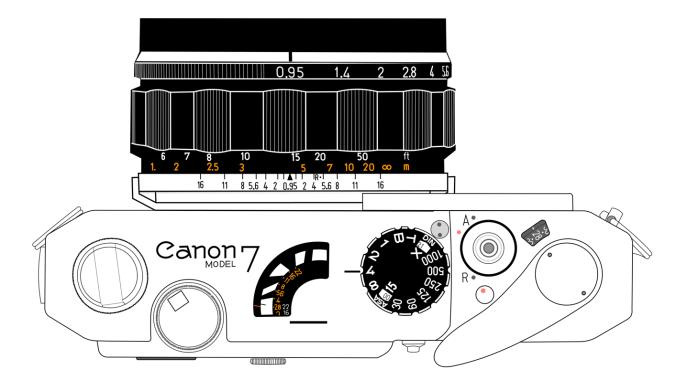
In August 1961, Canon released the 50mm f/0.95, designed as a standard lens for the Canon 7 rangefinder camera. At below f/1.0, it was the world’s fastest 35mm lens. It was created by lens designer Mukai Jirou, who also created several other rangefinder lenses for Canon (35mm f/1.5, 35mm f/1.8, 85mm f/1.8, and 100mm f/2). The Canon f/0.95 was often advertised attached to the Model 7, the first rangefinder Canon with four projected, parallax-compensating field frame lines.

Fig.1: The Canon 7 and the f/0.95

It was supposedly given the name “Dream Lens”, by British photojournalists, a term soon picked up by Canon’s astute marketing department (the exact source of the term is a mystery). The advertising generally touted the fact that it was “the world’s fastest lens, four times brighter than the human eye” (how this could be measured is questionable). In addition it was advertised as giving “least-flare edge-to-edge sharpness, and is ideally corrected for aberration”. Despite the hype, there are no reviews in photographic magazines of the period beyond a quick summary paragraph of the camera.

Fig.2: An ad for the Canon 7, and illustrating the obscured windows.

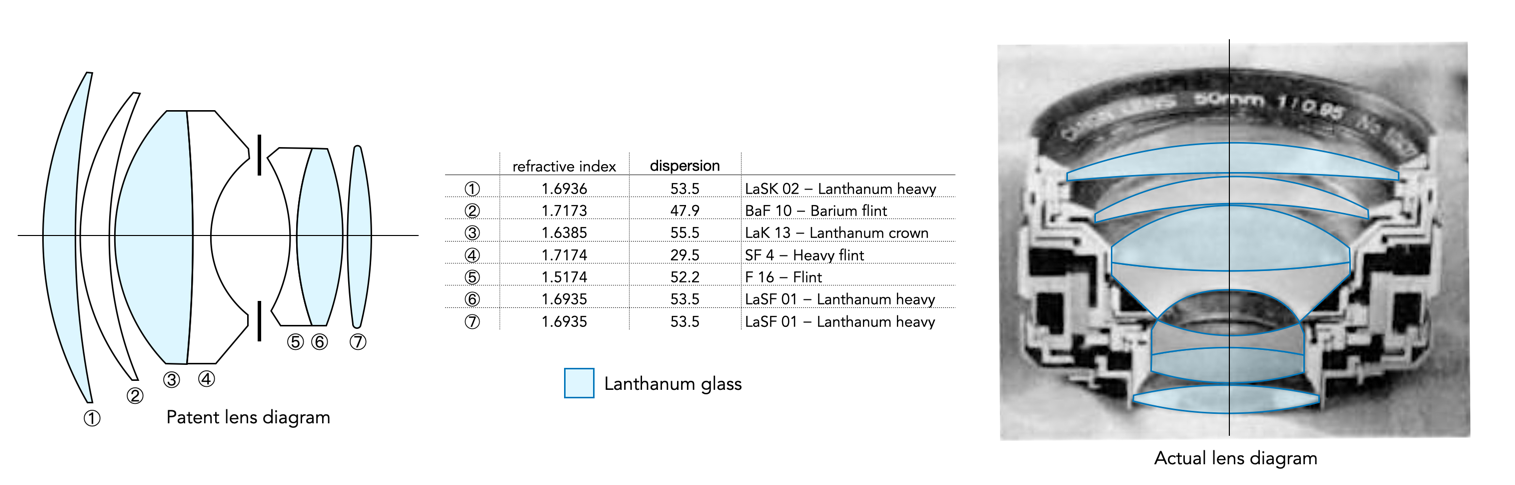
The lens incorporated rare-earth Lanthanum glass in four of the seven lens elements (there were no elements containing Thorium). However the entire lens design took some compromises. This chunky 605g, 79mm diameter lens was so large on the Canon 7 that it obscured a good part of the view in the bottom right-hand corner of the viewfinder, and partially obscured the field-of-view. However the rear lens element had to have about 10mm removed from the top to clear the interlocking roller associated with the rangefinder coupling mechanism, and a metal collar with four protruding feet had to be added to the back section to protect the rear element if the lens was placed on a flat surface with the front element facing up.

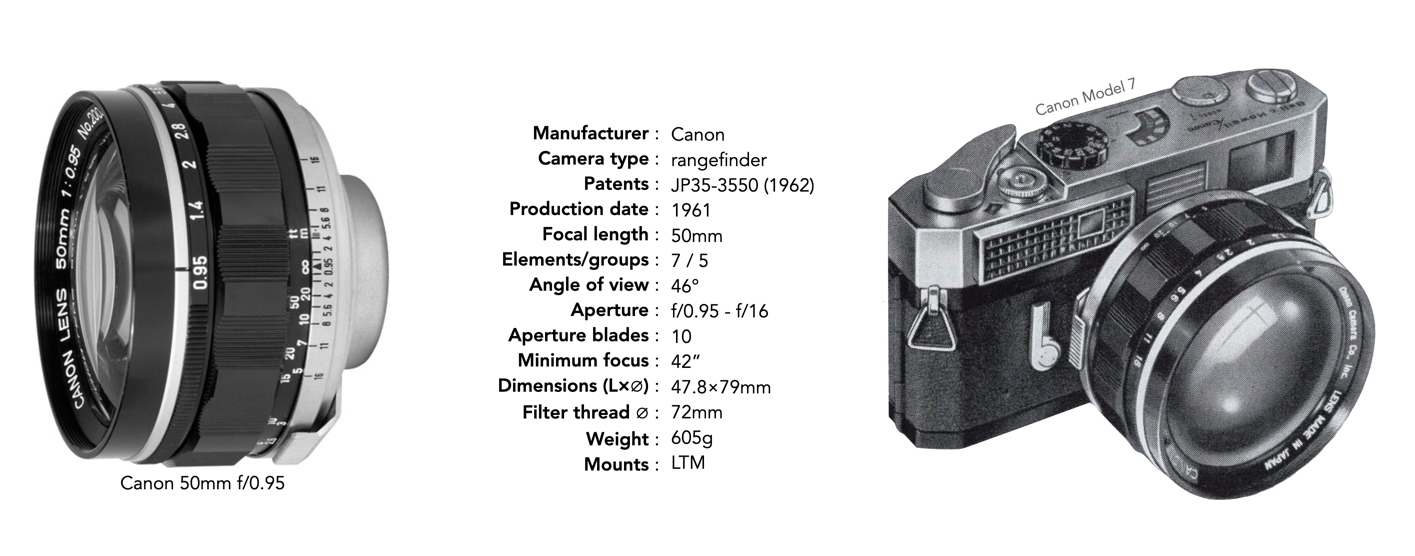
Fig.3: Lens specifications

It is Gauss type lens with 7 elements in 5 groups. In it is suggested that while there are many six-element Gaussian lenses, most suffer from some degree of oblique spherical aberration, with significant flare when used at maximum aperture.

There seems to be one Japanese patent of 1962, No.35-3550, [1] that may form the basis of this lens, although the lens diagram in the patent is not the same as that portrayed for the actual lens. The lens described also appears in a U.S. patent [2] where it is specified as an f/1.2 lens. The work has its underpinnings in an earlier Japanese patent, No.205,109 (Publication No.6,685/1953 corresponding to a US patent of 1954 [3]) which showed that spherical aberration could be reduced by selecting the appropriate arrangement of the refractive indices and radii of curvature at the cemented surfaces of each element. The purpose of the design was to create a lens that produced a high quality image.

How do users view the lens today? Overall it could be described as having a lot of vignetting, spherical aberration and quite a bit of softness [7]. Some suggest the soft-focus effect contributes to the lens’ ‘ethereal quality’, and the rendering has an impressionistic quality [4]. Some suggest that it isn’t very sharp wide open [7], having a ‘razor thin depth of field’ [7]. Bokeh is described as ‘Nisen-bokeh’ [5], and a ‘very retro, swirly’ bokeh [7].

Fig.4: Original lens diagram specifications from the Japanese patent [1], and the actual lens diagram (right)

Some 20,000 copies of this rangefinder-coupled lens were produced between May 1961 and September 1970. Between 1970 and 1984, Canon continued to manufacture a version of this lens for TV cameras and cinematography which had no rangefinder coupling. Of these, about 7,000 copies were produced. When released the lens cost 57,000 yen. The average yearly salary in Japan in 1961 was ¥294,000, so this lens was the equivalent of one-fifth of a years salary. In the US the Canon 7 was sold under the guise of Bell & Howell/Canon, and in 1962, with the body and lens retailing for $499.95, and the 50mm f/0.95 lens by itself for $320, with the f/1.2 at $210. To put this into context, $320 in 1962 is worth about $3430 today, and a Canon 7 with a f/0.95 lens in average condition sells for around this value. Lenses in mint condition are valued at around C$2200-5000.

Note: The lens is also often rehoused as a cine lens by companies such as Whitehouse Optics (the cost is €6,500, not including the cost of the optics).

Further reading:

  1. Canon, Utility Patent Japan, “High Photography Lens”, 35-3550 (1962)
  2. Hiroshi Ito, US2,836,102, “High Aperture Photographic Lens”, (Jun.14, 1956)
  3. Hiroshi Ito, US2,681,594, “Photographic Objective of Gauss Type”, (Jun.29, 1951)
  4. Living with the Canon 50mm f0.95 “Dream Lens”, (Jan.30, 2023)
  5. Canon 50mm f0.95 – A Lens has Emotional Character, (Jul.18, 2020)
  6. Canon 50mm f0.95 Review, James Fox-Davies (Nov.12, 2015)
  7. The Canon 50/0.95 TV ‘Dream Lens’ review, Joeri (Nov.21, 2017)

Cartier-Bresson on using a flash

“Oh, definitely no flash! That is not the light of life. I never use it, I do not want to use it. Let us remain within the real, the authentic! Because authenticity is perhaps the greatest virtue of photography.”

‘A Reporter, Interview with Daniel Masclet (1951)’ in Henri Cartier-Bresson, Interviews and Conversations 1951-1998, p.11 (2017)

Vintage lens makers − E. Ludwig (Germany/DDR)

Ernst Ludwig Optisches Werk Weixdorf Objektive was established in 1924 in Lausa near Dresden by Ernst Ludwig. The town of Lausa merged with the neighbour town of Weixdorf in 1938. Pre-war lenses are usually marked with Ludwig Lausa Dresden. The company made cameras for various types of cameras, e.g. 35mm viewfinders and SLRs. After the war, production resumed quickly, as the factory was undamaged, with Ernst Ludwig still at the helm.

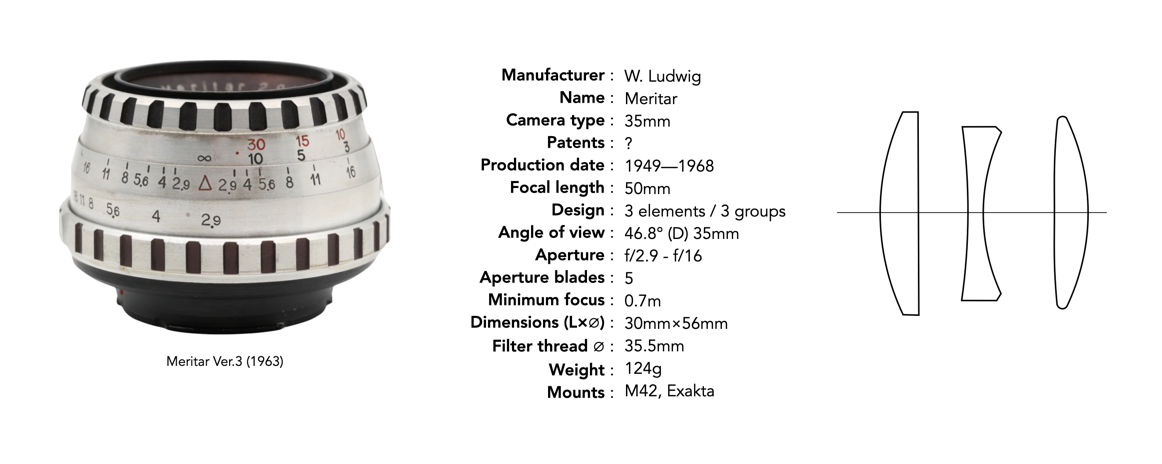
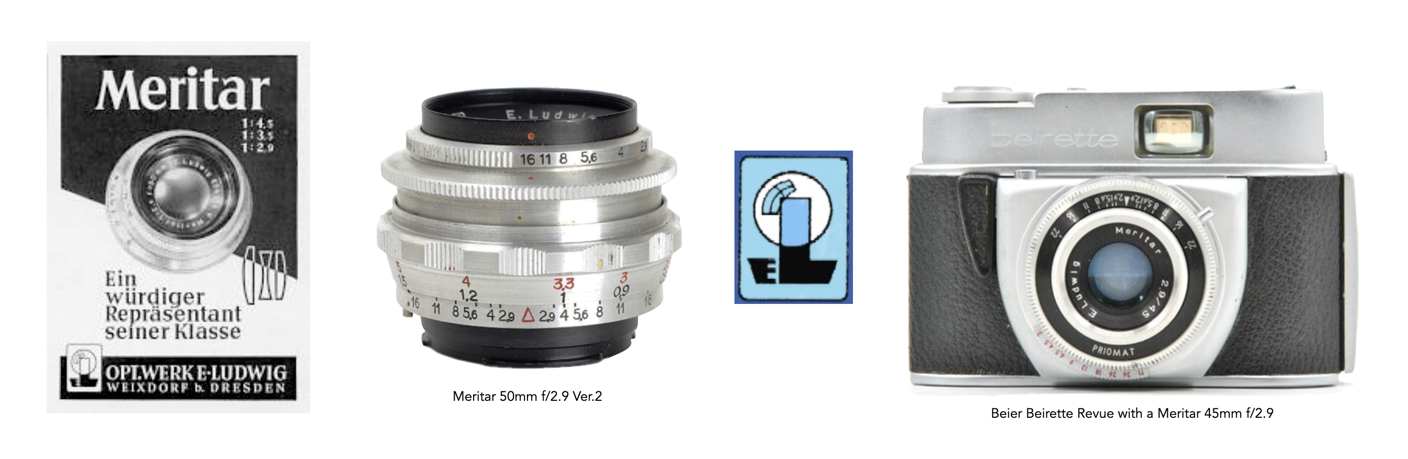
Fig.1: The most famous Ludwig lens, the Meritar 50mm

The company produced a number of different, inexpensive lenses, but is likely best known for the Meritar 50mm. With the introduction of the EXA camera in 1951, Ludwig became an original supplier, along with Carl Zeiss Jena, and Meyer Optik. The Meritar was a cheap lens using three air-spaced elements, i.e. the Cooke triplet. Lenses were produced with the Exakta mount for the Ihagee cameras, and some in the M42 mount. The Meritar 50mm f/2.9 was derived from the Victar could be manufactured inexpensively and therefore harmonized very well with the new, inexpensive Exa SLR. It was initially a manual lens, but eventually upgraded to preset diaphragm (1957).

The Meritar was a cheap lens. To put this into context, in the late 1950s the f/2.9 sold for 52 DM, whereas a basic Tessar 50mm f/2.8 was 139 DM, the Biotar 58mm f/2 305 DM. In fact the 3-lens Meritar was considered to be the cheapest lens outfitted on the EXA. In fact EXA + Meritar always offered the cheapest combination until production of these lenses ceased in the early 1970s. Although by 1961, there were eight standard choices for 50mm lenses for the EXA (II), all of but of which were faster.

Fig.2: Ludwig produced few advertisements, and produced a lot of inexpensive lenses for the likes of viewfinders cameras

Prior to the Meritar series, the company produced other lenses including the Victar 5cm f/2.9 (Exakta, Praktiflex), Victar 75mm f/2.9 (Reflex-Korelle) and Peronar 50mm f/2.9 (Exakta). Victar and Meritar were also used in cameras with central shutters (Beier Precisa, Beirax). In 1959 the East German state ‘acquired’ a small stake in the company, with Ludwig still at the company until 1968. In 1972 the company became the state owned VEB Optisches Werk Weixdorf, and in 1980 it was absorbed by the VEB Pentacon.

Notable lenses: Meritar 50mm f/2.9;

Cartier-Bresson on which lens and aperture to use

“Naturally I take full advantage of the possibilities of different lenses, but I don’t carry a suitcase full of them: an Elmar 50mm, a wide-angle 35mm, and an 85mm − these are my tools, with, of course, the latest, the f/1.5, for night photography. I take advantage of these various depths, I open or close the shutter, or I leave a full aperture: it depends on my needs.”

‘A Reporter, Interview with Daniel Masclet (1951)’ in Henri Cartier-Bresson, Interviews and Conversations 1951-1998, p.13 (2017)

Vintage SLR cameras – the Mecaflex

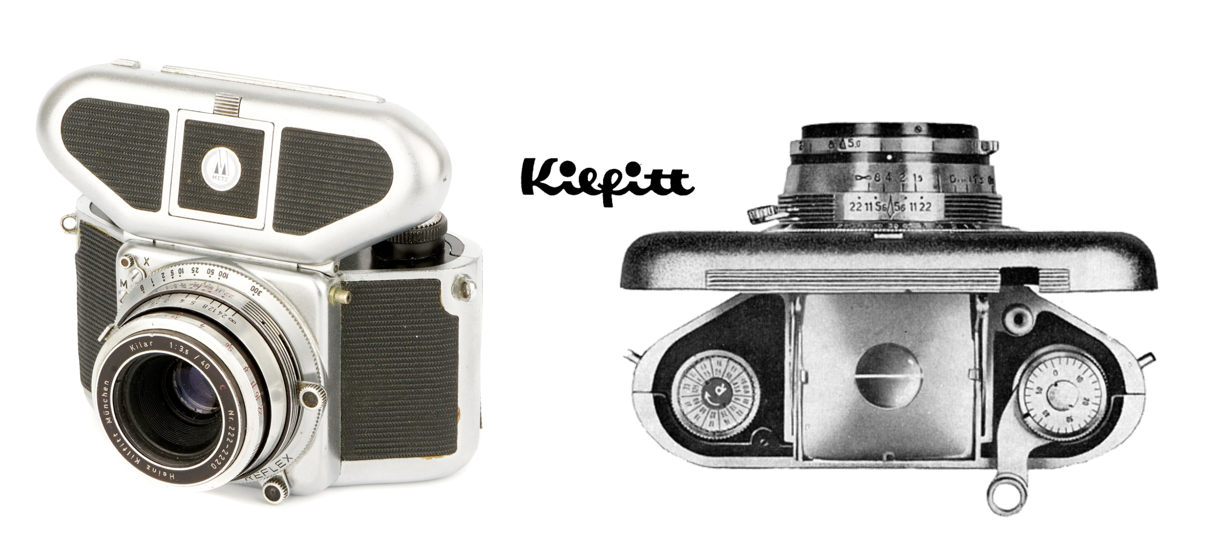
The Mecaflex is a 35mm SLR made by German designer Heinz Kilfitt, who is better known for having designed the successful Robot camera, and high precision lenses such as the Macro Kilar, and Voigtländer Zoomar (the first 35mm zoom lens). Presented at Photokina in 1951, it was first sold in 1953, they were manufactured for Kilfitt by Metz Apparatefabrik located in Fürth, Bavaria (West Germany). Production by Metz continued until 1958 but few units were actually built. Metz, dissatisfied with the collaboration withdrew from the partnership shortly afterwards. Production then shifted to Société d’Etude et Recherche Optique et Acoustique (S.E.R.O.A.) a camera maker in Monaco. This camera is better known as the Kilfitt Mecaflex, with the lenses also produced by Kilfitt.

Fig.1: The Mecaflex camera

It was a very aesthetically pleasing and compact camera at 9×6.5×6.5cm. However it was quite heavy at 700g. It had a flip-top cover which gave it very clean lines when closed. When opened to 90 degrees, the cover revealed the waist-level viewfinder and top-plate controls. The size of its exposures was a smaller 24×24mm, providing for more images on a film roll (some 50). One of interesting features was an early spring-loaded diaphragm. When the shutter and spring-loaded diaphragm mechanism of the Mecaflex are cocked, a bright, parallax-free ground-glass image appears, and this remains bright until the shutter is released. A push-up finder was also provided as an accessory. which could be inserted into the viewfinder

Like many other West German cameras, it too incorporated a Prontor behind-the-lens leaf shutter with speeds of 1 to 1/300s (+B). The camera had a bayonet mount, and used lenses designed by Kilfitt, and it was usually paired with a Kilar 40mm f/3.5 or f/2.8. The other lenses were the 40mm Makro-Kilar’s and Tele-Kilar 105mm f/4.5. Some additional lenses were made under license by SOM Berthiot (Paris). The camera was produced until 1958. It is possible to still find these for around C$1300-2000.

Specifications:

Type: 35mm SLR camera
Manufacturer: Metz (West Germany) ver.1, Kilfitt ver.2
Model: Mecaflex
Production period: 1953−1958
Format: 24×24mm on 135 film
Lens mount: bayonet
Standard lens: Kilar 40mm f/3.5
Shutter: leaf-shutter, Prontor-Reflex behind-the-lens
Shutter speeds: 1 to 1/300 sec., B (1 to 1/250s, B in the SEROA camera)
Viewfinder: waist-level viewfinder + central split-image rangefinder
Mirror: yes
Exposure meter: −
Flash synchronization: X, M
Self-timer: −
Aperture control: −
Film advance: lever wind
Weight/dimensions: 700 grams / 900×650×650mm

Cartier-Bresson on the ideal lens

“The 50mm. Not the 35mm: it’s too big, too wide! With that, photographers all think they are Tintoretto. Even if everything is sharp, it is still a distortion. With the 50mm, you keep a certain distance. I know, they are going to say again that I am ‘classic’. I don’t care: to me, the 50mm remains the closest thing there is to the human gaze. You can shoot everything with it − streets, landscapes, or portraits. When you have the eye of a painter and a visual grammar, you work with a 50mm without even thinking that with a 35mm you’d get more depth of field. Painting, drawing, photography, documentary film: to me, it’s all one.”

‘We Always Talk Too Much, Conversation with Pierre Assouline (1994)’ in Henri Cartier-Bresson, Interviews and Conversations 1951-1998, p.134 (2017)

Vintage SLR cameras – the phantom Zunowflex

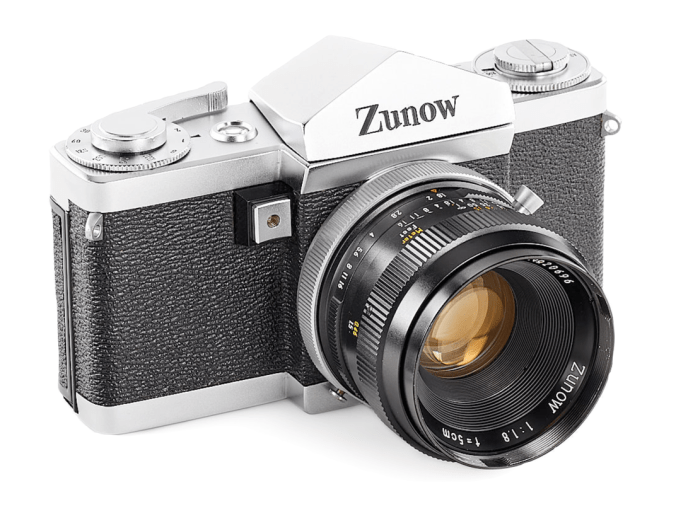
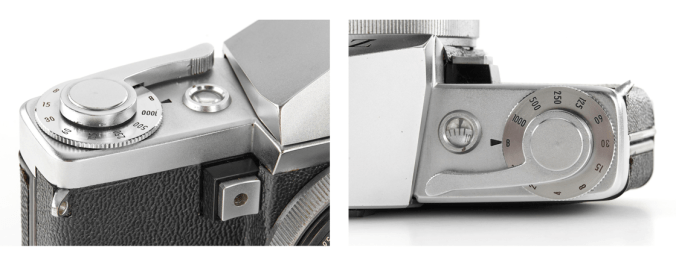
Zunow was a Japanese company best known for it’s innovation in superfast lenses. During the last few years of its existence, the company designed a couple of camera’s including a prototype of a Leica copy, the Teica, and their first 35mm SLR, the Zunow Pentaflex or ‘Zunowflex’. Work on the camera supposedly began around 1956, but it was only produced for a short time, from 1958-1959). The Zunowflex had a compact design, inspired by the likes of the Miranda T, or even the Praktina.

The design of the Zunow Pentaflex was initiated by Kiyoshi Arao, the managing director in charge of technology who had been transferred from Chiyoda Kogaku Seiko Co., Ltd. Zunow Optical was originally a lens factory with no experience in camera bodies, and Arao himself had little experience with 35mm SLRs, so went on to study the Miranda. Arao would leave the company due to conflicts around the time of the camera’s release (joining Mamiya Optical). The camera was first announced in the April 1958 issue of the monthly magazine Shashin Kōgyō.

This camera brought solutions to many of the issues outstanding with SLRs together into one camera. It was a very aesthetically pleasing camera, with a streamlined look, that would become normal for cameras in the 1960s. The elegant look was designed by Kenji Ekuan from GK Industrial Research Institute. Ekuan was an industrial designed best known for designing Kikkoman’s iconic soy sauce bottle, and a series of Japanese trains. The design was started from a completely new idea, taking the spirit of ancient Japanese “Noh” as its model, combining complex mechanisms into a simple and concise form.

Fig.1: The Zunow SLR with a Zunow 5cm f/1.8 lens

Where it broke from convention was the fact that the shutter release was front mounted, similar to how the Exakta and Miranda cameras were laid out, and the speed dial was situated beneath the wind lever, a concept which didn’t appear until much later on the Canon AE-1. It had a removable pentaprism, and interchangeable focusing screens. Supposedly a waist-level viewfinder was also available. It also had a right-hand front shutter release, and a lever wind, not found on many SLRs of the period (except for the Exakta which was left-handed, the Mecaflex, and the Asahi Pentax). The camera had a focal-plane shutter with speeds from 1 to 1/1000 sec, plus B.

It was the first Japanese camera to have an internally coupled automatic lens diaphragm, the “ZUNOWmatic” diaphragm system, when most cameras of the era had a pre-set system, meaning a lever had to be moved to open the diaphragm after the photograph had been taken. It worked like this: when the shutter release is triggered, “the automatic diaphragm actuating ring revolves and trips the auto-diaphragm “tail” of the lens mount, diaphragm closes down to previously determined aperture, mirror springs up out of the way, Shutter operates, mirror then returns to normal “seeing” position, diaphragm actuating ring revolves again, kicks the pin back into position and reopens diaphragm to maximum aperture” [1].

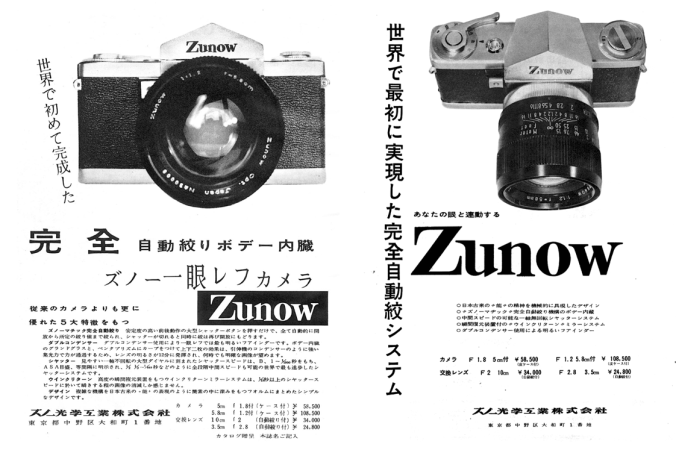
Fig.2: Japanese ads for the Zunow

The instant return mirror, was something Zunow called the “Wink Return”, which supposedly was quiet, or put another way – “quiet it is, silent it is not” [1]. In its marketing material the company suggested that traditional SLRs had issues with mirror return, i.e. there is a shock, and the sound of the shutter is loud. The “wink Return” was suppose to eliminate unpleasant noise and shock with almost no blackout effect. The lever was considered by some to be “heavy”, but the shutter release is “surprising light” [1]. There is a single shutter speed dial, with equally spaced speeds (which few SLRs had), which allowed for the choice of intermediary speeds. Another unique feature is an internal synchro-switch which automatically sets FP or X sync as shutter speeds are changed from fast to slow. The downside is that the camera was heavy at 620g.

Fig.2: The minimalistic clean lines of lines of the camera gave it a very aesthetically appealing feel.

One potential limitation of the camera was its proprietary breech mount, and a range of only six lenses: 35mm f/2.8, 50mm f/1.8, 58mm f/1.2, 100mm f/2, 200mm f/4, 400mm f/5.6, and 800mm f/8. Only the lenses 100mm and shorter had auto diaphragms. There were lens mount adapters to allow the use of M42, Exakta and L39 lenses, likely reducing the need to produce an entire range of lenses. Supposedly the lens provided with the camera was the Zunow 58mm f/1.2, which would have been the fastest SLR lens of the period (the only evidence of its existence seem to be the ads in Figure 2).

However in all reality there were issues with the camera. Adding new features to a camera implies that a substantial amount of testing must be performed before mass production commences. It has been suggested that hundreds of cameras were sold, however a lack of quality control meant many were returned [2] (this may be in part because most of the parts were outsourced, with the factory only doing assembly [3]). Other parts of the system, such as other interchangeable viewfinders were also lacking. There were also functional problems with the camera, for example the fully automatic aperture was slow, resulting in incidents of the aperture lagging behind the shutter [2]. Of the cameras existing today apparently few work perfectly [2].

The camera was only sold in Japan, and in total only about 500 were produced (at the rate of 8 cameras per day [1]). In 1959 the speculation was that it would be expensive in the US, as the Zunow + 58mm f/1.2 lens sold for US$300 in Japan. However Zunow was in a poor financial situation and was not able to capitalize on the design, closing the company in 1961. These cameras are now extremely rare. Auctions, where they occur then to suggest prices of around the US$20,000 mark.

Specifications:

Type: 35mm SLR camera
Manufacturer: Zunow (Japan)
Model: Zunowflex
Production period: 1958−1959
Format: 24×36mm on 135 film
Lens mount: breech
Standard lens: 5.8cm f/1.2, 5cm f/1.8
Shutter: focal-plane, single-axis non-rotating dial type
Shutter speeds: 1 to 1/1000 sec., B
Viewfinder: SLR with non-removable pentaprism
Mirror: “Wink return” system
Exposure meter:
Flash synchronization: FP, X automatic switching
Self-timer:
Aperture control: Instant opening and closing type built into the body, fully-automatic
Film advance: 180° operation lever wind, prevention of double exposures, automatic frame counter
Weight/dimensions: 615 grams / 144×88×56mm

Further reading:

  1. Tsuneo Baba, “Zunow: Indication of things to come in 35mm single-lens reflexes?”, Modern Photography, 23(4), p.110 (1959)
  2. Kosho Miura, “Systematic Survey on 35 mm High End Camera – History from Leica to SLR”, National Museum of Nature and Science Survey Reports of Systematization of Technology, 25, pp.55-56 (Mar. 2018)
  3. Interview with Suzuki Takeo, CEO of Ace Optical (son of Zunow’s president), May 2006 (PDF)

The sloppy 35mm photographer

The sloppy generation is made up of those who think the 35-mm camera is so simple to use that it can do everything merely by sighting and pressing the button. Everything about the camera invites careless behavior on the part of the photographer. It is such a marvelous precision instrument that the uninitiated get the impression it will do the technical job willy-nilly. See how easy it is: Read the builtin meter, set the shutter, focus, press the button, advance the film, shoot again. Film is cheap, shoot fast, advance, click, advance, click until the roll is used up… all the while forgetting the little things that demand clear thinking and seeing: the way the light falls, composition, background, gestures, expressions, camera angle, decisive moment. Film is cheap, just shoot away, and on the law of averages you’re bound to come up with good pictures. A monkey could do that?

Bruce Downes, “Is 35-mm producing a generation of sloppy photographers?”, Popular Photography, 43(2) p.43(1958)