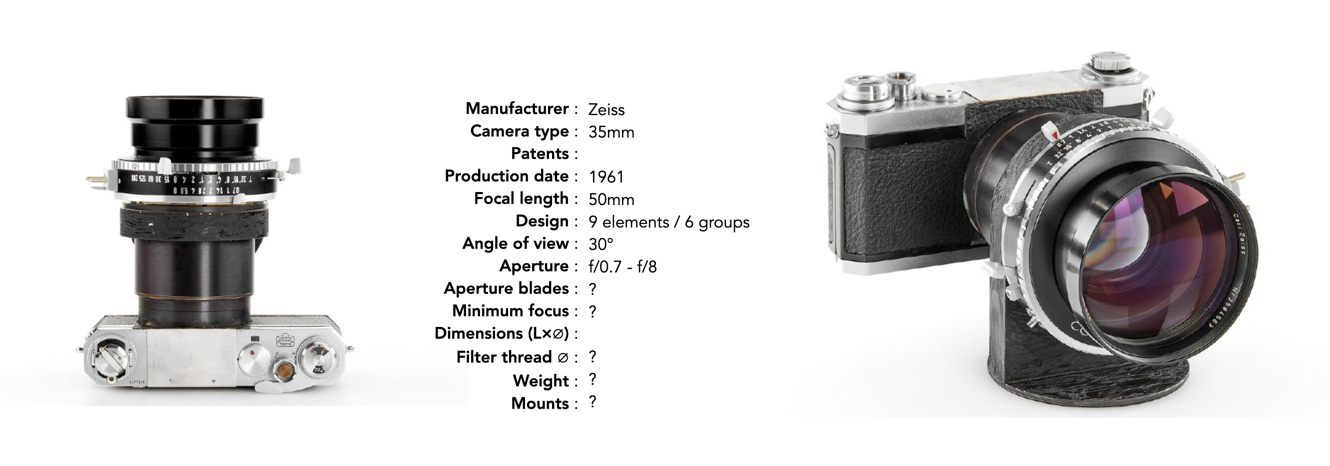
The quintessential vintage ultra-fast camera lens is the Zeiss Planar 50mm f/0.7. It was developed in 1961 for a specific purpose, namely to photograph the dark side of the moon during the NASA Apollo lunar missions. Only 10 lenses were built, one was kept by Zeiss, 6 went to NASA and 3 were sold to director Stanley Kubrick. Kubrick used the lenses to film scenes lit only by candlelight in the movie “Barry Lyndon” (1975).
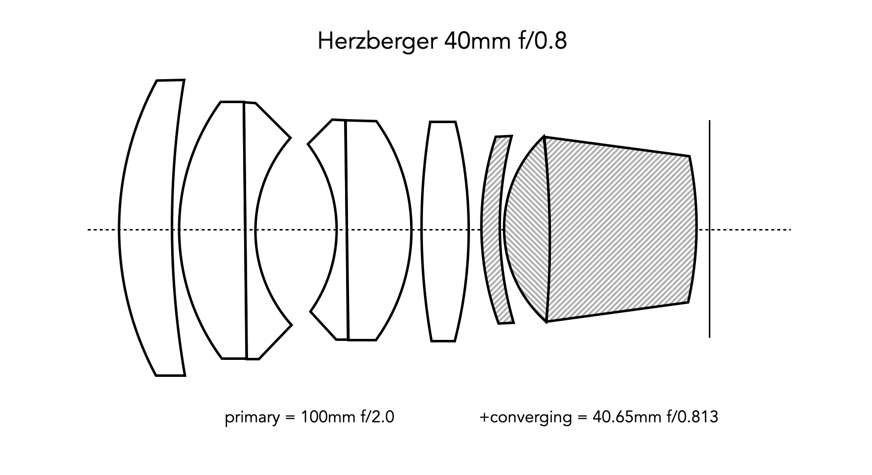
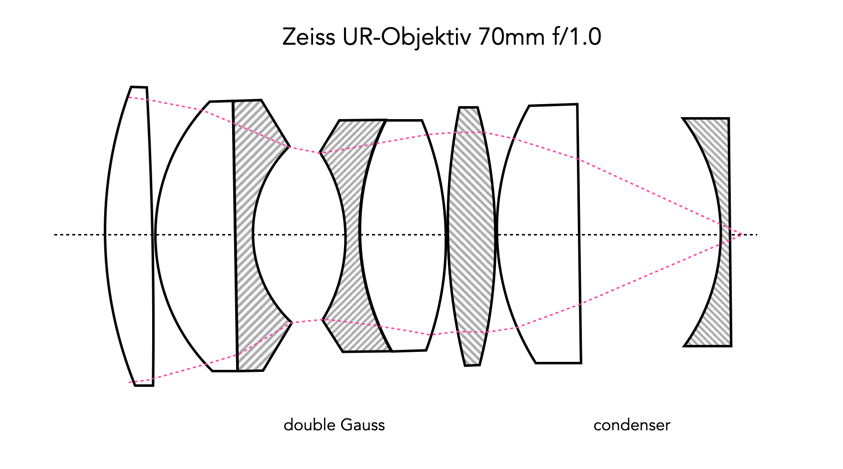
There is a similarity, at least in the double-Gauss optical design – it is essentially a Gauss front with two doublets glued together and a rear group which functioned as a condenser. (copies of optical diagram). The 50mm f/0.7 Planar was designed by Dr. Erhard Glatzel (1925-2002) and Hans Sauer. It is supposedly based on an f/0.8 lens designed by Maximilian Herzberger (1900-1982) for Kodak in 1937. Looking at the two schematics, they look quite similar. The idea is to take the 70mm f/1, and by adding a condenser, brute-force the lens into a 50mm f/0.7. The condenser actually shortens the focal length and condenses the light – in reality adding a ×0.7 teleconverter that gives 1 f-stop.
But this lens has an interesting backstory. According to Marco Cavina, who has done a lot of research into the origin of this lens (and others), the design of this lens was derived at least in part from lenses designed for the German war effort. During WW2, Zeiss Jena designed a series of lenses for infrared devices to be used for night vision in various weapons systems. One such lens was the Zeiss UR-Objektiv 70mm f/1.0. The design documents were apparently recovered during Operation Paperclip from the Zeiss Jena factory before the factory was occupied by the Soviets and then provided to the new Zeiss Oberkochen.
The design went through four prototypes before achieving the final configuration [1]. The final scheme was optimized on an IBM 7090, which had been in operation since the late 1950s. The lenses were used on a modified Hasselblad camera.
Glatzel, E., “New developments in the field of photographic objectives”, British Journal of Photography, 117, pp.426-443 (1970)
This series of photographs and their associated histograms covers good renditions of highlight clipping, i.e. photographs in which there are regions of white pixels, but they either genuinely exist in the image as white regions, or do not directly impact the aesthetics of the image.
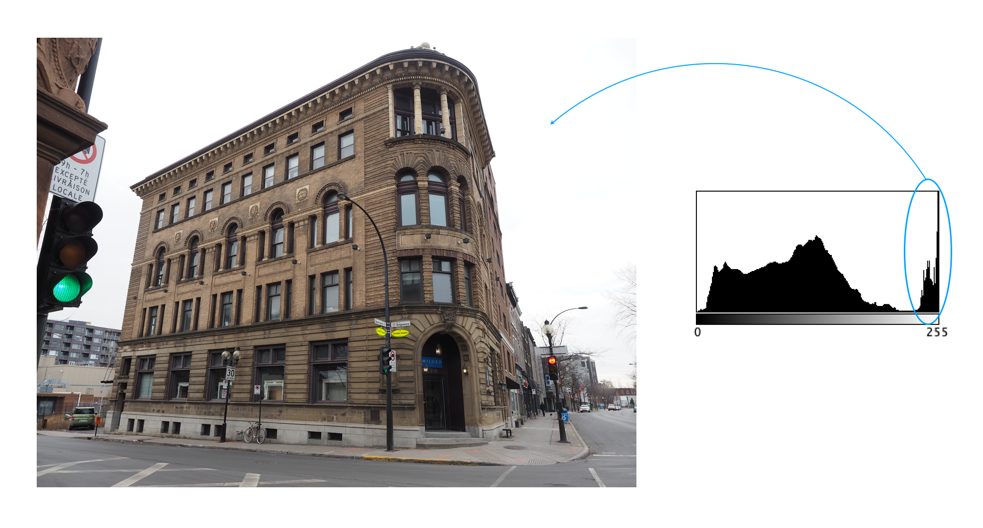
Histogram 1: A bright overcast sky
The image was taken on a very overcast day in Montreal. This is a good example of an image with highlight-clipping in the histogram, which is neither good nor bad. The building itself does not suffer from a lack of contrast, although the non-sky region can be enhanced slightly with no ill effects on the sky (because it is already basically white). This is a common situation in outdoor, overcast scenes. In an ideal world, more texture and contrast in the sky would be great, but in reality you have to use what nature provides.
Histogram 2: White buildings
This photograph was taken in Luzern, Switzerland. It is a well contrasted image, with a somewhat indistinct, multipeak histogram. The pixels are well distributed over the range of intensities, except for the spike at values 240-255. Here highlight clipping seems as though it has occurred because there are quite a number of white pixels in the image. However this density of white pixels comes not from anything being overblown, but rather from the white buildings in the image (of which there are many).
Fujifilm X10 (12MP): 7.1mm; f/4.5; 1/950
Histogram 3: A bit of overblown sky
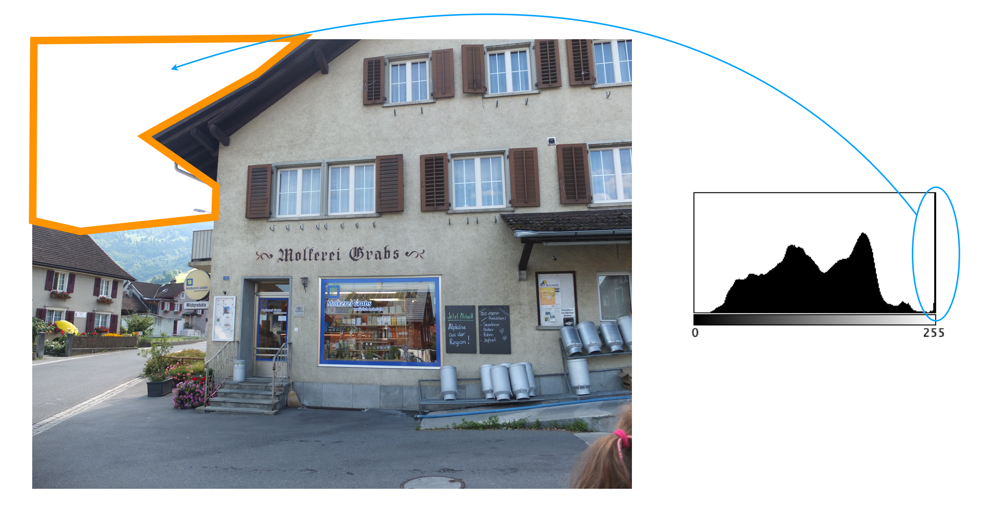
This photograph was taken in Grabs, Switzerland. The histogram is a nonuniform, and basically unimodal in shape, with the exception of a huge spike in the whites causing clipping. But this is a case of the highlight clipping not really affecting the core content of the image, i.e. it comprises the overblown sky in the top-left of the image. On a bright, partially overcast day, this is not an unusual scenario.
There are a whole lot of contemporary super-fast lenses, but that is to be expected from modern optical technology. For example the Voigtländer 50mm f/1.2 Nokton E is still a simple 8 element lens, but contains two optical elements each with two aspherical surfaces, helping to reduce lens aberrations. The Nikon Nikkor Z 50mm f/1.2 on the other hand has 17 elements in 15 groups, with three aspherical and two low-dispersion elements (but at 150mm in length, and 1090g it is a true monster). These lenses are now commonplace, but what about their vintage counterparts?
By the mid 1950s, lenses with speeds of f/2 and f/1.4 were commonplace. Lenses with large apertures such as f/1.0 were also available for applications such as radiography and motion-pictures. Sub-f/1.4 lenses for the 35mm “miniature” cameras had also started to appear. The literature of the period, such as Popular Photography, wrote a series of articles over the years, investigating these new fast lenses. Many of these technology reviews were not damning, but neither were they an acclamation of a new era in photography.
The September 1955 issue included an article “The new superspeed lenses – how useful will they be”, by Bob Schwalberg [2]. Schwalberg describes the rumours that superspeed lenses with apertures of f/1.1 and f/1.2 were in the offing from three different Japanese manufacturers. He suggested that although an f/1.4 lens should mathematically pass 100% more light than an f/2 lens, the actual results are more like 50%. Using the pretext that actual light transmission is 50% of that indicated, he surmises that an f/1.1 lens would only be 30% faster than an f/1.4 lens, but maybe even less due to more elements, and an increased number of light absorbing light-to-air surfaces. These tests were made by comparing exposures at different apertures changing nothing else. Schwalberg concedes that the lenses would be good for use with colour film, however doubted whether the same could be said for black-and-white film. One of the reasons was the reduced depth-of-field, although he concedes it is no worse than for the f/1.4 but regardless both require very close focusing for sharp pictures.
Norman Rothschild described the Zunow 50mm f/1.1 lens in a 1956 article [4], putting the lens through a series of tests, and exploring whether the addition of new optical elements would effect the speed advantage of the lens. He used an exposure meter (Norwood Model A) taped to the back of a Leica M-3 to measure light-transmission of the Zunow, and two control lenses (f/2, f/1.8). The findings indicated that the readings for the f/1.1 proportionally higher than those for the f/2. He also performed a number of practical field tests. Colour photos made with the lens were found to be ”warm, or reddish, but not displeasingly so”. Rothschild questioned the practicality of the lens, with its shallow depth of field, but concluded that while focusing was challenging, it is “no more severe than a press photographer using an f/3.5 lens on a 4×5 camera”.
When asking why these lenses weren’t more popular during the period they were developed, there are likely a number of differing factors. Foremost was cost. Lenses such as 50mm f/1.2 may have tested the limits of both manufacturing processes, and price to consumer. Making lenses with apertures larger than this may have been an act of sheer folly, as is testament to the few that were manufactured. Development costs associated with these lenses were likely steep, as was the use of optical elements containing rare-earth metals, and ultra-precise manufacturing techniques. To all but the professional photographer, these lenses were prohibitively expensive (and still are). When these fast lenses started to appear there was as much skepticism than there was praise. In a follow up article in 1956, “Another look at superspeed camera lenses”, Bob Schwalberg made the following points [3]:
The exposure gain obtained from f/1.1 and f/1.2 lenses was easier to obtain from additional development of f/1.4 and f/1.5 negatives.
Apertures larger than f/2 were seldom used for B&W work, but would be advantageous in colour work.
The reduced depth-of-field which limits the usefulness of f/1.4 and f/1.5 lenses at full aperture will further limit the usefulness of the f/1.1 and f/1.2 lenses.
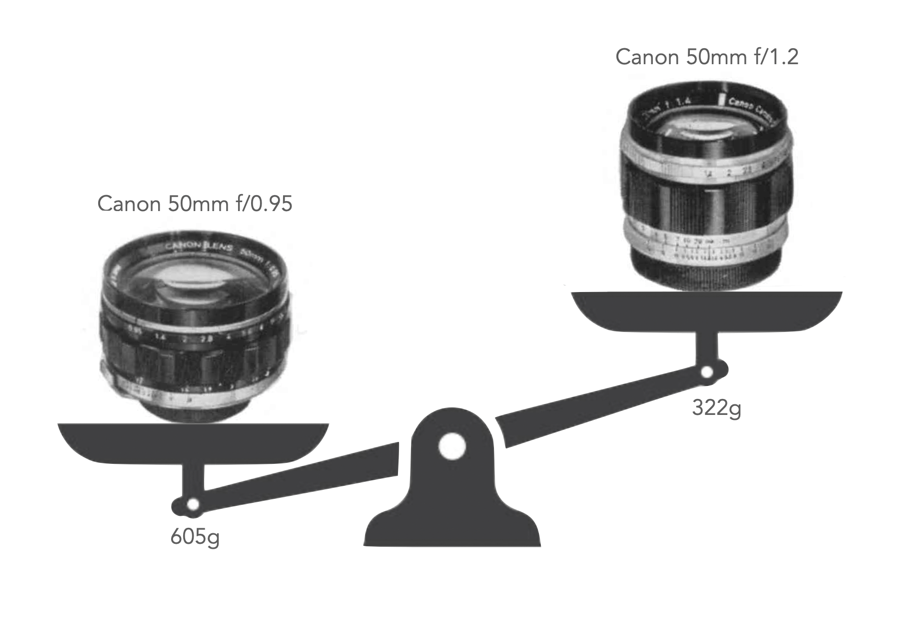
The lenses are large and heavy, sometimes obscuring the rangefinder and viewfinder windows.
The lenses are “extraordinarily” expensive. A 50mm f/1.1 lens retailed for $3 more than a Leica M-3 with aa 50mm f/2 Summicron lens.
Lens apertures greater than f/2 with a small amount of over-exposure can lead to drastic loss of definition and detail resolution. Tests shows that “at f/1.4 as little as 1/2 stop overexposure can kill sharpness”. Three times as much overexposure is required to produce the same ill-effects at f/2.
Schwalberg called it the “super-aperture problem”. He goes on to suggest that what was needed was not faster lenses, but better lenses, citing that film resolution was increasing to the point where lenses were not capable of producing.
In another Popular Photography article in 1956, it was suggested the ultimate value of f/1.1 and f/1.2 lenses was still a matter of conjecture [5]: “Speeds of f/1.4, f/1.5, and f/2, have long been with us and have proven extremely practical. Unless you are in the darkest, blackest, dingiest location, and unless every bit of shutter speed counts because of subject movement, it is highly advisable to limit black-and-white shooting to a maximum aperture of f/2.” The article cited a series of limiting factors that made photographers wary of the usefulness of sub f/2 lenses [5]:
Depth of field – this only comes apparent at close distances, but a larger opening will result in a shallower DOF. A 50mm lens focused at 4ft has 3.5” of depth at f/1.5 and 4.75” at F/2. A smaller DOF will require more precision in focusing.
The gain in light transmission is often less than can be expected. Light transmission is directly proportional to the square of the f-number. f/2 squares to 4, and f/1.4 to 1.96. Theoretically then, f/1.4 should transmit approximately 100% more light, however tests have shown that it is likely only 50-60%. The reasoning is that the more the diaphragm is opened, the more we depend upon light rays from the periphery of the lens. These rays enter at a steeper angle of incidence than those on the edges at smaller f-stops. There is therefore greater loss through internal reflection.
The other issue is that apertures greater than f/2 require exacting levels of exposure. overexposure at f/1.4 can ruin crisp detail. Errors at f/2 are more forgiving.
The other issue was weight – these lenses were heavy. The SMC Pentax 50mm f/1.2 (1975) was 385g, and had a maximum diameter of 65mm. The f/1.4 of the same era was only 266g, meaning the f/1.2 was a 45% increase in weight. When the Nikkor-N 50mm f/1.2 first appeared, its internal mount was problematic, with the mount not really able to support the weight of the lens, causing the mount to bend. In addition, the focusing wheel on the camera could not be used because it could not handle the weight of the lens. The weight of the lens was 425g, in comparison a comparable 50mm f/2 was around 200g.
There were many factors which contributed to the lack of interest in fast lenses. By the mid 1960s colour film was faster, and so there was less need for faster lenses. There were a number of f/1.2 options, but also many more options are f/1.4 at a much lower price point. So why bother purchasing a vintage sub-f/1.4 lens? One reason is for the character it provides, or for shooting in extreme low-light conditions. Why not to buy them? Mostly they are expensive.
Further reading:
G.H. Smith, Camera Lenses: From box camera to digital (2006)
Bob Schwalberg, “The new superspeed lenses – how useful will they be”, Popular Photography, 37(2), p.48 (September, 1955)
Bob Schwalberg, “Another look at superspeed camera lenses”, Popular Photography (April, 1956)
Norman Rothschild, “Meet the Zunow f/1.1”, Popular Photography, pp.126/128 (February, 1956)
“The Versatile 50-mm Lens”, Popular Photography, 39(2) pp.40,41,84 (August, 1956)
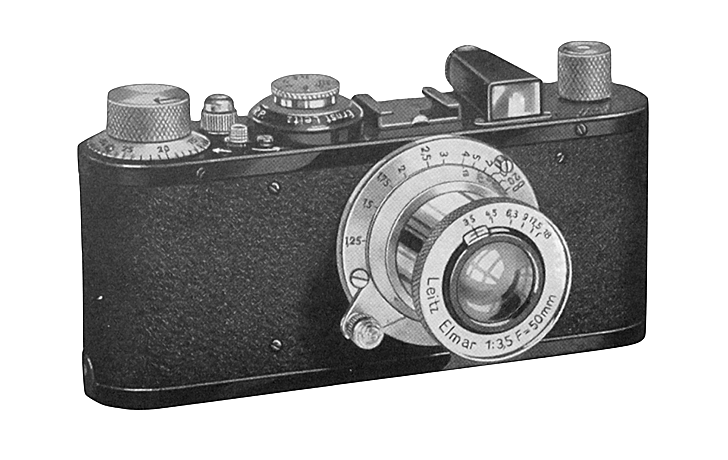
In the October 1936 issue of Fortune, there was an article on the “minicam boom”. It cited there being 100,000 miniature cameras in the US, comprised of more than 30 different makes.
Model E Leica, 1936
“Many a man who had owned a Kodak for years without feeling any impulse to see what he could do with it if he applied himself fancied that in the Leica he was finding a new invention that defied the laws of optics and would give him good pictures with no light to speak of and no effort save that of pressing the button. The Leica didn’t even look like a camera. No bellows, no bulk, no focusing hood; you shot from the hip, so to speak, and got your man.”
This is the first post in an ongoing series that looks at the intensity histograms of various images, and what they help tell us about the image. The idea behind it is to try and dispel the myths behind the “ideal” histogram phenomena, as well as helping to learn to read a histogram. The hope is to provide a series of posts (each containing three images and their histograms) based on histogram concepts such as shape, of clipping etc. Histograms are interpreted in tandem with the image.
Histogram 1: Ideal with a hint of clipping
The first image is the poster-boy for “ideal” histograms (almost). A simple image of a track through a forest in Scotland, it has a beautiful bell-shaped (unimodal) curve, almost entiorely in the midtones. A small amount of pixels, less than 1%, form a highlight clipping issue in the histogram, a result of the blown-out, overcast sky. Otherwise it is a well-formed image with good contrast and colour.
Histogram 2: The witches hat
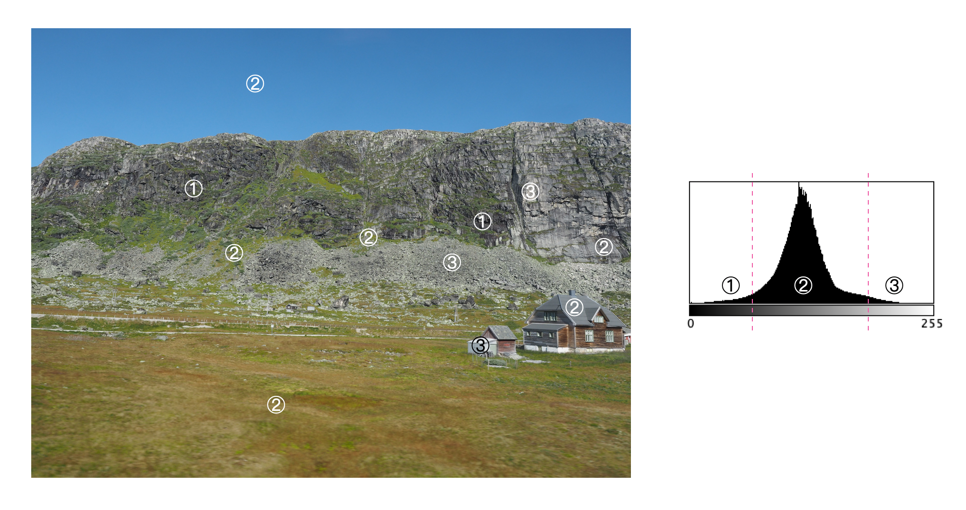
This is a picture taken along the route of the Bergen-Line train in Norway. A symmetric, unimodal histogram, taking on a classic “witches hat” shape. The tail curving towards 0 (①) deals with the darker components of the upper rock-face, and the house. The tail curving towards 255 (③) deals with the lighter components of the lower rock face, and the house. The majority of midtone pixels form the sky, grassland, and rock face.
Olympus E-M5MArkII (16MP): 12mm; f/6.3; 1/400
Histogram 3: An odd peak
This is a photograph of the statue of Leif Eriksson which is in front of Reykjavik’s Hallgrímskirkja. It provides for a truly odd histogram – basically the (majority of) pixels form a unimodal histogram, ③ , which represents the sky surrounding the statue. The tiny hillocks to either side (①,②) form the sculpture itself – the left forming the shadows, and the right forming the bright regions. However overall, this is a well formed image, even though it may appear as if the sculpture is low contrast.
“For me, capturing what I feel with my body is more important than the technicalities of photography. If the image is shaking, it’s OK, if it’s out of focus, it’s OK. Clarity isn’t what photography is about.”
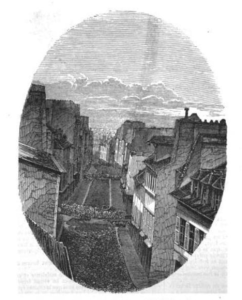
Photojournalism had its origins in the photography of war. Photojournalists are photographers who take pictures that illustrate or tell a story. The first photograph used as an “illustration of a newspaper report”, was a daguerreotype taken by Charles-François Thibault in Paris during the bloody June Days uprising in 1848. Two images were taken at Rue du Faubourg-du-Temple : the scene depicts a barricade on a empty street, at 7.30am on June 25th. On July 8th, the newspaper L’Illustration reproduced the images as woodcuts. Photographic coverage of the Crimean War (1853-1856), and the American Civil War in the 1860s required cumbersome cameras taking long exposures on plates – shots were taken before or after battles because combat coverage was impossible. WW1 brought medium format cameras with glass-plate negatives (these were used by “official” photographers, soldiers used the Vest Pocket Kodak).
Barricades in the Rue Saint-Maur (daguerreotype)
The woodcut from L’Illustration
The Golden Age of photojournalism was considered to be the period of the 1930s through the 1950s, largely due to the introduction of the Leica 35mm camera in 1925. But what sort of kit did the average photojournalist (not including army combat photographers) use in the mid-century period? Being a photojournalist was a demanding occupation. Consider the words of Boris Spremo (1935-2017): “
“I have walked through the wreckage’s of plane crashes and smashed cars . . . knelt beside dying people in Central Africa . . . faced bullets . . . run from tear gas bombs, been chased by angry mobs . . . ridden in a dug out canoe in the sweltering jungles of South America and on dog sleds at 50°C below zero in the Canadian far north . . . ”
Spremo, Boris. Boris Spremo: Twenty Years of Photojournalism. Toronto: McClelland, 1983.
So it is imaginable that a typical photojournalist would want to carry as little gear as possible. In the 1930s, while 35mm had followers, many photojournalists still used large format press cameras. For example Charles Kerlee (1907-1981) in his 1939 book “Pictures With a Purpose – How They Are Made” describes using a 4×5 series D Graflex with a 8¼” Steinheil Cassar lens, or a 40cm Tele-Tessar lens (400mm=135mm, 8¼”=65mm in 35mm equivalency).
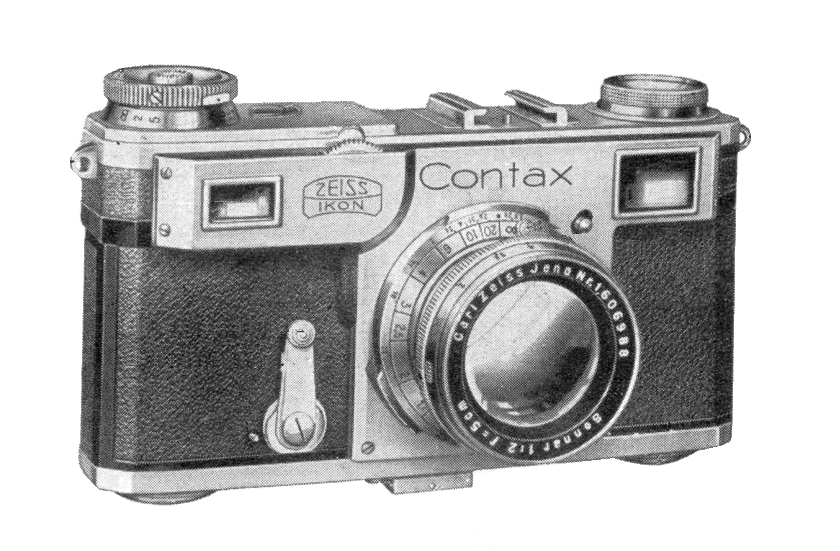
Robert Capa (1913-1954), who it is rumoured photojournalist, L.B. “Jeff” Jefferies is based on in the movie “Rear Window” was an icon of photojournalism, covering the Spanish Civil War and WW2. Capa is known for using a Leica at the beginning of his career, including for one of his most famous works, Falling Soldier taken during the Spanish Civil War. But by his coverage of the Chinese resistance to the Japanese invasion in the late 1930s, he had switched to the Contax II series of cameras. In 1944 as he followed allied troops onto the beaches at Normandy (the “Easy Red” sector of Omaha Beach), he carried two Contax cameras. His preference was for 50mm lenses, with a certain liking of the Zeiss 50mm Sonnar f/1.5. When he left on that ill-fated assignment to Indochina in 1954 he carried a Nikon S to complement his Contax.
A Contax II
Horace Bristol (1908-1997) was another American photographer who was best known for his work in Life. After WW2, Bristol settled in Japan, publishing “Tokyo on a five day pass with candid camera” in 1951. Although photographing for a photo-book he describes in detail the type of gear used through the process. It seems Bristol largely used 35mm cameras, typically still known as the “candid camera”. He states that while a telephoto and wide-angle are needed, the workhorse is the 50mm, it will “do almost anything any lens will do”. Photographing for the book, Bristol used an array of cameras, but typically carried a Canon III and Leica IIIc for candid work (likely what we would today term street photography). As to lenses, Bristol carried the following array: Serenar 135mm f/4, Serenar 85mm f/2, Nikkor 50mm f/1.4, Serenar 50mm f/1.8, Serenar 35mm f/3.2 and a Serenar 38mm f/3.5. Of course this sort of photography allowed for greater flexibility (Serenar = Canon).
Photojournalists also typically did not carry the full gamut of lenses. As suggested by Bristol:
“Don’t, however, be lead into the error of thinking that the answer to good pictures is to be found in a complete set of matched lenses. just the opposite is true, for there is a very definite correlation between the number of lenses the average photographer carries, and the worth-while pictures he produces. Unfortunately, this varies in inverse order; in other words, the more equipment to worry about, the fewer pictures of merit!”
Horace Bristol, Tokyo on a five day pass with candid camera (1951)
Many photographers adopted “candid cameras” because they were compact and convenient. W. Eugene Smith (1918-1978) supposedly left Newsweek in 1938 because they wanted him to work with a larger format, but he preferred his Leica. After that he secured a job at Life. Over his career he used many different 35mm cameras, Leica, Contax, Pentax, Nikon. His preference was for 21mm, 28mm, 35mm, 85mm and 135mm lenses. Yevgeny Khaldei (1917-1997), the Ukranian photographer who captured one of the most iconic WW2 photographs of a Soviet soldier raising a flag over the Reichstag in Berlin, used a Leica III throughout his career.
In the end, it is likely that 35mm cameras took over from larger format because they were practical. Practical and efficient, in the fast-paced world that photojournalism was becoming.
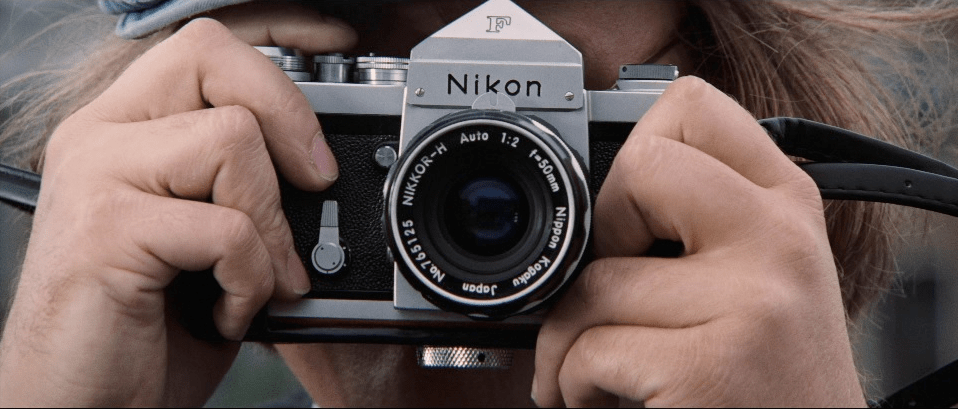
In 1971, two of the villains in the James Bond movie, Diamonds Are Forever used a Nikon F to take photos. The question is why the Nikon F? I mean it’s not like it was a new camera. First unveiled in 1959, it was no doubt an influential camera, but a decade later was it still cutting edge?
It was not the only time Nikon cameras were used in movies. The list is actually quite long, including the likes of The French Connection, Jaws, and Apocalypse Now (here’s another list of cameras in movies and TV shows). Nor was it the only camera used in Bond films – Bond used a Rolleiflex T in From Russia with Love (1963), a in Goldfinger (1964), a Nikonos Calypso in Thunderball (1965), and a Minox subminiature in On Her Majesty’s Secret Service (1969).
The Nikon F was at the forefront of SLR technology in the 1960s, and had a wide audience of users, from photojournalists covering the Vietnam War, to NASA. In March 1968 the Nikon F was laboratory tested by Popular Photography. Reviewers found little to complain about, it was an easy camera to function with, and extremely well built, except for the fact that it was heavy, “like a military tank of a camera”. It had a presence which was hard to dispute.
Choosing a camera for any movie may be a mere factor of chance. A personal preference of the director, or somebody facilitating props. Sometimes it’s product placement, although considering the Nikon F2 was released in the same year as the movie, it’s unlikely that is the case.
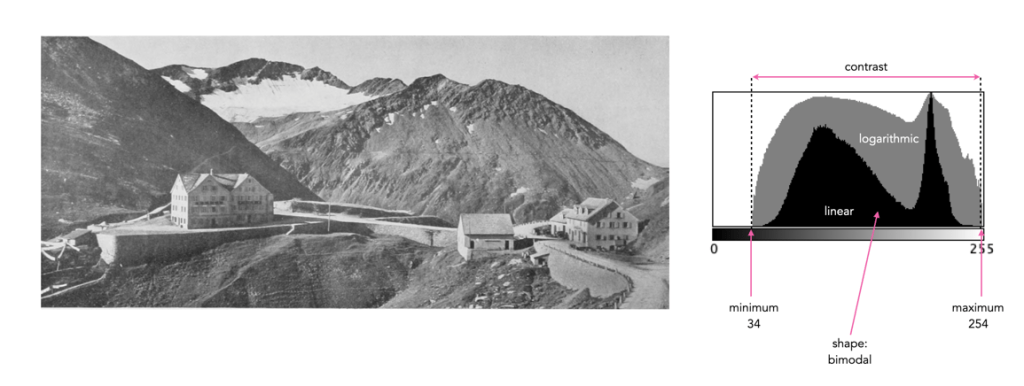
Sometimes a histogram is depicted logarithmically. A histogram will typically depict only large frequencies, i.e. histogram intensities with limited values will not be visualized. The logarithmic form helps to accentuate low frequency occurrences, making them readily apparent. In the example histogram shown below, intensity level 39 has a value of 9, which would not show up in a regular histogram given the scale, e.g. intensity 206 has a count of 9113.
Some of the most interesting vintage lenses are the sub-f/1.2 lenses, of which there are very few. In the 1950s Japanese lens makers wanted to push the envelope, racing to construct the fastest lenses possible. There were four contenders: the Zunow 50mm f/1.1, the Nippon Kogaku’s Nikkor-N.C 50mm f/1.1, Konishiroku (Konica’s predecessor) Hexanon 60mm f/1.2 and the Fujinon 50mm f1.2 LTM. This spurned research which led to the development of the Canon 50mm f/0.95 (1961), which at the time was the largest aperture of any cameras lens in the world. The other, which did not appear until 1976 was the Leitz (Canada) Noctilux-M 50mm f/1.0.
(Note that these lenses were made for 35mm rangefinder cameras.)
Why were these lenses developed?
The most obvious reason was the race to produce fast lenses. An article in the February 1956 issue of Popular Photography sheds more light on the issue. The article, titled “Meet the Zunow f/1.1” [1], by Norman Rothschild, described the virtues of the Zunow lens (more on that below), and concluded with one of the reasons these lenses were of interest, namely that it opened up new areas for the “available-light man”, i.e. the person who wanted to use only natural light, especially with slow colour films. This makes sense, as Kodachrome had an ASA speed of 10, and Type A’s speed was ASA 16. Even Kodachrome II released in 1961 only had a speed of 25 ISO. Conversely, black and white film of the period was much faster: Kodak Super-XX was 200 ISO, and Ilford FP3 was 125 ISO. Ilford HPS, introduced in 1954 pushed the ISO to 800. The newer Ektachrome and Anscochrome colour films were rated at ASA 32. In the patent for the Zunow f/1.1 lens [3], the authors claimed that objectives with apertures wider than f/1.4 were in more demand. In reality, the race to make even faster lenses was little different to the race to get to the moon.
Zunow 50mm f/1.1
The first of the sub-5/1.2 lenses was the Zunow 50mm f/1.1. Teikoku Kōgaku Kenkyūjo was founded by Suzuki Sakuta circa 1930 and worked for other companies grinding lenses. The company started working on fast lens around 1948, with the first prototypes completed in 1950, and the 50mm f/1.1 Zunow released in 1953. It made a number of lenses for rangefinder cameras, including slower 50mm lenses in f/1.3, and f/1.9, a f/1.7 35mm, and a 100mm f/2 lenses. In 1956 it became the Zunow Kōgaku Kōgyō K.K., or Zunow Optical Industry Co., Ltd., but closed its doors in early 1961. During the last years the company designed a couple of camera’s including a prototype of a Leica copy, the Teica, and the Zunow SLR, the first 35mm SLR camera with auto diaphragm, instant-return mirror, and bayonet mount interchangeable lenses (only about 500 were ever produced).
The Zunow 50mm f/1.1 was derived from the Sonnar-type f/1.5 lens. The patent for the Zunow f/1.1 lens [3] describes the lens as “an improved photographic objective suited for use with a camera that takes 36×24mm pictures”. Many of these fast lenses were actually manufactured for the cine industry. For example the company produced Zunow-Elmo Cine f/1.1 lenses for D-mount in 38mm and 6.5mm (and these lenses are reasonably priced, circa US$500, however not very useful for 35mm). The Zunow 50mm f/1.1 is today a vary rare lens. Sales are are US$5-10K depending on condition. The price for this lens in 1956 was US$450.
1953 – Zunow f/1.1 5cm, Leica M39 mount/Nikon S, 9 elements in 5 groups.
1955 – Zunow f/1.1 50mm, Leica M39 mount/Nikon S, 8 elements in 5 groups.
Nikkor-N 50mm f/1.1
Hot on the heals of Zunow was the Nikkor-N 5cm f/1.1 developed by Nippon Kogaku. Introduced in 1956, it was the second sub-f/1.2 lens produced. The lens was designed by Saburo Murakami, who received a patent for it in 1958 [5]. While the Zunow was an extension of the Sonnar-type lens, the Nikkor lens was of a gaussian type. It was also made using an optical glass made using the rare earth element Lanthanum in three of its optical elements. The lens was made in three differing mounts: the original internal Nikon mount (for use on Nikon S2, SP/S3 cameras), the external Nikon mount, and the Leica M39 mount. The original lens mount was an internal mount, and the heavy weight of the lens (425g) could damage the focusing mount, so it was redesigned in 1959 with an external mount. The lens had a gigantic lens hood with cut-outs for setting the focus with the rangefinder through the viewfinder.
1956 – Nikon Nikkor-N[.C] 50mm f/1.1, Leica screw mount/Nikon S, 9 elements in 6 groups (Nikon, 1200 units; M39, 300 units)
1959 – Nikon Nikkor-N 50mm f/1.1, Leica screw mount/Nikon S, 9 elements in 6 groups (1800 units)
A 1959 price list shows that this lens sold for US$299.50. Today the price of this lens is anywhere in the range $5-10K. Too few were manufactured to make this lens the least bit affordable. Nippon Kogaku also supposedly developed an experimental f/1.0 lens for the Nikon S, but it never went into production.
Canon 50mm f/0.95
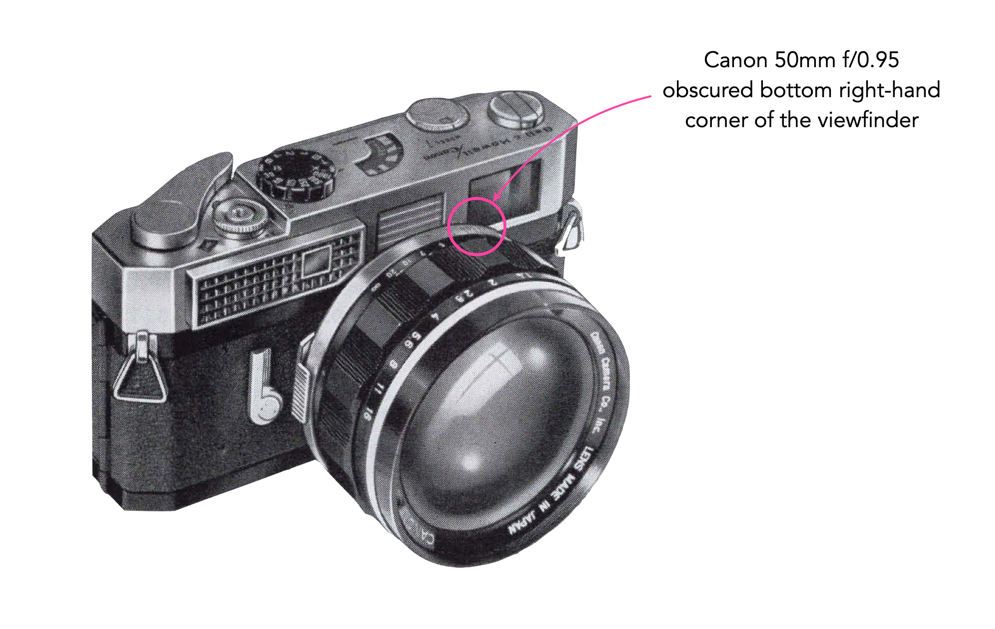
In August 1961, Canon released the 50mm f/0.95, designed as a standard lens for the Canon 7 rangefinder camera. It was the world’s fastest lens. The Canon f/0.95 was often advertised attached to the Model 7 camera – the Canon “dream” lens. The advertising generally touted the fact that it was “the world’s fastest lens, four times brighter than the human eye” (how this could be measured is questionable). It is Gauss type lens with 7 elements in 5 groups. The lens was so large on the Canon 7 that it obscured a good part of the view in the bottom right-hand corner of the viewfinder, and partially obscured the field-of-view.
In a 1970 Canon price list, the 50mm f/0.95 rangefinder lens sold for $320, with the f/1.2 at $220. To put this into context, $320 in 1970 is worth about $2320 today, and a Canon 7 with a f/0.95 lens in average condition sells for around this value. Lenses in mint condition are valued at around $5K.
The verdict?
So why did these lenses not catch on? Cost for one. While f/1.2 lenses were expensive, faster lenses were even more expensive. For specialist applications, the development of these lenses likely made sense, but for the average photographer likely not. There were a number of articles circa 1950 in magazines like Poplular Photography which seemed to downplay their value, which likely contributed to their decline. It is notable that by the the early 1960s, Nikon stopped advertising its 50mm f/1.1 lens, and never produced another sub-f/1.2 lens. By the late 1960s even Canon had ceased production of the f/0.95.
There were probably more sub f/1.2 lenses created for non-photographic applications, in many different focal lengths. For example x-ray machines (Leitz 50mm f/0.75), D-mount film cameras (e.g. Kern Switar 13mm f/0.9), C-mount for film, medical and scientific imaging (e.g. Angenieux 35mm f/0.95), and aerial photography lenses (e.g. Zeiss Planar 50mm f/0.7). Not until recently have super-fast lenses once again appeared, likely because they are technologically better lenses, made much cheaper than they ever could have been in the 1950s and 60s.
References:
Norman Rothschild, “Meet the Zunow f/1.1”, Popular Photography, pp.126/128, February (1956)
Kogoro Yamada, “Japanese photographic objectives for use with 35mm cameras”, Photographic Science and Engineering 2(1), p.6-13 (1958)
U.S. Patent 2,715,354, Sakuta Suzuki et al., “Photographic Objective with Wide Relative Aperture”, August 16, (1955)
Hagiya Takeshi, Zunō kamera tanjō: Sengo kokusan kamera jū monogatari (The birth of the Zunow camera: Ten stories of postwar Japanese camera makers) Japanese only (1999)
U.S. Patent 2,828,671, “Wide Aperture Photographic Objectives”, April 1, 1958.









 Crafting Pixels