Why 24-26 megapixels is just about right

When cameras were analog, people cared about resolving power – but of film. Nobody purchased a camera based on resolution because that was contained in the film (and different films have different resolutions). So you purchased a new camera only when you wanted to upgrade features. Analog cameras focused on the tools needed to capture an optimal scene on film. Digital cameras on the other hand focus on megapixels, and the technology to capture photons with photosites, and convert these to pixels. So megapixels are often the name of the game – the first criteria cited when speculation of a new camera arises.

Since the inception of digital sensors, the number of photosites crammed onto various sensor sizes has steadily increased (while at the same time the size of those photosites has decreased). Yet we are now reaching what some could argue is a megapixel balance-point, where the benefits of a jump in megapixels may no longer be that obvious. Is 40 megapixels inherently better than 24? Sure a 40MP image has more pixels, 1.7 times more pixels. But we have to question at what point is there too many pixels? At what point does the pendulum start to swing towards overkill? Is 24MP just about right?

First let’s consider what is lost with more pixels. More pixels means more photosites on a sensor. Cramming more photosites on a sensor will invariably result in smaller photosites (assuming the sensor dimensions do not change). Small photosites mean less light. That’s why 24MB is different on each of MFT, APS-C and full-frame sensors – more space means larger photosites, and better ability in situations such as low-light. Even with computational processing, smaller photosites still suffer from things like increased noise. The larger the sensor, the larger the images produced by the camera, and the greater the post-processing time. There are pros and cons to everything.

Fig.1: Fig: Compare a 24 megapixel image against devices that can view it.

There is also something lost from the perspective of aesthetics. Pictures should not be singularly about resolution, and sharp content. The more pixels you add to an image, there has to be come sort of impact on the aesthetics of an image. Perhaps a sense of hyper-realism? Images that seem excessively digital? Sure some people will like the the highly digital look, with uber saturated colour, and sharp detail. But the downside is that these images tend to lack something from an aesthetic appeal.

Many photographers who long for more resolution are professionals. People who may crop their images, or work on images such as architectural shots or complex landscapes that may require more resolution. Most people however don’t crop their images, and few people make poster-sized prints, so there is little or no need for more resolution. For people that just use photos in a digital context, there is little or no gain. The largest monitor resolution available is 8K, i.e. 7680×4320 pixels, or roughly 33MP, so a 40MP image wouldn’t even display to full resolution (but a 24MP image would). This is aptly illustrated in Figure 1.

Many high-resolution photographs live digitally, and the resolution plays little or no role in how the image is perceived. 24MP is more than sufficient to produce a 24×36 inch print, because nobody needs to pixel-peep a poster. A 24×36” poster has a minimum viewing distance of 65 inches – which at 150dpi, would require a 20MP image.

The overall verdict? Few people need 40MP, and fewer still will need 100MP. It may be fun to look at a 50MP image, but in all practical sense it’s not much better than a 24MP. Resolutions of 24-26MP (still) provide exceptional resolution for many photographic needs. It’s great for magazine spreads (max 300dpi), and fine art prints. So unless you are printing huge posters, it is a perfectly fine resolution for a camera sensor.

Choosing a vintage lens – more specialized focal lengths

While the standard focal lengths (28-150mm) are of most interest to the amateur vintage lens user, there are also more specialized options. These are for the photographer who wants to broaden the type of lens they use. Ironically the super-wide-angle and standard telephotos are at opposite ends of the spectrum, both from the perspective of focal-length, AOV, and cost. The shorter the focal length, the more expensive the lens, whereas the longer focal lengths are quite plentiful, and cheap.

Note that I have not included sub-15mm lenses because they nearly all verge on the specialized fisheye realm, and I’ll be covering that in another series of posts. Over 300mm, lenses tend to become very specialized, and not much use unless you are doing surveillance, or wildlife photography.

Super wide-angle lenses (15−25mm)

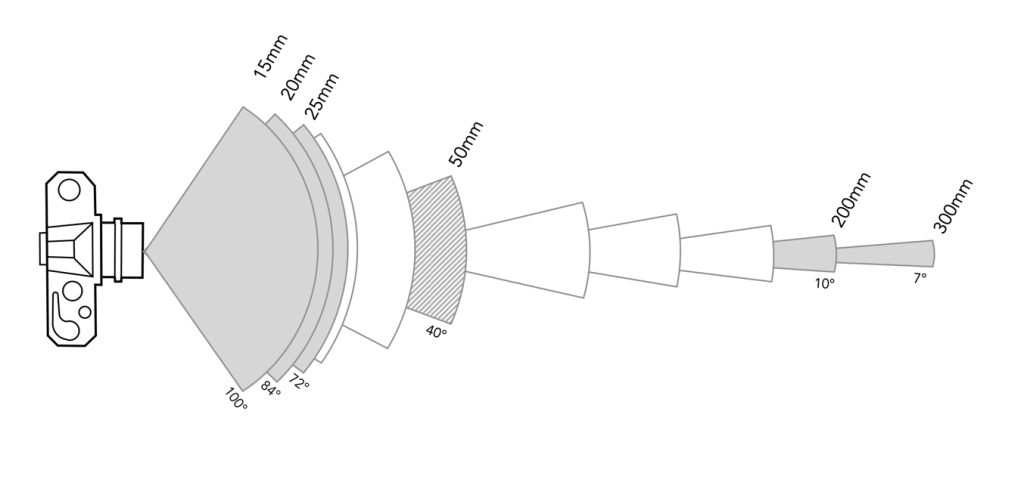
These are in the special lenses category, sometimes referred to as extreme wide-angle lenses. These lenses have a horizontal AOV of between 70-100°. Their primary function is to allow the inclusion of a broad subject area from a relatively close vantage point – this includes landscape with broad vistas, city scenes, and build interiors. Lenses in this category are corrected for curvilinear distortion (i.e. they reproduce straight lines), they reproduce parallel lines in the scene with greatly enhanced angles of convergence. The lower the focal length, generally the fewer the options available. Note that many of the lenses in this category did not appear until the mid-to-late 1960s.

24/25mm (74/72°)

Some consider 24mm to be where the “real” wide angles begin. There is a perceivable change in perspective from 28mm, although the horizontal AOV only changes from 65° to 74/72°. The biggest problem here is that there aren’t many options, in this focal length.

  • Examples Asahi Super-Multi-Coated Takumar 24mm f/3.5, Olympus Zuiko 24mm f/2.8; Isco-Gottingen Westrogon 24mm f/4;
  • Crop-sensors − 36/38mm (APS-C), 48/50mm (MFT)

20/21mm (84/81°)

These lenses obviously offer even a wider AOV than their 24/25mm counterparts. For some manufacturers this was the lower limit of the lenses they offered, partially because of the expense involved in designing them. The maximum aperture was at most f/2.8, with most of these lenses being f/4. The wider you go, the more aberrations like field curvature that exist.

  • Examples Carl Zeiss Jena Flektogon 20mm f/2.8 and f/2.4; Asahi Super-Multi-Coated Takumar 20mm f/4.5; Minolta MD 20mm f/2.8
  • Crop-sensors − 30/32mm (APS-C), 40/42mm (MFT)

15−18mm (100−90°)

These lenses didn’t really appear in great quantities until the 1970s. These uber-wide/(rectilinear) fisheyes performed well in the centre of the images, but the edges suffered from some field curvature and barrel distortion, but maybe that’s part of their appeal. Apertures were generally around f/3.5. Some of the lenses were fisheye’s others rectilinear wide’s. More Japanese lenses, and fewer German lenses.

  • Examples Asahi SMC Takumar 15mm f/3.5; Asahi Super-Multi-Coated Fish-Eye-Takumar 17mm f/4; Nikon Nikkor 15mm f/3.5; Asahi Fish-eye Takumar 18mm f/11.
  • Crop-sensors − 22-27mm (APS-C), 30-26mm (MFT)
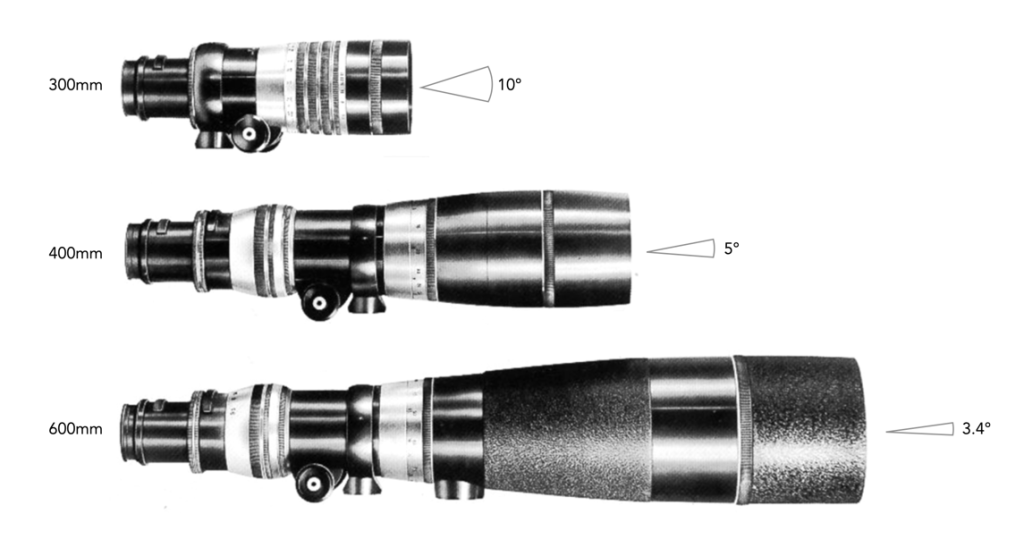
Specialized focal lengths, and their associated AOV (horizontal).

Standard telephoto lenses (180−300mm)

Telephoto lenses larger then 135mm were the purvey of the SLR, with rangefinder cameras requiring the use of a boxy reflex box. Still as with many prime telephotos, they were often sidelined by zoom telephotos.

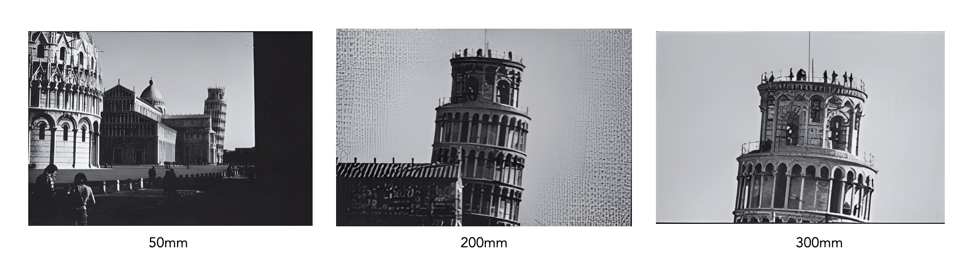
180−200mm (11−10°)

There were a number of good 200mm lenses with fast apertures in the range f/2 to f/1.8 available in the tail end of the manual focus era. The core 200mm lenses were the f/3.5 to f/4.5 models offering a good balance of size, weight, and performance.

  • Examples Meyer-Optik Orestegor 200mm f/4; Asahi Super-Multi-Coated Takumar 200mm f/4; CZJ Sonnar 200mm f/2.8;
  • Crop-sensors − 270-300mm (APS-C), 360-400mm (MFT)

250−300mm (8−7°)

Most manufacturers offered a 300mm lens or two. Early models can be bulky, and rare. Only for those who are really serious about seeing things close-up.

  • Examples Kilfitt Tele-Kilar 300mm f/5.6; Meyer-Optik Telemegor 300mm f/4.5;
  • Crop-sensors − 375-450mm (APS-C), 500-600mm (MFT)

Did Darth Vader use a Zeiss lens?

In a galaxy, far, far away, they used cameras with lenses from Carl Zeiss Jena. It’s true, Vader was into photography, he had a dark-room and everything. Actually I never saw anyone with a still camera of any sort in the Star Wars universe, but I guess they must have existed – they did use “holocams”. So how did a reference to a sci-fi classic get associated with the design of a lens?

In some of the early SLR lenses from CZJ, especially lens series like the Pancolar, many people describe them as being “Star Wars” lenses. What does this really mean? These lenses often have another moniker – “zebra” lenses, because of their striped design. Does the zebra somehow associated them with Star Wars? Most of the talk of Star Wars revolves around the Carl Zeiss Jena Pancolar lenses, and in particular the 50mm f/2 (and in odd cases the f/1.8).

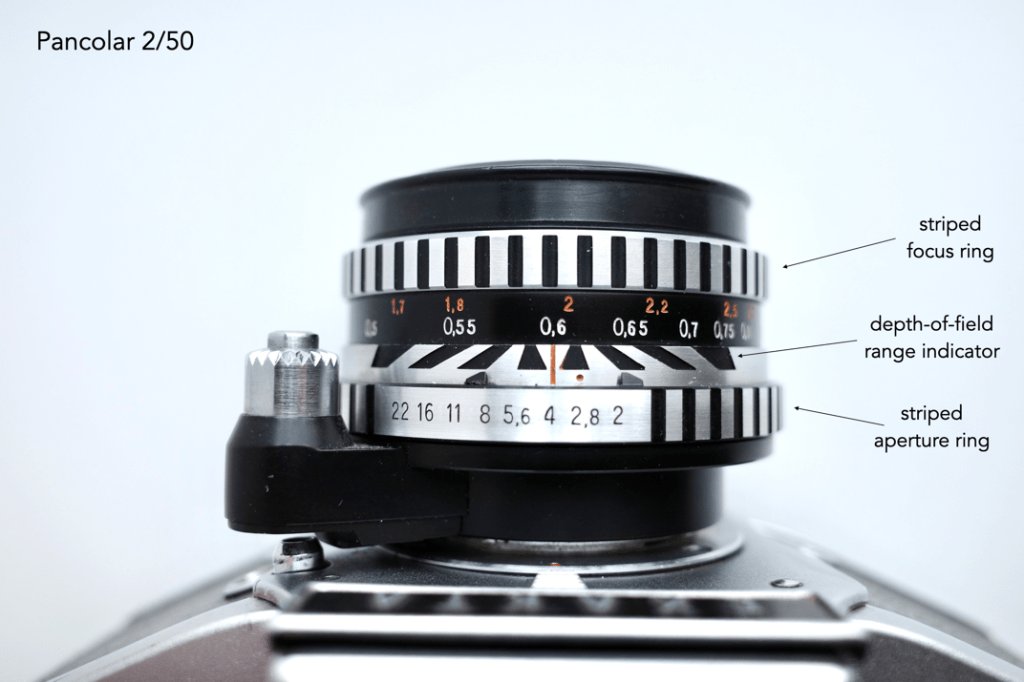
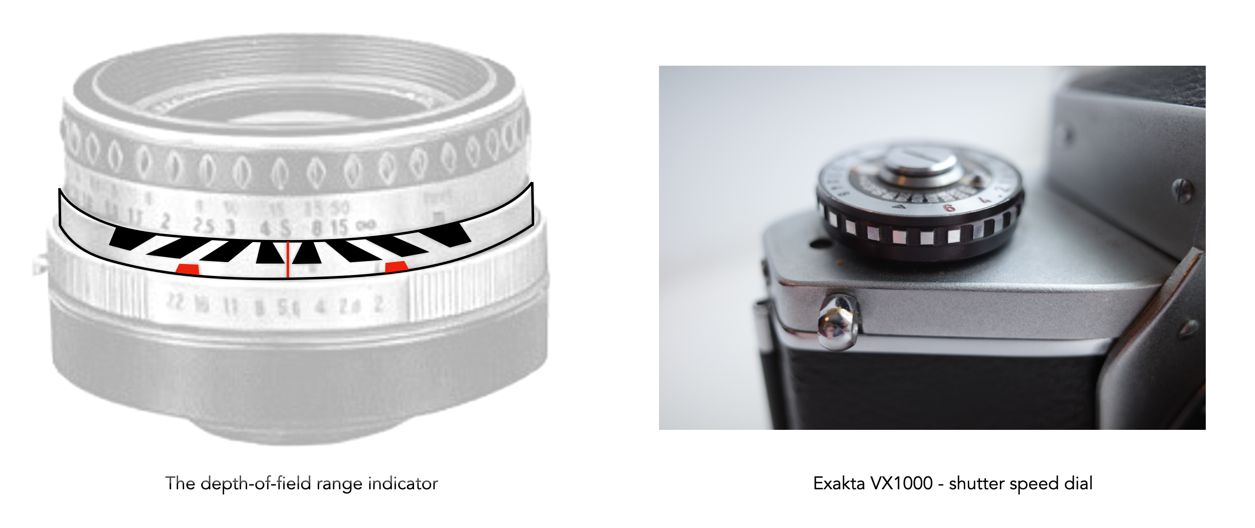
The Pancolar 50mm f/2, which first appeared as the Flexon 50mm f/2, was produced from 1959-69 (made mostly for Exakta mount), and had a number of differing aesthetic looks. Most differed by a change in the grip ring in the front of the lens, from a leather to plastic knobs, and finally to the stripped aluminum ring. Except for the earliest version of these lenses, they all sported the “converging” look of the “depth-of-field range indicator” (DoFRI), which appeared around 1962. Basically when the aperture was altered, the indicators (early models in red as shown, later models in black) would move in and out appropriately, so at f/2 they would converge at the red central line. A Zeiss brochure from 1962 which contained four lenses: Flektogon 4/50mm, Flektogon 2.8/35mm, Tessar 2.8/50mm and Pancolar 2/50mm. Strangely enough, the Pancolar was the only one with this converging distance design.

The “zebra design” is the colloquial term for lenses with grip rings that are aluminum – with vertical straight knurling that alternate black and bare aluminum. Supposedly this striped design evolved from the Exakta VX1000 which when released in 1966 had a shutter-speed selection knob of a similar design. The Pancolar 50mm f/2 also adopted the zebra design circa 1966, while still retaining the converging depth scale. The zebra looks was eventually replaced by the black-look lenses in the early 1970s.

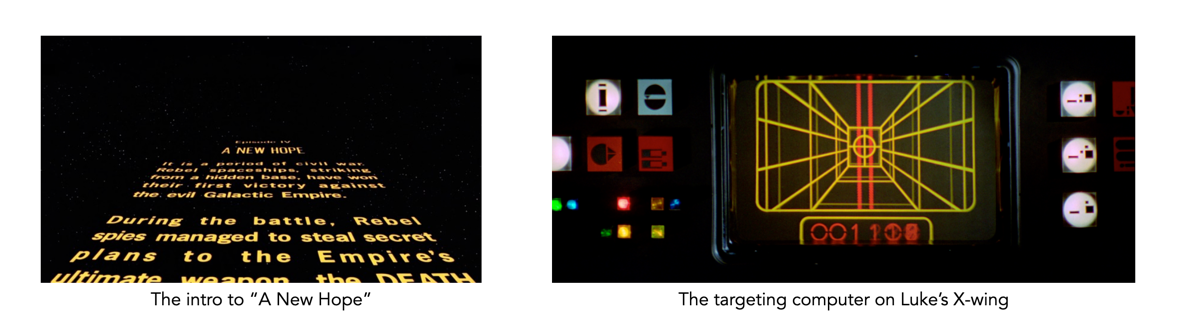
Some suggest the Star Wars moniker it is named for the characteristic look of the DoFRI, reminiscent of those very yellow credits at the beginning of the film. If anything, I think the range indicator could be better attributed to the targeting computer in Luke’s X-wing used on the trench run on the Death Star (Episode IV). It shows the same converging lines, and deals with a similar concept, i.e. distances of a sort. On later models of the 50mm f/2, the strips existed on the tandem with the DoFRI, but when the Pancolar 50mm f/1.8 appeared, it maintained the striped appearance, but lost the converging look DoFRI, opting instead for a more traditional one.

It seems then that the use of strips to describe the “Star Wars” look has no real basis. There were other Zeiss lenses that took on the zebra design, as well as other manufacturers, e.g. Meyer-Optik, Asahi (e.g. the Auto-Takumar 55mm f/1.9), using the design well into the 1970s, and no one ever talks about “Star Wars Takumars”.

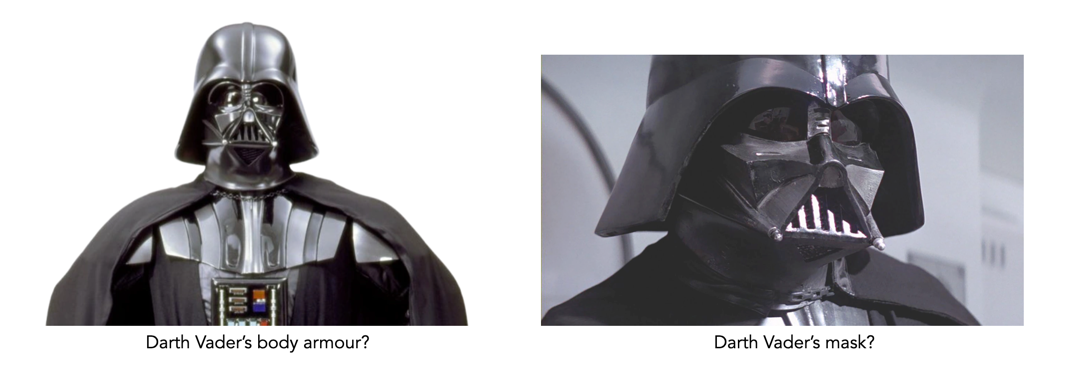
The reality is, no one really knows where the term originated or why it came into use. Were these lenses associated with Star Wars because of the striped design? Or perhaps it was a play on the “good” versus “evil” of West versus East Germany? If you look at a lens in isolation, it does have an association, but a dark one – it does share some characteristics with Darth Vader. It’s cloaked in blackness, and perhaps the striped design is associated with the strips on Vader’s armour? Or perhaps the strips were reminiscent of the mouth grill on Vader’s mask?

Maybe it just has a Star Wars feel about it, and you know, the more I look at it, the more I feel that way – maybe I’m being drawn in by the Force… must buy more…

Choosing a vintage lens – some FAQ

This is a follow-on to the general FAQ on vintage lenses, and answers questions related more to choosing a lens. There are often no truly definitive answers, i.e. there is no “one” perfect vintage lens.

Which focal lengths should I start with?

The most common focal length is 50mm, therefore this is the lens I would suggest starting with. On a crop-sensor such as APS-C, this will give you a 75mm moderate range telephoto, good for portraits etc. Next in line would be a 35mm, because this will give you a “normal” 52mm on an APS-C camera. At the end of the day, the focal length you choose is based on your photographic needs.

Do I need a fast vintage lens?

Sure, 50mm f/1.2 lenses are fast, and f/1.1’s are even faster, but in all likelihood you won’t need to spend the extra money for a fast lens. As digital cameras have higher native ISOs, lenses with f/1.8, f/2, f/2.8 and even f/3.5 are more than usable. Besides which, superfast lenses have a lot of limitations, and do you really want to spend that much money?

Should I choose a lens based on specifications?

Sometimes people will choose lenses based on its speed, i.e. large apertures. Don’t choose a lens based solely on its specifications. A lens has to have a real need for it to be useful, not a numeric one. If you have the wherewithal to buy a 50mm f/1.1 lens, then you have to actually be in a situation to use it, unless of course you are a collector. Besides which the character of a lens is more than just it’s technical specifications.

Should I choose a lens based on its aesthetic appeal?

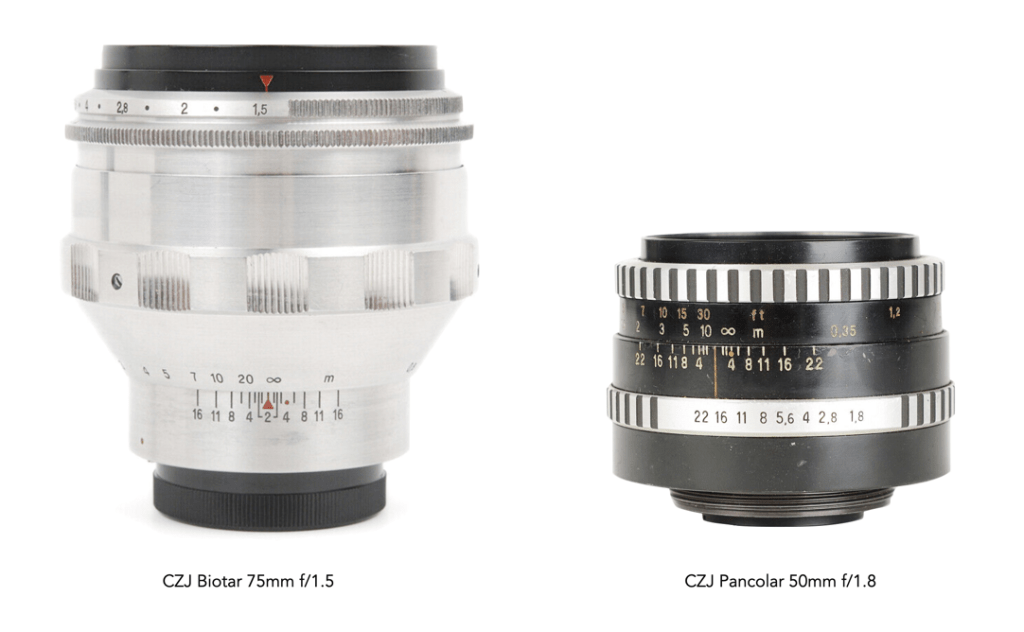
Sure, why not. I know most people think about the optical appeal of a lens, or the fabulous bokeh it will produce, but the reality is that aesthetics have to play some sort of role. I prefer the look of the older aluminum/chrome lenses over their matt black successors. For example I really like the “fat” version of the CZJ Biotar 75mm f/1.5 made from 1952-1968. It is made of aluminum and has an extremely scalloped focus ring, but these days it sells for upwards fo $2000, so not exactly affordable. I am also drawn towards the Zeiss lenses with the “Star Wars” motif, e.g. Pancolar 50mm.

Aesthetically pleasing lenses anyone?

Are hyped up lenses worth it?

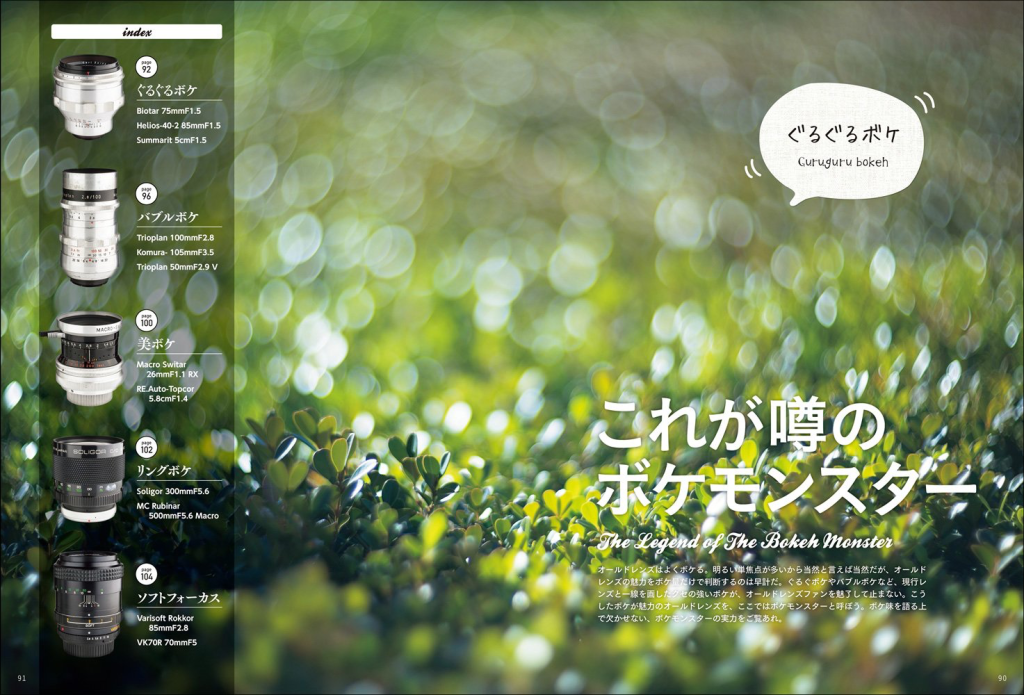
Maybe, or maybe not. In reality how good a lens is is very subjective. Choosing a lens based on a single persons opinion may be somewhat flaky. If a number of people share the same opinion, then it may be worth pursuing that lens. However hyped up lenses often become quite expensive, or even hard to find. For example the the Helios-40 85mm f/1.5 is quiet a hyped up lens – great if you are crazy for Bokeh, but for $500 too expensive for a 85mm lens.

Are lenses nobody talks about worth it?

This is the flip-side to hyped-lenses. The problem with lenses nobody talks about is that nobody talks about them, maybe because they are mediocre, or perhaps nobody has explored them properly. Of course once people get wind of a lens that has been ignored for decades but has some endearing characteristics, expect it to become more expensive, and harder to find. These lenses are often quite cheap, so maybe it’s worth a risk?

Are legendary lenses really that good?

Some lens reviews like to use terms like “legendary”, “mythical”, and “superior”. It is all very subjective. Some lenses do have the qualities to pull off being given one of these monikers, but many aren’t. For example the Carl Zeiss Pancolar 80mm f/1.8 is considered by most to be a really exceptional lens. It is very sharp, and has great bokeh, but the downside is that it isn’t that common, and therefore prices range from C$1200-2000.

Does the brand matter?

Most camera companies produced good lenses. Some people say Zeiss are the best (East or West Germany, that is the question?), others lover Asahi Pentax, and still others like Canon, or Nikon. It’s really all about what lens characteristics of a particular manufacturer you end up coveting. That being said, even prominent companies produced some dog lenses. There were also companies that just produced a certain genre of lenses – for example Heinz Kilfitt (München) produced macro (they produced the first macro lens), telephoto and zoom lenses, such as the famous Killfitt Fern-Kilar 40mm f/5.6 used in the movie Rear Window. (I’ll be doing a separate post on brands)

Are third-party lenses any good?

People also forget that there are 3rd-party lenses, from manufacturers like Soligor, which are usually pretty good, and often quite inexpensive. It often depends on the characteristics of individual lenses.

What things do people forget when choosing a lens?

The most common are likely size and weight. Faster lenses are generally larger, and heavier. An early lens may be made of chrome-plated steel and therefore much heavier than the aluminum lenses that followed. Also, cheaper lenses may not be built that well, i.e. using lower quality components, or heaven forbid plastic parts.

Vintage digital – the first full-frame DSLRs

The late 1990s saw a plethora of digital cameras evolve. Some were collaborations between various manufacturers such as Nikon-Fujifilm. But most of these cameras had sensor sizes which were smaller than that of a standard film camera, e.g. APS-C. The first true full-frame cameras appeared in the period 2000-2002.

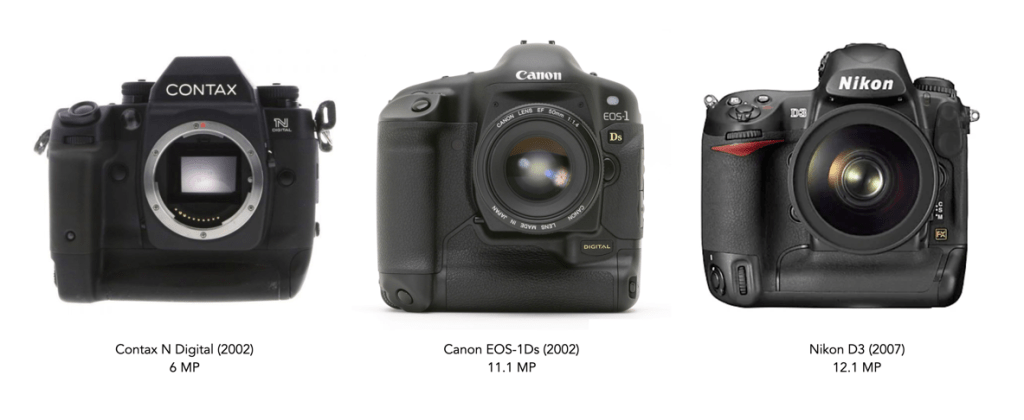
The first full-frame SLR of note was the Contax N Digital, a 6MP SLR produced by Contax in Japan. Although announced in late 2000, it didn’t actually appear until spring 2002. The sensor was a Philips FTF3020-C, and was only in production for a year before it was withdrawn from the market. Pentax also announced a full-frame camera (using the same sensor as the Contax N), the MZ-D in September 2000, but by October of the following year, the camera had been cancelled. The next full-frame was the Canon EOS-1Ds, which appeared September 2002. It was a monumental step forward, having a full-frame sensor that was 11.1 megapixels. In reality Canon dominated the full-frame market for quite a few years.

Nikon, who stayed in the APS-C for many year was relatively late to the game, not introducing a full-frame until 2007. The Nikon D3 had a modest 12.1MP sensor, but this is because Nikon opted for a low-resolution, high sensitivity sensor. Many lauded the camera for its high ISO noise control, with Popular Photography saying the D3 “will bestow an unheard of flexibility to low-light shooters, or give sports photographers the ability to crank up the shutter speed without adding flash.” To compare, the Canon 2007 equivalent was the Canon EOS-1Ds Mark III, sporting a 21.1MP sensor.

How do these stack up against a modern full-frame? If we compare the Canon 1Ds against a Canon R5C on certain charcteristics:

Canon 1Ds (2002)Canon R5 C (2022)
megapixels1145
ISO100-1250100-51200
video8K
weight1585g770g
number of focus points451053
number of shots per battery600220-320

These early full-frame DSLR’s were certainly beasts from the perspective of weight, and even megapixels, but to be honest 11MP still stacks up today for certain applications.

Further reading:

Vintage lens makers – Komura (Japan)

There are some lenses that few people have ever heard about, usually because they provided third-party lenses for many differing camera mounts. One such lens brand is Komura, manufactured by Japanese optical company Sankyō Kōki K.K. (Sankyo Kohki), known in English as Sankyo Koki Co. Ltd. In 1962 the company, registered the US trademark Komura, indicating that it was firat used as a trademark in 1953. Before that it is believed the company use the brand name Chibanon or Chibanone. By the 1970s, the company had changed its name to Komura Lens Manufacturing Ltd.

The Komura literature touted their lenses as being “superbly sharp”. They seem to have produced at least 40 different lenses from 28mm to 800mm, for SLR, rangefinder, and C-mount cameras. Their 28-200mm lenses were made with direct individual mounts, mostly in the Leica thread mount and Nikon rangefinder, but also M42, Exakta, Nikon F, Minolta, Miranda, Konica, Canon, Pentax and Petri. Those from 200-800mm had a generic 47mm screw mount which required a specific adapter, called a ‘Unidapter’ to convert them to other camera mounts (apparently to reduce inventory requirements).

Today Komura lenses are little known, but can still be found, especially for Japan (eBay). A 105mm f/2 is usually advertised for between C$300-500, while 85mm f/1.4 lenses seem to go as high ac C$1200. Actually quite high prices for a brand that doesn’t have a lot of presence. To put this into perspective, the Komura 800mm f/8.0 sold for US$695 in 1965 (plus $8.50 for an appropriate adapter). Conversely the 500mm f/7.0 sold for US$175 (+ $4.95 adapter). The 85mm f/1.4 sold for US$162.

Choosing a vintage lens – classic focal lengths

The number one choice when selecting a vintage lens is usually focal length. This post will look at the classic types of focal lengths, to provide some insight into choosing one to suits your needs. For each lens focal length, I have included some of the more popular examples of lenses. I have not included cost estimates, because they can be so varied, and dependent on a number of factors.

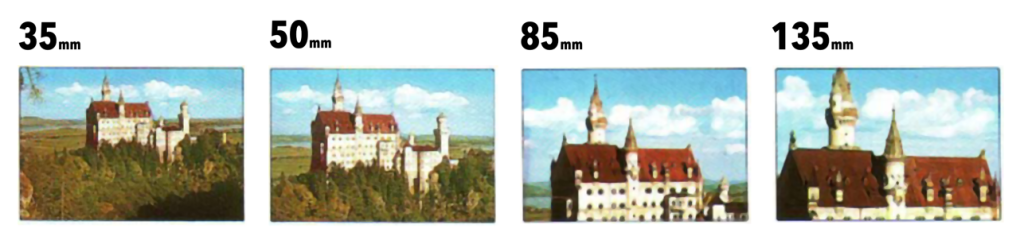
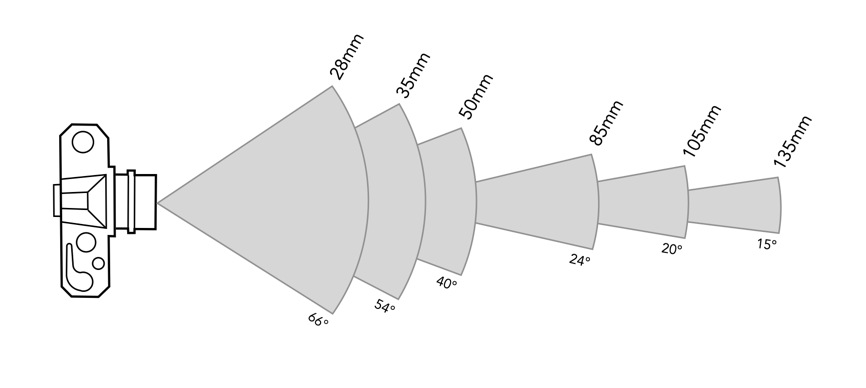
The values provided for the “crop sensor” denote the full0-frame equivalents when the lenses are used on crop-sensor bodies. For example a vintage 50mm lens on an APS-C sensor will behave the equivalent of a 75mm lens on an SLR. That means a 24mm super wide angle lenses on a DSLR will behave like a wide on an APS-C sensor, and a normal lens on a MFT sensor. Crop sensor focal lengths are simply calculated by multiplying the focal length of a lens by the appropriate crop factor: 1.5 (APS-C), 2.0 (MFT). Note that angles shown represent the angle-of-view (AOV) of the lens and are always horizontal. The AOV for the crop-factors are calculated in the same way as for the focal lengths.

Standard lenses (40−58mm)

Normal lenses tend to produce natural-looking pictures. There is a broad range of lenses in this category, both from the perspective of cost, weight, and aperture (speed). Wide apertures in the range f/1.2-1.4 are ideal for talking available light pictures indoors and out. Average aperture lenses are f/1.7 or f/1.8. Generally lens prices increase as apertures increase, hence why slow lenses are often inexpensive (and plentiful).

50mm (40°)

The 50mm lens is the most ubiquitous of all vintage lenses. Just about every camera came standard with a 50mm lens. 50mm lenses can generally be categorized into “fast” and “slow” lenses. Fast lenses are generally those with apertures of f/1.5 and larger, whereas slow 50’s were f/1.7 to f/2.8. Slow lenses are typical of the standard kit lenses found on cameras of the period, in part to reduce the cost of the basic system. Some higher end models were given an f/1.4 lens, and some like Canon advertised their Canon 7 rangefinder with the “dream lens”, the 50mm f/0.95. The super-fast lenses were designed for low-light situations, and really don’t make a lot of sense for the average photographer.

  • Examples Asahi Takumar 50mm f/1.8; CZJ Pancolar 50mm f/1.8; CZJ Tessar 50mm f/2.8; Meyer-Optik Görlitz Oreston 50mm f/1.8; Mamiya Sekor 50mm f/2; Carl Zeiss Planar 50mm f/1.8;
  • Crop-sensors − 75mm (APS-C), 100mm (MFT)

55mm (36°) and 57/58mm (35/34°)

Some cameras came standard with the “other” normals, 55mm and 57/58mm, depending on the manufacturer. Many of these lenses are from the period when SLR first appeared. Some suggest this was because of mechanical limitations imposed on producing fast 50mm lenses (impeded by the existence of a mirror), others suggest it is because photographers preferred the longer focal length because it was more portrait-focused. So the late 50’s to early 60’s saw a number of these lenses appear. 58mm lenses were generally f/1.4 to f/2, and 55mm were f/1.7 to 2.

  • Examples Helios-44 58mm f/2.0; Konica Hexanon AR 57mm f/1.2; Minolta Rokkor MC 58mm f/1.4; CZJ Biotar 58mm f/2; Mamiya Sekor 55mm f/1.4; Asahi Super-Takumar 55mm f/1.8;
  • Crop-sensors − 83/87mm (APS-C), 110/116mm (MFT)

40mm (48°) and 45mm (44°)

These focal lengths are not that common, usually appearing in the guise of “pancake” style lenses. These lenses are more likely to be found on fixed-lens cameras, for example the point-and-shoot Olympus Trip 35 (Zuiko 40mm f/2.8). These lenses are ideal for people who work outdoors, as they are light, and compact. They fit very discretely on any camera, but like many compacts look almost comical on larger cameras. These are the focal lengths closest to the diagonal of 36×24mm film, with 40mm offering 48.46° horizontal AOV. Generally they had apertures in the f/2 to f/2.8 range. Within the mainstream of lenses, these intermediary lenses are somewhat inconspicuous, possibly because there aren’t that many examples.

  • Examples Konica Hexanon AR 40mm f/1.8; Asahi SMC Pentax-M 40mm f/2.8; Minolta Rokkor MD 45mm f/2 (pancake)
  • Crop-sensors − 60/68mm (APS-C), 80/90mm (MFT)
Classic focal lengths, and their associated AOV (horizontal).

Wide-angle lenses (28−35mm)

Any lens shorter than a normal focal length qualifies as a wide-angle. They range from extreme fish-eye to the more moderate, and useful 24-35mm category. We have divided these into the “normal” wides, described here, and the super-wides. As the focal length decreases, the wide-angle characteristics increase – greater angle-of-view, greater depth of field, and greater apparent distortion.

35mm (54°)

Before the 1970s, the 35mm was the “standard” wide angle produced by many manufacturers. As such it was often the workhorse of wide-angle shots from the days of the rangefinders up to the 1970s, when wider lenses started to appear. Due to the increase in AOV, many photographers preferred its perspective and as a result was often carried as a secondary lens. It has a horizontal AOV of 54°, and was usually available is a wide range of apertures, from f/1.4 to f/4, and therefore there is no shortage of these wide-angle workhorses, and therefore can be quite inexpensive.

  • Examples CZJ Flektogon 35mm f/2.8; Enna München Lithagon 35mm f/3.5; Konica Hexanon AR 35mm f/2; Asahi Super-Takumar 35mm f/3.5
  • Crop-sensors − 52mm (APS-C), 70mm (MFT)

28mm (65°)

The 28mm has become the “standard” in wide angle lenses since the 1970s. Like the 35mm, there are copious lenses with many differing characteristics out there.

  • Examples Asahi Takumar 28mm f/3.5; Minolta Rokkor MC/MD 28mm f/3.5; Asahi Super-Takumar 28mm f/3.5;
  • Crop-sensors − 42mm (APS-C), 56mm (MFT)

29/30mm (64/62°)

Quite a rare option, it provides a small variation on the 28mm.

  • Examples Meyer-Optik Görlitz Lydith 30mm f/3.5 (also Pentacon 30mm); Pentacon 29mm f/2.8, and its predecessor the Meyer-Optik Görlitz Orestegon 29mm f/2.8
  • Crop-sensors − 44/45mm (APS-C), 58/60mm (MFT)

Moderate telephoto lenses (80−150mm)

These are likely the most common telephoto lenses, the moderate telephotos are often considered “portrait” lenses. Often reasonably fast and lightweight, they are easy to hold by hand they provide at least twice the magnification of normal lenses. Angle-of-view is generally 14-25°.

80−90mm (25-23°)

These focal lengths were common in rangefinder lenses, and are sought after for taking portraits, likely due to their limited compression effects. Apertures range from f/1.8 to f/3.5.

  • Examples Jupiter 9 85mm f/2.0; Asahi Super-Multi-Coated Takumar 85mm f/1.8; CZJ Pancolar 80mm f/1.8; Helios 85mm f/1.5
  • Crop-sensors − 127-135mm (APS-C), 170-180mm (MFT)

105mm (19°)

Sometimes overlooked, but just slightly narrower field (19°) than the more popular 85mm (24°).

  • Examples Asahi Super-Multi-Coated Takumar 105mm f/2.4; Meyer-Görlitz Trioplan 105mm f/2.8
  • Crop-sensors − 157mm (APS-C), 210mm (MFT)

120−150mm (17-14°)

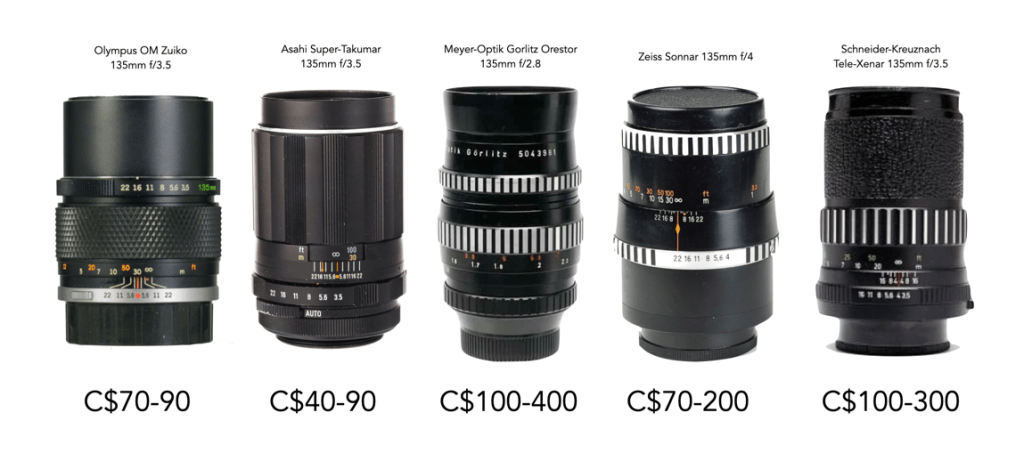
The ubiquitous 135mm is the most common lens in this range, and there are a lot of them. The 135 was likely the “standard” telephoto until telephoto-zooms started to make inroads in the 1970s. Available in a wide assortment of apertures, f/2.8 and f/3.5 were the most common.

  • Examples − Hard to pick one 135mm, there are SO many. CZJ Sonnar 135mm f/1.5; Meyer-Optik Görlitz Orestor 135mm f/2.8; Asahi Super-Multi-Coated Takumar 135mm f/3.5
  • Crop-sensors − 180-225mm (APS-C), 240-300mm (MFT)

The first forays into computer designed lenses

The early years of lens design, and particularly photographic lens design, were not for the faint-of-heart. Calculations were performed using mechanical calculators, books of trigonometric tables, Fuller’s cylindrical slide rules with helical scales, and people who known as ‘computers’ as assistants. Probably the most important tool in lens design was geometrical ray tracing, a technique by which the paths of light rays emanating from a point in an object are traced through several lens elements following the laws of geometrical optics to determine the manner in which these rays recombine in the image. An ideal lens would see all rays from a point recombine a corresponding point [3].

A Fuller’s spiral cylindrical slide rule (Keuffel & Esser 4015). This had a helical scale which allowed for 50 turns around the cylinder. It was equivalent to a traditional slide rule 500 inches (12.7m) in length. They could provide results of up to 4-5 significant digits.

One of the original pioneers of the use of computers in designing lenses was Charles Wynne. The design of his revolutionary f/0.71 lens took more than two years. At the time Alan Turing, working on the Manchester computer at Manchester University was looking for some arduous tasks to test the capability of the new machine. Wynne send the provisional design for the lens, including copies of the ray-trace equations. The computer wasn’t exactly up to the task, due to something like its thermionic valves failing, so the calculations results appeared long after the prototype had been completed.

By 1955 the next generation of computers were appearing, and with increased complexity a realization that they would be required to enhance optical formulae. This lead to the creation of dedicated computers to perform lens calculations. In continental Europe, by 1953 Leitz had in operation the Z5, a relay computer from Conrad Zuse. To keep up with the number crunching needs of lens design, Carl Zeiss Jena developed a relay computer, the Oprema [6], in 1954/55 (the first in the GDR). The computer was developed by a team led by Wilhelm Kämmerer and Herbert Kortum – it took up a floor area of 55m², had 17,000 relays, and used 500km of cables. It was in operation until 1963, and reduced calculations that would have taken an hour by hand to a few seconds. On the other side of the globe in 1956, Dr. Okazaki Bunji created Japan’s first electronic computer, for Fuji [5]. Known as the FUJIC, it was designed to perform lens calculations, and supposedly was 2000 times faster than the equivalent human calculation.

Post 1955, Wynne began work on the first Atlas computer, developing programs for ray-tracing. In 1959 Wynne, with his colleague at the Wray company, Michael Nunn, published their pair of classic papers on Wynne’s invention for iterative lens design with digital computers, with work performed on a Ferranti Mark 1 [1,2]. Later work [4] continued on a Ferranti Mercury computer.

Further reading:

  1. Wynne, C.G., “Lens Designing by Electronic Digital Computer: I”, Proceedings of the Physical Society, 73(5), pp.777-787 (May 1959)
  2. Nunn, M., Wynne, C.G., “Lens Designing by Electronic Digital Computer: II”, Proceedings of the Physical Society, 74(3), pp.316-329 (Sept. 1959)
  3. Finkelstein, N.A., “Small digital computers and automatic optical design”, in Proc. Eastern Joint Computer Conference: Design and Application of Small Digital Computers, pp. 81-85 (1954)
  4. Wynne, C.G., Wormell, P.M.J.H., “Lens Design by Computer”, Applied Optics, 2(12), pp.1233-1238 (1963)
  5. Okazaki, B., “The first electronic computer in Japan: The birth of FUJIC and its death”, BIT (Tokyo), 3(12), pp.1091-1097 (1971)
  6. Winkler, J.F.H., “Oprema – The Relay Computer of Carl Zeiss Jena“, (2019)
  7. Kidger, M.J., “The Application of Electronic Computer to the Design of Optical Systems, including Aspheric Lenses”, PhD Dissertation, University of London (1971)
  8. The World’s Largest Commercial Cylindrical Slide Rule has a Scale Length of 24m, Herbert Bruderer (2020)

When more is not always better – the deception of megapixels

I have never liked how companies advertise cameras using megapixels. Mostly because it is quite deceptive, and prompts people to mistakenly believe that more megapixels is better – which isn’t always the case. But the unassuming amateur photographer will assume that 26MP is better than 16MP, and 40MP is better than 26MP. From a purely numeric viewpoint, 40MP is better than 26MP – 40,000,000 pixels outshines 26,000,000 pixels. It’s hard to dispute raw numbers. But pure numbers don’t tell the full story. There are two numeric criteria to consider when considering how many pixels an image has: (i) the aggregate number of pixels in the image, and (ii) the image’s linear dimensions.

Before we look at this further, I just want to clarify one thing. A sensor contains photosites, which are not the same as pixels. Photosites capture light photons, which are then processed in various ways to produce an image containing pixels. So a 24MP sensor will contain 24 million photosites, and the image produced by a camera containing this sensor contains 24 million pixels. A camera has photosites, an image has pixels. Camera manufacturers use the term megapixel likely to make things simpler, besides which megaphotosite sounds more like some kind of prehistoric animal. For simplicities sake, we will use photosite when referring to a sensor, and pixel when referring to an image.

Aggregate pixels versus linear dimensions
Fig.1: Aggregate pixels versus linear dimensions

Every sensor is made up of P photosites arranged in a rectangular shape with a number of rows (r) and a number of columns (c), such that P = r×c. Typically the rectangle shape of the sensor forms an aspect ratio of 3:2 (FF, APS-C), or 4:3 (MFT). The values of r and c are the linear dimensions, which basically represent the resolution of the image in each dimension, i.e. the vertical resolution will be r, the horizontal resolution will be c. For example in a 24MP, 3:2 ratio sensor, r=4000, c=6000. The image aggregate is the number of megapixels associated with the sensor. So r×c = 24,000,000 = 24MP. This is the number most commonly associated with the resolution of an image produced by a camera. In reality, the number of photosites and the number of pixels are equivalent. Now let’s look at how this affects an image.

Doubling megapixels versus doubling linear dimensions
Fig.2: Doubling megapixels versus doubling linear dimensions

The two numbers offer different perspectives of how many pixels are in an image. For example the difference between a 16MP image and a 24MP image is a 1.5 times increase in aggregate pixels. However due to how these pixels are distributed in the image, it only adds up to a 1.25 times increase in the linear dimensions of the image, i.e. there are only 25% more pixels in the horizontal and vertical dimensions. So while upgrading from 16MP to 24MP does increase the resolution of an image, it only adds a marginal increase from a dimensional perspective. Doubling the linear dimensions of an image would require a sensor with 64 million photosites.

A visual depiction of different full-frame sensor sizes for Fuji sensors
Fig.3: A visual depiction of different full-frame sensor sizes for Fuji sensors

The best way to determine the effect of upsizing megapixels is to visualize the differences. Figure 3 illustrates various sensor sizes against a baseline 16MP – this is based on the actual megapixels found in current Fuji camera sensors. As you can see, from 16MP it makes sense to upgrade to 40MP, from 26MP to 51MP, and 40MP to 102MP. In the end, the number of pixels produced by an camera sensor is deceptive in so much as small changes in aggregate pixels does not automatically culminate in large changes in linear dimensions. More megapixels will always mean more pixels, but not necessarily better pixels.

A new film camera – Is Ricoh bonkers?

If you haven’t heard the news, Ricoh is considering developing a series of new “Pentax” film cameras, by means of its “Film Camera Project“. Pentax of course has a long and proud history of film camera development, but hasn’t really made huge inroads into the digital world. It was bought by Ricoh in 2011, becoming Ricoh Imaging Company Ltd. Still, the most successful digital camera coming out of the combined company is the Ricoh GR series.The company apparently surveyed 3,000 people in Japan and concluded that 20% of camera owners also owned film cameras. So in all likelihood, I imagine developing a series of film cameras is not a bad idea.

The trick of course is what route do you take? Do you go for a fully manual camera with no electronics aboard, or do you go with the opposite end of the spectrum and go fully electronic? I mean if you are going to start somewhere, why not reproduce the famed Ricoh GR1? It was introduced in 1996, so there wouldn’t be a huge curve in getting it back into production – update the lens, and the inner workings a bit. A fixed lens is fine – keep it simple, and I imagine there would be a bunch of Ricoh GR digital users that would spring for a film version. Small and compact is ideal.

Or perhaps rejig a Pentax Espio? The reality is that it shouldn’t be too hard to “develop” new cameras. You don’t need to add anything “fancy”, i.e. digital. And picking the best camera to replicate is as easy as determining which vintage cameras sell the best. They could build one from scratch, but would this be worthwhile? Could they replicate some other camera? What about full-frame cameras? Do you go with a Spotmatic type camera for an entry level, fully-manual? Or perhaps the diminutively sized MX series? Do you offer a manual and semi-automatic camera? Then there are the lenses – do you allow the use of vintage M42 mount lenses, or do you conform to the K-mount? Making a film camera without taking into consideration the legacy lenses is problematic. Then of course there are the lenses themselves – new digital-like lenses, or re-manufactured manual legacy lenses.

Done properly these film cameras could be very successful. Poorly done, and it will be a disaster. The best way to test the market would be simply to reintroduce an existing design like the GR1. But Ricoh needs to look beyond the Japanese market, and explore the needs of film users worldwide. At the same time, introducing a film camera requires some level of sustainability. A camera low in electronics, would of course reduce a camera’s footprint, and perhaps using a rechargeable battery would help as well. Of course there is also the issue of processing films, which does have quite an impact on the environment. One interesting addition to a new camera might be to allow cameras to incorporate both full- and half-frame shots. Allowing a 36-exposure film to take 72 shots certainly reduces the amount of rolls required, as honestly no one should treat film in the same manner as digital, i.e. 1000 frames of film when travelling is not really that realistic.

Which Pentax?

Ultimately it’s a very intriguing idea. Will it work? Time will tell I guess. A successful film camera will have to be well-priced for the market – even though Ricoh doesn’t really have any competition to speak of, there are still a *lot* of reasonably priced vintage film cameras around the world. And I’m not talking about Leica film cameras. The remade Leica M6 is likely a wonderful rangefinder camera, but at US$5,295 it’s not exactly affordable. Ricoh has one chance to get this right, and deliver a series of film cameras worthy of its legacy.