Who had the first 35mm SLR with a pentaprism?

Which 35mm SLR camera had the first pentaprism? Was it the Rectaflex or the Contax S? This question has turned into a bit of a conundrum over the years – many sources cite the Contax S as the first, with just as many opting for the Rectaflex. This discussion tries to provide some insight into the timeline of pentaprism use by looking at both the patents for cameras containing pentaprisms, and the cameras actually produced. Note that some original historical patents are hard to find, e.g. those from Italy.

In all probability the idea of using a pentaprism in a camera had been floating around for a while. On 28 January 1933, German architect Kurt Staudinger was issued a patent for a reflex device with eye level vision, which used a pentaprism-like system (DE556783A, “Vorrichtung fuer Reflexkameras” (Device for reflex cameras). The invention related to a device which “…is intended to convert the horizontal and reversed image projected into the screen into a vertical, upright and reversed image.” However instead of using a prism, this was actually a series of mirrors, i.e. a penta-mirror. Although he tried to interest German camera makers, none were seemingly that eager. At the time there was likely was too much invested in rangefinder cameras to think that an alternative was worthwhile. The only German patent to cite this work was that of Arno Rothe (DE741844A, sub. May 5, 1939) who proposed a reflex camera using mirrors which allowed for both waist level, and eye-level viewing.
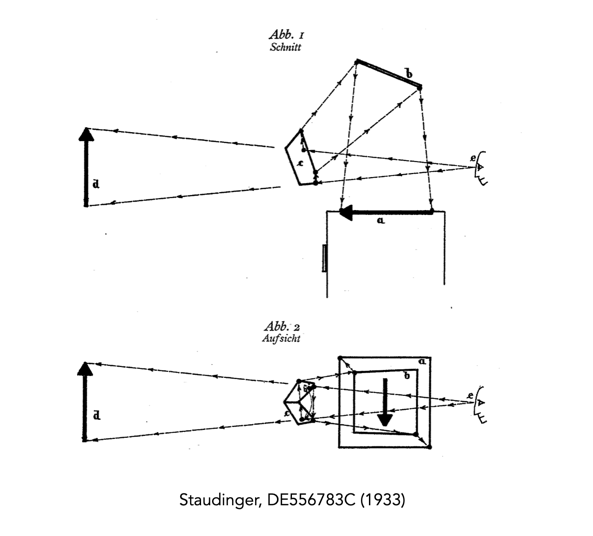
Fig.1: The concept of Kurt Staudinger

From about 1937 Zeiss Ikon began work on a 35mm reflex camera with a pentaprism eye-level viewfinder in the Camera Development Department. The camera was named the Syntax, and on September 2, 1940 Zeiss Ikon applied for a utility patent in Germany. Research has failed to find the German patent, but two patents associated with the camera were filed in France: FR884054 (sub. August 9, 1941) “Photographic apparatus constructed in particular in the form of a monocular mirror reflex camera”, and FR875596 (sub. August 9, 1941) “Mirror camera with photoelectric exposure meter forming part of the camera”. Both applications cite the filing of associated German utility patents on August 23, 1940. There is another Swiss patent submitted by Zeiss Ikon on 18 January 1943 (CH241034) – “Spiegelprisma mit konstanter Ablenkung” or “Mirror prism with constant deflection”. This gives further credence to the fact that Zeiss Ikon was working on a pentaprism for a camera.
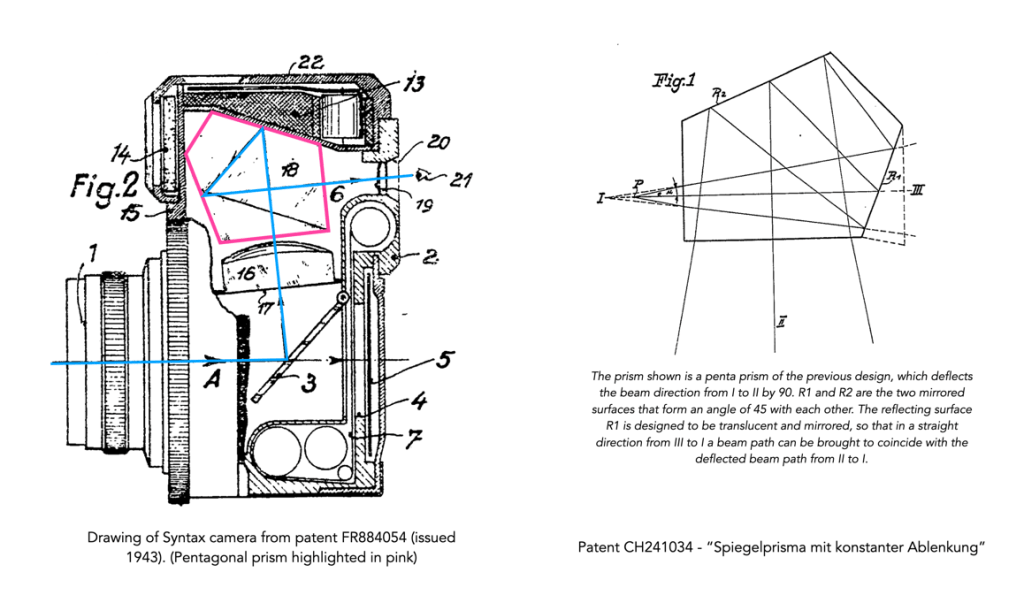
Fig.2: Drawing of Zeiss’s Syntax camera from the French patent and a drawing of a “spiegelprisma” from the Swiss patent.

Work was slow, but it has been suggested that there was a working model by 1944, supposedly a Contax II body with its metal vertical focal-plane shutter, however having its view/rangefinder replaced by a reflex mirror, delivering an upright and right-way-round image via a roof pentaprism to the eyepiece [1]. However the viewfinder image was too dark, and required f/2 and faster lenses. A diagram of the Syntax from the French patent is shown in Figure 2. According to Siegfried Böhm, design engineer with Zeiss Ikon, there were a series of issues with the Syntax [1]. The camera was complex, and would have required 750 parts to produce, in part due to the vertical shutter, and external bayonet lens mount of the Contax II. Böhm was working on the design for a horizontal focal-plane shutter, however on February 13, 1945, everything related to the project was destroyed by Allied air raids.
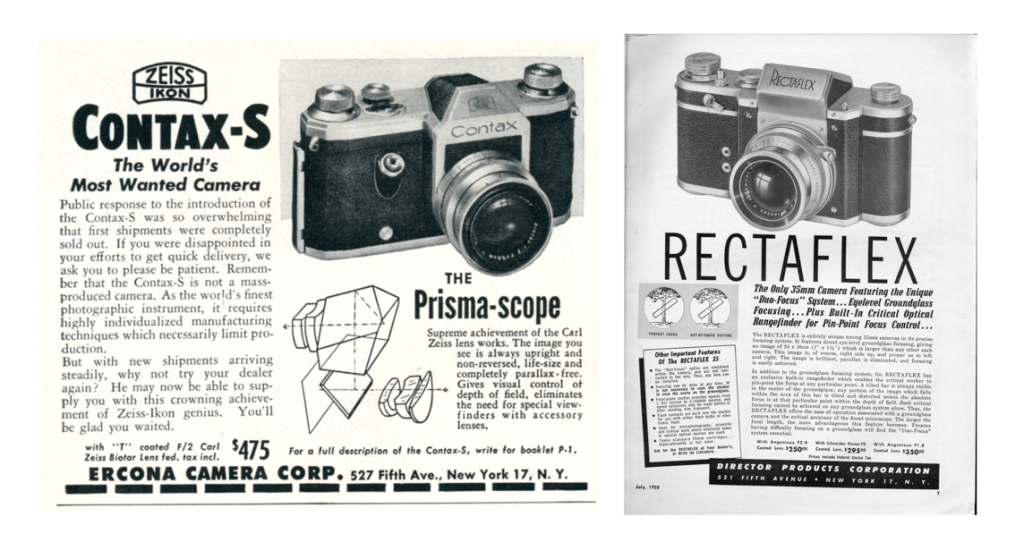
Fig.3: Advertisements for the first two pentaprism cameras

The first SLR manufactured with a pentaprism was the Rectaflex. It was the brainchild of Italian lawyer and camera enthusiast Telemaco Corsi (1899-1974), and was the only Italian SLR ever produced. Work began in 1946, and a prototype was shown at the Milan Fair in 1947 (this model used a flat pentaprism instead of a roof-pentaprism). This system seems to be described in a Swiss patent issued in 1949 (CH264025 based on an Italian patent filed in 1947). At the same fair a year later, a working prototype called the Standard 947 was introduced, with the production model A.1000 for sale in September 1948. Only 1150-odd copies were produced, with Rectaflex introducing the B.2000 in April of 1949, and the B.3000 in September. A patent for this pentaprism system is also described in a Swiss patent issued 1954 (CH298155, filed Jul.5/1951) – “Complementary sighting device in a photographic camera equipped with a reflector mirror viewfinder.”, and a West German patent (DE938764) filed the same month.
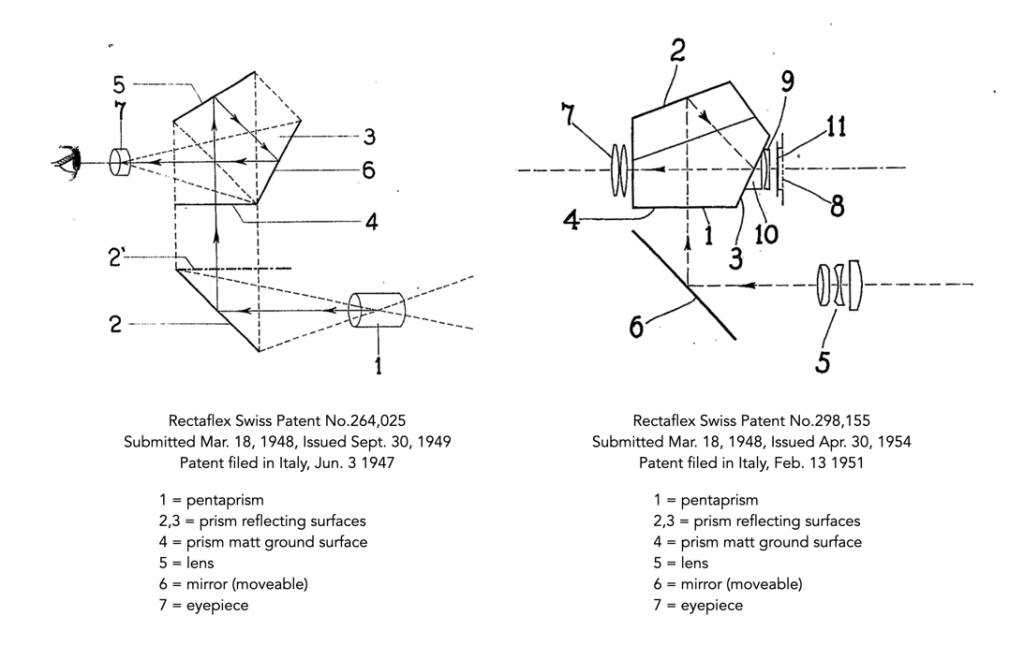
Fig.4: The Rectaflex pentaprism patents

The Wrayflex was England’s only attempt at developing a 35mm SLR. On Sept. 2, 1952 Wray (Cameras) Limited received a patent for “Reflex Camera with Curtain Shutter” (US2,608.921, filed on 21 May 1948). It matched a UK patent applied for on May 21, 1947 (GB2608921X), describing an SLR which contains a “pentagonal prism”, which appeared at the bottom of the camera, basically upside-down. However this “prototype” never seems to have been put into production.

Fig.5: The patent for the Wray Optical

Instead the Wrayflex production model used a mirror which folds backwards and upwards when the shutter is released. This means there was no space for installing a roof prism – instead the Wrayflex used two mirrors, arranged so as to reflect the ground-glass image twice – this arrangement provides an image which is laterally reversed, but the right way up. The two mirrors must be accurately positioned so that there is no possibility of misalignment. The Wrayflex I and Ia both used mirrors, it wasn’t until the Wrayflex II in 1959 that a pentaprism was incorporated. In addition to the Wrayflex, there is also a patents by Belgian Jean de Wouters d’Oplinter (1905-1973), applied for in Belgium on February 11, and May 29, 1941. The French version of the patent, “Improvements to photographic cameras and similar devices”, was issued on November 10, 1942 (FR879245), however this camera was never produced.
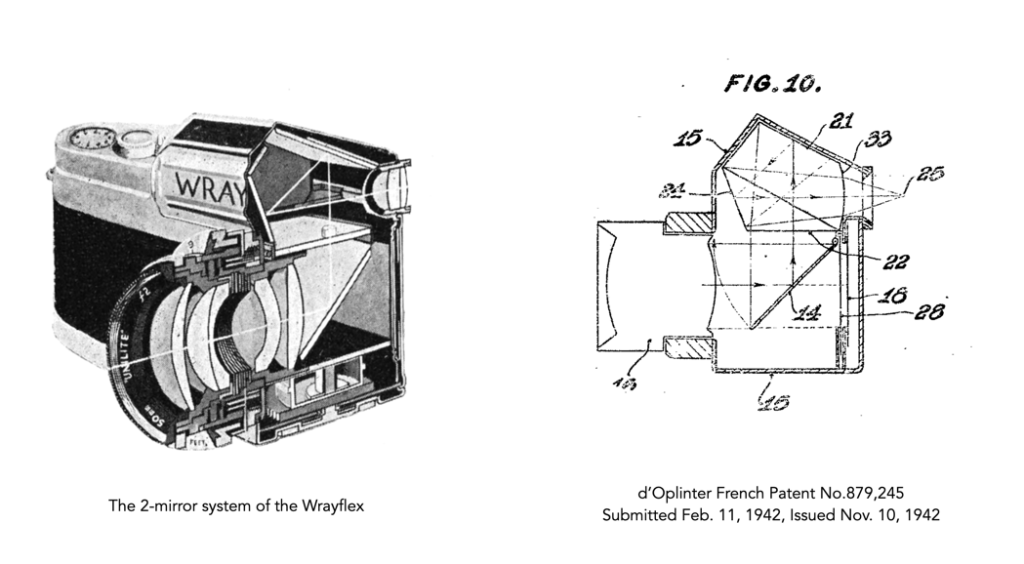
Fig.5: The mirror system of the Wrayflex and the patent for the d’Oplinter camera

In September 1949, Rectaflex was to received some competition in the form of the Contax S from VEB Zeiss Ikon. The development of the Contax S (also known as the Spiegel-Contax) basically involved recycling the wartime Syntax project. The camera was introduced in 1949. The prism on the Contax S was built into the camera body. The view was life-sized, a result of three factors: the focal length of the lens, the prism itself, and the small magnifying eyepiece behind the prism. Many early prisms were bright in the centre, but susceptible to fall-off in the corners. Later SLRs used systems to overcome this problem – e.g. condensing lenses underneath the ground glass, a flat fresnel lens which spreads out the light, and increases brightness in the corners. While there were a number of patents filed for this camera, most had to do with the shutter mechanism, and shutter release [2]. There don’t seem to be any patents that relate specifically to the pentaprism mechanism (there are war-era patents but that’s another story). Zeiss Ikon certainly marketed their camera in the light that this was the most significant advance since the SLR itself.

Here is the camera being hailed as the most significant advance in camera design since the first miniature itself. The twin-image, coupled range-finder has given way to a single viewer, the Prisma-Scope which enables you to sight directly through the camera lens. You see a life-size image, always upright and non-reversed, that spins into sharp focus with a twist of the lens barrel. For the first time in a single lens reflex, all focusing and viewing takes place at direct eye level. Without sacrificing the compact qualities of the miniature, the nuisance of parallax is forever eliminated … accessory lenses require no coupling with special and costly range-finders … close-up photography requires only the addition of extension tubes. Here is the most versatile camera ever created!

The third pentaprism 35mm SLR was by Swiss company ALPA. However they went in another direction, choosing a prism derived from an Abbe prism, the Kern prism. The main difference between this and a pentaprism prism is the fact that the latter provides a 90° image, while the former is only 45°. So the early ALPA-Prisma Reflex cameras (introduced in 1949) offered an oblique view, not a perpendicular view. This feature continued until the Model 6c of 1960.

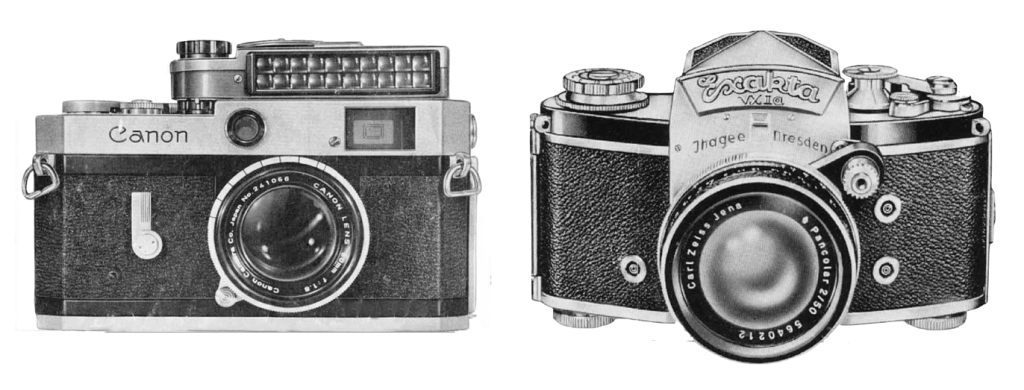
What about the Ihagee Exakta? Well the company that basically created the 35mm SLR was slower to adopt the pentaprism. It was not until 1949 that they incorporated the use of an auxiliary prism, the “Prismenaufsatz”, which provided a corrected right to left image (however it did make the camera top-heavy). Finally in 1950 Ihagee, introduced the Exakta Varex. As ALPA’s system did not produce an eye-level image, this really makes the Varex the third camera with an eye-level pentaprism. It was also the first SLR with an interchangeable viewfinder, as the waist-level viewfinder was still the most common of the period. The first Japanese pentaprism SLR did not appear until the Miranda T in 1955, followed by the Asahi Pentax, Minolta SR-2, Zunow, Nikon F and the Yashica Pentamatic.

So who was first? From a practical viewpoint of a manufactured camera, it was the Rectaflex. But I guess it depends on how you interpret history.

Notes:

  • The Gamma Duflex, designed by Hungarian Jenő Dulovits, was being sold by 1948, however despite some reports, it did not have a pentaprism. The patent for the optical viewfinder system incorporated a Porro-prism, but due to financial constraints only a Porro-mirror was implemented. It was however the first eye-level SLR, and had the first instant-return mirror. A design apparently existed for a ‘Duflex System Reflex S’ which did have a roof pentaprism, but it was never put into production.

Further reading

  1. Schulz, A., “From Syntax to Praktina”, Zeiss Historica, 30(1) pp.7-16 (2008)
  2. Contax S und Pentacon – History, patents, and design issues with the Spiegel-Contax

What camera is used on Sister Boniface Mysteries?

In the first episode of Sister Boniface Mysteries (BritBox), we are introduced to Sister Boniface, a Catholic nun with a PhD in forensic science. Now part of her job as police scientific adviser involves taking photographs, obviously given the time period in the early 1960s, she uses a 35mm SLR camera – but what camera?

The camera is introduced in the first episode, “Unnatural Causes”.

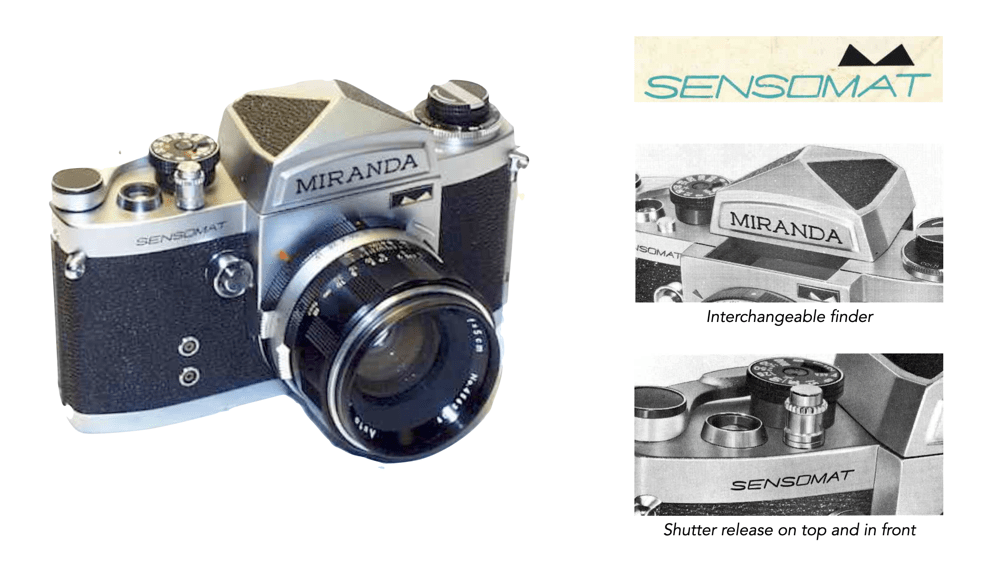
Well, it isn’t actually too hard to figure out the camera, despite the fact that the branding has been covered by black tape – the camera is from Japanese company Miranda, founded in 1947 and produced 35mm cameras from 1953 to 1976 (it was named Miranda Camera in 1957). During that period they introduced some 30 differing models nearly all with interchangeable pentaprism’s. The camera itself is a Miranda Sensomat, introduced in 1969. It was a budget camera, which had TTL CdS stop-down meter built-in the under mirror. The Sensomat range was produced from 1969-1974. The lens is likely the Auto-Miranda 50mm f/1.8, and the camera sold in 1969 for US$190 – it was advertised as being affordable.

The Miranda Sensomat

The interesting thing about the use of this camera is that the series is set in the early 1960s, and the camera was released in 1969, so there is some historical disparity. If one were choosing a Miranda camera of the period, a Miranda D might have been more appropriate. As to why the Miranda was chosen? Likely it was just a prop, it’s doubtful anyone thought about using a more historically significant camera for the period. Why cover up the brand? Likely due to not having to pay licensing fees, although it is unclear as to who currently owns the Miranda trademark.

Further reading:

Should you fix your own film camera?

Certain vintage cameras can be expensive, but there are sometimes opportunities to buy these cameras in a malfunctioning or “non-working” form for a reasonable price. A good store will tell you what is wrong with the camera, but the problem is that there aren’t exactly a lot of places where you can get film cameras fixed, and of those, they are often focused on a particular brand of camera. Fixes that involve digging into the guts of a camera are inherently marred with problems. A while back I bought an Exakta TL VX1000 camera, because it was cheap, but mostly for the lens. When it arrived it seemed to work, except the film-transport lever had been snapped in half. So I bought a replacement lever, and thought it would be a simple process to fix it. It wasn’t and although I replaced the lever, something else broke (a spring). I should have had a better understanding of the inner workings of Exakta cameras.

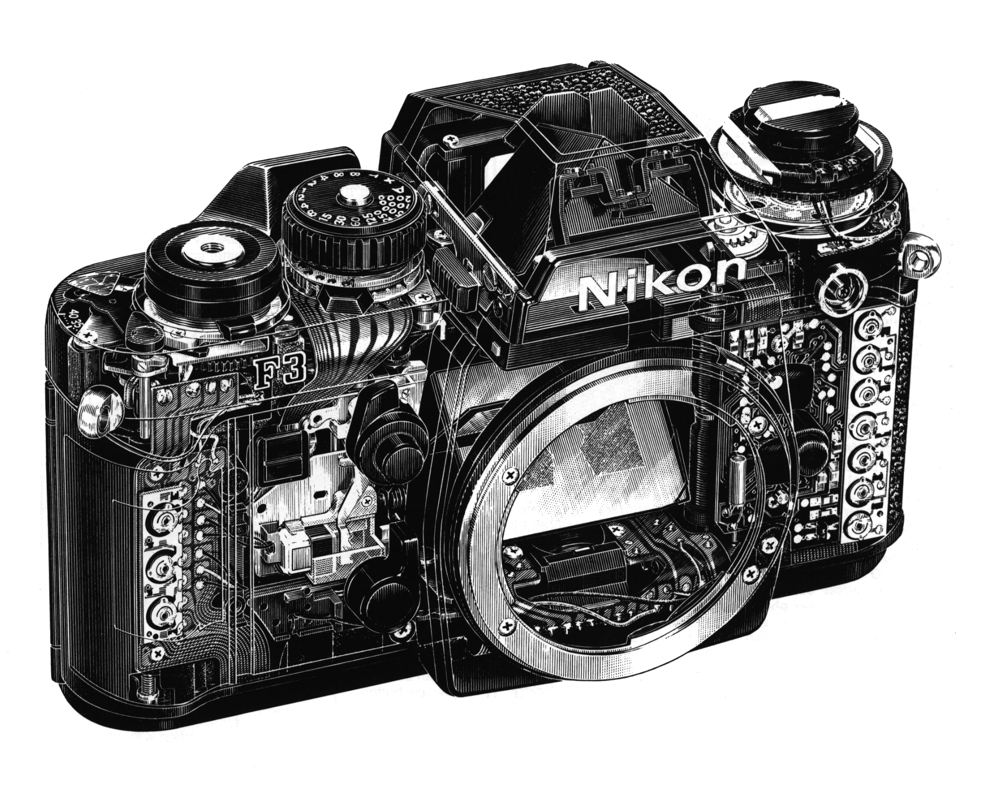
The Nikon F, a fully mechanical camera (and Nikon’s first SLR) has 918 mechanical pieces.

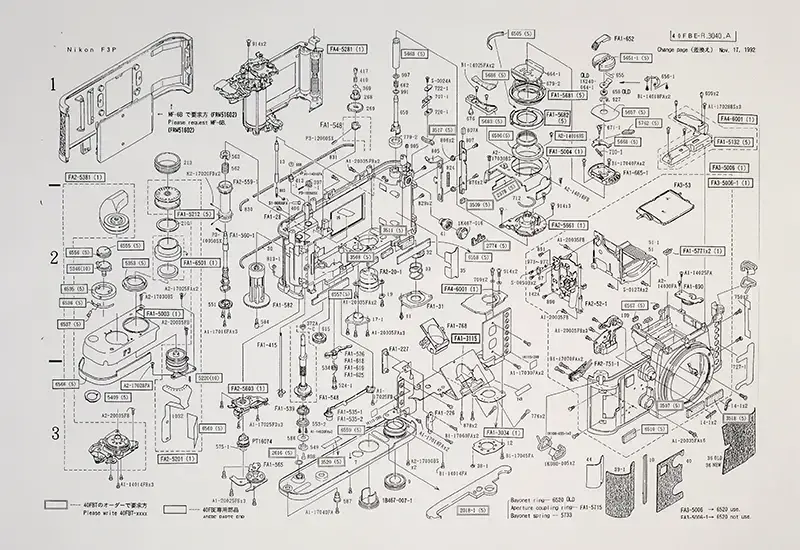
In reality, very few cameras are easy to fix. Fully mechanical cameras are filled with parts, and cameras with electronics are even trickier – i.e. it may be possible to source a donor part, or even 3D print a part, but recreating 50 year-old electronics is another thing altogether. You need the appropriate tools, and access to parts and assembly diagrams, e.g. the Nikon F3-P parts diagram posted on Japan Camera Hunter. The easiest repairs are obviously cosmetic issues – replacement of leatherette, battery covers, etc. or replacing light seals. There is also the issue of cost – fixing a vintage camera can often become expensive, especially as parts often have to be salvaged from a “donor” camera. Even the simplest parts, like springs, can be challenging to find, considering they may be decades old (springs have to be the right size and have the right tension).

The Nikon F3, with semi-automatic exposure control, was not any less complex than film cameras.

If you are really interested in doing your own internal camera repairs, I suggest reading though the information below. For cameras that are rare, I would recommend having them fixed at an experienced repair facility. In Canada, probably one of the best known camera repair spots is Paramount Camera Repair, in Saskatoon. There is also Factory Cameras in Vancouver.

DIY Camera/Lens Fixing Resources:

What is a pentaprism?

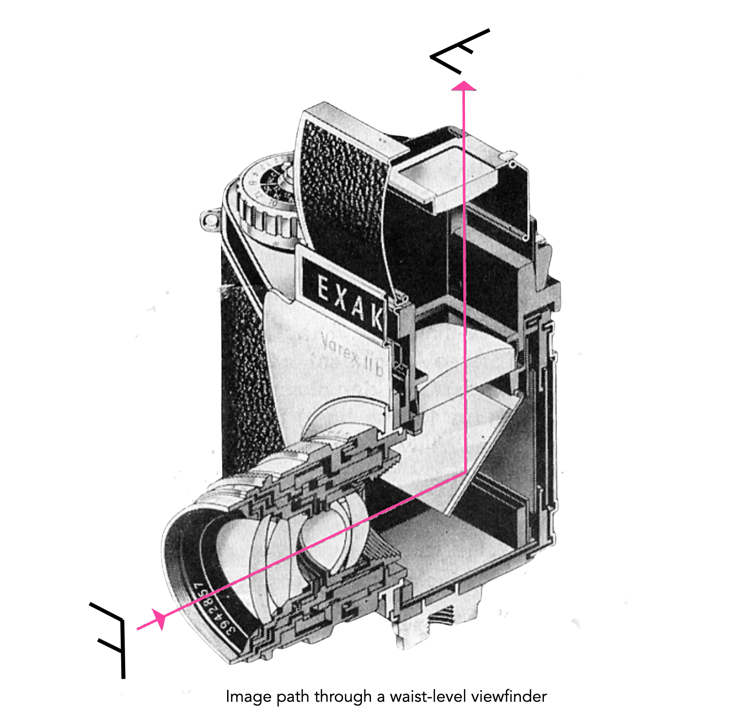
The first 35mm SLR camera, the Ihagee Kine Exakta, used a horizontal waist-level viewfinder. This was not unusual for the period, as there was no other means to view a picture through the camera at an eye-level (that wasn’t a rangefinder camera). The problem is that the image viewed would be flipped left-to-right. This would be rectified by the introduction of the first production pentaprism camera in 1947, in the guise of the Italian Rectaflex. The technology became more mainstream with the introduction of the Zeiss Ikon Contax S in 1949 (although waist-level viewfinders would still be dominant until the mid-1950s).

Fig.1: Early SLRs did not have a pentaprism, but instead required the photographer to look through a waist-level viewfinder

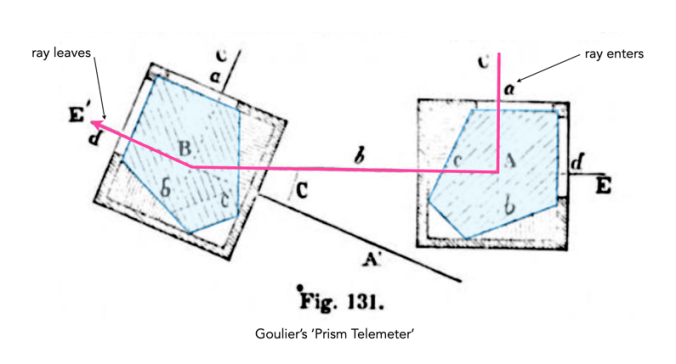
A pentaprism or pentagonal prism is a five-sided glass prism (although technically while the cross-section of a pentaprism is bound by five sides, it actually has seven or eight). Prisms were already being using in the Victorian era to design telescopes and binoculars. The use of a pentaprism in optics stems from an invention by a Captain Charles-Moÿse Goulier (1818–1891) of the French engineer corps in 1864, a “triangulation prism telemeter” [1]. It was a device with twin sighting paddles, connected by wire 40 meters long to establish a fixed baseline. Each paddle contains a five sided prism to give simultaneous orthogonal views. It may have been the first use of pentagonal prism in optics.

Fig.2: The pentaprisms used in Goulier’s 1964 invention (adapted from [1]).

This form of conventional pentaprism, sometimes referred to as a flat-roof or Goulier prism, is characterized by a 90° deviation angle (Fig.3(1)), i.e. it deviates a beam of light by 90°, reflecting the beam inside the prism twice. It is comprised of two reflective faces (Fig.3(1)b,c), arranged at 45° between them and two faces orthogonal to each other (Fig.3(1)a,d). The two surfaces performing the reflections are coated to provide mirror surfaces (e.g. silvered). The two opposite transmitting faces are often coated with an anti-reflective coating. In imaging applications this pentaprism will neither invert nor reverse an image, e.g. Fig.3(1). In the context of an SLR this still holds true, because the image is flipped as it passes through the lens and it is this flipped image that passes through the prism. So in the context of the ‘flippedi image, it is neither inverted or reversed. However, compared to the original object in front of the lens, the image viewed at the eyepiece is reversed left-to-right. Prior to the end of WW2, conventional pentaprisms were commonly used in telescopes, binoculars, and military equipment such as rangefinders.

This is illustrated in Fig.3(3) where the object F passes through the optical system of an SLR. The F is flipped by the lens and this flipped version of the F passes through the prism. The image viewed at the eyepiece is neither inverted nor reversed from that projected on the mirror. However compared to the original F, the image is reversed left to right.

Fig.3: The flat-roofed (conventional) pentaprism: (1) a simple optical path, (2) a breakdown of the angles, and (3) used in the context of an SLR optical system.

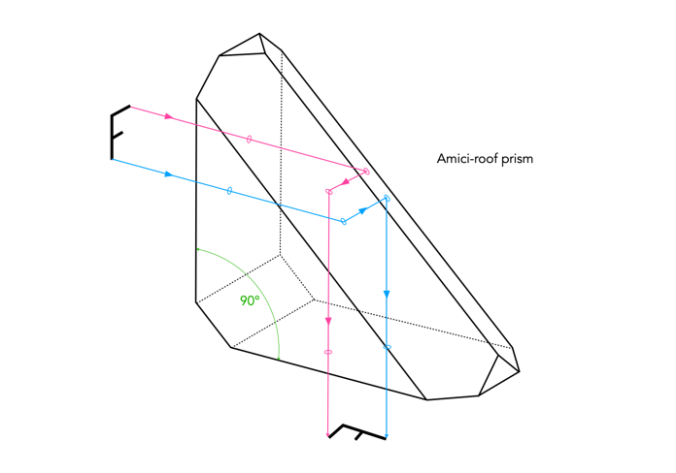
The more complex pentaprism found in the majority of SLR cameras is the roof pentaprism which reverses an image from left-to-right. It is similar to a conventional prism, but with the addition of two silvered “roof” surfaces. The concept of a roof prism was created by Italian astronomer Giovanni Battista Amici (1786-1863) in the mid-1800s. His Amici-roof prism, also known as a right-angle roof prism, was capable of reverting and inverting the image of an object while bending the line of sight through a 90° angle (Figure 4). It was used in various types of telescopes.

Fig.4: The Amici-roof prism.

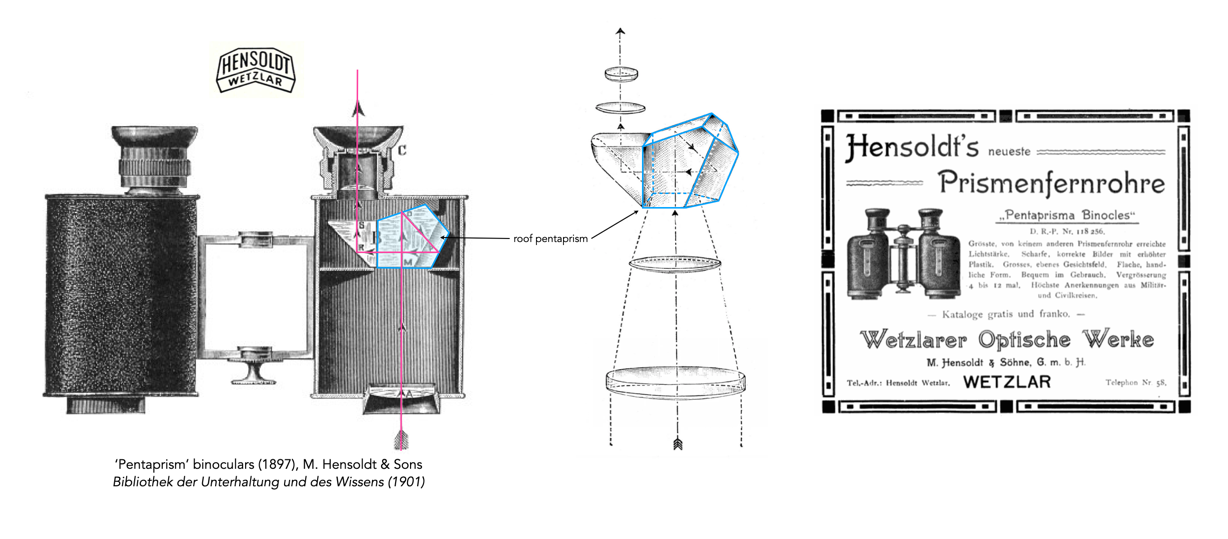
A roof prism is a prism containing a section where two faces meet at a 90° angle, resembling the roof of a building. Reflection from the two 90° faces returns an image that is flipped laterally across the axis where the faces meet. The first large scale use of a roof pentaprism may have been in binoculars, like the Pentaprisma Binocle 7×24 made by Hensoldt & Söhne (Wetzlar) introduced in 1900. An earlier version of the binoculars (1897) used a flat pentaprism attached to a right-angle prism with a roof (like an Amici-roof prism). This arrangement was denied a patent in Germany, due to a conflict with a Zeiss patent (DE77086, which used a Porro-prism), however was granted a patent in Great Britain (GB15806, 1898). The newer version of 1900 had a dialytic (split) optical system where the pentaprism had a roof edge (Figure 5).

Fig.5: Hensoldt & Söhne’s ‘Pentaprism binoculars’ (1900)

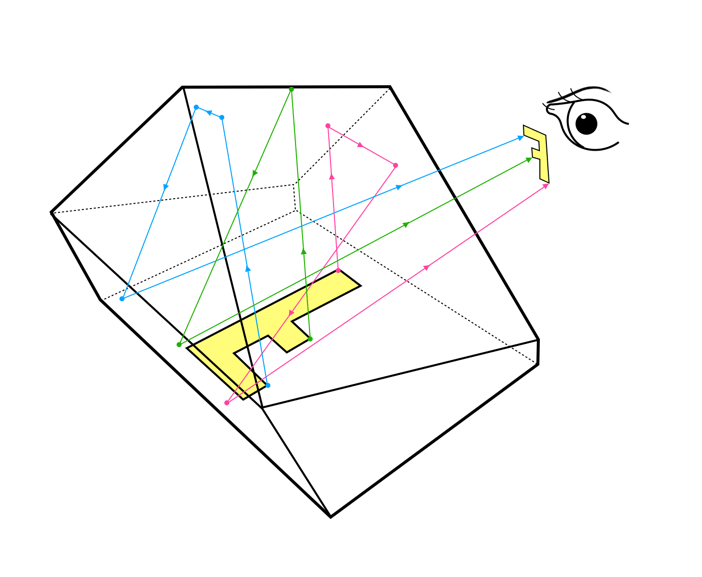
In an eye-level SLR, the roof pentaprism is inserted between the focusing screen and the viewing eyepiece. The roof pentaprism, by introducing extra reflecting surfaces, shows the object both upright and with the right and left sides in their proper place. The bottom surface of the pentaprism may form the focusing screen, or the latter may be positioned directly below the prism. The focusing screen may be of several different kinds, including plain ground glass, to various combinations of clear glass, ground glass, or micro-prism focus finder.

Fig.6: An example of light passing through a roof-pentaprism

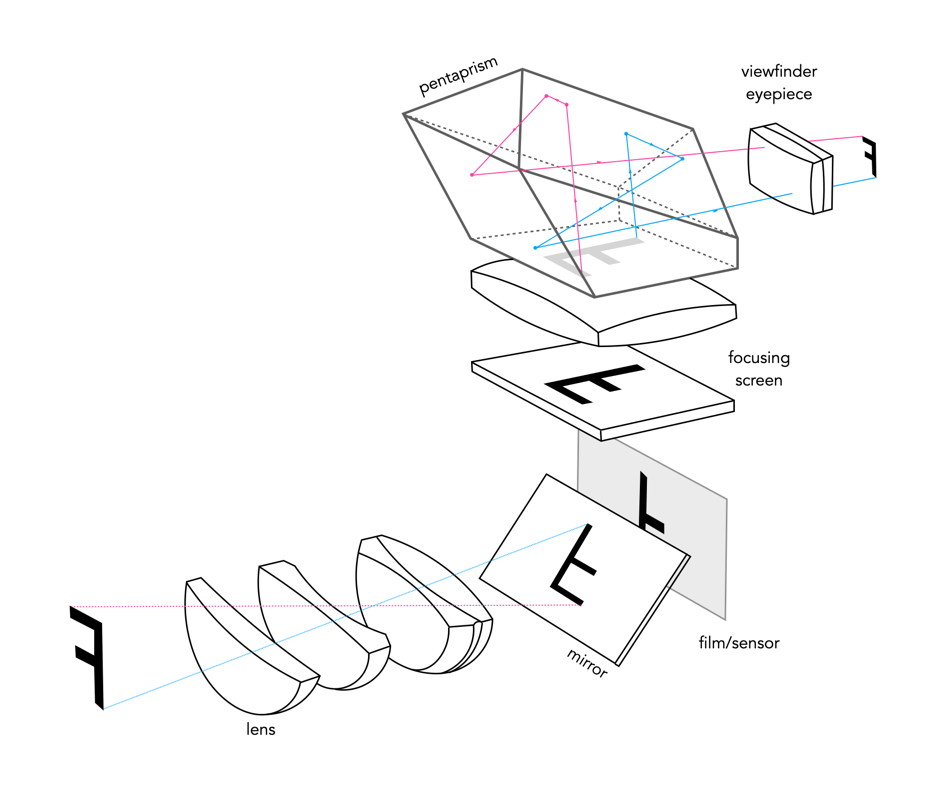
The light passing through a roof-pentaprism undergoes three separate reflections in order that the image is seen both right way up and right way round. The image enters the prism right way up, but laterally reversed, so that as the image must be turned again through 90° to allow it to be viewed at eye level, it must be reflected twice to keep it right way up. The third reflection has no effect on the vertical aspect of the image but it merely used to reverse the image laterally so that it is seen right way round.

Fig.7: Image passage through an SLR camera using a roof-pentaprism

The basic history of the pentaprism as it relates to the SLR can be found in a separate post. But a summary is provided below. A timeline of early SLR pentaprisms:

  • 1933 − Kurt Staudinger issued a patent for a reflex device, i.e. a penta-mirror
  • 1937 − Zeiss Ikon (Germany) begins work on the Syntax, a camera with a pentaprism. Patents exist for the concept, but the prototypes, ca. 1944 were destroyed during the war.
  • 1948 (Sept) − First commercially produced SLR with a roofed pentaprism, the Rectaflex (Italy). An earlier 1947 prototype used a flat pentaprism.
  • 1949 (Sept) − Zeiss Ikon (GDR) introduces the Contax S, the second SLR with a pentaprism, essentially recycling the Syntax.
  • 1949 − ALPA introduces the ALPA Prisma Reflex, a pentaprism with a 45° view. ALPA would not introduce a normal perpendicular view until the Model 6c (1960).
  • 1952 (Sept) − Wrayflex receive a patent for an SLR with a “pentagonal prism” which was never produced. The first Wrayflex with a pentaprism was the Wrayflex II (1959).
  • 1955 − The first Japanese SLR with a pentaprism, the Miranda T.

Note that a pentaprism is different to a penta-mirror, which instead of a glass prism uses three mirrors to perform the same task. Using a glass prism has definite benefits over mirrors. Changes in light direction in a prism is based on the notion of total reflection, which means reflectances of close to 100% can be achieved, while silver mirrors lose at least 10% to absorption losses. A glass prism is also better because the refractive index of glass causes a shortening of the light path.

Notes:

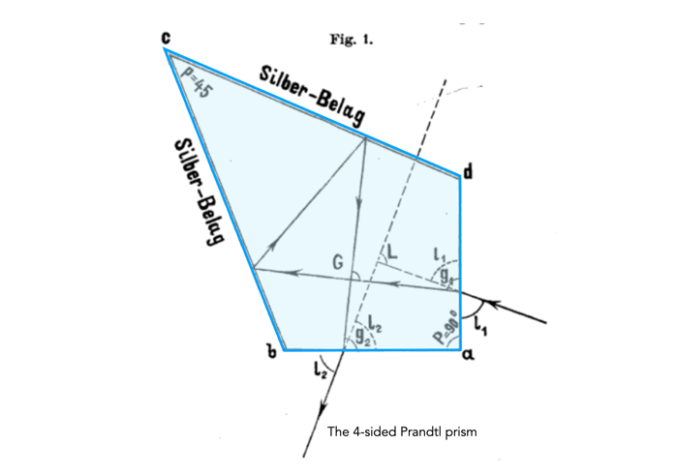
  • Goulier’s prism is sometimes known as the Prandl prism (or even the Goulier-Prandl prism), and is often cited as such, particularly in German literature. Now a cursory search will find very little, but digging a little deeper finds a paper published in the German journal Zeitschrift für Vermessungswesen (Journal of Surveying) in 1890, by an Alexander Prandtl [2]. Prandtl (1840-1896) was a professor at the Royal Bavarian Central Agricultural School in Weihenstephan specializing in dairy farming. But the paper describes a 4-sided prism, similar to Goulier’s prism except the extra side between the two surfaces meeting at 45° is missing. The other issue is the fact that Goulier’s prism was described 26 years previously. Prandtl’s real claim to fame was developing the first continuously operating milk centrifuge.
  • Hensoldt & Söhne created their first product, a rangefinder using a roof prism in 1892. The company would go on to develop the Hensoldt roof prism (DE180644, 1905) which required no mirroring, and had no axis offset, allowing for straight binoculars. In 1938 the Carl Zeiss Foundation would take a majority share in Hensoldt. It is entirely possible that this mechanism formed the basis of the work done on the Zeiss Syntax SLR in the late 1930s and early 1940s.
Fig.8: A depiction of the Prandtl prism (adapted from [2]).

Further reading:

  1. Barnard, F.A.P/, “Prism Telemeter”, Report on Machinery and Processes of The Industrial Arts and Apparatus of the Exact Science, p.589-592 (1869)
  2. Prandtl, A., “Ein neues Instrument zum Abstecken von rechten Winkeln” (A new instrument for marking out right angles), Zeitschrift für Vermessungswesen, 19, pp.462-467 (1890)

Updated: November 27, 2025.

Rangefinder or reflex?

35mm photography evolved in rangefinder cameras. In the early pre-prism days, photographers using “minicams” had a simple choice of Leica, or Contax. Post WW2, other Leica “knock-offs” would appear, mostly from Japan, but also from countries like Italy, and the USSR. So why did rangefinders languish? To answer that we will look back at two 1956 articles in Popular Photography under the banner: “Which 35 – Reflex or Rangefinder?” [1,2].

Rangefinder versus reflex?

Bob Schwalberg, an advocate for rangefinder cameras, described two of their limitations [1]: long and short views. Rangefinder couplings it seemed had a limitation of 135mm focal length for the purposes of long views, and a limit of 3½ feet in close-up (without accessories like a mirror reflex housing). In fact Schwalberg even commented that “Rangefinders just aren’t worth a speck of dust on your negative for focusing lenses longer than 135mm”. After this he focused on their strengths:

  • Speed in focusing – “With a rangefinder camera you move straight into focus instead of having to twist the lens back and forth several times…”.
  • Ease of focusing – Rangefinder cameras can be “focused under light levels so dim as to make photography unfeasible.”
  • Accuracy of focusing – “Rangefinder focusing is inherently more accurate than ground-glass focusing because the rangefinder mechanism can distinguish much more critically than the human eye.”
  • Time lag #1 (from focusing to stop down) – does not apply because the rangefinder is stopped down before focusing begins.
  • Time lag #2 (from pressing the release button to exposing the film) – rangefinders don’t have mirrors which add 1/50 sec. Reflex cameras have mirror lag.

Schwalberg actually considered the mirror lag to be the single most serious disadvantage of the SLR in as much as “You never see the picture you make with a single-lens reflex until you, develop the film. It all happened why you weren’t looking.” (unfortunately this was before the returning mirror). He goes on to say that “The prism reflex is a useful tool which brings many advantages to a number of specific, and I think special, photographic applications.”

Barrett Gallagher meanwhile made the case for the single-lens reflex [2]. His choice of the SLR was because, in his words, “I couldn’t see clearly through the viewfinders on the rangefinder cameras.” Or in other words “… any separate rangefinder-viewfinder system requires you to shift your eye from one peephole to another at the crucial moment, and with a moving target, you’re dead.” Rangefinder accuracy also falls off with long telephoto lenses, requiring of all things the addition of a clumsy reflex housing.

  • Close-up – it is possible to focus down to 3.5” with no parallax problems. Reflex cameras focus down to 2.5 feet, versus 3.5 feet for rangefinders.
  • Ease of focusing – rangefinders are easier to focus, however in dim light the reflex lens can open wide enough to allow focusing.
  • DOF – the SLR allows the photographer to see the DOF a lens offers at different f-stops.
  • Viewfinders – SLR’s have one viewfinder for all lenses. Rangefinders require supplementary rangefinders for lenses outside 50mm.

Gallagher summed up by saying that “The single-lens reflex is the versatile camera with no parallax, no viewfinders, no mechanical rangefinder limits. It lets you see full size with any lens exactly what you get – including actual depth of field.”

Further reading:

  1. Bob Schwalberg, “Which 35 – Reflex or Rangefinder? – The coupled rangefinder is for me”, Popular Photography, 39(2), pp. 38,108,110 (1956)
  2. Barrett Gallagher, “Which 35 – Reflex or Rangefinder? – I like a single-lens reflex best”, Popular Photography, 39(2), pp. 39,112 (1956)

A new film camera – Is Ricoh bonkers?

If you haven’t heard the news, Ricoh is considering developing a series of new “Pentax” film cameras, by means of its “Film Camera Project“. Pentax of course has a long and proud history of film camera development, but hasn’t really made huge inroads into the digital world. It was bought by Ricoh in 2011, becoming Ricoh Imaging Company Ltd. Still, the most successful digital camera coming out of the combined company is the Ricoh GR series.The company apparently surveyed 3,000 people in Japan and concluded that 20% of camera owners also owned film cameras. So in all likelihood, I imagine developing a series of film cameras is not a bad idea.

The trick of course is what route do you take? Do you go for a fully manual camera with no electronics aboard, or do you go with the opposite end of the spectrum and go fully electronic? I mean if you are going to start somewhere, why not reproduce the famed Ricoh GR1? It was introduced in 1996, so there wouldn’t be a huge curve in getting it back into production – update the lens, and the inner workings a bit. A fixed lens is fine – keep it simple, and I imagine there would be a bunch of Ricoh GR digital users that would spring for a film version. Small and compact is ideal.

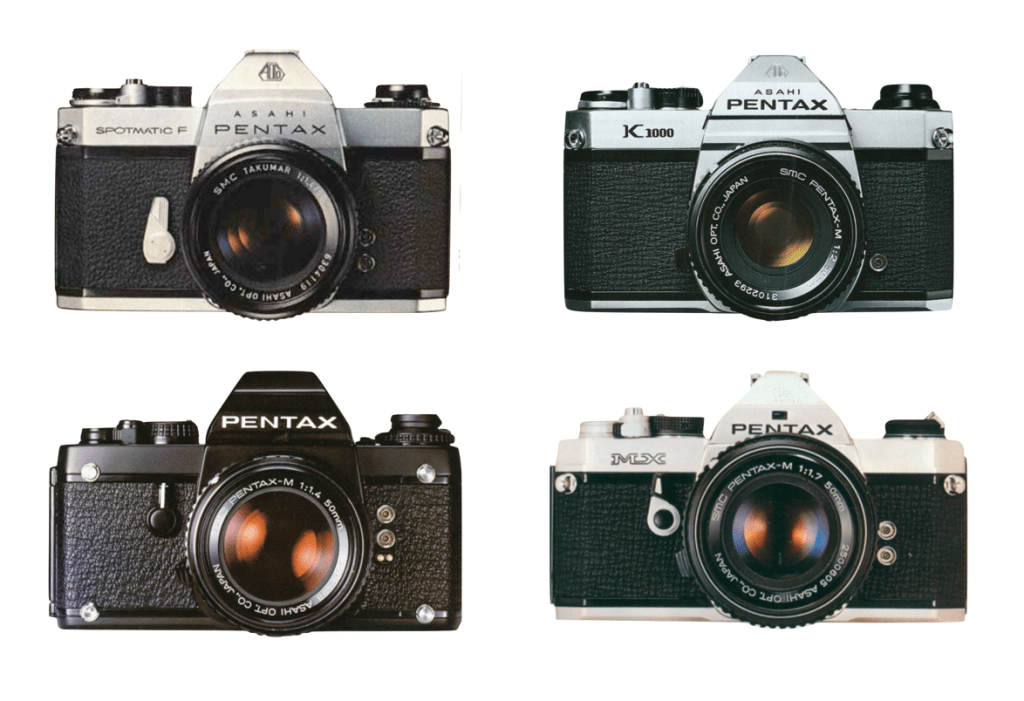
Or perhaps rejig a Pentax Espio? The reality is that it shouldn’t be too hard to “develop” new cameras. You don’t need to add anything “fancy”, i.e. digital. And picking the best camera to replicate is as easy as determining which vintage cameras sell the best. They could build one from scratch, but would this be worthwhile? Could they replicate some other camera? What about full-frame cameras? Do you go with a Spotmatic type camera for an entry level, fully-manual? Or perhaps the diminutively sized MX series? Do you offer a manual and semi-automatic camera? Then there are the lenses – do you allow the use of vintage M42 mount lenses, or do you conform to the K-mount? Making a film camera without taking into consideration the legacy lenses is problematic. Then of course there are the lenses themselves – new digital-like lenses, or re-manufactured manual legacy lenses.

Done properly these film cameras could be very successful. Poorly done, and it will be a disaster. The best way to test the market would be simply to reintroduce an existing design like the GR1. But Ricoh needs to look beyond the Japanese market, and explore the needs of film users worldwide. At the same time, introducing a film camera requires some level of sustainability. A camera low in electronics, would of course reduce a camera’s footprint, and perhaps using a rechargeable battery would help as well. Of course there is also the issue of processing films, which does have quite an impact on the environment. One interesting addition to a new camera might be to allow cameras to incorporate both full- and half-frame shots. Allowing a 36-exposure film to take 72 shots certainly reduces the amount of rolls required, as honestly no one should treat film in the same manner as digital, i.e. 1000 frames of film when travelling is not really that realistic.

Which Pentax?

Ultimately it’s a very intriguing idea. Will it work? Time will tell I guess. A successful film camera will have to be well-priced for the market – even though Ricoh doesn’t really have any competition to speak of, there are still a *lot* of reasonably priced vintage film cameras around the world. And I’m not talking about Leica film cameras. The remade Leica M6 is likely a wonderful rangefinder camera, but at US$5,295 it’s not exactly affordable. Ricoh has one chance to get this right, and deliver a series of film cameras worthy of its legacy.

So mechanical cameras were simple right?

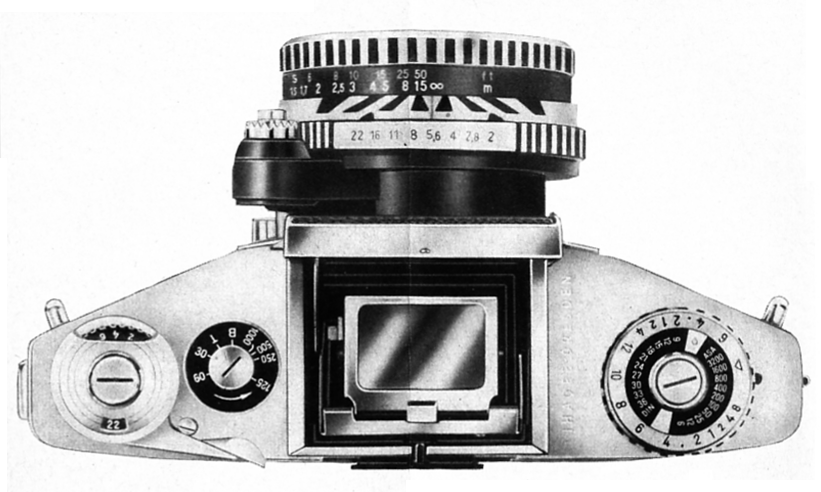
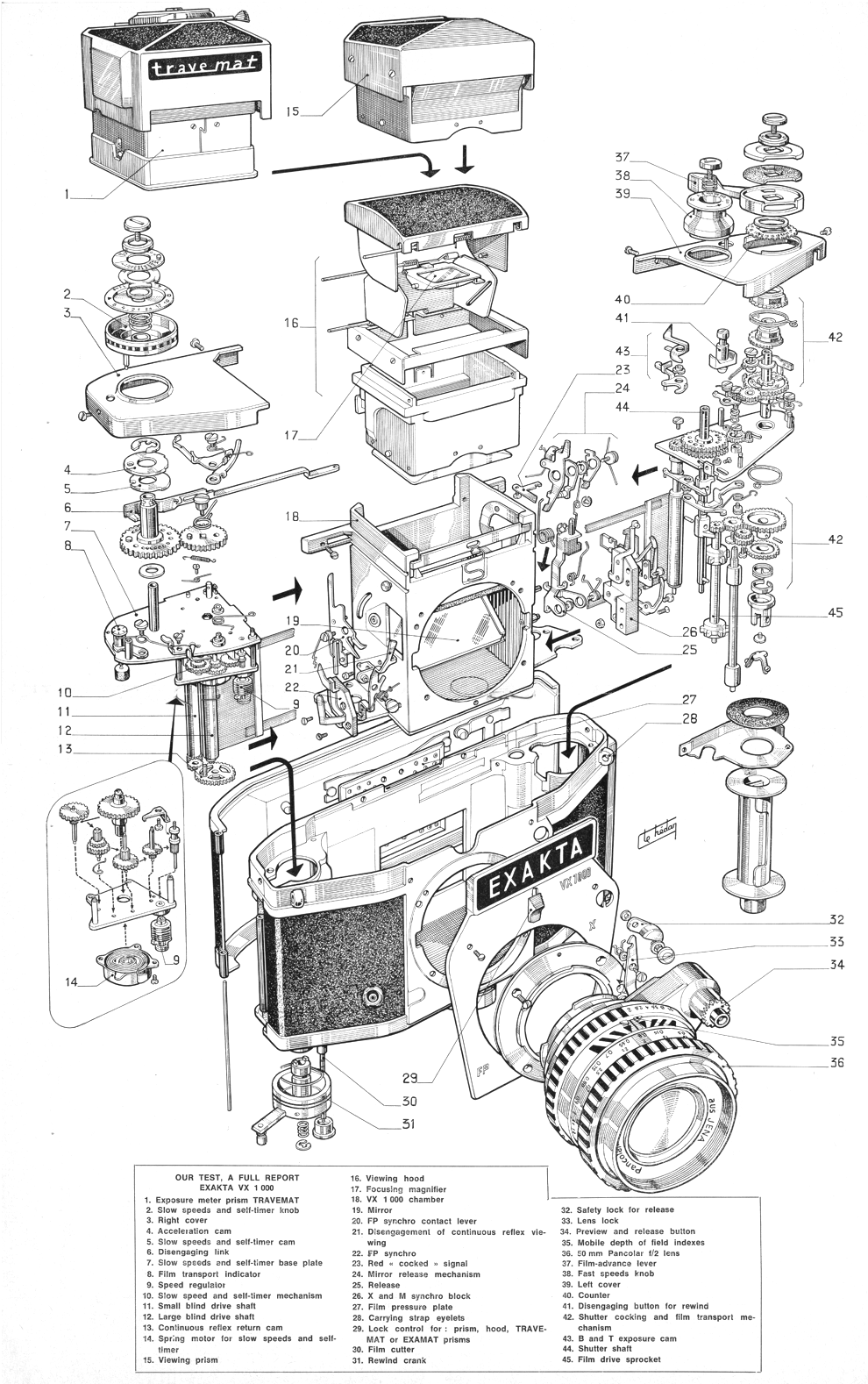
There were various types of analog cameras, but the simplest were mechanical cameras, that contained no electronics at all. That means everything that happened inside was mechanical in nature. Not that much really happened, I mean the mechanisms basically moved the film forward, set the film and shutter speeds, and set/activated the shutter mechanism (and move the mirror). But these mechanisms were inherently complex, and the cameras themselves were typically built by hand. A plan view of an Exakta VX1000 camera shows how simple it was…

… but the workings inside were another matter altogether – which was basically comprised of a whole lot of sprockets, rods, and some levers. Things got even more complicated once electronics were introduced.

Asahi and the Pentax name

If you do a search for “German Pentax” you will likely come across a reference to a German camera. Of course the name brand Pentax is most often associated with Japan’s Asahi Optical, but it wasn’t always the case. The name Pentax started life behind the Iron Curtain at VEB Zeiss Ikon Dresden. Zeiss Ikon was one of the photographic companies formed in East Germany after the division of Germany into East and West.

Zeiss Ikon Pentax

In 1954 Zeiss Ikon, based in Dresden, began work on a new 35mm camera. It was designed to use the new Zeiss 50mm f/2.8 lens, but was quite radical from a design perspective, looking more like a 120 film camera of the period. There only seem to be prototypes of this camera, and if you want to learn more you can check out the post on Marco Kroger’s website zeissikonveb.de. He says the first version of the camera was intended to be a 6×4.5 120-film camera, with the film loaded in removable cassettes. The page includes some interesting technical drawings of the camera.

But where did the name Pentax come from? Well due to the division of a number of German camera companies, there were some issues with product naming, mostly related to trademark infringement. As East German companies wanted to sell their products in the West, they often had to come up with new names. For example the name Contax was already being used by the West German Contax company. To circumvent this, East German companies often created portmanteau words by blending two words. For example, Pentacon was derived from “PENTAprism” and “CONtax”. Therefore it is thought that the registered trademark Pentax was derived from PENaprism ConTAX.

Because Zeiss Ikon had a name but no camera, it sold the name to Asahi in 1954 who attached it to their first Pentaprism SLR in 1957 – the Asahi Pentax.

The Leica changed photography

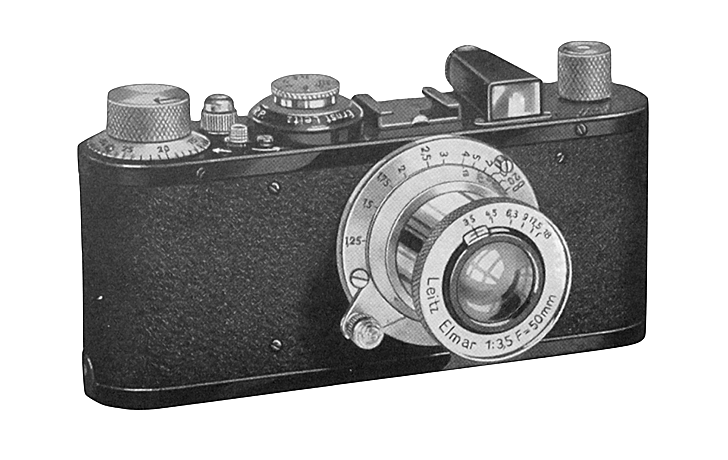
In the October 1936 issue of Fortune, there was an article on the “minicam boom”. It cited there being 100,000 miniature cameras in the US, comprised of more than 30 different makes.

Model E Leica, 1936

“Many a man who had owned a Kodak for years without feeling any impulse to see what he could do with it if he applied himself fancied that in the Leica he was finding a new invention that defied the laws of optics and would give him good pictures with no light to speak of and no effort save that of pressing the button. The Leica didn’t even look like a camera. No bellows, no bulk, no focusing hood; you shot from the hip, so to speak, and got your man.”

“Miniature Cameras”, Fortune, p.125 October 1936

Diamonds Are Forever – the Nikon F

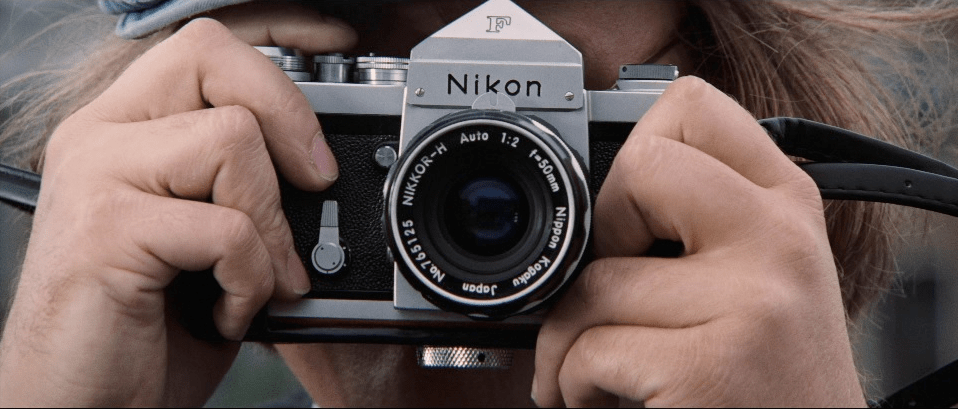
In 1971, two of the villains in the James Bond movie, Diamonds Are Forever used a Nikon F to take photos. The question is why the Nikon F? I mean it’s not like it was a new camera. First unveiled in 1959, it was no doubt an influential camera, but a decade later was it still cutting edge?

It was not the only time Nikon cameras were used in movies. The list is actually quite long, including the likes of The French Connection, Jaws, and Apocalypse Now (here’s another list of cameras in movies and TV shows). Nor was it the only camera used in Bond films – Bond used a Rolleiflex T in From Russia with Love (1963), a in Goldfinger (1964), a Nikonos Calypso in Thunderball (1965), and a Minox subminiature in On Her Majesty’s Secret Service (1969).

The Nikon F was at the forefront of SLR technology in the 1960s, and had a wide audience of users, from photojournalists covering the Vietnam War, to NASA. In March 1968 the Nikon F was laboratory tested by Popular Photography. Reviewers found little to complain about, it was an easy camera to function with, and extremely well built, except for the fact that it was heavy, “like a military tank of a camera”. It had a presence which was hard to dispute.

Choosing a camera for any movie may be a mere factor of chance. A personal preference of the director, or somebody facilitating props. Sometimes it’s product placement, although considering the Nikon F2 was released in the same year as the movie, it’s unlikely that is the case.

further reading: