Zeiss versus Zeiss : the trademark dispute

As cooperation deteriorated, and finally terminated in 1953, it was inevitable that eventually there were some issues with trademarks between the two Zeiss’s. I mean they were on different sides of the Iron Curtain. The East German Carl Zeiss company did not own all the rights to some of the names and brands. This would likely have been fine had they just been sold within the eastern-bloc countries, however many were made to be exported to the west (which is really somewhat ironic) – lenses were developed to sell in the West to produce hard currency. They achieved this at the beginning by resurrecting pre-war designs. Political influence over East Germany did not have any influence in how products were manufactured.
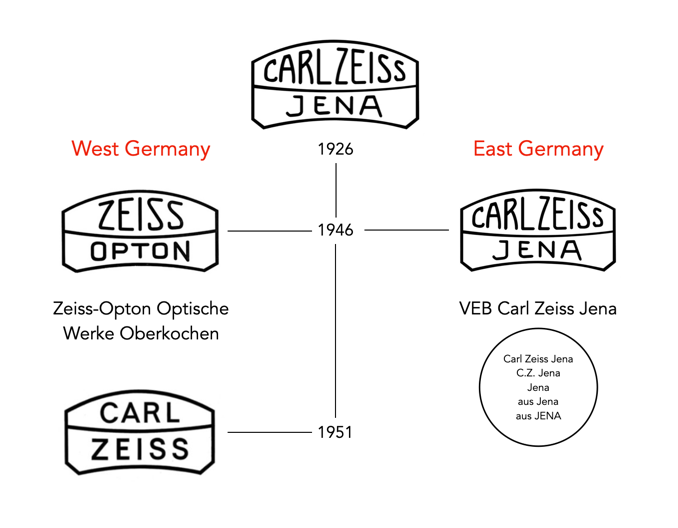
Zeiss vs. Zeiss branding over the years

In February 1954 Zeiss in Heidenheim fired the first shots in what would eventually become a worldwide litigation. They obtained an injunction in the District Court of Goettingen to prevent the continued sale of Jena-made, Zeiss-marked goods [1]. In April Zeiss Jena countered in West Germany by seeking an injunction and an order registering the Zeiss marks in West Germany in its name. That action was dismissed in 1960 when the West German Supreme Court ruled that there was no one in the Soviet Zone having capacity to represent the Zeiss Foundation.

In the same year Zeiss Heidenheim brought action against the Zeiss Jena to prevent them from using the Zeiss name and trademarks anywhere in the world. The Supreme Court of the Federal German Republic determined that the Heidenheim firm was entitled to exclusive use of the Zeiss name and trademarks in West Germany and West Berlin [1]. Interestingly, a CIA report from 1954 [2] suggests that should the naming issues take an “unfavourable” turn for VEB CZJ, then the plan was to change its name to VEB Ernst Abbe Werk (which they obviously never did).
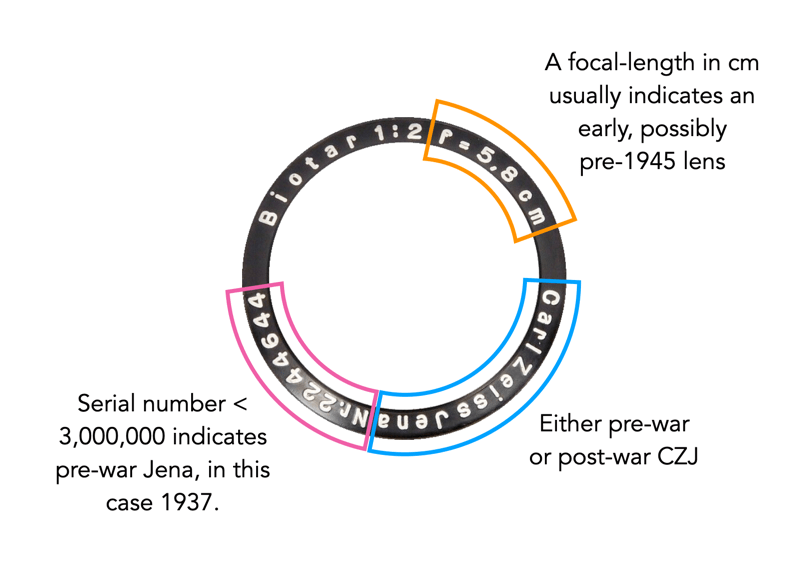
Information provided by lens markings

There was also a long court battle in the US over who owned the rights to the Zeiss name. The litigation commenced on February 14, 1962, filed by Carl Zeiss Foundation and Zeiss Ikon AG against VEB Carl Zeiss Jena and its US distributors [1] (Carl Zeiss Stiftung v. VEB Carl Zeiss Jena). The case went to discovery from 1963-1967 and finally to trial in November 1967. On November 7, 1968, the court found in favour of the plaintiffs, deciding that the US trademarks “Zeiss”, “Zeiss Ikon”, and “Carl Zeiss Jena”, were the property of the Zeiss firm located in West Germany. As to the legitimacy of this? The courts found that the original “Stiftung” ceased to exist in Jena when it had been stripped of its assets. The Stiftung’s domicile was then changed from Jena to Heidenheim. It was not until 1971 [3] that the US Supreme Court finally settled the case of Carl Zeiss vs. VEB Carl Zeiss Jena, after a long 9½ year battle for control of the “Zeiss” trademark, siding with Heidenheim.
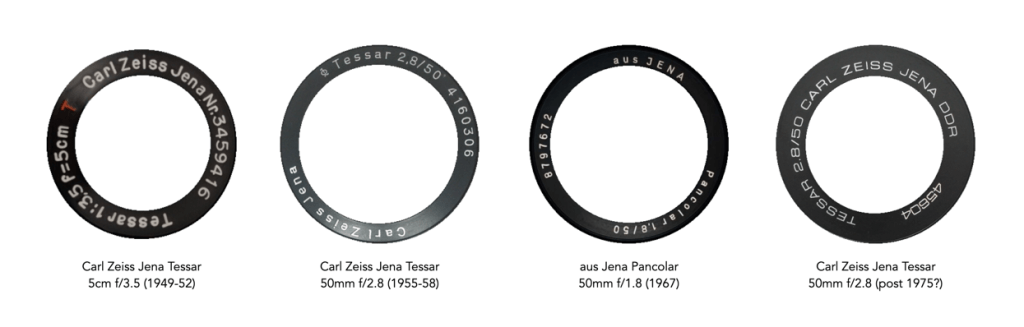
Examples of Carl Zeiss Jena lens markings over the years.

After this, Carl Zeiss marketed their lenses as “Carl Zeiss” exclusively in the United States, whereas Carl Zeiss Jena exported their lenses to the US with the marking “aus Jena”, or sometimes “JENOPTIK”, or even “JENOPTIK JENA”. The branding on these lenses was changed: “T” instead of Tessar, “B” for Biotar, “Bm” for Biometar, “S” for Sonnar, “F” for Flektogon, etc. in order not to infringe on the copyright. Therefore a lens might be labelled “Carl Zeiss Jena s”, or “aus Jena s”, and be exactly the same lens. It really depended on where the lenses were sold.

  • In the Eastern-bloc countries, CZJ could use the name “Carl Zeiss”. Carl Zeiss Oberkochen was not allowed to use “Zeiss” by itself, and instead used the name “Opton” or “Zeiss-Opton”.
  • In some western countries – namely West Germany, Italy, Greece, Holland, Belgium, Luxembourg, and Austria – CZO was allowed to use the name “Carl Zeiss”. CZJ chose to use the name “aus Jena” in the case of lenses.
  • The rest of the world, i.e. Commonwealth countries like England and Canada, Switzerland, Japan, both companies could use the name “Carl Zeiss”, but only if there was an indicator of origin. For example CZO used “Carl Zeiss West Germany”, and CZJ used “Carl Zeiss Jena” or the term DDR somewhere.
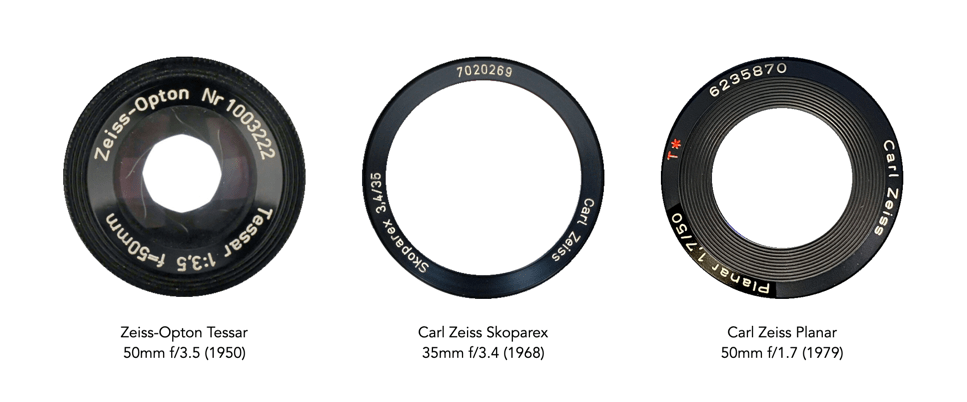
Examples of Carl Zeiss Opton lens markings over the years.

Of course it is also easy to identify a lens if it is marked with DDR. Some lenses were made in only East or West Germany, while others had names which continued to be shared.

  • East German only lenses: Biometar (a modified Planar), Flektogon (similar to Distagon), Flexon, Pancolar
  • West German only lenses: Distagon
  • Shared lenses: Hologon, Biogon, Biotar, Magnar, Planar, Protar, Sonnar, Tessar, Topogon, Triotar

Further reading:

  1. Shapiro, I., “Zeiss v. Zeiss – The Cold War in a Microcosm”, International Lawyer, 7(2) pp.235-251 (1973)
  2. “Possible Name Change of VEB Carl Zeiss Jena”, Central Intelligence Agency, Information Report, 22 Nov (1954)
  3. Allison, R.C., “The Carl Zeiss Case”, International Lawyer, 3(3), pp.525-535 (1969)
Zeiss versus Zeiss : the postwar split

One of the things that gets very confusing for some people is differentiating between Zeiss lenses from East and West Germany. First, let’s look at the backstory. Prior to World War II, Carl Zeiss Jena had been one of the largest suppliers of optical goods in the world. Note that Carl Zeiss was an optical company and different to Zeiss Ikon, which was a camera company formed in 1926 from the merger of four camera makers: Contessa-Nettel, Ernemann, Goerz and Ica. Both were members of the Carl Zeiss Foundation.

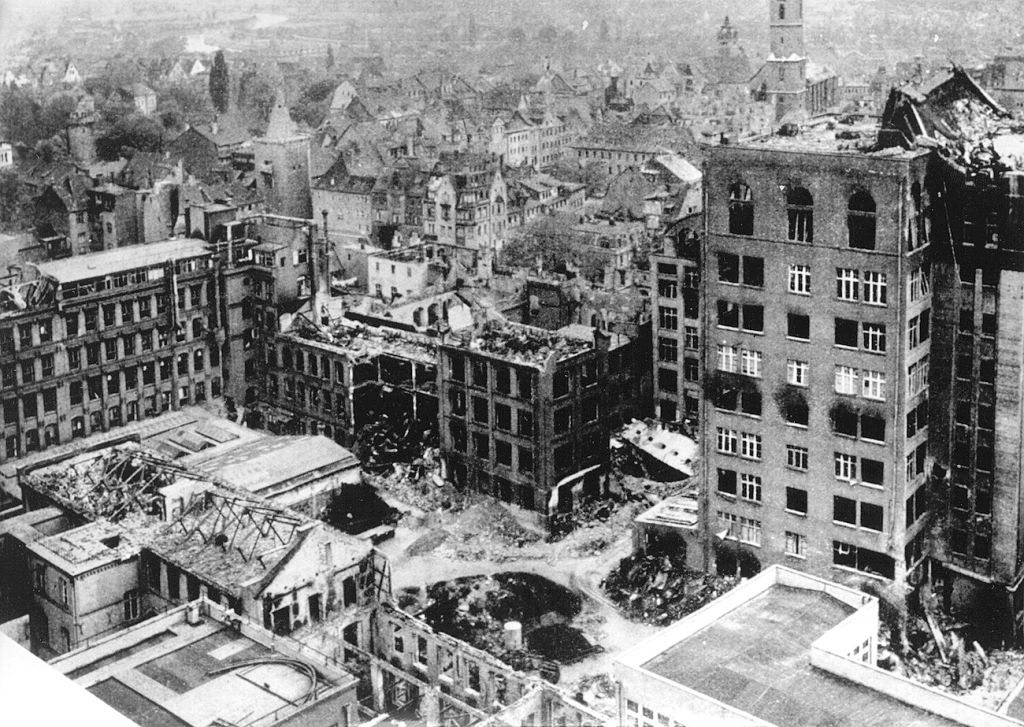
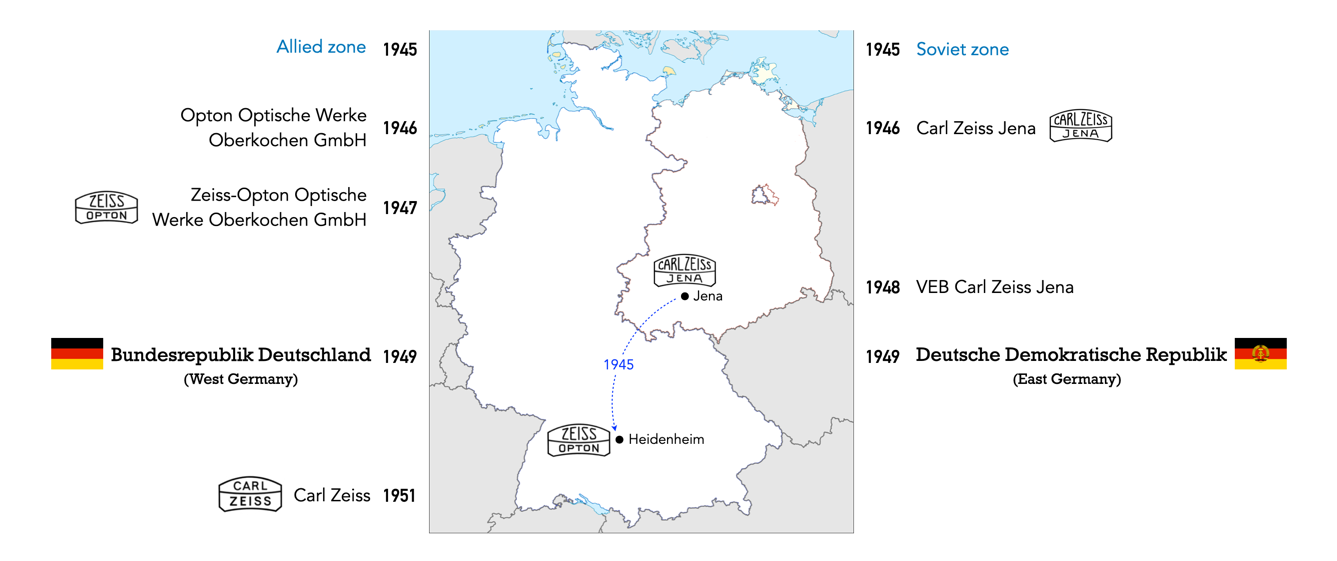
During the war, Jena had been pounded by allied bombing – the British bombed the Zeiss works on 27 May 1943, and the Americans repeated this twice in 1945. Mind you, there was not enough damage to put the factories out of commission but enough to slow production. Jena was captured by the American 80th Infantry Division on April 13th, 1945, and would remain in US control for two months before withdrawing in favour of the Soviet forces. As Americans departed, they took with them 122 key personnel from Jena to Heidenheim in the US zone of occupation (the personnel were from Carl Zeiss and Schott). At the conclusion of hostilities in 1945, Germany was split into differing zones, and as Jena was in the German state of Thuringia, it came under Soviet control (based on the Yalta Conference agreement).

A New York Times article in September 1946 suggested that the Russians were taking US$3,000,000 worth of finished products monthly for reparations [1]. At this stage there was very little in the way of dismantling equipment to ship back to Russia. In fact an earlier NYTimes article [2], suggested Russian occupation authorities had actually stimulated production at the Zeiss plants to pre-war levels, in order to facilitate reparations. It should be noted that the Zeiss plant produced more than just photographic optics – it also produced microscopes, medical and surgical instruments, ophthalmic instruments, geodetic instruments, electron microscopes, binoculars, etc., and military items [3].

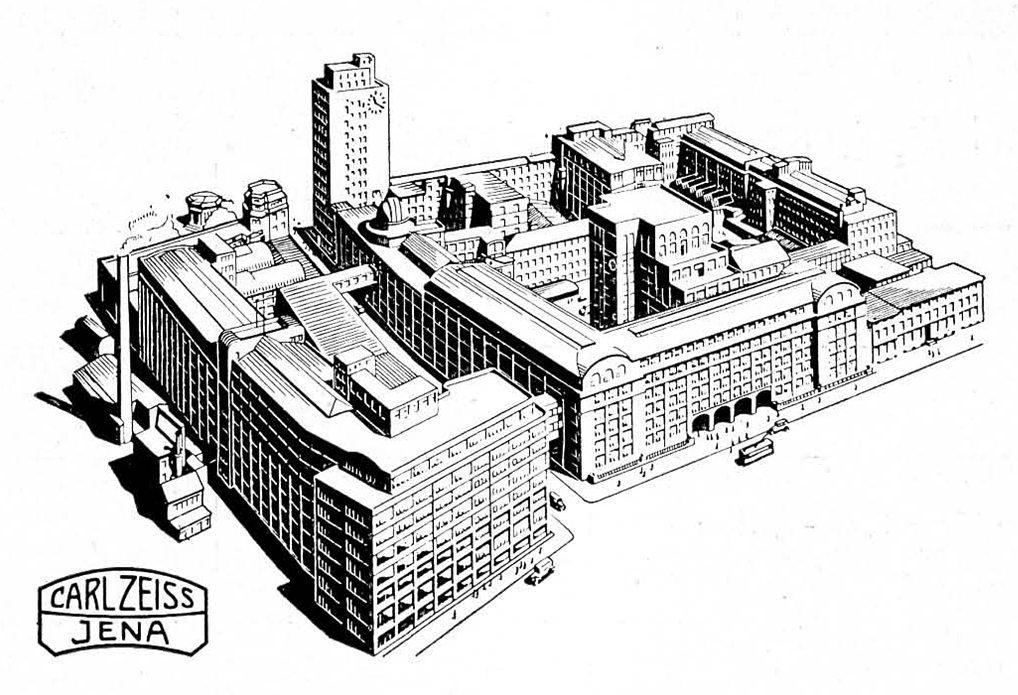
The bombing damage to the Zeiss Jena plant

By 22 October 1946, the Soviet occupation authorities began dismantling the Zeiss plant [3] as war reparation payments agreed upon in the Potsdam Agreement. This was known as Operation Osoaviakhim, and involved many industries across Germany. It resulted in the removal of 93% of Zeiss’ equipment (including raw material, pipes, boilers, sanitary installations, etc), and 275 Zeiss specialists [4] deported to various locations in the USSR (approximately 90% of those deported would return to Jena in 1952). The taking of war “booty” was of course entirely legitimate, yet as Peter Nettl put it in a 1951 article, “Like a child long deprived of chocolate, the first Soviet ‘dismantlers’ flung themselves on all the available tidbits” [5].

A US intelligence report from July 1947 described the status of the Zeiss works at Jena [6]. In it they suggest that optical and photographic production had been least affected by the dismantling, with the plant producing lenses for the Soviets (Tessar 5cm f/3.5). The dismantling program had been completed by April 1947 [7], after which the Soviet High Command turned the plant over to the Germans, who re-established the plant. About 1000 machines remained at Jena after the dismantling, allowing for the continued production of eye glasses, camera lenses, medical glass and measuring instruments [8]. There was every hope at this time (at least from the West German side of things), that this was a temporary situation and that in 3-5 years Heidenheim staff would move back to Jena [6].

In June 1948, the Zeiss Jena plants were expropriated by the Land Expropriation Commission [9] and transferred to state ownership, becoming known as “VEB Carl Zeiss Jena”. In the American zone, Zeiss was reborn as “Opton Optische Werke Oberkochen GmbH” in 1946, becoming “Zeiss-Opton Optische Werke Oberkochen GmbH” in 1947, and Carl Zeiss in 1951. They had very little except the relocated personnel and supposedly a quantity of Zeiss documents. In 1949 Germany officially split into East Germany (Deutsche Demokratische Republik) and West Germany (Bundesrepublik Deutschland). Between 1948 and 1953 the two firms cooperated commercially with one another, after which cooperation deteriorated as the East German regime tightened control on VEB.

Like Zeiss, Zeiss Ikon (Dresden), best known for its Contax camera, also split in 1948. In the west, it was reformed into Zeiss Ikon AG Stuttgart. In the mid 1960s it merged with Voigtländer. It followed the Contax rangefinder line releasing the Contax IIa and IIIa cameras in the early 1950s. In the east, Zeiss Ikon became state owned, known as VEB Zeiss Ikon Dresden (ZID). ZID may be best known for its advanced SLR model, the Contax S, introduced in 1948.

Further reading:

  1. “Russians take 90% of Zeiss Output”, The New York Times, Sept.10, 1946.
  2. “Russians Increase German Industry”, The New York Times, July.5, 1946.
  3. “Activities at the Zeiss Plant, Jena”, Central Intelligence Agency, Information Report, 28 May (1953)
  4. “Deportation of Technicians and Specialists from Karl Zeiss, Jena”, Central Intelligence Group, Information Report, 13 January (1947)
  5. Nettl, P., “German Reparations in the Soviet Empire”, Foreign Affairs, 29(2), pp.300-307 (1951)
  6. “Status of the Zeiss Works in Jena and Moscow”, Central Intelligence Group, Intelligence Report, July (1947)
  7. “Layout and Organizational Setup of the Jena VEB Carl Zeiss”, Central Intelligence Agency, Information Report, 29 August (1955)
  8. “Dismantling, Production in the Societ Zone”, Central Intelligence Group, Information Report, May (1947)
  9. Allison, R.C., “The Carl Zeiss Case”, The International Lawyer, 3(3), pp.525-535 (1969)