The controversy over ‘miniature’ cameras

In the years following the arrival of the Leica (1926) the process of using it came to be known as ‘miniature photography’. Magazines of the period were full of techniques under the heading ‘miniature camera’, and the term itself would last until the early 1950s (the term was unknown before the Leica). Prior to this it was the age of large format cameras, which is any format larger than 9×12cm with one of the most common being the 10×13cm (4×5″). Probably the smallest format camera prior to 1926 was the Kodak Vest Pocket (VP) camera (1912-1934) which produced an image 2½×1⅝” (6.4×4.1cm) in size. By the early 1930s, photographers had become very miniature camera conscious. Big was out, small was in, but miniature started to evolve beyond 35mm, including any camera which took pictures smaller than 6×6cm (2¼×2¼”).
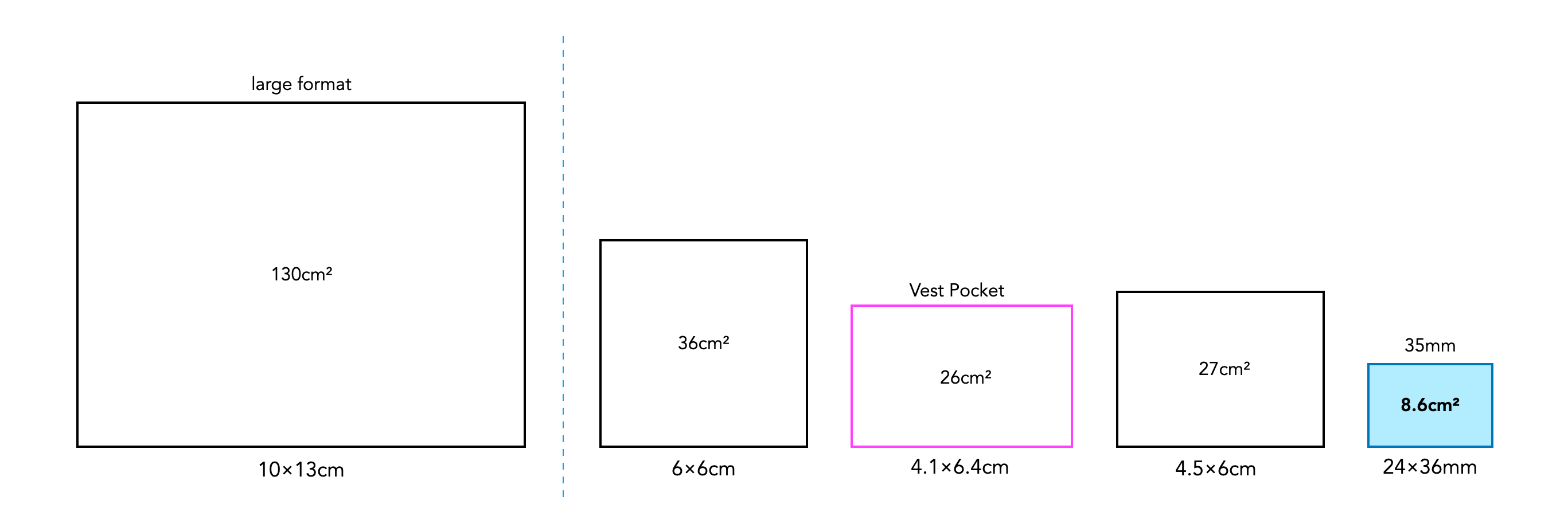
Fig.1: A comparison of ‘miniature’ size formats

The question is why were formats like 6×6cm included in the definition of miniature? Inevitably, in view of the success of 35mm film cameras like the Leica other cameras began to appear in the category, essentially creating an industry within an industry in which manufacturers vied with one another to produce innovations based on the miniature theme. However in many cases these manufacturers just broadened the category to fit their camera rather than produce anything innovative. By the mid-1930s, there were circa four categories of miniature cameras:

  • Small roll-film, film-pack or plate cameras, with negatives 2¼×3¼” or smaller that have one lens and a fixed bellows. Cameras included the Zeiss Ikonta (4.5/6/9×6cm), Foth Derby(24×36), Kodak Retina (24×36mm), and Voigtländer Virtus (4.5×6cm).
  • Rangefinder cameras with a single lens or interchangeable lenses with negative sizes from 24×36mm to 2¼×3¼”. Cameras included the Leitz Leica and Zeiss Contax (24×36mm), Zeiss Super Ikonta (4.5/6×6cm) and Super Nettel (24×36mm).
  • Single lens reflex cameras, which have a single lens with negatives ranging from 24×36mm to 4×6.5cm. This includes cameras like the Exakta (4×6.5cm), Kine Exakta (24×36mm), National Graflex (6×6.5cm), and Noviflex (6×6cm).
  • Twin lens reflex cameras which have two lenses, and Cameras included the likes of the Rolleiflex and Rolleicord (6×6cm), Zeiss Ikoflex (6×6cm), Voigtländer Brilliant and Superb (6×6cm), Welta Perfekta (6×6cm). Many of these were limited to a single focal length. Another camera was the Zeiss Contaflex (24×36mm) which had a built-in electric cell exposure meter.

Indeed the March 10th, 1937 issue of The Amateur Photographer & Cinematographer outlines the ‘Modern Miniature Cameras’ available at the time by size [3]: a total of 98 cameras − 24×36mm (20), 24×36mm reflex (2), 3×4cm (15), 3×4cm reflex (1), 4×4cm reflex (1), 4×6.5cm (8), 4×6.5cm reflex (3), 4×6.5cm on 3¼×2¼ film (23), 6×6cm on 3¼×2¼ film (7), 6×6cm reflex (13), and five non-standard.
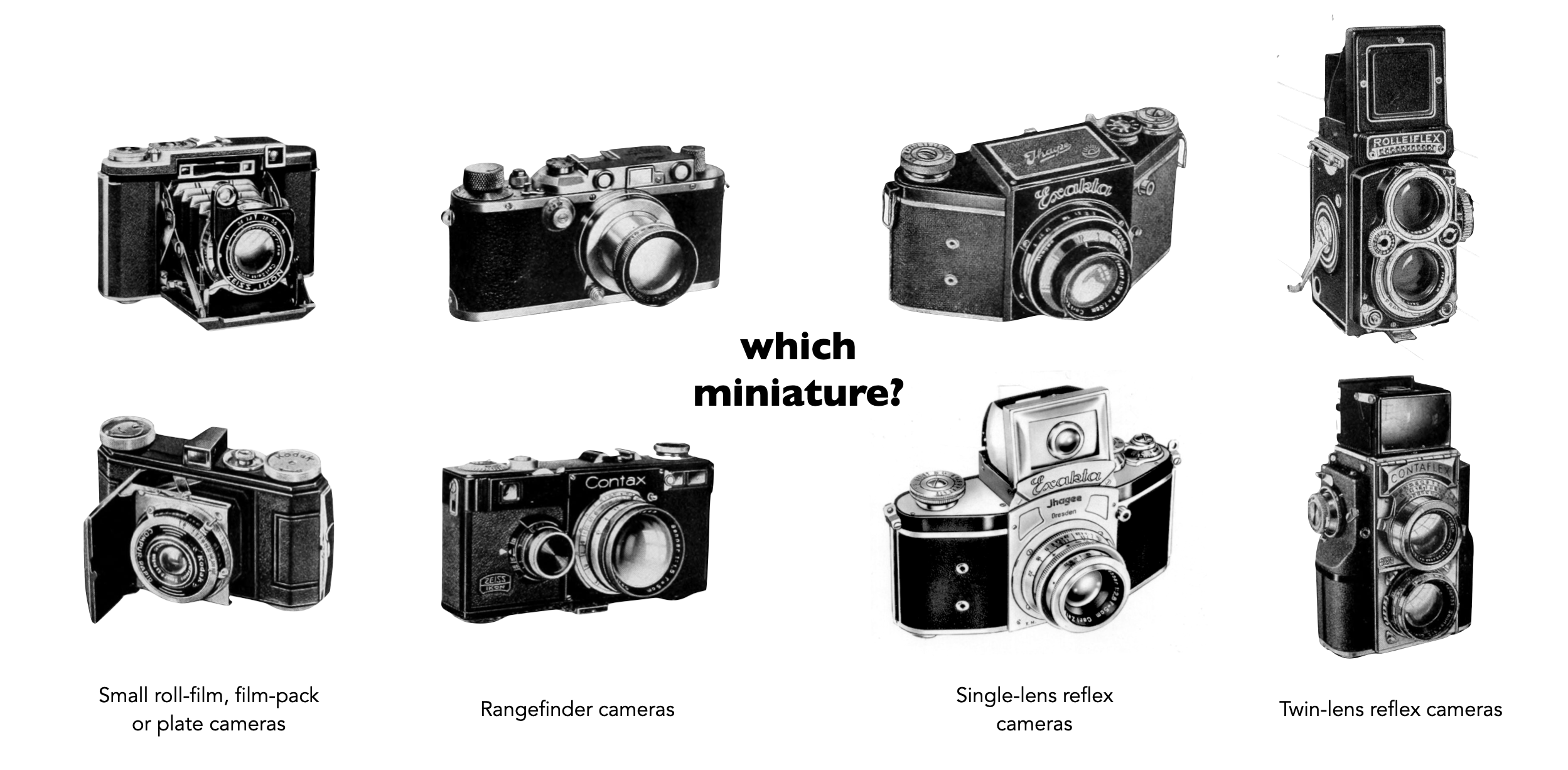
Fig.2: Too many miniatures

In late 1936 a heated debate on the topic started in the ‘Letters to the Editor’ section of The Amateur Photographer & Cinematographer. It stemmed from an article in the November 4th 1936 issue titled ‘What is a Miniature Camera?’ [1]. In it the definition of a miniature camera was one which took a picture of 6×6cm (2¼×2¼) or less. However the article also suggested that a camera taking a 4.5×6cm picture on 3½×2½ film (using a mask) could also be classed as a miniature. What followed was a litany of responses. In the Jan.6 1937 issue, one B.Z. Simpson suggested that “the only rationale definition of the miniature camera relates to the area of the negative used which must for the purpose be smaller than the V.P. size negative.” He goes on to say that “cameras using V.P. size… are not miniature at all, but ordinary size cameras.” [2].

Now we have 2¼” square and even 3¼×2¼” users crying out to be allowed within the ‘select circle’. If this matter goes much farther we shall shortly have the man with the half-plate calling himself a miniaturist.

Murdoch, J.N., “Letters to the Editor: Miniature Cameras”, The Amateur Photographer & Cinematographer, Jan.13 (1937)

Some seemed to settle on the idea of 5 square inches being the threshold, which would include 2¼×2¼ (6×6cm) cameras. Other objected to 6×6cm cameras being left out on the principle that the square shape utilizes the maximum area of the circular lens field (never mind that to compare a square image to a 24×36mm you would really be talking about a 36×36mm). Still others seemed to think the concept of miniature could be defined based on the focal length of the normal lens employed, e.g. 5cm for 24×36mm. It seemed that no-one wanted to be left out. The trend would continue until the industry was interrupted by the war, after which it was fundamentally altered.

By the early 1950s, the 6×6 had morphed on into its own category, the medium-format camera, and many of the other formats had disappeared altogether as the world’s photographers embraced 35mm. The miniature category itself contracted back to 35mm, but opened to include many differing types of 35mm. Here are some 35mm camera types from the early 1950s:

  • Rangefinder cameras with interchangeable lenses − e.g. Canon IV-S2, Zeiss Contax IIa/IIIa, Foca Universal, Leica IIf/IIIf, Nikon
  • Rangefinder cameras with fixed lenses − e.g. Argus C4, Kodak Retina IIa, Voigtländer Vitessa
  • Rangefinder cameras with fixed lenses + separate film-shutter wind − e.g. Zeiss Ikon Contessa 35, Konica I/II, Voigtländer Vito III.
  • Viewfinder cameras with fixed lenses + separate film-shutter wind − e.g. Argus A4, Zeiss Ikon Contina, Welta Welti, Kodak Retinette, King Regula I/II, Braun Paxette
  • Rapid sequence cameras − e.g. Robot Star
  • Reflex cameras, waist-level − e.g. Alpa 4, Exa, Exakta VX, Praktiflex FX, Praktica FX
  • Reflex cameras, eye-level − e.g. Alpa 5/6, Contax S/D, Rectaflex

Further reading:

  1. “What is a Miniature Camera?”, The Amateur Photographer & Cinematographer, p.15 Nov.4 (1936)
  2. Simpson, B.Z., “Letters to the Editor: What is a Miniature Camera?”, The Amateur Photographer & Cinematographer, Jan.6 (1937)
  3. “Modern Miniature Cameras”, The Amateur Photographer & Cinematographer, pp.40-46, Mar.10 (1937)
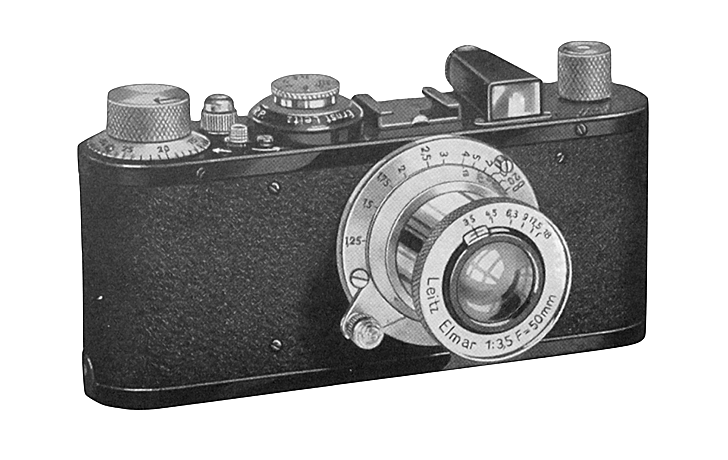
The Leica changed photography

In the October 1936 issue of Fortune, there was an article on the “minicam boom”. It cited there being 100,000 miniature cameras in the US, comprised of more than 30 different makes.

Model E Leica, 1936

“Many a man who had owned a Kodak for years without feeling any impulse to see what he could do with it if he applied himself fancied that in the Leica he was finding a new invention that defied the laws of optics and would give him good pictures with no light to speak of and no effort save that of pressing the button. The Leica didn’t even look like a camera. No bellows, no bulk, no focusing hood; you shot from the hip, so to speak, and got your man.”

“Miniature Cameras”, Fortune, p.125 October 1936

The kit of the mid-century photojournalist

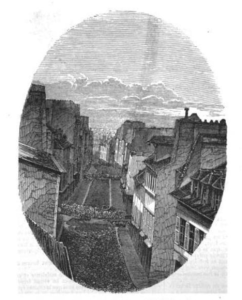
Photojournalism had its origins in the photography of war. Photojournalists are photographers who take pictures that illustrate or tell a story. The first photograph used as an “illustration of a newspaper report”, was a daguerreotype taken by Charles-François Thibault in Paris during the bloody June Days uprising in 1848. Two images were taken at Rue du Faubourg-du-Temple : the scene depicts a barricade on a empty street, at 7.30am on June 25th. On July 8th, the newspaper L’Illustration reproduced the images as woodcuts. Photographic coverage of the Crimean War (1853-1856), and the American Civil War in the 1860s required cumbersome cameras taking long exposures on plates – shots were taken before or after battles because combat coverage was impossible. WW1 brought medium format cameras with glass-plate negatives (these were used by “official” photographers, soldiers used the Vest Pocket Kodak).

Barricades in the Rue Saint-Maur (daguerreotype)
The woodcut from L’Illustration

The Golden Age of photojournalism was considered to be the period of the 1930s through the 1950s, largely due to the introduction of the Leica 35mm camera in 1925. But what sort of kit did the average photojournalist (not including army combat photographers) use in the mid-century period? Being a photojournalist was a demanding occupation. Consider the words of Boris Spremo (1935-2017): “

“I have walked through the wreckage’s of plane crashes and smashed cars . . . knelt beside dying people in Central Africa . . . faced bullets . . . run from tear gas bombs, been chased by angry mobs . . . ridden in a dug out canoe in the sweltering jungles of South America and on dog sleds at 50°C below zero in the Canadian far north . . . ”

Spremo, Boris. Boris Spremo: Twenty Years of Photojournalism. Toronto: McClelland, 1983.

So it is imaginable that a typical photojournalist would want to carry as little gear as possible. In the 1930s, while 35mm had followers, many photojournalists still used large format press cameras. For example Charles Kerlee (1907-1981) in his 1939 book “Pictures With a Purpose – How They Are Made” describes using a 4×5 series D Graflex with a 8¼” Steinheil Cassar lens, or a 40cm Tele-Tessar lens (400mm=135mm, 8¼”=65mm in 35mm equivalency).

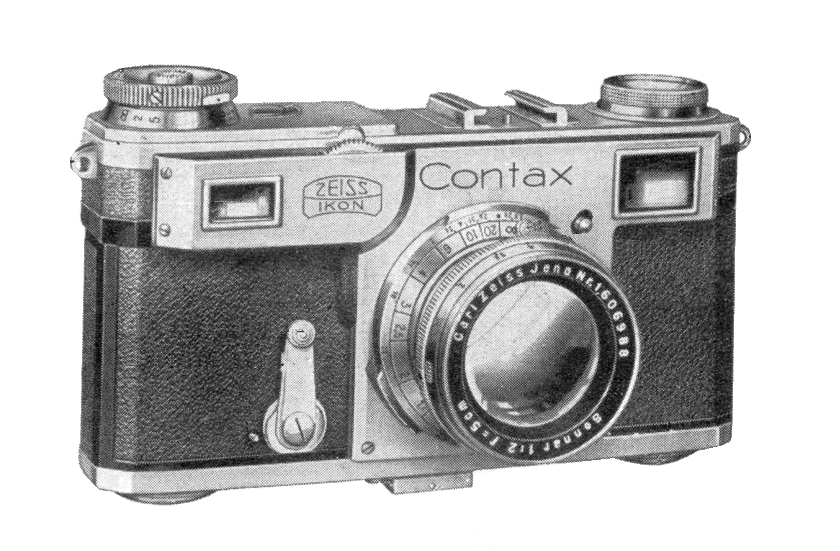
Robert Capa (1913-1954), who it is rumoured photojournalist, L.B. “Jeff” Jefferies is based on in the movie “Rear Window” was an icon of photojournalism, covering the Spanish Civil War and WW2. Capa is known for using a Leica at the beginning of his career, including for one of his most famous works, Falling Soldier taken during the Spanish Civil War. But by his coverage of the Chinese resistance to the Japanese invasion in the late 1930s, he had switched to the Contax II series of cameras. In 1944 as he followed allied troops onto the beaches at Normandy (the “Easy Red” sector of Omaha Beach), he carried two Contax cameras. His preference was for 50mm lenses, with a certain liking of the Zeiss 50mm Sonnar f/1.5. When he left on that ill-fated assignment to Indochina in 1954 he carried a Nikon S to complement his Contax.

A Contax II

Horace Bristol (1908-1997) was another American photographer who was best known for his work in Life. After WW2, Bristol settled in Japan, publishing “Tokyo on a five day pass with candid camera” in 1951. Although photographing for a photo-book he describes in detail the type of gear used through the process. It seems Bristol largely used 35mm cameras, typically still known as the “candid camera”. He states that while a telephoto and wide-angle are needed, the workhorse is the 50mm, it will “do almost anything any lens will do”. Photographing for the book, Bristol used an array of cameras, but typically carried a Canon III and Leica IIIc for candid work (likely what we would today term street photography). As to lenses, Bristol carried the following array: Serenar 135mm f/4, Serenar 85mm f/2, Nikkor 50mm f/1.4, Serenar 50mm f/1.8, Serenar 35mm f/3.2 and a Serenar 38mm f/3.5. Of course this sort of photography allowed for greater flexibility (Serenar = Canon).

Photojournalists also typically did not carry the full gamut of lenses. As suggested by Bristol:

“Don’t, however, be lead into the error of thinking that the answer to good pictures is to be found in a complete set of matched lenses. just the opposite is true, for there is a very definite correlation between the number of lenses the average photographer carries, and the worth-while pictures he produces. Unfortunately, this varies in inverse order; in other words, the more equipment to worry about, the fewer pictures of merit!”

Horace Bristol, Tokyo on a five day pass with candid camera (1951)

Many photographers adopted “candid cameras” because they were compact and convenient. W. Eugene Smith (1918-1978) supposedly left Newsweek in 1938 because they wanted him to work with a larger format, but he preferred his Leica. After that he secured a job at Life. Over his career he used many different 35mm cameras, Leica, Contax, Pentax, Nikon. His preference was for 21mm, 28mm, 35mm, 85mm and 135mm lenses. Yevgeny Khaldei (1917-1997), the Ukranian photographer who captured one of the most iconic WW2 photographs of a Soviet soldier raising a flag over the Reichstag in Berlin, used a Leica III throughout his career.

In the end, it is likely that 35mm cameras took over from larger format because they were practical. Practical and efficient, in the fast-paced world that photojournalism was becoming.

Further reading:

The first 35mm lens

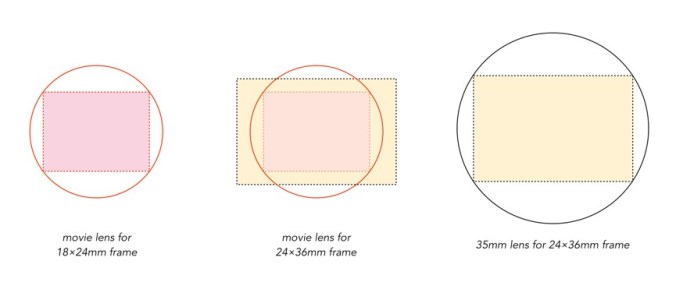
With the advent of 35mm film cameras came the need to design 35mm lenses. The first still cameras designed to use 35mm film inevitably used lenses modified from use on motion-picture cameras, or microscopes. This made sense when the 35mm cine-film used the 18×24mm frame format, however these lenses only covered part of a 24×36mm frame. The figure below shows frame coverage of a cine (movie) lens versus a 35mm lens.

Frame coverage of pre-35mm lenses

For instance the Tourist Multiple used a Bausch & Lomb Zeiss 4-element Tessar (50mm f / 3.5 lens), which was used on motion picture cameras.

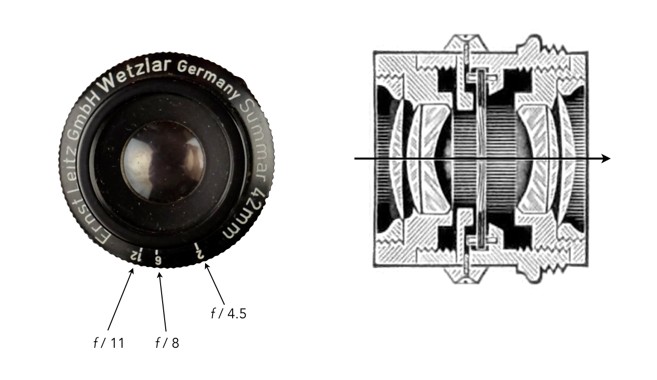
Leitz, founded in 1869, began as a company focused on the manufacture of microscopes, and other optical instruments. When work began on the Ur-Leica, Barnack and Berek tried a number of lenses. The simplest option was the 5cm f / 3.5 Zeiss Kino-Tessar movie camera lens. The problem is that the lens could not provide a light spot able to cover the 24×36mm frame format, as it was designed for a 18×24mm format. In addition it produced vignetting not suitable for a camera. The lens they ended up using was the 6-element 42mm f / 4.5 Leitz Mikro-Summar, in a classic double-Gauss formula. This lens had a number of shortcomings, including edge blurring, and a lack of contrast.

The Leitz Mikro-Summar (from 1907 catalog)

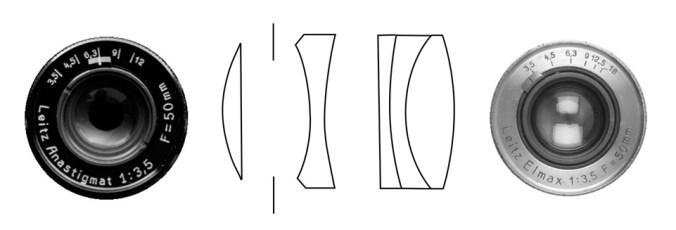
The design of a new 35mm lens was the responsibility of German physicist and mathematician, Max Berek (1886-1949). The first 35mm lens developed at Leica was a 50mm f/3.5 Anastigmat. Based on the “Cooke Triplet” lens design, it had 5 elements in 3 groups. The lens was later marginally redesigned, still containing 5 elements in 3 groups, and was given the name Elmax (The name is derived from Ernst Leitz and Max Berek.). These lenses were used on the pre-production Leica-0, of which 31 were manufactured from 1920-1925.

The Anastigmat / Elmax lenses

At that time, the calculation of such a lens was still very complex. Light beam paths from points near or away from the optical axis had to be calculated for three wavelengths and seven refractive surfaces, all by hand using logarithmic tables. Leitz was granted patent No. 343086 for the Anastigmat in 1920.

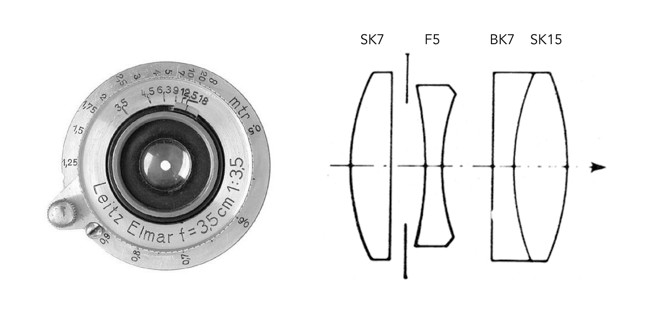
The first lens formula was difficult to build, so Berek changed the design to a triplet with the last element a cemented doublet, i.e., 4 elements in 3 groups. This lens was renamed Elmar, and was subsequently manufactured for decades (1925-1961). The lens was similar to a Tessar, except for the location of the diaphragm. On the Elmar the diaphragm was located between the first and second elements, rather than the rear two elements.

The Elmar lens

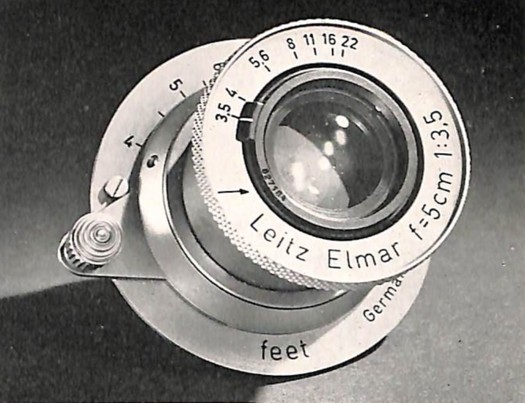
The first lenses which appeared were of the fixed type used on the Leica I. From 1930-1959, the Elmar was made in a screw mount, and an M (bayonet) mount from 1954-1961. From 1930-1932 the lenses were matched with one body, after which they became interchangeable (M39 mount). The lens would evolve to have a maximum aperture of f/2.8, and a minimum aperture of f/22. .

The Leica Elmar 50mm, with screw mount

Specifications: (Original)
50mm f / 3.5 Elmar lens
Angle of view: 45°
No. of elements: 4
Minimum focusing distance: 1.0m
Minimum aperture: 16
Aperture range: 3.5, 4.5, 6.3, 9, 12.5, 16
Weight: 92g

Here are some links to extra info on early Leica lenses:

The origins of 35mm camera film

Full-frame sensors take their dimensions from traditional 35mm film, but where did the ubiquitous 35mm come from?

The second half of the 19th Century spirited the development of many photographic materials and processes. Kodak’s first roll-film camera, the No.1 was introduced in 1888. By 1901, the use of roll-film had become quite common, with Kodak releasing the 120 film format, which was approximately 60mm wide and allowed for various frame sizes. Thomas Edison invented¹ the Kinetoscope in 1893, a device for showing basic film loops, and which used 35mm (1⅜”) gauge cine-film, half the size used in Eastman Kodak cameras. In March 1895, The Lumière Brothers introduced their Cinématographe, the first motion picture film camera, using the same width as Edison, 35mm. By 1909, 35mm had become the standard motion picture film.

Why is it called 35mm film? The 35mm represents the width of the film, irrespective of the size of the frame on the film.

A number of manufacturers started using 35mm cine-film for still photography between 1905 and 1913. The first patent for a 35mm camera was issued to Leo, Audobard and Baradat in England in 1908. It represented one of many patents and prototypes, few of which were produced commercially or even built. The first publicly available 35mm cameras were that used 35mm cine-film were the Tourist Multiple, and the Simplex. The Tourist Multiple, built by US company Herbert & Huesgen, was released in 1913. It was a half-frame camera, taking (750) 18×24mm exposures on 35mm cine-film. The Simplex, invented by Alfred Huger Moses, and was released in 1914. It existed in a number of different models, many of which allowed convertible full/half-frame exposures. The Simplex Model B was the only one to use standard 35mm format (it was only produced from 1914-1918).

The Simplex Model B.

It was Oskar Barnack (1879-1936), who produced the first commercially successful 35mm camera, at the Ernst Leitz Optische Werke in Wetzlar. In 1912, Barnack began work on a new motion picture camera, yet he struggled to get shutter timings right, largely because film emulsions were quite inconsistent. Proper exposure in the early days of motion picture was challenging because of the lack of devices such as photoelectric meters. In response to this, Barnack created a film tester to determine correct exposure settings. Barnack’s device would allow small test exposures to be processed, and exposure issues adjusted accordingly. This prototype device became known as the Ur-Leica, where the prefix “Ur” in German means prime, or original. It was equipped with a Mikro-Summar f / 4.5, 6-element, 42mm lens.

The Leica I (1927) © Kameraprojekt Graz 2015 / Wikimedia Commons

Barnack’s design allowed the camera to move the film horizontally, increasing the frame size to increase to 24×36mm, instead of the 18×24mm exposures of cameras that carried film vertically. This essentially created “double-sized” images. The aspect ratio also changed from 3:4 to 2:3. With the onset of WW1, it was not until 1924 that Leica decided to produce the 35mm camera, with the 35mm Leica I (A) making its first appearance as the Leipzig Spring Fair in 1925. The Leica I had an all-metal housing, a collapsible lens, and a focal-plane shutter. The Leica succeeded because it was compact, and the quality of the exposures was as good as the more commonly used roll film.

So why did 35mm film become so successful? It was partially to do with cost. Due to its use in the cinematic industry, 35mm motion picture film was widely available, and inexpensive. The number of exposures which could be loaded into a camera was 40. Initially the film had to be loaded in the dark, however Barnack soon realized this was a problem and developed a reloadable cassette which could easily be inserted into the camera, and could accommodate 36 exposures. By 1932, Leica’s competitor Zeiss had introduced the 35mm Contax, and Kodak entered the market in 1934 with the Retina I.

¹ It is widely believed that the Kinetoscope was actually designed by one of Eastman’s employees, William Dickson.

For more information on early 35mm cameras check out Max Bertacchi’s page dedicated to early 35mm cameras, or early Leica’s.