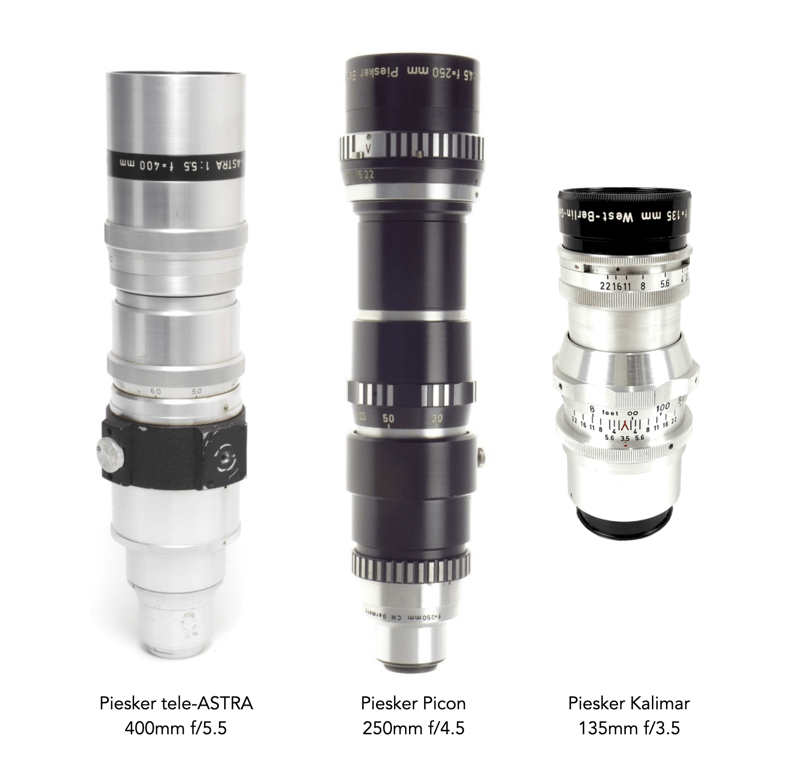
Paul Piesker & Co. was founded in 1936 as a Berlin manufacturer of lenses and lens accessories for reflex cameras (in West Germany). After WW2 the company focused on lenses with long focal lengths for the Exakta and cameras with M42 mounts. Like its competitors, Astro-Berlin, and Tewe, Piesker lenses don’t seem to very common, at least not in Europe. Most of the lenses produced seem to have been for the US market, where they appeared in ads in Popular Photography in the mid 1950s. The lenses can also be found under the “Kalimar” trademark, and also rebranded for Sterling Howard, under the trademark “Astra”, and “Voss” (in addition to other brands: Picon, Votar, Telegon). Production at Piesker was discontinued in 1964.
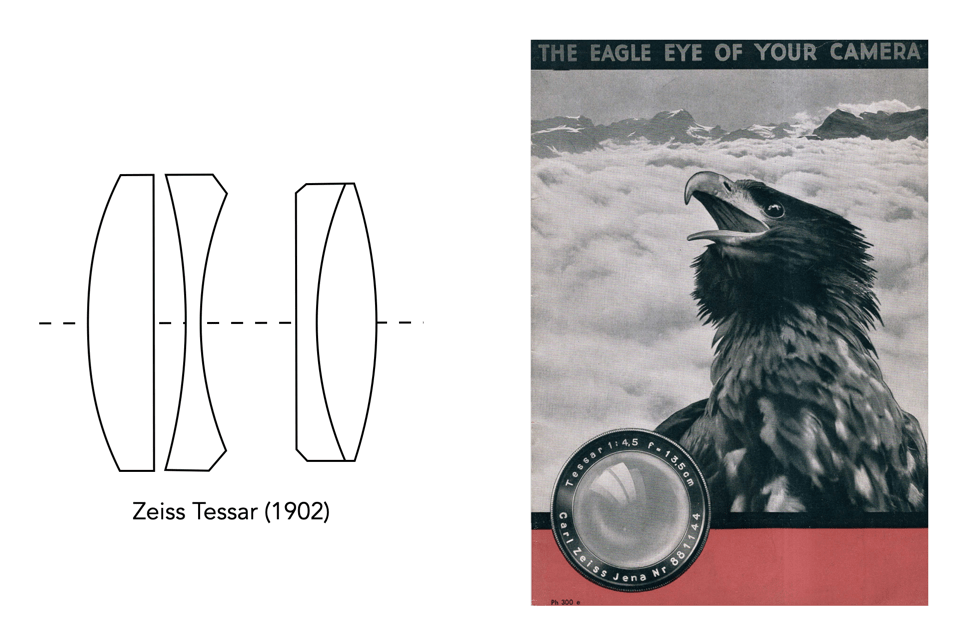
It was Zeiss who came up with the “the eagle eye of your camera” slogan in the 1930s to advertise their lenses (or in German “Das Adlerauge Ihrer Kamera” – eagle eye being Adlerauge) [1]. Of course they were mostly talking about the Tessar series of lenses.
“The objective should be as the eagle’s eye, whose acuity is proverbial. Where its glance falls, every finest detail is laid bare. Just as the wonderful acuity of the eagle’s eye has its origin, partly in the sharpness of the image produced by its cornea and lens, and partly in the ability of the retina – far exceeding that of man’s vision – to resolve and comprehend the finest details of this delicate image, so, for efficiency, must the camera be provided on the one hand with a ‘retina’ (the plate or film) of the highest resolving power – a fine grain emulsion – and on the other hand with an objective which can produce the needle sharp picture of the eagle’s lens and cornea.”
The Eagle Eye of your Camera (1932)
Zeiss took great lengths to use this simile to describe their lenses. A lens must have the sharpness of an eagle’s eye, and the ability to admit a large amount of light – sharpness and rapidity over a wide field of view – the Zeiss Tessar. While Leica named their lenses to indicate their widest aperture, Zeiss instead opted to name their lenses for the design used. Indeed the Tessar came in numerous focal length/aperture combinations, from a 3¾cm f/2.8 to a 60cm f/6.3.
Zeiss “Eagle Eye” advertising in the 1930s
The Tessar is an unsymmetrical system of lenses : 7 different curvatures, 4 types of glass, 4 lens thicknesses, 2 air separations, i.e. 17 elements which can be varied. Zeiss went to great lengths to disseminate the message about Tessar lenses:
sharp, flare-free definition
great rapidity (allowing short instantaneous exposures)
exceptional freedom from distortion (obviating any objectionable curvature)
good colour correction
compact design (so that light falling off near the edge is reduced to a minimum)
sufficient separation of the components of the lens (to allow a between lens shutter)
the use of types of glass as free as possible of colour
reduction to the minimum of the number of lenses, and particularly of glass-air surfaces
“It must have the sharpness of the eagle’s eye”
It is then not surprising that Zeiss choose to compare the lens to an eagle’s eye. The eagle is considered to be the pinnacle of visual evolution. They can see prey from a distance – it is said they can see a rabbit in a field while soaring at 10,000 feet (1.9 miles or 3km). It was Aristotle (in 350BCE) who in his manuscript “Aristotle, History of Animals” pointed out that “the eagle is very sharp-sighted”. The problem however is that it’s not really possible to compare a simple lens against the eye of a living organism. Zeiss was really comparing the lens of an eagle’s eye against the Tessar, or rather the Tessar and the human eye behind it, because the camera lens is just a part of the equation of analog picture taking. So how does an eagle eye compare to a human one?
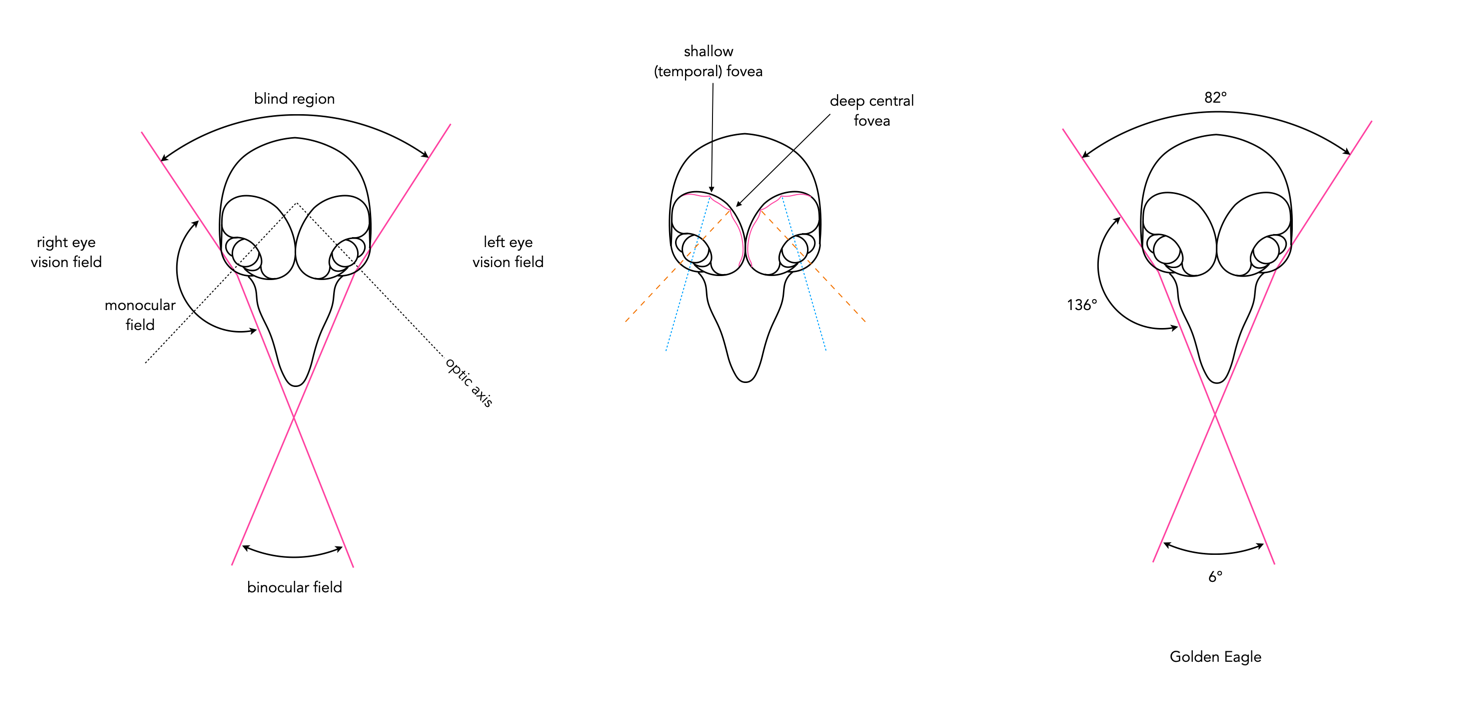
It’s kind of hard to really compare eyes from different species because they are all designed to do different things. In all likelihood, human eyes have evolved over time as our environment changed. In birds, unlike humans, each eye looks outwards at a differing scene, and the overlap of the visual field of both eyes, i.e. the binocular region, is relatively small. This is typically less than 60° in birds, versus 120° in humans, and can be as narrow as 5-10° in some species. Because of this a birds total visual field is quite extensive, with just a narrow blind region behind the head. Eagle’s have a highly developed sense of sight which allows them to easily spot prey. They have 20/5 vision compared to the average human who has 20/20 vision. This means they can see things at 20’ away that humans only have the ability to see at 5’. They have fixed eye sockets, angled 30° from the mid-line of their face, giving them a 340° view. Many also have violet-sensitive visual systems, i.e. the ability to see ultraviolet light and detect more colours than human eyes can.
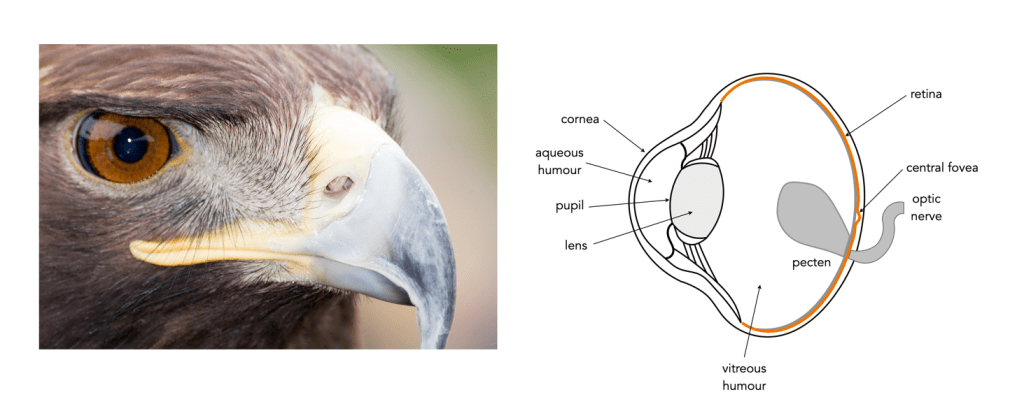
A Golden eagle, and a cross-section of an eagle’s eye
The first thing to consider may be the size of the eye. We will pick one eagle to compare against human vision, and the best option is the (European) Golden Eagle, because it is quite common in Germany. The average weight of a Golden Eagle is 6.1kg, versus the average weight of a European (human) at 70.8kg. If we work on the principle that an eagle’s eye is similar in weight to a human eye (ca. 7.5g) then an eagle’s eye would comprise 0.12% of its body weight, versus 0.01% of a human. So for the human’s eye to be equivalent in mass based on eye:body weight ration, it would need to be 85g. But this is really an anecdotal comparison, the bigger picture lies with the construction of the eye.
One of the reasons birds of prey have such incredible eye-sight is the fact that their deeper fovea allows them to accommodate a greater number of photoreceptors and cones. The central fovea in an eagle’s eye has 1 million cones per square millimetre, compared to 200,000 in a human eye. One way that eagles do this is by having increased resolution. This is achieved by have reduced space between their photoreceptors. Due to the physics of light, the absolute minimum separation between cones for an eye to function correctly is 2µm (0.002mm). As the space between the photoreceptors decreases, so too does the minimum size of the detail.
Parts of an eagle’s vision
The other thing of relevance is that while humans have one fovea, eagles generally have two – a central fovea used for hunting (cone separation 2µm, versus human cone separation of 3µm), and a secondary fovea which provides a high resolution field of view to the side of their head. So like a camera sensor, more cones means better resolution. In context Robert Shlaer [2] suggested that the resolution of a Golden eagle’s eye may be anywhere from 2.4 to 2.9 times that of a human, with the Martial Eagle somewhere between 3.0 and 3.6 times. The spatial resolution of a Wedge-Tailed eagle is between 138-142 cycles per degree [3], while that of a human is a mere 60. Their foveae are also distinctly shaped, deep and convex, as opposed to the rounded and shallow single fovea of human eyes. In a 1978 article for the scientific journal Nature, Snyder and Miller [4] proposed that the unique shape of foveae found in some birds of prey may act like a telephoto lens, magnifying their vision, which is perhaps why these feathered predators can spot food from so far in the sky. Like humans, eagles can change the shape of their lens, however in addition they can also change the shape of their corneas. This allows them more precise focusing and accommodation than humans.
But Zeiss themselves harked on the limitations of the simile: The fact that an eagle can quickly turn its head to allow for viewing in any direction; the fact that the retina is curved, not flat. From the perspective of resolution the ads were true to form, however the other aspects of the an eagle’s vision did not ring true. Yes, telephoto lenses based on the Tessar design could certainly see further than a human, and given the right lens and film could see into the violet spectrum, but Zeiss’s claim was really more about finding a way to describe it’s lenses in a provoking manner, one which would ultimately sell lenses.
Further reading:
Zeiss Brochure: “The Eagle Eye of your Camera”, Carl Zeiss, Jena (1932)
Reymond, L. (1985). Spatial visual acuity of the eagle Aquila audax: A behavioural, optical and anatomical investigation. Vision Research, 25(10), 1477–1491.
Snyder, A.W., Miller, W.H., “Telephoto lens system of falconiform eyes”, Nature, 275, pp.127-129 (1978)
As cooperation deteriorated, and finally terminated in 1953, it was inevitable that eventually there were some issues with trademarks between the two Zeiss’s. I mean they were on different sides of the Iron Curtain. The East German Carl Zeiss company did not own all the rights to some of the names and brands. This would likely have been fine had they just been sold within the eastern-bloc countries, however many were made to be exported to the west (which is really somewhat ironic) – lenses were developed to sell in the West to produce hard currency. They achieved this at the beginning by resurrecting pre-war designs. Political influence over East Germany did not have any influence in how products were manufactured.
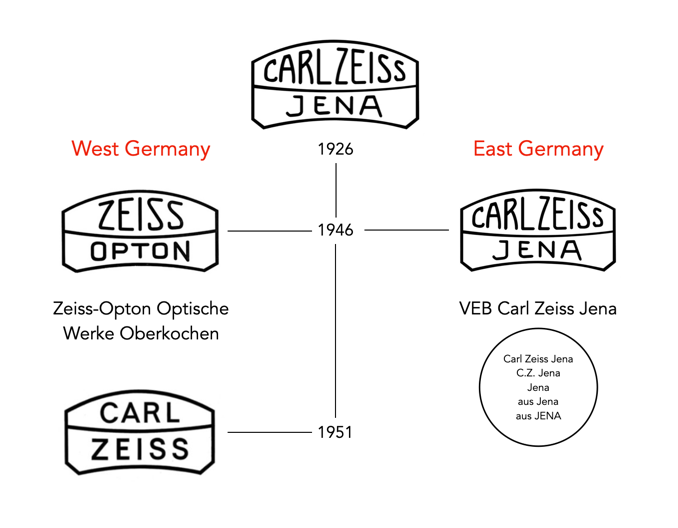
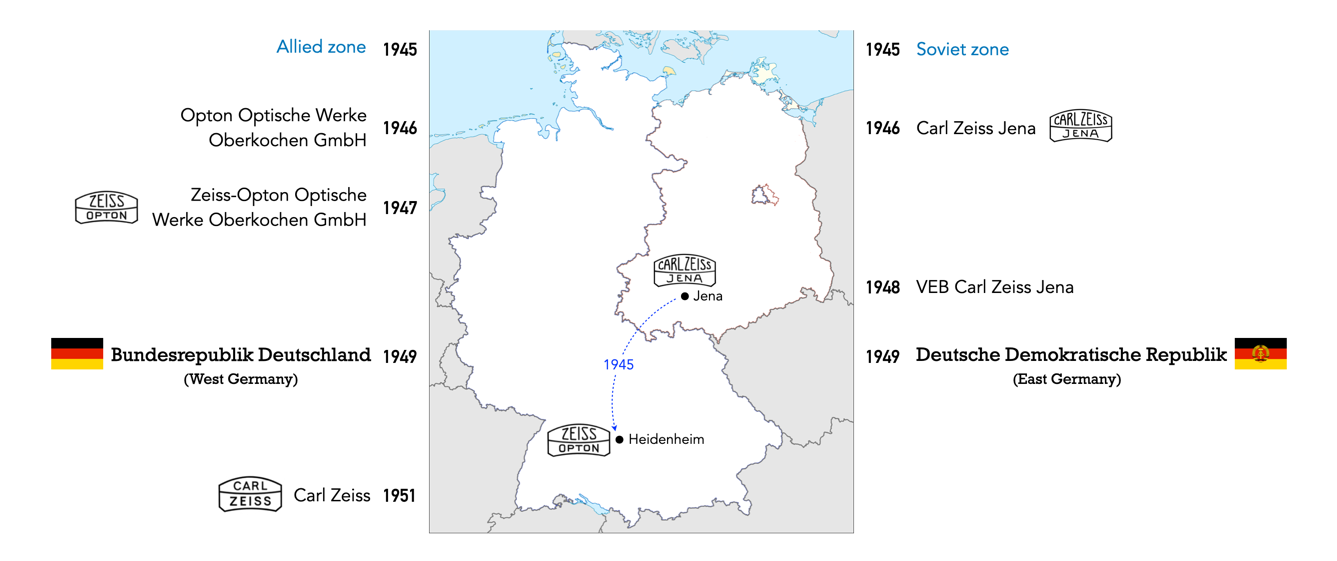
Zeiss vs. Zeiss branding over the years
In February 1954 Zeiss in Heidenheim fired the first shots in what would eventually become a worldwide litigation. They obtained an injunction in the District Court of Goettingen to prevent the continued sale of Jena-made, Zeiss-marked goods [1]. In April Zeiss Jena countered in West Germany by seeking an injunction and an order registering the Zeiss marks in West Germany in its name. That action was dismissed in 1960 when the West German Supreme Court ruled that there was no one in the Soviet Zone having capacity to represent the Zeiss Foundation.
In the same year Zeiss Heidenheim brought action against the Zeiss Jena to prevent them from using the Zeiss name and trademarks anywhere in the world. The Supreme Court of the Federal German Republic determined that the Heidenheim firm was entitled to exclusive use of the Zeiss name and trademarks in West Germany and West Berlin [1]. Interestingly, a CIA report from 1954 [2] suggests that should the naming issues take an “unfavourable” turn for VEB CZJ, then the plan was to change its name to VEB Ernst Abbe Werk (which they obviously never did).
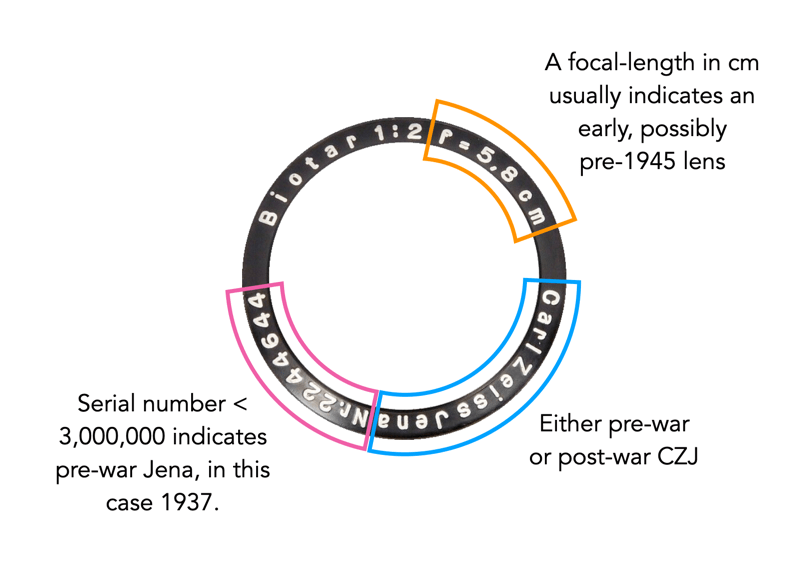
Information provided by lens markings
There was also a long court battle in the US over who owned the rights to the Zeiss name. The litigation commenced on February 14, 1962, filed by Carl Zeiss Foundation and Zeiss Ikon AG against VEB Carl Zeiss Jena and its US distributors [1] (Carl Zeiss Stiftung v. VEB Carl Zeiss Jena). The case went to discovery from 1963-1967 and finally to trial in November 1967. On November 7, 1968, the court found in favour of the plaintiffs, deciding that the US trademarks “Zeiss”, “Zeiss Ikon”, and “Carl Zeiss Jena”, were the property of the Zeiss firm located in West Germany. As to the legitimacy of this? The courts found that the original “Stiftung” ceased to exist in Jena when it had been stripped of its assets. The Stiftung’s domicile was then changed from Jena to Heidenheim. It was not until 1971 [3] that the US Supreme Court finally settled the case of Carl Zeiss vs. VEB Carl Zeiss Jena, after a long 9½ year battle for control of the “Zeiss” trademark, siding with Heidenheim.
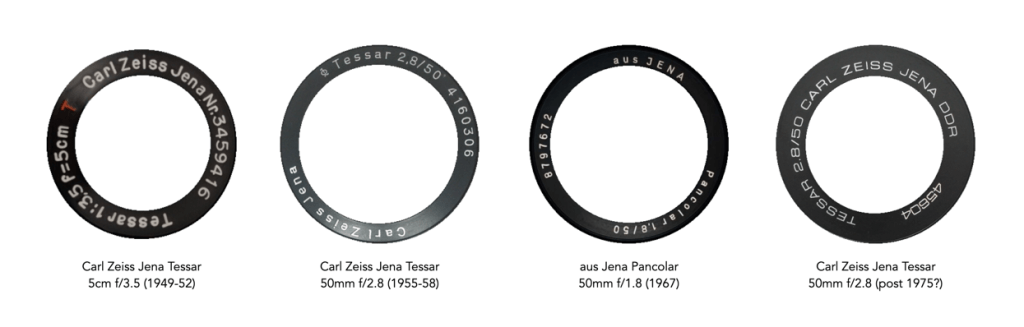
Examples of Carl Zeiss Jena lens markings over the years.
After this, Carl Zeiss marketed their lenses as “Carl Zeiss” exclusively in the United States, whereas Carl Zeiss Jena exported their lenses to the US with the marking “aus Jena”, or sometimes “JENOPTIK”, or even “JENOPTIK JENA”. The branding on these lenses was changed: “T” instead of Tessar, “B” for Biotar, “Bm” for Biometar, “S” for Sonnar, “F” for Flektogon, etc. in order not to infringe on the copyright. Therefore a lens might be labelled “Carl Zeiss Jena s”, or “aus Jena s”, and be exactly the same lens. It really depended on where the lenses were sold.
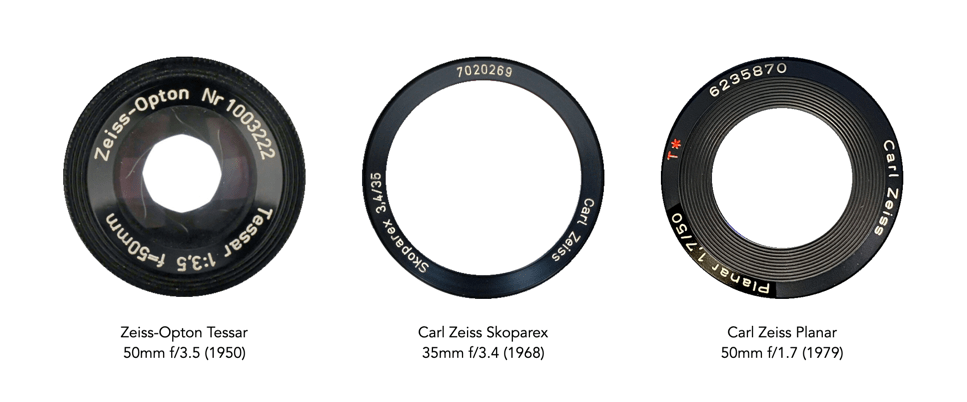
In the Eastern-bloc countries, CZJ could use the name “Carl Zeiss”. Carl Zeiss Oberkochen was not allowed to use “Zeiss” by itself, and instead used the name “Opton” or “Zeiss-Opton”.
In some western countries – namely West Germany, Italy, Greece, Holland, Belgium, Luxembourg, and Austria – CZO was allowed to use the name “Carl Zeiss”. CZJ chose to use the name “aus Jena” in the case of lenses.
The rest of the world, i.e. Commonwealth countries like England and Canada, Switzerland, Japan, both companies could use the name “Carl Zeiss”, but only if there was an indicator of origin. For example CZO used “Carl Zeiss West Germany”, and CZJ used “Carl Zeiss Jena” or the term DDR somewhere.
Examples of Carl Zeiss Opton lens markings over the years.
Of course it is also easy to identify a lens if it is marked with DDR. Some lenses were made in only East or West Germany, while others had names which continued to be shared.
East German only lenses: Biometar (a modified Planar), Flektogon (similar to Distagon), Flexon, Pancolar
One of the things that gets very confusing for some people is differentiating between Zeiss lenses from East and West Germany. First, let’s look at the backstory. Prior to World War II, Carl Zeiss Jena had been one of the largest suppliers of optical goods in the world. Note that Carl Zeiss was an optical company and different to Zeiss Ikon, which was a camera company formed in 1926 from the merger of four camera makers: Contessa-Nettel, Ernemann, Goerz and Ica. Both were members of the Carl Zeiss Foundation.
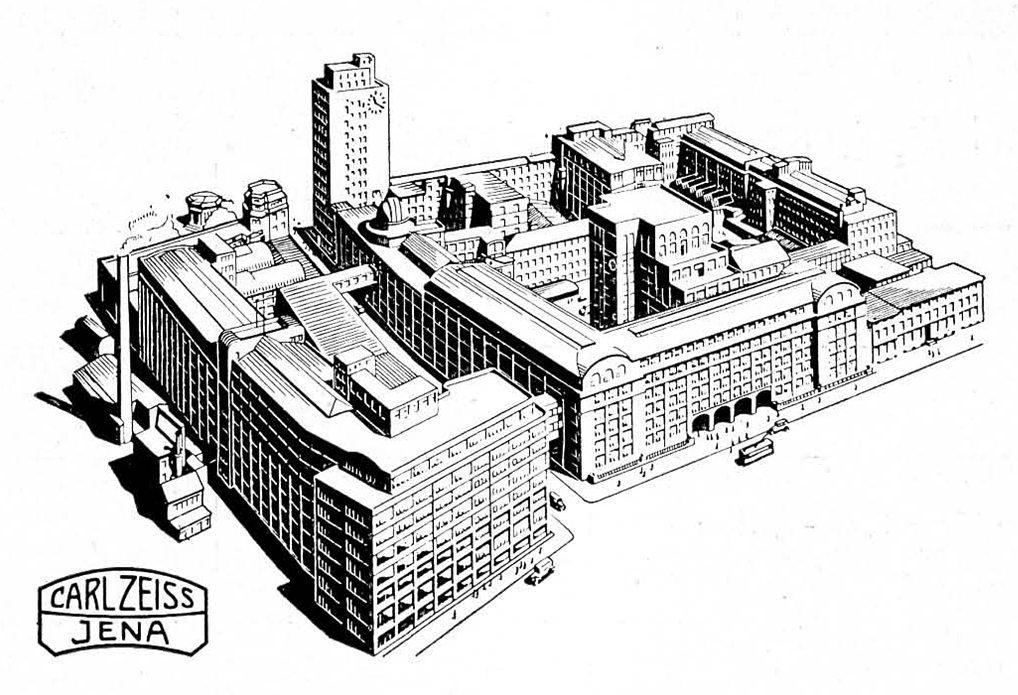
During the war, Jena had been pounded by allied bombing – the British bombed the Zeiss works on 27 May 1943, and the Americans repeated this twice in 1945. Mind you, there was not enough damage to put the factories out of commission but enough to slow production. Jena was captured by the American 80th Infantry Division on April 13th, 1945, and would remain in US control for two months before withdrawing in favour of the Soviet forces. As Americans departed, they took with them 122 key personnel from Jena to Heidenheim in the US zone of occupation (the personnel were from Carl Zeiss and Schott). At the conclusion of hostilities in 1945, Germany was split into differing zones, and as Jena was in the German state of Thuringia, it came under Soviet control (based on the Yalta Conference agreement).
A New York Times article in September 1946 suggested that the Russians were taking US$3,000,000 worth of finished products monthly for reparations [1]. At this stage there was very little in the way of dismantling equipment to ship back to Russia. In fact an earlier NYTimes article [2], suggested Russian occupation authorities had actually stimulated production at the Zeiss plants to pre-war levels, in order to facilitate reparations. It should be noted that the Zeiss plant produced more than just photographic optics – it also produced microscopes, medical and surgical instruments, ophthalmic instruments, geodetic instruments, electron microscopes, binoculars, etc., and military items [3].
The bombing damage to the Zeiss Jena plant
By 22 October 1946, the Soviet occupation authorities began dismantling the Zeiss plant [3] as war reparation payments agreed upon in the Potsdam Agreement. This was known as Operation Osoaviakhim, and involved many industries across Germany. It resulted in the removal of 93% of Zeiss’ equipment (including raw material, pipes, boilers, sanitary installations, etc), and 275 Zeiss specialists [4] deported to various locations in the USSR (approximately 90% of those deported would return to Jena in 1952). The taking of war “booty” was of course entirely legitimate, yet as Peter Nettl put it in a 1951 article, “Like a child long deprived of chocolate, the first Soviet ‘dismantlers’ flung themselves on all the available tidbits” [5].
A US intelligence report from July 1947 described the status of the Zeiss works at Jena [6]. In it they suggest that optical and photographic production had been least affected by the dismantling, with the plant producing lenses for the Soviets (Tessar 5cm f/3.5). The dismantling program had been completed by April 1947 [7], after which the Soviet High Command turned the plant over to the Germans, who re-established the plant. About 1000 machines remained at Jena after the dismantling, allowing for the continued production of eye glasses, camera lenses, medical glass and measuring instruments [8]. There was every hope at this time (at least from the West German side of things), that this was a temporary situation and that in 3-5 years Heidenheim staff would move back to Jena [6].
In June 1948, the Zeiss Jena plants were expropriated by the Land Expropriation Commission [9] and transferred to state ownership, becoming known as “VEB Carl Zeiss Jena”. In the American zone, Zeiss was reborn as “Opton Optische Werke Oberkochen GmbH” in 1946, becoming “Zeiss-Opton Optische Werke Oberkochen GmbH” in 1947, and Carl Zeiss in 1951. They had very little except the relocated personnel and supposedly a quantity of Zeiss documents. In 1949 Germany officially split into East Germany (Deutsche Demokratische Republik) and West Germany (Bundesrepublik Deutschland). Between 1948 and 1953 the two firms cooperated commercially with one another, after which cooperation deteriorated as the East German regime tightened control on VEB.
Like Zeiss, Zeiss Ikon (Dresden), best known for its Contax camera, also split in 1948. In the west, it was reformed into Zeiss Ikon AG Stuttgart. In the mid 1960s it merged with Voigtländer. It followed the Contax rangefinder line releasing the Contax IIa and IIIa cameras in the early 1950s. In the east, Zeiss Ikon became state owned, known as VEB Zeiss Ikon Dresden (ZID). ZID may be best known for its advanced SLR model, the Contax S, introduced in 1948.
Further reading:
“Russians take 90% of Zeiss Output”, The New York Times, Sept.10, 1946.
“Russians Increase German Industry”, The New York Times, July.5, 1946.
“Activities at the Zeiss Plant, Jena”, Central Intelligence Agency, Information Report, 28 May (1953)
“Deportation of Technicians and Specialists from Karl Zeiss, Jena”, Central Intelligence Group, Information Report, 13 January (1947)
Nettl, P., “German Reparations in the Soviet Empire”, Foreign Affairs, 29(2), pp.300-307 (1951)
“Status of the Zeiss Works in Jena and Moscow”, Central Intelligence Group, Intelligence Report, July (1947)
“Layout and Organizational Setup of the Jena VEB Carl Zeiss”, Central Intelligence Agency, Information Report, 29 August (1955)
“Dismantling, Production in the Societ Zone”, Central Intelligence Group, Information Report, May (1947)
Allison, R.C., “The Carl Zeiss Case”, The International Lawyer, 3(3), pp.525-535 (1969)
This FAQ covers more of the purchasing aspects of choosing a vintage lens, and is a follow-on to a post I did on buying cameras and lenses.
Is there a price list for vintage lenses somewhere?
Providing generic price information for a genre of lenses is extremely challenging. For example if someone asks what the price of a 50mm lens from manufacture X is, it really depends on a number of different factors: availability (or rarity), the current market, lens quality, speed, and even factors such as the mount type. For example the beloved Carl Zeiss 50mm Planar f/1.4 for a Contax/Yashica mount sells for C$400-600, whereas the same lens with an M42 mount is C$800-1200.
You can find some basic info on camera and lens prices attractive Collectiblend, however not all lenses are listed. There is no one encompassing place to find prices, yet sometimes eBay provides a good cross-section of the current market.
Why are some lenses so expensive?
Some lenses are expensive, either because the lens is rare, or has some attribute that makes it more expensive, or a review by someone with a lot of followers has pushed prices up. A good example is wide aperture lenses. If you are looking for a vintage f/1.0 lens, expect to pay a lot of money for it. For example a Leitz 50mm f/1 Noctilux-M lens is C$6-8K. A Canon 50mm f/1.2 rangefinder lens (LTM) will however only cost C$-400-800. Even a Helios 40, 85mm f/1.5 lens will fetch $500, even though it’s only real virtue is that it is considered the “Bokeh King”.
Why is there so much price variability?
The price of a lens depends on many factors, the same things that afflict super-fast lenses affect all lenses: rarity, quality of optical glass, manufacturer, lens quality, desirability. You will pay less for a 50mm f/2.8 than a f/1.4 and less for a Vivitar lens than a Pentax. Consider the following list of 50mm f/1.8 lenses, and their approximate market prices.
Carl Zeiss Planar 50mm f/1.8 − C$200-400 (M42 mount C$500-800)
Should I take a risk on a cheap item?
Sometimes there are sellers who are selling a piece of camera gear without knowing what they have, usually because it was part of an estate, and not something they normally deal with. If the item is cheap enough, there is likely very little risk, but if it seems too expensive, avoid it. This is especially true if the item is marked “rare”. A good reseller will mark the item as “untested”, or elaborate on the problems with the lens, e.g. sticky aperture, presence of fungus on the lens.
How do you know a lens will be in good condition?
You don’t, unless you buy from a reputable dealer. Someone who has been dealing in vintage photographic equipement for a long time, and sells a good amount of it will provide a good insight into a particular lens, including providing a quality rating.
If a lens physically looks good, it should be okay right?
Probably, but you just never really know. Unless a lens has some sort of provenance, it’s hard to know where it has spent its life, and what it was used for. Was it used by a photojournalist? Was it ever dropped? It is possible to drop a lens and see no external changes, yet it might cause minor misalignment of some internal working. Was it kept in cupboard in a damp room? So many possibilities. That’s the benefit of buying a lens in-person versus online.
How do I know if a shop is good?
This is tricky, but I suggest searching for reviews on the shop. There are a couple of online stores that have extremely bad ratings. Good shops will have an active social media presence, and often a physical store. The larger the store, the larger the amount, and scope of stock. Smaller stores tend to focus more on specialized or rare cameras/lenses. It pays to do some research.
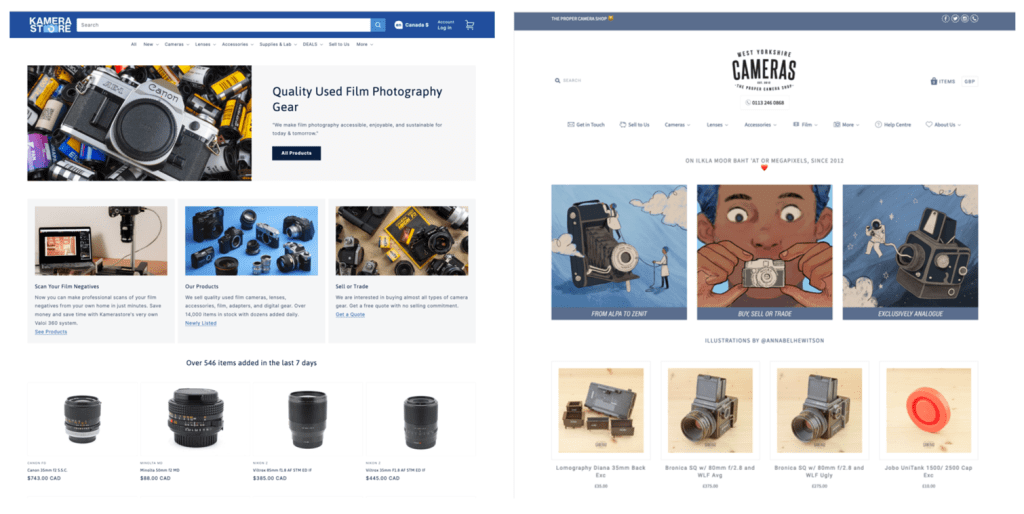
Two of the best vintage camera stores are Kamera Store (Finland), and West Yorkshire Cameras (UK). They both have quality vintage cameras and lenses, and provide exceptional customer service.
Are there red-flags for buying lenses online?
Yes – if a listing somewhere only has 1-2 images, and offers no real description, then stay well clear – unless of course it is a $1000 lens selling for $10, and even then you have to wonder what is wrong with it.
Is eBay any good?
Like anything, it really depends on the reseller. Some sell only camera gear, and have been doing it for a while, or have a physical shop and use eBay as their storefront. Always check the resellers ratings, and review comments.
There are a lot of lenses available on eBay from Japan – are they trustworthy?
In most circumstances yes. There are a lot of physical camera stores in Japan, so its no surprise that there are a lot of online stores. Japanese resellers are amongst the best around, because nearly all of them rate every aspect of a lens, cosmetic and functional. If something seems like a bargain it is likely because there are a lot of vintage cameras and lenses in Japan.
What should lens ratings include?
If we take the example of Japanese resellers, there are normally four categories: overall condition, appearance, optics, and functionality. Appearance deals with aesthetics of the lens, and indicates any defects present on the lens body, e.g. scratches or scuffs. Optics deals with the presence of absence of optical issues: haze, fungus, balsam separation, scratches, dust. Finally functionality deals with the operation of the lens, e.g. aperture stiffness.
In this post we’ll talk briefly about lens brands and manufacturers. When it comes to vintage analog lenses, people either choose a brand first, and then a focal length, or vice-versa. There are as many different brands as there are historic camera and lens manufacturers. Typically most vintage lenses come from East and West Germany, and Japan, largely because that is where the camera industry was focused. Choosing a brand can be a matter of personal interest, cost, or more often than not – popularity.
When looking at the type of vintage lens, you have to understand that there are different families of lenses, usually focused on a particular brand from a specific epoch. In order to choose a vintage lens it is important to obtain a basic understanding of the brand of interest – dates of manufacture, basic lens information (e.g. construction, materials, potential issues), and reviews. A particular 50mm lens from one manufacture may have evolved over many years, often with differing characteristics. For example the Asahi Super-Takumar 50mm f/1.4 appeared in 1964 as an 8-element lens, and evolved into a 7-element lens containing some elements which incorporated Thorium. It then became the Super-Multi-Coated Takumar, and finally the SMC Takumar. All have differing characteristics, although fundamentally they are all 50mm f/1.4 lenses.
These days there is quite a lot of digital material online, including scanned brochures, and lens reviews. The aim here is to just cover some of the more common manufacturers. Brands of lenses are generally divided into three major categories – (i) the core companies that produced cameras and lenses, (ii) companies with smaller 35mm impression, and (iii) independent companies that just produced lenses for many different manufacturers (not all camera makers produced lenses). To make it even more confusing, some camera companies rebranded lenses from other companies on their cameras. Many major manufacturers offered an extensive array of interchangeable lenses from extremely wide angle to mammoth telephoto lenses. In addition there were companies that specialize only in the development of lenses, including special purpose lenses.
Note that I have not included very small companies, e.g. Wrayflex, or companies who just produced cameras, and very few of their own lenses, e.g. ALPA (they used lenses from a number of manufacturers), Exakta (they only made/rebranded a couple of their lens as Exakta), or KW (makers of the Praktica line of cameras).
Landmark brand lenses
The first category involves milestone manufacturers who got into the 35mm game early, and focused heavily on SLRs. This means manufacturers like Asahi Pentax, Minolta, Yashica, Nikon, Canon, Leica, Zeiss Ikon, and Zeiss. These companies often may have started producing 35mm rangefinder cameras, and then transitioned to 35mm SLRs, and associated lenses (Asahi was the only one of these that did not produce a rangefinder camera). The exception here is Carl Zeiss, who did not make camera’s but was one of the largest optical lens manufacturers. They often designed a broad range of lenses to suit the needs of their cameras. These companies did not rely on 3rd party lens makers (although they did not prevent other companies making lenses for their cameras), and set the standard for many of the lens mounts used. Exakta, while manufacturing many cameras, and the bayonet-mount, designed few of their own lenses.
Second-tier brand lenses
Next are the companies that I consider second tier, i.e. they had a smaller footprint, made only SLRs or got into the game late. That’s not to say they didn’t make good lenses, but their lenses often don’t have the same character as the older lenses. They may have made cameras for other formats, or dabbled in the 35mm SLR market (because they thought they could compete), so the lenses available might just be an effect of short-lived cameras. This includes Konica, Fuji, Olympus, Topcon, Petri, Mamiya, Miranda, Ricoh, Rollei, Voigtländer. For example, Olympus did not introduce it’s first full-frame 35mm SLR, the Olympus OM-1 until 1972. Fuji first interchangeable lens SLR was the Fujica ST701 from 1970. Some of these manufacturers uses rebadged 3rd party lenses. For example Miranda initially used lenses from Zunow or Ofunar, and by the late 1950s had moved to Soligor.
Independent (i.e. 3rd party) brand lenses
The final level of brands are those companies who really just produced lenses. They essentially produced lenses for the cameras of other brands (or more commonly for specific camera mounts). They were 3rd party suppliers, and some were experts in lens design, having been in the business since the 19th century. This included a long list of German and Japanese companies, e.g. Meyer-Optik, Tokina, Soligor, Enna-Werk, Heinz Kilfitt, and Astro-Berlin. Some of these manufacturers produced a broad range of lenses for many different brands, while others produced specific types of lenses such a telephoto lenses. As they often focused solely on lenses, some of these manufacturers produced exceptionally good lenses.
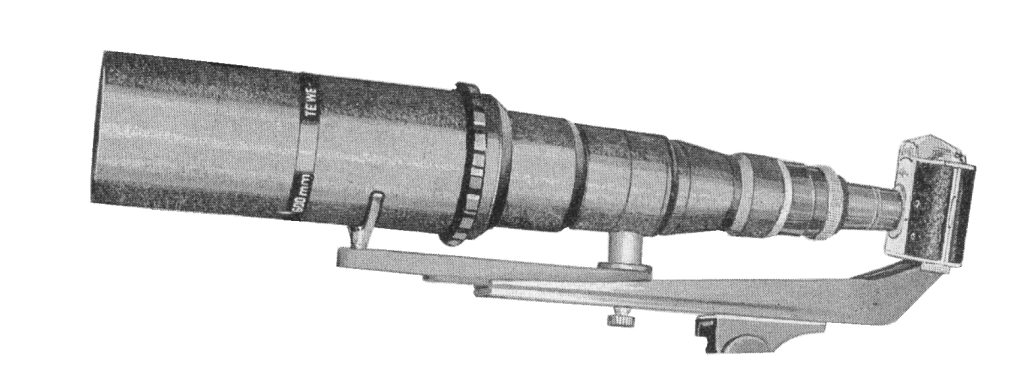
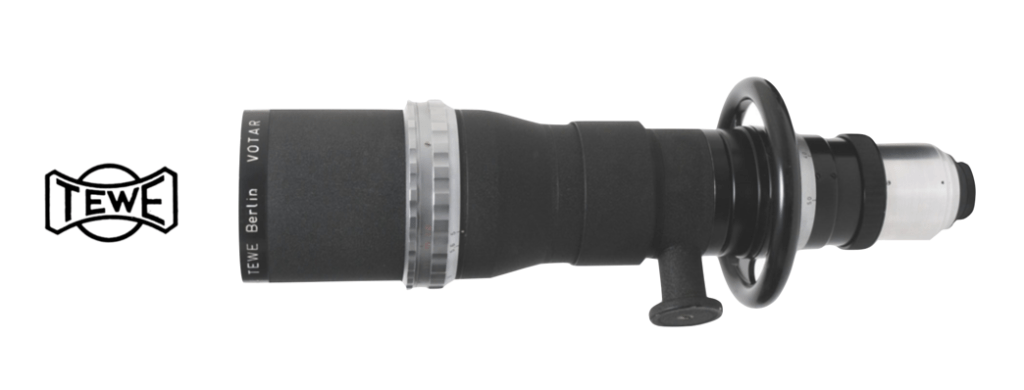
Tewe was a German company based in Berlin and well known for its long-distance lenses, up to 2000mm. Technische Werkstätten für Photo-Kinotechnik, Weiste & Co., TEWE OHG, was founded in 1935 in Schöneberg Berlin (in West Berlin during the Cold War period). The company initially developed long-focal length cinematic lenses, but by the 1950s and 60s they were producing long-focal length lenses for reflex cameras. Some of these lenses were designed in association with Astro-Berlin and Piesker. The company discontinued production in 1972.
Supposedly their lenses were used by astronomical observatories around the world, and lenses were well known for their “exceptional light intensity, unique brilliance, and needle-sharp, critical definition”. Their lenses were adapted for Exakta cameras, with lenses in the realm of 300-800mm.
Tewe Berlin Votar 500mm f/5
Some of the lenses produced by Tewe
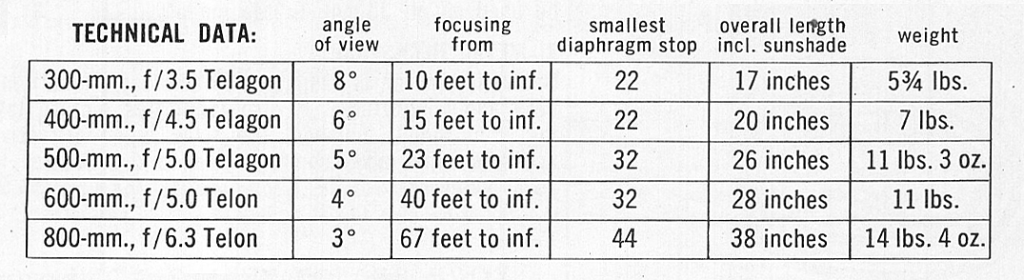
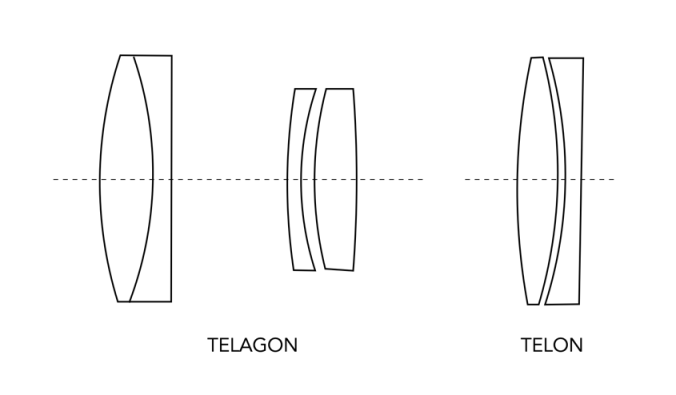
These lenses were sold in two lens configurations, Telagon, or Telon. The Telagon had 4 elements in 3 groups, whereas the Telon was 2 elements in 2 groups. The Telon lenses were available in 400mm, 500mm, 600mm, and 800mm for 35mm, and a 1000mm for 6×6 cameras. The Telagon was available in 300/400/500/600mm. These lenses were heavy – the Telon 800mm was 6.5kg!
C.A. Steinheil & Söhne is the oldest of Munich’s optical companies, founded in 1854. It was established by Carl August von Steinheil (1801-1870), who was a physicist, astronomer, mathematician, and engineer. The company manufactured telescopes, spectroscopes and photometers. Over time this was supplemented by the production of optical glass.
During one period there was a great indignation against adulteration of Munich beer by greedy brewers. In the early 1840’s Steinheil designed a “beer lens”, a triplet that consisted of two glass lenses, in the middle of which was a fluid lens, a tiny quantity of the beer. The gadget showed impurities by means of spectral comparison. This was known as the optico-areometric beer test, and was based on the connection between the light refracting power of the beer, and its constituents.
By the end of the 1930s the company had been renamed Optische Werke C. A. Steinheil Söhne GmbH. In 1954 the name Steinheil was trademarked in the USA. In 1962 the company was sold to the Elgeet company in Rochester (NY), followed shortly after in 1964 to the aviation conglomerate Lear Siegler in Santa Monica. This resulted in a decline in the manufacture of commercial lenses in favour of aerospace/military applications.
From the 1940s through to the 1970s, the company produced a myriad of lenses for Exakta, M42, and Leica mounts. Many of the early lenses had the classic chrome finish of the period. By the mid-1960’s Steinheil dumped the chrome finish in favour of black enamel finishes typically with a striped focus ring. Examples include Quinaron, Quinon, Quinar, Tele-Quinar, Culminar, Cassar, Cassaron, Culmigon, Cassarit, Macro -Quinaron, Macro-Quinone, Macro-Quinar, Macro-Cassarite, Exagon, Tele-Exaktar. Some examples include:
Auto Quinaron 35mm f/2.8 – extreme close focus to 11cm.
Auto Tele-Quinar 135mm f/2.8 – exceptional mid-range lens, aperture down to f/32, and a minimum focus distance of 12.5cm.
Tele-Quinar 200mm f/4.5 – excellent preset telephoto, aperture down to f/32, chrome body, 14-blade aperture.
Astro-Optik is one of a number of German optical companies that flew under the radar, due to its speciality lenses. It was founded in 1922 as Astro-Gesellschaft Bielicke & Co and based in Neukölln, Berlin (which would become part of West-Berlin). The founders were William (Willy) F. Bielicke, Hugh Ivan Gramatzki and Otto (?). Gramatzki (1882-1957) was a successful amateur astronomer and astrophotographer who published in the journal Astronomische Nachrichten, and headed the local branch of “Berliner Astronomische Vereinigung” for a number of years. Gramatzki invented the Transfokator in 1928. Bielicke (1881-1945) a German-American optical designer was involved in the technical development of the lenses and was responsible for the “Tachar” and “Tachon” lenses.
The 1000mm lens
So it is then not surprising that Astro-Berlin’s product range included lenses suitable for astrophotography and astronomical photometry. After the war the company focused on its film technology (Astro-Kino, Astro-Kino Color) developing lenses that had long and extremely long focal lengths, sometimes called “optical heavy artillery”. The company ceased operations in 1991.
The company produced a multitude of lenses, many under the brand Astro-Berlin. Astro-Berlin is likely most famous for its long lenses for cinematography and photography. These lenses were very simple consisting of one (f/5, f/6.3) or two (f/2.3) achromatic doublets. The f/5 lenses for 35mm came in 300mm, 400mm, 500mm, and 640mm lengths. The 800mm f/5 lens was designed for medium 60×60mm format, and the 1000mm f/6.6 for 60×90mm format.
mm
125
150
150
200
300
300
400
500
500
640
800
1000
2000
f/
2.3
2.3
1.8
3.5
3.5
5
5
4.5
5
5
5
6.3
10
Focal lengths (mm), and apertures of Astro lenses for 35mm/6×6 reflex mounts
In addition they produced quite fast lenses. In 1933 they introduced the Tachor f/0.95 which was available in various focal lengths. The 75mm version was suitable for an 18×24mm format (half-frame) but it was a large lens at 110mm in length with a frontal diameter of 81mm. The longest lens produced was possibly the 2000mm f/10 Astro Telastan. At times Astro also cooperated with the other Berlin optics manufacturers Piesker and Tewe.
Ads from Das Atelier des Photographen (1936)
These days, Astro-Berlin lenses are expensive on the secondhand market. For example the Astro Berlin Pan Tachar 100mm f/1.8 can sell for up to C$6000 depending on condition. However it is possible to find a 500mm f/5 lens for between C$900-1200.
Not a definitive list, but one which covers a few of the “tech” issues. More will be added as I think of them.
Are all lenses built the same?
Most manufacturing companies provided a good, clean environment for constructing lenses. That’s not to say that there won’t be lousy copies of a particular lens, as well as outstanding copies, due to manufacturing tolerances. This is exacerbated in some lenses from the USSR, mostly because the same lens could be manufactured in a number of different factories, all with differing levels of quality (which during the period could be true of any company running multiple manufacturing locations).
Are vintage lenses radioactive?
There are some lenses that produce low-level radiation because they contain one or more optical elements made using Thorium. It was useful in lens design because it gave optical glass of the period a high refractive index, so fewer lens elements would be needed in a lens.
What sort of aberrations do vintage lenses produce?
No lens is perfect (not even modern ones). Lenses can suffer from soft edges, chromatic aberrations, and vignetting. But that’s not to say these things are negatives. Some vintage lenses can create the same sort of distortions that app filters do – using the lens aberrations.
Do vintage lens have coatings?
Lens coatings first appeared in the 1930s, yet many early vintage lenses only had a single layer coating and as such many lenses are susceptible to internal reflections and lens flare. Lens coatings were made from a variety of materials, including rare-earth elements. Lens coatings were primarily created to eliminate or reduce light reflections. Through the practical application of lens coatings, a significant reduction in the reflective index of the lens allowed for more complex optical designs to be constructed. The lack of coatings can add to a lenses’ character.
Are vintage lenses sharp?
Vintage lenses may not be as sharp as modern ones, but then again vintage lenses aren’t really about sharpness. Older lenses are often sharp in the centre, but decreasingly so as you move to the corners. Stopped down to f/8 many produce good results. The reduced sharpness is due to the use of fewer low-dispersion optics, fewer anti-reflective coatings, and the widespread use of spherical elements in lens construction. The use of low-dispersion glass and aspherical elements has lead to finer detail in modern lenses.
Does bokeh matter?
Does it? Look honestly, buying a lens just for its ability to produce “creamy” bokeh is fine, but you still have to have the right circumstances so the lens will produce bokeh. Bokeh certainly adds interest to a picture, but it’s not the be-all and end-all some people make it out to be.
Is faster better?
An f/1.2 lens is often (incorrectly) considered to be better than an f/1.4 lens, which is turn is better than a f/1.8 lens, while an f/3.5 lens is not even considered. This misconception is derived, in part, from the fact that large aperture lenses are more costly to design and manufacture. However a high cost is not necessarily associated with better quality when all aspects of lens performance are considered. Large aperture lenses do benefit from superior light-gathering power, good in low light situations – but how often is this needed? Large aperture settings also suffer from a very shallow depth-of-field.
Why do later lenses have so few aperture blades?
Lenses of the 1950s often had a lot of aperture blades, from a low of 8 to a high of 18-20. This means that the apertures produced in scenarios such as Bokeh are almost perfectly round. However with the introduction of fully automatic aperture in 1961, there was a need to reduce the operating resistence of the blades, hence many manufacturers chose to reduce the number of aperture blades to 6.
Can vintage lenses be stabilized?
Vintage lenses don’t come with built-in stabilization. This is not a problem with cameras that have in-body stabilization like Olympus, but can be an issue with those that rely on lens-based stabilization.
Do vintage lenses produce EXIF data?
Vintage lenses do not have an electronic connection, so that means the camera will only record metadata (EXIF) for images relative to camera settings like shutter speed, ISO, FPS, picture profiles, etc. However, no lens data will be included, such as f-stop, or focal length. The camera also won’t think there is a lens attached, so it is necessary to change the setting “Release without lens” to activate the shutter release. This can really hamper some people as it requires taking notes while out shooting, and it isn’t always practical – like when you are taking a few shots in sequence. With no lens specific information, the camera has little ability to correct for things like vignetting.




 Crafting Pixels