In a 1956 copy of Popular Photography, there was an article on the German lens maker Kilfitt. In the article, reference was made to a 180mm f/1.9 lens called the Grand-Kilar… there was even a picture. But did this lens actually exist? Well according to vague literature, it appeared in 1955, a 4-element lens, designed by A. Burger. But brochures of the early 1960’s show nothing in the way of 180mm lenses. It does appear in various editions of Arthur Cox’s “Photographic optics” in the 1960s, however searching the net does not seem to yield anything in the way of tangible proof to suggest any exist today. Perhaps very few were actually manufactured. In comparison the to SLR, it seems like a massive lens for the period.
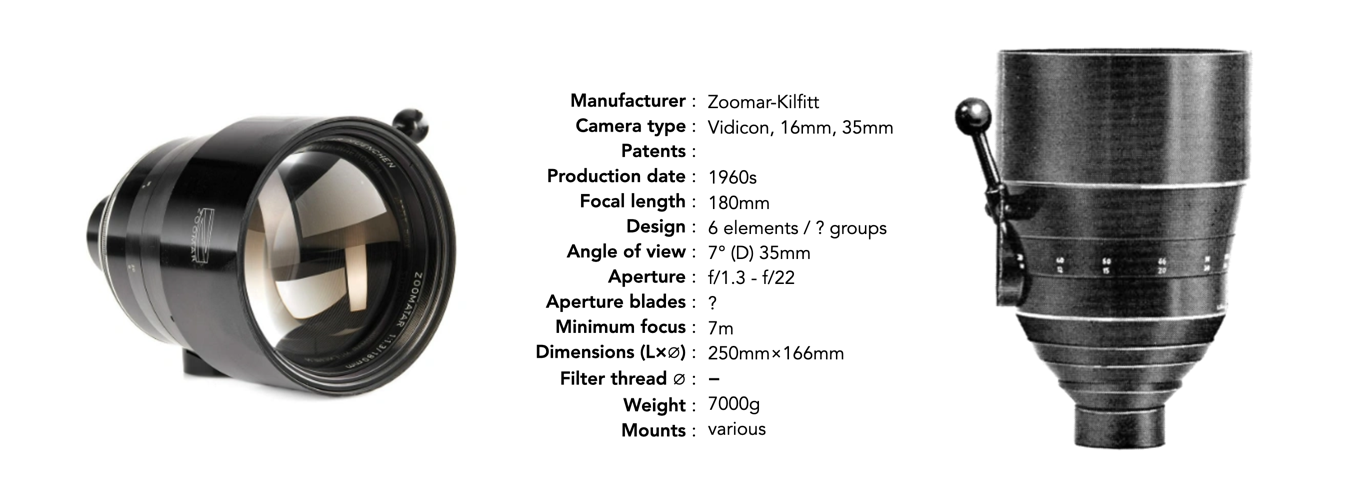
We now look at a fast telephoto lens – the Zoomatar 180mm f/1.3. This lens may have been a natural successor to the Grand-Kilar, the lens that seemingly never was. It was produced in the period after Zoomar Inc. took over Heinz Kilfitt. It is one of the fastest lenses above 100mm.
It was one of two super-fast telephoto lenses produced by Kilfitt in the 1960s, the other being the Zoomatar 75mm f/1.3. Both were intended for use in cinematography, with the 180mm also able to cover the 36×24mm area of normal SLRs. It seems like the 180mm lens was designed with the sole purpose to allow a maximum amount of light in, and it had the proportions to justify this – it was 250mm in length, had a diameter of 166mm, and weighed an astonishing 7kg – heavier than their Reflectar 1000mm f/8.
Kilfitt Zoomatar 180mm f/1.3
It has an optical scheme with six lenses, with a large difference between the diameter of the front (140mm) and rear (31mm) elements. Interestingly, because this lens was a cinematographic lenses, there is also some data on light transmission. Supposedly the light transmission was 80%, giving a T-stop of 1.5. Unlike the 75mm lens which was only supplied in C-mount, the 180mm lens came in various film formats (16mm and 35mm cine), in addition to 35mm. This means the angle-of-view could range from 3° on 16mm film to 7° on 35mm film. In 2011, one of these lenses sold on eBay for US$10,480.
Super Zoomatar 240mm f/1.2
Considering it sold in the mid-$2000’s in the 1970s, I don’t imagine many were actually manufactured (I have seen estimates of between 50-70). Zoomar did however create an even faster lens, relative to focal length – the Super Zoomatar 240mm f/1.2 – it was a behemoth at 11kg. It was originally developed for instrumentation cameras and for use with image intensifier tubes.
On the heals of the Biotar 75mm f/1.5, I came across a posting for a Biotar 70mm f/1.4 in a Leica L39 mount. Was this a real lens? The serial number of the lens is 2620709, and it was selling for ca. C$78K. The serial number suggests it was produced in 1939.
This is a strange lens because there is very little information regarding its provenance. CollectiBlend suggests only 116 lenses were produced between 1929 and 1939. Most seem like they have been adapted to mounts such as M42. The early 1930s Zeiss catalogs do specify a 70mm f/1.4 lens, however it is for cinematographic work, specifically recommended for 40×35mm format. By the late 1930s they were also being advertised for miniature, i.e. 35mm cameras. This was however not advertised for use with either Contax 35mm camera offered by Zeiss-Ikon, which advertised a 85mm as a portrait lens.
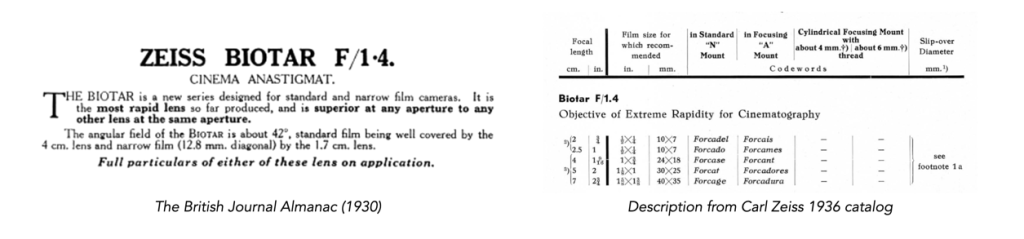
Early brochure information on the Biotar f/1.4
According to the catalogs of the period, there were a series of f/1.4 Biotars, in 2cm, 2.5cm, 4cm, and 5cm focal lengths in addition to the 7cm (70mm). The Biotar initially played virtually no role at all for still image cameras. In fact one of the most numerous Biotars produced at that time was the Biotar 2.5cm f/1.4 which went into production in1928. By the end of WW2, just over 1,300 units had been manufactured, most of which were delivered to Bell & Howell or Kodak, but also to Siemens, among others. The Biotar 4cm f/1.4 was created as a medium focal length for 18×24mm standard film cameras – the format used in 35mm cine cameras.
Dating based on serial numbers: 2620709 (1939) and 950044 (1929-30)
Now I have seen three different versions of this lens, none of which really meshes with the descriptions found in early catalogs – here the lenses are cited to a mount diameter of 60mm, and come in either an “N” mount (for cameras with bellows extensions), or an “A” mount (for folding and other hand cameras). The few lenses available today are in the form of re-housed optics, i.e. the lens has been adapted at come point to fit mounts like the Leica mount. Some of these lenses were made for “miniature” cameras, and so some may actually have native LTM mounts.
Not every fast vintage lens is a 50mm. Sometimes others are fast in relation to their focal length, like the Carl Zeiss BIotar 75mm f/1.5, considered by some to be the original ‘King of Bokeh’. The lens has a reputation for creating an incredible picture, which can be partially attributed to its ability to produce amazing bokeh, which was not exactly something that was mainstream in the mid-decades of the 20th century.
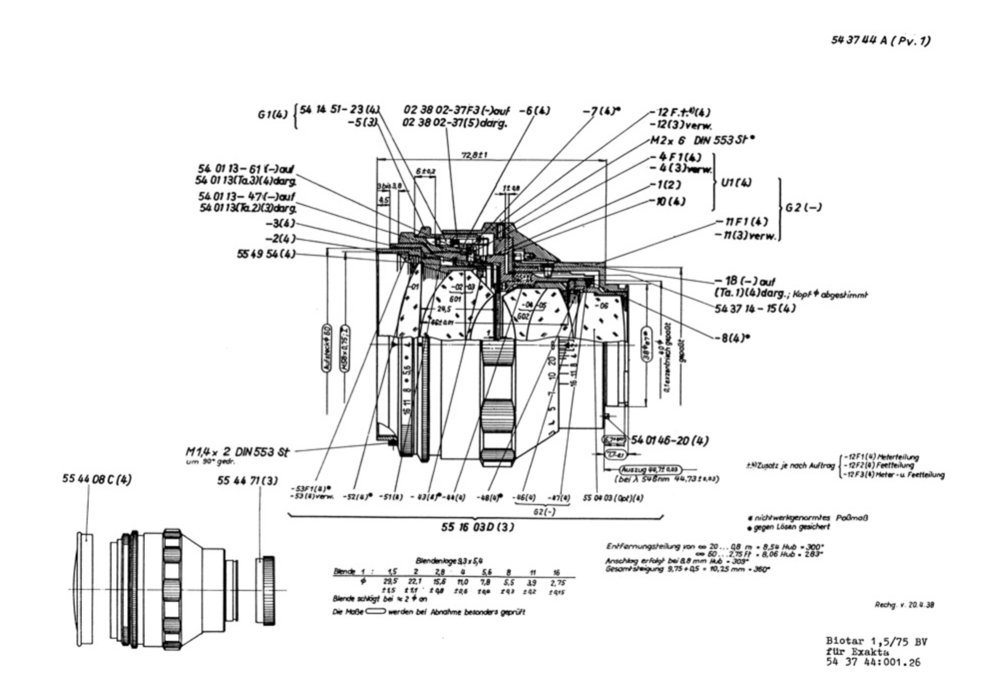
The Biotar lenses were designed in 1927 by Willi Merté (1889-1948) for cine cameras (Patent No. DE485,798). Merté continued developing the Biotar lenses, and in 1938 introduced the Biotar 75. Construction was complete by April 1938, and the lens went into production in February 1939. It was quite radical for the time, especially considering that all calculations for these systems were performed manually, i.e. by humans. It is often the reason very few of these lenses changed their specifications. The lens is a 6-element, 4-group, Double-Gauss optical design.
The first copies were made for cinematography, followed shortly after for Ihagee’s 35mm Kine Exakta. The advent of WWII meant that few lenses were sold, and those sales were likely restricted to lens enthusiasts who could afford them. Based on the available literature, it doesn’t seem like any were exported from Germany. In 1943, competition arrived in the form of the Leitz Summarex 85mm f/1.5. The design was a 7/6, but was prone to flaring, and heavier, at 700g to the Zeiss’s 500g. Post-war more competition in the German market resulted in the Meyer-Optik Görlitz Primoplan 75mm f/1.9; the Enna-Werke Ennaston-Lithagon 85mm f/1.5, and the Carl Zeiss Jena 85mm f/2 Sonnar. By the mid 1950s there was also competition originating from Japan.
“The ultra-light intensity of the 75mm ‘Night Lens’ ensures adequate exposures even under the most adverse lighting conditions, i.e. theatre, circus, cabaret, and night life. As this particular lens is more than three times as fast as the 2.8 lens, successful pictures can be obtained in towns and cities, illuminated only by normal street lighting.”
Exakta Varex IIa brochure, 1958
The three Biotar 75mm variants
There are three known variants of this lens. The first pre-war variant is known as the “skinny” Biotar 75. Introduced in 1938, this version has a thin, compact barrel. It was supposedly made of brass with a chrome-plated finish (although it is likely this changed to aluminum during the war). This lens were predominantly made for the EXA mount (not surprising considering the Exakta was the prominent 35mm SLR of the period). Early versions did not have an anti-reflection coating on the glass surface, which could cause flare when shooting against the light. Coatings, marked with a red “T”, began to be applied during the war (possibly for the military).
Carl Zeiss Jena Biotar 75mm f/1.5 Ver.1
After the war, Zeiss-Ikon was to release the Contax S, which used the M42 screw mount. Zeiss redesigned many of their lenses to take on the M42 mount. This resulted in the second version of the lens, produced between 1946 and 1952. This lens made use of lanthanum-containing Schott glass for its lens elements. This version was made in East Germany. Starting with this model, aluminum was used for the lens barrel to reduce weight. Additionally, the minimum aperture has been changed to allow up to f/22. In this variant, mounts for M42, Leica (L39), and Praktina were added, and it was compatible with at least five types of mounts, including those for Exakta and Contax. All have the “T” coating, although it may not be marked with a red “T”. Around 1950 markings were changed from 7.5cm to 75mm. The distance scale is a single one, which is very easy to read.
Carl Zeiss Jena Biotar 75mm f/1.5 Ver.2
The third version of the lens was produced from 1952-1968, as is known as the “fat” Biotar 75. This version has a solid barrel with a knurled/scalloped focus ring, a double distance scale, i.e. numbers on either side. The diaphragm is now preset, and the minimum aperture is back to f/16.
Carl Zeiss Jena Biotar 75mm f/1.5 Ver.3
The lens had various names over the 1950’s based on where it was sold. The lens was known as Nachtobjektiv Jena B (Night-lines Jena B), Zeiss-Biotar, “Jena B”, or just Biotar.
The lens is truly a pivotal design, it was not until new types of glass were designed, and the advent of computer-aided optical development that further progress could be achieved, ultimately leading to the Zeiss Pancolar 75mm f/1.4 in the mid-1960s. The 75mm lens itself would not really feature in the future of lenses, supplanted by the 80mm and 85mm focal lengths. Over its 30 years in existence, only roughly 20,000 copies were made. Supposedly they were made in very small batches (100-200) due to the nature of the lens – the optical elements required large pieces of flawless glass.
Zeiss specs for the “fat” version
In the early 1950s, the lens sold in the USA as a “high speed lens”, for around US$216, which is US$2,500 in 2023 based on inflation. In Germany in 1953, this lens sold for DM596 (which when converted was cheaper than in the USA (US$141). Today these lenses sell anywhere from US$2000-6000+ depending on condition, and variant. An alternative, which honestly costs a whole lot less, is the modern Biotar 75 f1.5 II, from Meyer Optik Görlitz (it sells for €1400, ca. C$2000).
NB: You can always tell when a Zeiss lens was manufactured from the serial number.
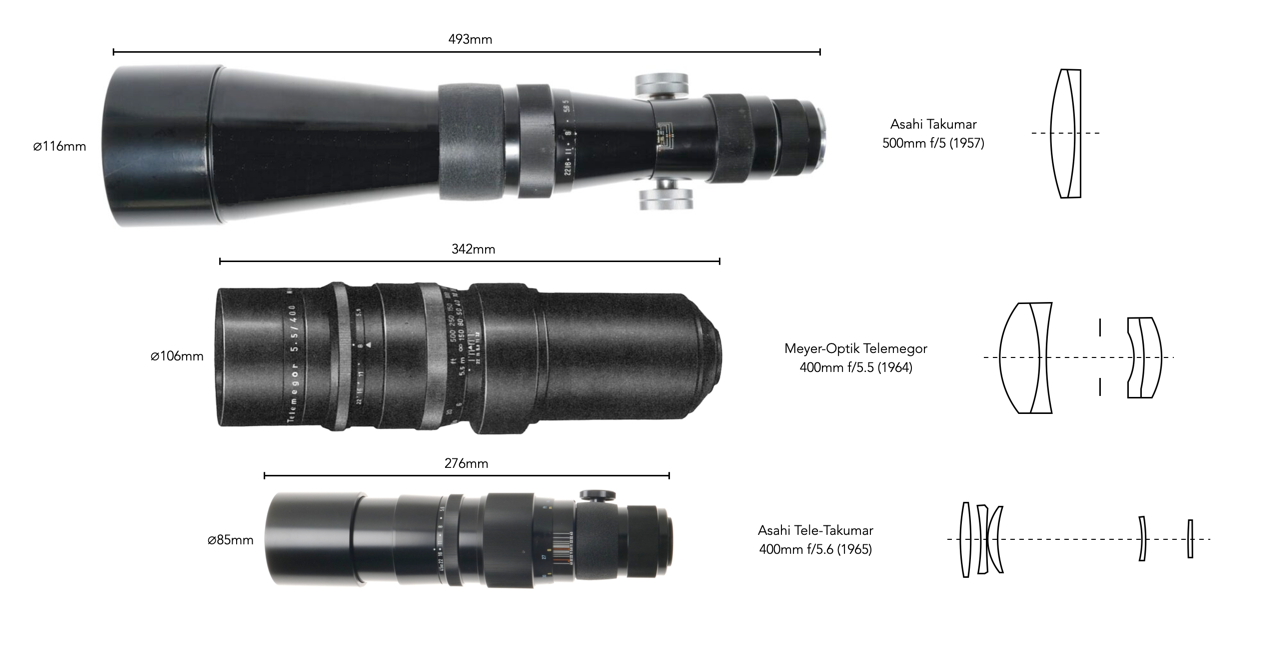
A long-focus lens is a lens that has a focal length longer than the diagonal measure of the film or sensor. A telephoto lens is a sub-category, whereby a lens contains a group of elements that allow the physical length of the lens to be shorter than the focal length. Therefore all telephotos are long-focus lenses, but not all long-focus lenses are telephotos.
The most important difference between a long-focus lens of conventional construction and a telephoto lens of the same focal length lies in the overall length of the lens. Thus, a conventional 400mm lens will be positioned roughly 400mm away from the film, and will be fitted in a lens barrel approaching 400mm in length. Many of the lenses produced by companies such as Tewe were long focus lenses. A telephoto with a focal length of 400mm, on the other hand, may be as little as 300mm in length, and will be usually much lighter in weight than the conventional lens.
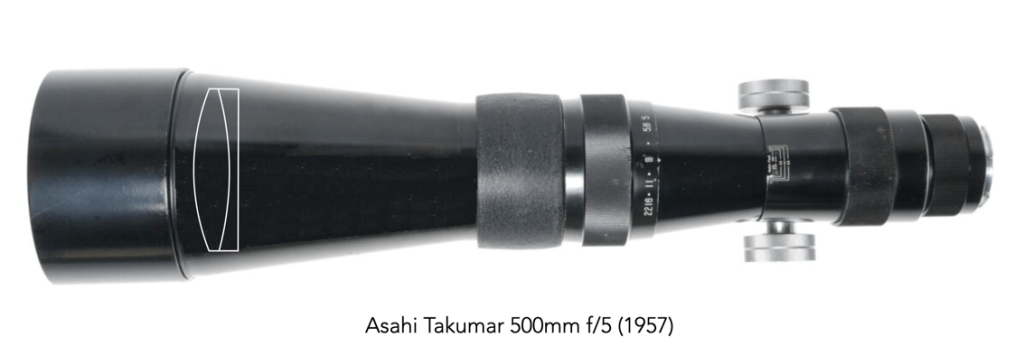
A tale of three different 400mm long focus lenses. The Telemegor and Tele_Takumar are telephoto lenses, the Asahi Takumar 500mm is a pure long-focus lens.
The reduced length of a telephoto is derived by using a more “complex” optical design. One tremendous advantage of the telephoto construction is that it permits the use of lenses of very great focal length – lenses which would be impossibly heavy and inconvenient if the normal construction were used. Historically, long focus lenses, with focal lengths up to 2000mm, were often so big that it was customary to support the lens on a sturdy tripod.
Lenses are funny. Lenses with small focal lengths usually contain a lot of glass, conversely those with long focal lengths contain very little. Why is this the case? Shouldn’t telephoto lenses be filled with optical elements? The answer is no, and it’s because of the nature of how telephoto lenses, or in this case long-focus lenses, work – vintage telephoto lenses are not all built in the same way.
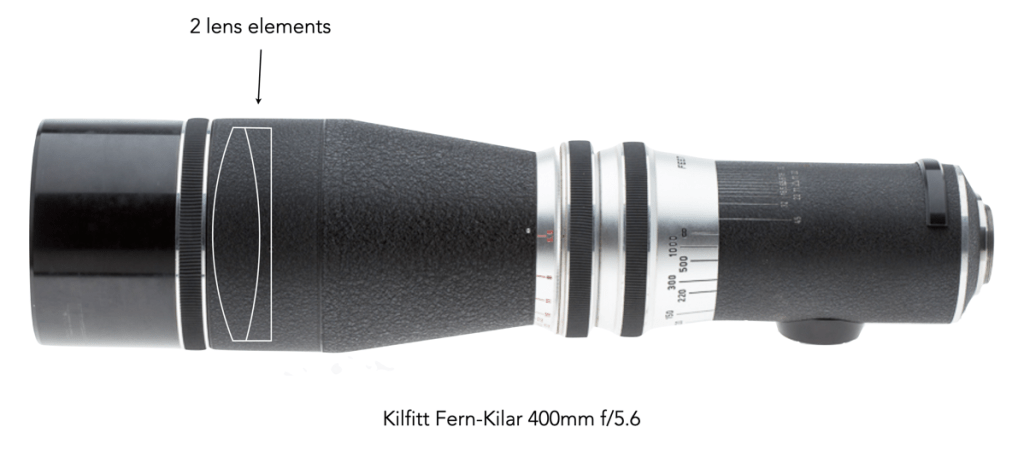
The famous 400mm lens from “Rear Window” only has two lens elements.
There are some vintage long-focus lenses that have a mere two elements – many of these lenses have extremely long focal lengths. These two-element lenses were often cemented together, positioned in front of the diaphragm, with very little in the way of anything else in the lens barrel. Simple lenses of the type are capable of excellent definition if the field is restricted to a few degrees from the axis and the aperture is not too great.
This type of 2-element lens was made by a number of different manufacturers:
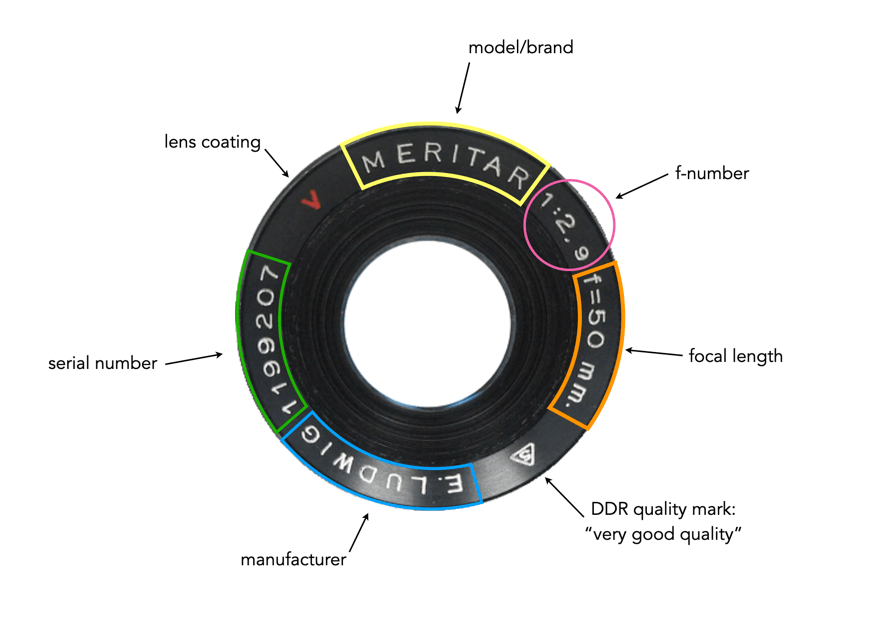
Vintage lenses are festooned with markings. There are the numbers related to focusing, and the f-stop values, but the details engraved upon the lens name plate will explain most things about the lens. This post will look at vintage lens markings by investigating a few examples. In general, most lenses have 5-6 markings: (i) lens model/brand; (ii) maximum aperture (speed); (iii) focal length, (iv) serial number; (v) company; and (vi) place of manufacture (these are shown in Figure 1 using colour coding to highlight). In addition there may be some symbols used to denote specialty characteristics such as lens coatings. These markings are usually found on the front of the lens on the rim sounding the first element. On lenses where there is no room on the front of the lens, the lens marking are usually found circumscribed around the outside of the lens.
Fig 1. The various markings on a lens (colour coded)
The first two items described are the manufacturer (or brand), and the type or name of the lens. In this case the manufacturer is E.Ludwig, and the type or name of the lens is a MERITAR. Most vintage lenses also provide the len’s serial number on the name plate – in this case 1199207. With come manufacturers the serial number helps track down information like where, and when it was manufactured. The most important information is the 1:2.9, which basically specifies the speed (maximum aperture) of the lens, here f/2.9. The last piece of information is f=50mm which specifies the focal length of the lens. On this particular lens there is also two additional symbols which specify lens coating and a quality mark.
Fig 2. Lens markings on various brands (same colour-coding as Fig.1, with the addition of red to denote place of manufacture)
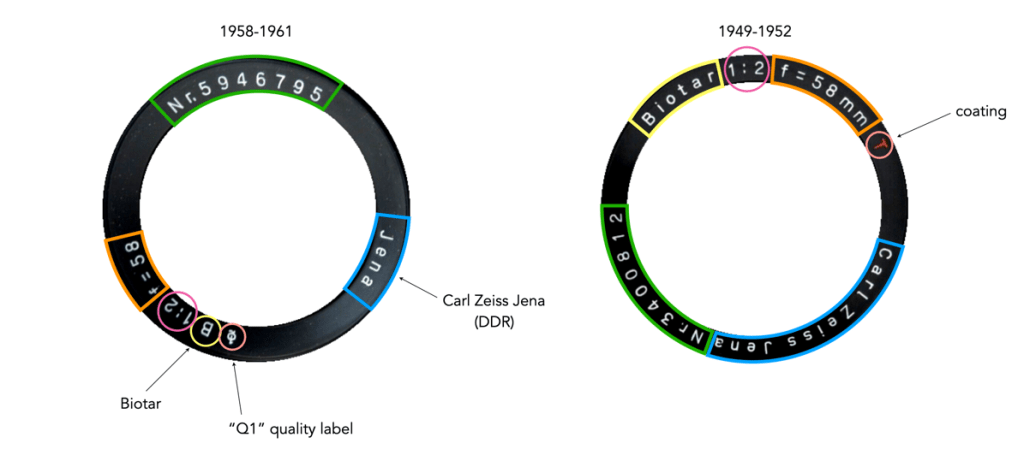
Figure 2 shows three more examples of lens markings from Kilfitt, Asahi, and Enna. Figure 3 shows lens markings from Zeiss Biotar 58mm f/2 lenses from two differing periods. The latter one has more cryptic lens marking – there is less info here because the lens was produced during the infamous Zeiss trademark dispute. Zeiss Jena in East Germany marked the Biotar lenses with a “B”, in order for them to be sold in the west.
Fig 3. Zeiss Biotar lenses from two differing periods
The focal length/aperture combination is the one thing that can be described in a number of different ways. The f-number is normally specified using a ratio, 1:x, rather than the f/ term. On some lenses the length and aperture are combined in the form aperture/focal length, e.g. 2.8/50. It’s actually somewhat rare to see f being used to specify maximum aperture, instead it is often used to signify focal length, e.g. f=58mm. Focal length is nearly always specified in metric, the only difference being that up until about 1950, many lenses were specified in centimetres, whereas afterwards the focal length became more standardized using millimetres. So an early lens might have been 5cm, versus the more standardized 50mm.
Fig 4. Specialized lens markings found on various German lenses.
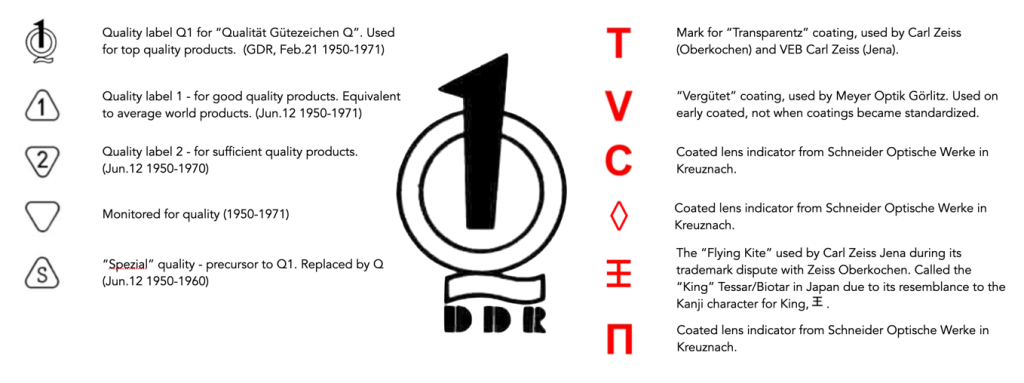
Sometimes vintage lenses also carry other markings. Sometimes instead of a brand name, there is a logo to signify a brand. This is common in vintage Russian lenses where the same lens could have been manufactured in more than one plant. Some lenses also have a number with the diameter symbol, ∅, which indicates the filter size of the lens in mm. Some lenses also use letters to signify the presence of lens coatings, e.g. Meyer Optik specified a lens coating using a red “V”, after the focal length (which means Vergütet = coating). Examples of specialized lens markings for German lenses is shown in Figure 5.
Fig 5. Types of specialized lens markings found on German lenses.
Some online photographic stores have lenses that are marked as “rare”. This is sometimes a bit of a red flag, because as is often the case, these lenses are not really rare. Rare sometimes indicates that the seller has priced the lens high, even if the lens has defects. It is possible that “rare” emanates from an internet search that found few comparable lenses. For example there is nothing rare about a Helios 44-2 58mm f/2 lens, certainly not one that usually sells for under $100. There may be some early versions of the lens, e.g. the early “silver” ones, that are less common, but the lens itself is not rare. Rare lenses do exist, but these are usually rare because few were produced, or few are available. The Helios-40, 85mm f/1.5 is a less-common lens, and could rightly be portrayed as rare. In many respects it would be better to use the term “uncommon” when describing lenses that have low availability, leaving “rare” for the truly rare lenses.
Truly rare lenses include the likes of the Fisheye Nikkor Auto 6mm f/2.8, which can be worth upwards of $150K. The Canon 50mm f/0.95 on the other hand could probably be considered uncommon, as only 20,000 were produced. The Konica Hexanon 60mm f/1.2 is even rarer, with only 800 units supposedly produced. However it is fairly hard to define a Zeiss Sonnar 135mm lens as being rare, because a lot were produced, and there is nothing inherently special about them just because they are branded ZEISS (they sell for about C$75) – vintage 135mm lenses are a dime a dozen. The only rare 135mm lenses are those from companies who produced very few, or the lenses themselves had some sort of interesting or exclusive characteristic.
Is it rare or uncommon? The distinction is not always an easy one.
There are many reasons a lens could be considered rare. Vintage lenses with small focal lengths, or super-fast speeds (for a particular period) will always be quite rare, because few were likely produced (they were expensive to produce). A good example is the Vivitar Professional 135mm f/1.5 (T-mount) – nobody would necessarily use the terms Vivitar and rare in the same sentence, but is a special lens. Possibly only a few hundred of the 135mm lenses were made, having been originally produced for NASA in 1966-1967. But it’s claim to fame is that it was a superfast 135mm (and it was super large, 140mm long, 100mm diameter, and 2kg in weight). There are few, if any, on the market today.
A further reason is that a lens may represent the first of a series, or has some particular historical significance. A good example is the first 35mm macro lens, the Kilfitt Macro Kilar D 40mm f/3.5. Or perhaps it is rare because it is a pre-war lens – for example associated with the release of the Kine Exakta, the first 35mm SLR. A good example of this is the famed Biotar 75mm f/1.5, released in 1939, and was the fastest portrait lens at the time. Still another form of rarity – one where a lens is very rare in one version, but commonplace in another, even though both versions being optically identical – usually has something to do aesthetic differences between the the lenses, or the amount of time it was in production.
Some lenses are marked “rare” for the pure shock value – because if people think a lens is rare, they will be more likely to purchase it. So before buying a lens make sure to determine whether the lens is in fact rare, and whether it warrants the price being asked. In addition avoid purchasing a rare lens that is severely deficient, e.g. has stiff focusing or aperture mechanisms, or optical fungus. Spending $1000 on a defective lens, even if it is rare, is somewhat foolhardy (unless you are a collector, and have no plans to actually use the lens). It can be very challenging to have a rare lens repaired, depending of course on the type of damage – first it is hard to find someone to repair it, and it may also be hard and expensive to find parts (rare lenses means rare parts). For example I’ve seen one ad for a Konica Hexanon 57mm f/1.2, for C$500, cited the lens as being rare, with a series of caveats – internal spots of fungus on the optics, and stiff focus, and aperture mechanism. It turns out this lens is one of the least rare Hexanon lenses.
Note that some sellers use the term “rare find”, which is somewhat different in context. A rare find implies that there aren’t many available at a particular time.
P.S. Another term to be wary of is “mint”, which means pristine, or unblemished. Is it truly possible to define a lens as being devoid of all defects? Most vintage lenses contain contain at least some sort of dust internally (unless it was stored in its box in the right conditions for the past 50+ years).
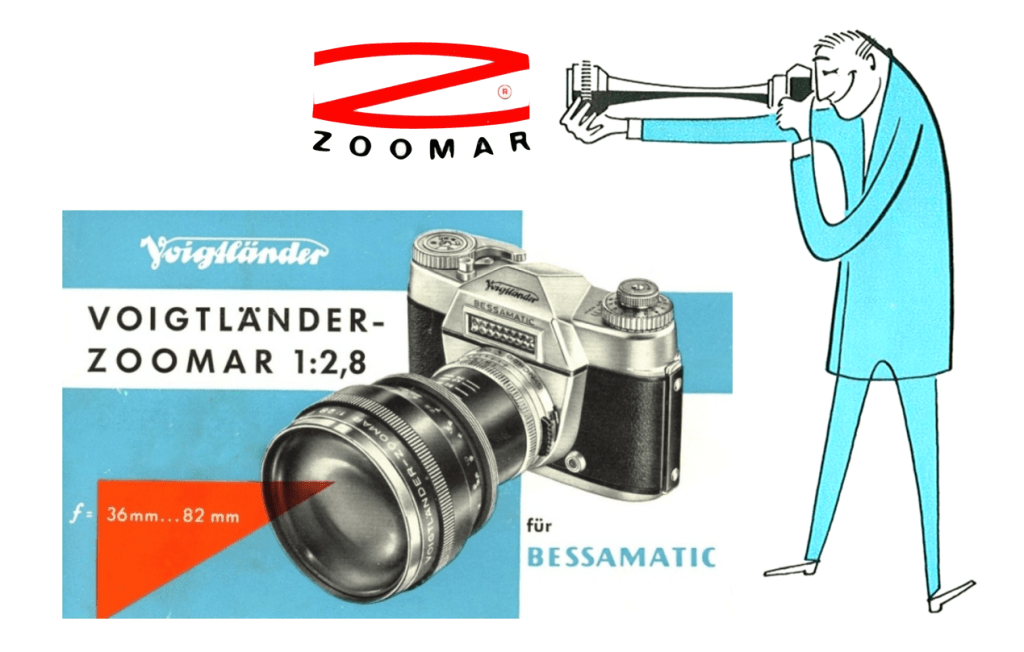
Historical accounts of who actually invented the zoom lens differ. But its adaptation to the SLR is down to one person – Frank Gerhard Back. He designed the first zoom lens for 35mm cameras – the Voightländer Zoomar. Before the Zoomar saw the light of day, designs with adjustable focal lengths were called varifocal lenses or rubber lenses.
“A great number of optical problems have been overcome in this lens. It is a splendid achievement. It zooms – what other still lens does?”
Look! A real zoom lens for your 35mm, Herbert Keppler, Modern Photography (May, 1959)
Back was born in Vienna, Austria in 1902. He attended the Technische Hochschule of Vienna where he received a masters in mechanical engineering in 1925, and a doctorate of science in 1931. From 1929 to 1938 he worked as a consulting engineer during which he was employed by Georg Wolfe, a manufacturer of endoscopes. In July 1939, he emigrated to the United States. After working for various companies in New York City, he started his own company in 1944, Research and Development Laboratory. In 1945 he started Zoomar Inc. where he developed and patented an optically-compensated zoom lens for 16mm television cameras (1948), and one for 35mm SLR cameras by 1959. From the late 1940s through to the 1970s, Back introduced new innovations for television, motion, picture, film photography, astronomical, and numerous other applications. On 25 October 1946, Back presented a new type of variable focal length lens to a convention of the Society of Motion Picture Engineers (SMPE) in Hollywood, California. The lens, sometimes known as the could zoom from 17 to 53mm, and contained 22 lens elements. It was 12” in length, weighed 790 grams and had an aperture range of f/2.9-f/22 [3].
Zoomar lenses disrupted the market for American television camera lenses, and likely were the catalyst in making zoom lenses ubiquitous in the industry. Back’s Zoomar lens had a substantial impact on both the motion picture, and television industries in the years following. It gradually made the “practice of “zooming” a more desirable, acceptable, and practical technique, in turn spurring demand for zoom lenses suitable for feature film use, with higher optical quality and greater zoom ranges. By 1954 a more compacts version of the “Zoomar 16” appeared – 5” in length, and weighing 570g it now had a zoom range of 25-75mm. It is not surprising that the concept would eventually spill over into the still camera industry.
In Back’s design, four of the lens’s 14 elements (the lenses in groups 2, 3, and 6 move linearly together to allow for focal length changes) move from 36mm to 82mm. A ×2.3 range from 36mm to 82mm allowed the lens to retain a reasonable speed of f/2.8, good image sharpness, and optical anomalies kept to a minimum (something earlier varifocal lenses could not achieve). The use of the word “zoom” likely derived from the Zoomar name. The lens used a push/pull mechanism to change focal length, whereby the change of focal length happens when the photographer moves the ring towards the mount or backwards.
Zoomar lens schematics (the lens diagram shows the 36mm and 82mm positions of the moving lens components).
Optically, the Zoomar 36-82 was a great breakthrough, made possible according to Dr. Back by new rare earth element glasses (Lanthanum) and computer aided optical designs. Back filed two patents in 1958 [6,7], one for optical design, and another for mechanics, likely at the same time production was already gearing up. Starting in 1959 the German optics firm Heinz Kilfitt would build the lens, under contract with Voigtländer for their Bessamatic SLR. The Voigtländer Zoomar was presented to the public on February 10, 1959 at the International Camera Show in Philadelphia (the same show that introduced the Nikon F and Canon Canonflex). Back would file another patent relating to an improved optical design in 1959 [8]. This optical design modified the rear lens elements, both in the type of element, and the material from which they were constructed.
Thelens optical design in Patent No. US2902901
By the late-1950s, Zoomar was to have some legal issues regarding its patent, fighting a patent battle with Paillard Products, the US subsidiary of Swiss company Paillard-Bolex, which had been importing French zoom lenses. In 1958 the New York Southern District Court ruled that Back’s patent overreached by appearing to cover all zoom lenses of any design. Zoomar eventually reduced its R&D of new lenses in favour of promoting foreign-made lenses – Back purchased Heinz Kilfitt in 1968 (catalog).
“The Voigtlander-Zoomar is the only Zoomar lens for still cameras. This model, with fully automatic diaphragm, is designed expressly for use with the Bessamatic Camera. A high-precision varifocal lens, in focus at all focal lengths from 36 to 82mm, it enables the photographer to shoot continuously at variable focal lengths without changing camera position.”
Description from the manufacturer.
The lens was produced from 1959-1968, with a total of only 15,000 units being built. Today the Zoomar 36-82 f/2.8 is often associated with the Voigtländer Bessamatic SLR. However the Zoomar was introduced from day one in both the DKL (Voigtländer) and Exakta mounts. Later it was also produced in other mounts, including the ALPA, and an M42 mount for the East German cameras like the Ikon Contax S. By the early 1960’s there were more zoom lens options, mostly in the telephoto zoom realm. None were anything special when compared to prime lenses, as they often had increased distortion and less contrast, but these were often overlooked because of the “newness” of the technology. It is still possible to find these lenses today, with prices in the range of C$700-1200 for lenses in reasonable condition.
✽ The Zoomar actually had a doppelganger – the Russian Zenit-6 camera came standard with a zoom lens called the Rubin-1. It wasn’t exactly the same, the focal length is shorter at 37-80mm and both had different zooming mechanisms.









 Crafting Pixels