Vintage lenses are festooned with markings. There are the numbers related to focusing, and the f-stop values, but the details engraved upon the lens name plate will explain most things about the lens. This post will look at vintage lens markings by investigating a few examples. In general, most lenses have 5-6 markings: (i) lens model/brand; (ii) maximum aperture (speed); (iii) focal length, (iv) serial number; (v) company; and (vi) place of manufacture (these are shown in Figure 1 using colour coding to highlight). In addition there may be some symbols used to denote specialty characteristics such as lens coatings. These markings are usually found on the front of the lens on the rim sounding the first element. On lenses where there is no room on the front of the lens, the lens marking are usually found circumscribed around the outside of the lens.
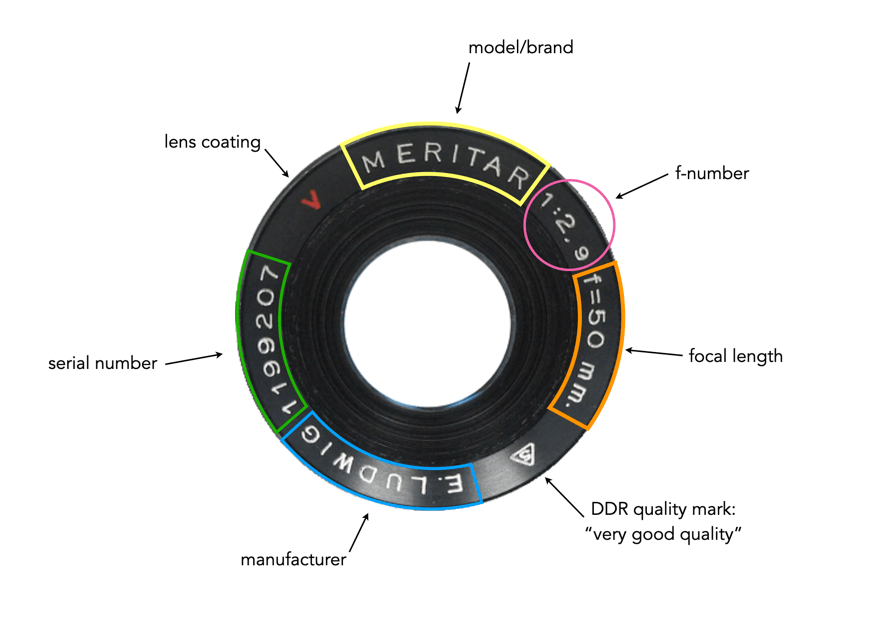
The first two items described are the manufacturer (or brand), and the type or name of the lens. In this case the manufacturer is E.Ludwig, and the type or name of the lens is a MERITAR. Most vintage lenses also provide the len’s serial number on the name plate – in this case 1199207. With come manufacturers the serial number helps track down information like where, and when it was manufactured. The most important information is the 1:2.9, which basically specifies the speed (maximum aperture) of the lens, here f/2.9. The last piece of information is f=50mm which specifies the focal length of the lens. On this particular lens there is also two additional symbols which specify lens coating and a quality mark.

Figure 2 shows three more examples of lens markings from Kilfitt, Asahi, and Enna. Figure 3 shows lens markings from Zeiss Biotar 58mm f/2 lenses from two differing periods. The latter one has more cryptic lens marking – there is less info here because the lens was produced during the infamous Zeiss trademark dispute. Zeiss Jena in East Germany marked the Biotar lenses with a “B”, in order for them to be sold in the west.
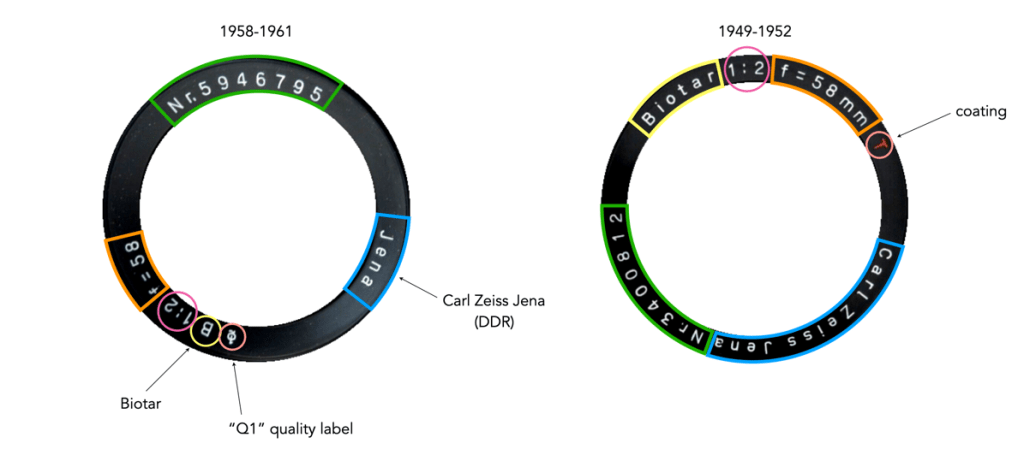
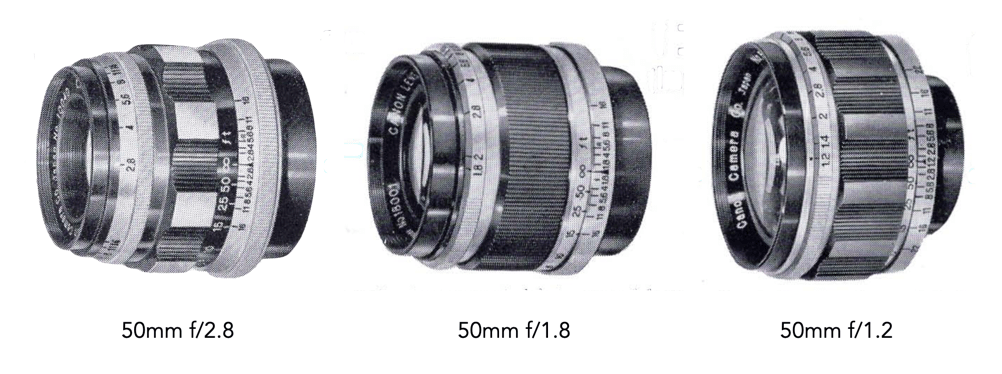
The focal length/aperture combination is the one thing that can be described in a number of different ways. The f-number is normally specified using a ratio, 1:x, rather than the f/ term. On some lenses the length and aperture are combined in the form aperture/focal length, e.g. 2.8/50. It’s actually somewhat rare to see f being used to specify maximum aperture, instead it is often used to signify focal length, e.g. f=58mm. Focal length is nearly always specified in metric, the only difference being that up until about 1950, many lenses were specified in centimetres, whereas afterwards the focal length became more standardized using millimetres. So an early lens might have been 5cm, versus the more standardized 50mm.

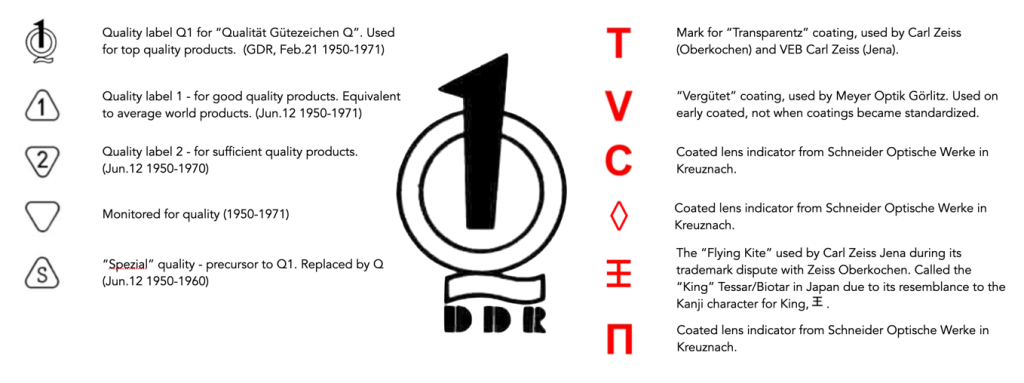
Sometimes vintage lenses also carry other markings. Sometimes instead of a brand name, there is a logo to signify a brand. This is common in vintage Russian lenses where the same lens could have been manufactured in more than one plant. Some lenses also have a number with the diameter symbol, ∅, which indicates the filter size of the lens in mm. Some lenses also use letters to signify the presence of lens coatings, e.g. Meyer Optik specified a lens coating using a red “V”, after the focal length (which means Vergütet = coating). Examples of specialized lens markings for German lenses is shown in Figure 5.


 Crafting Pixels