ISCO was essentially an offshoot of Schneider. It was founded in 1936 with the name Jos. Schneider & Co., Optische Werke, Göttingen. The factory was constructed in Göttingen as a second production site on behalf of the Reich Ministry of Aviation. The site produced manufactured Schneider lenses, and during the war years they produced cameras for aerial reconnaissance (the Luftwaffe required fast lenses with exceptional resolution). Lenses included the high-speed Night Xenons with 125mm, 330mm, 400mm, and 500mm focal lengths. During WW2 they produced around 45,000 lenses for aerial cameras, the main supplier of the Luftwaffe.
Due to the nature of the war production, the plant was dismantled by the Allied powers at the end of the war. The company name was not allowed to be used until 1953, so the company operated under the name Optische Werke Göttingen. They initially produced lenses for cinematic projectors, with names like Kiptar and Super-Kiptar. In 1951 camera lenses were produced for the first time, initially as built-in lenses for various camera manufacturers, e.g. Apparate & Kamerabau, Balda, Bilora, Franka, Wirgin. These were triplets of 4-element lenses, such as Isconar and Westanar. From 1956 ISCO increased its designs for wide-screen projection, and included lenses for 8mm, 16mm and 35mm cine cameras.
An an example of a well known ISCO lens
The first lens for SLR cameras appeared in 1952, and was the Westar 50mm f/2.8. It was sold with Exa cameras in the US. This was followed by the Westagon 50mm f/2, and Westrocolor 50mm f/1.9. In 1958 ISCO designed the Westrogon 24mm f/4, the worlds first extreme wide-angle lens for SLR cameras, ahead of the Zeiss 20/25mm Flektogons. Lenses were produced under a number of names: Westar (50mm, 100mm), Westanar (50/85/135/150/180mm), Westagon (50mm), Westron (28/35mm), Westromat (35/135mm), Westrogon (24mm), Westrocolor (50mm), Isco-Mat (35/50/135mm), Iscotar (50mm), Isconar (50/80/100/135mm), Tele-Iscaron (135/180/400mm), Tele-Westanar (135/180mm), Isconar (90/100/135mm) and Iscorama.
With the decline of the German camera industry, the demand for SLR interchangeable lenses also decreased. ISCO shifted its production back to the field of projection lenses for film, narrow film and slides. In 2009 the name was changed to Schneider Kreuznach ISCO Division GmbH & Co. KG. The lenses now produced are full frame lens set for both anamorphic and spherical cine photography.
Joseph Schneider (1855-1933) founded Optische Anstalt Jos. Schneider & Co in Bad Kreuznach on January 18, 1913, and in 1922 changed its name to Jos. Schneider & Co., Optische Werke, Kreuznach. The chief designer was Albrecht Wilhelm Tronnier (1902-1982), who joined the company in 1924, and would eventually set up the sister company ISCO (throughout his life he accumulated 124 German patents). They produced a large series of lenses with early trademarks such as “Symmar”, “Componar” and “Isconar”, and “Xenar”. From 1919 they produced a Tessar clone, the “Xenar” in focal lengths from 75 to 480mm. In 1925 the famous “Xenon” was introduced, with focal lengths up to 80mm. The Xenon, is perhaps the company’s most famous lens, and is still being made today.
Schneider’s most famous lens?
In 1933 with the passing of Joseph Schneider, his son Josef August Schneider took over the company. In 1936 ISCO was formed as an offshoot of the company. Schneider was one of the lens suppliers to the first Exakta, the 4.5×6cm VP Exakta, providing the Xenar f/3.5, the Xenar f/2.9, and the Xenon f/2. The same lenses would find their way onto the first 35mm SLR, the Kine Exakta in 1936.
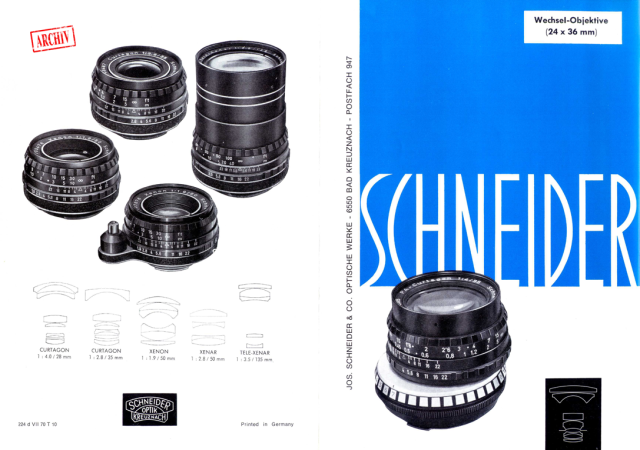
During WW2, Schneider had to supply the German Wehrmacht and was forced to manufacture Zeiss products. In the 1950s the company continued development of interchangeable SLR lenses, and supplied lenses to almost all German camera manufacturers. Lenses were made in mounts for Edixa-Mat, Pentax (M42), Praktica, Exakta, and Praktina. Lenses for film cameras were also produced, especially for the 8 and 16 mm narrow film cameras that were popular at the time. Also in the 1950s, the company was one of the first to use computers, the Zuse Z22 to perform lens calculations.
Schneider started developing zoom lenses from 1957, which led to the market launch of the Variogon 1:4/80-240 in 1964. At the end of 1967, Schneider introduced its first TV lens, the TV1 Variogon 2.1/18-200mm. NASA used Schneider lenses on its “Lunar Orbiter” space missions of the Apollo program from 1959 to 1976 and on the space shuttle flights since 1990. The first images of the Earth were taken using Schneider lenses with 45 and 75 mm focal lengths. The lunar orbiter probes also each had a Schneider “Xenotar” on board.
Due to changing economies, Schneider ran into economic difficulties and filed for bankruptcy in 1982. The company was subsequently re-founded by Heinrich Manderman and over the years, acquired the B+W filter factory and Rollei photo technology, among others. After German reunification, Manderman also became involved with Pentacon in Dresden and resumed production of the Exakta 66. The company still exists today, producing cinematic lenses and filters, industrial optical filters, industrial lenses (e.g. C-mount), and photo optics, most notably the B+W Filter brand.
In a 1956 copy of Popular Photography, there was an article on the German lens maker Kilfitt. In the article, reference was made to a 180mm f/1.9 lens called the Grand-Kilar… there was even a picture. But did this lens actually exist? Well according to vague literature, it appeared in 1955, a 4-element lens, designed by A. Burger. But brochures of the early 1960’s show nothing in the way of 180mm lenses. It does appear in various editions of Arthur Cox’s “Photographic optics” in the 1960s, however searching the net does not seem to yield anything in the way of tangible proof to suggest any exist today. Perhaps very few were actually manufactured. In comparison the to SLR, it seems like a massive lens for the period.
Historical accounts of who actually invented the zoom lens differ. But its adaptation to the SLR is down to one person – Frank Gerhard Back. He designed the first zoom lens for 35mm cameras – the Voightländer Zoomar. Before the Zoomar saw the light of day, designs with adjustable focal lengths were called varifocal lenses or rubber lenses.
“A great number of optical problems have been overcome in this lens. It is a splendid achievement. It zooms – what other still lens does?”
Look! A real zoom lens for your 35mm, Herbert Keppler, Modern Photography (May, 1959)
Back was born in Vienna, Austria in 1902. He attended the Technische Hochschule of Vienna where he received a masters in mechanical engineering in 1925, and a doctorate of science in 1931. From 1929 to 1938 he worked as a consulting engineer during which he was employed by Georg Wolfe, a manufacturer of endoscopes. In July 1939, he emigrated to the United States. After working for various companies in New York City, he started his own company in 1944, Research and Development Laboratory. In 1945 he started Zoomar Inc. where he developed and patented an optically-compensated zoom lens for 16mm television cameras (1948), and one for 35mm SLR cameras by 1959. From the late 1940s through to the 1970s, Back introduced new innovations for television, motion, picture, film photography, astronomical, and numerous other applications. On 25 October 1946, Back presented a new type of variable focal length lens to a convention of the Society of Motion Picture Engineers (SMPE) in Hollywood, California. The lens, sometimes known as the could zoom from 17 to 53mm, and contained 22 lens elements. It was 12” in length, weighed 790 grams and had an aperture range of f/2.9-f/22 [3].
Zoomar lenses disrupted the market for American television camera lenses, and likely were the catalyst in making zoom lenses ubiquitous in the industry. Back’s Zoomar lens had a substantial impact on both the motion picture, and television industries in the years following. It gradually made the “practice of “zooming” a more desirable, acceptable, and practical technique, in turn spurring demand for zoom lenses suitable for feature film use, with higher optical quality and greater zoom ranges. By 1954 a more compacts version of the “Zoomar 16” appeared – 5” in length, and weighing 570g it now had a zoom range of 25-75mm. It is not surprising that the concept would eventually spill over into the still camera industry.
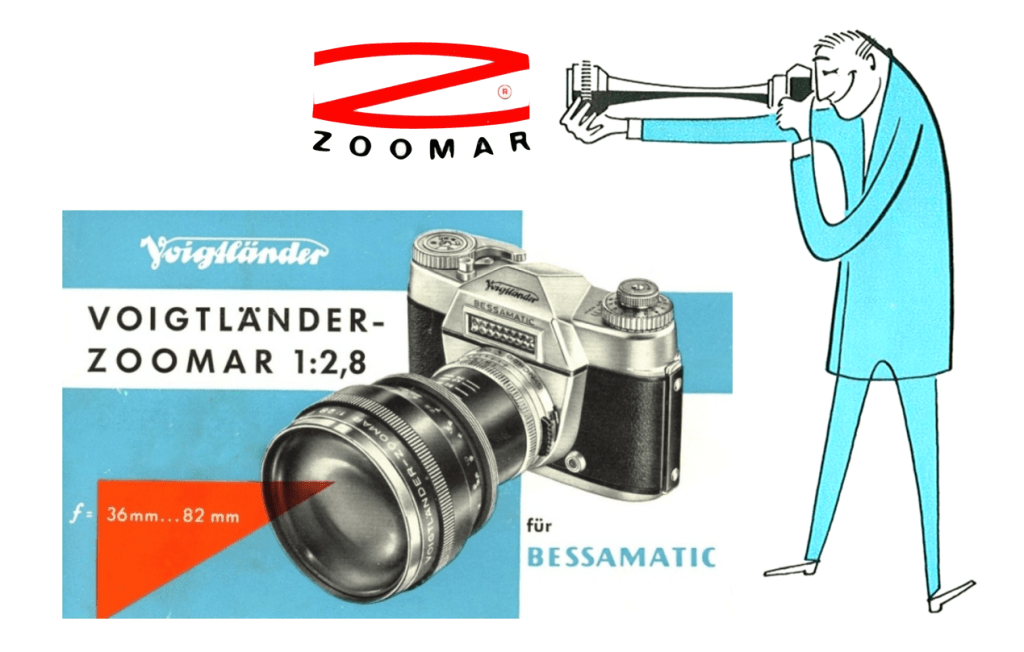
In Back’s design, four of the lens’s 14 elements (the lenses in groups 2, 3, and 6 move linearly together to allow for focal length changes) move from 36mm to 82mm. A ×2.3 range from 36mm to 82mm allowed the lens to retain a reasonable speed of f/2.8, good image sharpness, and optical anomalies kept to a minimum (something earlier varifocal lenses could not achieve). The use of the word “zoom” likely derived from the Zoomar name. The lens used a push/pull mechanism to change focal length, whereby the change of focal length happens when the photographer moves the ring towards the mount or backwards.
Zoomar lens schematics (the lens diagram shows the 36mm and 82mm positions of the moving lens components).
Optically, the Zoomar 36-82 was a great breakthrough, made possible according to Dr. Back by new rare earth element glasses (Lanthanum) and computer aided optical designs. Back filed two patents in 1958 [6,7], one for optical design, and another for mechanics, likely at the same time production was already gearing up. Starting in 1959 the German optics firm Heinz Kilfitt would build the lens, under contract with Voigtländer for their Bessamatic SLR. The Voigtländer Zoomar was presented to the public on February 10, 1959 at the International Camera Show in Philadelphia (the same show that introduced the Nikon F and Canon Canonflex). Back would file another patent relating to an improved optical design in 1959 [8]. This optical design modified the rear lens elements, both in the type of element, and the material from which they were constructed.
Thelens optical design in Patent No. US2902901
By the late-1950s, Zoomar was to have some legal issues regarding its patent, fighting a patent battle with Paillard Products, the US subsidiary of Swiss company Paillard-Bolex, which had been importing French zoom lenses. In 1958 the New York Southern District Court ruled that Back’s patent overreached by appearing to cover all zoom lenses of any design. Zoomar eventually reduced its R&D of new lenses in favour of promoting foreign-made lenses – Back purchased Heinz Kilfitt in 1968 (catalog).
“The Voigtlander-Zoomar is the only Zoomar lens for still cameras. This model, with fully automatic diaphragm, is designed expressly for use with the Bessamatic Camera. A high-precision varifocal lens, in focus at all focal lengths from 36 to 82mm, it enables the photographer to shoot continuously at variable focal lengths without changing camera position.”
Description from the manufacturer.
The lens was produced from 1959-1968, with a total of only 15,000 units being built. Today the Zoomar 36-82 f/2.8 is often associated with the Voigtländer Bessamatic SLR. However the Zoomar was introduced from day one in both the DKL (Voigtländer) and Exakta mounts. Later it was also produced in other mounts, including the ALPA, and an M42 mount for the East German cameras like the Ikon Contax S. By the early 1960’s there were more zoom lens options, mostly in the telephoto zoom realm. None were anything special when compared to prime lenses, as they often had increased distortion and less contrast, but these were often overlooked because of the “newness” of the technology. It is still possible to find these lenses today, with prices in the range of C$700-1200 for lenses in reasonable condition.
✽ The Zoomar actually had a doppelganger – the Russian Zenit-6 camera came standard with a zoom lens called the Rubin-1. It wasn’t exactly the same, the focal length is shorter at 37-80mm and both had different zooming mechanisms.
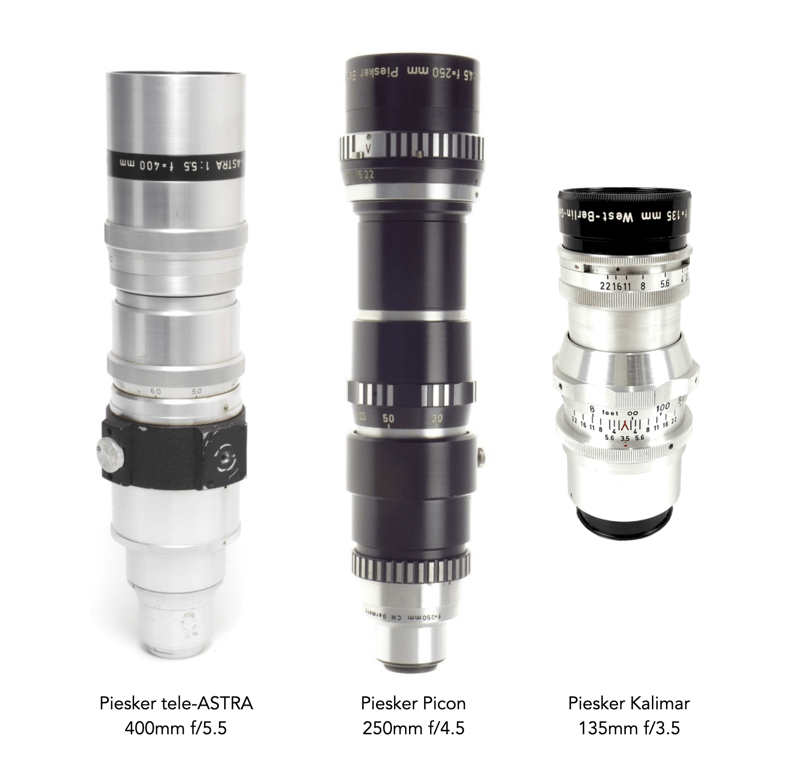
Paul Piesker & Co. was founded in 1936 as a Berlin manufacturer of lenses and lens accessories for reflex cameras (in West Germany). After WW2 the company focused on lenses with long focal lengths for the Exakta and cameras with M42 mounts. Like its competitors, Astro-Berlin, and Tewe, Piesker lenses don’t seem to very common, at least not in Europe. Most of the lenses produced seem to have been for the US market, where they appeared in ads in Popular Photography in the mid 1950s. The lenses can also be found under the “Kalimar” trademark, and also rebranded for Sterling Howard, under the trademark “Astra”, and “Voss” (in addition to other brands: Picon, Votar, Telegon). Production at Piesker was discontinued in 1964.
If it were not for one particular point in time, Kilfitt may not be as well known a brand as it is. That event was the use of the Kilfitt Fern-Kilar f/5.6 400mm lens in Alfred Hitchcock’s 1954 movie “Rear Window”, where the lens, as well as the Exakta camera it was attached to, played a prominent role in the movie (in fact no other camera/lens combination likely ever had such a leading role).
Kilfitt was one of the most innovative lens makers of the 1950s. Born in Westphalia in 1898, Heinz Kilfitt had quite a pedigree for design. Before the war he had established his reputation designing the Robot I camera (24×24mm format), the first motorized camera, introduced in 1934. Rejected by Agfa and Kodak, Kilfitt partnered with Hans-Heinrich Berning to develop the camera. In 1939 Kilfitt sold his interests in the Robot to Berning. In Munich, Kilfitt acquired a small optical company, Werkstätte für Präzisionsoptik und Mechanik GmbH, where he began developing lenses for the like of 35mm systems.
The Kilfott lens used in Rear Window.
By the end of the war in 1945 Kilfitt had very little left, basically a run-down plant, and few workers. He started a camera repair shop for US army personnel, and by 1948 had started to manufacture precision lenses. Kilfitt devoted himself to what he considered an inherent problem with the photographic industry – the lack of lens mount universality. Every camera had to have its own set of lenses. This led him to introduce the “basic lens” system in 1949. In this system, each lens was supplied with a “short mount”, the rear of which had a male thread which accommodated a series of adapters [1]. Some for SLR, some for C-mount, or reflex housings.
Like many independent lens companies, Kilfitt produced a series of lenses which could be adapted to almost any camera by means of lens mounts. One of their core brands was Kilar.
While the company is famous for its telephoto lenses, it actually specialized in another area: macro. Early SLR lenses such as the Biotar 58mm f/2 were able to focus as close as 18 inches, which likely seemed quite amazing, considering the best a rangefinder could do was 60-100cm. Kilfitt thought he could do better, producing the world’s first 35mm macro lens, the 40mm f/2.8 Makro-Kilar in 1955 [3]. It would be what Norman Rothschild called the first “infinity-to-gnats’-eyeball” [2]. It was offered in two versions: one that focuses from ∞ to 10cm, with a reproduction of 1:2, and one that focused from ∞ to 5cm, with 1:1.
The early version of the Makro-Kilar, showing the Edixa-Reflex version.
Heinz Kilfitt also continued developing cameras. The Kilfitt-Reflex 6×6 appeared around 1952, a camera that had a new system for quickly changing lenses, a complex viewfinder and a swing-back mirror. It influenced the design of other 6×6 format cameras, e.g. Kowa 6. There was also the Mecaflex SLR, another 24×24mm camera produced from 1953-1958 (first by Metz Apparatefabrik, Fürth, Germany later by S.E.R.A.O. Monaco). It was constructed by Heinz Kilfitt, who also supplied the lenses (Kilfitt Kamerabau, Vaduz, Liechtenstein).
Lens
Smallest aperture
AOV
Shortest focus
Weight
40mm Makro-Kilar f/2.8
f/22
54°
2-4″
150g
90mm Makro-Kilar f/2.8
f/22
28°
8″
480g
135mm KILAR f/3.8
f/32
18°
60″
260g
150mm KILAR f/3.5
f/22
16°
60″
400g
300mm TELE-KILAR f/5.6
f/32
8°
120″
990g
300mm PAN-TELE-KILAR f/4
f/32
8°
66″
1930g
400mm FERN-KILAR f/4
f/45
6°
30′
1760g
400mm SPORT-FERN-KILAR f/4
f/45
6°
16′
2720g
600mm SPORT-FERN-KILAR f/5.6
f/45
4°
35′
4080g
The more commonly available Kilfitt lenses
When Heinz Kilfitt retired in 1968 he sold the company to Dr. Back, who operated it under the Zoomar name from its headquarters in Long Island, New York. Dr. Back designed the first production 35mm SLR zoom, the famous 36-82/2.8 Zoomar in 1959. The company eventually transitioned the brand to Zoomar-Kilfitt, and then merged it completely into Zoomar. By this stage the company was providing lenses for 12.84×17.12mm, 24×36mm and 56×56mm cameras. The most notable addition to the line-up was a Macro Zoomar 50-125mm f/4.
The lens selection provided by Zoomar-Kilfitt
Note that the Zoomar lenses are often cited as products of Kilfitt, however although some of them may have been produced in the Kilfitt factories, Zoomar was its own entity. Kilfitt was contracted to manufacture the groundbreaking 1960 Zoomar 36-82mm lens for Voigtländer.
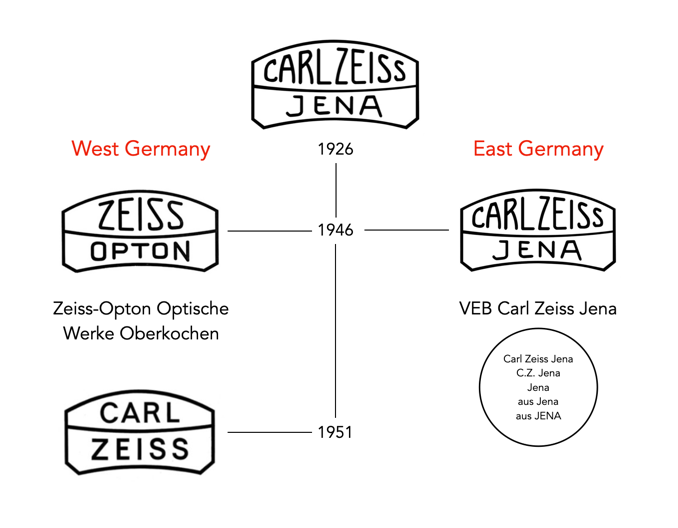
As cooperation deteriorated, and finally terminated in 1953, it was inevitable that eventually there were some issues with trademarks between the two Zeiss’s. I mean they were on different sides of the Iron Curtain. The East German Carl Zeiss company did not own all the rights to some of the names and brands. This would likely have been fine had they just been sold within the eastern-bloc countries, however many were made to be exported to the west (which is really somewhat ironic) – lenses were developed to sell in the West to produce hard currency. They achieved this at the beginning by resurrecting pre-war designs. Political influence over East Germany did not have any influence in how products were manufactured.
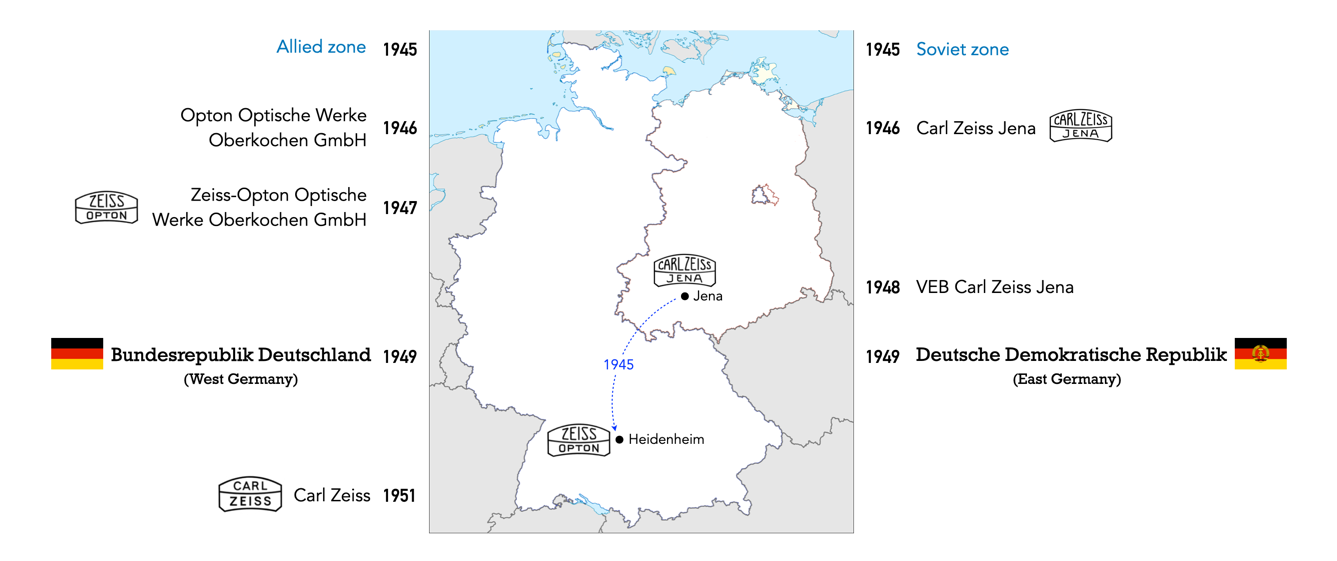
Zeiss vs. Zeiss branding over the years
In February 1954 Zeiss in Heidenheim fired the first shots in what would eventually become a worldwide litigation. They obtained an injunction in the District Court of Goettingen to prevent the continued sale of Jena-made, Zeiss-marked goods [1]. In April Zeiss Jena countered in West Germany by seeking an injunction and an order registering the Zeiss marks in West Germany in its name. That action was dismissed in 1960 when the West German Supreme Court ruled that there was no one in the Soviet Zone having capacity to represent the Zeiss Foundation.
In the same year Zeiss Heidenheim brought action against the Zeiss Jena to prevent them from using the Zeiss name and trademarks anywhere in the world. The Supreme Court of the Federal German Republic determined that the Heidenheim firm was entitled to exclusive use of the Zeiss name and trademarks in West Germany and West Berlin [1]. Interestingly, a CIA report from 1954 [2] suggests that should the naming issues take an “unfavourable” turn for VEB CZJ, then the plan was to change its name to VEB Ernst Abbe Werk (which they obviously never did).
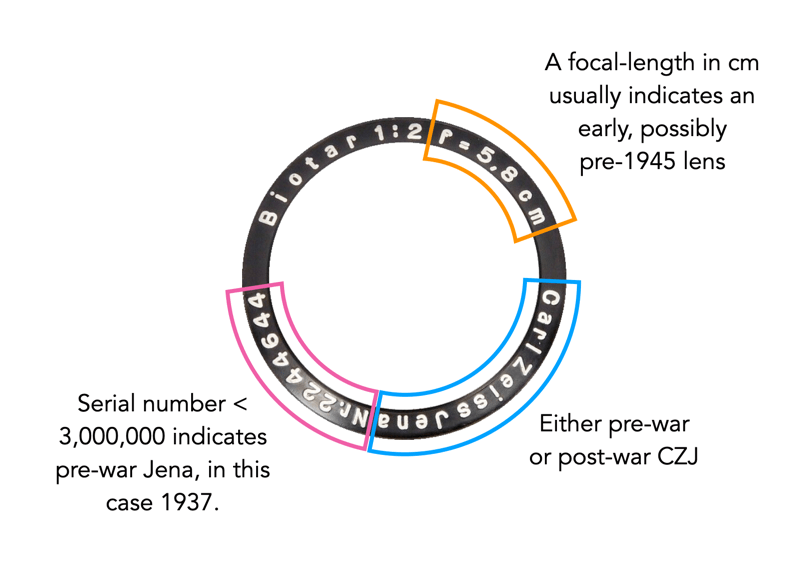
Information provided by lens markings
There was also a long court battle in the US over who owned the rights to the Zeiss name. The litigation commenced on February 14, 1962, filed by Carl Zeiss Foundation and Zeiss Ikon AG against VEB Carl Zeiss Jena and its US distributors [1] (Carl Zeiss Stiftung v. VEB Carl Zeiss Jena). The case went to discovery from 1963-1967 and finally to trial in November 1967. On November 7, 1968, the court found in favour of the plaintiffs, deciding that the US trademarks “Zeiss”, “Zeiss Ikon”, and “Carl Zeiss Jena”, were the property of the Zeiss firm located in West Germany. As to the legitimacy of this? The courts found that the original “Stiftung” ceased to exist in Jena when it had been stripped of its assets. The Stiftung’s domicile was then changed from Jena to Heidenheim. It was not until 1971 [3] that the US Supreme Court finally settled the case of Carl Zeiss vs. VEB Carl Zeiss Jena, after a long 9½ year battle for control of the “Zeiss” trademark, siding with Heidenheim.
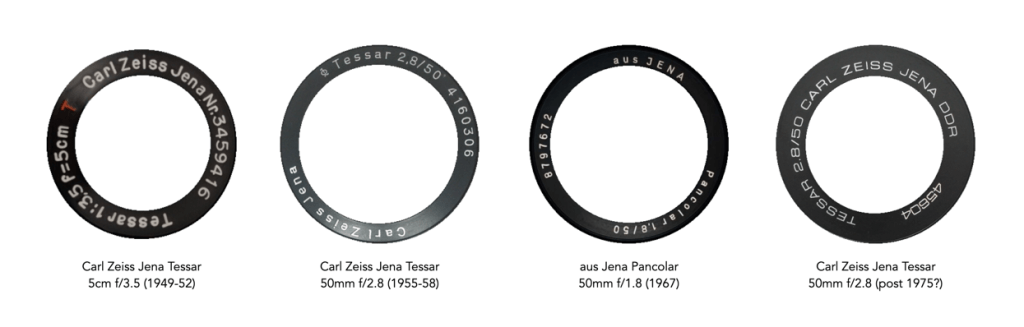
Examples of Carl Zeiss Jena lens markings over the years.
After this, Carl Zeiss marketed their lenses as “Carl Zeiss” exclusively in the United States, whereas Carl Zeiss Jena exported their lenses to the US with the marking “aus Jena”, or sometimes “JENOPTIK”, or even “JENOPTIK JENA”. The branding on these lenses was changed: “T” instead of Tessar, “B” for Biotar, “Bm” for Biometar, “S” for Sonnar, “F” for Flektogon, etc. in order not to infringe on the copyright. Therefore a lens might be labelled “Carl Zeiss Jena s”, or “aus Jena s”, and be exactly the same lens. It really depended on where the lenses were sold.
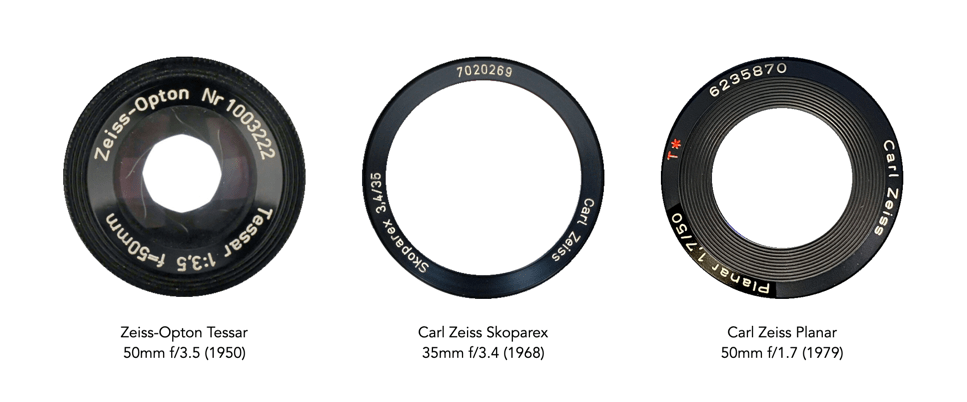
In the Eastern-bloc countries, CZJ could use the name “Carl Zeiss”. Carl Zeiss Oberkochen was not allowed to use “Zeiss” by itself, and instead used the name “Opton” or “Zeiss-Opton”.
In some western countries – namely West Germany, Italy, Greece, Holland, Belgium, Luxembourg, and Austria – CZO was allowed to use the name “Carl Zeiss”. CZJ chose to use the name “aus Jena” in the case of lenses.
The rest of the world, i.e. Commonwealth countries like England and Canada, Switzerland, Japan, both companies could use the name “Carl Zeiss”, but only if there was an indicator of origin. For example CZO used “Carl Zeiss West Germany”, and CZJ used “Carl Zeiss Jena” or the term DDR somewhere.
Examples of Carl Zeiss Opton lens markings over the years.
Of course it is also easy to identify a lens if it is marked with DDR. Some lenses were made in only East or West Germany, while others had names which continued to be shared.
East German only lenses: Biometar (a modified Planar), Flektogon (similar to Distagon), Flexon, Pancolar
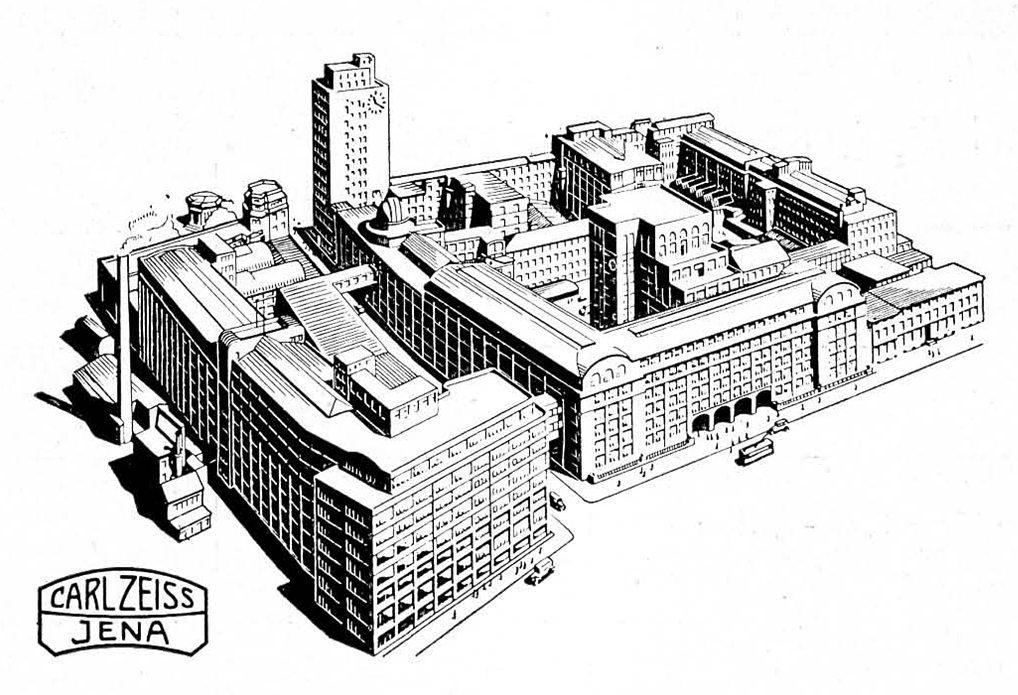
One of the things that gets very confusing for some people is differentiating between Zeiss lenses from East and West Germany. First, let’s look at the backstory. Prior to World War II, Carl Zeiss Jena had been one of the largest suppliers of optical goods in the world. Note that Carl Zeiss was an optical company and different to Zeiss Ikon, which was a camera company formed in 1926 from the merger of four camera makers: Contessa-Nettel, Ernemann, Goerz and Ica. Both were members of the Carl Zeiss Foundation.
During the war, Jena had been pounded by allied bombing – the British bombed the Zeiss works on 27 May 1943, and the Americans repeated this twice in 1945. Mind you, there was not enough damage to put the factories out of commission but enough to slow production. Jena was captured by the American 80th Infantry Division on April 13th, 1945, and would remain in US control for two months before withdrawing in favour of the Soviet forces. As Americans departed, they took with them 122 key personnel from Jena to Heidenheim in the US zone of occupation (the personnel were from Carl Zeiss and Schott). At the conclusion of hostilities in 1945, Germany was split into differing zones, and as Jena was in the German state of Thuringia, it came under Soviet control (based on the Yalta Conference agreement).
A New York Times article in September 1946 suggested that the Russians were taking US$3,000,000 worth of finished products monthly for reparations [1]. At this stage there was very little in the way of dismantling equipment to ship back to Russia. In fact an earlier NYTimes article [2], suggested Russian occupation authorities had actually stimulated production at the Zeiss plants to pre-war levels, in order to facilitate reparations. It should be noted that the Zeiss plant produced more than just photographic optics – it also produced microscopes, medical and surgical instruments, ophthalmic instruments, geodetic instruments, electron microscopes, binoculars, etc., and military items [3].
The bombing damage to the Zeiss Jena plant
By 22 October 1946, the Soviet occupation authorities began dismantling the Zeiss plant [3] as war reparation payments agreed upon in the Potsdam Agreement. This was known as Operation Osoaviakhim, and involved many industries across Germany. It resulted in the removal of 93% of Zeiss’ equipment (including raw material, pipes, boilers, sanitary installations, etc), and 275 Zeiss specialists [4] deported to various locations in the USSR (approximately 90% of those deported would return to Jena in 1952). The taking of war “booty” was of course entirely legitimate, yet as Peter Nettl put it in a 1951 article, “Like a child long deprived of chocolate, the first Soviet ‘dismantlers’ flung themselves on all the available tidbits” [5].
A US intelligence report from July 1947 described the status of the Zeiss works at Jena [6]. In it they suggest that optical and photographic production had been least affected by the dismantling, with the plant producing lenses for the Soviets (Tessar 5cm f/3.5). The dismantling program had been completed by April 1947 [7], after which the Soviet High Command turned the plant over to the Germans, who re-established the plant. About 1000 machines remained at Jena after the dismantling, allowing for the continued production of eye glasses, camera lenses, medical glass and measuring instruments [8]. There was every hope at this time (at least from the West German side of things), that this was a temporary situation and that in 3-5 years Heidenheim staff would move back to Jena [6].
In June 1948, the Zeiss Jena plants were expropriated by the Land Expropriation Commission [9] and transferred to state ownership, becoming known as “VEB Carl Zeiss Jena”. In the American zone, Zeiss was reborn as “Opton Optische Werke Oberkochen GmbH” in 1946, becoming “Zeiss-Opton Optische Werke Oberkochen GmbH” in 1947, and Carl Zeiss in 1951. They had very little except the relocated personnel and supposedly a quantity of Zeiss documents. In 1949 Germany officially split into East Germany (Deutsche Demokratische Republik) and West Germany (Bundesrepublik Deutschland). Between 1948 and 1953 the two firms cooperated commercially with one another, after which cooperation deteriorated as the East German regime tightened control on VEB.
Like Zeiss, Zeiss Ikon (Dresden), best known for its Contax camera, also split in 1948. In the west, it was reformed into Zeiss Ikon AG Stuttgart. In the mid 1960s it merged with Voigtländer. It followed the Contax rangefinder line releasing the Contax IIa and IIIa cameras in the early 1950s. In the east, Zeiss Ikon became state owned, known as VEB Zeiss Ikon Dresden (ZID). ZID may be best known for its advanced SLR model, the Contax S, introduced in 1948.
Further reading:
“Russians take 90% of Zeiss Output”, The New York Times, Sept.10, 1946.
“Russians Increase German Industry”, The New York Times, July.5, 1946.
“Activities at the Zeiss Plant, Jena”, Central Intelligence Agency, Information Report, 28 May (1953)
“Deportation of Technicians and Specialists from Karl Zeiss, Jena”, Central Intelligence Group, Information Report, 13 January (1947)
Nettl, P., “German Reparations in the Soviet Empire”, Foreign Affairs, 29(2), pp.300-307 (1951)
“Status of the Zeiss Works in Jena and Moscow”, Central Intelligence Group, Intelligence Report, July (1947)
“Layout and Organizational Setup of the Jena VEB Carl Zeiss”, Central Intelligence Agency, Information Report, 29 August (1955)
“Dismantling, Production in the Societ Zone”, Central Intelligence Group, Information Report, May (1947)
Allison, R.C., “The Carl Zeiss Case”, The International Lawyer, 3(3), pp.525-535 (1969)
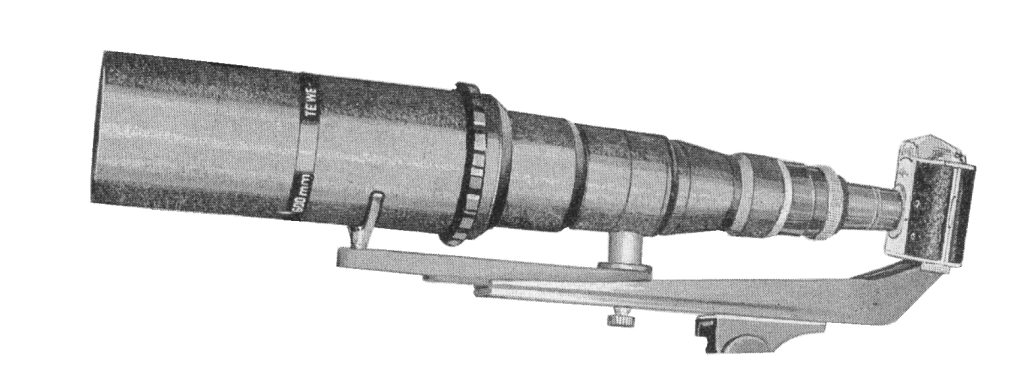
Tewe was a German company based in Berlin and well known for its long-distance lenses, up to 2000mm. Technische Werkstätten für Photo-Kinotechnik, Weiste & Co., TEWE OHG, was founded in 1935 in Schöneberg Berlin (in West Berlin during the Cold War period). The company initially developed long-focal length cinematic lenses, but by the 1950s and 60s they were producing long-focal length lenses for reflex cameras. Some of these lenses were designed in association with Astro-Berlin and Piesker. The company discontinued production in 1972.
Supposedly their lenses were used by astronomical observatories around the world, and lenses were well known for their “exceptional light intensity, unique brilliance, and needle-sharp, critical definition”. Their lenses were adapted for Exakta cameras, with lenses in the realm of 300-800mm.
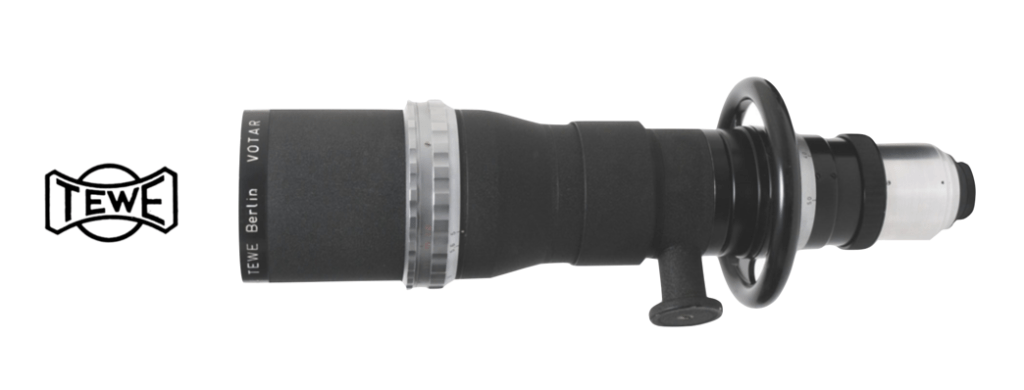
Tewe Berlin Votar 500mm f/5
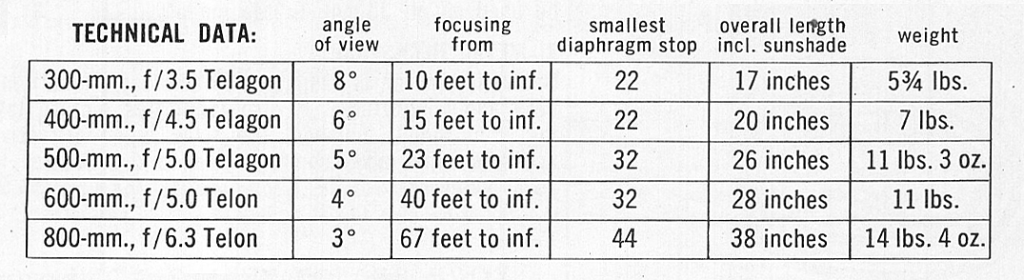
Some of the lenses produced by Tewe
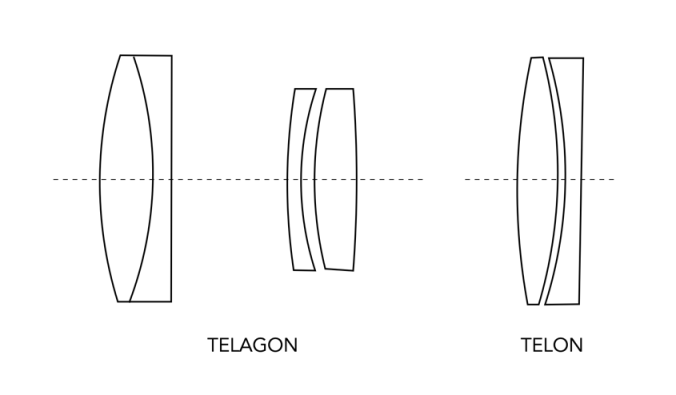
These lenses were sold in two lens configurations, Telagon, or Telon. The Telagon had 4 elements in 3 groups, whereas the Telon was 2 elements in 2 groups. The Telon lenses were available in 400mm, 500mm, 600mm, and 800mm for 35mm, and a 1000mm for 6×6 cameras. The Telagon was available in 300/400/500/600mm. These lenses were heavy – the Telon 800mm was 6.5kg!
C.A. Steinheil & Söhne is the oldest of Munich’s optical companies, founded in 1854. It was established by Carl August von Steinheil (1801-1870), who was a physicist, astronomer, mathematician, and engineer. The company manufactured telescopes, spectroscopes and photometers. Over time this was supplemented by the production of optical glass.
During one period there was a great indignation against adulteration of Munich beer by greedy brewers. In the early 1840’s Steinheil designed a “beer lens”, a triplet that consisted of two glass lenses, in the middle of which was a fluid lens, a tiny quantity of the beer. The gadget showed impurities by means of spectral comparison. This was known as the optico-areometric beer test, and was based on the connection between the light refracting power of the beer, and its constituents.
By the end of the 1930s the company had been renamed Optische Werke C. A. Steinheil Söhne GmbH. In 1954 the name Steinheil was trademarked in the USA. In 1962 the company was sold to the Elgeet company in Rochester (NY), followed shortly after in 1964 to the aviation conglomerate Lear Siegler in Santa Monica. This resulted in a decline in the manufacture of commercial lenses in favour of aerospace/military applications.
From the 1940s through to the 1970s, the company produced a myriad of lenses for Exakta, M42, and Leica mounts. Many of the early lenses had the classic chrome finish of the period. By the mid-1960’s Steinheil dumped the chrome finish in favour of black enamel finishes typically with a striped focus ring. Examples include Quinaron, Quinon, Quinar, Tele-Quinar, Culminar, Cassar, Cassaron, Culmigon, Cassarit, Macro -Quinaron, Macro-Quinone, Macro-Quinar, Macro-Cassarite, Exagon, Tele-Exaktar. Some examples include:
Auto Quinaron 35mm f/2.8 – extreme close focus to 11cm.
Auto Tele-Quinar 135mm f/2.8 – exceptional mid-range lens, aperture down to f/32, and a minimum focus distance of 12.5cm.
Tele-Quinar 200mm f/4.5 – excellent preset telephoto, aperture down to f/32, chrome body, 14-blade aperture.










 Crafting Pixels