Ernst Ludwig Optisches Werk Weixdorf Objektive was established in 1924 in Lausa near Dresden by Ernst Ludwig. The town of Lausa merged with the neighbour town of Weixdorf in 1938. Pre-war lenses are usually marked with Ludwig Lausa Dresden. The company made cameras for various types of cameras, e.g. 35mm viewfinders and SLRs. After the war, production resumed quickly, as the factory was undamaged, with Ernst Ludwig still at the helm.
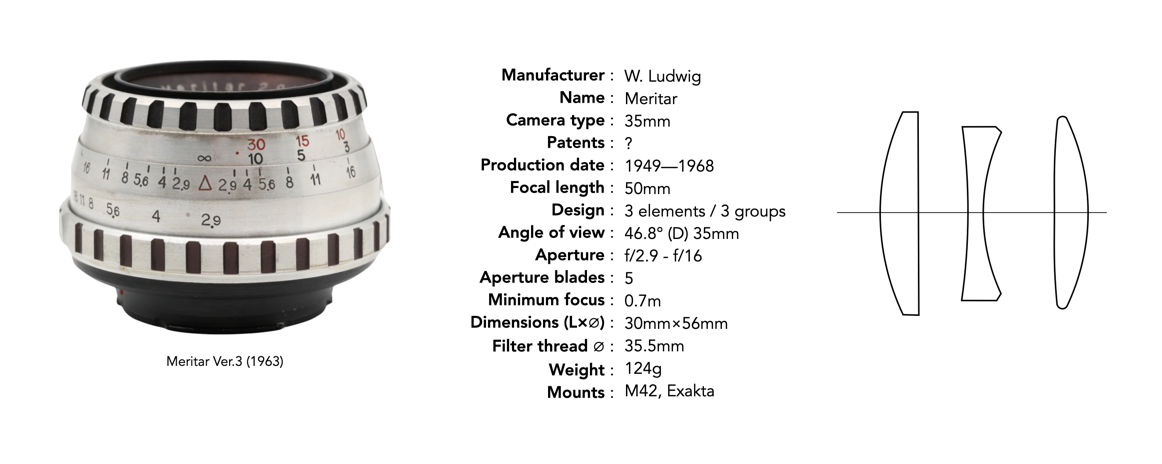
Fig.1: The most famous Ludwig lens, the Meritar 50mm
The company produced a number of different, inexpensive lenses, but is likely best known for the Meritar 50mm. With the introduction of the EXA camera in 1951, Ludwig became an original supplier, along with Carl Zeiss Jena, and Meyer Optik. The Meritar was a cheap lens using three air-spaced elements, i.e. the Cooke triplet. Lenses were produced with the Exakta mount for the Ihagee cameras, and some in the M42 mount. The Meritar 50mm f/2.9 was derived from the Victar could be manufactured inexpensively and therefore harmonized very well with the new, inexpensive Exa SLR. It was initially a manual lens, but eventually upgraded to preset diaphragm (1957).
The Meritar was a cheap lens. To put this into context, in the late 1950s the f/2.9 sold for 52 DM, whereas a basic Tessar 50mm f/2.8 was 139 DM, the Biotar 58mm f/2 305 DM. In fact the 3-lens Meritar was considered to be the cheapest lens outfitted on the EXA. In fact EXA + Meritar always offered the cheapest combination until production of these lenses ceased in the early 1970s. Although by 1961, there were eight standard choices for 50mm lenses for the EXA (II), all of but of which were faster.
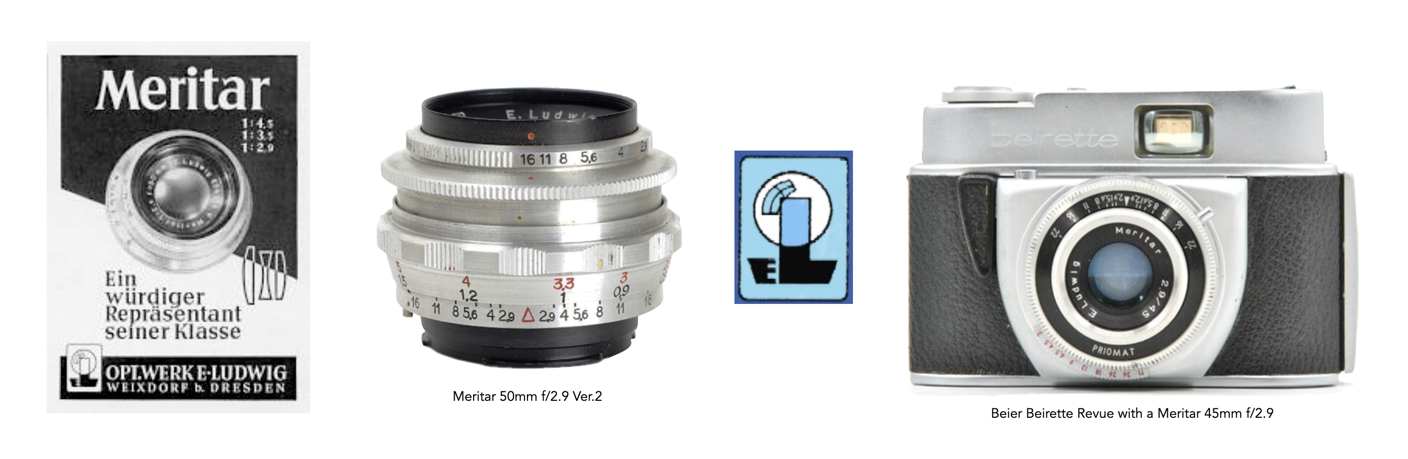
Fig.2: Ludwig produced few advertisements, and produced a lot of inexpensive lenses for the likes of viewfinders cameras
Prior to the Meritar series, the company produced other lenses including the Victar 5cm f/2.9 (Exakta, Praktiflex), Victar 75mm f/2.9 (Reflex-Korelle) and Peronar 50mm f/2.9 (Exakta). Victar and Meritar were also used in cameras with central shutters (Beier Precisa, Beirax). In 1959 the East German state ‘acquired’ a small stake in the company, with Ludwig still at the company until 1968. In 1972 the company became the state owned VEB Optisches Werk Weixdorf, and in 1980 it was absorbed by the VEB Pentacon.
Novoflex is a German maker of lenses and camera accessories (macro bellows, tripods, tilt-shift bellows, etc.). It was founded in 1948 by photographer Karl Müller Jr. In 1949 the company produced the reflex housings for Leica, which allowed SLR lenses to be modified for use on Leica cameras. These were initially marketed under the name Reproflex, until being changed to Novoflex in 1950. From 1954 housings were also made for Contax cameras.
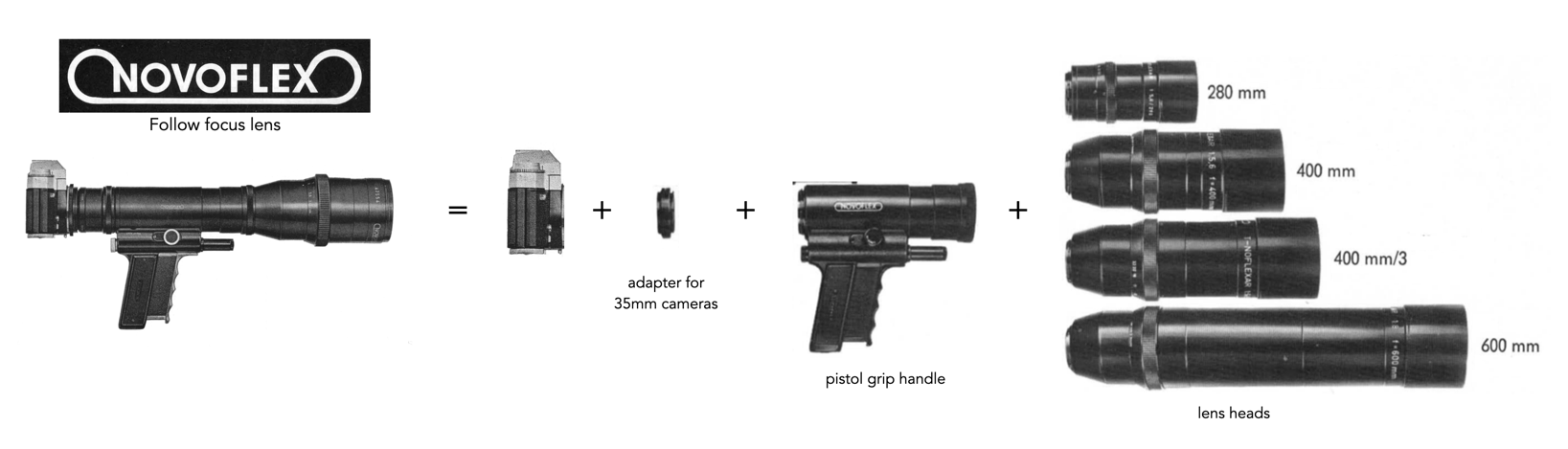
Fig.1: The basic Novoflex Follow-Focus lens system
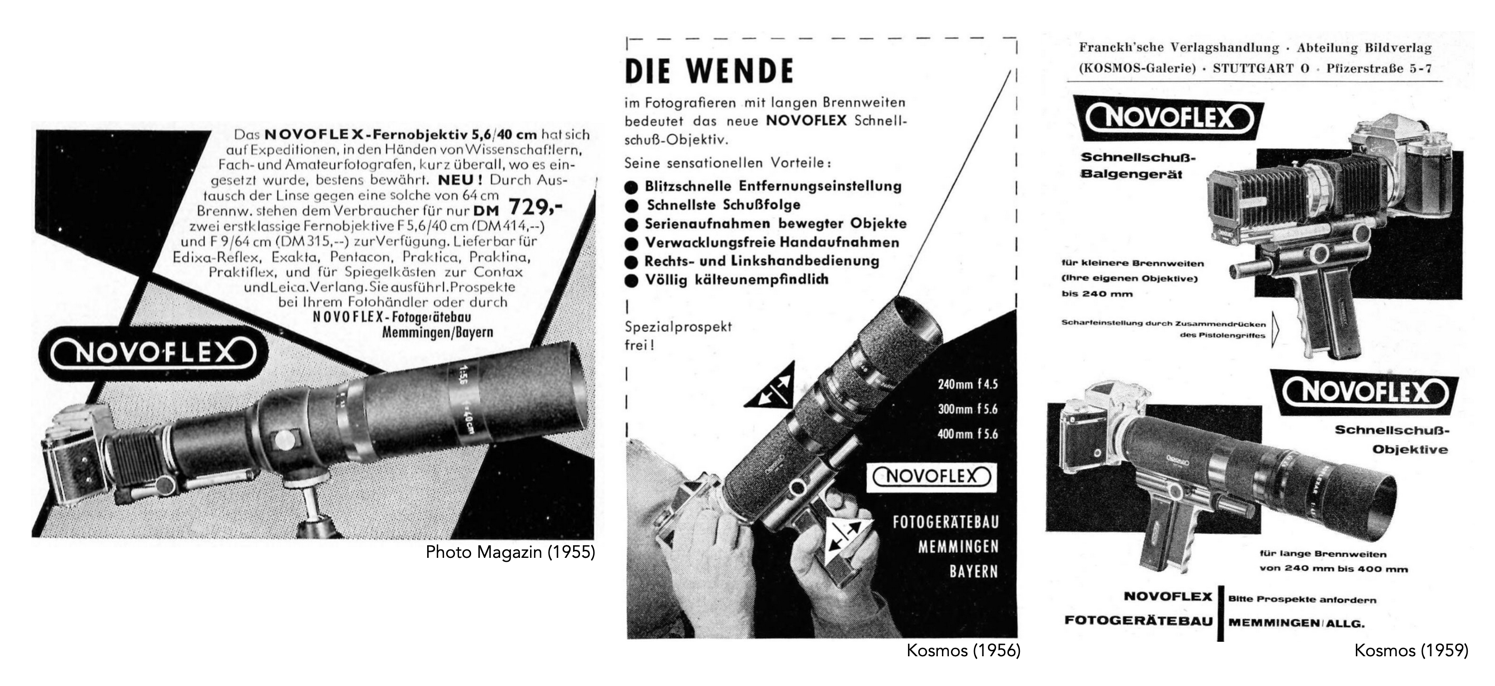
In 1956 they started production of their first lenses, the Novoflex Follow Focus lenses. The Follow Focus lens system was interesting because it included a pistol-grip focusing device that allows the user to go from infinity to minimum focus in a split second. Essentially it provides one-handed focusing. According to the company this was useful for “wildlife subjects in full flight, sports, the fleeting moment, the unexpected are unusual picture opportunities that must be taken at peak-action.”
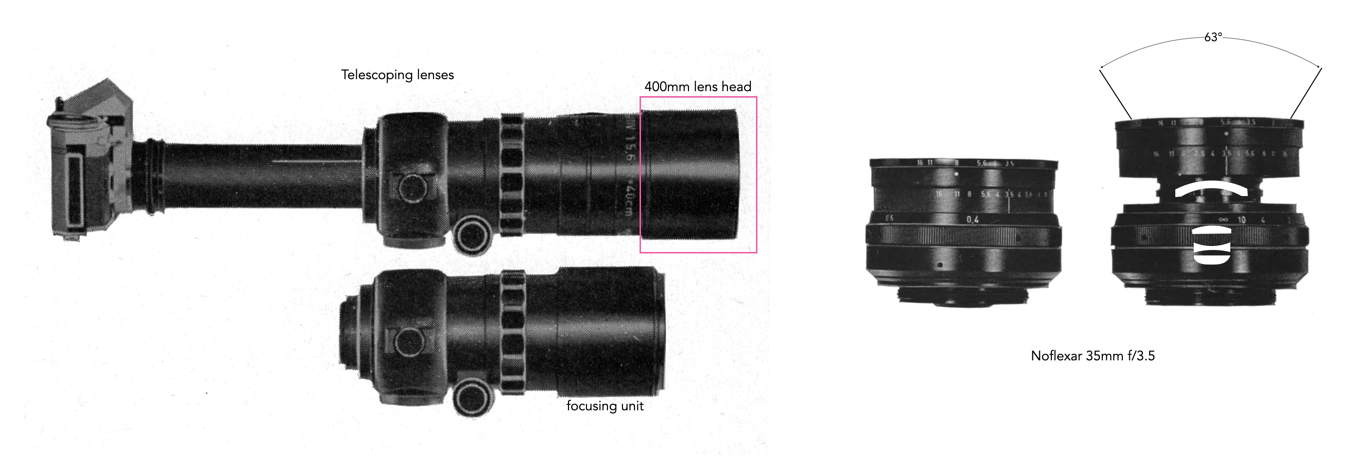
Fig.2: The telescoping lens and Noflexar
This was followed in 1960 with nesting telephoto lenses, advertised as ‘telescopic tele lenses’. These were designed in order to make telephoto lenses easier to transport, being able to collapse to half their size. The focusing unit could be equipped with lens heads for 400mm and 640mm. In 1962 the company introduced the ‘2-in-1 lens’, 35mm f/3.5 Noflexar, a macro wide-angle lens with a focusing range from infinity to 2.75”, and a reproduction ratio of 1:2. In 1969 the company started making automatic bellows devices. The company had an extensive range of ancillary products for many camera systems. This included a wide-angle macro lenses, bellow units, follow-focus lenses, slide copiers, and associated coupling adapters.
Fig.3: Vintage ads for Novoflex lenses
Novoflex is still an active company, producing photographic accessories such as auto-bellows, tripods, macro systems and camera-lens adapters.
Kinoptik was founded in Paris in 1932 by Georges Grosset and Georges Perthuis. Grosset began by creating 35mm camera optics with a series of Apochromat lenses in 1939 (lenses with better correction of chromatic and spherical aberrations), all with the same double-gauss optical structure.
The workshop was destroyed by the RAF in March 1942. Production resumed in the summer, however during the German occupation they were forced to produce Askania camera sights. However this didn’t stop Grosset from designing two new lenses, the Fulgior 50mm f/1.3 (which was used on the Rectaflex), and the Apochromat-C 32mm f/2.8. Postwar, French cinema boomed and Kinoptik concentrated its efforts on the cinema business. It designed numerous lenses for 16mm, Super-16 and 35mm cine cameras.
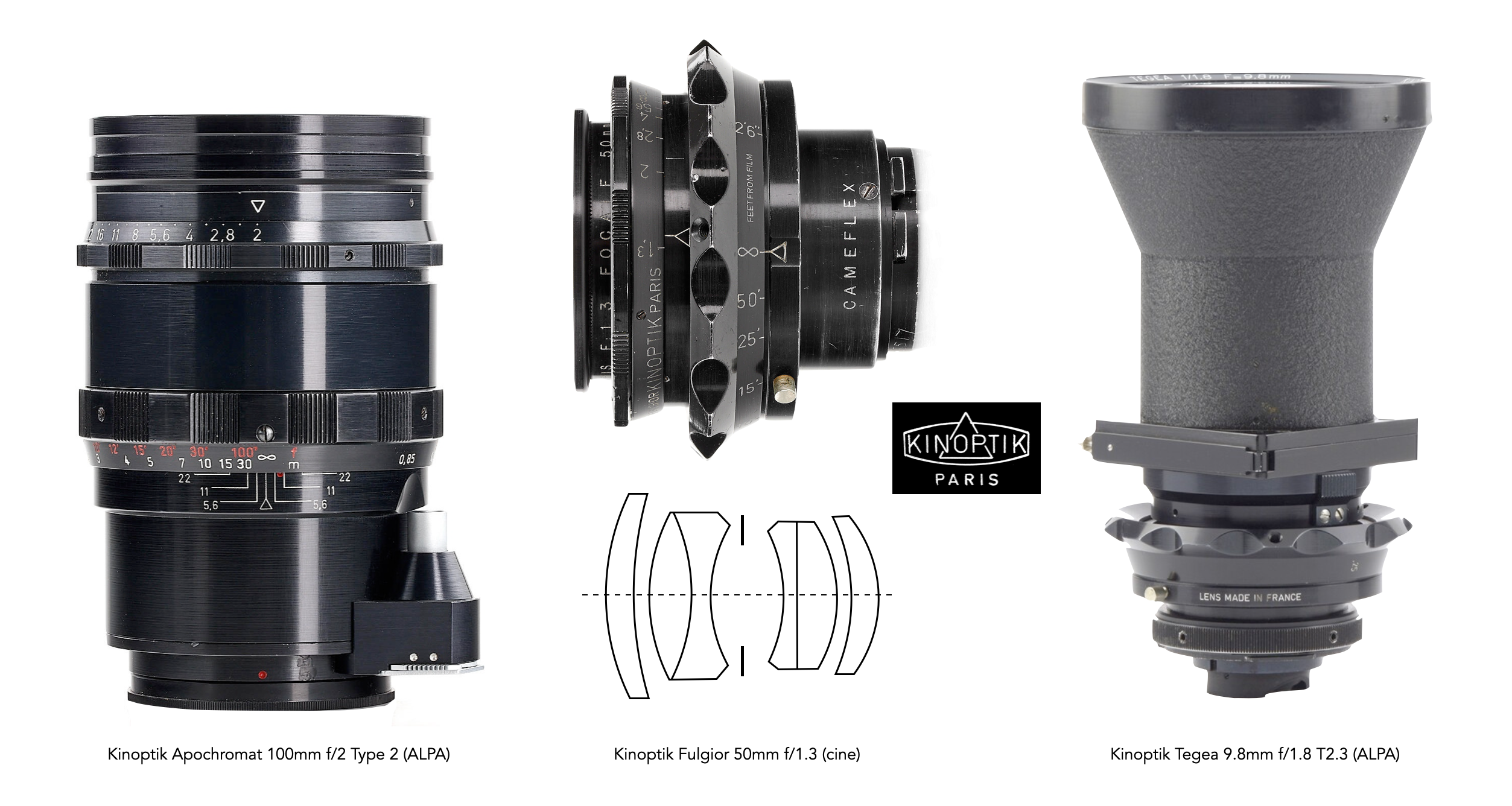
In the early 1950s they also diversified into optical systems for microfilm, medical radiology, and control of industrial furnaces. The company bore the Japanese competition in the 1960s better than most of its European counterparts due to its business in professional cinema equipment. From a 35mm perspective, Kinoptik produced a number of lenses for ALPA, as well as Leica, Nikon, Canon and Minolta. Examples include the Apochromat 100mm f/2 and the Aplanat 500mm f/5.6. The Apochromat 100mm f/2 was described as having exclusive correction of all primary colours, critical sharpness and highest contrast, even at full aperture.
Fig.1: Various Kinoptik lenses
After the death of Georges Grosset, his wife Marie-Louise Grosset took over running of the company, and hired French optician Edgar Hugues (1915-2004) who became technical director of the company from 1957-1964. He designed the 75mm f/1.1, 100mm f/1.3 as well as the Lynxar 60mm f/0.7, arguably the fastest French lens ever created. He also designed the Tegea rectilinear “fish-eye” lenses (130° angle-of-view for 24×36mm). One such lens, the Tegea 9.8mm f/1.8 was used by the likes of Stanley Kubrick in films like A Clockwork Orange (1971) and The Shining (1980).
In 1981 the company was sold to Société de Fabrication d’Instruments de Mesure, after which it underwent numerous integrations, mergers, and acquisitions before closing in 2003. The lenses were by no means inexpensive. In 1980 prices, the 50mm f/2 Macro-Apochromat sold for US$999, and the 100mm f/2 Auto-Apochromat for US$799. Vintage Kinoptik lenses are still vogue in the film industry, often rehoused in new bodies. The Apochromat 100mm f/2 sells for anywhere from US$5000-7000 on todays market.
Feinmess was founded by Gustav Heyde (1846-1930) in Dresden (1872) as Gustav Heyde – Mathematical-Mechanical Institute & Optical Precision Workshop (Feinmess roughly translates to “fine measurement”). The company produced astronomical and geodetic precision devices: binoculars, domes and refractors for observatories, telescopes, theodolites (land surveying devices), hand-held rangefinders for aerotopography, and actino-photometers (light meters). From 1931 the company was converted to a limited partnership and concentrated on arms production. In 1945 the company operated under the name Gustav Heyde GmbH. After the war the company was expropriated by the state of Saxony operating as Optik, VVB für feinmechanische und optische Geräte. Finally in 1948 it changed its name to Optik – Feinmess Dresden VEB.
In the 1950s, Welta (Freital) requested a lens for their Belfoca 1 and 2, medium format cameras. There was so much demand for lenses that Feinmess accepted the order, never having produced lenses before. The optical design office was set up by Ihagee, and work on the design of the lens was taken over by Claus Lieberwirth is August 1953. From 1954 the Bonotar was created as a 105mm, f/4.5 lens. A second lens, the 105mm f/6.5 Bonar was derived from the Bonotar. Both lenses were simple in construction, and inexpensive. About 20,000 M42 and 4,000 Exakta mount Bonotars were produced. The lens established itself as a cheaper alternative to the popular Meyer Optik Trioplan. In 1960 production of both lenses was halted, and the optics department was eventually merged into VEB Carl Zeiss Jena.
Interestingly, VEB Feinmess was used in the 1950s as “shield” company, especially for patent applications related to VEB Zeiss Ikon, due to the issues with Zeiss-Ikon Stuttgart. This is why camera patents for well known GDR products are the property of VEB Feinmess, until the founding of VEB Kamera-and-Kinowerk in 1959. There are literally hundreds of patents for lenses, viewfinder systems, motor winding systems, and viewfinder cameras (to name but a few) − all products that Feinmess did not manufacture.
The company still exists today, recently renamed from Feinmess Dresden GmbH to Steinmeyer Mechatronik GmbH, and makes various measuring instruments, positioning systems and optical devices. Bonotar 105mm lenses can be found for between €60-90.
Zunow was a lens maker who dabbled in camera making. Their biggest claim to fame is arguably that they were the first to introduce an ultrafast 50mm lens for rangefinder cameras. Supposedly the meaning of Zunow derived from the Japanese word zunō meaning “brain” (although there was also a Zunow company producing bikes where it meant “genius”).
Suzuki Sakuta founded Teikoku Kōgaku Kenkyūjo (Imperial Optical Research Institute) circa 1930 and worked for other companies grinding lenses. In 1954, the company changed names to Teikoku Kogaku Kogyo Kabushiki Kaisha (Teikoku Optical Industry Corporation), and in 1956 it became Zunow Kōgaku Kōgyō K.K., or Zunow Optical Industry Co. Ltd..
Fig.1: Various lenses produced by Zunow
Zunow made a number of lenses for both rangefinder and SLR cameras, including slower 50mm lenses in f/1.3, and f/1.9, a 35mm f/1.7, and a 100mm f/2 lens. In 1953 they introduced a 5cm f/1.1 lens for rangefinder cameras, which at the time was the fastest lens available for any 35mm camera. The f/1.1 lens was not matched in speed until Nippon Kogaku introduced the Nikkor 50mm 1.1 in 1956. After this they started making lenses for other manufacturers, which weren’t as fast, but they were good quality lenses. For example the 35mm f/1.7 was a smidgen faster than the Nikkor 35mm f/1.8. The lenses were often used by other manufacturers as standard lenses. A good example is the Miranda T which came standard with a Zunow 50mm f/1.9 lens. There is some supposition that Zunow supplied the 5.8cm f/1.7 lens for the Yashica Pentamatic II when it appeared in 1960 [1].
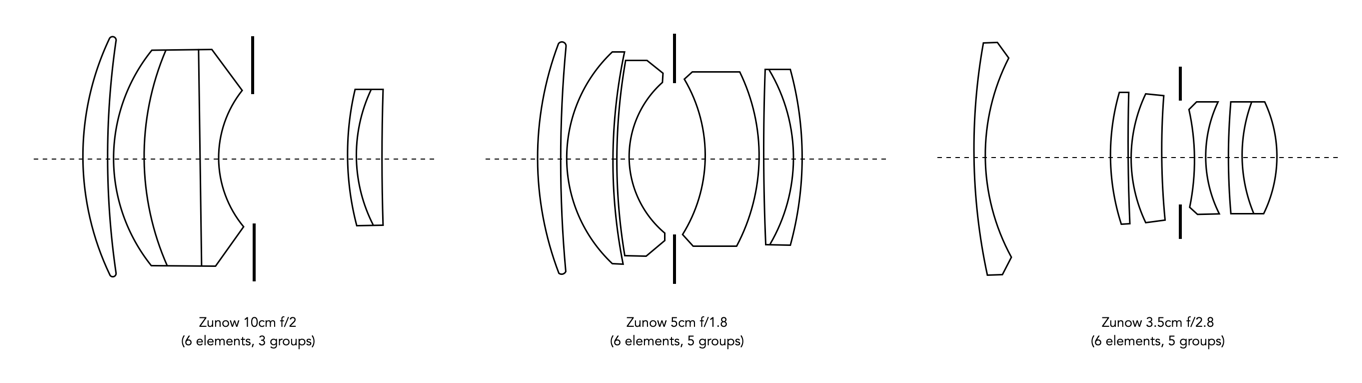
Fig.2: Lens configurations of various Zunow 35mm lenses
The first cine lens was a 5cm f/1.1 lens produced for American motion picture camera company Mitchell. The company also produced Zunow-Elmo Cine f/1.1 lenses for D-mount (8mm) in 13mm, 25mm, 38mm; and C-mount (16mm) 25mm, 38mm and 50mm.
Fig.3: Zunow lenses can be found on Neoca cameras, as fixed lenses with leaf shutters; and on Nikon rangefinders
The decline of Zunow was precipitated by the failure of its Zunow SLR in 1959, and by the bankruptcy of two of its customers – Arco in late 1960 and Neoca in January 1960. Zunow’s financial situation worsened, and rather than become a subsidiary of another company, the company was closed in 1961 [2]. In the same year, Suzuki Takeo founded a new company in partnership with Elmo (who Zunow had supplied lenses for) called Ace Optical who continued making lenses for 8mm and 16mm cine cameras, as well as other commercial lenses [2].
Besides the 5cm f/1.1, other lenses are available, especially in the Japanese market. The cine lenses seem to sell anywhere from US$200-1000. The 3.5cm f/1.7 rangefinder (L39) lens has sold for around US$3500. Typically they are found mostly on the Japanese market.
Company name timeline: 1930 − Teikoku Kōgaku Kenkyūjo (Imperial Optical Research Institute) 1954 − Teikoku Kogaku Kogyo Kabushiki Kaisha or Teikoku Optical Industry Corporation 1956 − Zunow Kōgaku Kōgyō K.K., or Zunow Optical Industry Co., Ltd. 1961 − Company closes, re-envisioned as Ace Optical the same year
Notable lenses: Zunow 5cm f/1.1 (1953)
Note that there is still an unrelated company called Zunow in the north of Japan, which makes conversion lenses and filters (for cine cameras).
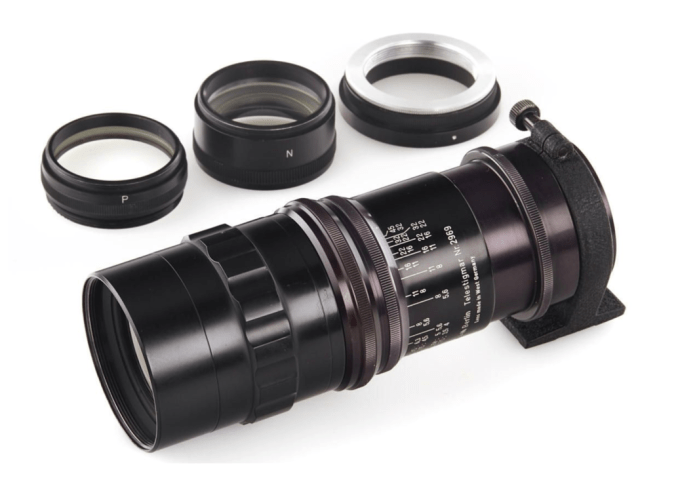
Dr. Max Weth Optik, was a German lens maker located in Berlin in the 1950s (West Germany). The company is best known for its Telestigmar multi focal lens set, first made in 1955 (sometimes known as Votar Telestigmar). This was a very unique 6-element lens, with the ability to configured in four different focal lengths, with four different apertures: 315mm f/6.3, 250mm f/5, 225mm f/4.5, and 175mm f/3.5. The lens was described in a 1957 article in Modern Photography [1]. The lens has three interchangeable components: N and P are negative and positive lenses, and Z an extension tube, i.e. spacer (the kit also included R, a close-focus extender). When one or two of these are combined with the front lens, V, the different focal lengths are obtained. For example P+V = 135mm. The article suggest that the best “critical sharpness” was obtained using N+P+V=225mm lens. The lens was made in mainly in M42, and Exakta mounts (and custom ALPA).
TheTelestigmar multi focal lens
The rationale behind the lens was that it provided four telephoto lens without the weight of four telephoto’s. It was basically a prime lens with two ancillary rear elements and a spacer. The lens would ultimately be superseded by zoom lenses of similar focal range, i.e. 175-315mm. In 1957 the lens sold for US$220. The most recent prices online are around US$100-300.
Further reading:
“The Amazing Tele-Lens of Dr. Weth”, Modern Photography, 21(10), pp.70,71,140 (Oct,1957)
“The Magical Optic of Dr. Weth”, Peter Dechert (1992)
Pierre Angénieux (1907-1998) was born in Saint-Héand near Lyon in 1907. In 1928 he graduated with a engineering degree and a year later received a degree in optical engineering. In 1930 he joined Pathé, a company involved in the motion picture industry in France. In 1935 he founded a manufacturing company specializing in cinematic gear in Paris. Initial production was primarily for military purposes, and this was discontinued during WW2. During the war, 35mm lenses were manufactured predominantly for the Swiss Alpa camera. The first lenses ca. 1938 were the 50mm f/2.9, and 50mm f/1.8 (for Alpa). In 1940 the Paris workshop was closed, and work relocated to Saint-Héand.
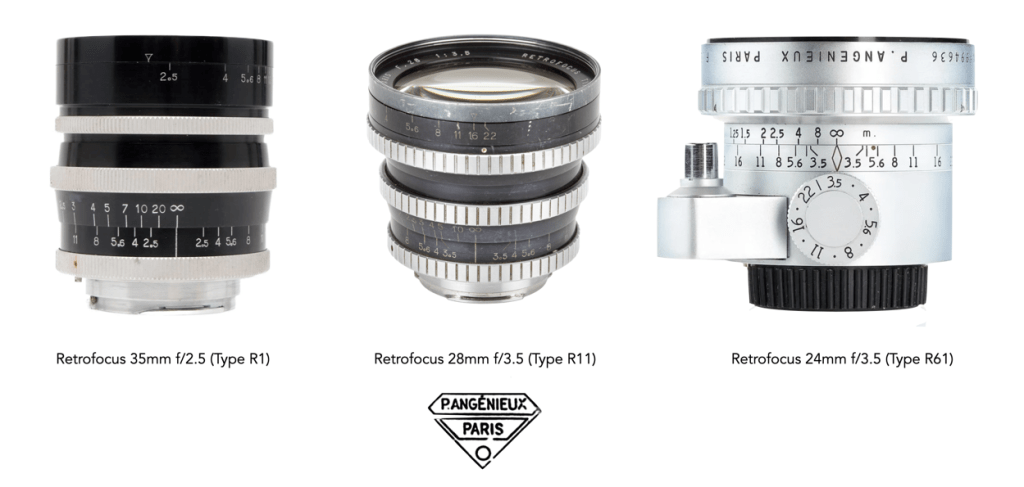
In 1950 Angénieux eleased the first retrofocus lens. These lenses used an inverted-telephoto design, with the negative lens group at the front of the lens, increasing the back focal distance. The first lenses were intended for rangefinder cameras, but the design was ideal for 35mm SLRs which allowed a wide-angle lens without interfering with the moving mirror. The first lens was the Retrofocus R1 series – 35mm, f/2.5. This was followed by the R11 28mm f/3.5 in 1953, and the R61 24mm f/3.5 in 1957. The Retrofocus design allowed wide-angle lenses on the range of interchangeable lens SLRs developed in the 1950s. By the 1950s they were producing 45,000 retrofocus lenses a year.
The most famous Angénieuxretrofocus lenses
This “retrofocus” design moved the optical focal point further to the front of the lens, using an additional lens element. A focal length shorter than 40mm was achieved by placing a diverging lens with a very large diameter in the front of the optical system. Traditional lenses using the Gaussian-double design could not be positioned close enough to the image plane without hindering the movement of the mirror in SLR cameras. Angénieux also made standard lenses in 50mm, 75mm, 90mm, 135mm and 180mm focal lengths.
In 1951 Angénieux adapted the Retrofocus lens or cine lenses, 8mm, 16mm, and 35mm. In 1960 the first Angénieux 35mm cine zoom was released, the 35-140mm f/3.5. This was followed by a litany of cine zoom lenses. NASA was to use Angénieux’s 25mm f/0.95 lens in the Ranger 7-9 missions. The NASA Gemini missions used Maurer 16mm cameras with 18mm f/2, 25mm f/0.95, and 75mm f/2.5 cameras, optics which would again appear on the Apollo 7, 8, 9, and 10 missions – on Apollo 11 the lenses would help record Neil Armstrong’s first steps on the Moon. Angénieux’s work with NASA would continue through the space shuttle era.
Schacht was founded by Albert Schacht in 1948 in Munich (Germany). Albert Schacht had a long pedigree of lens design. From 1913-1919 he was an operations manager at Carl Zeiss Jena, followed by seven years at ICA A.G., before it was merged into Zeiss Ikon (Dresden) where he continued until 1939. During the war years until 1946 he was a technical director at Steinheil in Munich. Schacht focused on designing and building lenses for 35mm film cameras. In 1954 production was moved to Ulm. Schacht manufactured interchangeable lenses in the range of 35-200mm for all common camera connections. Most lenses at Schacht were designed by Ludwig Bertele, who founded an optics office in Switzerland in 1946 with the help of Wild Heerbrugg.
The first interchangeable SLR lens manufactured was the Albinar, 13.5cm f/4.5 in 1952. It was produced exclusively for export to the USA and with an Exakta bayonet connection. It wasn’t really a telephoto, but rather just used a simple 4-lens design. Production was then expanded to include three more common focal lengths: the Travenar 50mm f/2.8, 85mm f/2.8, and 135mm f/3.5. The Albinar was renamed Travegon in 1954. They were available in Alpa, Exakta, Praktica (M42), Pentacon, and Leica mounts. In 1956 a wide-angle Travegon 35mm f/3.5 was introduced. Schacht produced lenses in the most popular focal lengths, and was one of the first lens manufacturers to deliver SLR lenses with an automatic aperture.
Fig.1: Advertisements from Schacht
Most of its early lenses were of standard 1950s aluminum construction. In the 1960’s Schacht changed the visual appearance of their lenses to match those of other manufacturers, i.e. a black lens with a zebra-style design which initially incorporated berg-and-tal stype controls, opting eventually for a more modest raised style of grip. These are generally considered good quality lenses, however not as common as other brands. Early lenses are marked as A. Schacht Munchen, older ones A. Schacht Ulm. Brands included: Albinar, Travenar, Travegon, Travelon, Travegar, Travenon, sometimes with the prefix tele- S-, M-, or Tele-.
Fig.2: Schacht changed their design over the years from an aluminum aesthetic to black with a zebra-style look.
In 1967 the company was acquired by Constantin Rauch. In 1969 the optics division was sold on to the Wilhelm Will KG company in Wetzlar. Due to production difficulties, lens production ended in 1970.
The Kern company was established by Jakob Kern (1790-1867) in the Swiss Canton of Aargau in 1819. Over the years it was involved in the design and manufacturing of drawing tools, surveying instruments, binoculars, army optics, and camera optics.
The start of the First World War was problematic for Kern because it put a strain on the procurement of lenses and prisms for use in surveying instruments. The parts were sourced entirely from abroad, and so Kern decided to establish their own optics production. At the same time the company was looking for products to expand beyond surveying equipment, which ultimately lead to the choice to develop cameras, binoculars, and associated optics. After the war there was growing competition from new surveying instruments producer Wild Heerbrugg (Heerbrugg, SG).
The foray into lenses was spear-headed by Walther Zschokke (1870-1951). Born in Gontenschwil, Aargau, he started as an optician’s apprentice at the Steinheil company in Munich in 1888. In 1895 together with Max Loehr he founded Steinheil’s branch workshop in Paris, and in 1901 he moved to the Goerz company, Berlin-Friedenau where he developed lenses such as the wide-angle Hypergon and the Goerz Dagor. From 1914 to 1918, Zschokke ran the “Sendlinger optical glassworks” founded by Rudolf Steilheil, and then 1919 returned to work for Kern, developing their first lenses. He left the company in 1925.
Early Kern products
In 1923 the company also began manufacturing “plate” cameras, with the first model being the “Bijou”. They followed this with roll-film cameras, a 35mm stereo camera. The company was also involved in making 3rd-party lenses, e.g. to equip the wooden cameras from the Swiss company Frey & Co.
The first cinematic and projection lenses appeared in the late 1920s, particularly for the Bolex film cameras (designed by Jacques Bogopolsky of ALPA fame). After the takeover of Bol S.A. in 1930 by Paillard S.A., there was close cooperation between the two companies. In 1937 Paillard developed the 8mm Bolex which would have a substantial impact on lens development. Kern would supply the Paillard-Bolex cameras with lenses with brand names such as Switar (high aperture), Pizar (cheaper lenses), and Vario-Switar. In 1946 Kern and Paillard jointly founded the company Yvar in Geneva to produce the Yvar cinema lenses. A lot of cinema lenses were produced over the years including the Switar 5.5mm f/1.8 (a 8/4 design by Hans Schlumpf), and the 13mm f/0.9 (a 10/5 design also by Schlumpf).
Kern also built a whole series of varifocal lenses. The first was made for the Bolex 16mm in 1955 by Dr. Raimond Stettler – it was the Vario-Switar 21-75mm f/2.8. There were no computers at the time, so he calculated the complicated optics by hand using logarithmic tables. This lens was not produced, however provided research for the first mass-produced Vario lens – the Vario-Switar 18-86mm f/2.5. This lens was the first computer calculated lens, designed by Dr. Stettler and Walter Zuercher, and released in 1960. By 1964 one million lenses had been produced in the Aarau and Yvar S.A. factories. Paillard S.A. was responsible for this success as most Bolex film cameras were equipped with Switar lenses for 8mm, Super-8mm and 16mm formats.
An ALPA brochure for the Switar 50mm f/1.8
Kern only really made one focal length of 35mm lens, and typically only for one company – ALPA. At the end of the 1940s, Pignons S.A. approached Kern regarding lenses for its ALPA series cameras. Of course during this period there was a lot of competition from both German and French optical companies. Hans Schlumpf, who had achieved remarkable things with his cinema-Switars, created the Photo-Switar in 1950, followed in 1960 by the Macro-Switar, both 7-element lens, and in 1968 the improved 8-element Macro-Switar. These lenses were only made for ALPA, with production continuing until 1970, however the supply was so good that some ALPA cameras produced in the 1980s still came equipped with the lens.
On Monday 21 July 1969, Neil Armstrong became the first human to set foot on the moon during the Apollo 11 mission. This was the first time Kern had supplied lenses to NASA. It was lenses made by Kern that captured the descent of the Eagle module which took Neil Armstrong and Buzz Aldrin to the surface of the moon. There were four data acquisition cameras (Maurer 16mm data acquisition camera) used to collect data. Mounted both on the command module and on the lunar module, the 16mm cameras recorded the events for later evaluation. The lenses for these cameras were supplied by Kern: 180mm f/4.5 (2 pieces), 75mm f/2.2 (21 pieces), 18mm f/0.9 (21 pieces), 10mm f/1.6 (33 pieces).
In 1988 it became part of the Wild Leitz Group and the Aarau factory closed in 1991.
Enna Werk was a small German optical company founded in 1920 by Alfred Neumann and located in Munich. There seem to be two stories regarding its name: (i) Enna is the founder’s daughter’s name reversed, or (ii) Enna is derived from the reversed initials “N.A.”, of its founder (pronounced Enna). During WWII, the company supplied lenses for the German military. In 1945 the plant was destroyed by allied air raids and was relocated to Ebersberg, near Munich. After the death of Neumann, the running of the company was taken over by his son-in-law, Dr. Werner Appelt and renamed “Enna-Werk Optische Anstalt Dr. Appelt K.G.”. By 1948 the plant at Konradinstraße in Munich was rebuilt.
Fig 1: Some of the more interesting Enna lenses
Circa 1950 the company started making lenses under its own name – prior to this the company only manufactured lenses for other companies, including Alpa, Balda, Braun, Corfield, Edixa (Wirgin), and Ihagee. In 1952 it started producing lenses for interchangeable rangefinder cameras. This was followed in 1953 by the production of SLR lenses with a focal length range between 24 and 600 mm. By 1964 Enna had produced 4 million lenses. The primary lens designer was Dr. Siegfried Schäfer and some of his designs are based on drafts by Ludwig Bertele, designer of the famous Sonnar. They made lenses in various mounts including M42, M39, and Exakta.
The first interchangeable SLR lens was the 35mm wide-angle Lithagon f/4.5 (1953), followed soon afterwards by f/3.5 and f/2.8 and even f/2.5 versions (1956). A Lithagon with a 28mm focal length, the Ultra-Lithagon 28mm f/3.5 was unrivalled at the time (1955). A very fast Ennalyt 85mm f/1.5 appeared in 1954, followed a year later by a telephoto, the Tele-Ennalyt 135mm f/3.5. Enna had a number of milestones, which included the world’s fastest wide-angle lens, the 9-element Super-Lithagon 35mm f/1.9 in 1958, and the worlds first telephoto zoom lens, the Enna Tele-Zoom 85-250mm f/4 in 1961 (only two years after the release of the Zoomar, the worlds first zoom lens). The high-speed 6-lens Ennaston (later Ennalyt) 85mm f/1.5 was also one of the world-renowned lens developments in the 1950s.
Fig 2: Enna Lithagon 24mm f/4
Enna was the first lens manufacturer in West Germany to introduce a wide-angle lens of the Retrofocus type. This lens design, developed almost simultaneously by Angenieux Paris and Carl Zeiss Jena (Flektogon), enabled shorter focal lengths than 40mm in 35mm SLR cameras for the first time. This lens was the Ultra Lithagon 28mm f/3.5 (Patent#US2959100A) which appeared in 1955 (it was also the second 28mm lens ever made). It was the brainchild of Hans Lautenbacher, and was so named due to the existence of the Lithagon 35mm. His contributions also included the retrofocus lens calculations which produced the wide-angle Lithagon 35mm f/2.8 (1953, Patent#DE1062028), and Enna’s ultrawide Lithagon 24mm f/4 (1960, Patent#DE1228820).
Enna is most typically associated with the Lithagon family of lenses, mostly in the wide-angle spectrum. The name had to be abandoned around 1960 for legal reasons. From then on the lenses were called “Ennagon” or “Ennalyt”. Prior to 1956 Enna lenses read “Enna-Werk München” on the lens ring, and from 1957 onwards they read “ENNA München.” In 1958 Enna introduced the Sockel lens system “Springblendensockel”, a precursor to Tamron’s Adapt-all system. This allowed various lens units to be mounted to different cameras using appropriate adapters. The adapters incorporated both the aperture and focusing controls. There were two (incompatible) versions of the system: the first was semi-automatic, offering twelve lenses from 24-240mm for Exakta and M42 mounts; the second was automatic with ten lenses, and additional adapters for Alpa and Miranda.
The company still exists, but now focuses on precision plastic injection molding. This diversification had begun in the early 1970s, with the realization that German lens production was loosing ground to Japan. They started with the production of plastic parts for the camera industry, and by the 1990s it had become the main focus of the company.






 Crafting Pixels