Pierre Angénieux (1907-1998) was born in Saint-Héand near Lyon in 1907. In 1928 he graduated with a engineering degree and a year later received a degree in optical engineering. In 1930 he joined Pathé, a company involved in the motion picture industry in France. In 1935 he founded a manufacturing company specializing in cinematic gear in Paris. Initial production was primarily for military purposes, and this was discontinued during WW2. During the war, 35mm lenses were manufactured predominantly for the Swiss Alpa camera. The first lenses ca. 1938 were the 50mm f/2.9, and 50mm f/1.8 (for Alpa). In 1940 the Paris workshop was closed, and work relocated to Saint-Héand.
In 1950 Angénieux eleased the first retrofocus lens. These lenses used an inverted-telephoto design, with the negative lens group at the front of the lens, increasing the back focal distance. The first lenses were intended for rangefinder cameras, but the design was ideal for 35mm SLRs which allowed a wide-angle lens without interfering with the moving mirror. The first lens was the Retrofocus R1 series – 35mm, f/2.5. This was followed by the R11 28mm f/3.5 in 1953, and the R61 24mm f/3.5 in 1957. The Retrofocus design allowed wide-angle lenses on the range of interchangeable lens SLRs developed in the 1950s. By the 1950s they were producing 45,000 retrofocus lenses a year.
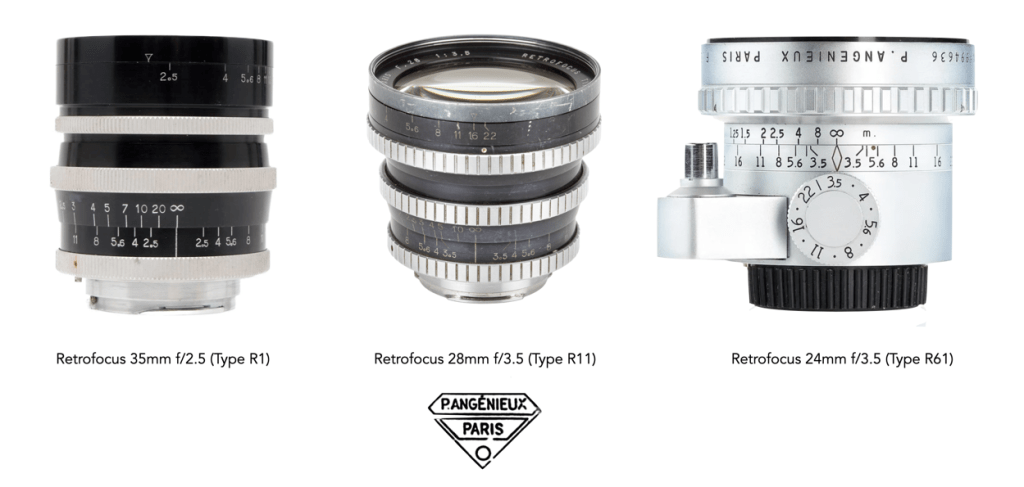
This “retrofocus” design moved the optical focal point further to the front of the lens, using an additional lens element. A focal length shorter than 40mm was achieved by placing a diverging lens with a very large diameter in the front of the optical system. Traditional lenses using the Gaussian-double design could not be positioned close enough to the image plane without hindering the movement of the mirror in SLR cameras. Angénieux also made standard lenses in 50mm, 75mm, 90mm, 135mm and 180mm focal lengths.
In 1951 Angénieux adapted the Retrofocus lens or cine lenses, 8mm, 16mm, and 35mm. In 1960 the first Angénieux 35mm cine zoom was released, the 35-140mm f/3.5. This was followed by a litany of cine zoom lenses. NASA was to use Angénieux’s 25mm f/0.95 lens in the Ranger 7-9 missions. The NASA Gemini missions used Maurer 16mm cameras with 18mm f/2, 25mm f/0.95, and 75mm f/2.5 cameras, optics which would again appear on the Apollo 7, 8, 9, and 10 missions – on Apollo 11 the lenses would help record Neil Armstrong’s first steps on the Moon. Angénieux’s work with NASA would continue through the space shuttle era.
The company still makes cine lenses.
Notable lenses: 24mm f/3.5 (1957); 28mm f/3.5 (1953); 35mm f/2.5 (1950)
 Crafting Pixels