“Capa’s pictures were made in his brain – the camera only completed them. You can no more mistake his work than you can the canvas of a fine painter. Capa knew what to look for and what to do with it when he found it. He knew, for example, that you cannot photograph war because it is largely an emotion. But he did photograph that emotion by shooting beside it. He could show the horror of a whole people in the face of a child. His camera caught and held emotion.”
John Steinbeck, “Robert Capa” in The Best of Popular Photography (1979)
quote
Szarkowski on the history of photography
“The history of photography has been less a journey than a growth. Its movement has not been linear and consecutive, but centrifugal. Photography, and our understanding of it, has spread from a center; it has, by infusion, penetrated our consciousness. Like an organism, photography was born whole. It is in out progressive discovery of it that its history lies.”
John Szarkowski, The Photographer’s Eye (1966)
A photograph’s life in the world
“As an object, a photograph has its own life in the world. It can be saved in a shoebox or in a museum. It can be reproduced as information or as as advertisement. It can be bought and sold. It may be regarded as a utilitarian object or as a work of art. The context in which a photograph is seen effects the meanings a viewer draws from it.”
Stephen Shore, The Nature of Photographs
More Rothschild on photography
“In a civilization which is becoming more and more mechanized, in which buildings look more and more alike, in which native crafts which gave identify to individual tribes and nations are being replaced with machine-made goods, in which relatively few people make music and many listen to it, in which passive sitting before a TV set is the order of the day, photography offers the ability to produce works of art.”
Norman Rothschild, “The Super-Q-Gigantar lens – it’s a gag, but some people took it rather seriously”, Popular Photography, 72(5), pp.58,62 (1975)
Rothschild on photography
“Once the transistor radio is turned off, once the hi-fi set is not being used; and once the thrilling ride in the sports car, motorcycle or snowmobile is over, there is silence – the actual experience is over except as a fond or not-so-fond memory. Carrying the use of the camera to its logical conclusion gets you a picture, a solid reminder of your continued involvement.”
Norman Rothschild, “The Super-Q-Gigantar lens – it’s a gag, but some people took it rather seriously”, Popular Photography, 72(5), pp.58,62 (1975)
The Leica changed photography
In the October 1936 issue of Fortune, there was an article on the “minicam boom”. It cited there being 100,000 miniature cameras in the US, comprised of more than 30 different makes.
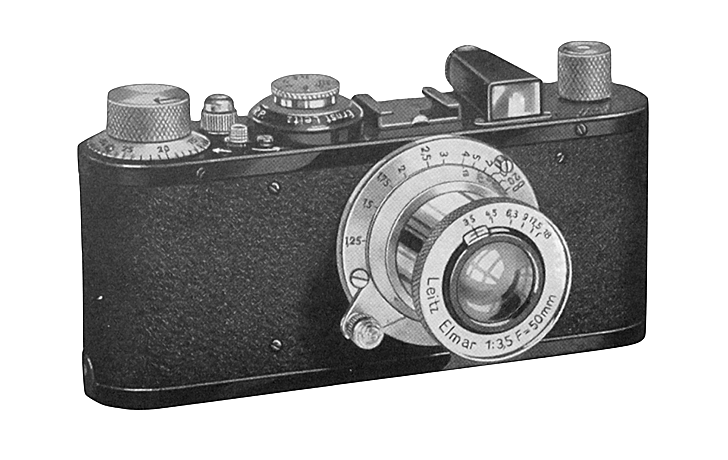
“Many a man who had owned a Kodak for years without feeling any impulse to see what he could do with it if he applied himself fancied that in the Leica he was finding a new invention that defied the laws of optics and would give him good pictures with no light to speak of and no effort save that of pressing the button. The Leica didn’t even look like a camera. No bellows, no bulk, no focusing hood; you shot from the hip, so to speak, and got your man.”
“Miniature Cameras”, Fortune, p.125 October 1936
The world is 3D
“The world is three-dimensional; a photographic image is two-dimensional. Because of this flatness, the depth of depictive space always always bears a relationship to the picture plane. The picture plane is a field upon which the lens’s image is projected. A photographic image can rest on this picture plane and, at the same time, contain an illusion of deep space.”
Stephen Shore, The Nature of Photographs
Time and photographs
“There is no such thing as an instantaneous photograph. All photographs are time exposures, of shorter or longer duration, and each describes a discrete parcel of time. This time is always the present. Uniquely in the history of pictures, a photograph describes only that period of time in which it was made. Photography alludes to the past and the future only in so far as they exist in the present, the past through its surviving relics, the future through prophecy visible in the present.”
John Szarkowski, The Photographer’s Eye (1966)
One lens or a hundred?
“It’s a great temptation, especially here in Japan, where really beautiful precision cameras and lenses ca be had for a fraction of the cost in the United States, to add just one more to an already over-stuffed gadget bag.
Don’t however, be led into the error of thinking that the answer to good pictures is to be found in a complete set of matched lenses. Just the opposite is true, for there is a very definitive correlation between the number of lenses the average photographer carries, and the worth-while pictures he produces. Unfortunately, this varies in inverse order; in other words, the more equipment to worry about, the fewer pictures of merit!
Special demand will require special equipment. For example, any photographer specializing in portraits or stage photography will find the f2 Serenar 85mm indispensable, but neither this or any number of lenses will do more than allow you to take better pictures. In fact, you chances of becoming a great photographer are probably better with only one lens, than with one hundred.”
Horace Bristol, TOKYO on a five day pass; with candid camera (1951).
 Crafting Pixels