What happened to the Zeiss lens collection?

When Carl Zeiss Jena was still under US control in June 1945, the US Army Signal Corp’s Pictorial Division expropriated the “Zeiss lens collection”, which consisted of approximately 2000 sample lenses, and associated documentation. The collection was handed over to Colonel Tebov on May 12, 1945 in Jena.

The collection represented not only Zeiss lenses, but optics from other manufacturers, and was used in research and production control. The lenses were transferred to the Signal Corps laboratories at Fort Monmouth, and the documentation to Dayton-Wright Army Air Field in Ohio. At Fort Monmouth, chief of the photographic branch (Signal Corps Engineering Laboratories) Dr. Edward F. Kaprelian, studied the lenses, attempting to understand and recreate the optical designs in many of the prototype Zeiss lenses. Supposedly the lenses were to be analyzed, in particular several hundred experimental lenses that were never sold. None of these historically and technically significant lenses had been clearly documented as part of the appropriation. Willy Merté, head of optical computation at the former Carl Zeiss Jena was apparently languishing in a refugee camp in Heidenheim before Carl Zeiss could begin operation in Western Germany. Merté would go on to catalogue the collection.

In April 1947, Popular Photography was the first major US publication to give a two page sneak peek [1]. Example lenses described include:

  • The Spherogon, a 1.9cm f/8 lens with a plano (flat) front element 3” in diameter, with an AOV of almost 160°.
  • The R-Biotar, was the fastest commercially produced lens in the world, at 4.5cm with an aperture of f/0.85. It was used for 16mm movies of fluorescent x-ray screens.
  • The Bauart BLC, a 20cm f/6.3 objective used by the Luftwaffe for aerial mapping.
  • The Perimetar 2.5cm f/6.3 for 35mm cameras, covering a 90° AOV with a deeply concave front element.

Probably the best description of some of the more unusual lenses comes from a June 1947 article by Kaprelian himself [2]. In it he describes some of the V (versuch) or experimental lenses. He describes lenses like the V1940, a 7.5cm f/2.8 lens with a 70° AOV, with little astigmatism or coma, and very little in the way of distortion. Or the V1935, 10cm f/6.2 lens whose front element is strongly concave. Another lens already produced in certain quantities was the Sphaerogon, available in focal lengths from 1.6 to 12cm and f/7, f/8 apertures. Other lenses include experimental aspherical surfaces, telephoto, and wide-aperture lenses.

Where are these lenses today? Perhaps stuck in a storage locker somewhere in the vast storage facilities of the US Army? Well, actually no. In an article in Zeiss Historica in 2016, the fate of the collection is documented [3]. Stefan Baumgartner bought a number of lenses from the collection in 2006, and as he tells it, this is when a major portion of the collection was put up for sale on eBay, a legacy of the estate from American photographic businessman Burleigh Brooks. Apparently after Kaprelian’s release from his military service the collection was left in the custodianship of Burke and James in Chicago, occupying warehouse space for about 20 years. It was later disposed of as military surplus, which is why Brooks probably acquired some of the lenses (as he owned Burke and James).

Further reading:

  1. Walter Steinhard, “Lens Oddities”, Popular Photography, 20(4), pp.82-83 (1947)
  2. Edward K. Kaprelian, “Recent and Unusual German Lens Designs”, Journal of the Optical Society of America, 37(6), pp.446-471 (June, 1947)
  3. Stefan Baumgartner, “A Mystery of Another Lens from the Zeiss Collection”, Zeiss Historica, 38(1), pp.17- (Spring, 2016)
A brief note on historical photographic patents in Germany

When it comes to “who invented what first” in the photographic industry, there is always a lot of discussion when it comes to German patents. For example the idea that the Contax S had the first pentaprism for 35mm SLRs is based on a early patent. But just because a patent existed somewhere didn’t mean that similar technology wasn’t being developed elsewhere in parallel. And concepts don’t always make it to reality.

During the Second World War, German companies often applied for patents in other European countries, such as France and Switzerland. France made somewhat sense, considering it was mostly occupied by Germany during the war. Why this was done is still up for debate, but the end result is that there are often patents for photographic objects which exist outside Germany, but no longer have an associated German patent (for whatever reason). For example, information on the the precursor to the Spiegel-Contax (Contax S) camera, the Syntax, which was designed during the war, is available by means of a French patent FR884054 filed on August 9, 1941. The patent is supposedly based on a German utility patent filed on August 23, 1940, however a search of German patents finds nothing. Is that because it never existed, was never processed, or was lost? (The non-German patents normally identify that they are based on a German patent, however no German patent numbers are provided). It was also possible that during a war economy, only inventions that were important to the war effort were granted, many as so-called “secret” patents.

A patent is only effective within the scope of the respective patent law. Companies therefore register patents abroad in order to protect their inventions there from unauthorized imitation. In most cases during the war, these patents were confiscated. For example with the “Patents, Designs, Copyright and Trade Marks (Emergency) Act, 1939” of September 21, 1939, the British began confiscating enemy patents. Other Allied countries undoubtedly enacted similar laws.

The fate of German patents in the period 1945-1950 is somewhat interesting. According to the German Patent and Trademark Office, in 1944 due to the bombings, large portions of the patent office in Berlin (some 250-320K volumes were moved to the town of Heringen, and stored in a 500m deep potash mine shaft. The town was occupied by U.S. troops on 3 April 1945, and the shaft was located, although the patents were not exactly in great shape, and likely would have disintegrated if brought to the surface. So a team was sent down the mineshaft to microfiche the patents. Other patents were dispersed throughout Germany, and supposedly one set of copies of 180,000 patent applications were taken into eastern Germany where they were later lost by fire. Now the U.S. were actively engaged in tracking down secret documents from the industrial and research community. This involved 17 U.S. industries, and hundreds of civilian investigators. They discovered vacuum tubes made of heavy porcelain, magnetophone tape, and infrared technologies.

Starting in July 1945, U.S. troops seized some 145,000 “non-concluded” patent files. Essentially nearly all the German patents ended up in West Germany, meaning that the companies in East Germany likely no longer had access to the protection of these patents. Quite a number of the patents seized were used to help industries in allied countries. Why were not more photographic patents used? The allied countries really didn’t have the same level of photographic industry as Germany. Most German camera/lens companies actually ended up in the Soviet occupation zone. In addition, it is likely the main company in the Western zone, Leitz, had enough pull to allow it to continue operating.

In addition, from the end of April 1945 until 1 October 1948 there was no facility to file patents, aka the “patent-office-free-period” when no patents could be filed. Germans in the western zones were able to file patents again on 1 October 1948 and the German Patent Office began operations on 1 October 1949. In East Germany, patents could be submitted again on 15 September 1948, and on 6 September 1950, the Office for Inventions and Patents of the GDR was established.

What about the old patents which had basically been neutralized? Well in West Germany, the provisions on the maintenance of old IP rights were covered by the “First Act on the Amendment and Transition of the Provisions in the Field of Industrial Property Protection” of 8 July 1949. A request to maintain the IP rights had to be filed by 30 September 1950. A similar act appeared in East Germany in 1950. An example is one of Zeiss’s patents for pentaprisms from 15.4.1942: “Z 679 IXa/42 h ‘Spiegelprisma mit konstanter Ablenkung’ ” – basically a version of the 1946 Swiss patent, CH241034. It was reapproved on 14 June, 1951 (DE000Z0000679MAZ). Note that the 1942 patent does not appear in the German Patent Office searchable database.

It is therefore possible to find some patents, but others were likely lost in the attempt to save them during the tail end of the war. So the idea of defining who invented something first during the 1940s in Europe, but in particular Germany is very challenging, as noted in my post on Who had the first 35mm SLR with a pentaprism? Having said that it is generally easy to find historic patents from countries like Germany, Switzerland, and France. It is much harder to find them from Italy, or even Belgium.

Further reading:

War reparations at Carl Zeiss Jena – where did the dismantled equipment go?

The Soviets reportedly stripped Carl Zeiss Jena of 93% of its equipment, most of which was redistributed throughout factories in the USSR. This included 14 of the 16 glass furnaces at Zeiss [4], machines, office supplies and equipment, stocks and raw materials, boilers, elevators, switchboards etc. [5]. So what happened to the equipment taken by the Soviets as war reparations from the Jena plant from October 1946 to April 1947?

The majority of the dismantled equipment was transferred to three cities in the USSR – Moscow, Leningrad, and Kiev [8]. To Moscow went the rangefinder equipment, to Leningrad the equipment for the production of microscopes, micrometers and fine measuring devices, and to Kiev the geodetic equipment and the Contax Camera section [8]. Most of it seems to have been transferred to two factories in Russia: No.349, and No.393.

The Optical-Mechanical Plant No.349 near Leningrad (now St. Petersburg) was founded in 1914 in Petrograd. In 1919 it was nationalized, and in 1921 it was renamed the Factory of State Optics. Further reorganizations resulted in the factory in Leningrad becoming Gosudarstvennyy Opticheskiy Mekhanicheskiy Zavod (GOMZ), or State Optical-Mechanical Factory, in 1932. In 1965 GOMZ changed its name to LOMO (Leningradskoe Optiko Mekhanichesko Obedinenie), or Leningrad Optical-Mechanical Union. They produced optics for the Soviet military and space programs, as well as consumer cameras. Seventy-nine of the Zeiss experts from Jena were assigned to GOMZ, and the existing equipment in various parts of the factory was replaced by equipment dismantled from Jena [2]. By mid-1947 the process was completed, and the Soviet personnel were trained on using the equipment. A CIA report on the facility [2] suggests that much of the dismantled equipment stored in the open, or spoiled by mishandling, and the Soviets gained very little from the seized equipment [2].

Zavod (factory) No.393 is located in the small town of Krasnogorsk, a few kilometers from Moscow. Krasnogorsky Zavod was founded in 1942. During the Soviet era it became known as Krasnogorskiy Mechanicheskiy Zavod (Krasnogorskiy Mechanical Works), or KMZ for short. After 1945 it began producing lenses to Carl Zeiss specifications. The machinery at No.393 seems to be almost entirely made up of machines dismantled from Zeiss, Jena [6]. All the grinding and polishing machines at No.393 were transferred from Jena, amounting to one-third of the entire Zeiss plant as it existed prior to dismantling (100 lens grinding machines, 300 milling machines, and 100 metal grinding machines) [3]. The largest segment of machines was the 400 lathes of various sizes. All optical glass used at No.393 from 1946 to 1952 was from Jena, and of good quality [3].

No.393 produced a lot of optical items, including the Zorky camera, designated “FED”, and associated 5cm lenses. The Zorky was essentially a copy of the Leica IIc manufactured during the period 1940-1944. By 1951, about 400 cameras per month were being produced [6]. By 1947 the plant also made Moscow II 6×9cm camera, aerial cameras, photo-rectifiers, phototheodolites, 16mm motion picture cameras, and a series of military items.

The Contax camera section went to Arsenal No.1 in Kiev, Ukraine [8]. By the later 1940s this plant was making reproductions of the Contax II and Contax III cameras. These would morph into Kiev II and III cameras, eventually modified into the Kiev and 4A and 4AM. Some of the equipment also made it to smaller factories in the USSR. A good example of this is Optical Plant No.230 near the small town of Lytkarino (not far from Moscow). They received 50-60 grinding and polishing machines from Jena [7], although the CIA reports this as “bad and uncared-for equipment”. Some of the equipment was used to outfit a vacant optical plant in Zagorsk. Zeiss specialists installed the machinery, and trained Soviet workers [1].

The dismantling was in many ways not considered to be optimally successful, in all likelihood because insufficient care was taken with the sensitive equipment [4].

✽ Please note that while some people seem to regard the Soviet dismantling of equipment in East Germany to be looting, it was actually part of the reparation payments agreed upon in the Potsdam Agreement.

Further reading:

Please note that the CIA links don’t seem to work sometimes (since the issues with the US government websites began).

  1. Zeiss Specialists in the USSR”, Central Intelligence Agency, Information Report, 17 December (1952)
  2. Optical-Mechanical Factory No.349 GOMZ in Leningrad”, Central Intelligence Agency, Information Report, 23 June (1954)
  3. Quantity and Types of Optical Machinery and Equipment at Zavod 393 in Krasnogorsk and at Zeiss in Jena”, Central Intelligence Agency, Information Report, 25 August (1953)
  4. Zeiss and Schott and Genossen, Jena”, Central Intelligence Agency, Information Report, 1 April (1947)
  5. Organization and Production of the Carl Zeiss Plant at Jena”, Central Intelligence Agency, Information Report, 31 August (1953)
  6. Production at Factory 393 at Krasnogorsk”, Central Intelligence Agency, Information Report, 20 August (1953)
  7. Optical Plant in Lytkarino”, Central Intelligence Agency, Information Report, 19 January (1950)
  8. Activities and Production at Arsenal No.1 Kiev”, Central Intelligence Agency, Information Report, 6 February (1953)

Vintage camera makers – The origins of Zeiss Ikon

Zeiss Ikon was a part of the Zeiss empire emerging in Dresden in the 1920s as the conglomeration of six German optical companies. But its origins were likely in 1909 with the creation of the Internationale Camera A.-G. (ICA) in Dresden. It was initiated by Carl Zeiss and resulted in the merging of four companies: Hüttig, Krügener, Carl Zeiss Palmos, and Wünsche. This was likely precipitated by overproduction in the photographic industry in 1908.

  • Hüttig AG (1862) − One of the larger camera makers of the period. Produced the first single-lens-reflex camera, the Zeus-Spiegel-Kamera.
  • Krügener − Maker of cameras with magazines.
  • Wünsche AG (1887) − Camera maker: roll film, sheet film, plate film. Notable cameras included the “Bosco” and “Ada” mirror cameras, and the Mars detective camera
  • Carl Zeiss Palmos (1902) − Founded in 1900 as an independent camera company, then absorbed by CZJ.

In 1912 the small Swiss camera maker Zulauf joined the group. After rationalization, ICA produced a number of cameras continuing some of the lines of the founding companies. New products were also added. In 1926 Zeiss Ikon was formed. It was comprised of four companies:

  • ICA – Internationale Camera A.-G. (Dresden, 1909)
  • Optical Institute CP Goerz A.-G. (Berlin, 1888) − Camera and lens manufacturer
  • Contessa-Nettel A.-G. (Stuttgart, 1919) − Camera manufacturer created from the merger of Contessa Camerawerke Drexler & Nagel and Nettel Camerawerk.
  • Ernemann-Werke A.-G. (Dresden, 1889) − Camera maker
The evolution of Zeiss Ikon

To emphasize the focus on photography, the word Ikon was used, the German word for the Greek εἰκών meaning image. The use of Zeiss indicated an affiliation with the parent company in Jena. In 1927/28 two others companies joined the fold:

  • AG Hahn für Optik und Mechanik (Ihringshausen)
  • Goerz Photochemisches Werk GmbH (Berlin)

Over the years, a lot of streamlining was done, slimming down the company from 100 basic camera models in 1927 to 14 basic models in 1938. One of the most important products to come out of Zeiss Ikon was the Contax system, which appeared in 1932. This was followed by the Contax II in 1936. There were many cameras in the 1930s – Ikonta folding cameras, Baldur (a box camera), Contaflex (twin-lens reflex). From 1940 the German economy pivoted to a war economy. The end of the war brought damage to many of the factories, and in 1948 the company was expropriated and converted into a state company (using the designation VEB, meaning Volkseigener Betrieb or publicly owned enterprise). In the same year, the new western headquarters of Zeiss Ikon was established in Stuttgart.

Over the next few years Zeiss Ikon in East Germany changed its name quite a lot:

  • 1945 − VEB Zeiss Ikon Dresden
  • 1948 − VEB Mechanik Zeiss Ikon
  • 1951 − VEB Optik Zeiss Ikon
  • 1955 − VEB Zeiss Ikon
  • 1958 − VEB Kinowerke

In 1959 of course, VEB Kinowerke was folded into VEB Kamera-und Kinowerk Dresden, the precursor to VEB Pentacon Dresden.

In West Germany, the company continued to be known as Zeiss Ikon. In 1956 the Carl Zeiss Stifung, (the parent company of Zeiss Ikon), bought Voigtlander. It continued to be operated as a separate company until 1965, when it was merged with Zeiss Ikon to form Zeiss Ikon-Voigtlander. It produced mostly different products to its eastern brethren, although there were similarities. For example both companies made renditions of the Contax camera. In 1972, Zeiss Ikon-Voigtlander ceased production of cameras.

❖ Zeiss Ikon in West Germany was established at the Contessa-Nettel factory in Stuttgart, the only one of Zeiss’s major facilities not under Soviet control.

Vintage camera makers – The origins of Pentacon

Post-WW2 there were still a lot of camera companies in Germany, and particularly in East Germany. In fact the heart of the German camera industry lay in Dresden, Jena and the surround area. Over the next decade, many of the companies were merged into a series of VEBs (Volkseigener Betrieb or Publicly Owned Enterprise) culminating with VEB Pentacon.

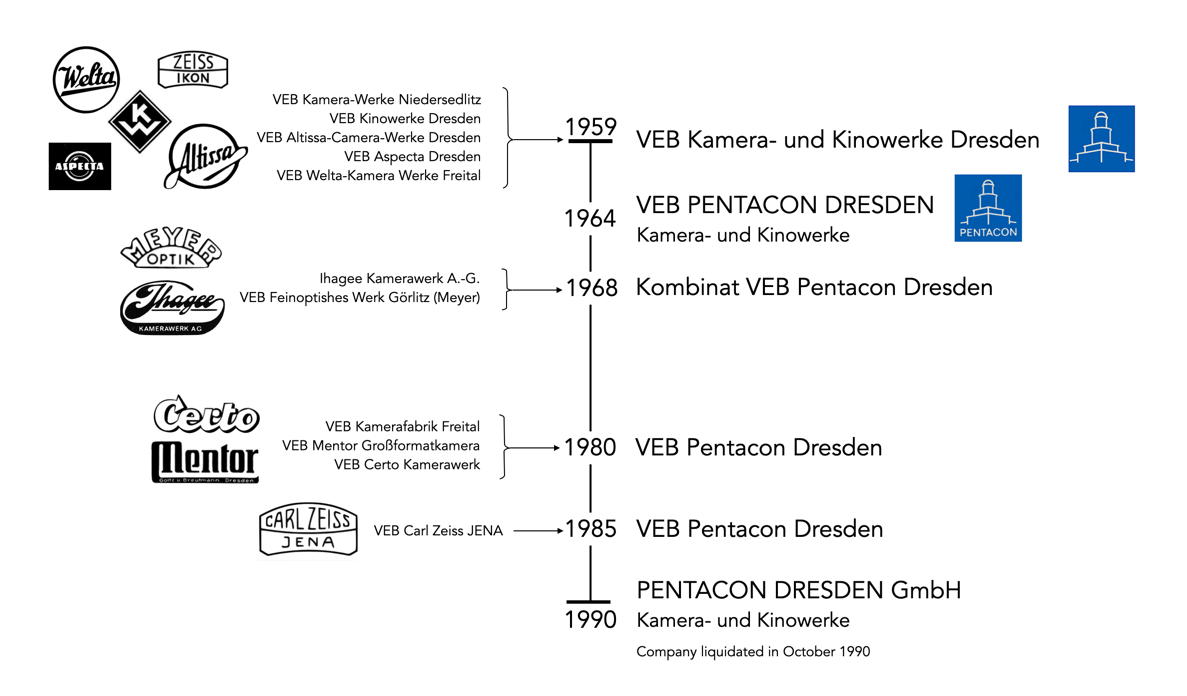
On January 1, 1959 a series of Dresden camera manufacturers were merged to create the large state-owned VEB Kamera und Kinowerke Dresden (KKWD). The company was a conglomerate of existing companies which produced a broad range of products and had numerous production sites. Joining them together meant production could be rationalized, yet cameras were still produced under their brands names, e.g. Contax, Welta, Altissa, Reflekta, Belfoca.

  • VEB Kinowerke Dresden − Formerly VEB Zeiss Ikon
  • VEB Kamera-Werke Niedersedlitz − This is where the Praktiflex, precursor of the Praktica, was invented; it included VEB Belca-Werk absorbed in 1957.
  • VEB Welta-Kamera Werke Freital − This included the VEB Reflekta-Kamerawerk Tharandt and Welta-Kamera-Werk Freital (Reflekta II, Weltaflex und Penti).
  • VEB Altissa Kamerawerke Dresden − Formerly Altissa-Camera-Werk Berthold Altmann, (including Altissa, Altiflex and Altix cameras).
  • VEB Aspecta Dresden − Formerly Filmosto-Projektoren Johannes (including projectors, enlargers, lenses).

In 1964 the company was renamed to VEB Pentacon Dresden Kamera-und Kinowerke. This was intended to provide a catchy name for the company (not forgetting that a lot of its products were intended for Western markets). Pentacon was already being used as the export name for the mirror Contax D, and was derived from PENTAprisma and CONtax. Pentacon used the stylized silhouette of the Ernemann Tower (on the old Ernemann camera factory site, which belonged to the former Zeiss Ikon) as its corporate logo. The company continued to produce good SLRs: Praktica V (1964), Praktica Nova with return mirror (1964), Praktica Nova B with uncoupled light meter (1965), Praktica Mat for the first time with TTL interior light metering (1965). In 1966 the 6×6 format Pentacon Six appeared, with the Praktica PL Nova I in 1967.

The evolution of Pentacon

On January 2, 1968, the VEB was restructured, and more companies were added into the fold, including Ihagee Kamerawerk (which had remained independent until this point), and VEB Feinoptisches Werk Görlitz. The name became Kombinat VEB Pentacon Dresden.

  • Ihagee Kamerawerk AG i.V. − Produced Exakta and Exa cameras.
  • VEB Feinoptisches Werk Görlitz − Formerly Meyer-Optik Görlitz

The continuous expansion and bundling of technical expertise and concentration of the production capacities of the Pentacon, led to the incorporation of three more companies in 1980.

  • VEB Kameratechnik Freital − Formerly Freitaler camera industry Beier & Co., including Beirette cameras.
  • VEB Mentor Großformatkamera − large format cameras
  • VEB Certo Kamerawerk Dresden − folding cameras

Finally in 1985, VEB Carl Zeiss JENA was added. Unfortunately it was likely all too late. There were scarce few years between this and the reunification of Germany. In July 1990 the company was renamed PENTACON DRESDEN GmbH, but by October it was being liquidated.

Zeiss versus Zeiss : the trademark dispute

As cooperation deteriorated, and finally terminated in 1953, it was inevitable that eventually there were some issues with trademarks between the two Zeiss’s. I mean they were on different sides of the Iron Curtain. The East German Carl Zeiss company did not own all the rights to some of the names and brands. This would likely have been fine had they just been sold within the eastern-bloc countries, however many were made to be exported to the west (which is really somewhat ironic) – lenses were developed to sell in the West to produce hard currency. They achieved this at the beginning by resurrecting pre-war designs. Political influence over East Germany did not have any influence in how products were manufactured.

Zeiss vs. Zeiss branding over the years

In February 1954 Zeiss in Heidenheim fired the first shots in what would eventually become a worldwide litigation. They obtained an injunction in the District Court of Goettingen to prevent the continued sale of Jena-made, Zeiss-marked goods [1]. In April Zeiss Jena countered in West Germany by seeking an injunction and an order registering the Zeiss marks in West Germany in its name. That action was dismissed in 1960 when the West German Supreme Court ruled that there was no one in the Soviet Zone having capacity to represent the Zeiss Foundation.

In the same year Zeiss Heidenheim brought action against the Zeiss Jena to prevent them from using the Zeiss name and trademarks anywhere in the world. The Supreme Court of the Federal German Republic determined that the Heidenheim firm was entitled to exclusive use of the Zeiss name and trademarks in West Germany and West Berlin [1]. Interestingly, a CIA report from 1954 [2] suggests that should the naming issues take an “unfavourable” turn for VEB CZJ, then the plan was to change its name to VEB Ernst Abbe Werk (which they obviously never did).

Information provided by lens markings

There was also a long court battle in the US over who owned the rights to the Zeiss name. The litigation commenced on February 14, 1962, filed by Carl Zeiss Foundation and Zeiss Ikon AG against VEB Carl Zeiss Jena and its US distributors [1] (Carl Zeiss Stiftung v. VEB Carl Zeiss Jena). The case went to discovery from 1963-1967 and finally to trial in November 1967. On November 7, 1968, the court found in favour of the plaintiffs, deciding that the US trademarks “Zeiss”, “Zeiss Ikon”, and “Carl Zeiss Jena”, were the property of the Zeiss firm located in West Germany. As to the legitimacy of this? The courts found that the original “Stiftung” ceased to exist in Jena when it had been stripped of its assets. The Stiftung’s domicile was then changed from Jena to Heidenheim. It was not until 1971 [3] that the US Supreme Court finally settled the case of Carl Zeiss vs. VEB Carl Zeiss Jena, after a long 9½ year battle for control of the “Zeiss” trademark, siding with Heidenheim.

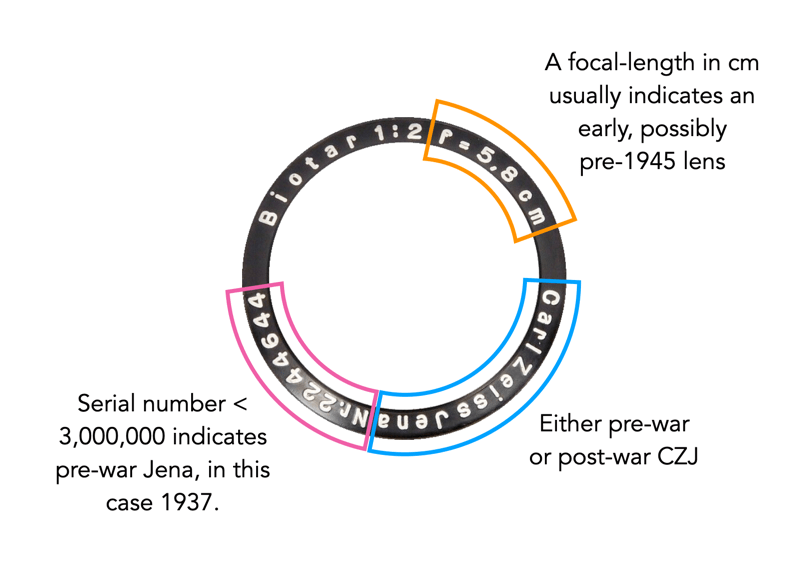
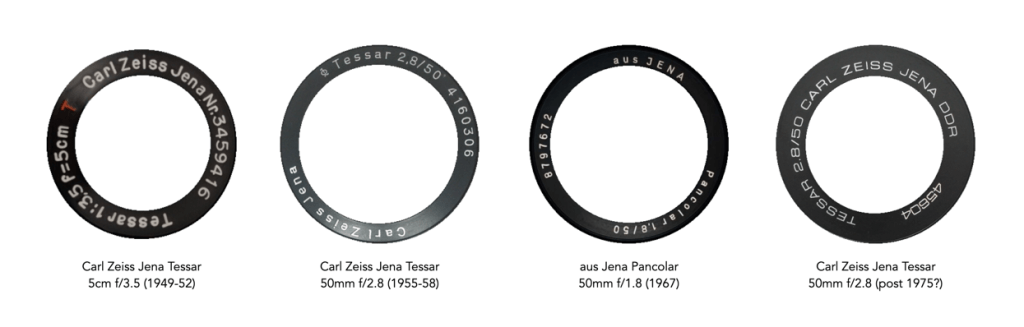
Examples of Carl Zeiss Jena lens markings over the years.

After this, Carl Zeiss marketed their lenses as “Carl Zeiss” exclusively in the United States, whereas Carl Zeiss Jena exported their lenses to the US with the marking “aus Jena”, or sometimes “JENOPTIK”, or even “JENOPTIK JENA”. The branding on these lenses was changed: “T” instead of Tessar, “B” for Biotar, “Bm” for Biometar, “S” for Sonnar, “F” for Flektogon, etc. in order not to infringe on the copyright. Therefore a lens might be labelled “Carl Zeiss Jena s”, or “aus Jena s”, and be exactly the same lens. It really depended on where the lenses were sold.

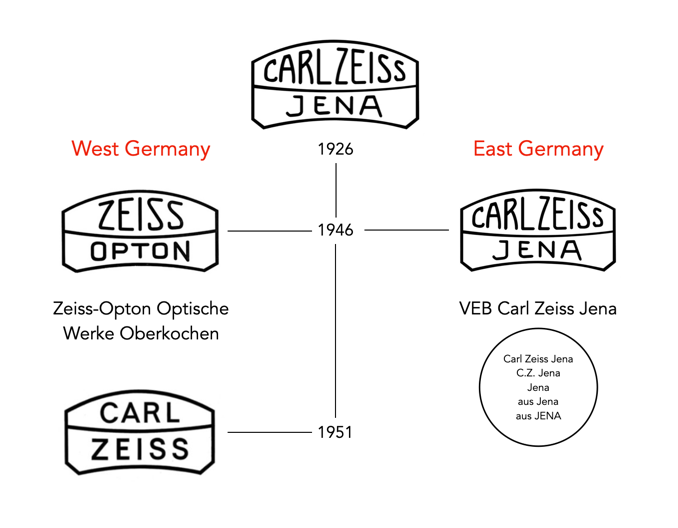
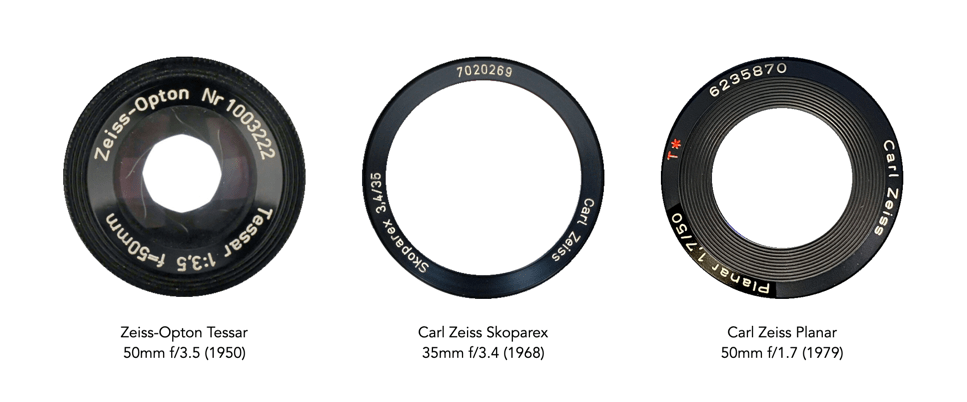
  • In the Eastern-bloc countries, CZJ could use the name “Carl Zeiss”. Carl Zeiss Oberkochen was not allowed to use “Zeiss” by itself, and instead used the name “Opton” or “Zeiss-Opton”.
  • In some western countries – namely West Germany, Italy, Greece, Holland, Belgium, Luxembourg, and Austria – CZO was allowed to use the name “Carl Zeiss”. CZJ chose to use the name “aus Jena” in the case of lenses.
  • The rest of the world, i.e. Commonwealth countries like England and Canada, Switzerland, Japan, both companies could use the name “Carl Zeiss”, but only if there was an indicator of origin. For example CZO used “Carl Zeiss West Germany”, and CZJ used “Carl Zeiss Jena” or the term DDR somewhere.
Examples of Carl Zeiss Opton lens markings over the years.

Of course it is also easy to identify a lens if it is marked with DDR. Some lenses were made in only East or West Germany, while others had names which continued to be shared.

  • East German only lenses: Biometar (a modified Planar), Flektogon (similar to Distagon), Flexon, Pancolar
  • West German only lenses: Distagon
  • Shared lenses: Hologon, Biogon, Biotar, Magnar, Planar, Protar, Sonnar, Tessar, Topogon, Triotar

Further reading:

  1. Shapiro, I., “Zeiss v. Zeiss – The Cold War in a Microcosm”, International Lawyer, 7(2) pp.235-251 (1973)
  2. “Possible Name Change of VEB Carl Zeiss Jena”, Central Intelligence Agency, Information Report, 22 Nov (1954)
  3. Allison, R.C., “The Carl Zeiss Case”, International Lawyer, 3(3), pp.525-535 (1969)

Zeiss versus Zeiss : the postwar split

One of the things that gets very confusing for some people is differentiating between Zeiss lenses from East and West Germany. First, let’s look at the backstory. Prior to World War II, Carl Zeiss Jena had been one of the largest suppliers of optical goods in the world. Note that Carl Zeiss was an optical company and different to Zeiss Ikon, which was a camera company formed in 1926 from the merger of four camera makers: Contessa-Nettel, Ernemann, Goerz and Ica. Both were members of the Carl Zeiss Foundation.

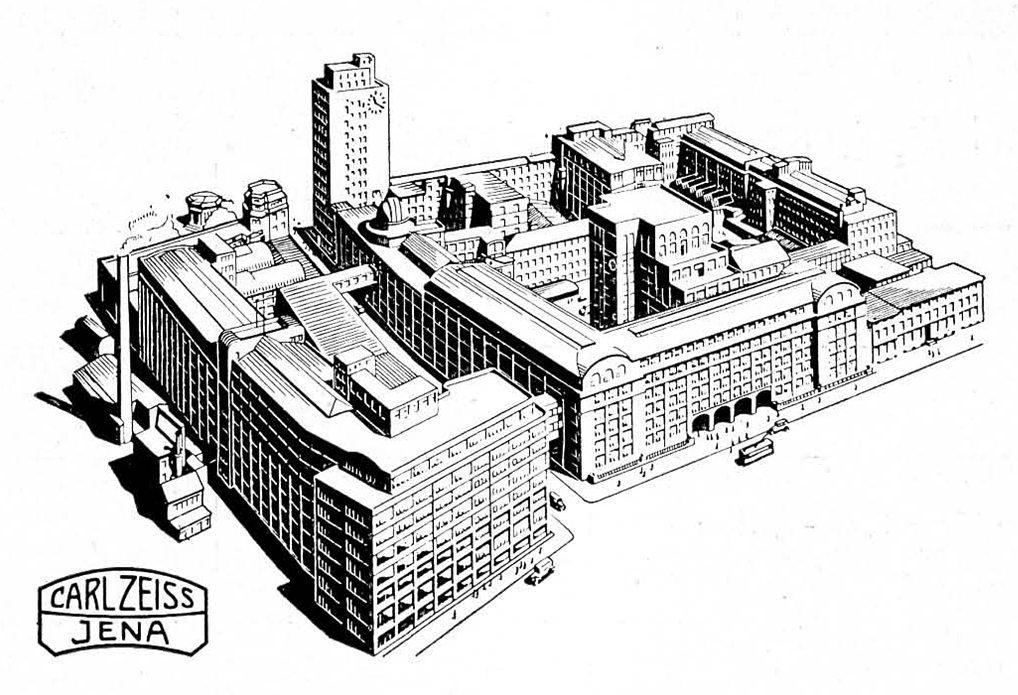
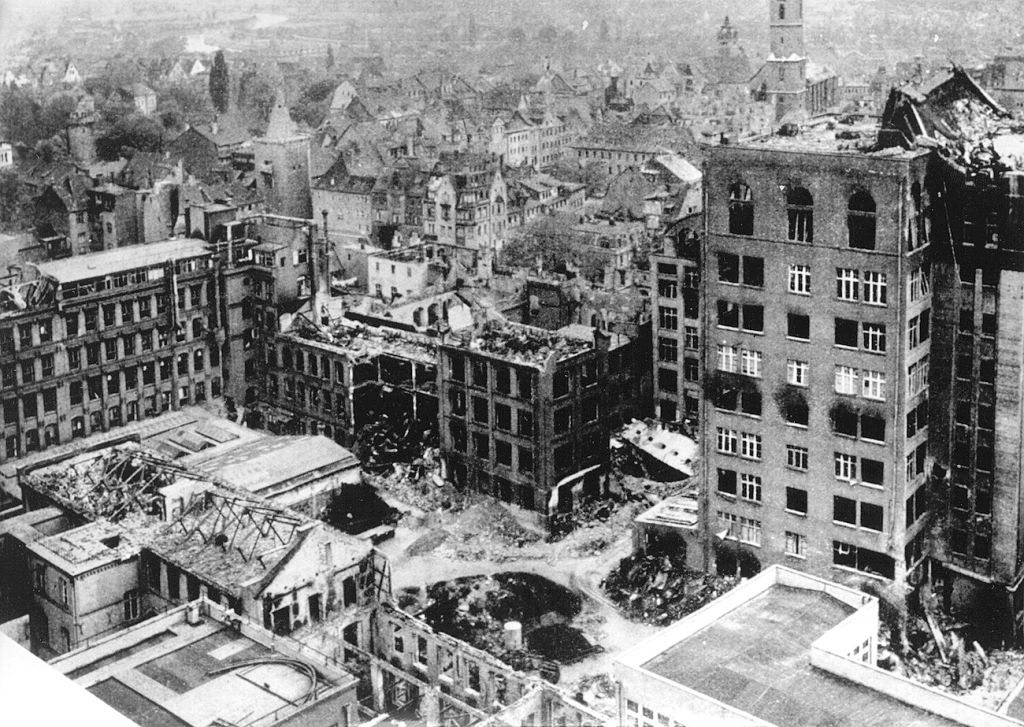
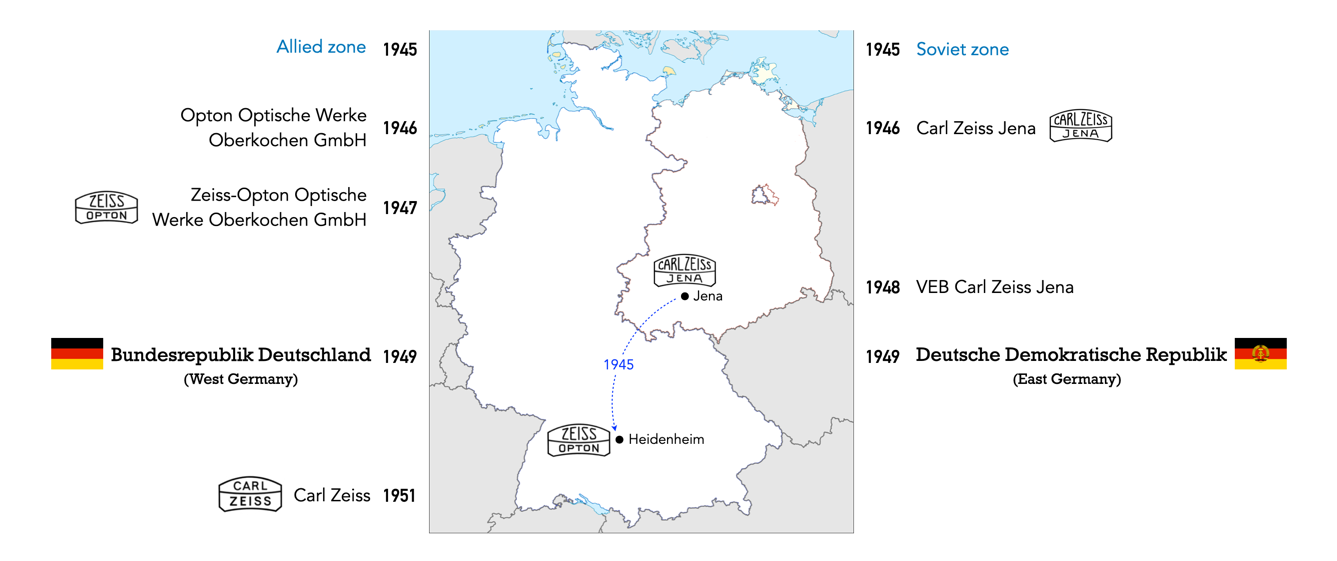
During the war, Jena had been pounded by allied bombing – the British bombed the Zeiss works on 27 May 1943, and the Americans repeated this twice in 1945. Mind you, there was not enough damage to put the factories out of commission but enough to slow production. Jena was captured by the American 80th Infantry Division on April 13th, 1945, and would remain in US control for two months before withdrawing in favour of the Soviet forces. As Americans departed, they took with them 122 key personnel from Jena to Heidenheim in the US zone of occupation (the personnel were from Carl Zeiss and Schott). At the conclusion of hostilities in 1945, Germany was split into differing zones, and as Jena was in the German state of Thuringia, it came under Soviet control (based on the Yalta Conference agreement).

A New York Times article in September 1946 suggested that the Russians were taking US$3,000,000 worth of finished products monthly for reparations [1]. At this stage there was very little in the way of dismantling equipment to ship back to Russia. In fact an earlier NYTimes article [2], suggested Russian occupation authorities had actually stimulated production at the Zeiss plants to pre-war levels, in order to facilitate reparations. It should be noted that the Zeiss plant produced more than just photographic optics – it also produced microscopes, medical and surgical instruments, ophthalmic instruments, geodetic instruments, electron microscopes, binoculars, etc., and military items [3].

The bombing damage to the Zeiss Jena plant

By 22 October 1946, the Soviet occupation authorities began dismantling the Zeiss plant [3] as war reparation payments agreed upon in the Potsdam Agreement. This was known as Operation Osoaviakhim, and involved many industries across Germany. It resulted in the removal of 93% of Zeiss’ equipment (including raw material, pipes, boilers, sanitary installations, etc), and 275 Zeiss specialists [4] deported to various locations in the USSR (approximately 90% of those deported would return to Jena in 1952). The taking of war “booty” was of course entirely legitimate, yet as Peter Nettl put it in a 1951 article, “Like a child long deprived of chocolate, the first Soviet ‘dismantlers’ flung themselves on all the available tidbits” [5].

A US intelligence report from July 1947 described the status of the Zeiss works at Jena [6]. In it they suggest that optical and photographic production had been least affected by the dismantling, with the plant producing lenses for the Soviets (Tessar 5cm f/3.5). The dismantling program had been completed by April 1947 [7], after which the Soviet High Command turned the plant over to the Germans, who re-established the plant. About 1000 machines remained at Jena after the dismantling, allowing for the continued production of eye glasses, camera lenses, medical glass and measuring instruments [8]. There was every hope at this time (at least from the West German side of things), that this was a temporary situation and that in 3-5 years Heidenheim staff would move back to Jena [6].

In June 1948, the Zeiss Jena plants were expropriated by the Land Expropriation Commission [9] and transferred to state ownership, becoming known as “VEB Carl Zeiss Jena”. In the American zone, Zeiss was reborn as “Opton Optische Werke Oberkochen GmbH” in 1946, becoming “Zeiss-Opton Optische Werke Oberkochen GmbH” in 1947, and Carl Zeiss in 1951. They had very little except the relocated personnel and supposedly a quantity of Zeiss documents. In 1949 Germany officially split into East Germany (Deutsche Demokratische Republik) and West Germany (Bundesrepublik Deutschland). Between 1948 and 1953 the two firms cooperated commercially with one another, after which cooperation deteriorated as the East German regime tightened control on VEB.

Like Zeiss, Zeiss Ikon (Dresden), best known for its Contax camera, also split in 1948. In the west, it was reformed into Zeiss Ikon AG Stuttgart. In the mid 1960s it merged with Voigtländer. It followed the Contax rangefinder line releasing the Contax IIa and IIIa cameras in the early 1950s. In the east, Zeiss Ikon became state owned, known as VEB Zeiss Ikon Dresden (ZID). ZID may be best known for its advanced SLR model, the Contax S, introduced in 1948.

Further reading:

  1. “Russians take 90% of Zeiss Output”, The New York Times, Sept.10, 1946.
  2. “Russians Increase German Industry”, The New York Times, July.5, 1946.
  3. “Activities at the Zeiss Plant, Jena”, Central Intelligence Agency, Information Report, 28 May (1953)
  4. “Deportation of Technicians and Specialists from Karl Zeiss, Jena”, Central Intelligence Group, Information Report, 13 January (1947)
  5. Nettl, P., “German Reparations in the Soviet Empire”, Foreign Affairs, 29(2), pp.300-307 (1951)
  6. “Status of the Zeiss Works in Jena and Moscow”, Central Intelligence Group, Intelligence Report, July (1947)
  7. “Layout and Organizational Setup of the Jena VEB Carl Zeiss”, Central Intelligence Agency, Information Report, 29 August (1955)
  8. “Dismantling, Production in the Societ Zone”, Central Intelligence Group, Information Report, May (1947)
  9. Allison, R.C., “The Carl Zeiss Case”, The International Lawyer, 3(3), pp.525-535 (1969)