The internet is full of articles suggesting smartphone cameras are better than actual digital cameras. Sure the smartphone market is booming, and they do take good pictures, but it’s really not possible to accurately compare them to digital cameras. It’s like saying to an astronomer that they could get the same quality astronomical image using a full-frame or medium format camera?
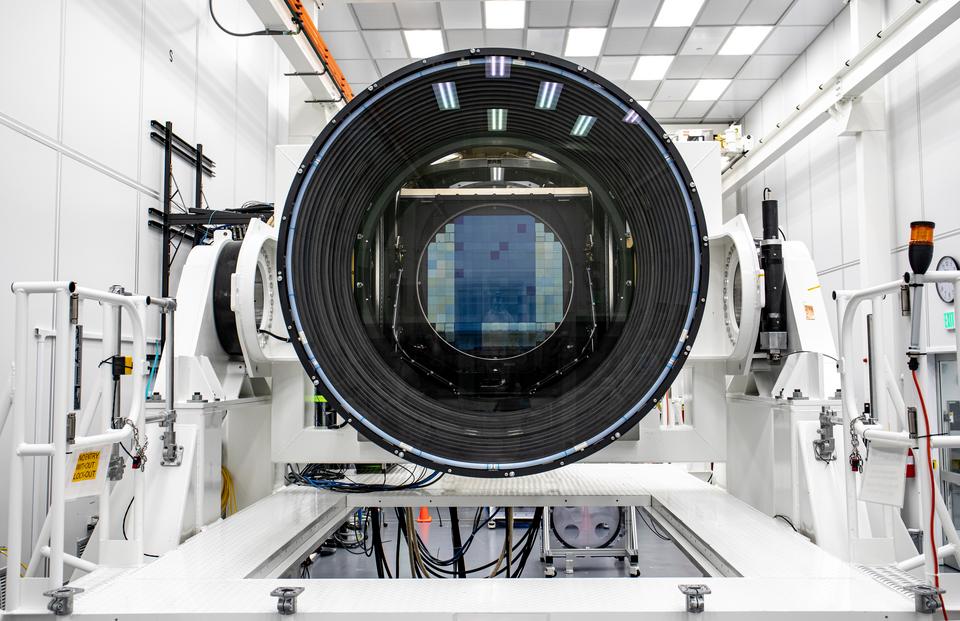
In late 2022 the worlds largest digital camera was unveiled at SLAC National Accelerator Laboratory in California. By the end of 2024 it will be installed at the Vera C. Rubin Observatory in Chile, and will be used in a 10-year project called the Legacy Survey of Space and Time to help unlock the mysteries of the universe. The composite sensor is comprised of 189 individual 16MP sensors, each 42mm2 in size, for a total resolution of 3.2 gigapixels. It’s largest lens has a diameter of 1.57m. Overall the focal length is 10.31m, with a speed of f/1.23. The camera will take 200,000 pictures per year.
This camera is massive. The individual photosites are 10×10μm in size – and large photosites mean that an abundance of light can be captured in such a ultra-low light environment (the sensors will be able to spot objects 100 million times dimmer than those visible to the naked eye). You could never achieve this with any sort of medium format 100MP 44×33mm camera… it’s just not possible. So why then do people still harp on about 12MP smartphone cameras being able to produce the same quality image as a 46MP DSLR?
Researchers at SLAC National Accelerator Laboratory are nearly done with the LSST Camera, the world’s largest digital camera ever built for astronomy. Roughly the size of a small car and weighing in at three tons, the camera features a five foot wide front lens and a 3,200 megapixel sensor that will be cooled to 100°C to reduce noise. Once complete and in place atop the Vera C. Rubin Observatory’s Simonyi Survey Telescope in Chile, the camera will survey the southern night sky for a decade, creating a trove of data that scientists will pore over to better understand some of the universe’s biggest mysteries, including the nature of dark energy and dark matter. (Jacqueline Ramseyer Orrell/SLAC National Accelerator Laboratory)
✽ Note that the size of the effective aperture on a smartphone lens such as the wide-angle 6.86mm (f/1.78) on the iPhone 14 Pro Max is 3.85mm. From a full-frame equivalency point-of-view, this is a 24mm lens with a speed of f/6.3. No one produces 24mm FF lenses with such a slow speed, but as an example, a Sony 24mm f/2.8 has an effective aperture of 8.57mm. Small lenses just aren’t as effective at capturing light – it’s basic physics. Of course the other big issue with smartphone cameras is that the lens elements are mostly constructed of moulded plastic (as opposed to glass).
Most people who use smartphones have little, if any, idea about things like aperture and shutter speed. They just use their smartphone camera to take pictures, and tend to ignore functional specifics. Settings are whatever the smartphone deems appropriate for the situation. For example clicking on ×0.5 in the Camera app on a modern iPhone will get you an image automatically taken with the ultra-wide camera. Yes you have some control over things, or more control when using a 3rd-party app, but generally these things don’t matter to most people. The future will bring more AI to smartphone cameras to produce so-called “perfect” photos – and if you like point-and-click photography, that’s fine. But sometimes that’s just not enough.
So what happens when you are intrigued enough to upgrade from a smartphone to a “real” digital camera? Should you run out and buy a full-frame (FF), or should you opt instead for a compact camera? To figure out what you really need, you have to first determine why you want to upgrade. Is it because you want to learn more about photography, or perhaps you want better control of the pictures you take? Or because you feel hamstrung using smartphone a camera and want more megapixels, better optics, or just a better way of taking pictures. Regardless of what people say, a smartphone camera will never provide the same sort of control, or image quality of a dedicated camera. There are many reasons for this, but the big ones are optics, storage space, and battery life. But this isn’t a post about that, here I want to consider options for “upgrading” from a smartphone camera (I’ll cover those in a separate post).
Upgrading from a smartphone to a compact – some specs.
Once you have figured out why, then we move onto what sort of photography you will be focusing on. Do you just want a camera for better travel photographs, or are you interested in landscapes? Or perhaps macro-photography? At this stage it is best to make a list of things you would like to achieve with a digital camera. Some of these things will help you narrow down the type of camera is best for you. For instance if you like street photography, then the best camera might be a compact camera like the Ricoh GRIII/IIIx, or the Fujifilm X100V. Compact cameras offer several advantages over smartphones – a larger sensor is the most obvious benefit, while physical controls and ergonomics offer a more tactile shooting experience. Most compact cameras now also use touchscreen interfaces, making them very accessible. These cameras generally have a fixed focal length lens, and a sensor somewhere between 20-24MP (which is more than adequate). Compact and inconspicuous cameras are perfect for street photography – the last thing you want as a street photographer is lugging around a huge hunk of a camera – it makes you stick out like a sore thumb.
Some of the benefits of digital cameras
If you want a better camera for travel, then a compact is good as well, as are crop-sensor cameras. Here cameras with mirrorless APS-C sensors have become popular, like the Fuji-series of cameras. Cameras for travel have to be versatile, compact and light – the new Fujifilm X-S20 weighs only 491g (without lens) – add a general purpose Fujifilm XF 23mm lens at 180g, and you get a total of 671g (and frankly you don’t need to travel with a cornucopia of lenses). You could also go for a smaller Micro-Four-Thirds sized sensor, which provides a camera with an even smaller form-factor. Now you could even go for a full-frame (FF) sensor, but I would not really recommend it for people upgrading from a smartphone. They are generally heavy, ostentatious (for travel anyway), and are not a good fit for novice photographers. Learn on something smaller before deciding on whether you really need a FF (or buy an inexpensive, older FF camera). Then there are those that want a more specialized set-up for landscapes, macro, sport or wildlife. As these types of photography are much more specialized, requiring specialized lenses, I would not jump straight into them. They can be expensive, and often need a good amount of experience to be used in an effective manner.
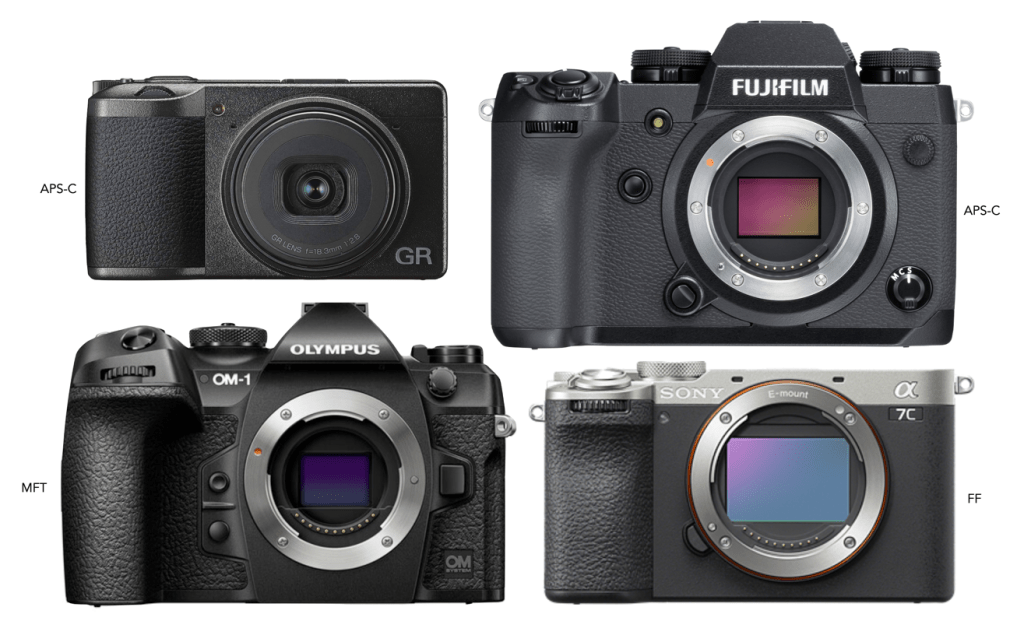
Choosing a camera is about what you are interested in photographing, budget, future expandability (if that is important), camera ergonomics (it has to feel right to use, or you will hate using it), diversity of lenses, and a myriad of other things. Decisions on choosing a camera are often made based on sensor size, or ultimately megapixels, but upgrading should not be purely about megapixels. Most good cameras have around 24-26 megapixels, which is more than adequate. You don’t need 40 megapixels – really, you don’t. Choice of sensor size, Micro-Four-Thirds (MFT)/APS-C/FF, is often a factor of the type of photography a person is interested in. Every different camera sensor has its own advantages and disadvantages.
If you want to delve into the world of real cameras, it doesn’t have to be expensive. Start with a used camera, with a single, versatile lens. You can add other lenses as required, and even add vintage lenses from 35mm film cameras. For instance you can readily purchase vintage telephoto lenses for very little $. There are an abundance of them out there. They require manual focusing (that’s a good skill to learn), but it’s a good way to find out if you like wildlife photography before going out and spending thousands of $. There is no need to run out and buy the latest and greatest. When everything is taken into consideration, upgrading from a smartphone camera to an actual digital camera allows for increased flexibility and enhanced artistic opportunities.
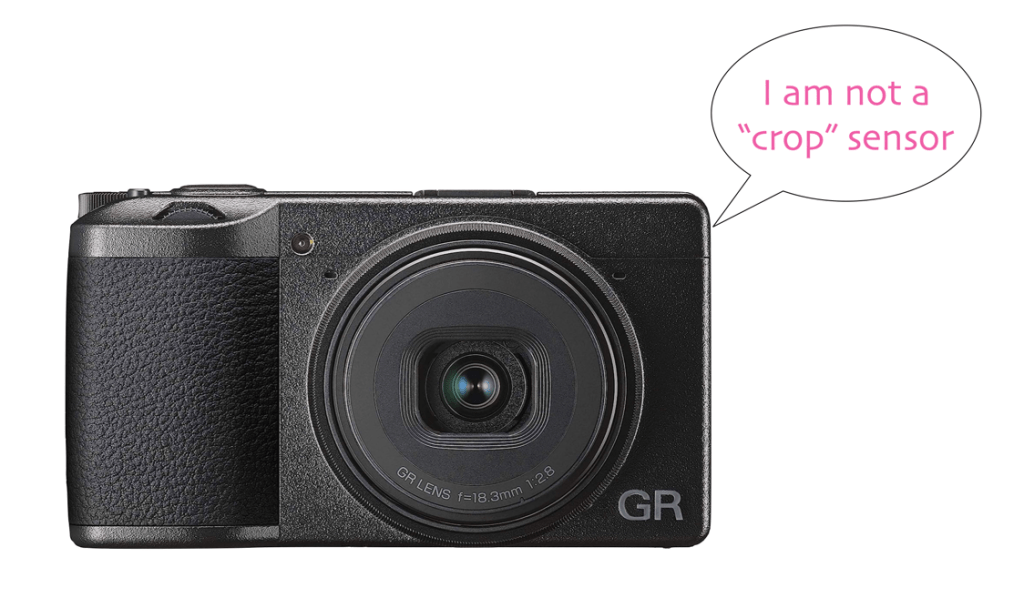
The term “crop-sensor” doesn’t make much sense anymore, if it ever did. I understand why it evolved, because a term was needed to collectively describe smaller-than-35mm sized sensors (crop means to clip or prune, i.e. make smaller). That is, if it’s not 36×24mm in size it’s a crop-sensor. However it’s also sometimes used to describe medium-format sensors, even though they are larger than 36×24mm. In reality non-35mm sensors do provide an image which is “cropped” in terms of comparison with a full-frame sensor, but taken in isolation they are sensors unto themselves.
The problem lies with the notion that 36×24mm constitutes a “full-frame”, which only exists as such because manufacturers decided to continue using the concept from 35mm film SLR’s. It is true that 35mm was the core film standard for decades, but that was constrained largely by the power of 35mm film. Even half-frame cameras (18×24mm, basically APS-C size) used the same 35mm film. In the digital realm there are no constraints on a physical medium, yet we are still wholly focused on 36×24mm.
Remember, there were sub-full-frame sensors before the first true 36×24mm sensor appeared. Full-frame evolved in part because it made it easier to transition film-based lenses to digital. In all likelihood in the early days there were advantages to full-frame over its smaller brethren, however two decades later we live in a different world. “Crop” sensors should no longer be treated as sub-par players in the camera world. Yet it is this full-frame mantra that sees people ignore the benefits of smaller sensors. Yes, there are benefits to full-frame sensors, but there are also inherent drawbacks. It is the same with the concept of equivalency. We say a 33mm APS-C lens is “equivalent” to a 50mm full-frame. But why? Because some people started the trend of relating everything back to what is essentially a 35mm film format. But does there even need to be a connection between different sensors?
What about some sensor equality?
The reason “crop” sensors have continued to evolve is because they are much cheaper to produce, and being smaller, the cameras themselves have a reduced footprint. Lenses also require less glass, making them lighter, and less expensive to manufacture. Maybe instead of using “crop-sensor”, we should just acknowledge the sensors exactly as they are: Medium, APS-C, and MFT, and change full-frame to be “35mm” format instead. So when someone talks about a 35mm sensor, they are effectively talking about a full-frame. All it takes is a little education.
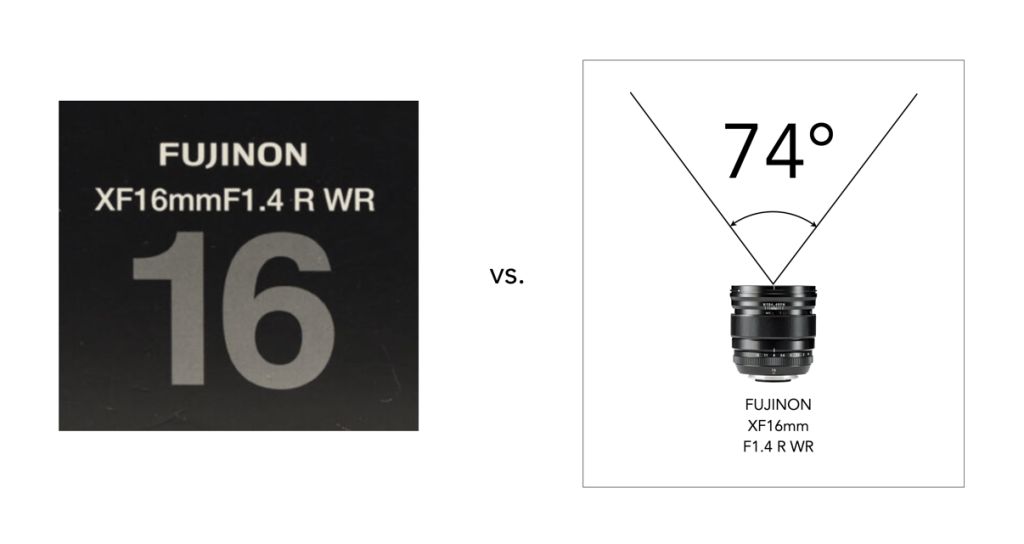
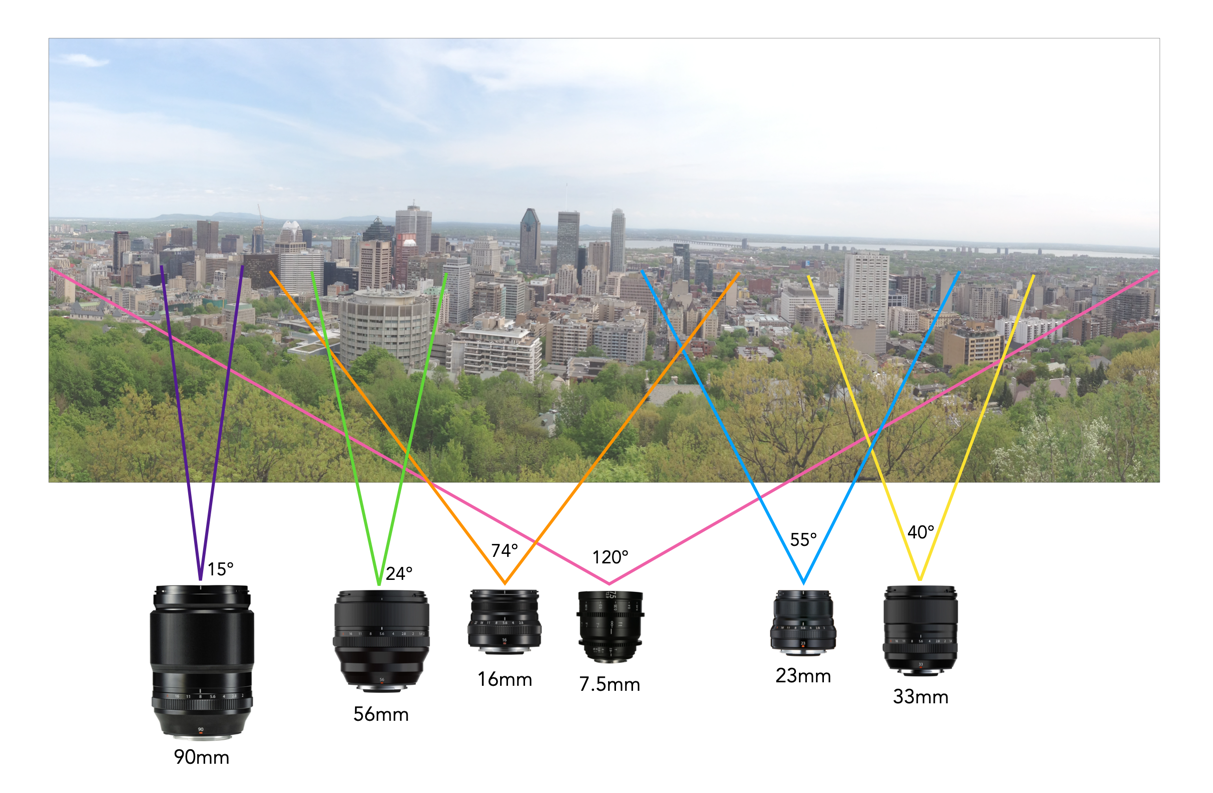
Old versus smarter advertising which puts the emphasis on the angle-of-view. In this case an Fuji APS-C lens – rather than focusing on 16mm, it focuses instead on the horizontal AOV, i.e. 74 degrees. It could also designate that the lens is a wide angle lens.
Using the term-crop sensor also does more harm than good, because it results in more terms: equivalency and crop-factor which are used in the context of focal length, AOV, and even ISO. People get easily confused and then think that a lens with a focal length of 50mm on an APS-C camera is not the same as one on a FF camera. Focal lengths don’t change, a lens that is 50mm is always 50mm. What changes is the Angle-of-View (AOV). A larger sensor gives a wider AOV, whereas a smaller sensor gives a narrower AOV. So while the 50mm lens on the FF camera has a horizontal AOV of 39.6°, the one on the APS-C camera sees only 27°.
It would be easier not to have to talk about a sensor in terms of another sensor. But even though terms like “crop-sensor” and “crop-factor” are nonsensical, in all likelihood the industry won’t change the way they perceive non-35mm sensors anytime soon. I have previously described how we could alleviate the term crop-factor as it relates to lenses, identifying lenses based on their AOV rather than purely by their focal length. This works because nearly all lenses are designed for a particular sensor, i.e. you’re not going to buy a MFT lens for an APS-C camera.
The funny thing about the photosites on a sensor is that they are mostly designed to pick up one colour, due to the specific colour filter associated with with photosite. Therefore a normal sensor does not have photosites which contain full RGB information.
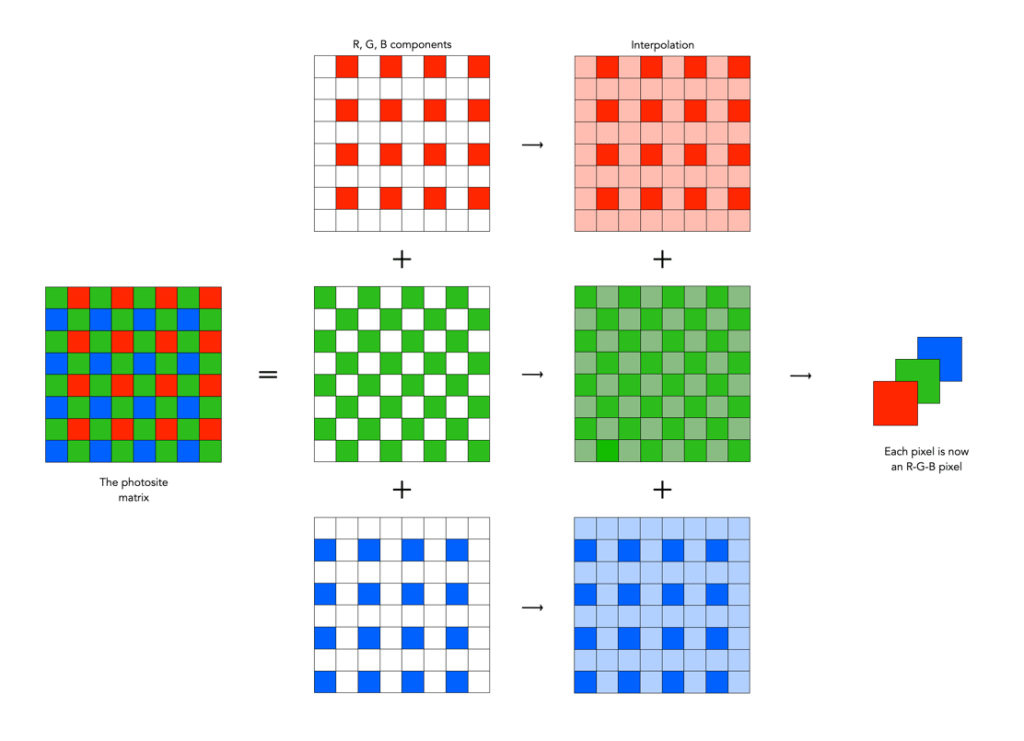
To create an image from a photosite matrix it is first necessary to perform a task called demosaicing (or demosaiking, or debayering). Demosaicing separates the red, green, and blue elements of the Bayer image into three distinct R, G, and B components. Note a colouring filtering mechanism other than Bayer may be used. The problem is that each of these layers is sparse – the green layer contains 50% green pixels, and the remainder are empty. The red and blue layers only contain 25% of red and blue pixels respectively. Values for the empty pixels are then determined using some form of interpolation algorithm. The result is an RGB image containing three layers representing red, green and blue components for each pixel in the image.
A basic demosaicing process
There are a myriad of differing interpolation algorithms, some which may be specific to certain manufacturers (and potentially proprietary). Some are quite simple, such as bilinear interpolation, while others like bicubic interpolation, spline interpolation, and Lanczos resampling are more complex. These methods produce reasonable results in homogeneous regions of an image, but can be susceptible to artifacts near edges. This leads to more sophisticated algorithms such as Adaptive Homogeneity-Directed, and Aliasing Minimization and Zipper Elimination (AMaZE).
An example of bilinear interpolation is shown in the figure below (note that no cameras actually use bilinear interpolation for demosaicing, but it offers a simple example to show what happens). For example extracting the red component from the photosite matrix leaves a lot of pixels with no red information. These empty reds are interpolated from existing red information in the following manner: where there was previously a green pixel, red is interpolated as the average of the two neighbouring red pixels; and where there was previously a blue pixel, red is interpolated as the average of the four (diagonal) neighbouring red pixels. This way the “empty” pixels in the red layer are interpolated. In the green layer every empty pixel is simply the average of the neighbouring four green pixels. The blue layer is similar to the red layer.
One of the simplest interpolation algorithms, bilinear interpolation.
❂ The only camera sensors that don’t use this principle are the Foveon-type sensors which have three separate layers of photodetectors (R,G,B). So stacked the sensor creates a full-colour pixel when processed, without the need for demosaicing. Sigma has been working on a full-frame Foveon sensor for years, but there are a number of issues still to be dealt with including colour accuracy.
It is a camera without a mirror of course! Next you’ll ask why a camera would ever need a mirror.
Over the last few years we have seen an increased use of the term “mirrorless” to describe cameras. But what does that mean? Well, 35mm SLR (Single Lens Reflex) film cameras all contained a reflex mirror. The mirror basically redirects the light (i.e. view) coming through the lens to the film by means of a pentaprism, to the optical viewfinder (OVF) – which is then viewed by the photographer. Without it, the photographer would have to view the scene by means of an offset window (like in a rangefinder camera, which were technically mirrorless). This basically means that the photographer sees what the lens sees. When the photographer presses the shutter-release button, the mirror swings out of the way, temporarily blocking the light from passing through the viewfinder, and instead allowing the light to pass through the opened shutter onto the film. This is depicted visually in Figure 1.
Fig.1: A cross-section of a 35mm SLR camera showing the mirror and optical viewfinder (OVF)
When DSLR (Digital Single Lens Reflex) cameras appeared they used similar technology. The problem is that this mirror, together with the digital electronics, meant that the cameras became larger than traditional film SLRs. The concept of mirrorless cameras appeared in 2008, with the introduction of the Micro-Four-Thirds system. The first mirrorless interchangeable lens camera was the Panasonic Lumix DMC-G1. It replaced the optical path of the OVF with an electronic viewfinder (EVF), making it possible to remove the mirror completely, hence reducing the size of cameras. The EVF shows the image that the sensor outputs, displaying the output on a small LCD or OLED screen.
Fig.2: DSLR versus a mirrorless camera. In the DLSR the light path to the OVF by means of the mirror is shown in blue. When the shutter-release button is pressed, the mirror retracts (pink mirror), and the light is allowed to pass through to the sensor (pink path).
As a result of nixing the mirror, mirrorless cameras are typically have fewer moving parts, and are slimmer than DSLRs, shortening the distance between the lens and the sensor. The loss of the mirror also means that it is easier to adapt vintage lenses for use on digital cameras. Some people still prefer using an OVF, because it is optical, and does not require as much battery-life as an EVF.
These days the only cameras still containing mirrors are usually full-frame DSLRs, and they are slowly disappearing, replaced by mirrorless cameras. Basically all recent crop-sensor cameras are mirrorless. DSLR sales continue to decline. Looking only at interchangeable lens cameras (ILC), according to CIPA, mirrorless cameras in 2022 made up 68.7% of all ILD units (4.07M versus 1.85M), and 85.8% of shipped value (out of 5.927 million units shipped).
So if you are planning to purchase a new camera with “upgraded megapixels”, what makes the most sense? In many cases, people will tend to continue using the same brand or sensor. This makes sense from the perspective of existing equipment such as lenses, but sometimes an increase in resolution requires moving to a new sensor. There are of course many things to consider, but the primary ones when it comes to the images produced by a sensor are: aggregate MP and linear dimensions (we will consider image pixels rather than sensor photosites). Aggregate MP are the total number of pixels in an image, whereas linear dimensions relate to the width and height of an image. Doubling the number of pixels in an image does not double an images linear dimensions. Basically doubling the megapixels will double the aggregate megapixels in an image. To double the linear dimensions of an image, the megapixels need to be quadrupled. So 24MP needs to ramp up to 96MP in order to double the linear dimensions.
Table 1 shows some sample multiplication factors for aggregate and linear dimensions when upgrading megapixels, ignoring sensor size. The image sizes offer a sense of what is what is offered, with the standard MP sizes offered by various manufacturers shown in Table 2.
→
16MP
24MP
30MP
40MP
48MP
60MP
16MP
−
1.5 (1.2)
1.9 (1.4)
2.5 (1.6)
3.0 (1.7)
3.75 (1.9)
24MP
−
−
1.25 (1.1)
1.7 (1.3)
2.0 (1.4)
2.5 (1.6)
30MP
−
−
−
1.3 (1.2)
1.6 (1.3)
2.0 (1.4)
40MP
−
−
−
−
1.2 (1.1)
1.5 (1.2)
48MP
−
−
−
−
−
1.25 (1.1)
Table 1: Changes in aggregate megapixels, and (linear dimensions) shown as multiplication factors.
Same sensor, more pixels
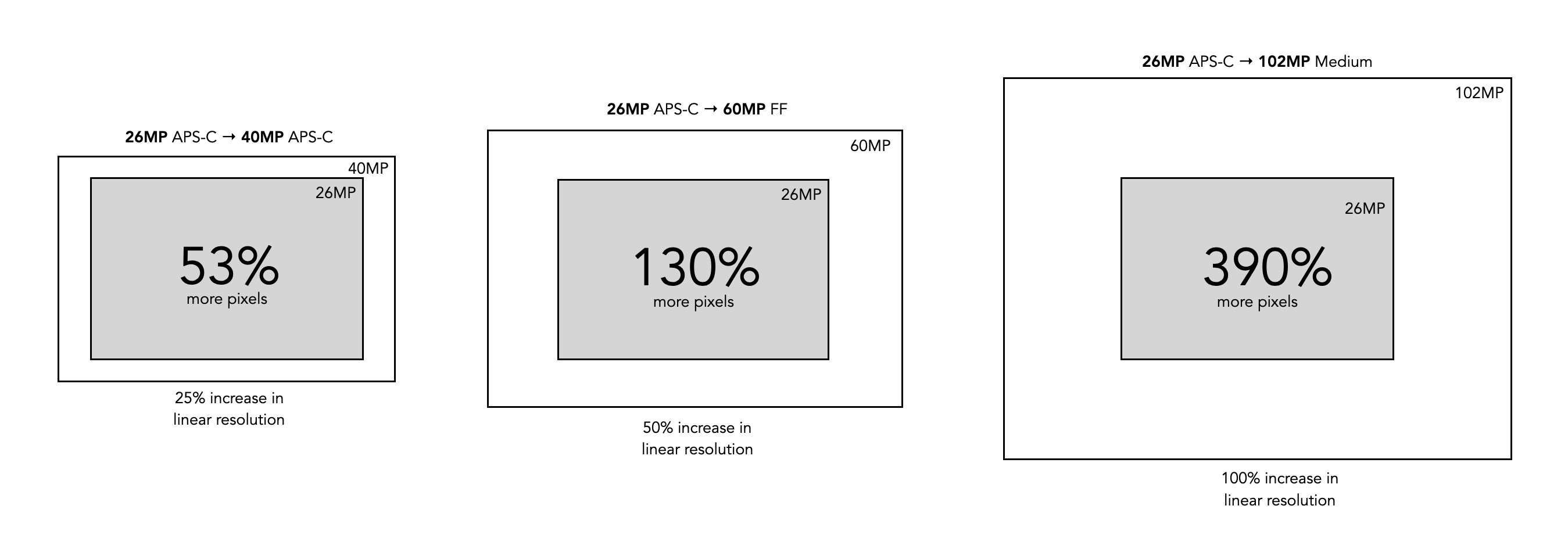
First consider a different aggregate of megapixels on the same size sensor – the example compares two Fuji cameras, both of which use an APS-C sensor (23.6×15.8mm).
So there are 1.53 times more pixels in the 40MP sensor, however from the perspective of linear resolution (comparing dimensions), there is only a 1.24 times differential. This means that horizontally (and vertically) there are only one-quarter more pixels in the 40MP versus the 26MP. But because they are on the same size sensor, the only thing that really changes is the size of the photosites (known as the pitch). Cramming more photosites on a sensor means that the photosites get smaller. In this case the pitch reduces from 3.78µm (microns) in the X-H2S to 3.05µm in the X-H2. Not an incredible difference, but one that may affect things such as low-light performance (if you care about these sort of things).
A visualization of differing sensor sizechanges
Larger sensor, same pixels
Then there is the issue of upgrading to a larger sensor. If we were to upgrade from an APS-C sensor to an FF sensor, then we typically get more photosites on the sensor. But not always. For example consider the following upgrade from a Fuji X-H2 to a Leica M10-R:
So there are very few differences from the perspective of either image resolution, or linear resolution (dimensions). The big difference here is the photosite pitch. The Leica has a pitch of 4.59µm, versus the 3.05µm of the Fuji. From the perspective of photosite area, this means that 21µm² versus 9.3µm², or 2.25 times the light-gathering space on the full-frame sensor. How much difference this makes from the perspective of the end-picture is uncertain due to the multiplicities of factors involved, and computational post-processing each camera provides. But it is something to consider.
Larger sensor, more pixels
Finally there is upgrading to more pixels on a larger sensor. If we were to upgrade from an APS-C sensor (Fuji X-H2S) to a FF sensor (Sony a7R V) with more pixels:
FF: Sony a7R V (61MP, 9504×6336) APS-C: Fuji X-H2S (26MP, 6240×4160)
Like the first example, there are 2.3 times more pixels in the 61 MP sensor, however from the perspective of linear resolution, there is only a 1.52 times differential. The challenge here can be that the photosite pitch can actually remain the same. The pitch on the Fuji sensor is 3.78µm, versus the 3.73µm of the Sony.
brand
MFT
APS-C
Full-frame
Medium
Canon
−
24, 33
24, 45
−
Fuji
−
16, 24, 26, 40
−
51, 102
Leica
17
16, 24
24, 41, 47, 60
−
Nikon
−
21, 24
24, 25, 46
−
OM/Olympus
16, 20
−
−
−
Panasonic
20, 25
−
24, 47
−
Sony
−
24, 26
33, 42, 50, 60, 61
−
Table 2: General megapixel sizes for the core brands
Upgrading cameras is not a trivial thing, but one of the main reasons people do so is more megapixels. Of all the brands listed above, only one, Fuji, has taken the next step, and introduced a medium format camera (apart from the medium format camera manufacturers, e.g. Hasselblad), allowing for increased sensor size and increased pixels, but not at the expense of photosite size. The Fujifilm GFX 100S has a medium format sensor, 44×33mm in size, providing 102MP with 3.76µm. This means it provides approximately double the dimensional pixels as a Fuji 24MP APS-C camera (and yes it costs almost three times as much, but there’s no such thing as a free lunch).
At the end of the day, you have to justify why more pixels are needed to yourself. They are only part of the equation in the acquisition of good images, but small upgrades like 24MP to 40MP may not actually provide much of a payback.
There was a time when the compact camera had quite a market. These cameras sat somewhere between the larger sensor cameras (full-frame/APS-C), and tiny sensor “pocket” cameras. The tiny sensor cameras died off with the evolution of the smartphone. Nowadays there aren’t many compacts left, perhaps victims to the success of the smartphone cameras, or to the success of mirrorless. Contenders now include the Ricoh GR series, the Fujifilm X100V, and Sony RX100. A mirrorless offers almost the same form factor with interchangeable lenses, and more features. Compacts often try to do too much, and maybe that is a function of modern technology where smaller does not mean reduced functional capacity. Many compacts do nothing at all particularly well, but maybe they were never meant to. They offer too many controls to be simple, but too few to show versatility. They are often built by trying to cram too much technology into the one thing that unifies them all – space. For a compact camera should be exactly that, compact. If they are compact, it is unlikely they will win awards for ergonomics. Compact cameras with small footprints, may not fit into everyone’s hands comfortably.
Compact cameras are exceptional for the purposes of street photography. The best example of this is legendary Japanese street photographer Daidō Moriyama. He has used Ricoh compacts for years, from the early GR film series to the digital GR.
“The GR has been my favorite since it was a film camera. Because I’m so used to it, I felt comfortable with the new GR III immediately. When I shoot with a 28mm fixed lens machine, I remember my old days. Comfortable enough to take photographs to your heart’s content. For my street photography, the camera must be compact and light-weighted.”
But here’s the thing, I don’t buy a compact to be the pinnacle of cameras. The job of the compact is to be compact. It should offer a good amount of features, but obviously cannot offer them all. The role of the compact in my life is simple – pocketable, easy to use, small, inconspicuous. It’s for that reason, my GR III sits around the kitchen for photographing recipes, or slips into a pocket for a walk about town. It’s small, compact, and oh so discreet. You can get into trouble in places like transit systems using mirrorless cameras because they seem too professional, but compacts? Compacts scream inconspicuous.
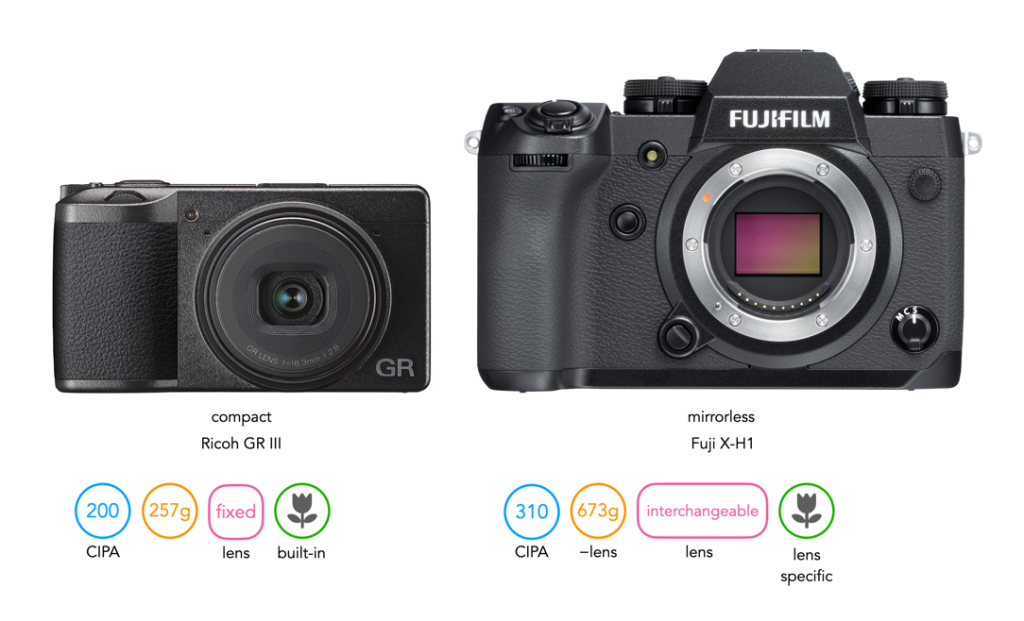
Comparing some features of the Ricoh GR III (compact) against the Fuji X-H1 (mirrorless). Both have the same 24MP APS-C sensor and IBIS.
It is of course impossible to find the perfect camera – it doesn’t exist. Compact cameras are even less so, but the modern ones offers a good amount of technology and convenience. The Ricoh GR III for example offers image stabilization, and snappy focus, at the expense of loosing the flash (not something I use much anyways), not a great battery life (carry an extra), and no weather sealing (not that big a deal). It’s low-light performance is impressive, and I don’t need much more than a 28mm equivalent lens. It’s role is street-photography, or kitchen-photography, or back-up travel camera, for taking photographs in those places where photography is technically “not allowed”. It also offers a 24MP APS-C sensor, which is more pixels than anyone needs. In fact these cameras could likely get even better if we ditched some of the onboard shrot. Compacts don’t necessarily need 4K video, or 300-point AF tracking. The more features, and customization, the more the likelihood that you will loose track of what is going on.
Pros
versatility – Fills a niche between smartphones and mirrorless cameras. macro – Many provide some sort of capacity to take close-up photos. small – Unobtrusive, and lightweight, making them easy to carry. automatic – No fiddling with settings and missing the shot.
Cons
limited control – Lacks low-level controls found in interchangeable lens cameras. low-light – Often not well suited to low-light conditions. fixed lens – Not as flexible as interchangeable lens cameras. battery – Shorter battery life because of the smaller battery.
Pros and cons of compact cameras
This is the fourth compact I’ve owned. The first was a Canon Powershot G9, then the Fuji X10, followed by the Leica D-Lux6 (likely the only Leica I will ever own). The Ricoh GR III provides me with the same sensor size as my Fuji X-H1, but is much easier to take some places when travelling, and provides much more in the way of versatility than does my iPhone 14, and twice the resolution.
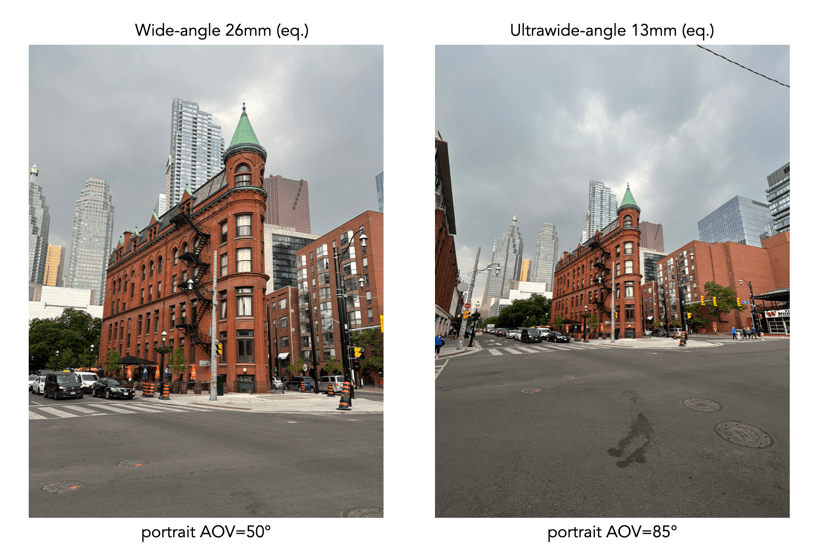
I must say, I quite like the wide lenses on the iPhone 14. It has two rear-facing cameras, an ultra-wide with a focal length of 13mm, and a 26mm wide (full-frame equiv). I don’t really want to get into reviewing these cameras, because other people have already done extensive reviews. An example of a portrait shot taken with each camera is shown below in Figure 1 (picture of the Gooderham “flatiron” Building in Toronto).
Fig.1: Example of portrait photos using both 26mm and 13mm cameras.
But I do want to talk briefly about the Angle of View (AOV) of these cameras. Firstly, you really have to hunt for some of this information. Apple doesn’t really talk about sensor size, or even AOV to any great extent. The most they give you is that the AOV of the ultrawide camera is 120°. But they don’t tell you the full story (maybe because most people don’t care?). It may be 120°, but only in landscape mode, and that angle describes the diagonal angle, which as I have mentioned before isn’t really that useful for most people because it is much harder to conceptualize than horizontal degrees (it’s no different to TV’s, and nobody measures a TV based on its diagonal).
Pixel count
Focal length
Sensor size
f-number
AOV landscape
Crop factor
12MP
26mm (equiv.)
Type 1/1.7 (9.5×7.6mm)
f/1.5
69° (H)
4.6
12MP
13mm (equiv.)
Type 1/3.4 (4×3mm)
f/2.4
108°(H) 120°(D)
8.6
iPhone 14 (rear-facing) camera specs
So the wide-angle camera has a horizontal AOV of 69°, and the ultrawide has an AOV of 108°. But this is when a photograph is taken in landscape mode. When a photograph is taken in portrait mode, the horizontal AOV defaults to the vertical AOV from landscape mode – this means 85° for the wide, and a mere 50° for the ultrawide. This concept is the same for all sensors in all cameras, because in portrait mode the width of the photo is obviously less than that of the landscape photo. In mobile devices such as the iPhone this does become a little trickier, because most photos are likely taken in portrait mode.
Examples of the AOV’s in portrait mode for each of the focal lengths as they relate to the photographs in Figure 1 are shown below in Figure 2 (along with the potential AOV’s for landscape mode).
Fig.2: A visual depiction of the portrait AOV’s associated with the photographs of Fig.1
This is really more of a specification problem, information which I wish Apple would just post instead of ignoring. Some people are actually interested in these sort of things.
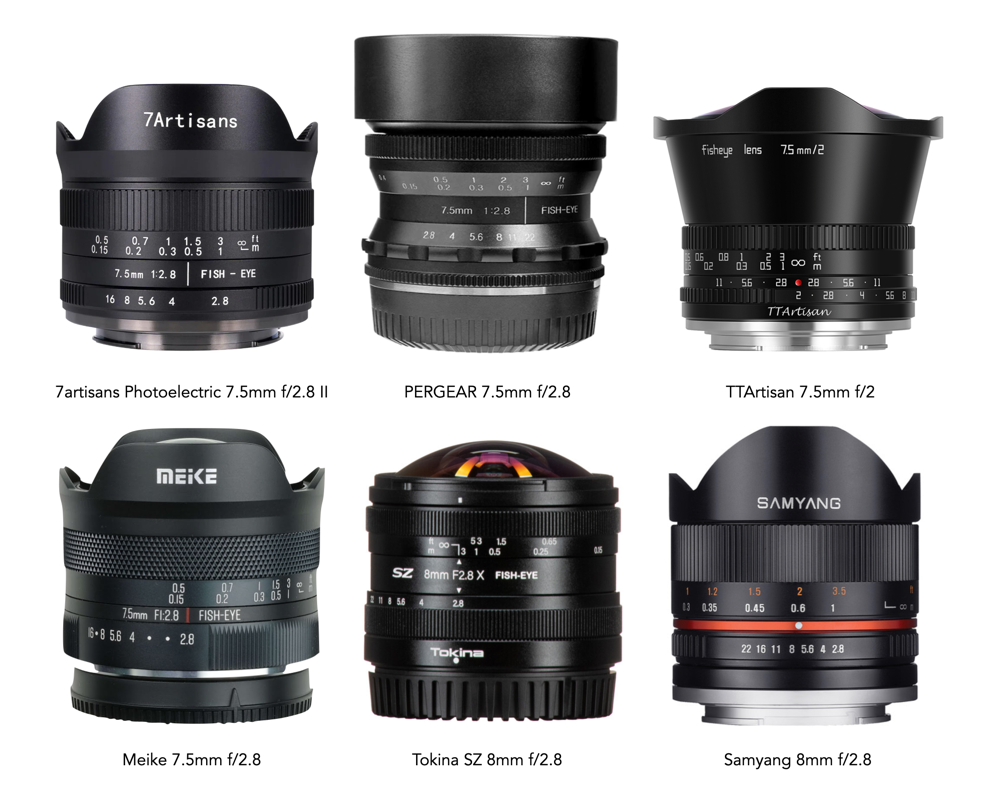
Most large camera manufacturers don’t really make a lot of sub 20mm (FF eq.) lenses. Why? Mostly the cost involved, and likely the lack of sales potential – not many people want to spend a lot of money on a lens that provides a circular fisheye image. I mean these are fun lenses to play with, but in reality aren’t really that practical for everyday use. This may be why 3rd party manufacturers have taken up the mantra, producing low-cost, often reasonable quality sub-20mm lenses. Let’s look at some for Fuji-X.
Let’s divide this into two APS-C categories, the 9-13mm ultra-wide group, and the fisheye group <=8mm. Fisheye lenses can be further categorized into circular and full-frame fisheyes. With regard to focusing MF=manual, AF=auto. Angle-of-view is shown in degrees on the diagonal.
So which one to choose? It’s really hard to know. It really depends on what you want to do. All these lenses will have some sort of distortion, with the notable exception being the Laowa 9mm, which is described as “Zero-D”. The circular fisheye lenses are nice from an artistic point-of-view, but don’t have that many practical applications (well they are actually used in scientific applications such as assessing forest canopy cover).
Why are these lenses so cheap? Firstly nearly all of the inexpensive lenses, bar the Zeiss 12mm, are manual focus, because obviously incorporating auto-focus mechanisms into any lens is expensive. Another reason may be competition, but it may also be the notion that many of these focal lengths are more for use in an artisanal manner. If these lenses become too expensive, they push themselves out of the market. But inexpensive doesn’t mean a cheap lens. The Laowa 9mm has 15 elements in 10 groups, likely needed to reduce the lenses distortion – so it doesn’t lack good design. Is the Laowa glass inferior to that of Fuji? Possibly, but it’s impossible to tell.
Should you buy an ultra-wide, diagonal fisheye, or even a circular fisheye lens? Well, for the cost involved many of these lenses certainly won’t break the bank, and if you are interested in exploring some artistic photography then it may be a good fit. Which one? Well that’s a bit of a conundrum. Of the six 7.5-8mm lenses, it’s hard to know which is really the best. I would suggest checking out some online reviews, and see what people think of the various lenses.
Choosing a digital camera, and a sensor size is one thing, but I think the thing that really stumps people is choosing the most appropriate lenses to use. Of course for the amateur photographer, what the lens will be used for may be the most important consideration. Travel? Landscapes? Street photography? The task is always made easier if there are some constraints on the number of lenses available. For example the range of lenses available for Micro-Four-Thirds, or even Fuji-X cameras has always been a little bit constrained, well until recently with the expansion of 3rd-party lenses.
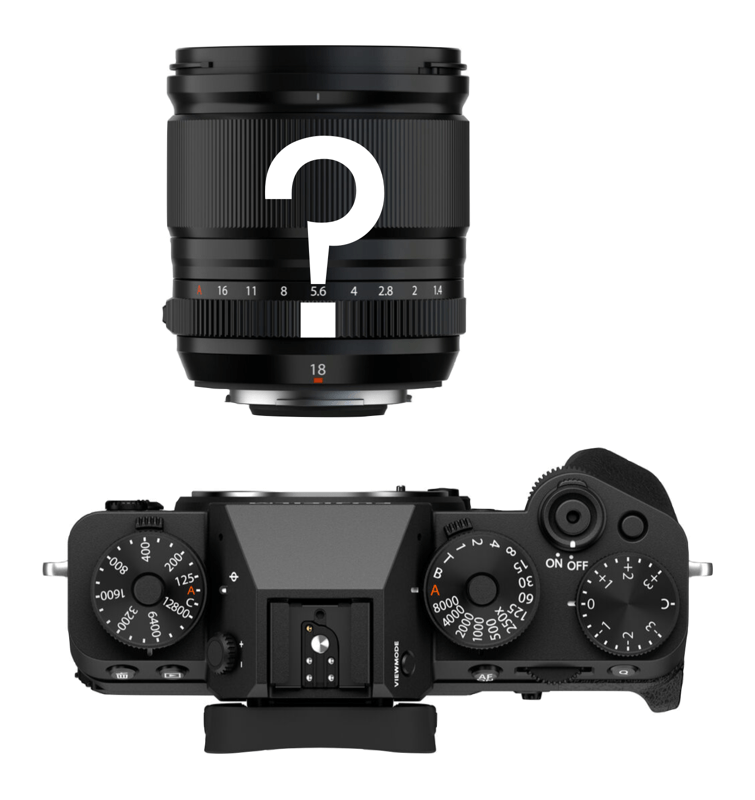
So how do you choose the right lens? Like vintage lenses, digital lenses are principally chosen based on focal length (which advocates their use), and speed, i.e. aperture size. In addition there is cost, and “extras” such as weather sealing, and stabilization. The problem comes with the variety of lenses available – consider the long list of Fuji-X lenses, many of which are 3rd-party. Which one should you choose? Do you choose a prime or a zoom, a Fujifilm, or a third-party? Do you need an 8mm APS-C lens? Would 13mm be better? What about 16mm? Is manual focus okay, or would you prefer auto-focus? It’s not easy, even with the myriad of videos reviewing lenses.
I’ll concentrate on Fuji-X here, because it’s at the heart of my current lens dilemma (my camera is a Fujifilm X-H1). Now my photography is a mixed bag of street, landscape, architecture and travel. I currently have the 23mm f/2 R WR (which is a FF 35mm equiv.). Now I’m looking to expand, primarily a wide-angle lens. Here are some of the typical focal lengths for Fuji-X (APS-C sensor), and their applications. Measurements in ( ) represent the full-frame equivalences.
50-56mm (75-85mm) – Good for portraiture.
33-35mm (50-53mm) – Good for general photography, portraiture and cityscapes.
23mm (35mm) – The upper end of the wide spectrum, provides more scene than the 33mm, but without the distortion of wider focal lengths. Good for street photography.
18mm (28mm) – The standard choice for landscapes (and sometimes architecture), providing a relatively wide angle of view, without introducing obvious distortions.
14-16mm (21-24mm) – The common lower end of the wide spectrum, good for very broad landscapes. Can include some noticeable perspective distortion, especially if the camera is tilted.
Beyond that we begin to move into the ultra-wide focal lenses, of which there seem to be quite a number. 11-13mm (16-20mm) lenses encompass more of the scene than can be seen with normal vision, so there is an innate sense of exaggerated perspective. Subjects close to the camera appear quite large, with the relative size of more distant subjects reducing quickly with distance. These lenses can be ideal for photography where the distortion does not impact the aesthetics of the image.
Various Fuji (APS-C) lenses and their associated angles of view. (Photo taken from Belvédère Kondiaronk lookout on Mont Royal, Montreal)
In reality, going down this rabbit hole has led me towards the 16mm, and possibly something like a 33-35mm. I have enough vintage lenses to cover the 50mm+ spectrum, and this makes sense as I don’t envision using them that often. And I’m going to stick with prime lenses. Some people really like zoom lenses because of the flexibility they allow, but I find I always seem to stick to one focal length – the 12-40mm on my Olympus camera used when travelling is perpetually set at 12mm (24mm). There are other compromises as well – weight can be an issue, as well as slower apertures.
Choosing a digital lens is challenging, especially for the hobbyist photographer. There are a lot of options, regardless of the sensor. Even Micro Four Thirds also has a long list of lenses. If someone is unsure, then I suggest starting with lenses from the camera manufacturer. As to focal length, choose a lens that provides the most optimal angle-of-view for the application you are most interested in. For example, if you shoot with an APS-C camera, and your focus is street photography, then a 23mm (35mm) lens is the most optimal solution.





 Crafting Pixels