Why was the 50mm lens considered “normal”?

Why was the 50mm lens considered the “normal” lens used on 35mm cameras? Why not 40mm or 60mm? When Barnack introduced his revolutionary Leica camera, he used a traditional method of selecting the lens – the most commonly used lens has a focal length should be approximately equal to the diagonal of the negative, which is how the 50mm likely evolved. The Leica I came with a fixed 50mm lens, and even when the Leica II appeared in 1932 with interchangeable lenses, the viewfinder was designed to work with 50mm lenses. Zeiss Contax lens brochures from the 1930s mark 50mm lenses as “universal lenses”, “For all-round use and subjects which occur in every-day photography…”. Nikon also made the point that “Nikkor normal lenses cover a picture angle of approximately 45°, corresponding closely to the angle of view of the human eye”.

It is then no surprise that 50mm is the most ubiquitous analog lens. By the 1950s, most interchangeable lens cameras came standard with a 50mm lens, ensuring that novice photographers could capture sharp photographs in a variety of conditions without requiring a books worth of knowledge. Nikon in one of their lens brochures suggested “the 50mm focal length has become the standard lens for all around work”. This deep-seeded ideology is probably why 50mm lenses came in so many speeds – the same Nikon brochure provides an f/3.5, f/2, f/1.4, and f/1.1 50mm lenses. Many camera manufacturers followed suit. The late 1970s “standard” line-up for Asahi Pentax included four 50mm lenses (f/1.2, f/1.4, f/1.7, f/2) and a 40mm f/2.8 which they touted as being “extremely versatile”.

Fig.1: How many normal’s is too many normal’s? (Pentax SMC lenses)

There are a number of arguments that have traditionally been made as to why 50mm is “normal”. The most common argument of course is that the 50mm lens has a diagonal angle-of-view (AOV) of about 45° which approximates the AOV of the human eye. But in reality it makes assumptions about what “normal vision” is , and the ability of a 50mm lens to reproduce it. The idea that 50mm best approximates human vision has more to do with the evolution of lenses than it has to do with any correspondence between the human eye and a lens. There are other arguments, for instance that 50mm reproduces facial proportions, depth and perspective roughly as how our eyes perceive them. Many manufacturers drove this point home by saying 50mm lenses “give pictures of natural, i.e. normal, perspective”.

Fig.2: Angle of views of the human vision system

Firstly we should remember that “normal” human vision is binocular, while camera lenses are not. The eye is also composed of a gel-like material, versus the glass of lens elements. So there are already fundamental structural and functional differences. There is also the matter of AOV. A lens generally has one AOV, whereas the human visual system (HVS) has a series, based on differing abilities to focus – binocular vision is approximately 120° of view, of which only 60° is the central field of vision (the remainder is peripheral vision), and only 30° of that is vision capable of symbol recognition (even less is capable of sharp focusing, perhaps 5°?). Note that I use horizontal AOV in comparisons, because it is easier for people to conceptualize than diagonal AOV.
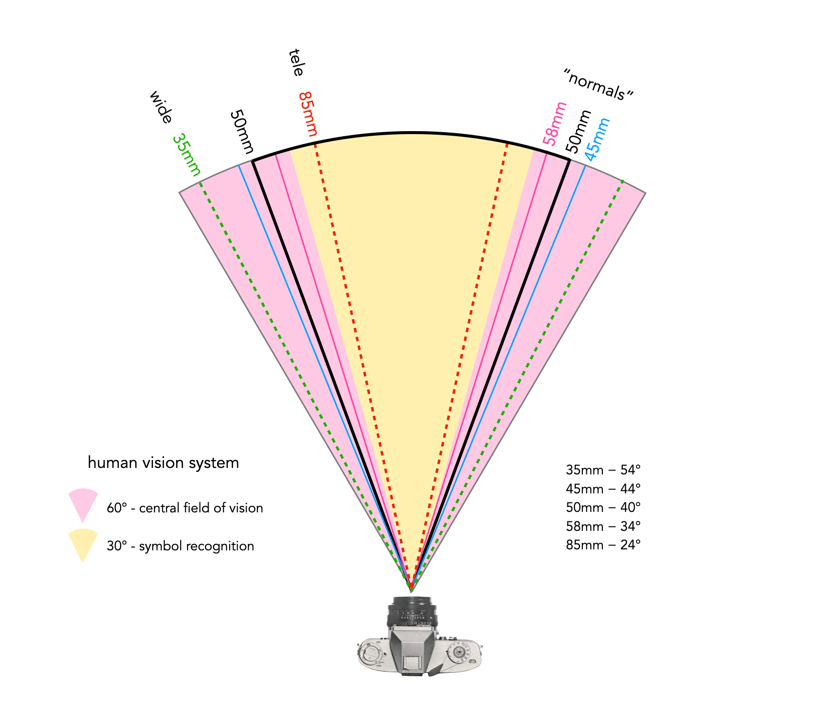
Fig.3: AOV of various lens focal lengths against the AOV of the human vision system

In reference to Figure 3, for the hard limits, a 67mm lens would likely best approximate the 30° region of the HVS that deals with symbol recognition, whereas a 31mm would best approximate the 60° central field of vision. If we were simply to take the middle ground, at 45°, we get a 43mm lens, which actually matches the diagonal of the 24×36mm frame.

But how closely does the 50mm AOV resembles that of the human visual system (HVS)? In terms of horizontal vision, a 50mm lens has a 40° AOV, so it’s not that far removed from that of the 43mm lens. Part of the problem lies with the fact that it is hard to establish an exact value that represents the “normal viewing angle” of the HVS. This is why other lens fit into this “normal” category – the 40mm (48°), the 45mm (44°), the 55mm (36°) and the 58mm (34°). Herbert Keppler may have put it best in his book The Asahi Pentax Way (1966):

“A normal focal length lens on any camera is considered to be a lens whose focal length closely approximates the diagonal of the picture area produced on the film. With 35mm cameras, this actually works out to be about 43mm, generally considered a little too short to produce the best angle of coverage and most pleasing perspective. Consequently, makers of 35mm cameras have varied their “normal” focal lengths between 50 and 58mm. With early single lens reflexes the longer 58mm length was in general use. However, in recent years there seems to be a trend to slightly shorter focal lengths which produce a greater angle of view. Current Pentax models use both 50 and 55mm focal length lenses.”

In some respects it seems like 50mm was chosen because it is close to what could be perceived as the AOV of the HVS, such that it is, and provided a nice rounded focal length value. By the 1950s, the 50mm had become “the standard” lens, with 35mm and 85mm lenses providing wide and telephoto capabilities respectively (a 35mm lens has an AOV of 54°, and the 85mm lens has an AOV of 24°, and surprisingly, 50mm sits smack dab in the middle of these). Many brochures simply identified it as an “all-round” lens. It is difficult to pinpoint where the reference of 50mm approximating the AOV of the human eye may have first appeared.

With the move to digital, the exact notion of a 50mm “normal” lens has not exactly persevered. This is primarily because the industry has moved away from 36×24mm being the normal film/sensor size, even though we hang onto the idea of 35mm equivalency. While a 50mm lens might be considered “normal” on a full-frame sensor, on an APS-C sensor a “normal” lens would be 35mm, because it is “equivalent” to a 50mm full-frame lens, from the perspective of focal length and more importantly AOV. Note that Zeiss still allude to the fact that the “focal length of the ZEISS Planar T* 1.4/50 is equal to the perspective of the human eye.”
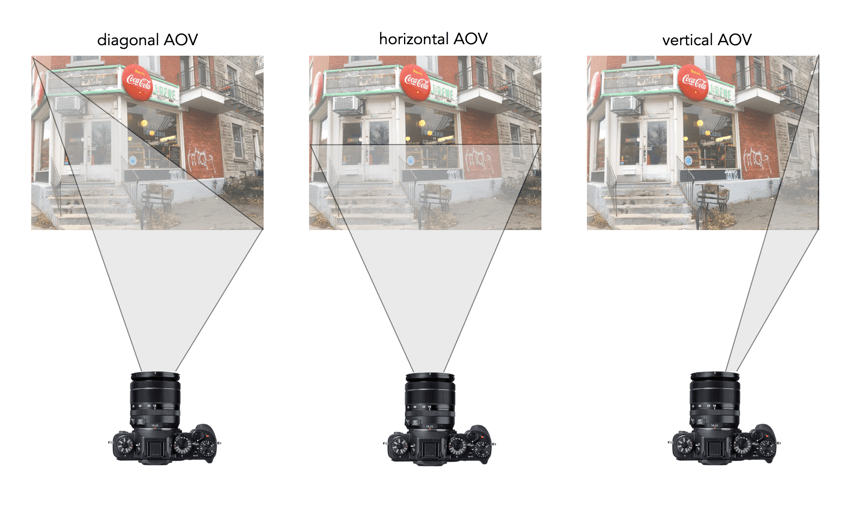
The different Angle-of-View measurements

Look at any lens spec, and they will normally talk about the angle-of-view (AOV), sometimes used interchangeably (and incorectly) with field-of-view (FOV). But there are three forms of AOV, and they can be somewhat confusing. The first form is the diagonal AOV. It is one of the most common ones found in lens literature, but it isn’t very easy to comprehend without viewing the picture across the diagonal. Next is the vertical AOV, which makes the least sense, because we generally don’t take pictures, or even visualize the vertical. Lastly is the horizontal AOV, which makes the most sense, because of how humans perceive the world in front of them.

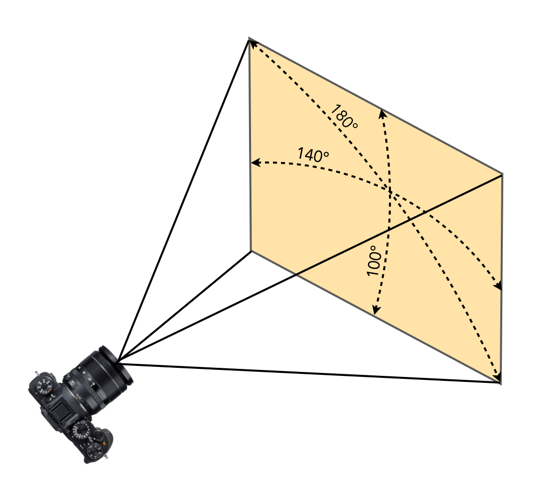
Showing the diagonal AOV of a lens is hard to conceptualize. It’s a bit like the way TV’s are described as being, say 50″, which is the diagonal measurement. In reality through, the TV is only 43.6″ wide. Horizontal is how people generally conceptualize things. As an example of a lens, consider a 24mm full-frame lens – it has a diagonal AOV of 84°, and a horizontal AOV of 74°. This isn’t really a lot, but enough to get a little confusing. A 16mm lens that has a AOV of 180° in the vertical, may only have a horizontal AOV of 140° An example of this is shown below.

The photography of Daidō Moriyama

Daidō Moriyama was born in Ikeda, Osaka, Japan in 1938, and came to photography in the late 1950s. Moriyama studied photography under Takeji Iwamiya before moving to Tokyo in 1961 to work as an assistant to Eikoh Hosoe. In his early 20’s he bought a Canon 4SB and started photographing on the streets on Osaka. Moriyama was the quintessential street photographer focused on the snapshot. Moriyama likened snapshot photography to a cast net – “Your desire compels you to throw it out. You throw the net out, and snag whatever happens to come back – it’s like an ‘accidental moment’” [1]. Moriyama’s advice on street photography was literally “Get outside. It’s all about getting out and walking.” [1]

In the late 1960s Japan was characterized by street demonstrations protesting the Vietnam War and the continuing presence of the US in Japan. Moriyama joined a group of photographers, associated with the short-lived (3-issue) magazine Provoke (1968-69), which really dealt with elements of experimental photography. His most provocative work during the Provoke-era was the are-bure-boke style that illustrates a blazing immediacy. His photographic style is characterized by snapshots which are gritty, grainy black and white, out-of-focus, extreme contrast, Chiaroscuro (dark, harsh spotlighting, mysterious backgrounds). Moriyama is “drawn to black and white because monochrome has stronger elements of abstraction or symbolism, colour is something more vulgar…”.

“My approach is very simple — there is no artistry, I just shoot freely. For example, most of my snapshots I take from a moving car, or while running, without a finder, and in those instances I am taking the pictures more with my body than my eye… My photos are often out of focus, rough, streaky, warped etc. But if you think about I, a normal human being will in one day receive an infinite number of images, and some are focused upon, other are barely seen out of the corners of one’s eye.”

Moriyama is an interesting photographer, because he does not focus on the camera (or its make), instead shoots with anything, a camera is just a tool. He photographs mostly with compact cameras, because with street photography large cameras tend to make people feel uncomfortable. There were a number of cameras which followed the Canon 4SB, including a Nikon S2 with a 25/4, Rolleiflex, Minolta Autocord, Pentax Spotmatic, Minolta SR-2, Minolta SR-T 101 and Olympus Pen W. One of Moriyama’s favourite film camera’s was the Ricoh GR series, using a Ricoh GR1 with a fixed 28mm lens (which appeared in 1996) and sometimes a Ricoh GR21 for a wider field of view (21mm). Recently he was photographing with a Ricoh GR III.

“I’ve always said it doesn’t matter what kind of camera you’re using – a toy camera, a polaroid camera, or whatever – just as long as it does what a camera has to do. So what makes digital cameras any different?”

Yet Moriyama’s photos are made in the post-processing stage. He captures the snapshot on the street and then makes the photo in the darkroom (or in Silver Efex with digital). Post-processing usually involves pushing the blacks and whites, increasing contrast and adding grain. In his modern work it seems as though Moriyama photographs in colour, and converts to B&W in post-processing (see video below). It is no wonder that Moriyama is considered by some to be the godfather of street photography, saying himself that he is “addicted to cities“.

“[My] photos are often out of focus, rough, streaky, warped, etc. But if you think about it, a normal human being will in one day perceive an infinite number of images, and some of them are focused upon, others are barely seen out of the corner of one’s eye.”

For those interested, there are a number of short videos. The one below shows Moriyama in his studio and takes a walk around the atmospheric Shinjuku neighbourhood, his home from home in Tokyo. There is also a longer documentary called Daidō Moriyama: Near Equal, and one which showcases some of his photographs, Daido Moriyama – Godfather of Japanese Street Photography.

Artist Daido Moriyama – In Pictures | Tate (2012)

Further Reading:

Vintage cameras and lenses – where to buy?

I have been buying vintage analog cameras and lenses for a few years now, and so this article offers a few tips, on where to buy them based on my experiences. Now when you’re dealing with vintage camera equipment, you will quickly realize that there is a lot of inventory around the world. This isn’t so surprising considering how the photographic industry blossomed with the expanding consumer market from 1950 onward. Analog equipment can be old, mostly dating pre-1980s, some quite common, others quite rare. I say pre-1980s because that decade heralded cameras and lenses that were bulky, ugly, made of plastic, and had clumsy auto-focus mechanisms. I will cover what to look for in vintage lenses, and cameras at a later date.

Bricks-and-mortar stores

If you are new to the buying vintage photographic equipment, then the obvious place to start is a store that focuses on vintage gear, but honestly they are few and far in between, which may be the nature of dealing with analog. Sometimes photographic retailers who sell modern camera equipment may deal with some “used” gear, but you often won’t find a really good range of gear, as they tend to deal more with used digital gear. Some people of course will comment that specialized stores tend to have higher prices, but we are talking about vintage equipment here, which may be anywhere from 40-70 years old, so if you are serious about lenses it is worth paying for the expertise to properly assess them.

In Toronto a good place to start is F-Stop Photo Accessories, which has a good amount of online information on their inventory (but does not ship). You will find a good assortment of Japanese gear, with some German and Soviet-era gear as well. The store is tiny, so best to check out the website and email to make sure the items you’re interested in are in stock, then drop by to examine them. In places like the UK, Europe and even Japan there are likely more bricks-and-mortar stores that deal predominantly with vintage. For example Tokyo abounds with used camera stores, some of which have huge inventories.

Fairs / Camera shows

If you are fortunate to live somewhere that has a photographic club, they may also have swap-meets, or auctions. In Toronto there is the Photographic Historical Society of Canada, which typically has two fairs a year, which are a good place to pick up vintage gear. The first time I went in 2019 I managed to find an 8-element Takumar 50mm f/1.4 (C$250), a Helios 58mm Version 4 ($20), a Takumar 35mm f/3.5 ($60), and a Carl Zeiss Tessar and Biotar 58mm f/2 for $140. The benefit is always that you get to examine the lens/camera, and check the functionality. There is generally a huge amount of lenses and cameras, some quite inexpensive for the person wanting to get started in analog photography.

Online stores

What about purchasing from an online reseller? This is somewhat tricky, because you are buying a physical device. I typically don’t buy any vintage electronic things off the internet because you can never be 100% certain. Thankfully the type of vintage we are looking at here, especially as it pertains to lenses, rarely involves any electronics. However it still involve moving parts, i.e. the focusing ring, and the aperture, both of which have to move freely, and are obviously hard to test online. There are a number of differing options for buying online. There are (i) physical stores which have an online presence, (ii) online retailers with a dedicated website, and (iii) online retailers on platforms such as Etsy and eBay.

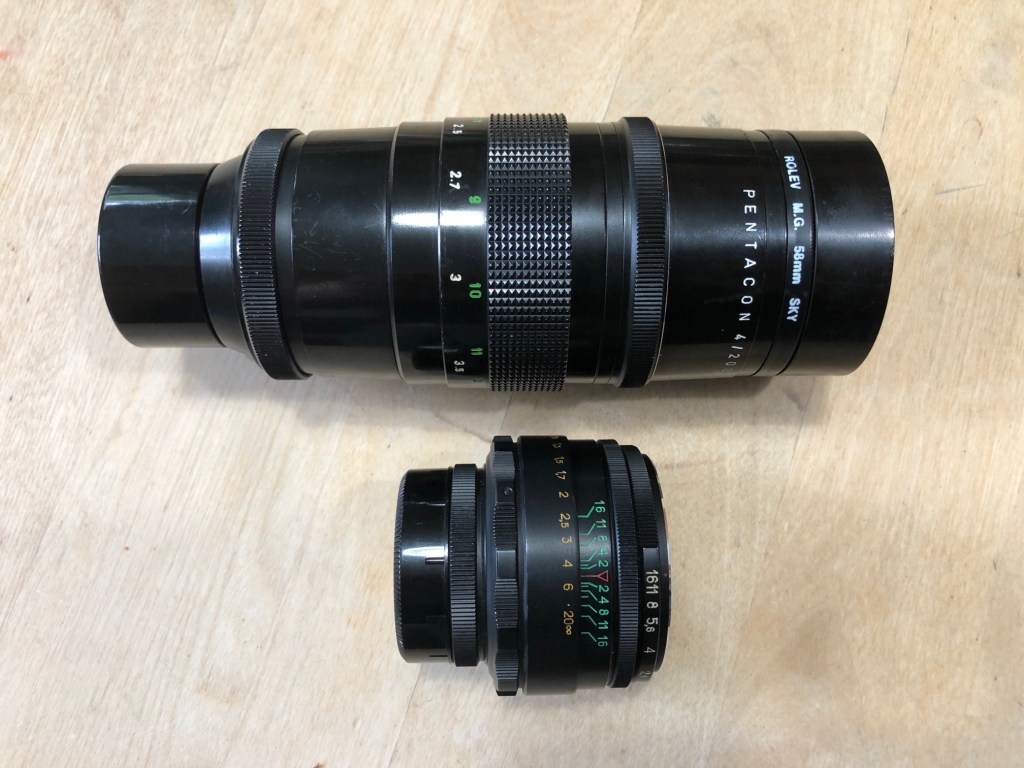
I have had a number of good experiences when shopping at online stores. The first one was with the Vintage & Classic Camera Co., on Hayling Island near Portsmouth (UK). I bought an Exakta Varex 11a, and the experience was extremely good. Listings are well described, with ample photographs and a condition reported (as a percentage). The second was a recent experience with West Yorkshire Cameras, arguably one of the premium retailers for vintage camera gear. I have also bought lenses from a number of resellers on Etsy and eBay. Etsy provides access to resellers from all over the globe, and vintage products have to be a minimum of 20 years. I have bought some Russian lenses from Aerarium (Ukraine), cameras from Coach Haus Vintage (Toronto, Canada) and Film Culture (Hamilton, Canada). If you are looking for Japanese vintage cameras, I can also recommend Japan Vintage Camera based in Tokyo, who have an Etsy store as well.

What makes a good store?

A good vintage camera reseller will be one who lives and breathes vintage cameras. Typically they might have an Instagram account, offer weekly updates of new inventory, and service/inspect the equipment before even advertising it. If there should be something wrong with an item when you receive it, the reseller should make it good (I mean things do get missed). A good online store will have listings which describe the lens/camera in detail while listing any defects, provide a good series of photographs showing the camera from different angles, and some sort of grading criteria. Ideally the store should also provide some basic information on shipping costs.

Regardless of the store, always be sure to Google them and check online reviews. Don’t be swayed by a cool website, if there is a lack of customer service you won’t want to shop there. Sometimes the company has a Google review, or perhaps a review on Trustpilot. If there are enough negative reviews, then it is safe to say there is likely some truth to them. For example a company that posts 70% bad reviews is one to avoid, regardless of the amount of inventory on their site, how quickly it is updated, or how aesthetically pleasing the website looks. I had an extremely poor experience with a British online reseller that has an extremely good website with weekly updates of inventory. I had purchased a series of vintage lenses in Nov.2020. After one month they had not shipped, after two also nothing. I conversed with the owner twice during the period and each time the items were going to be “shipped tomorrow”. To no avail, after 5 months, I finally submitted a refund request with Paypal, which was duly processed. I have since written a review, which wasn’t favourable, but then neither were 90% of the reviews for that particular reseller.

The website Light Box has a whole list of places to buy film cameras and lenses in the UK, including a section named “Caution advised”, outlining those to avoid. I have created a listing of various stores in the Vintage Lenses etc. page.

Stores by region

Geographical locations do play a role in where to purchase vintage camera equipment. For example during the early decades of the post-war camera boom, there were two core epicentres of camera design and manufacture: Europe (more specifically both East and West), and Japan. So if you are interested in cameras/lenses from these regions, then stores within those geographical locales might offer a better selection. For example there are quite a few vintage camera resellers on Etsy from Ukraine and Russia. This makes sense considering cameras like FED were made in factories in Kharkov, Ukraine. Interested in Pentax or any number of Japanese vintage lenses, then resellers from Japan make sense. There are a lot of good camera stores in places that have few links to manufacturing, but may have had a good consumer base, e.g. UK and the Netherlands. The trick of course is being able to navigate the sites. Many Japanese stores have online presence, but very few provide an English-language portal.

Camera versus binocular optics in Hitchcock’s “Rear Window”

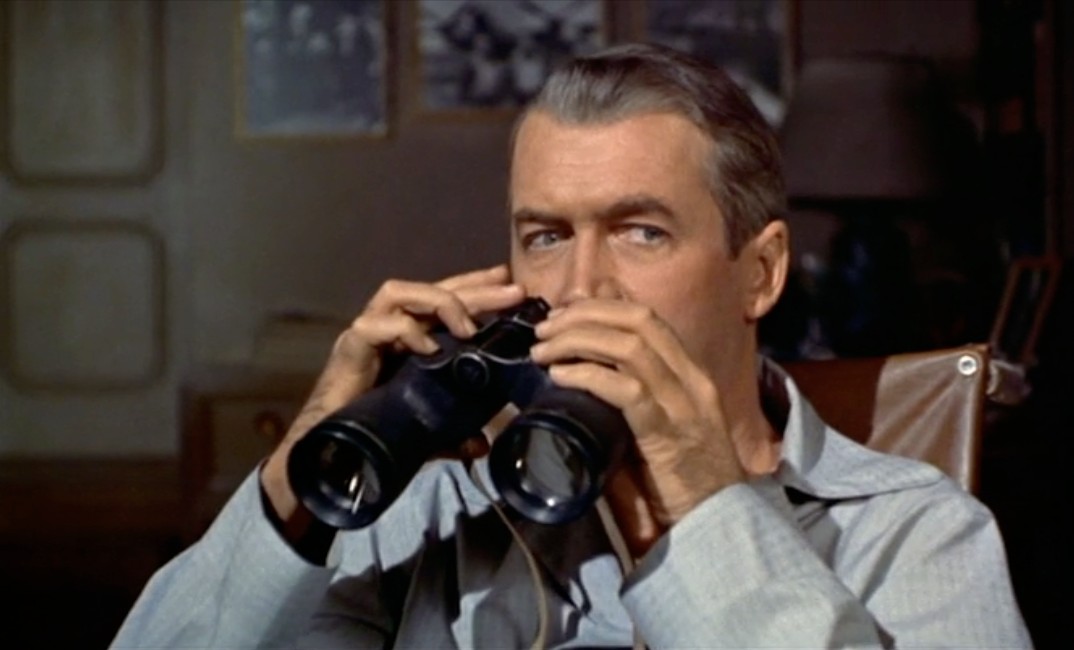
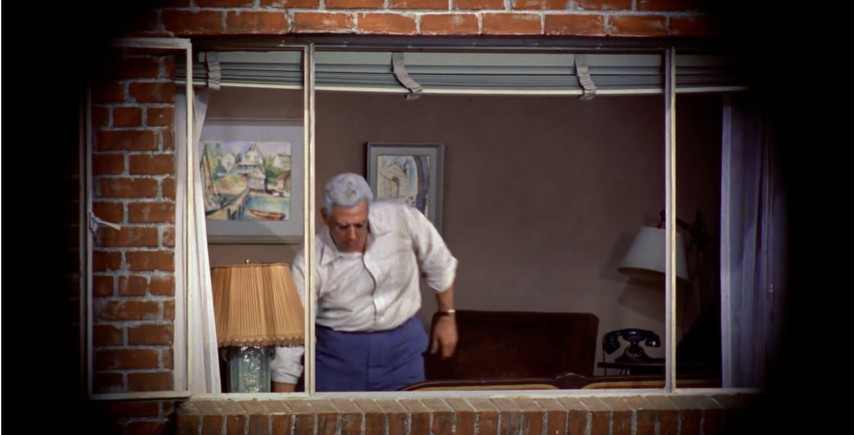
The other interesting thing about Hitchcock’s “Rear Window” is the fact that the binocular shots, and the camera shots appear the same. Again we could mark this down to artistic license, but there are inherently some issues which persist from an optical point-of-view. Firstly, what kind of binoculars are they? Little is written in the literature about the brand, so that requires a little investigative work.

Jeff with his binoculars in Rear Window

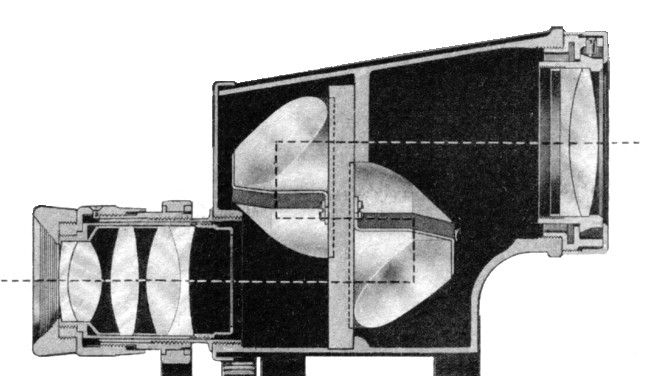
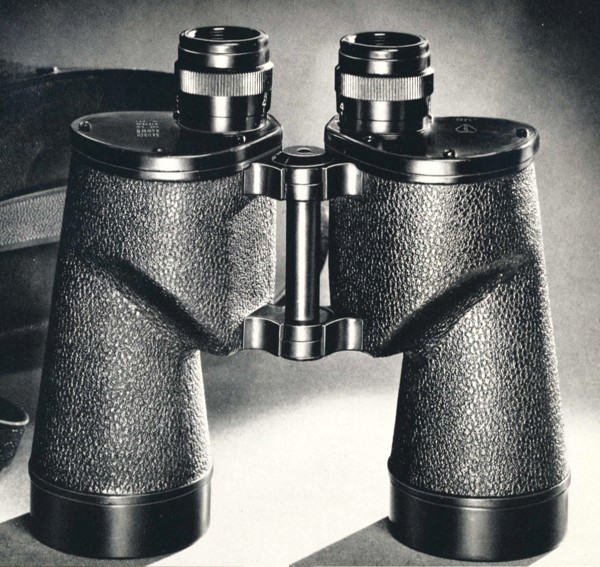
The most telling feature of these binoculars is that these are porro prism binoculars. In Porro prism Binoculars the objective or front lens is offset from the eyepiece. This offset is often characterized by a cap, which terminates the transition from ocular to objective lens.

The cross-section of half of a binocular. showing the transition from ocular (left) to objective (right) lens.

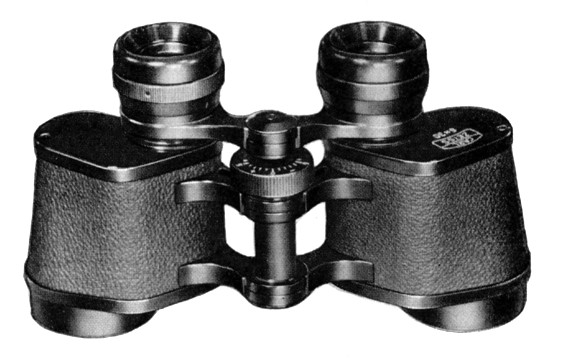
With some manufacturers, the transition seems to be smooth, with streamlined curves. There are a couple of brands that stand out in this respect: Bausch and Lomb (USA), Bushnell (USA), Cadillac (USA, made in Japan). Brands like Zeiss on the other hand, had a capped, “hard” transition.

A pair of Zeiss binoculars, showing the hard black “caps” covering the lenses.

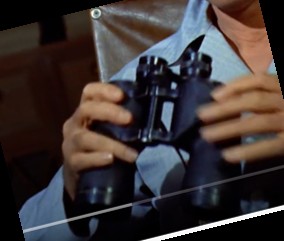
Beyond this, it is hard to tell what brand they were, because those markings would be on the front of the binoculars. More important are likely the power of magnification (how many times closer you are to the thing you are viewing), and the objective diameter of the lens. After doing some comparative measurements of the binoculars in the movie, with those in a early 1950s Bausch and Lomb catalog, I would guesstimate that these are the 7×50 binoculars, i.e. objective diameter was 50mm, and the power of magnification 7 times. A 400mm lens has a magnification factor of ×8, so binoculars with a power of ×7-8 would make sense (if we ignore the optical differences between binoculars and 35mm film lenses, e.g. cameras have a film plane, binoculars don’t).


A comparison of the binoculars in the movie, and the Bausch and Lomb 7×50 binoculars, circa early 1950s – notice the ergonomic flow of the lens parts.

The other factor which makes the B&L 7×50 the most likely candidate is that Bausch and Lomb supplied the US armed forces during WW2 (and Jeff was in the US Army Air Force), and this particular model was the Navy model, which had the “highest relative brightness of any binocular”, a so-called true “night glass”. So what are the issues between the 400mm camera lens and the binocular optics, assuming 7×50?

  • Field-of-View – The FoV of a 400mm lens is just over 5° (horizontal), which at 100′ distance (the width of the courtyard), translates to around 9 feet. The B&L 7×50 binoculars had a linear field of 381′ at 1000 yards, which would be about 12.7′ at 100′.
  • Full image circle – The camera would truncate the image circle of the lens to a rectangle, and therefore the maximum FoV is only possible along the diagonal of the frame. Binoculars allow you to see the full circle of the FoV and thus the maximum FoV in all directions. A 35mm camera with a 3:2 ratio only displays about 59% of an image circle with the same diameter as the diagonal of the rectangular image sensor.
  • Stereo Vision –  Binoculars allow both eyes to see slightly different angles of the same objects that allow use of depth perception. Other than specialized 3D cameras, most cameras are monocular.
Rear Window: The view through the binoculars.

So Hitchcock’s use of both binoculars and a 35mm camera with a 400mm lens does take a lot of artistic license, because they are not the same, but portray the same thing on screen.

The first 35mm lens

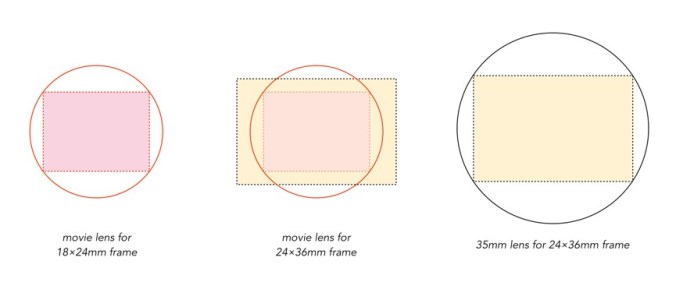
With the advent of 35mm film cameras came the need to design 35mm lenses. The first still cameras designed to use 35mm film inevitably used lenses modified from use on motion-picture cameras, or microscopes. This made sense when the 35mm cine-film used the 18×24mm frame format, however these lenses only covered part of a 24×36mm frame. The figure below shows frame coverage of a cine (movie) lens versus a 35mm lens.

Frame coverage of pre-35mm lenses

For instance the Tourist Multiple used a Bausch & Lomb Zeiss 4-element Tessar (50mm f / 3.5 lens), which was used on motion picture cameras.

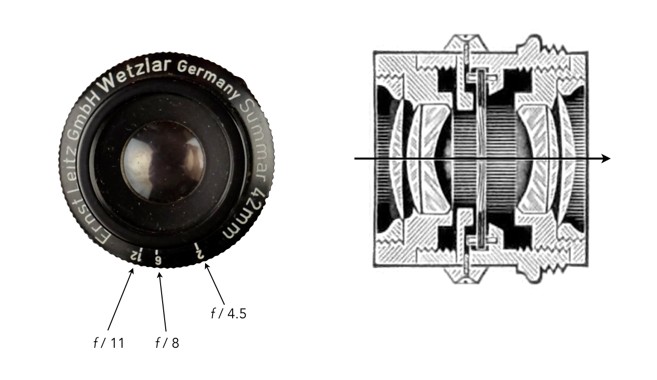
Leitz, founded in 1869, began as a company focused on the manufacture of microscopes, and other optical instruments. When work began on the Ur-Leica, Barnack and Berek tried a number of lenses. The simplest option was the 5cm f / 3.5 Zeiss Kino-Tessar movie camera lens. The problem is that the lens could not provide a light spot able to cover the 24×36mm frame format, as it was designed for a 18×24mm format. In addition it produced vignetting not suitable for a camera. The lens they ended up using was the 6-element 42mm f / 4.5 Leitz Mikro-Summar, in a classic double-Gauss formula. This lens had a number of shortcomings, including edge blurring, and a lack of contrast.

The Leitz Mikro-Summar (from 1907 catalog)

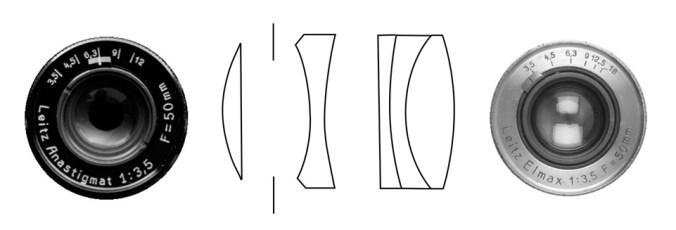
The design of a new 35mm lens was the responsibility of German physicist and mathematician, Max Berek (1886-1949). The first 35mm lens developed at Leica was a 50mm f/3.5 Anastigmat. Based on the “Cooke Triplet” lens design, it had 5 elements in 3 groups. The lens was later marginally redesigned, still containing 5 elements in 3 groups, and was given the name Elmax (The name is derived from Ernst Leitz and Max Berek.). These lenses were used on the pre-production Leica-0, of which 31 were manufactured from 1920-1925.

The Anastigmat / Elmax lenses

At that time, the calculation of such a lens was still very complex. Light beam paths from points near or away from the optical axis had to be calculated for three wavelengths and seven refractive surfaces, all by hand using logarithmic tables. Leitz was granted patent No. 343086 for the Anastigmat in 1920.

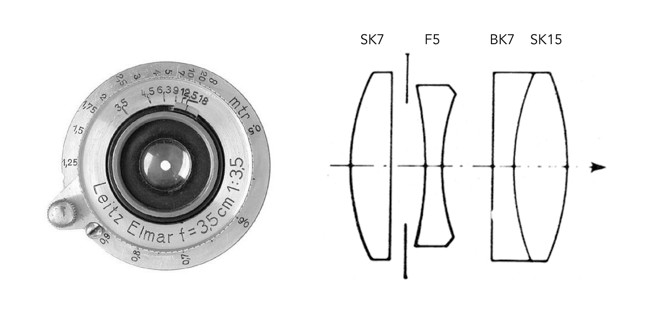
The first lens formula was difficult to build, so Berek changed the design to a triplet with the last element a cemented doublet, i.e., 4 elements in 3 groups. This lens was renamed Elmar, and was subsequently manufactured for decades (1925-1961). The lens was similar to a Tessar, except for the location of the diaphragm. On the Elmar the diaphragm was located between the first and second elements, rather than the rear two elements.

The Elmar lens

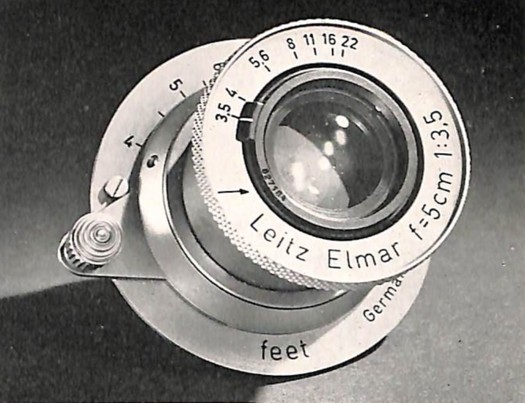
The first lenses which appeared were of the fixed type used on the Leica I. From 1930-1959, the Elmar was made in a screw mount, and an M (bayonet) mount from 1954-1961. From 1930-1932 the lenses were matched with one body, after which they became interchangeable (M39 mount). The lens would evolve to have a maximum aperture of f/2.8, and a minimum aperture of f/22. .

The Leica Elmar 50mm, with screw mount

Specifications: (Original)
50mm f / 3.5 Elmar lens
Angle of view: 45°
No. of elements: 4
Minimum focusing distance: 1.0m
Minimum aperture: 16
Aperture range: 3.5, 4.5, 6.3, 9, 12.5, 16
Weight: 92g

Here are some links to extra info on early Leica lenses:

The origins of 35mm camera film

Full-frame sensors take their dimensions from traditional 35mm film, but where did the ubiquitous 35mm come from?

The second half of the 19th Century spirited the development of many photographic materials and processes. Kodak’s first roll-film camera, the No.1 was introduced in 1888. By 1901, the use of roll-film had become quite common, with Kodak releasing the 120 film format, which was approximately 60mm wide and allowed for various frame sizes. Thomas Edison invented¹ the Kinetoscope in 1893, a device for showing basic film loops, and which used 35mm (1⅜”) gauge cine-film, half the size used in Eastman Kodak cameras. In March 1895, The Lumière Brothers introduced their Cinématographe, the first motion picture film camera, using the same width as Edison, 35mm. By 1909, 35mm had become the standard motion picture film.

Why is it called 35mm film? The 35mm represents the width of the film, irrespective of the size of the frame on the film.

A number of manufacturers started using 35mm cine-film for still photography between 1905 and 1913. The first patent for a 35mm camera was issued to Leo, Audobard and Baradat in England in 1908. It represented one of many patents and prototypes, few of which were produced commercially or even built. The first publicly available 35mm cameras were that used 35mm cine-film were the Tourist Multiple, and the Simplex. The Tourist Multiple, built by US company Herbert & Huesgen, was released in 1913. It was a half-frame camera, taking (750) 18×24mm exposures on 35mm cine-film. The Simplex, invented by Alfred Huger Moses, and was released in 1914. It existed in a number of different models, many of which allowed convertible full/half-frame exposures. The Simplex Model B was the only one to use standard 35mm format (it was only produced from 1914-1918).

The Simplex Model B.

It was Oskar Barnack (1879-1936), who produced the first commercially successful 35mm camera, at the Ernst Leitz Optische Werke in Wetzlar. In 1912, Barnack began work on a new motion picture camera, yet he struggled to get shutter timings right, largely because film emulsions were quite inconsistent. Proper exposure in the early days of motion picture was challenging because of the lack of devices such as photoelectric meters. In response to this, Barnack created a film tester to determine correct exposure settings. Barnack’s device would allow small test exposures to be processed, and exposure issues adjusted accordingly. This prototype device became known as the Ur-Leica, where the prefix “Ur” in German means prime, or original. It was equipped with a Mikro-Summar f / 4.5, 6-element, 42mm lens.

The Leica I (1927) © Kameraprojekt Graz 2015 / Wikimedia Commons

Barnack’s design allowed the camera to move the film horizontally, increasing the frame size to increase to 24×36mm, instead of the 18×24mm exposures of cameras that carried film vertically. This essentially created “double-sized” images. The aspect ratio also changed from 3:4 to 2:3. With the onset of WW1, it was not until 1924 that Leica decided to produce the 35mm camera, with the 35mm Leica I (A) making its first appearance as the Leipzig Spring Fair in 1925. The Leica I had an all-metal housing, a collapsible lens, and a focal-plane shutter. The Leica succeeded because it was compact, and the quality of the exposures was as good as the more commonly used roll film.

So why did 35mm film become so successful? It was partially to do with cost. Due to its use in the cinematic industry, 35mm motion picture film was widely available, and inexpensive. The number of exposures which could be loaded into a camera was 40. Initially the film had to be loaded in the dark, however Barnack soon realized this was a problem and developed a reloadable cassette which could easily be inserted into the camera, and could accommodate 36 exposures. By 1932, Leica’s competitor Zeiss had introduced the 35mm Contax, and Kodak entered the market in 1934 with the Retina I.

¹ It is widely believed that the Kinetoscope was actually designed by one of Eastman’s employees, William Dickson.

For more information on early 35mm cameras check out Max Bertacchi’s page dedicated to early 35mm cameras, or early Leica’s.