In the first episode of Sister Boniface Mysteries (BritBox), we are introduced to Sister Boniface, a Catholic nun with a PhD in forensic science. Now part of her job as police scientific adviser involves taking photographs, obviously given the time period in the early 1960s, she uses a 35mm SLR camera – but what camera?
The camera is introduced in the first episode, “Unnatural Causes”.
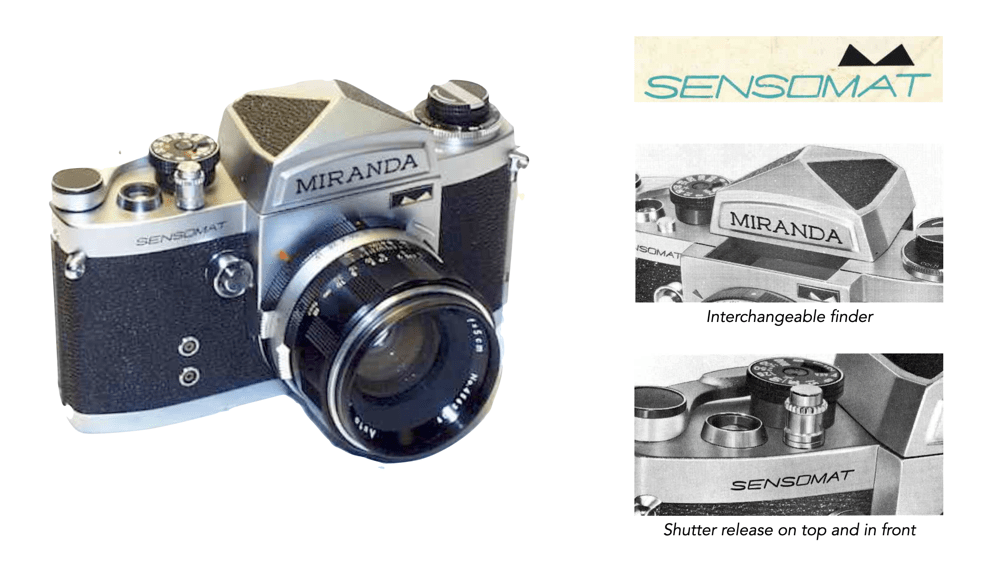
Well, it isn’t actually too hard to figure out the camera, despite the fact that the branding has been covered by black tape – the camera is from Japanese company Miranda, founded in 1947 and produced 35mm cameras from 1953 to 1976 (it was named Miranda Camera in 1957). During that period they introduced some 30 differing models nearly all with interchangeable pentaprism’s. The camera itself is a Miranda Sensomat, introduced in 1969. It was a budget camera, which had TTL CdS stop-down meter built-in the under mirror. The Sensomat range was produced from 1969-1974. The lens is likely the Auto-Miranda 50mm f/1.8, and the camera sold in 1969 for US$190 – it was advertised as being affordable.
The Miranda Sensomat
The interesting thing about the use of this camera is that the series is set in the early 1960s, and the camera was released in 1969, so there is some historical disparity. If one were choosing a Miranda camera of the period, a Miranda D might have been more appropriate. As to why the Miranda was chosen? Likely it was just a prop, it’s doubtful anyone thought about using a more historically significant camera for the period. Why cover up the brand? Likely due to not having to pay licensing fees, although it is unclear as to who currently owns the Miranda trademark.
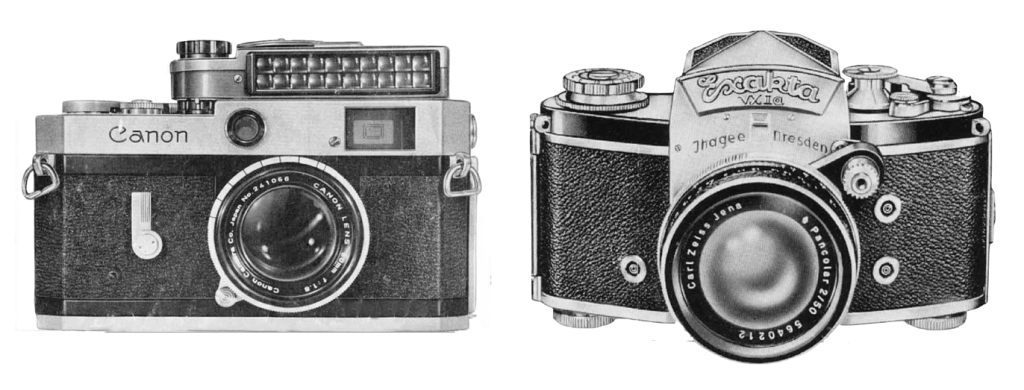
Certain vintage cameras can be expensive, but there are sometimes opportunities to buy these cameras in a malfunctioning or “non-working” form for a reasonable price. A good store will tell you what is wrong with the camera, but the problem is that there aren’t exactly a lot of places where you can get film cameras fixed, and of those, they are often focused on a particular brand of camera. Fixes that involve digging into the guts of a camera are inherently marred with problems. A while back I bought an Exakta TL VX1000 camera, because it was cheap, but mostly for the lens. When it arrived it seemed to work, except the film-transport lever had been snapped in half. So I bought a replacement lever, and thought it would be a simple process to fix it. It wasn’t and although I replaced the lever, something else broke (a spring). I should have had a better understanding of the inner workings of Exakta cameras.
The Nikon F, a fully mechanical camera (and Nikon’s first SLR) has 918 mechanical pieces.
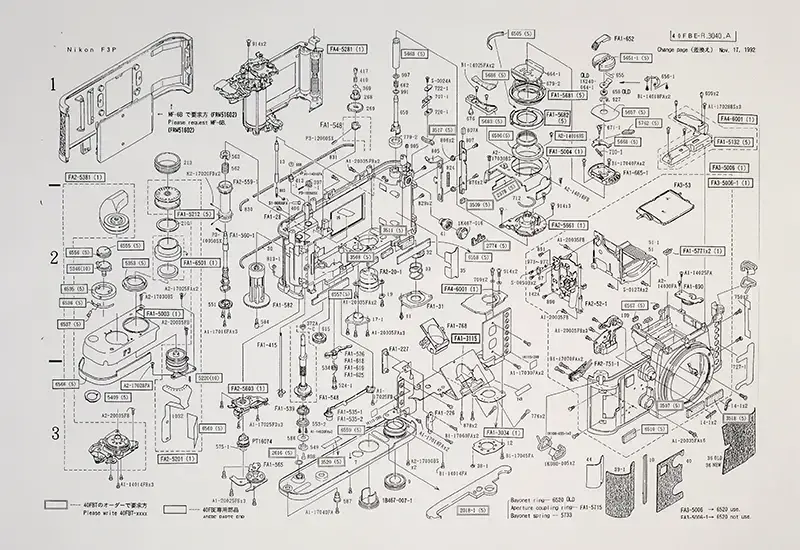
In reality, very few cameras are easy to fix. Fully mechanical cameras are filled with parts, and cameras with electronics are even trickier – i.e. it may be possible to source a donor part, or even 3D print a part, but recreating 50 year-old electronics is another thing altogether. You need the appropriate tools, and access to parts and assembly diagrams, e.g. the Nikon F3-P parts diagram posted on Japan Camera Hunter. The easiest repairs are obviously cosmetic issues – replacement of leatherette, battery covers, etc. or replacing light seals. There is also the issue of cost – fixing a vintage camera can often become expensive, especially as parts often have to be salvaged from a “donor” camera. Even the simplest parts, like springs, can be challenging to find, considering they may be decades old (springs have to be the right size and have the right tension).
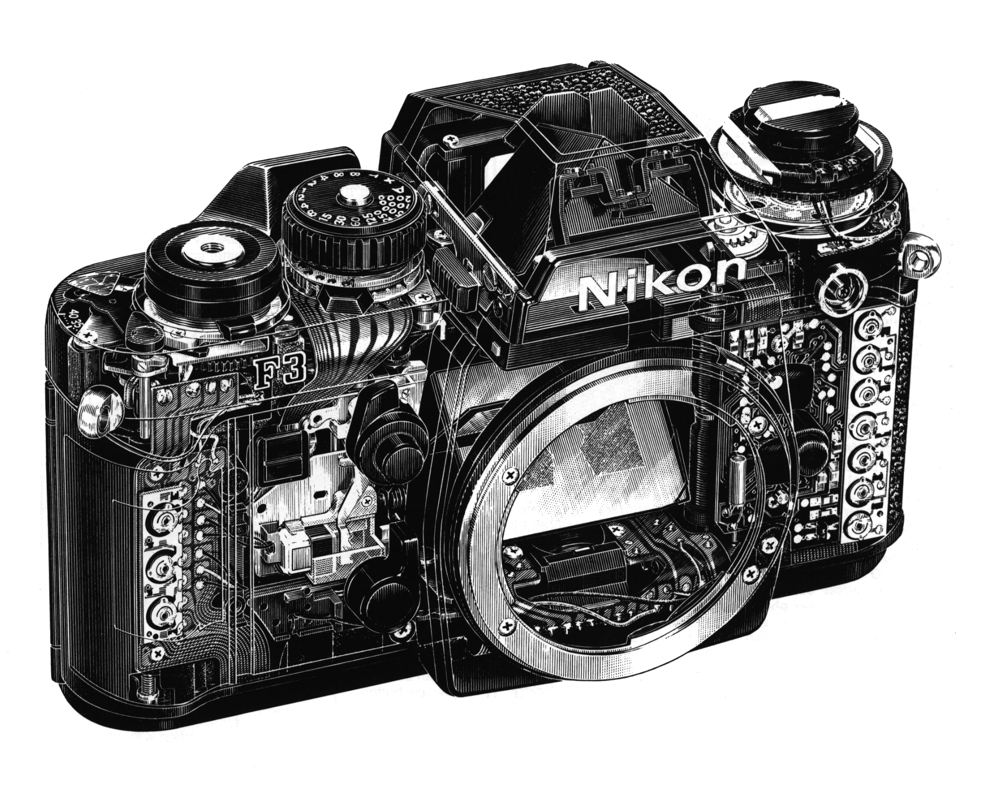
The Nikon F3, with semi-automatic exposure control, was not any less complex than film cameras.
If you are really interested in doing your own internal camera repairs, I suggest reading though the information below. For cameras that are rare, I would recommend having them fixed at an experienced repair facility. In Canada, probably one of the best known camera repair spots is Paramount Camera Repair, in Saskatoon. There is also Factory Cameras in Vancouver.
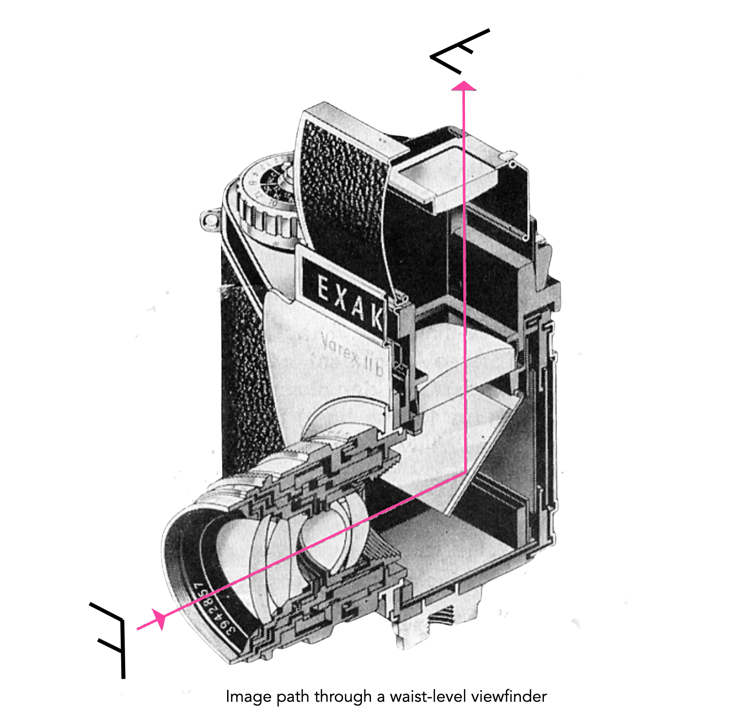
The first 35mm SLR camera, the Ihagee Kine Exakta, used a horizontal waist-level viewfinder. This was not unusual for the period, as there was no other means to view a picture through the camera at an eye-level (that wasn’t a rangefinder camera). The problem is that the image viewed would be flipped left-to-right. This would be rectified by the introduction of the first production pentaprism camera in 1947, in the guise of the Italian Rectaflex. The technology became more mainstream with the introduction of the Zeiss Ikon Contax S in 1949 (although waist-level viewfinders would still be dominant until the mid-1950s).
Fig.1: Early SLRs did not have a pentaprism, but instead required the photographer to look through a waist-level viewfinder
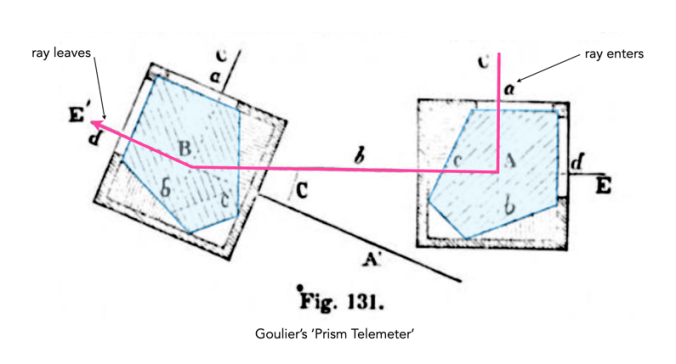
A pentaprism or pentagonal prism is a five-sided glass prism (although technically while the cross-section of a pentaprism is bound by five sides, it actually has seven or eight). Prisms were already being using in the Victorian era to design telescopes and binoculars. The use of a pentaprism in optics stems from an invention by a Captain Charles-Moÿse Goulier (1818–1891) of the French engineer corps in 1864, a “triangulation prism telemeter” [1]. It was a device with twin sighting paddles, connected by wire 40 meters long to establish a fixed baseline. Each paddle contains a five sided prism to give simultaneous orthogonal views. It may have been the first use of pentagonal prism in optics.
Fig.2: The pentaprisms used in Goulier’s 1964 invention (adapted from [1]).
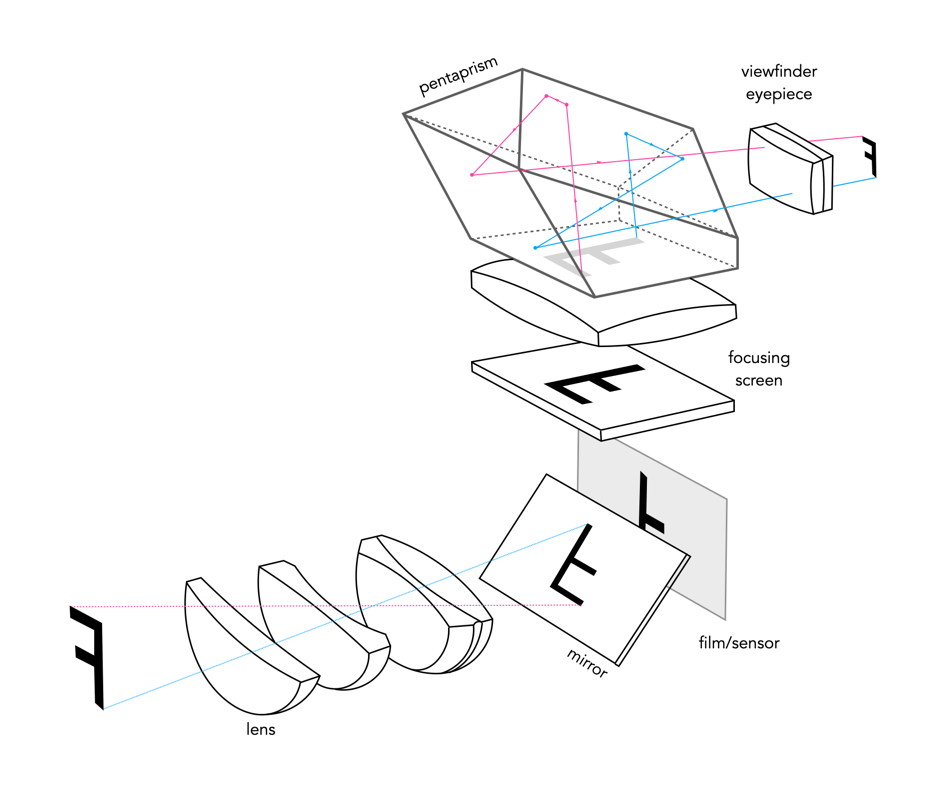
This form of conventional pentaprism, sometimes referred to as a flat-roof or Goulier prism, is characterized by a 90° deviation angle (Fig.3(1)), i.e. it deviates a beam of light by 90°, reflecting the beam inside the prism twice. It is comprised of two reflective faces (Fig.3(1)b,c), arranged at 45° between them and two faces orthogonal to each other (Fig.3(1)a,d). The two surfaces performing the reflections are coated to provide mirror surfaces (e.g. silvered). The two opposite transmitting faces are often coated with an anti-reflective coating. In imaging applications this pentaprism will neither invert nor reverse an image, e.g. Fig.3(1). In the context of an SLR this still holds true, because the image is flipped as it passes through the lens and it is this flipped image that passes through the prism. So in the context of the ‘flippedi image, it is neither inverted or reversed. However, compared to the original object in front of the lens, the image viewed at the eyepiece is reversed left-to-right. Prior to the end of WW2, conventional pentaprisms were commonly used in telescopes, binoculars, and military equipment such as rangefinders.
This is illustrated in Fig.3(3) where the object F passes through the optical system of an SLR. The F is flipped by the lens and this flipped version of the F passes through the prism. The image viewed at the eyepiece is neither inverted nor reversed from that projected on the mirror. However compared to the original F, the image is reversed left to right.
Fig.3: The flat-roofed (conventional) pentaprism: (1) a simple optical path, (2) a breakdown of the angles, and (3) used in the context of an SLR optical system.
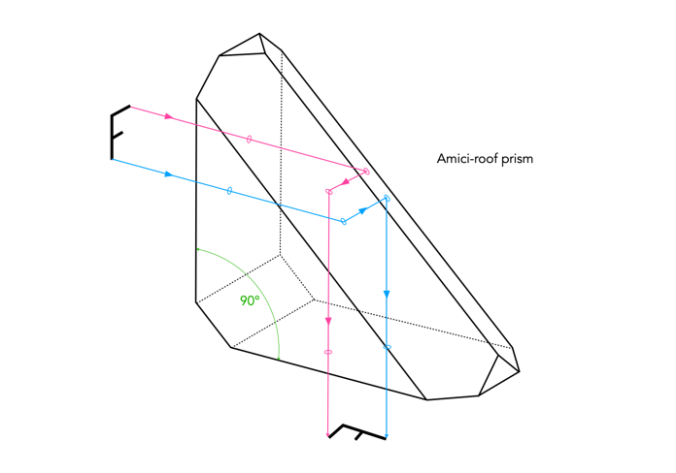
The more complex pentaprism found in the majority of SLR cameras is the roof pentaprism which reverses an image from left-to-right. It is similar to a conventional prism, but with the addition of two silvered “roof” surfaces. The concept of a roof prism was created by Italian astronomer Giovanni Battista Amici (1786-1863) in the mid-1800s. His Amici-roof prism, also known as a right-angle roof prism, was capable of reverting and inverting the image of an object while bending the line of sight through a 90° angle (Figure 4). It was used in various types of telescopes.
Fig.4: The Amici-roof prism.
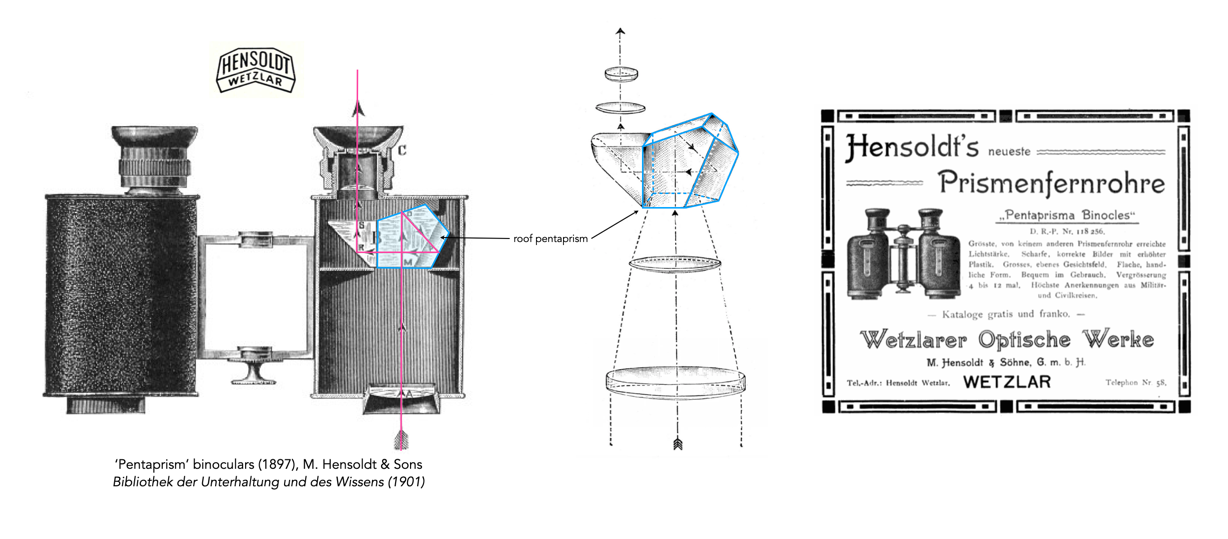
A roof prism is a prism containing a section where two faces meet at a 90° angle, resembling the roof of a building. Reflection from the two 90° faces returns an image that is flipped laterally across the axis where the faces meet. The first large scale use of a roof pentaprism may have been in binoculars, like the Pentaprisma Binocle 7×24 made by Hensoldt & Söhne (Wetzlar) introduced in 1900. An earlier version of the binoculars (1897) used a flat pentaprism attached to a right-angle prism with a roof (like an Amici-roof prism). This arrangement was denied a patent in Germany, due to a conflict with a Zeiss patent (DE77086, which used a Porro-prism), however was granted a patent in Great Britain (GB15806, 1898). The newer version of 1900 had a dialytic (split) optical system where the pentaprism had a roof edge (Figure 5).
In an eye-level SLR, the roof pentaprism is inserted between the focusing screen and the viewing eyepiece. The roof pentaprism, by introducing extra reflecting surfaces, shows the object both upright and with the right and left sides in their proper place. The bottom surface of the pentaprism may form the focusing screen, or the latter may be positioned directly below the prism. The focusing screen may be of several different kinds, including plain ground glass, to various combinations of clear glass, ground glass, or micro-prism focus finder.
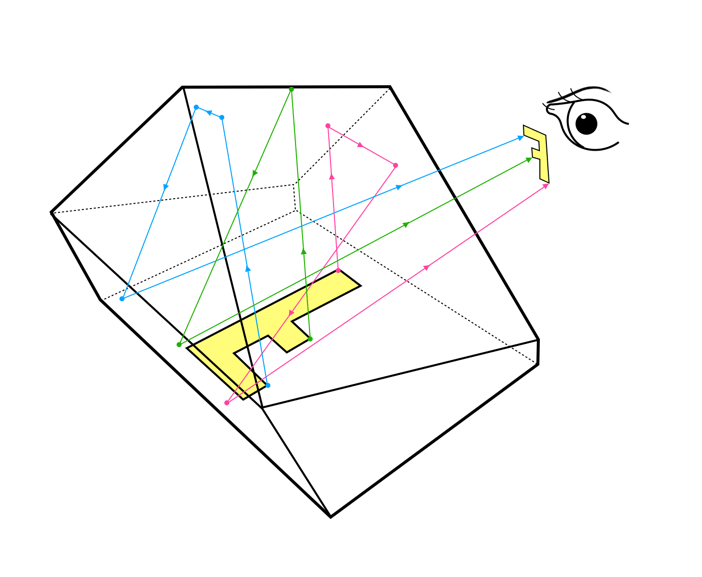
Fig.6: An example of light passing through a roof-pentaprism
The light passing through a roof-pentaprism undergoes three separate reflections in order that the image is seen both right way up and right way round. The image enters the prism right way up, but laterally reversed, so that as the image must be turned again through 90° to allow it to be viewed at eye level, it must be reflected twice to keep it right way up. The third reflection has no effect on the vertical aspect of the image but it merely used to reverse the image laterally so that it is seen right way round.
Fig.7: Image passage through an SLR camera using a roof-pentaprism
The basic history of the pentaprism as it relates to the SLR can be found in a separate post. But a summary is provided below. A timeline of early SLR pentaprisms:
1933 − Kurt Staudinger issued a patent for a reflex device, i.e. a penta-mirror
1937 − Zeiss Ikon (Germany) begins work on the Syntax, a camera with a pentaprism. Patents exist for the concept, but the prototypes, ca. 1944 were destroyed during the war.
1948 (Sept) − First commercially produced SLR with a roofed pentaprism, the Rectaflex (Italy). An earlier 1947 prototype used a flat pentaprism.
1949 (Sept) − Zeiss Ikon (GDR) introduces the Contax S, the second SLR with a pentaprism, essentially recycling the Syntax.
1949 − ALPA introduces the ALPA Prisma Reflex, a pentaprism with a 45° view. ALPA would not introduce a normal perpendicular view until the Model 6c (1960).
1952 (Sept) − Wrayflex receive a patent for an SLR with a “pentagonal prism” which was never produced. The first Wrayflex with a pentaprism was the Wrayflex II (1959).
1955 − The first Japanese SLR with a pentaprism, the Miranda T.
Note that a pentaprism is different to a penta-mirror, which instead of a glass prism uses three mirrors to perform the same task. Using a glass prism has definite benefits over mirrors. Changes in light direction in a prism is based on the notion of total reflection, which means reflectances of close to 100% can be achieved, while silver mirrors lose at least 10% to absorption losses. A glass prism is also better because the refractive index of glass causes a shortening of the light path.
Notes:
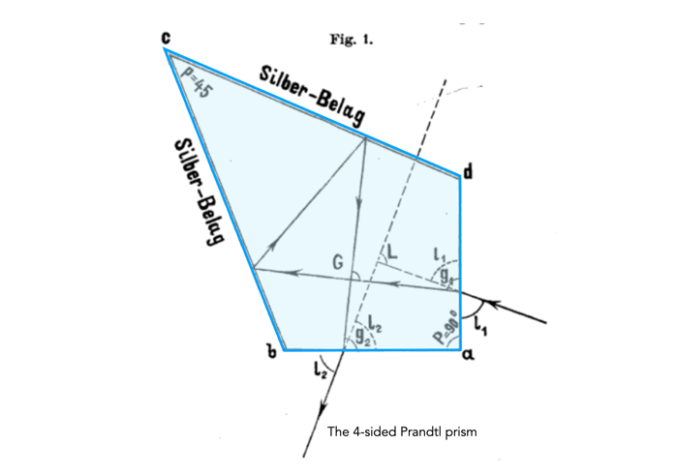
Goulier’s prism is sometimes known as the Prandl prism (or even the Goulier-Prandl prism), and is often cited as such, particularly in German literature. Now a cursory search will find very little, but digging a little deeper finds a paper published in the German journal Zeitschrift für Vermessungswesen (Journal of Surveying) in 1890, by an Alexander Prandtl [2]. Prandtl (1840-1896) was a professor at the Royal Bavarian Central Agricultural School in Weihenstephan specializing in dairy farming. But the paper describes a 4-sided prism, similar to Goulier’s prism except the extra side between the two surfaces meeting at 45° is missing. The other issue is the fact that Goulier’s prism was described 26 years previously. Prandtl’s real claim to fame was developing the first continuously operating milk centrifuge.
Hensoldt & Söhne created their first product, a rangefinder using a roof prism in 1892. The company would go on to develop the Hensoldt roof prism (DE180644, 1905) which required no mirroring, and had no axis offset, allowing for straight binoculars. In 1938 the Carl Zeiss Foundation would take a majority share in Hensoldt. It is entirely possible that this mechanism formed the basis of the work done on the Zeiss Syntax SLR in the late 1930s and early 1940s.
Fig.8: A depiction of the Prandtl prism (adapted from [2]).
Further reading:
Barnard, F.A.P/, “Prism Telemeter”, Report on Machinery and Processes of The Industrial Arts and Apparatus of the Exact Science, p.589-592 (1869)
Prandtl, A., “Ein neues Instrument zum Abstecken von rechten Winkeln” (A new instrument for marking out right angles), Zeitschrift für Vermessungswesen, 19, pp.462-467 (1890)
35mm photography evolved in rangefinder cameras. In the early pre-prism days, photographers using “minicams” had a simple choice of Leica, or Contax. Post WW2, other Leica “knock-offs” would appear, mostly from Japan, but also from countries like Italy, and the USSR. So why did rangefinders languish? To answer that we will look back at two 1956 articles in Popular Photography under the banner: “Which 35 – Reflex or Rangefinder?” [1,2].
Rangefinder versus reflex?
Bob Schwalberg, an advocate for rangefinder cameras, described two of their limitations [1]: long and short views. Rangefinder couplings it seemed had a limitation of 135mm focal length for the purposes of long views, and a limit of 3½ feet in close-up (without accessories like a mirror reflex housing). In fact Schwalberg even commented that “Rangefinders just aren’t worth a speck of dust on your negative for focusing lenses longer than 135mm”. After this he focused on their strengths:
Speed in focusing – “With a rangefinder camera you move straight into focus instead of having to twist the lens back and forth several times…”.
Ease of focusing – Rangefinder cameras can be “focused under light levels so dim as to make photography unfeasible.”
Accuracy of focusing – “Rangefinder focusing is inherently more accurate than ground-glass focusing because the rangefinder mechanism can distinguish much more critically than the human eye.”
Time lag #1 (from focusing to stop down) – does not apply because the rangefinder is stopped down before focusing begins.
Time lag #2 (from pressing the release button to exposing the film) – rangefinders don’t have mirrors which add 1/50 sec. Reflex cameras have mirror lag.
Schwalberg actually considered the mirror lag to be the single most serious disadvantage of the SLR in as much as “You never see the picture you make with a single-lens reflex until you, develop the film. It all happened why you weren’t looking.” (unfortunately this was before the returning mirror). He goes on to say that “The prism reflex is a useful tool which brings many advantages to a number of specific, and I think special, photographic applications.”
Barrett Gallagher meanwhile made the case for the single-lens reflex [2]. His choice of the SLR was because, in his words, “I couldn’t see clearly through the viewfinders on the rangefinder cameras.” Or in other words “… any separate rangefinder-viewfinder system requires you to shift your eye from one peephole to another at the crucial moment, and with a moving target, you’re dead.” Rangefinder accuracy also falls off with long telephoto lenses, requiring of all things the addition of a clumsy reflex housing.
Close-up – it is possible to focus down to 3.5” with no parallax problems. Reflex cameras focus down to 2.5 feet, versus 3.5 feet for rangefinders.
Ease of focusing – rangefinders are easier to focus, however in dim light the reflex lens can open wide enough to allow focusing.
DOF – the SLR allows the photographer to see the DOF a lens offers at different f-stops.
Viewfinders – SLR’s have one viewfinder for all lenses. Rangefinders require supplementary rangefinders for lenses outside 50mm.
Gallagher summed up by saying that “The single-lens reflex is the versatile camera with no parallax, no viewfinders, no mechanical rangefinder limits. It lets you see full size with any lens exactly what you get – including actual depth of field.”
Further reading:
Bob Schwalberg, “Which 35 – Reflex or Rangefinder? – The coupled rangefinder is for me”, Popular Photography, 39(2), pp. 38,108,110 (1956)
Barrett Gallagher, “Which 35 – Reflex or Rangefinder? – I like a single-lens reflex best”, Popular Photography, 39(2), pp. 39,112 (1956)
If you haven’t heard the news, Ricoh is considering developing a series of new “Pentax” film cameras, by means of its “Film Camera Project“. Pentax of course has a long and proud history of film camera development, but hasn’t really made huge inroads into the digital world. It was bought by Ricoh in 2011, becoming Ricoh Imaging Company Ltd. Still, the most successful digital camera coming out of the combined company is the Ricoh GR series.The company apparently surveyed 3,000 people in Japan and concluded that 20% of camera owners also owned film cameras. So in all likelihood, I imagine developing a series of film cameras is not a bad idea.
The trick of course is what route do you take? Do you go for a fully manual camera with no electronics aboard, or do you go with the opposite end of the spectrum and go fully electronic? I mean if you are going to start somewhere, why not reproduce the famed Ricoh GR1? It was introduced in 1996, so there wouldn’t be a huge curve in getting it back into production – update the lens, and the inner workings a bit. A fixed lens is fine – keep it simple, and I imagine there would be a bunch of Ricoh GR digital users that would spring for a film version. Small and compact is ideal.
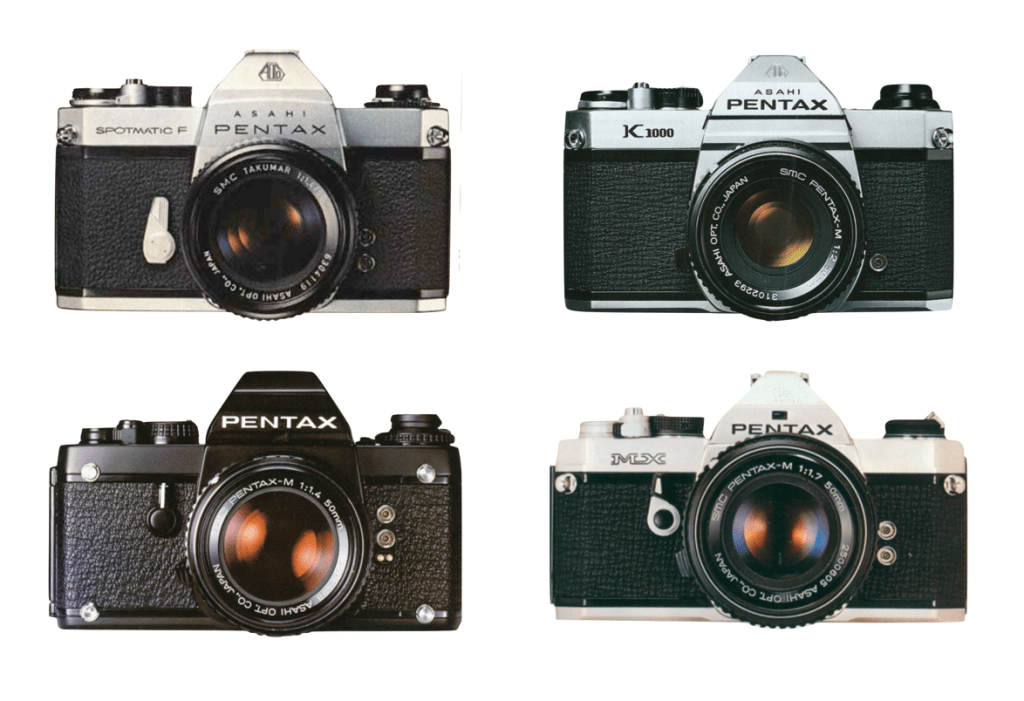
Or perhaps rejig a Pentax Espio? The reality is that it shouldn’t be too hard to “develop” new cameras. You don’t need to add anything “fancy”, i.e. digital. And picking the best camera to replicate is as easy as determining which vintage cameras sell the best. They could build one from scratch, but would this be worthwhile? Could they replicate some other camera? What about full-frame cameras? Do you go with a Spotmatic type camera for an entry level, fully-manual? Or perhaps the diminutively sized MX series? Do you offer a manual and semi-automatic camera? Then there are the lenses – do you allow the use of vintage M42 mount lenses, or do you conform to the K-mount? Making a film camera without taking into consideration the legacy lenses is problematic. Then of course there are the lenses themselves – new digital-like lenses, or re-manufactured manual legacy lenses.
Done properly these film cameras could be very successful. Poorly done, and it will be a disaster. The best way to test the market would be simply to reintroduce an existing design like the GR1. But Ricoh needs to look beyond the Japanese market, and explore the needs of film users worldwide. At the same time, introducing a film camera requires some level of sustainability. A camera low in electronics, would of course reduce a camera’s footprint, and perhaps using a rechargeable battery would help as well. Of course there is also the issue of processing films, which does have quite an impact on the environment. One interesting addition to a new camera might be to allow cameras to incorporate both full- and half-frame shots. Allowing a 36-exposure film to take 72 shots certainly reduces the amount of rolls required, as honestly no one should treat film in the same manner as digital, i.e. 1000 frames of film when travelling is not really that realistic.
Which Pentax?
Ultimately it’s a very intriguing idea. Will it work? Time will tell I guess. A successful film camera will have to be well-priced for the market – even though Ricoh doesn’t really have any competition to speak of, there are still a *lot* of reasonably priced vintage film cameras around the world. And I’m not talking about Leica film cameras. The remade Leica M6 is likely a wonderful rangefinder camera, but at US$5,295 it’s not exactly affordable. Ricoh has one chance to get this right, and deliver a series of film cameras worthy of its legacy.
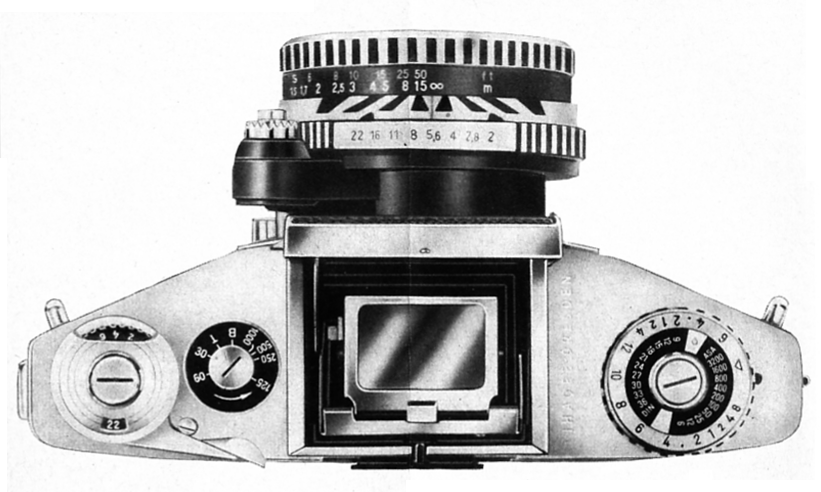
There were various types of analog cameras, but the simplest were mechanical cameras, that contained no electronics at all. That means everything that happened inside was mechanical in nature. Not that much really happened, I mean the mechanisms basically moved the film forward, set the film and shutter speeds, and set/activated the shutter mechanism (and move the mirror). But these mechanisms were inherently complex, and the cameras themselves were typically built by hand. A plan view of an Exakta VX1000 camera shows how simple it was…
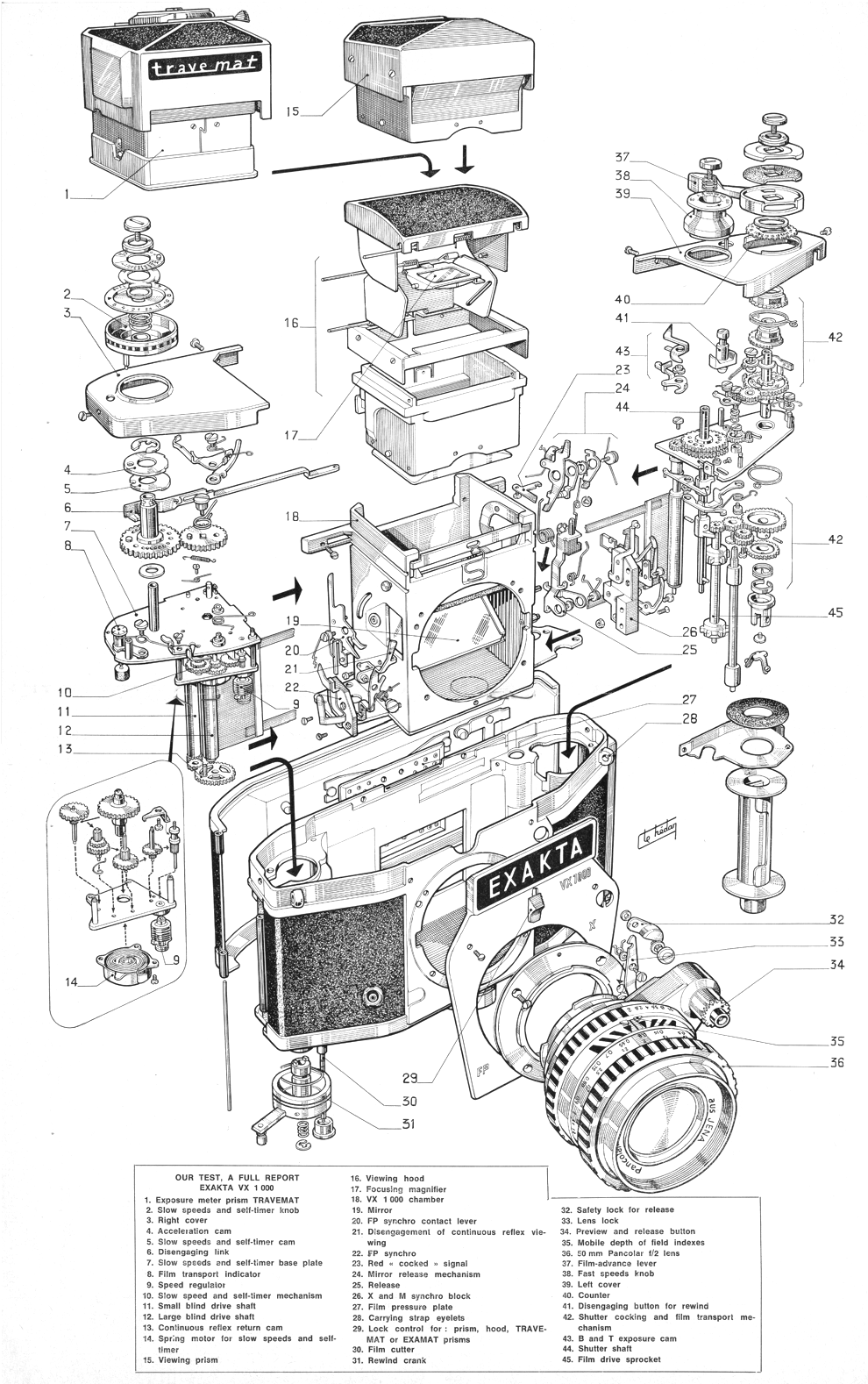
… but the workings inside were another matter altogether – which was basically comprised of a whole lot of sprockets, rods, and some levers. Things got even more complicated once electronics were introduced.
If you do a search for “German Pentax” you will likely come across a reference to a German camera. Of course the name brand Pentax is most often associated with Japan’s Asahi Optical, but it wasn’t always the case. The name Pentax started life behind the Iron Curtain at VEB Zeiss Ikon Dresden. Zeiss Ikon was one of the photographic companies formed in East Germany after the division of Germany into East and West.
Zeiss Ikon Pentax
In 1954 Zeiss Ikon, based in Dresden, began work on a new 35mm camera. It was designed to use the new Zeiss 50mm f/2.8 lens, but was quite radical from a design perspective, looking more like a 120 film camera of the period. There only seem to be prototypes of this camera, and if you want to learn more you can check out the post on Marco Kroger’s website zeissikonveb.de. He says the first version of the camera was intended to be a 6×4.5 120-film camera, with the film loaded in removable cassettes. The page includes some interesting technical drawings of the camera.
But where did the name Pentax come from? Well due to the division of a number of German camera companies, there were some issues with product naming, mostly related to trademark infringement. As East German companies wanted to sell their products in the West, they often had to come up with new names. For example the name Contax was already being used by the West German Contax company. To circumvent this, East German companies often created portmanteau words by blending two words. For example, Pentacon was derived from “PENTAprism” and “CONtax”. Therefore it is thought that the registered trademark Pentax was derived from PENaprism ConTAX.
Because Zeiss Ikon had a name but no camera, it sold the name to Asahi in 1954 who attached it to their first Pentaprism SLR in 1957 – the Asahi Pentax.
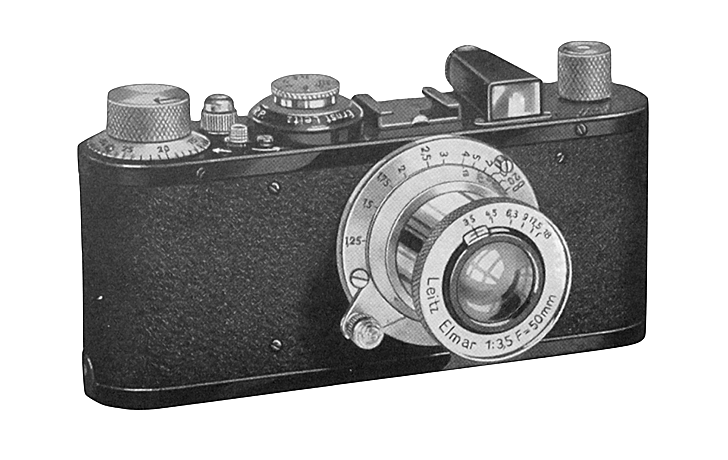
In the October 1936 issue of Fortune, there was an article on the “minicam boom”. It cited there being 100,000 miniature cameras in the US, comprised of more than 30 different makes.
Model E Leica, 1936
“Many a man who had owned a Kodak for years without feeling any impulse to see what he could do with it if he applied himself fancied that in the Leica he was finding a new invention that defied the laws of optics and would give him good pictures with no light to speak of and no effort save that of pressing the button. The Leica didn’t even look like a camera. No bellows, no bulk, no focusing hood; you shot from the hip, so to speak, and got your man.”
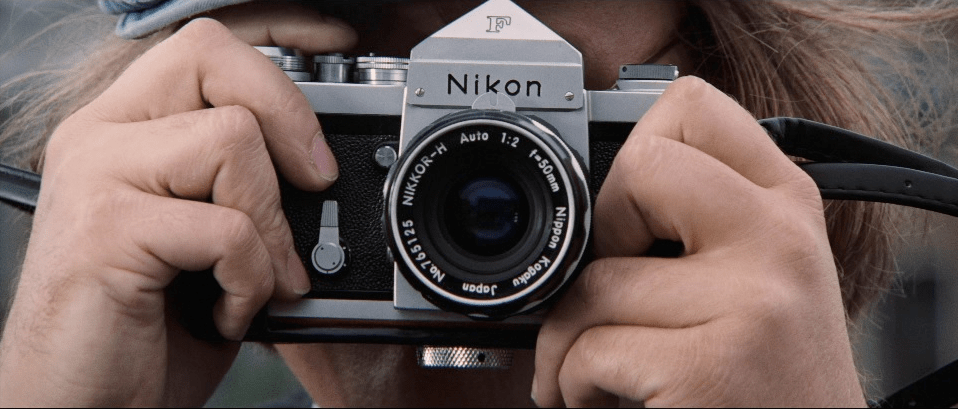
In 1971, two of the villains in the James Bond movie, Diamonds Are Forever used a Nikon F to take photos. The question is why the Nikon F? I mean it’s not like it was a new camera. First unveiled in 1959, it was no doubt an influential camera, but a decade later was it still cutting edge?
It was not the only time Nikon cameras were used in movies. The list is actually quite long, including the likes of The French Connection, Jaws, and Apocalypse Now (here’s another list of cameras in movies and TV shows). Nor was it the only camera used in Bond films – Bond used a Rolleiflex T in From Russia with Love (1963), a in Goldfinger (1964), a Nikonos Calypso in Thunderball (1965), and a Minox subminiature in On Her Majesty’s Secret Service (1969).
The Nikon F was at the forefront of SLR technology in the 1960s, and had a wide audience of users, from photojournalists covering the Vietnam War, to NASA. In March 1968 the Nikon F was laboratory tested by Popular Photography. Reviewers found little to complain about, it was an easy camera to function with, and extremely well built, except for the fact that it was heavy, “like a military tank of a camera”. It had a presence which was hard to dispute.
Choosing a camera for any movie may be a mere factor of chance. A personal preference of the director, or somebody facilitating props. Sometimes it’s product placement, although considering the Nikon F2 was released in the same year as the movie, it’s unlikely that is the case.
The term plastic is somewhat relative – it actually means any material that is moldable, shapable, ductile. At extremely high temperatures even rocks can become plastic. The most common use of the word is likely to describe a synthetic material made from a wide range of organic polymers. The first plastic made from synthetic materials was Bakelite, which was invented in 1907. It was used in the 1930s to make cameras such as the Kodak Baby Brownie, and Purma Special. Plastic materials such as methyl methacrylate, or acrylic (often better known by its trade names, e.g. Lucite, Plexiglas, Perspex), were developed in the 1920s, largely to make unbreakable eyeglasses.
There was little interest in the use of plastics as substitutes for optical glass until WW2. Many plastic materials were examined during the war period, but few were found to have the right optical characteristics for use in photographic lenses. After the war, research continued, and plastics replaced glass in a number of non-critical optical purposes. But in the realms of photography, few if any manufacturers gave up their dependence on glass, save perhaps for lenses in inexpensive box-cameras. In 1946 Andrew Hecht wrote an article on plastic lenses [1]. The first statement he made was “Plastic lenses are here, and they are here to stay…”. Hecht suggested they would only be economical in lenses of 2.5” or more in diameter. The article focuses on Thomas S. Curtis Laboratories, which produced thousands of lenses up to 18” in diameter for the US Army. These lenses were manufactured from large slabs produced in electric furnaces which is then cut, and shaped on lathes, ground and polished. The article seemed to focus on lenses for applications such as industrial magnifiers.
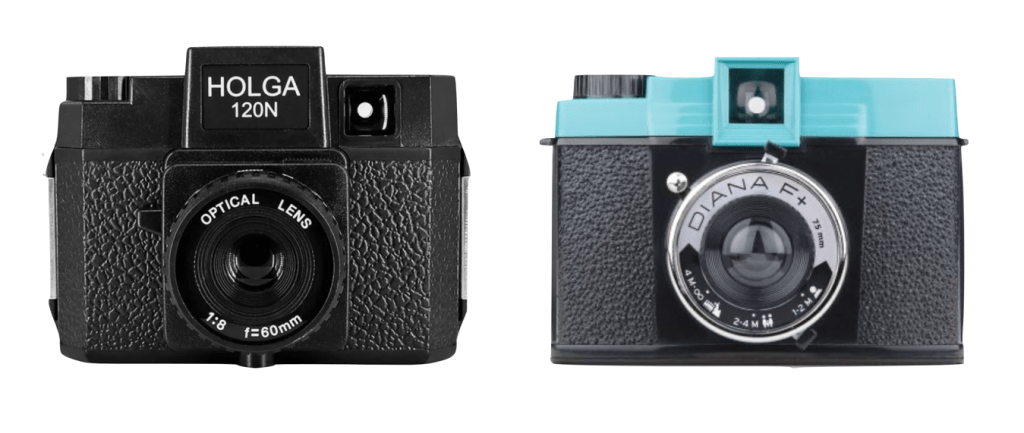
The HOLGA 120N and DIANA cameras with plastic lenses
The 1950s saw a growing trend towards the idea of using plastics in cameras. In 1952 Kodak was experimenting with plastic viewfinders in its simple cameras, and by 1957 was making injection molded meniscus lenses for use in snapshot cameras. In 1959 it was using triplet lenses with an f/8 aperture in its Starmatic Brownie cameras. The March 1961 issue of Modern Plastics [2] had an article on plastic lenses, with a cover touting “Lenses – The Focus is on Plastics”. The article describes large plastic lenses made of acrylic, 4-30” in size, used in applications such as magnifiers and reflectors. The article described the many benefits of plastic lenses: reduced weight, more light transmission, impervious to thermal shock, and chip-proof. However of the varied applications it suggests the “prospects are not overly bright for injection molded methacrylate”, largely due to the refractive index. Doubts had already started to set in.
Lloyd Varden investigated plastic lenses in the August 1961 of Popular Photography [3]. He describes a long list of properties that glass had that made it superior to plastic: (i) range of refractive indexes, and dispersion values available, (ii) homogeneity, (iii) physical hardness, (iv) transparency, (v) selective absorption, i.e. absence of colour, (vi) light and atmospheric stability, (vii) freedom from excessive bubbles, (viii) thermal expansion, (ix) moisture absorption, (x) chemical reactivity and solubility, and economy in manufacturing. Unfortunately, plastics of the period could not match up to all these requirements. Plastics could have a high degree of transparency, a low selective absorption, and an absence of bubbles, but failed in other categories such as physical hardness, making them susceptible to scratches, or a high refractive index/low dispersive power.
In 1964 Leonard Lipton wrote Popular Photography article, again looking at plastic lenses: “Plastic Lenses: Good Enough!” [4], in which he said “we are already deep into the plastic lens revolution.” He estimated that in 1963 five million plastic lenses were manufactured, and good photographic objectives could be made up to f/8. He suggests that Kodak was reluctant to admit their inexpensive cameras contained plastic lenses, largely due to the perception that the public associated plastic with an inferior product. Kodak instead preferred to use the term “acrylic”. Many companies were at the time using plastic in products such as viewfinders, and slide viewers. Lipton’s article was a lengthly one, describing the virtues of plastic (over glass), how plastic has dealt with issues such as striation, and changes in temperature, the process of molding lenses, and their limitations.
Plastic lenses are typically molded from polymers such as methyl methacrylate (MM), and styrene acrylonitrile copolymer (SAC). Optical glass is chemically nothing like optical grade plastic. Plastic has a definite molecular structure, whereas glass does not. Plastic is basically made from carbon, hydrogen and oxygen, whereas glass can contain a wide variety of materials, e.g. silicon dioxide, barium, boron, lead, and even thorium. The single biggest benefit of plastic is that it could be injection molded. Glass on the other hand, could not be injection molded as it would produce surface irregularities, which would then have to be ground and polished out (modern glass can be precision moulded). Injection molding allowed for complex shapes to be made easily, and inexpensively. Early plastic lenses suffered from something called “striation” whereby a lens has regions which with an index of refraction different from the rest of the lens, resulting in fuzzy pictures. It was caused by uneven cooling in the mold, but by the mid-60s this had been eliminated from lenses.
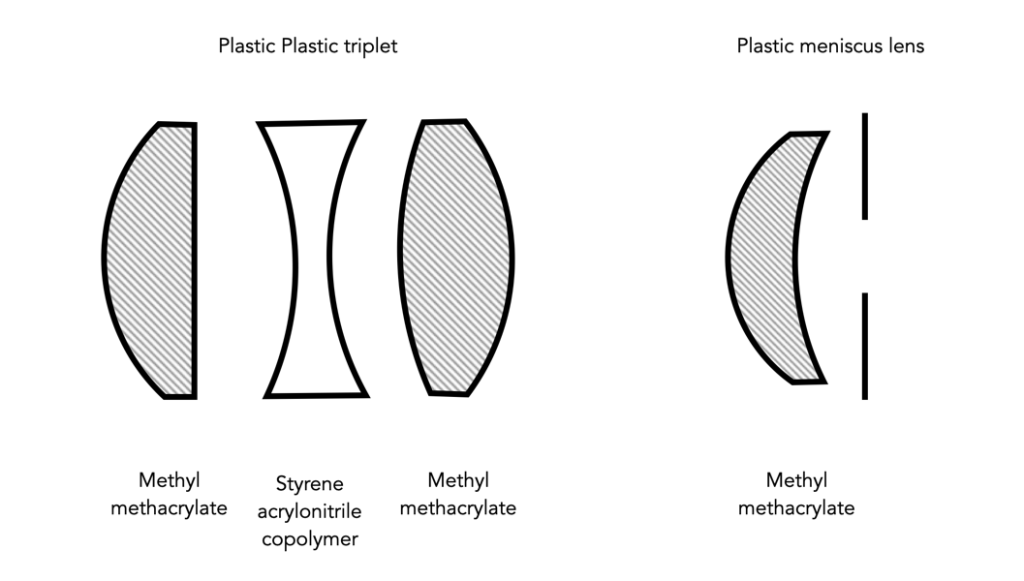
Plastics were said to suffer from defects, e.g. becoming pitted, or discoloured. However as they were usually used in simple, small lenses, this was hardly ever a real issue. Scratching (of the outer lens) was reduced through the use of plastics like Plexiglas V100, another acrylic which is very hard. The biggest issue with plastic lenses centred around the index of refraction (IR), which is a dimensionless number that indicates the light bending ability of a medium. The IR of plastics was (and is) rather low compared to optical glass. Acrylic has an IR of 1.49, and styrene acrylonitrile copolymer, 1.57. Compare this against modern glass of the period, at 1.52 to 1.89. Another problem was the fact that the IR of acrylics decreases as temperatures increases, changing the focus. Some plastic lenses were designed to automatically compensate for this. For example the plastic f/8 Cooke triplet, which used lens elements made from both acrylic and SAC. The focus of the acrylic elements (front and rear) increases, while the focus of the middle SAC lens decreases, balancing out any changes in focus.
The plastic lenses: Cooke triplet and the single lens
Lipton went a long way to describe the manufacturing benefits of plastic (and the drawbacks of optical glass) [4]. Optical glass is made by melting raw materials, which is processed when it cools into glass. Optical glass requires a number of steps including grinding, polishing, and testing, which made them expensive to manufacture. Plastic lenses on the other hand were simple to manufacture:
“Plastic lenses are made in air conditioned pressurized rooms, and in the case of Plexiglas or Lucite, the plastic, in powder form, is fed to a machine where it is heated and softened. It may be heated to a temperature of 400 to 500 degrees Fahrenheit. The softened plastic is then forced, under a pressure of at least 16,000 pounds per square inch, into a mold when it remains until it cools enough to retain the mold’s shape. The mold is then opened, and the lens is popped out, ready to be used as is, or assembled with other elements with no necessity for working to a finished size.”
Not that manufacturing optical plastics didn’t have its limitations. It was challenging to mold large diameter optical lenses, lenses with plane surfaces, and those with thick centres and thin edges. Lipton considered two stumbling blocks prohibiting the creation of high-speed 35mm lenses: low refractive indices, and the inability to mold large diameter lenses. In fact Dr. Rudolf Kingslake, director of optical design for Kodak, said of plastic objectives: “It’s the low indicies of refraction that are stopping us, it’s just a matter of substituting plastic for glass.”[4].
In 1972 Bob Schwalberg wrote an article describing why glass still reigned supreme [5]. He suggested SLR pentaprisms were a good candidate for conversion to acrylic which would reduce production costs. Schwalberg outlines five benefits:
Lower cost – Raw materials are cheaper, and less expensive to work.
Complete form freedom – Aspherical (non-spherical curvature) lenses are expensive to make in glass.
Exceptional clarity – Not all optical glass is perfectly colourless, the highest grades of optical plastics are quite colourless, and their clarity frequently superior.
Light weight – Plastic lenses are lighter.
High impact resistance – Glass is brittle, plastics are flexible.
and five counter-arguments:
Too limited range of optical specifications – i.e. The refractive index, and the dispersion. Refractive indexes for optical plastics are close to 1.5, optical glass ranges from 1.42 to 1.95.
Poor curve holdability – Accurate lens curvatures are critical for quality performance. Plastic lenses have poor curve conformity because of (3) below, and their inherent flexibility. Glass is stronger and more stable, it holds curvature much better in the face of external forces.
High temperature coefficients – The expansion and contraction of optical plastics is much greater than for optical glass. Muti-element plastic lenses have been developed with elements possessing opposing temperature coefficients. Unthinkable for precision camera lenses.
Clear plastics are hygroscopic – They absorb airborne moisture. Optical media must be isotropic, i.e. equal in all directions. The absorption of moisture destroys this homogeneity.
Low abrasion resistance – Plastics are softer and more prone to scratching than optical glass.
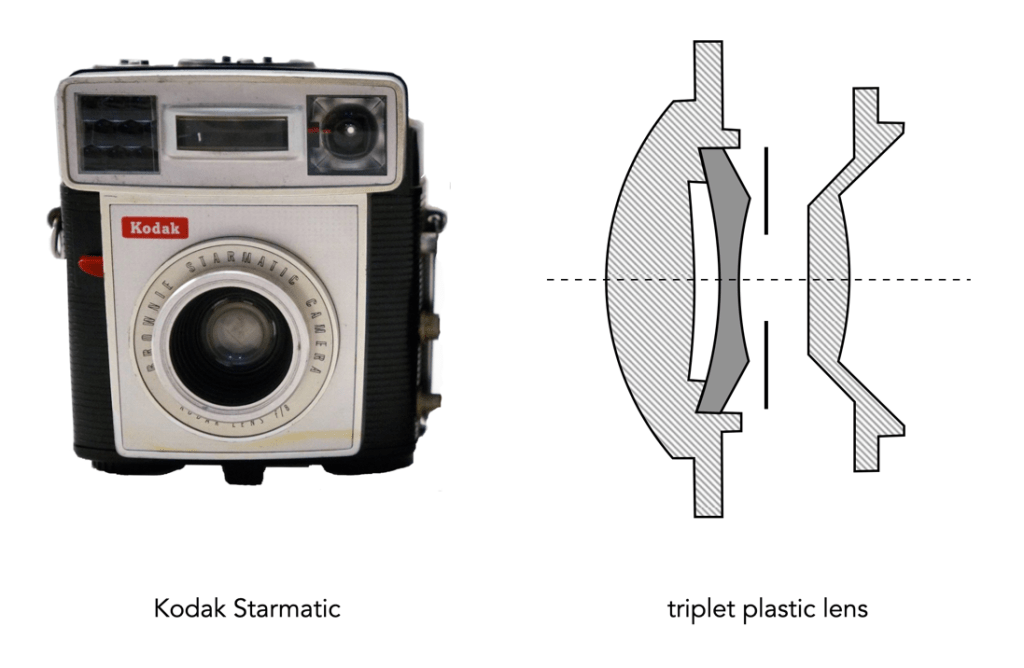
The Kodak Starmatic and its lens
Many of the cameras that use(d) plastic lenses are considered to be “toy” cameras. In 1959 Kodak introduced the Starmatic, the top of Kodak’s Brownie line. It had an 44mm f/8 three-element, plastic lens. The Lomography Diana appearing in the 1960s, and was made entirely of plastic (and in 1975 cost less than $2). The Polaroid Pronto Land camera (mid 1970s), also had a 116mm 3-element Polatriplet plastic lens. Most Holga cameras, had a 60mm f/8 plastic meniscus lens.
But the breakthroughs and sophisticated designs associated with plastic lenses never really materialized. In the end, low refractive indices, and the inability to successfully mold large diameter lenses may have been stumbling blocks to making 35mm lenses from plastic. There are some plastic optical materials [6] that have reached a refractive index of as high as 1.68, e.g. PolyEtherImide, but they often suffer from having a lower transmission rate (36-82% for PolyEtherImide, versus 92% for acrylic). Leica APO glass, on the other hand, has a refractive index of 1.9005.
Apart from their use in inexpensive cameras, there is another use of optical plastic, that is in hybridaspherics. A hybrid aspherical element is a lens element consisting of a glass base upon which plastic is glued, creating the desired aspheric shape. They are typically used in zoom lenses, e.g. the Nikon 28-70mm f/3.5-4.5 AF, first introduced in 1991. Companies like Tamron use hybrid aspherical lenses, likely to reduce the cost of the lenses. Lipton somewhat predicted this use in 1964 [4] when he suggested it would be difficult to grind an aspheric lens in optical glass, yet the manufacture of aspheric lenses in plastic would be no problem. Ironically, many smartphones have lenses which are actually plastic. This is not surprising considering the small size of the lenses required for mobile devices – it is less of a technological challenge, and hence costs less to manufacture (but as manufacturers don’t publish lens diagrams, it’s hard to know). For example the Leica lenses used in Huawei smartphones are plastic. Are there smartphones with glass elements? Sure, but they are usually quite expensive.
Ultimately the inability to derive high precision optics is one of the reasons we don’t see more plastic lenses. But there is another, human factor involved in companies shying away from the use of plastics – the perception of quality. Glass is more associated with quality that plastic, whereas plastic is considered “cheap”, and disposable. This is largely due to its use in inexpensive cameras, and the stigma attached to plastic itself.
Andrew B. Hecht, “And Now Plastic Lenses”, Popular Photography, 18(5) pp.72-74,128 (1946)
“Learn from Lenses”, Modern Plastics, 38(7), pp.90-93 (1961)
Lloyd E. Varden, “Plastic Lenses”, Popular Photography, 49(2) p.48,97,98 (August, 1961)
Leonard Lipton, “Plastic Lenses: Good Enough!”, Popular Photography, 55(2) p.44-45,100-101 (August, 1964)
Bob Schwalberg, “Plastic optics vs. glass, and why glass still reigns”, Popular Photography, 70(2) p.52,118 (1972)
Kingslake, R., Johnson, R.B., “The Work of the Lens Designer”, in Lens Design Fundamentals, 2nd ed. (2010)





 Crafting Pixels