The Mecaflex is a 35mm SLR made by German designer Heinz Kilfitt, who is better known for having designed the successful Robot camera, and high precision lenses such as the Macro Kilar, and Voigtländer Zoomar (the first 35mm zoom lens). Presented at Photokina in 1951, it was first sold in 1953, they were manufactured for Kilfitt by Metz Apparatefabrik located in Fürth, Bavaria (West Germany). Production by Metz continued until 1958 but few units were actually built. Metz, dissatisfied with the collaboration withdrew from the partnership shortly afterwards. Production then shifted to Société d’Etude et Recherche Optique et Acoustique (S.E.R.O.A.) a camera maker in Monaco. This camera is better known as the Kilfitt Mecaflex, with the lenses also produced by Kilfitt.
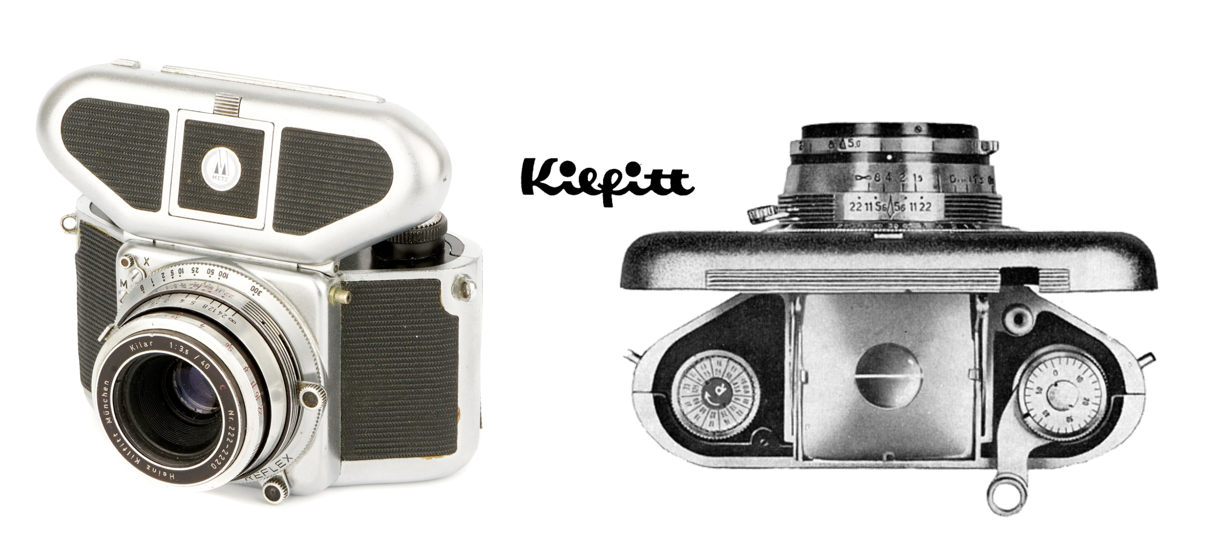
Fig.1: The Mecaflex camera
It was a very aesthetically pleasing and compact camera at 9×6.5×6.5cm. However it was quite heavy at 700g. It had a flip-top cover which gave it very clean lines when closed. When opened to 90 degrees, the cover revealed the waist-level viewfinder and top-plate controls. The size of its exposures was a smaller 24×24mm, providing for more images on a film roll (some 50). One of interesting features was an early spring-loaded diaphragm. When the shutter and spring-loaded diaphragm mechanism of the Mecaflex are cocked, a bright, parallax-free ground-glass image appears, and this remains bright until the shutter is released. A push-up finder was also provided as an accessory. which could be inserted into the viewfinder
Like many other West German cameras, it too incorporated a Prontor behind-the-lens leaf shutter with speeds of 1 to 1/300s (+B). The camera had a bayonet mount, and used lenses designed by Kilfitt, and it was usually paired with a Kilar 40mm f/3.5 or f/2.8. The other lenses were the 40mm Makro-Kilar’s and Tele-Kilar 105mm f/4.5. Some additional lenses were made under license by SOM Berthiot (Paris). The camera was produced until 1958. It is possible to still find these for around C$1300-2000.
Specifications:
Type: 35mm SLR camera Manufacturer: Metz (West Germany) ver.1, Kilfitt ver.2 Model: Mecaflex Production period: 1953−1958 Format: 24×24mm on 135 film Lens mount: bayonet Standard lens: Kilar 40mm f/3.5 Shutter: leaf-shutter, Prontor-Reflex behind-the-lens Shutter speeds: 1 to 1/300 sec., B (1 to 1/250s, B in the SEROA camera) Viewfinder: waist-level viewfinder + central split-image rangefinder Mirror: yes Exposure meter: − Flash synchronization: X, M Self-timer: − Aperture control: − Film advance: lever wind Weight/dimensions: 700 grams / 900×650×650mm
Zunow was a Japanese company best known for it’s innovation in superfast lenses. During the last few years of its existence, the company designed a couple of camera’s including a prototype of a Leica copy, the Teica, and their first 35mm SLR, the Zunow Pentaflex or ‘Zunowflex’. Work on the camera supposedly began around 1956, but it was only produced for a short time, from 1958-1959). The Zunowflex had a compact design, inspired by the likes of the Miranda T, or even the Praktina.
The design of the Zunow Pentaflex was initiated by Kiyoshi Arao, the managing director in charge of technology who had been transferred from Chiyoda Kogaku Seiko Co., Ltd. Zunow Optical was originally a lens factory with no experience in camera bodies, and Arao himself had little experience with 35mm SLRs, so went on to study the Miranda. Arao would leave the company due to conflicts around the time of the camera’s release (joining Mamiya Optical). The camera was first announced in the April 1958 issue of the monthly magazine Shashin Kōgyō.
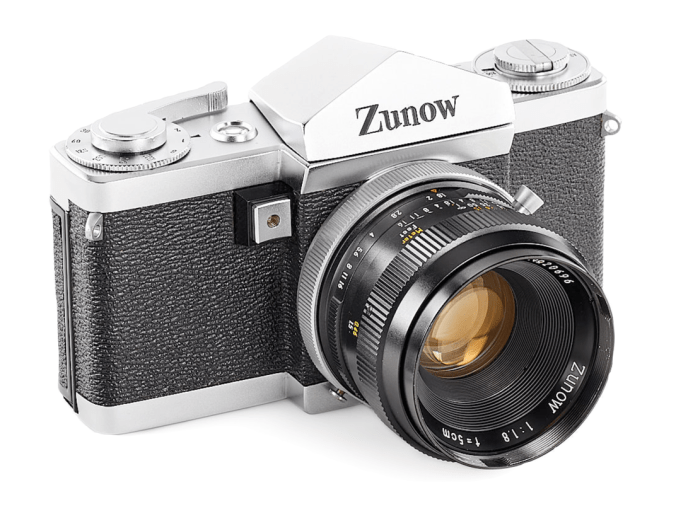
This camera brought solutions to many of the issues outstanding with SLRs together into one camera. It was a very aesthetically pleasing camera, with a streamlined look, that would become normal for cameras in the 1960s. The elegant look was designed by Kenji Ekuan from GK Industrial Research Institute. Ekuan was an industrial designed best known for designing Kikkoman’s iconic soy sauce bottle, and a series of Japanese trains. The design was started from a completely new idea, taking the spirit of ancient Japanese “Noh” as its model, combining complex mechanisms into a simple and concise form.
Fig.1: The Zunow SLR with a Zunow 5cm f/1.8 lens
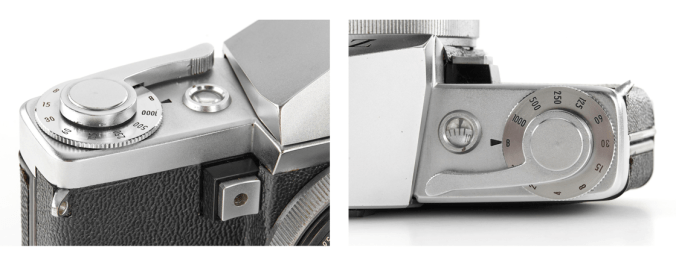
Where it broke from convention was the fact that the shutter release was front mounted, similar to how the Exakta and Miranda cameras were laid out, and the speed dial was situated beneath the wind lever, a concept which didn’t appear until much later on the Canon AE-1. It had a removable pentaprism, and interchangeable focusing screens. Supposedly a waist-level viewfinder was also available. It also had a right-hand front shutter release, and a lever wind, not found on many SLRs of the period (except for the Exakta which was left-handed, the Mecaflex, and the Asahi Pentax). The camera had a focal-plane shutter with speeds from 1 to 1/1000 sec, plus B.
It was the first Japanese camera to have an internally coupled automatic lens diaphragm, the “ZUNOWmatic” diaphragm system, when most cameras of the era had a pre-set system, meaning a lever had to be moved to open the diaphragm after the photograph had been taken. It worked like this: when the shutter release is triggered, “the automatic diaphragm actuating ring revolves and trips the auto-diaphragm “tail” of the lens mount, diaphragm closes down to previously determined aperture, mirror springs up out of the way, Shutter operates, mirror then returns to normal “seeing” position, diaphragm actuating ring revolves again, kicks the pin back into position and reopens diaphragm to maximum aperture” [1].
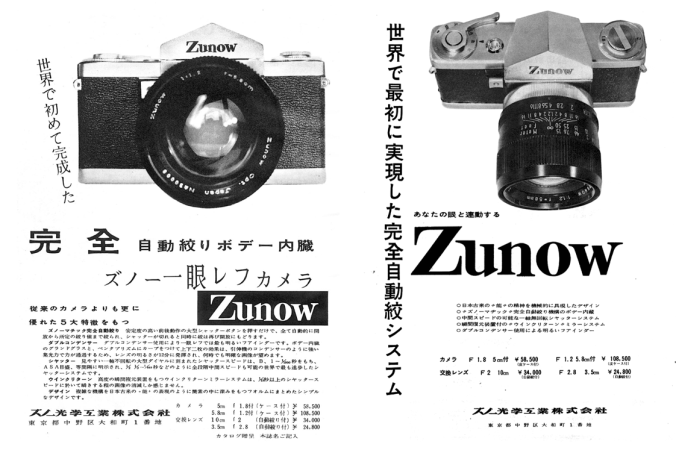
Fig.2: Japanese ads for the Zunow
The instant return mirror, was something Zunow called the “Wink Return”, which supposedly was quiet, or put another way – “quiet it is, silent it is not” [1]. In its marketing material the company suggested that traditional SLRs had issues with mirror return, i.e. there is a shock, and the sound of the shutter is loud. The “wink Return” was suppose to eliminate unpleasant noise and shock with almost no blackout effect. The lever was considered by some to be “heavy”, but the shutter release is “surprising light” [1]. There is a single shutter speed dial, with equally spaced speeds (which few SLRs had), which allowed for the choice of intermediary speeds. Another unique feature is an internal synchro-switch which automatically sets FP or X sync as shutter speeds are changed from fast to slow. The downside is that the camera was heavy at 620g.
Fig.2: The minimalistic clean lines of lines of the camera gave it a very aesthetically appealing feel.
One potential limitation of the camera was its proprietary breech mount, and a range of only six lenses: 35mm f/2.8, 50mm f/1.8, 58mm f/1.2, 100mm f/2, 200mm f/4, 400mm f/5.6, and 800mm f/8. Only the lenses 100mm and shorter had auto diaphragms. There were lens mount adapters to allow the use of M42, Exakta and L39 lenses, likely reducing the need to produce an entire range of lenses. Supposedly the lens provided with the camera was the Zunow 58mm f/1.2, which would have been the fastest SLR lens of the period (the only evidence of its existence seem to be the ads in Figure 2).
However in all reality there were issues with the camera. Adding new features to a camera implies that a substantial amount of testing must be performed before mass production commences. It has been suggested that hundreds of cameras were sold, however a lack of quality control meant many were returned [2] (this may be in part because most of the parts were outsourced, with the factory only doing assembly [3]). Other parts of the system, such as other interchangeable viewfinders were also lacking. There were also functional problems with the camera, for example the fully automatic aperture was slow, resulting in incidents of the aperture lagging behind the shutter [2]. Of the cameras existing today apparently few work perfectly [2].
The camera was only sold in Japan, and in total only about 500 were produced (at the rate of 8 cameras per day [1]). In 1959 the speculation was that it would be expensive in the US, as the Zunow + 58mm f/1.2 lens sold for US$300 in Japan. However Zunow was in a poor financial situation and was not able to capitalize on the design, closing the company in 1961. These cameras are now extremely rare. Auctions, where they occur then to suggest prices of around the US$20,000 mark.
Specifications:
Type: 35mm SLR camera Manufacturer: Zunow (Japan) Model: Zunowflex Production period: 1958−1959 Format: 24×36mm on 135 film Lens mount: breech Standard lens: 5.8cm f/1.2, 5cm f/1.8 Shutter: focal-plane, single-axis non-rotating dial type Shutter speeds: 1 to 1/1000 sec., B Viewfinder: SLR with non-removable pentaprism Mirror: “Wink return” system Exposure meter: − Flash synchronization: FP, X automatic switching Self-timer: − Aperture control: Instant opening and closing type built into the body, fully-automatic Film advance: 180° operation lever wind, prevention of double exposures, automatic frame counter Weight/dimensions: 615 grams / 144×88×56mm
Further reading:
Tsuneo Baba, “Zunow: Indication of things to come in 35mm single-lens reflexes?”, Modern Photography, 23(4), p.110 (1959)
Kosho Miura, “Systematic Survey on 35 mm High End Camera – History from Leica to SLR”, National Museum of Nature and Science Survey Reports of Systematization of Technology, 25, pp.55-56 (Mar. 2018)
Interview with Suzuki Takeo, CEO of Ace Optical (son of Zunow’s president), May 2006 (PDF)
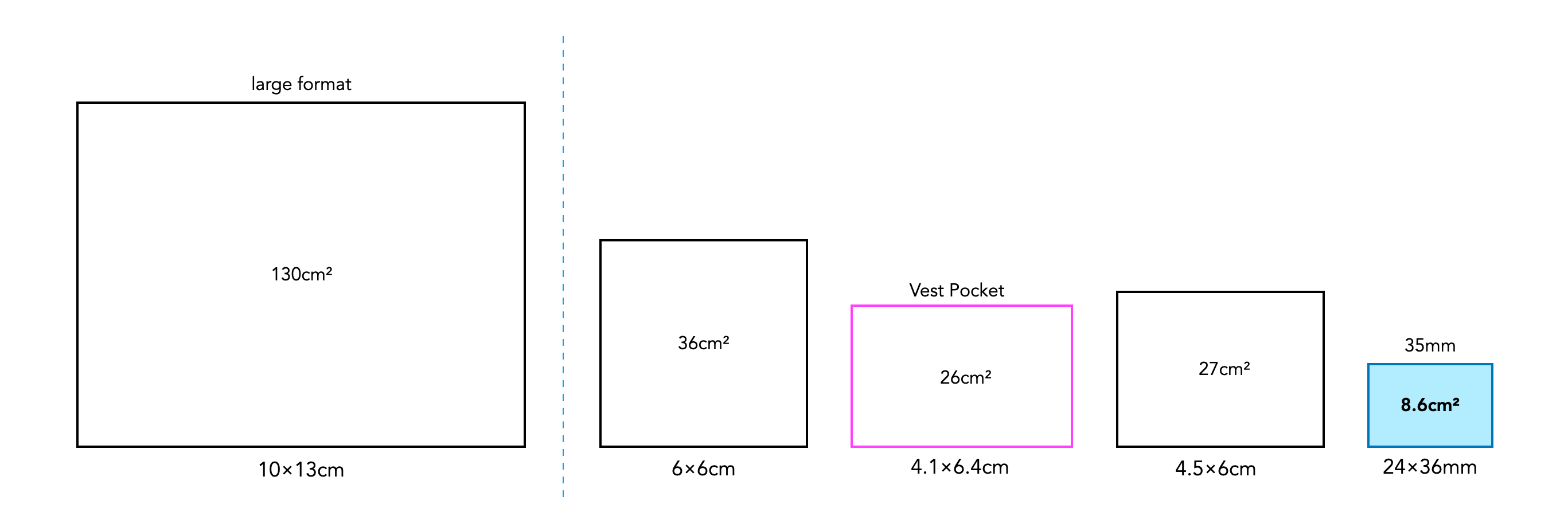
In the years following the arrival of the Leica (1926) the process of using it came to be known as ‘miniature photography’. Magazines of the period were full of techniques under the heading ‘miniature camera’, and the term itself would last until the early 1950s (the term was unknown before the Leica). Prior to this it was the age of large format cameras, which is any format larger than 9×12cm with one of the most common being the 10×13cm (4×5″). Probably the smallest format camera prior to 1926 was the Kodak Vest Pocket (VP) camera (1912-1934) which produced an image 2½×1⅝” (6.4×4.1cm) in size. By the early 1930s, photographers had become very miniature camera conscious. Big was out, small was in, but miniature started to evolve beyond 35mm, including any camera which took pictures smaller than 6×6cm (2¼×2¼”).
Fig.1: A comparison of ‘miniature’ size formats
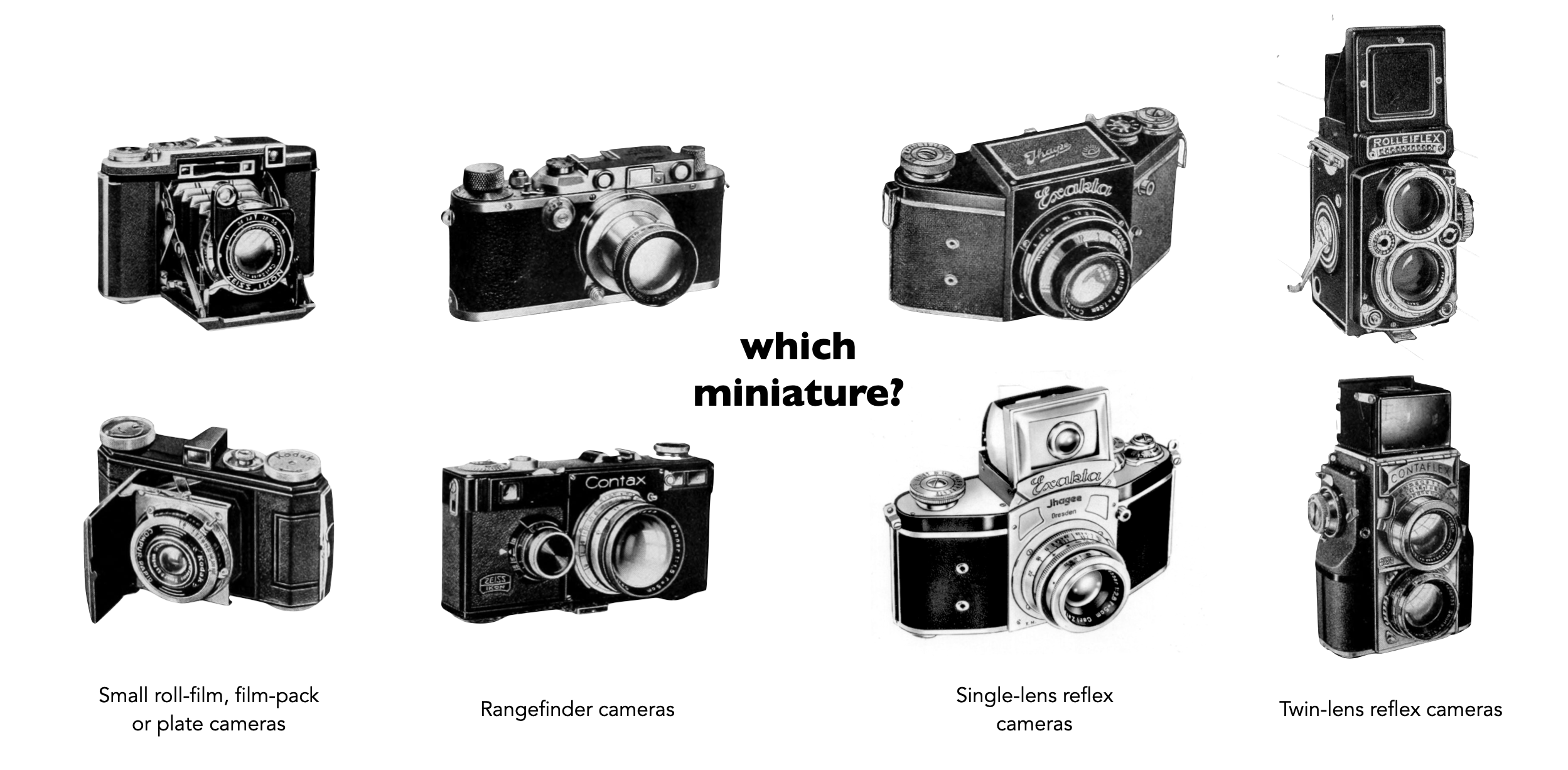
The question is why were formats like 6×6cm included in the definition of miniature? Inevitably, in view of the success of 35mm film cameras like the Leica other cameras began to appear in the category, essentially creating an industry within an industry in which manufacturers vied with one another to produce innovations based on the miniature theme. However in many cases these manufacturers just broadened the category to fit their camera rather than produce anything innovative. By the mid-1930s, there were circa four categories of miniature cameras:
Small roll-film, film-pack or plate cameras, with negatives 2¼×3¼” or smaller that have one lens and a fixed bellows. Cameras included the Zeiss Ikonta (4.5/6/9×6cm), Foth Derby(24×36), Kodak Retina (24×36mm), and Voigtländer Virtus (4.5×6cm).
Rangefinder cameras with a single lens or interchangeable lenses with negative sizes from 24×36mm to 2¼×3¼”. Cameras included the Leitz Leica and Zeiss Contax (24×36mm), Zeiss Super Ikonta (4.5/6×6cm) and Super Nettel (24×36mm).
Single lens reflex cameras, which have a single lens with negatives ranging from 24×36mm to 4×6.5cm. This includes cameras like the Exakta (4×6.5cm), Kine Exakta (24×36mm), National Graflex (6×6.5cm), and Noviflex (6×6cm).
Twin lens reflex cameras which have two lenses, and Cameras included the likes of the Rolleiflex and Rolleicord (6×6cm), Zeiss Ikoflex (6×6cm), Voigtländer Brilliant and Superb (6×6cm), Welta Perfekta (6×6cm). Many of these were limited to a single focal length. Another camera was the Zeiss Contaflex (24×36mm) which had a built-in electric cell exposure meter.
Indeed the March 10th, 1937 issue of The Amateur Photographer & Cinematographer outlines the ‘Modern Miniature Cameras’ available at the time by size [3]: a total of 98 cameras − 24×36mm (20), 24×36mm reflex (2), 3×4cm (15), 3×4cm reflex (1), 4×4cm reflex (1), 4×6.5cm (8), 4×6.5cm reflex (3), 4×6.5cm on 3¼×2¼ film (23), 6×6cm on 3¼×2¼ film (7), 6×6cm reflex (13), and five non-standard.
Fig.2: Too many miniatures
In late 1936 a heated debate on the topic started in the ‘Letters to the Editor’ section of The Amateur Photographer & Cinematographer. It stemmed from an article in the November 4th 1936 issue titled ‘What is a Miniature Camera?’ [1]. In it the definition of a miniature camera was one which took a picture of 6×6cm (2¼×2¼) or less. However the article also suggested that a camera taking a 4.5×6cm picture on 3½×2½ film (using a mask) could also be classed as a miniature. What followed was a litany of responses. In the Jan.6 1937 issue, one B.Z. Simpson suggested that “the only rationale definition of the miniature camera relates to the area of the negative used which must for the purpose be smaller than the V.P. size negative.” He goes on to say that “cameras using V.P. size… are not miniature at all, but ordinary size cameras.” [2].
Now we have 2¼” square and even 3¼×2¼” users crying out to be allowed within the ‘select circle’. If this matter goes much farther we shall shortly have the man with the half-plate calling himself a miniaturist.
Murdoch, J.N., “Letters to the Editor: Miniature Cameras”, The Amateur Photographer & Cinematographer, Jan.13 (1937)
Some seemed to settle on the idea of 5 square inches being the threshold, which would include 2¼×2¼ (6×6cm) cameras. Other objected to 6×6cm cameras being left out on the principle that the square shape utilizes the maximum area of the circular lens field (never mind that to compare a square image to a 24×36mm you would really be talking about a 36×36mm). Still others seemed to think the concept of miniature could be defined based on the focal length of the normal lens employed, e.g. 5cm for 24×36mm. It seemed that no-one wanted to be left out. The trend would continue until the industry was interrupted by the war, after which it was fundamentally altered.
By the early 1950s, the 6×6 had morphed on into its own category, the medium-format camera, and many of the other formats had disappeared altogether as the world’s photographers embraced 35mm. The miniature category itself contracted back to 35mm, but opened to include many differing types of 35mm. Here are some 35mm camera types from the early 1950s:
Rangefinder cameras with interchangeable lenses − e.g. Canon IV-S2, Zeiss Contax IIa/IIIa, Foca Universal, Leica IIf/IIIf, Nikon
Rangefinder cameras with fixed lenses − e.g. Argus C4, Kodak Retina IIa, Voigtländer Vitessa
Rangefinder cameras with fixed lenses + separate film-shutter wind − e.g. Zeiss Ikon Contessa 35, Konica I/II, Voigtländer Vito III.
Viewfinder cameras with fixed lenses + separate film-shutter wind − e.g. Argus A4, Zeiss Ikon Contina, Welta Welti, Kodak Retinette, King Regula I/II, Braun Paxette
Rapid sequence cameras − e.g. Robot Star
Reflex cameras, waist-level − e.g. Alpa 4, Exa, Exakta VX, Praktiflex FX, Praktica FX
Reflex cameras, eye-level − e.g. Alpa 5/6, Contax S/D, Rectaflex
Further reading:
“What is a Miniature Camera?”, The Amateur Photographer & Cinematographer, p.15 Nov.4 (1936)
Simpson, B.Z., “Letters to the Editor: What is a Miniature Camera?”, The Amateur Photographer & Cinematographer, Jan.6 (1937)
Some people collect what others would consider to be the most horrendous cameras. But what are considered the worst? A camera can obviously be bad for any number of reasons. It might be unreliable, ugly, lack usability, too heavy, too light, crappy lenses or useless without batteries. Some were too complex, and challenging at the best of times. Others had that one feature that just didn’t work well, condemning a perfectly good camera. Incorporating a proprietary lens mount that nobody else used, or only offering half a dozen lenses also condemned a camera. But while a whole slew of cameras might fit the criteria, it is hard to list them because of subjective opinion. If a camera only lasted in a catalogue for one year, then in all likelihood even the manufacturer thought ill of it.
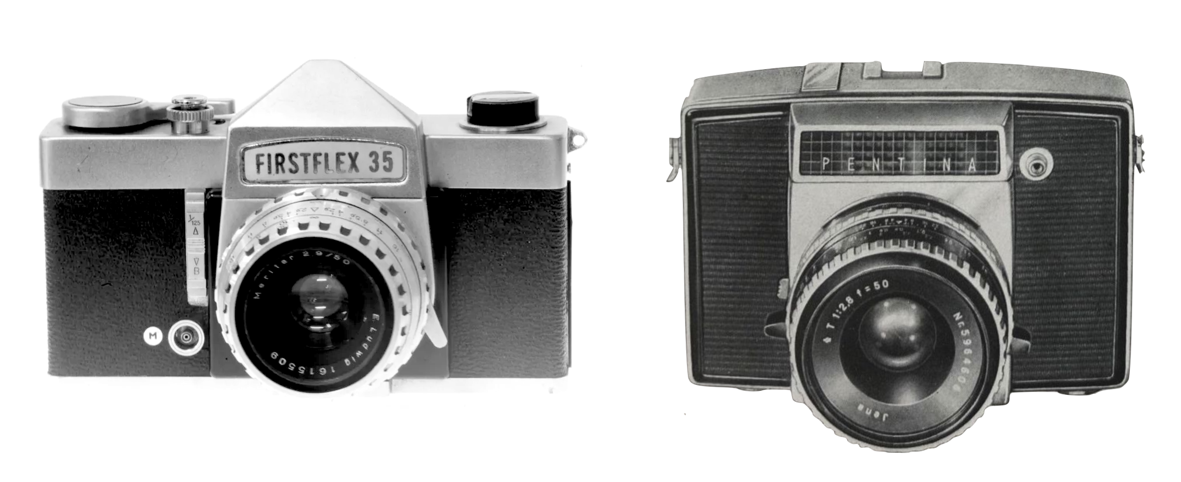
The only place that didn’t produce any bad cameras (or any good ones for that matter) was the Southern Hemisphere, where arguably very few cameras were ever made. The Japanese on the whole produced good cameras, with a few exceptions. One is a camera made by Japanese company Tokiwa Seiki K.K., which operated in the 1950s. There were a lot of start-up camera manufacturers during this period, all trying to cash in on the market… not all were successful at what they produced. They produced a number of 120, and a few 35mm SLRs, one of which was the Firstflex 35 (or any one of Soligor-35, Windsorflex-35 and Lafayette-35). Produced in 1955 it was a leaf-shutter SLR with a waist-level viewfinder and specialized bayonet mount. The second version of the camera (1958), had a pentaprism viewfinder and Exakta lens mount, but it had a shutter that doubled as a mirror, and only two speeds, 1/125s and B. Hardly at all useful. Its successor, the PLUSflex-35 added 1/60s.
The Firstflex 35 and Pentina cameras − not exactly ugly, but suffering from design flaws.
On the German side there is the Pentina, made by VEB Kamera- und Kinowerke Dresden in the 1960s. This camera used a leaf shutter which was a departure from the usual focal-plane shutter used in East Germany, and likely somewhat of a backwards step as East Germany lost its ability to produce high-end leaf shutters after the war (both companies of the leaf-shutter monopoly, Deckel and Gauthier were situated in West Germany), meaning they had to reinvent the technology. But the camera had a non-standard bayonet mount, a meagre choice of four lenses, and was extremely chunky looking as the designers had opted for ‘clean design’ with the camera enclosing the pentaprism, rather than exposing it with a roof-shaped top. According to various sources this camera could be summed up by the fact that they were hated by repairmen. The Pentina was, in the words of Kampermann on the Dutch blog Vintage-Photo, the result of ‘...megalomania, building something that had never been built before, extravagant in design and over-complicated in technical innovation’. The Pentina may have been the most extraordinary design of an SLR of the period, but its eccentric design may have lead to its short production period, with only 45,000 units were built between 1961 and 1965 with as many as seven variants.
Note that identifying the ‘worst’ SLR is a very individualistic endeavour. One person’s Dali is another ones Monet, so to speak.
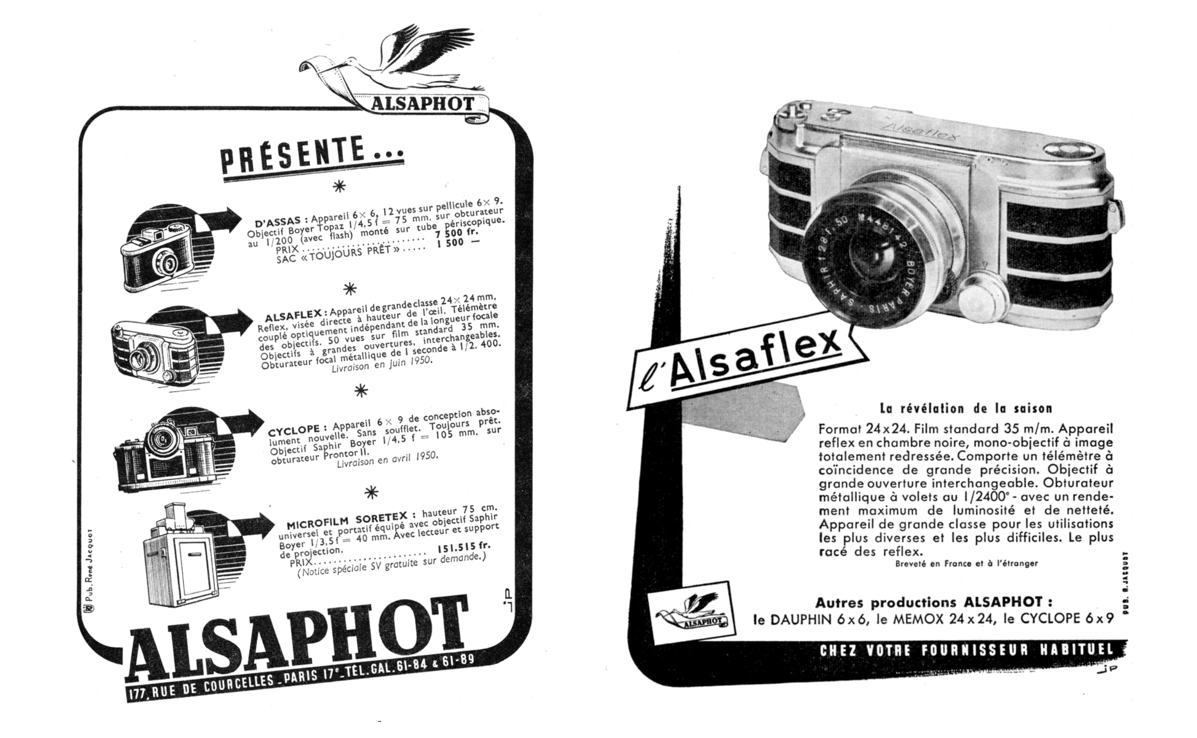
This is a story of another camera that could have been quite successful, but unfortunately didn’t make it past the initial batch of cameras. Alsaphot was the photographic department of a French company called Alsetex, and produced cameras from 1949 to 1970. Using a brand logo which incorporated an Alsatian stork, the company produced a broad range of cameras. This included the Dauphin I, II and III, small 6×6 reflex cameras in the style of the Voigtländer Brilliant and the Cima (4×6), Ajax (6×6), and D’Assas (6×6) viewfindser cameras.
In 1947 the company hired French inventor Lucien Dodin (1900-1989) as technical director. Dodin designed two cameras, the Cyclops, and Alsaflex. The Cyclops, which appeared in 1950 was a 6×9cm format camera. Dodin’s claim to fame was the design of the “stigmometer”, or Dodin telemeter, more commonly known as the split-image rangefinder, something found in many SLRs.
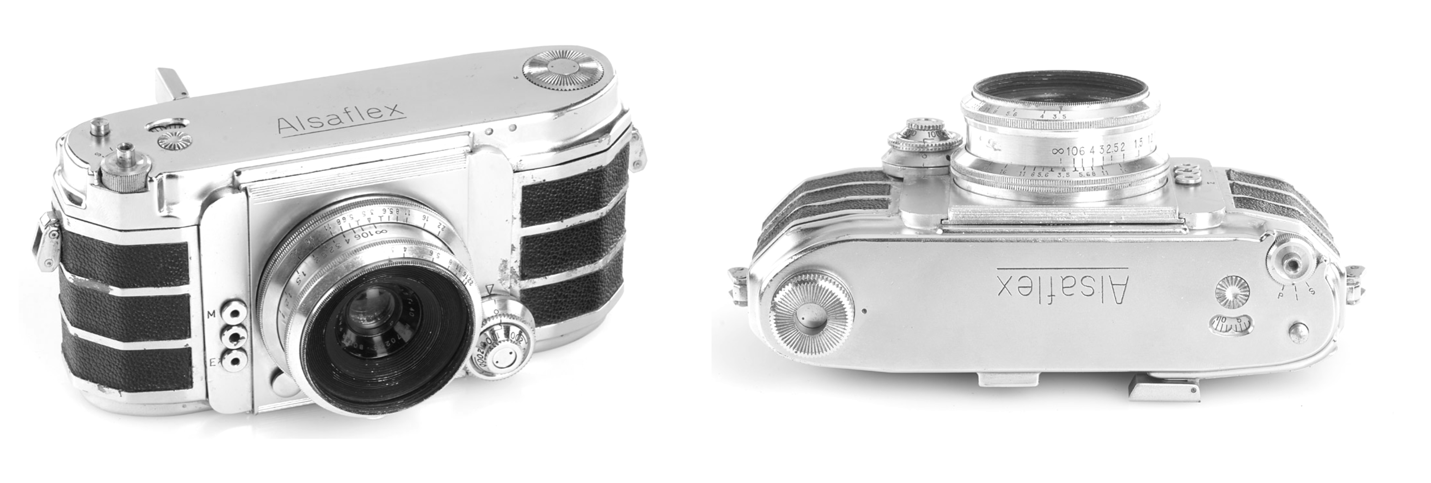
Fig.1: The aesthetically pleasing Alsaflex
The Alsaflex was an SLR camera which used the 24×24mm format on 35mm film, and incorporated Dodin’s stigmometer. The viewfinder was reduced in size by using lateral reflection, the retractable mirror pivoting around a vertical axis – essentially a Porro prism. The camera was innovative because it was quite compact for an SLR. It sported a bayonet mount with interchangeable lenses, with a Saphir Boyer 40mm f/3.5 (with automatic aperture selection) as the standard lens. The shutter was of a new design, made of metal and in the shape of a fan, with speeds from 1 to 1/2400 sec. The body of the camera was die-cast (150mm×70mm×42mm) with a back that could open to accommodate carious accessories. The camera has a rapid lever actuation which causes the film to advance, the mirror and the frame counter to be set up, and the shutter to cock in a single movement. When activated during shutter release, the mirror retracts without vibration.
Fig.2: Advertising the camera that never really made it big
A second variant, the Dudragne is a special, much simpler model of the Alsaflex, without a horizontal viewfinder eyepiece, X-sync and 1/100 speeds, and made to be used with a retinograph (instrument for examining the retina of the eye) made by Dudragne. Interestingly, the license for the viewfinder using the Porro prism would be taken over in 1963 by Olympus for the Pen F series. The camera appeared in advertising in early 1950, suggesting it would be released in May 1950, but in reality it would be 1952, and very few would be produced. It was advertised as having an “optically coupled rangefinder independent of the focal length of the lens”.
Alsaphot itself declined in the 1960s with the rise of both German and Japanese imports. In 1954 the Alsaflex with a Saphir Boyer 50mm f/2.8 was advertised for 138,000 Frs or about C$384 [1]. When the occasional camera go on sale, the price is generally in the range of €3000-5000.
In January 1954, 1 Canadian $ equals about 360 Old French Francs.
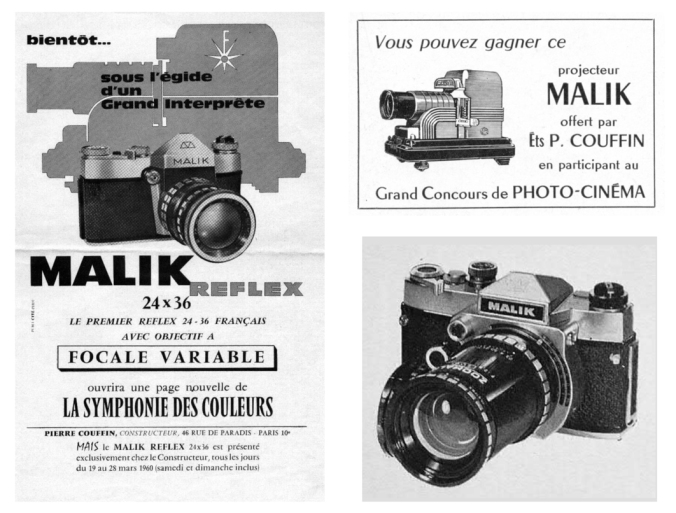
Some cameras were designed to be rare. They were often prototypes, or cameras that were just made in small quantities that very rarely come on the market. Such is the SLR produced by French company Malik. Malik was a company who produced included projectors, enlargers, a 9×12 camera (pre-WW2) and tripods, all made in France. Pierre Couffin was the sister company which was a distributor of cameras, like the Robot, and Leidox. Both were founded by Ets Pierre Couffin.
Fig.1: Some of the advertising for Malik and the Malik Reflex
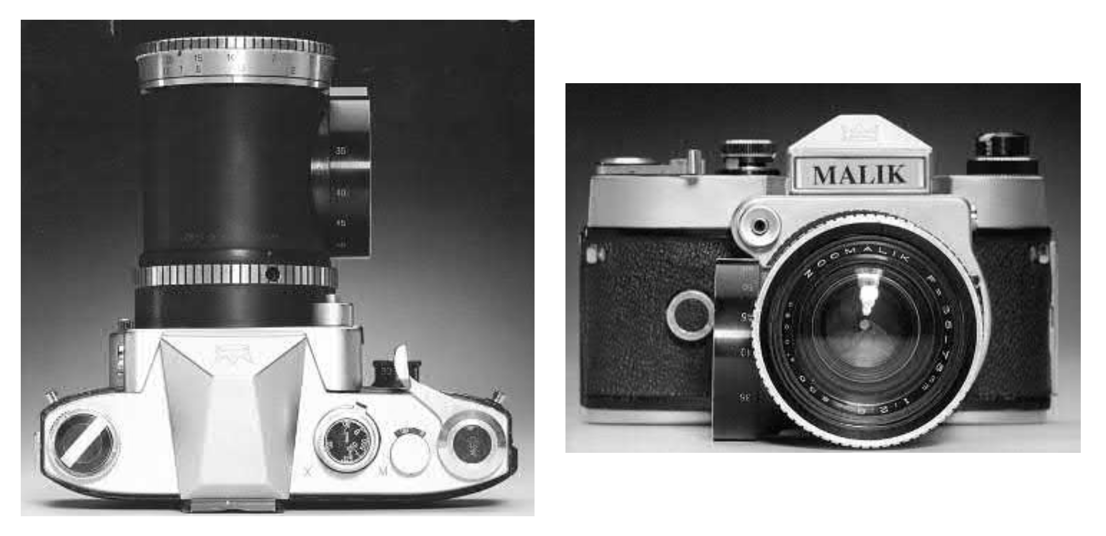
The Reflex Zoomalik was presented at Photokina in 1960. It was an SLR that came standard with a zoom lens, which was unusual for the time period. It was a 35-75mm f/2.8 (preset, 16 elements, although some reports note 14 or even 17). The literature seems to talk more about the lens than the camera – the fact that it is “only 75mm in length for a diameter of 55mm, hardly larger than a classic 90mm lens”. Changing the focal length on the lens was done by means of a large side wheel. The camera had a series of features: focal-plane shutter, five speeds (1/30, 1/60, 1/120, 1/250, and 1/500), crank rewind, removable rear, die-cast metal body. One curious feature was that the film-winding lever was in the front of the camera, which did not allow fast wind-on using the thumb. It was a well advertised camera, appearing in numerous industry magazines, and even a journal, The French Review [1].
Fig.2: Some of the few pictures of the camera
A press release in L’Express (June 16, 1960) suggested it would be the first SLR manufactured in France. It also said the camera was design in consultation with American company Bell & Howell of which Couffin was the French agent. It was suggested the camera would be provide serious competition for the Bessamatic from Voigtlander.
Modern Photography described the camera in the following way [2]:
The picture of the camera is an excellent example of French retouching and airbrush work. Production? By the time you are reading this, Maliks should be flowing from the production line like champagne. At the price of $200 for camera and lens, it’s a bargain even if the camera is never made.
But it was only ever produced as a pilot series, and abandoned before production began. It’s hard to know why it fell apart, possibly because the company had little experience in actual producing cameras (other Malik cameras, like the Malik, Auto Malik, and Super Auto Malik were manufactured by German company Leidorf). Or perhaps the idea of a zoom lens as the main lens of a camera was just too radical for the time – the Zoomar 36-82mm had only appeared in 1959, and many photographers were still sceptical. Likely it was a combination of events, not least of which would have been increased competition from Japanese camera companies.
Further reading:
“Smallest-Best of its Type”, The French Review, 34(5) p.513 (Apr. 1961)
“The French Touch”, Modern Photography, 24(9) pp.18,28 (1960)
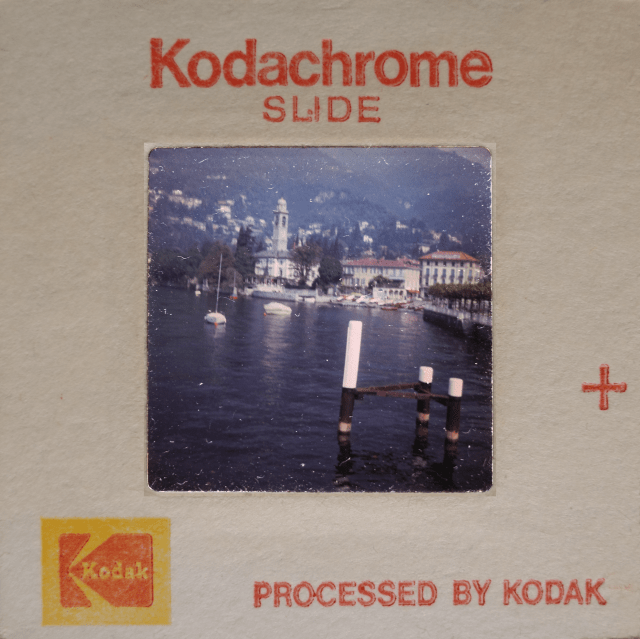
A “slide” in the more common use of the word refers to a translucent positive image which is held inside a cardboard sleeve, or plastic frame (or mount). A positive image is created using reversal film, whereas negative film produces an inverted or reversed image (which in turn is used to make a paper photo). When a slide is held up to the light, it is possible to see the scene as it was shot rather than the “negative” of the scene. Slides are typically viewed using a slide projector which projects the image against a white screen. Without the mount, the film would not be able to “slide” from one image to another when inside the magazine of a projector.
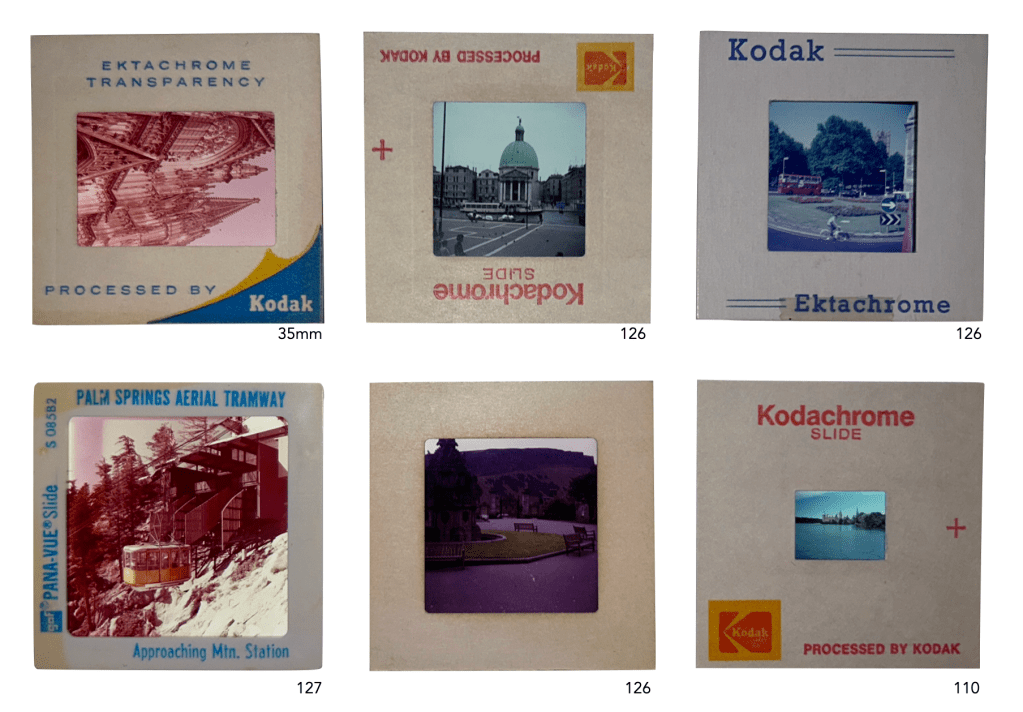
The classic Kodachrome slide
The slide is not a modern phenomena. The earliest was likely the Lantern slide, also known as the “magic lantern”. It was an early type of image projector which appeared in the 17th century which projected glass slides onto various surfaces. With the advent of photographic processes in the mid-19th century, magic lantern slides were black-and-white positive images, created with the wet collodion or a dry gelatine process on glass. Slide shows became a popular pastime in the Victorian period, but they were not the same as modern film slides.
Examples of colour slides
It 1826 Nicéphore Niépce invented the first form of negative photography, but it would take nearly a century before its use in flexible celluloid film became a reality. The earliest commercially successful reversal process came into being in 1907 with the Lumière Autochrome. It was an additive screen-plate method using a panchromatic emulsion on a thin glass plate coated with a layer of dyed potato starch grains. It was Leopold Godowsky Jr., and Leopold Mannes working with Kodak Research Laboratories who in April 1935 produced the first commercially successful reversal film – Kodachrome (first as a 16mm movie film, and in May 1936 as 8mm, 135 and 828 film formats). Based on the subtractive method, the Kodachrome films contained no colour dye couplers, these were added during processing. In 1936 Agfa introduced Agfa Neu, which had the dye couplers integrated into the emulsion, making processing somewhat easier than Kodachrome.
For sparkling pictures big as life. . . . Kodak 35 mm color slides.
Kodak’s commercial slogan during the 1950s
There are different types of reversal film, based on the type of processing. The first, which includes films like Kodachrome, uses the K-14 process. Kodachrome is essentially a B&W stock film, with the colour added during the 14-step development process. That means it has no integrated colour couplers. Kodachrome was an incredible film from the perspective of the richness and vibrancy of the colours it produced – from muted greens and blues to bold reds and yellows. However developing Kodachrome was both complex and expensive, which would eventually see the rise of films like Ektachrome, which used the E-6 development process (a 6-step process). Films like Ektachome have different emulsion layers, each of which is sensitive to a different colour of light. There are also chemicals called dye couplers present in the film. After slide film is developed, the image that results from the interaction of the emulsion with the developer is positive.
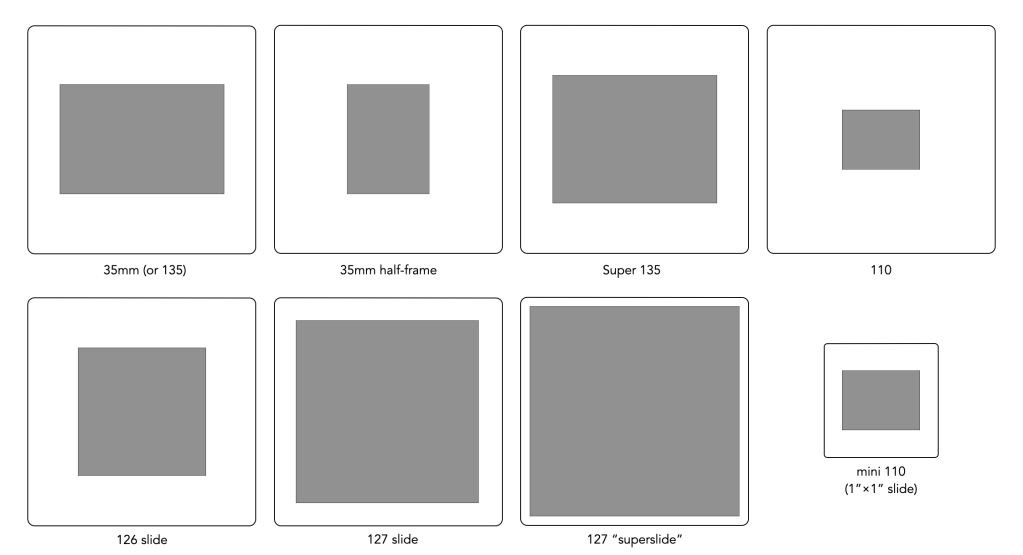
Common slide mount sizes
Many companies made reversal films, typically acknowledged through the use of the “chrome” synonym – e.g. Agfachrome (Agfa), Fujichrome (Fuji), Ektachrome (Kodak), Scotchchrome (3M, after buying Italian filmmaker Ferrania), Ilfochrome (Ilford), Peruchrome (Perutz), and Anscochrome (the US arm of Agfa). The initial Kodachrome had a very slow speed (10 ASA), this was replaced in 1961 by Kodachrome II (1961) which produced sharper images, and had a faster speed (25 ASA). In 1962 Kodak introduced Kodachrome X (ASA 64). Kodak’s other transparency film was Ektachrome, which was much faster than Kodachrome. In 1959 High Speed Ektachrome was introduced, providing a ASA 160 colour film (by 1968 this had been pushed to ASA 400).
Format
Year it appeared
Transparency size (w×h)
Notes
35mm /135
1935
36mm × 24mm
very common
Super 135
36mm × 28mm
110
1972
17mm × 13mm
also on 1”×1” slides (mini 110)
Half-frame
1950s
24mm × 18mm
126
1963
28mm × 28mm
127
1912-1995
40mm × 40mm
Super 127
1912-1995
rare
Table 1: Characteristics of slide sizes
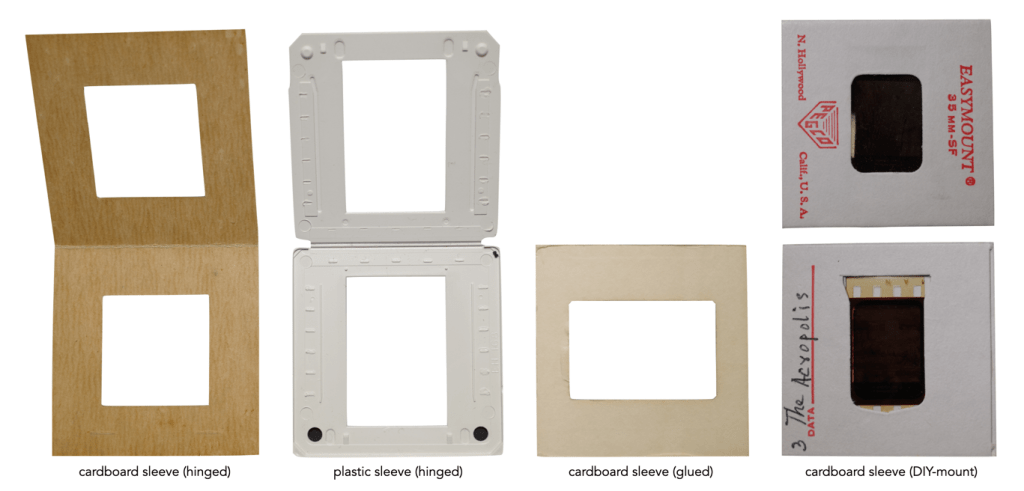
What about the “slide” side of things? A patent for a “Transparency Mount” was submitted by Henry C. Staehle of Eastman Kodak in October 1938, and received it in December 1939. Its was described as “a pair of overlapping flaps formed from a single strip of sheet material such, for example, as paper.”. Early slide mounts were mostly made of cardboard, but as plastic became more common, various designs appeared. Most cardboard mounts were either hinged on one side or two separate pieces, glued together after the emulsion was sandwiched between the two sides of the frame. There were also systems for the DIYer, where the emulsion could simply be inserted to the slide frame. Plastic frames were either welded together or designed in an adjustable format, i.e. the film frame could be inserted and removed. The exterior dimension of most common slide formats is 2 inches by 2 inches. There were many different sizes of slides, all on a standard 2″×2″ mount, to encompass the myriad of differing films formats during the period. Slides are usually colour – interestingly, black-and-white reversal film does exist but is relatively uncommon.
Some different types of slide frames
Slides were popular from the 1960’s probably up until the early 1990’s. It was an easy way to get a high-quality projected image in a pre-digital era. Slides were a popular medium for tourists to take pictures with, and then beguile visitors with a carousel of slides depicting tales of their travels. Slide film is still available today, all of which uses the E-6 process. E-6 slide film is a lot less forgiving as it has a lower ISO value but produces vivid colour with evidence of finer grain. Modern slide films include Kodak Ektachrome 100, Fujifilm Velvia 50, and Fujifilm Fujichrome Provia 100.
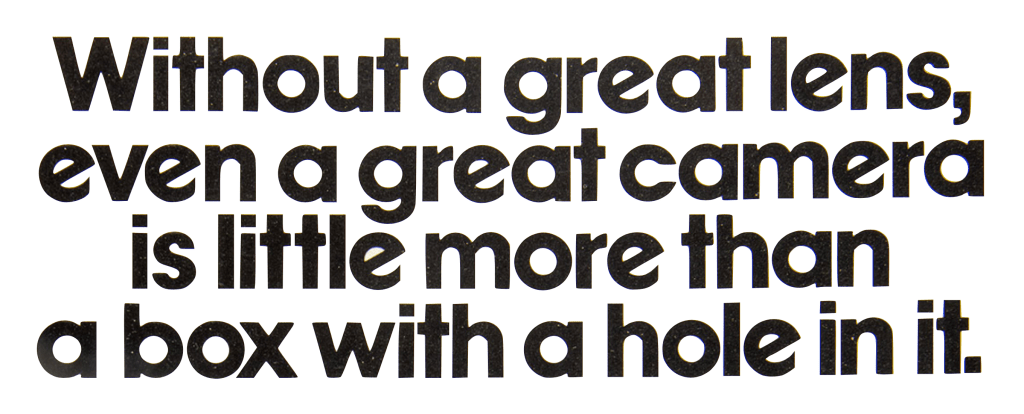
In the 1980s, Fuji ran magazine ads with the headline shown below. It was to proclaim how good their lenses were, in a time when competition among camera manufacturers was high. Does this statement still hold true in the digital age?
This FAQ deals more with the purchasing side of things of SLR cameras.
What is the average price of a vintage SLR?
There is no such thing. See below.
What sort of things impact price?
The cost of a vintage SLR is directly associated with a number of differing things. Firstly things like brand and rarity. Rare cameras cost a lot, sometimes it doesn’t even matter that their condition is somewhat mediocre. Next there is the brand, specific type, year of manufacture, condition, i.e. what works, and what doesn’t, and of course the spec of the lens attached to the camera. Some cameras will sell just as bodies, and others will be coupled together with a lens of some sort – it might be the stock lens the camera camera with, or perhaps something similar.
Why are some cameras so expensive?
Some cameras are expensive, either because the camera is rare, or has some attribute that makes it more expensive, or a review by someone with a lot of followers has pushed prices up. It also depends on the condition of a camera, those in pristine condition will have a greater value associated with them.
Are prices sometimes overinflated?
Basically yes. Sometimes this is due to someone’s belief that a camera (or lens) is worth far more than it actually is. Sometimes it is because of availability – there may have been 10,000 copies of a camera manufactured, but if only two are currently available on the market, it will invariably push up the price. Desirability also helps over-inflate prices.
Is price equitable with value?
Not always. Someone might advertise a camera for $4000, even though it’s value may only be $2500 – this may be related to availability (or possibly the camera is just overpriced).
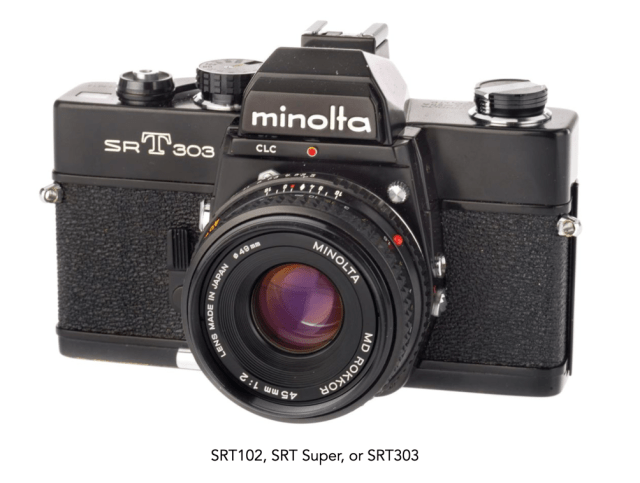
This is an extremely inexpensive manual SLR, usually around $100-250 (with lens). It has three different designations, for the markets it was sold in: SRT102 (North America), SRT330 (Europe), and SRT Super (Asia)
What is the cheapest SLR?
There are quite a few cheap SLRs on the market. For example Asahi Pentax sold over 4 million Spotmatic cameras between 1960 and 1977 – a Spotmatic SP1000 can go as cheap as C$150, whereas a Spotmatic F might go for C$350. Generally lesser-known brands are always less expensive, e.g. Konica, Miranda, Yashica.
Is the market for vintage cameras the same as that for vintage lenses?
No, largely because there is one end-user for cameras, and two for lenses. Lenses will be bought by people who (i) want to use them on a film camera, or (ii) want to use them on a digital camera. Photographers purchasing vintage cameras will only use them for film, and may only purchase one or two film cameras (useless they have GAP), whereas lens purchasers may buy many.
Should I take a risk on a cheap camera?
Sometimes there are sellers who are selling a camera without knowing what they have, usually because it was part of an estate, and not something they normally deal with. If the item is cheap enough, there is likely very little risk, but if it seems too expensive (or seems to have excessive shipping), avoid it. This is especially true if the item is marked “rare”.
How do you know a camera will be in good condition?
You don’t, unless you buy it from a reputable dealer. Someone who has been dealing in vintage photographic equipment for a long time, and sells a good amount of it will provide a good insight into a particular camera body, including providing a quality rating. Otherwise, without a full evaluation it is difficult to know exactly how well a camera will function. For example, unless shutter speeds are tested, there is no way to properly determine that they function accurately. The word “functioning” is pretty vague if there aren’t any qualifying statements. It could just mean the person has played with all the knobs and levers, and they work. Whether the shutter speeds are accurate is another thing altogether.
Are there red-flags for purchasing cameras online?
Yes – if a listing somewhere only has 1-2 images, and offers no real description, then stay well clear – unless of course it is a $500 camera selling for $20, and even then you have to wonder if there is anything wrong with it.
Is eBay any good?
Like anything, it really depends on the seller. Some sell only camera gear, and have been doing it for a while, or have a physical shop and use eBay as their storefront. Always check the resellers ratings, and review comments.
There are a lot of vintage cameras available on eBay from Japan – are they trustworthy?
In most circumstances yes. There are a lot of physical camera stores in Japan, so its no surprise that there are a lot of online stores. Japanese resellers are amongst the best around, because nearly all of them rate every aspect of a camera, cosmetic and functional. If something seems like a bargain it is likely because there are a lot of vintage cameras in Japan.
What should camera ratings include?
If we take the example of Japanese resellers, there are normally four categories: overall condition, appearance, optics, and functionality (body and lens). Appearance deals with aesthetics of the lens, and indicates any defects present on the lens body, e.g. scratches or scuffs. Optics deals with the presence of absence of optical issues: haze, fungus, balsam separation, scratches, dust. Finally functionality deals with the operation of the lens, and camera (e.g. shutter speeds).
What does “untested” mean?
If a posting is marked as untested, it basically means exactly that, you are buying the camera “as is”. There is usually some basic information on condition, but the camera functions haven’t been tested in any manner, i.e. shutter speeds, or with film. If a camera is marked as “parts-only”, it means exactly that, i.e. it does not function properly.
Which 35mm SLR camera had the first pentaprism? Was it the Rectaflex or the Contax S? This question has turned into a bit of a conundrum over the years – many sources cite the Contax S as the first, with just as many opting for the Rectaflex. This discussion tries to provide some insight into the timeline of pentaprism use by looking at both the patents for cameras containing pentaprisms, and the cameras actually produced. Note that some original historical patents are hard to find, e.g. those from Italy.
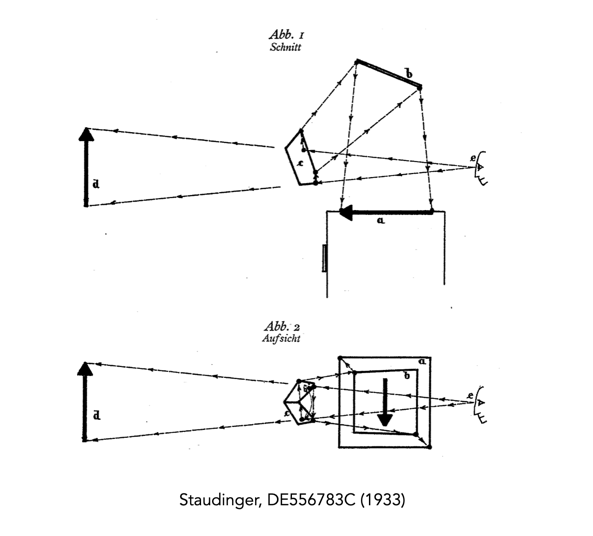
In all probability the idea of using a pentaprism in a camera had been floating around for a while. On 28 January 1933, German architect Kurt Staudinger was issued a patent for a reflex device with eye level vision, which used a pentaprism-like system (DE556783A, “Vorrichtung fuer Reflexkameras” (Device for reflex cameras). The invention related to a device which “…is intended to convert the horizontal and reversed image projected into the screen into a vertical, upright and reversed image.” However instead of using a prism, this was actually a series of mirrors, i.e. a penta-mirror. Although he tried to interest German camera makers, none were seemingly that eager. At the time there was likely was too much invested in rangefinder cameras to think that an alternative was worthwhile. The only German patent to cite this work was that of Arno Rothe (DE741844A, sub. May 5, 1939) who proposed a reflex camera using mirrors which allowed for both waist level, and eye-level viewing.
Fig.1: The concept of Kurt Staudinger
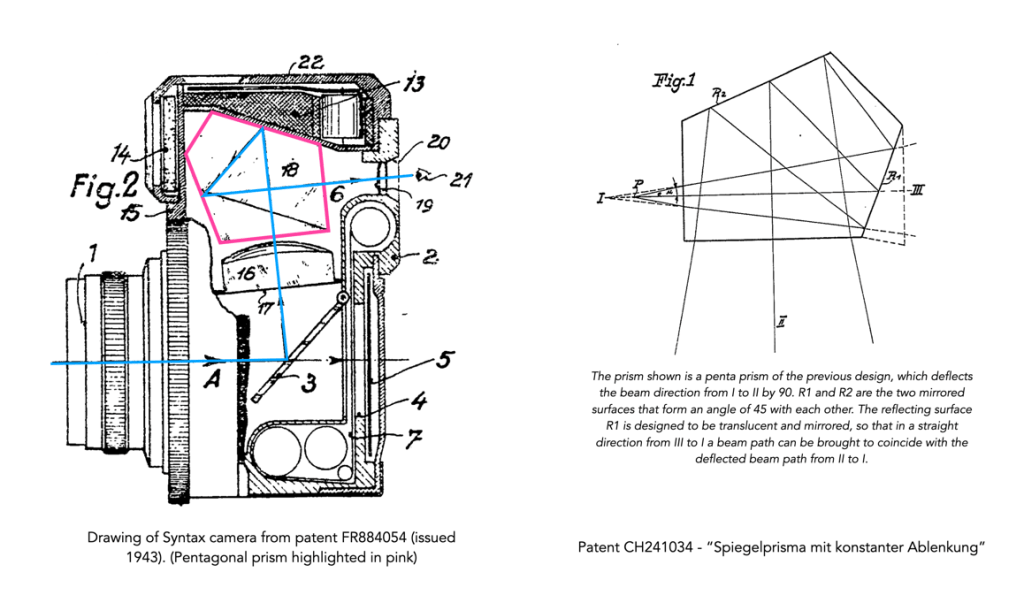
From about 1937 Zeiss Ikon began work on a 35mm reflex camera with a pentaprism eye-level viewfinder in the Camera Development Department. The camera was named the Syntax, and on September 2, 1940 Zeiss Ikon applied for a utility patent in Germany. Research has failed to find the German patent, but two patents associated with the camera were filed in France: FR884054 (sub. August 9, 1941) “Photographic apparatus constructed in particular in the form of a monocular mirror reflex camera”, and FR875596 (sub. August 9, 1941) “Mirror camera with photoelectric exposure meter forming part of the camera”. Both applications cite the filing of associated German utility patents on August 23, 1940. There is another Swiss patent submitted by Zeiss Ikon on 18 January 1943 (CH241034) – “Spiegelprisma mit konstanter Ablenkung” or “Mirror prism with constant deflection”. This gives further credence to the fact that Zeiss Ikon was working on a pentaprism for a camera.
Fig.2: Drawing of Zeiss’s Syntax camera from the French patent and a drawing of a “spiegelprisma” from the Swiss patent.
Work was slow, but it has been suggested that there was a working model by 1944, supposedly a Contax II body with its metal vertical focal-plane shutter, however having its view/rangefinder replaced by a reflex mirror, delivering an upright and right-way-round image via a roof pentaprism to the eyepiece [1]. However the viewfinder image was too dark, and required f/2 and faster lenses. A diagram of the Syntax from the French patent is shown in Figure 2. According to Siegfried Böhm, design engineer with Zeiss Ikon, there were a series of issues with the Syntax [1]. The camera was complex, and would have required 750 parts to produce, in part due to the vertical shutter, and external bayonet lens mount of the Contax II. Böhm was working on the design for a horizontal focal-plane shutter, however on February 13, 1945, everything related to the project was destroyed by Allied air raids.
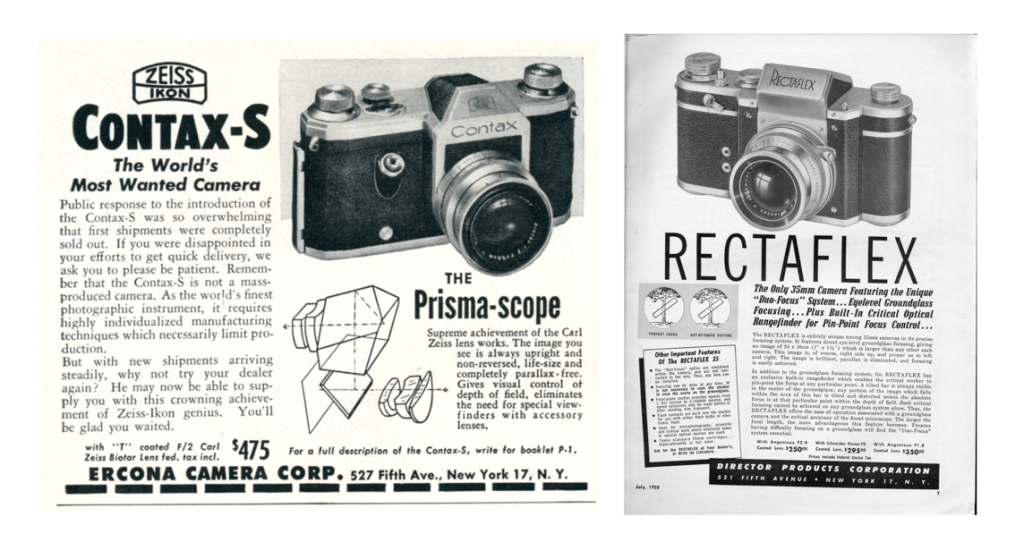
Fig.3: Advertisements for the first two pentaprism cameras
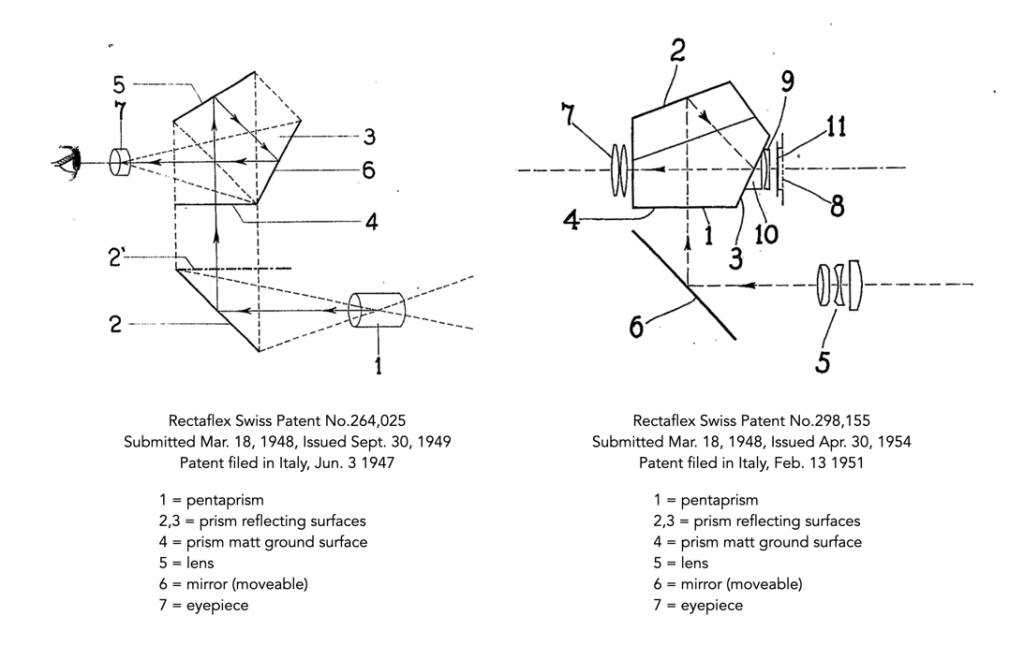
The first SLR manufactured with a pentaprism was the Rectaflex. It was the brainchild of Italian lawyer and camera enthusiast Telemaco Corsi (1899-1974), and was the only Italian SLR ever produced. Work began in 1946, and a prototype was shown at the Milan Fair in 1947 (this model used a flat pentaprism instead of a roof-pentaprism). This system seems to be described in a Swiss patent issued in 1949 (CH264025 based on an Italian patent filed in 1947). At the same fair a year later, a working prototype called the Standard 947 was introduced, with the production model A.1000 for sale in September 1948. Only 1150-odd copies were produced, with Rectaflex introducing the B.2000 in April of 1949, and the B.3000 in September. A patent for this pentaprism system is also described in a Swiss patent issued 1954 (CH298155, filed Jul.5/1951) – “Complementary sighting device in a photographic camera equipped with a reflector mirror viewfinder.”, and a West German patent (DE938764) filed the same month.
Fig.4: The Rectaflex pentaprism patents
The Wrayflex was England’s only attempt at developing a 35mm SLR. On Sept. 2, 1952 Wray (Cameras) Limited received a patent for “Reflex Camera with Curtain Shutter” (US2,608.921, filed on 21 May 1948). It matched a UK patent applied for on May 21, 1947 (GB2608921X), describing an SLR which contains a “pentagonal prism”, which appeared at the bottom of the camera, basically upside-down. However this “prototype” never seems to have been put into production.
Fig.5: The patent for the Wray Optical
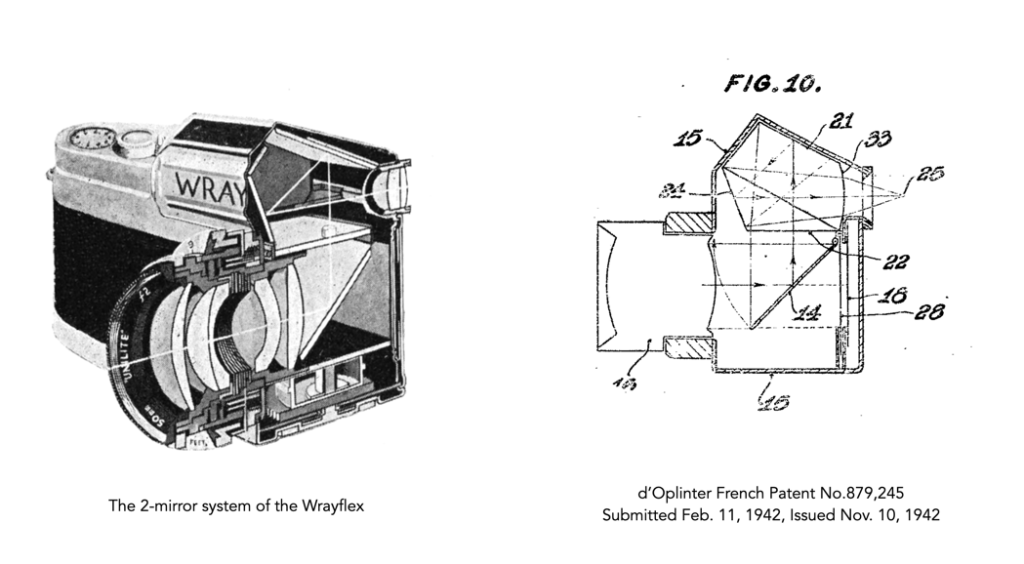
Instead the Wrayflex production model used a mirror which folds backwards and upwards when the shutter is released. This means there was no space for installing a roof prism – instead the Wrayflex used two mirrors, arranged so as to reflect the ground-glass image twice – this arrangement provides an image which is laterally reversed, but the right way up. The two mirrors must be accurately positioned so that there is no possibility of misalignment. The Wrayflex I and Ia both used mirrors, it wasn’t until the Wrayflex II in 1959 that a pentaprism was incorporated. In addition to the Wrayflex, there is also a patents by Belgian Jean de Wouters d’Oplinter (1905-1973), applied for in Belgium on February 11, and May 29, 1941. The French version of the patent, “Improvements to photographic cameras and similar devices”, was issued on November 10, 1942 (FR879245), however this camera was never produced.
Fig.5: The mirror system of the Wrayflex and the patent for the d’Oplinter camera
In September 1949, Rectaflex was to received some competition in the form of the Contax S from VEB Zeiss Ikon. The development of the Contax S (also known as the Spiegel-Contax) basically involved recycling the wartime Syntax project. The camera was introduced in 1949. The prism on the Contax S was built into the camera body. The view was life-sized, a result of three factors: the focal length of the lens, the prism itself, and the small magnifying eyepiece behind the prism. Many early prisms were bright in the centre, but susceptible to fall-off in the corners. Later SLRs used systems to overcome this problem – e.g. condensing lenses underneath the ground glass, a flat fresnel lens which spreads out the light, and increases brightness in the corners. While there were a number of patents filed for this camera, most had to do with the shutter mechanism, and shutter release [2]. There don’t seem to be any patents that relate specifically to the pentaprism mechanism (there are war-era patents but that’s another story). Zeiss Ikon certainly marketed their camera in the light that this was the most significant advance since the SLR itself.
Here is the camera being hailed as the most significant advance in camera design since the first miniature itself. The twin-image, coupled range-finder has given way to a single viewer, the Prisma-Scope which enables you to sight directly through the camera lens. You see a life-size image, always upright and non-reversed, that spins into sharp focus with a twist of the lens barrel. For the first time in a single lens reflex, all focusing and viewing takes place at direct eye level. Without sacrificing the compact qualities of the miniature, the nuisance of parallax is forever eliminated … accessory lenses require no coupling with special and costly range-finders … close-up photography requires only the addition of extension tubes. Here is the most versatile camera ever created!
The third pentaprism 35mm SLR was by Swiss company ALPA. However they went in another direction, choosing a prism derived from an Abbe prism, the Kern prism. The main difference between this and a pentaprism prism is the fact that the latter provides a 90° image, while the former is only 45°. So the early ALPA-Prisma Reflex cameras (introduced in 1949) offered an oblique view, not a perpendicular view. This feature continued until the Model 6c of 1960.
What about the Ihagee Exakta? Well the company that basically created the 35mm SLR was slower to adopt the pentaprism. It was not until 1949 that they incorporated the use of an auxiliary prism, the “Prismenaufsatz”, which provided a corrected right to left image (however it did make the camera top-heavy). Finally in 1950 Ihagee, introduced the Exakta Varex. As ALPA’s system did not produce an eye-level image, this really makes the Varex the third camera with an eye-level pentaprism. It was also the first SLR with an interchangeable viewfinder, as the waist-level viewfinder was still the most common of the period. The first Japanese pentaprism SLR did not appear until the Miranda T in 1955, followed by the Asahi Pentax, Minolta SR-2, Zunow, Nikon F and the Yashica Pentamatic.
So who was first? From a practical viewpoint of a manufactured camera, it was the Rectaflex. But I guess it depends on how you interpret history.
Notes:
The Gamma Duflex, designed by Hungarian Jenő Dulovits, was being sold by 1948, however despite some reports, it did not have a pentaprism. The patent for the optical viewfinder system incorporated a Porro-prism, but due to financial constraints only a Porro-mirror was implemented. It was however the first eye-level SLR, and had the first instant-return mirror. A design apparently existed for a ‘Duflex System Reflex S’ which did have a roof pentaprism, but it was never put into production.
Further reading
Schulz, A., “From Syntax to Praktina”, Zeiss Historica, 30(1) pp.7-16 (2008)

 Crafting Pixels