Choosing a vintage SLR camera – some FAQ

This past covers more aspects of buying a vintage camera in FAQ form. When it comes to 35mm interchangeable-lens cameras there are two categories: rangefinder and single-lens-reflex (SLR). This FAQ is concerned with SLRs because they became the dominant form of SLR camera found on the used market.

What are the best vintage cameras?

Identifying the best vintage camera is very much a subjective thing. Unlike lenses though, which are often chosen for the aesthetic appeal they impart upon photographs, cameras are all about functionality. All cameras really serve the same purpose, as a vessel to hold the lens, and film, and control the process of taking a photo. So the best vintage cameras are often those that achieve this in a way that doesn’t compromise functionality. They should be simple to use, aesthetically pleasing, ergonomic, and don’t suffer from a series of maladies, e.g. shutters that could imminently fail, poor engineering or manufacture etc.

Which camera types are best?

It really depends on what sort of features are required, and perhaps what sort of lens mount (not all lens mounts are inter-compatible, and it is hard to find adapters for film cameras). Do you want fully manual, semi-automatic, or fully electronic? Do you want a built-in light meter (which is tricky because many don’t work anymore)? Then you have to figure out which ones are problematic from some functional viewpoint, e.g. problems with shutters, or flaky electronics. For example Olympus made 14 major models of manual focus SLR in the period 1972 until 2002, and two automatic models. The OM-707 was an auto-only camera, and somewhat of a disaster from a usability perspective. The Olympus OM-4Ti (1986-2002) is considered by many to be best film SLRs money can buy.

What is the most versatile camera mount?

In reality, M42 is likely the most common lens mount, at least up until the early 1970s. There were a lot of lenses made for this mount from a myriad of manufacturers. There were also a bunch of cameras that used it as the mount. Next in line might be the Exakta mount.

Can film cameras use lenses from other brands?

Unlike mirrorless digital cameras, which have a short focal flange distance, allowing for adapters to suit a bunch of 35mm film lenses, the same is not true for film cameras. Some cameras can use lenses with other mounts, many can’t. For example the Minolta cameras with an SR-mount can use M42 mount lenses, because the flange distance on the camera (43.50mm) is less than that of the lens, allowing an adapter to convert the M42 to SR-flange (MD,MC) – however the opposite is not true.

Do some people buy cameras because they are aesthetically pleasing?

Yes. Some people love how cameras look, even if they don’t function that well. Form over function is a real thing for some people, of course beauty is always in the eye of the beholder.

Why were some SLRs unsuccessful?

Sometimes cameras didn’t sell that well, and as a result weren’t that successful. This was usually down to poor choices in the design of the camera. A good example is Rollei which had its own bayonet mount lens system known as the QBM – proprietary lens mounts means a smaller choice of lenses. Poor usability, or finicky mechanical features often lead photographers to abandon a camera. Sometimes it can be poor aesthetics, as with the case of the Minolta Maxxum 7000, although to be honest requiring photographers to dump all their lenses in favour of a new system with autofocus, probably wasn’t the best idea.

What about brands?

There are three major categories of vintage camera manufacturers. The first are landmark manufacturers who got into the game early, and focused heavily on SLRs. They likely had a start in 35mm rangefinder cameras. This means manufacturers like Exakta, Asahi-Pentax, Nikon, and Canon. Pentax is the only one of the three that did not produce rangefinder cameras. Next are the companies that are second tier, i.e. they had a smaller footprint, made only SLRs or got into the game late. This includes Konica, Minolta, Fuji, Olympus, Topcon, Yashica, Petri, Mamiya, Miranda, Ricoh, Zeiss Ikon, KW, ALPA. Lastly are the companies who didn’t really do a great job with 35mm SLR – Leica, Rollei, Voigtländer. Each manufacturer produced both good and mediocre cameras, and so it really requires some investigation into the right brand.

Are Japanese SLRs better than German ones?

In all probability, yes. There are undoubtedly some good German SLRs, mostly from East Germany, produced in the 1950s and 1960s. West Germany really didn’t produce that many successful SLRs. Both countries struggled to produce SLRs that could compete with the ones produced by Japanese manufacturers. There are a few good German SLRs, e.g. the Contax S2, but the reality is there is likely better Japanese cameras that are way cheaper.

Should I buy a camera made in East Germany?

With the exception of Exakta cameras, many post-war Eastern bloc cameras suffer from lower standards of engineering, reliability, and in some cases poorer usability than West German and Japanese cameras. When they were new, this was less of an issue because these cameras were often sold for dramatically lower prices. However aging cameras can be fraught with issues. Check the reliability of any camera you are interested in.

Why are there so many Eastern-bloc cameras?

Cold hard currency. The communist-bloc countries needed currency, and one was to achieve that was to produce goods to sell in the west. Banking on Germany’s pre-war reputation for producing photographic equipment, this was a very lucrative option. Dresden, which ended up in East Germany, was once the European epicentre of photographic innovation. The cameras were often sold cheaply, thanks in part to Eastern-bloc government subsidies.

What’s are the best East German SLRs?

Anything in the Exakta range, or perhaps a Praktina, or Praktica IV.

What about the weird brand SLRS?

Oh, you’re talking about the small independent brands?

  • Rectaflex (Italy, 1949) – over-engineered, heavy yet reliable, these cameras are expensive only because of their rarity.
  • Alpa (Switzerland, 1942) – exacting, well-built cameras. Some models such as the 6c are extremely good cameras, although some are susceptible to shutter issues. Expensive, but provides a unique character, and high level of quality.
  • Wrayflex (England, 1950) – the only commercially successful, English made SLR.
  • Edixa Reflex (West Germany, mid 1950s) – moderate quality cameras made by Wirgin (Weidbaden), these cameras rarely operate for very long.

Why are there so few cameras not made in Germany or Japan?

This is in part due to a lack of interest in developing their photographic sectors. While the allies poached a lot of high-tech workers from Germany, particularly from the armaments sector, they didn’t relocate any photographic expertise, except from the Russian occupied zone in Germany to the US zone. The boom in SLRs which occurred in the 1950s was driven by cheap cameras and lenses coming out of East Germany, and the growth of the photographic sector in Japan. Countries like the US, UK, and France could not compete, or just didn’t have the ability to get into a market that was dominated pre-war by Germany.

What’s does “mint” mean?

This is a term used by some resellers to indicate that a camera is in near perfect condition, almost like it came out of the factory last week. In many cases it likely means the camera sat in its box, and was never used (if it comes with the box and instructions, even better). However just because it’s mint doesn’t always mean that everything will function the same as it did when it came out of the factory 60 years ago. Materials still may degrade, grease solidifies, and gears seize up.

What about electronically-controlled 35mm SLRs?

This is often a choice for people who don’t want to deal with a fully manual camera. This means any 35mm SLR where electronics aid in calculating things like exposure. This could range from something like an aperture-priority-only camera to an autofocus equipped, completely automatic SLR. The only problem with these cameras can be aging electronics. If the electronics stop working, you basically have a paper weight. Choose a camera that is well reviewed and barely ever gets negative reviews. Note that manual cameras often had light meters, but that doesn’t make them electronic cameras (a camera with a light meter can generally be used even if the light meter doesn’t work.)


Choosing a vintage 35mm (interchangeable lens) camera

Choosing a vintage lens is one thing, choosing a vintage camera is a completely different matter. This is partially because people often choose vintage lenses for use with digital cameras, whereas people choose vintage cameras because they are interested in film photography. Choosing a 35mm camera is tricky, because unlike vintage lenses, which are often quite simple in their mechanical ways, 35mm cameras can be quite complex.

Firstly 35mm encompasses two core types of interchangeable lens: rangefinder, and single-lens-reflex (SLR). The rangefinder period started in 1925 with the commercial introduction of the Leica I, and reigned until the early 1960s when 35mm SLR cameras began to dominate. The first production 35mm SLR emerged as the Kine Exakta in 1936 and they progressively gained more of the market. So the first choice really is whether you want to choose a 35mm rangefinder camera, or a 35mm SLR? The choice is based on different perspectives of how a photograph is taken. This choice also dictates the age of a camera, which can be a major issue.

Cameras can be broadly categorized into pre-WW2, and post-WW2. With age comes the same proclivities as suffered by any complex mechanical device. This includes things like penetration of dust and other contaminants which can lead to gears not working properly, or springs loosing their tension. Lubrication grease can dry up, and shutter mechanisms can become brittle. There are a lot of issues which are often very challenging to fix. The problem is exacerbated by the fact that it is impossible to see inside to view the state of the mechanisms. Even the simplest of designs can include an incredible amount of mechanics, mostly to control the shutter, but in some cases the aperture as well.

How to choose a vintage 35mm SLR camera (with camera clues)

There is also complexity. Early cameras were obviously manual, and as the decades progressed they incorporated progressively more automatic features, i.e. electronics. In either case, film cameras can be complex with many moving parts. Automatic control and light meters obviously came with another issue – power, or rather batteries.

Apart from the physical issues, choosing a film camera is more about personal choice than anything else. There are a lot of 35mm cameras out there. The best way to choose a camera is to first roughly decide on rangefinder or SLR. The next decision is manual, semi-automatic or automatic. This can be followed by brand, and then narrow it down to a specific model, perhaps based on features. The best way to decide on a specific model, is to make a short-list, and then find some reviews of the cameras. Reviews will usually provide some context on the pros and cons of the camera, including any potential red flags, e.g. commonly recognized faults. If there aren’t any reviews, then that in itself could be a red flag, meaning few people are actually using the camera. Many of these camera reviews are quite extensive, so they should be able to help choose an appropriate film camera.

Beyond the functionality of vintages cameras, to some there is also the aesthetic appeal. Some people like certain 35mm cameras because of how they look. Mostly this is a legacy of likeable cameras.

My best advise for buying a vintage camera is to buy one from a reputable dealer, one who has examined the camera, perhaps fixed any problems, or in any case is willing to specify what issues there are with a camera. A good example is Kamerastore from Finland. They will identify a camera as “Not Passed”, “Passed”, “Certified”, or “Restored”. For example you can buy a restored Olympus OM-1 for around C$370 that has new light seals and has had both the light meter and exposure calibrated. If you find a good camera somewhere for a really good price, and most things seem to work, you can take a gamble, but things like shutter speeds might not be accurate.

Photographing nondescript buildings can be fun

Architectural photography usually involves photographing interesting buildings – new, creative buildings, or historic period buildings. Average buildings aren’t usually that interesting, unless you can find an interesting angle. Almost any building can be made interesting just by looking for qualities that make the building stand out.

Consider the photographs below, of one of the buildings in Canada Square in Toronto. The building is simply known as 2180 Yonge Street, and was built in 1972 for the Canadian Tire Corp. This is a building that has only been around for 52 years, but like so many buildings is due to be replaced sometime soon by some neomodernist nightmare. I don’t really know what architectural style the building exhibits, perhaps internationalism? I don’t think most people really think about the building when they walk by it – it is fairly nondescript, from afar it looks like a black block.

The building at 2180 Yonge Street – not known for much except being the home of Canadian Tire and TVO

But it does have one interesting characteristic – it is festooned with mirrored glass. This can be used to create a series of photographs that reflect the changing neighbourhood. Unlike the many flat modern mirrored buildings, the face of this one has a textured appearance created by different colours of horizontal glass, and vertical banded divisions. This creates an abstract mosaic effect of the the buildings reflected from the opposing side of the road. It almost makes the building seem like a huge screen, bringing it to life. So the interest is not in the building per se, but it’s interaction with its surrounds.

Reflections…

Vintage lens makers – Schneider (Germany)

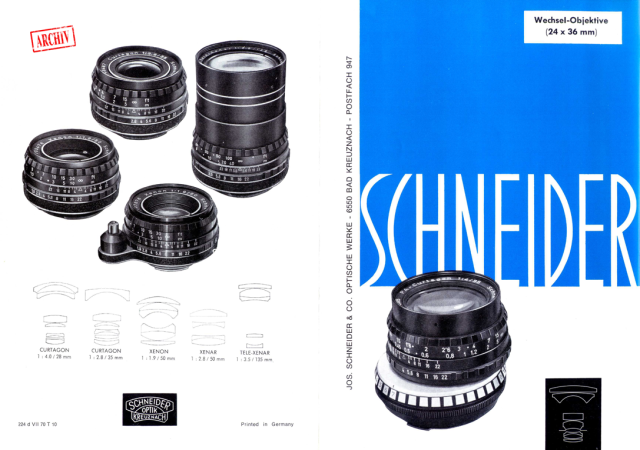
Joseph Schneider (1855-1933) founded Optische Anstalt Jos. Schneider & Co in Bad Kreuznach on January 18, 1913, and in 1922 changed its name to Jos. Schneider & Co., Optische Werke, Kreuznach. The chief designer was Albrecht Wilhelm Tronnier (1902-1982), who joined the company in 1924, and would eventually set up the sister company ISCO (throughout his life he accumulated 124 German patents). They produced a large series of lenses with early trademarks such as “Symmar”, “Componar” and “Isconar”, and “Xenar”. From 1919 they produced a Tessar clone, the “Xenar” in focal lengths from 75 to 480mm. In 1925 the famous “Xenon” was introduced, with focal lengths up to 80mm. The Xenon, is perhaps the company’s most famous lens, and is still being made today.

Schneider’s most famous lens?

In 1933 with the passing of Joseph Schneider, his son Josef August Schneider took over the company. In 1936 ISCO was formed as an offshoot of the company. Schneider was one of the lens suppliers to the first Exakta, the 4.5×6cm VP Exakta, providing the Xenar f/3.5, the Xenar f/2.9, and the Xenon f/2. The same lenses would find their way onto the first 35mm SLR, the Kine Exakta in 1936.

During WW2, Schneider had to supply the German Wehrmacht and was forced to manufacture Zeiss products. In the 1950s the company continued development of interchangeable SLR lenses, and supplied lenses to almost all German camera manufacturers. Lenses were made in mounts for Edixa-Mat, Pentax (M42), Praktica, Exakta, and Praktina. Lenses for film cameras were also produced, especially for the 8 and 16 mm narrow film cameras that were popular at the time. Also in the 1950s, the company was one of the first to use computers, the Zuse Z22 to perform lens calculations.

Schneider started developing zoom lenses from 1957, which led to the market launch of the Variogon 1:4/80-240 in 1964. At the end of 1967, Schneider introduced its first TV lens, the TV1 Variogon 2.1/18-200mm. NASA used Schneider lenses on its “Lunar Orbiter” space missions of the Apollo program from 1959 to 1976 and on the space shuttle flights since 1990. The first images of the Earth were taken using Schneider lenses with 45 and 75 mm focal lengths. The lunar orbiter probes also each had a Schneider “Xenotar” on board.

Due to changing economies, Schneider ran into economic difficulties and filed for bankruptcy in 1982. The company was subsequently re-founded by Heinrich Manderman and over the years, acquired the B+W filter factory and Rollei photo technology, among others. After German reunification, Manderman also became involved with Pentacon in Dresden and resumed production of the Exakta 66. The company still exists today, producing cinematic lenses and filters, industrial optical filters, industrial lenses (e.g. C-mount), and photo optics, most notably the B+W Filter brand.

Further reading:

The truth about digital cameras

Have you ever noticed how often camera companies release new camera bodies? There is always a lot of fanfare about the fantastic new things these cameras do – but here’s the thing, nothing much has changed with digital cameras in the past decade. In the era of film companies produced new camera bodies as well, but usually only when they heralded the addition of new technology such as the transition to 35mm SLR, or through-the-lens metering. For the most part, analog cameras are just simply a light box which has a lens attached and is loaded with film. The lens deals with the aperture, the camera controls the shutter, and film deals with the fixed ISO.

Camera manufacturers try and make people believe that they need a new camera by flaunting its bells and whistles, to which there are rarely many new ones. More megapixels? Been there, done that. What else is there? Better processing power, more AI? The reality is the things that matter – aperture, shutter-speed, ISO – don’t really change that much. As I have mentioned before there is a point where more megapixels produced diminishing returns.

What really matters in digital photography is lenses. Good quality optics will make the difference between good and mediocre pictures – and lens technology has vastly improved over the past decade. To the point where maybe lenses are a little too complex, but that’s just my personal opinion. There will likely never be a “perfect” lens, but then again neither should there be – from the sheer perspective of character. But even more important than the lens is the ability of the photographer. So if you have a good digital camera, there is no real need to buy a new one. A 24 megapixel camera will be more than adequate for the foreseeable future. Features are nice, but in all likelihood don’t really contribute a great deal to good pictures.

Q&A: Limitations of smartphone cameras (ii)

The remainder of the Q&A.

Is battery life a big issue?

Smartphones have an extremely limited battery life. The newer smartphones like the iPhone have exceptional battery life, for a phone, but not for a camera. Batteries just don’t last that long with smartphones, requiring a battery pack of some sort to keep them going. It is hard to pin down exactly how many photos you can take off a charge, because a smartphone is not a dedicated camera, and therefore uses power for things apart from taking photos. For average use, smartphone batteries are more than adequate, however when used when travelling it could become an issue, largely due to the number of photographs taken. It is easy to have multiple spare batteries for a camera.

Are smartphones limited by storage?

Smartphones differ on whether they just offer on-board storage (Apple) or offer access to a removable microSD card slot (Android). Choosing a smartphone with no expandable storage means things will fill up very quickly.

Are smartphones easy to use as cameras?

Smartphones tend to lack what I like to call tactile awareness. They aren’t really that ergonomic from the point of holding them, let alone using features. There are some apps that allow better creative control, but all have to be manipulated by means of the touchscreen. And even then they have somewhat poor creative control. Although cameras often suffer from poorly designed menus, the problem with smartphones is that even the best photography software suffers from having a lot of features in a small space. This is sometimes balanced by the amount of post-processing techniques available, but editing a photograph on a small screen is severely limiting. Sure, these smartphones do have fancy AI software to reduce issues, and make “nice” looking photographs, but there is one inherent limitation with this – a loss of character. Smartphone displays, however good aren’t really ideal for photography. Sometimes its hard to see what you are shooting due to glare. Cameras have an EVF which is shielded from the sun.

Can smartphones produce the same aesthetics?

Aesthetics on a camera is really down to the quality and type of lenses. Most cameras, except for compacts, have interchangeable lenses which makes it easier to achieve a certain aesthetic. For example smartphone cameras can generally not produce bokeh naturally. Smartphone cameras are not exactly designed to have narrow depth-of-field areas, without which it is impossible to naturally create bokeh. Bokeh is typically found in portrait-style photographs where it is added algorithmically by means of computational photography and machine learning (it basically delineates a subject, and then artificially adds blur to the background).

What things do DSLR/mirrorless cameras do better?

  1. Real cameras have larger sensors. Larger sensors mean better quality images.
  2. Real cameras have better lenses – high quality optical glass, and faster apertures.
  3. Real cameras offer more control – shutter speed, ISO, aperture
  4. Real cameras shoot in RAW
  5. Real cameras are dedicated to one job, and last longer.

Can smartphone cameras handle climate extremes?

This is a important, because smartphones use Lithium-Ion batteries which are effected by temperature extremes. For example Apple suggests keeping their devices between zero and 35°C. Cold batteries can slow down the function of a smartphone. Cameras on the other hand have a broader working range of temperatures, from 0 to 40°C, and some are designed for temperatures as low as -10°C (e.g. Fujifilm X-T4). Smartphone batteries are also not removable, versus camera batteries which can be removed and kept warm while they are not being used in the cold. Smartphones and freezing temperatures do not mix well. Professional cameras can shoot through everything.

Are smartphone zoom lenses useful?

Smartphones can have either digital or optical zoom, or both. Optical zoom provides high-quality, lossless magnification. Digital zoom however enlarges the captured image, and does not involve movement of the camera lens. Digital zoom just zooms in on the pixels, and may result in a loss of image quality. It is achieved by magnifying and interpolating pixels, which can lead to a loss of sharpness and detail. When used on smartphones, digital zoom is often used when the physical limitations of the lens prevent further optical zoom. Some, like the plain iPhone 14, only have digital zoom (5× in this case). The main pros of digital zoom are related to smartphone form-factor: convenience, compact design and cost effectiveness. But the cons somewhat outweigh the pros: loss of image quality, no true magnification, interpolation artifacts, and inferior performance in low light.

Q&A: Limitations of smartphone cameras (i)

Here I’m going to explain a bit more about the caveats of smartphone cameras in the form of a FAQ. I will add that for all their compactness, smartphone cameras produce incredible images, they just have the same limitations all small devices have.

Is the image quality as good as a dedicated digital camera?

Image quality is partially reliant on the size of photosites, the building blocks of digital images. The larger the photosite, the better it is for low-light conditions. Smartphones have relatively small sensors, and therefore are constrained by the size of their photosites. They still produce images with exceptional quality, but there is a reason people choose full-frame and medium sized sensors for professional work.

Regardless of what companies say, image quality on a smartphone will never be as good as those on a camera. The iPhone 14 Pro has a 1/1.28” sensor on the wide camera with a sensor area of 75mm2, and a pixel pitch of 1.22μm in 48MP mode (2.44μm in 12MP mode). Don’t get me wrong, the technology is amazing – squeezing a camera with a 7-element, 24mm focal length equivalent lens with optical sensor shift. But those pixels are small, and there is only so far you can scale up a 12MP image. In comparison, a 26MP APS-C camera sensor has photosites that have nearly four times the area of the 14 Pro, which means more light can be captured. It also has twice the number of photosites, more photosites amounts to better resolution.

Are lens elements made of plastic?

Cameras are all about the glass, or in the case of smartphones – plastic. Most smartphone cameras are comprised of lens elements made out of injection molded optical plastic. Now plastic lenses have been around for a long while, and they have benefits and drawbacks. There are many reasons for this, most notably the fact that plastic elements can be molded into much more extreme aspheric shapes, something not possible in optical glass (aspherical lenses are used in high-end optics to create sharper images and reduce or eliminate some types of optical imperfections). Plastic also allows for thinner lenses that have more complex flange geometries.

An example of a plastic 5-element smartphone lens.Made of injection-molded optical plastic, they are extremely cheap to produce.

Are lens apertures limited?

The aperture of a lens controls how much light makes its way through to the sensor, controlling things like depth-of-field (or how much of the scene is in focus). Smartphones that work well in low-light situations, without the use of a flash, have large apertures. The wide lens on the iPhone 14 Pro has an aperture of f/1.78, which allows for good low-light performance, but taken into context, an aperture of f/1.78 has the DOF equivalent of an f/6.1 aperture on a full-frame camera. That makes it hard to produce blurry effects naturally – they are usually added artificially in post-processing. These lenses are stuck with a single fixed aperture, providing limited control of exposure. It may seem like you can change the aperture, but apps that allow the aperture to be changed to increase the amount of background blur are really just adding a certain amount of artificial background blur. Camera lenses can change the aperture, and hence the depth of field, facilitating natural blur, i.e. bokeh.

Do smartphones create natural Bokeh?

Bokeh has to do with unfocused regions in an image, and relies heavily on a shallow depth-of-field. Many smartphones use wide-angle lenses, and as a result, have quite a large depth-of-field (DOF), the distance between the nearest and farthest elements in a scene that are in acceptably sharp focus. The available depth of field increases as the sensor size and lens focal length decrease, which is why smartphone photographs tend to have very large DOFs. Landscapes, everyday shots, even close-ups have very little out-of-focus. How is bokeh created? Through the power of algorithms. The iPhone uses both cameras to create a DOF-effect in Portrait Mode. It combines the photographs taken by the wide-angle and telephoto lenses, and after applying some computational magic, produces a blurred background. There is even a Depth Control feature which allows the bokeh, to be tailored, between an aperture of f/1.4 and f/16. But it is computationally created, and bokeh is a natural phenomena which occurs in part because of lens optics.

Are different lens focal lengths useful?

While these lenses are exceptionally designed for the small space they are required to inhabit, they can not really be compared to the larger glass available in dedicated cameras. Photography is about light, and smartphone lenses are extremely small and so don’t really let in the same amount of light. The 24mm equivalent wide angle lens of the iPhone 14 Pro has an actual focal length of 6.9mm (35mm equivalent), the 13mm is actually only 2.2mm, and the 77mm is only 9mm. Basically the focal lengths often used to described in lenses are in terms of their 35mm equivalents, likely to create better associations. For example a 77mm telephoto lens seems easier to understand than a 9mm telephoto.

To get a bit technical, this means the effective diameter of the entrance pupil (DEP) of the wide-angle 6.9mm lens with a max aperture of f/1.78 is 6.9/1.78 = 3.88mm. Comparing this to the equivalent 24mm full-frame lens, say the Sony FE 24mm f/1.4, and the DEP is 17.14mm, much larger. More area equals more light. Apart from the fixed aperture, and compactness of the lenses, there is another big issue. Smartphone lenses, regardless of how many of them are on a phone, can only cover a finite number of focal lengths. Cameras, especially those with interchangeable lenses, can use optical zoom lenses that cover a very broad range of focal lengths. For example the APS-C lens Fujifilm XF 18-135mm (f/3.5-5.6) covers the full-frame equivalent of 36 to 270mm.

Why smartphone cameras will never replace digital cameras

Don’t believe the hype: a smartphone will never completely replace a traditional camera.

There is no doubt that smartphones have closed the gap on image quality, and they are popular for their convenience and ease-of-use. But they are not the same as digital cameras. Photography is a craft – it’s not just about capturing reality, which smartphones do really well. It’s about telling stories, and to do that you need some level of creative freedom, which is only available with a versatile camera. Cameras are ergonomically designed for taking photographs, that is their only job.

Cameras are a ubiquitous tool now, as everyone has one in the guise of a smartphone. In 2022 some 1.5 trillion photographs were taken, of which up to 90% originated from smartphones. The quality of the images produced by smartphone cameras is really very good, and why shouldn’t they be, as there is a crazy amount of technology that is incorporated into them. Smartphones of course have many functions, although I am increasingly convinced that their major roles are as a camera, a visual social media device, and a communications device that involves using the phone, or texting. I use mine as a translator with the Google Translate app because it conveniently takes a snapshot of the text I want to translate, and provides me with a quite accurate rendition of the text in English – useful because of the camera. A smartphone is inherently convenient, because it has a small form factor, and is convenient to travel with, allowing us to take pictures of whatever we want. It almost turns the phone into a form of visual record. Then of course there is social media like Instagram, which we use to take photos of things we like to share, like food. Where would we be without the smartphone camera?

However there are natural limits to the effectiveness of a smartphone camera. The first caveat is that while a smartphone is a jack-of-all-trades, a camera is dedicated to just one task – taking pictures. A camera is not a GPS, nor a social media device, nor a music player. But let’s look at some of the core issues. Smartphone cameras are small. As much as that plays as a strength to their overall usefulness, it is a deficit when it comes to being a platform for photography. There is only so much space in a smartphone, and the quality of the images produced is truly magical considering these constraints. The sensors are small, and are therefore limited in their versatility. Photography is all about light, and the more light that can be captured the better. To make up for their compactness, smartphones rely on software to improve the image quality of pictures that are captured.

The biggest elephant in the room with smartphone cameras may be image resolution. Most smartphones have restrained the megapixel count to around 12. The iPhone 14 Pro has a 48MP quad-sensor main camera, which seems quite spectacular, but in actuality the sensor defaults to 12MP – the quad-pixel sensor combines every four pixels into one large quad pixel. To create 48MP images ProRAW mode has to be activated, but the images produced are anywhere from 75-100MB in size. The 1/1.28” sensor is 10×7.5mm in size, giving it a crop-factor of 3.46. The crop-factor of APS-C is only 1.5 in comparison. Of course comparing a smartphone camera to a full-frame at the opposite end of the spectrum is hardly fair, they are really designed for different types of photographers.

There are situations where smartphone cameras perform extremely well, and there are others where they don’t. Convenience may be the key factor to their popularity. There is no need to worry about a memory card, and you always have a camera on you. But dig a little deeper, and for the photographer there are some issues. Foremost is the lens itself. It’s compact, small, has a fixed focal length, and usually made of plastic. They are usually good lenses, and continuously evolving, but you can never replicate the same quality as in a larger format camera lens – it just isn’t possible. Then how do smartphones produce images as good as those from full-frame cameras? The reason for the exceptional quality of photos from smartphones is the amalgam of post-processing that is achieved using fancy algorithms. Instagram filters are simple in comparison. Smartphone photo apps are full of “intelligent” computational photography algorithms capable of overcoming the limitations of small sensors and lenses. For example artifacts like geometric distortion, and vignetting, can be easily corrected in-situ. There are even high-end noise reduction algorithms to deal with the fact that smartphones contain small sensors with small photosites.

Then there are the physical things you can do with a camera, even a compact, that just aren’t possible with a smartphone. Case in point, focusing. I know most people never think twice about this because smartphone cameras auto-focus, but what if you don’t want that, what if you want to wrestle some control back? It’s hard. Even with apps like Halide, it isn’t exactly a trivial experience. Part of that has to do with the lack of tactile physical controls. It just isn’t the same trying to control some parameters using a touch-screen interface. There are other neat features on phones, to correct for various artifacts, or add artifacts, but it isn’t exactly easy trying to edit a photograph on a small screen. It’s hard to do things like play with DOF, or heaven forbid bokeh – the device just isn’t set up for that. I find phone cameras great for Instagram, or in situations where I need to copy a document – those apps are awesome. But otherwise, there is just something lacking. Smartphones cameras offer a record of events, places, and things. You can use them to take photos in places where cameras are shunned. In many ways they have created disposable images.

There are a myriad of articles pertaining to the death of cameras, but for true photographers, smartphone cameras will never be a replacement. The basic truth underpinning this is that regardless of the technology, smartphone cameras are limited by their form factor. Yes, smartphone cameras have high resolution, even 12MP is still impressive, but there are more components to the aesthetics of a photograph than just resolution. Even with some manufacturers breaking into uber-pixel smartphone camera, for example the Samsung Galaxy S23 Ultra can take 200MP images, but in reality these are often just more marketing hype than anything else. Yes, you can take a 200MP image, however perhaps not in low-light situations.

Now smartphone cameras can’t replace traditional cameras, but they can help augment your photography. I love my smartphone for the convenience it offers me, 12 megapixels, portability, basic in-app image processing, Instagram, and even being able to translate documents. Smartphones have completely automated photography, but one has to question what happened to the aesthetics of taking photographs? For photography is not just about recording events, it is about capturing a moment in time in such a way that it is memorable.

Examining a vintage lens - optical anomalies (ii)

Let’s continue with optical anomalies.

⑤ Fungus

A lens that has been stored in an inappropriate environment, i.e. one that is dark and humid, may provide the perfect conditions for the growth of fungus. Fungus takes the form of tendril or web-like structures on the surface of the lens. The fungus secretes an acid that etches a lenses’ multicoating. This sort of damage can be permanent, and hard to remove. Too much fungus will lower contrast, and way too much will give darker, fuzzier images as it blocks light. Fungus is bad news – avoid lenses with it, however small the “infection”.

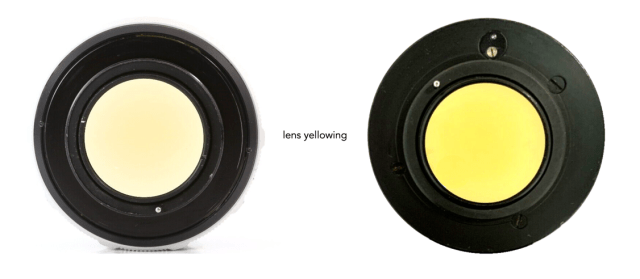
⑥ Yellowing

Coatings on lenses often yellow in time. Glass in general does not yellow, but lens coatings, or at least older ones do. This is also true of glass made with radioactive elements, e.g. Thorium, to reduce refraction.

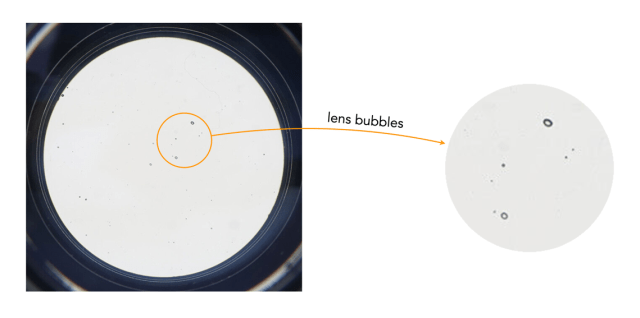
⑦ Bubbles

Some lenses pre-1970 had defects caused by the optical glass manufacturing process which left a few pin-prick sized air bubbles inside the glass. These bubbles may come from different sources, but in most cases the source is imperfect refining. They look like tiny dust specks when viewed with the naked eye, but if magnified, they are indeed bubbles.

⑧ Separation

Lens groups are most often held together with some type of glue. In modern lenses this is usually a UV-cured epoxy. Vintage lenses typically use epoxy, polyester, and urethane-based adhesives, and some pre-WW2 lenses use Canada balsam (basically a resin from balsam fir trees). The balsam was used because it has a refractive index that is similar to crown glass and is invisible when dry. Unfortunately, Canada balsam is not resistant to temperature extremes or solvents. A degradation of the adhesive will result in the lens delamination. This usually manifests itself as a multicoloured band or blobs around the edge of a lens with coatings, or a white band/blobs on lenses with few or no coatings (but it can also occur in the centre of a lens). A small amount of separation on the edges of a lens will likely have little effect on image quality. A large amount may cause a decrease in contrast, flare and ghosting, softer edges, loss of sharpness, and a difficulty in focusing.

Fixing anomalies

Is it possible to rectify these optical defects? The table below provides a quick guide, and later posts will explore some of these defects in more detail.

DefectRepairable?Lens disassembly required?Notes
scratchesmaybenoIt is hard to remove scratches, especially deep scratches, although fine scratches might be able to be buffed or polished out (some people suggest toothpaste).
haze/fogyesyesIt might be possible to use a cleaning solution to reduce or suppress the haze.
dustyesyes/noDust on external lens surfaces is easy to clean. Internal dust is harder because it requires lens disassembly.
blemishesnonoMulticoating damage cannot be repaired.
fungusmaybeyesIt is possible to repair low levels of fungal infections, but it does require lens disassembly. Heavy fungal infections are not repairable.
yellowingyesnoYellowing caused by the presence of Thorium can be reduced using UV lights.
bubblesnonoIntrinsic to the lens glass, consider it a feature of certain older lenses.
separationnoyesSeparated lens groups are basically not fixable. Fixing these requires lens separation, re-centering and re-cementing.

Examining a vintage lens - optical anomalies (i)

There are a number of physical anomalies that can be found on the optics of vintage lenses. Regardless of the abnormalities of the lens body, the critical part is the optics. Sometimes people classify lenses as “a little rough”, or “needs some attention”. These can be red flags. Note that when shopping for vintage lenses in person, take an LED flashlight along as it will help peer inside the lens to determine if it is fit for use.

① Scratches

Glass doesn’t scratch that easily, but coatings do. Scratches are easy to detect, because they usually occur on the visible, exposed glass elements. Scratches usually occur on the front or rear element of a lens. They signify obvious signs of wear, or possibly damage. Small scratches will have little effect on an image, but deep scratches will. A few small scratches on the front element will not impair performance significantly – the reason is the depth of field generally works to negate their impact. The exceptions are macro lenses and wide-angle lenses. A large number of tiny scratches may also reduce the contrast of a lens. Scratches on the rear lens will be more problematic (it is best to avoid lenses with scratched rear elements). Because there is less distance between the element and the sensor/film, most scratches will appear on the resulting picture. Deep scratches can be a sign of severe trauma. Also check for pitting. Sometimes lenses have light scratches which are caused by poor lens cleaning/polishing techniques.

② Haze or fog

Haze can be anything that settles out of the air inside the lens onto the inner surfaces of the glass. The lubricants on the aperture mechanism and in the focus threads can vaporize over time and then resettle onto the glass, and with enough time other things (dust, salt-air, fungus) can get in and collect on the glass, to the point that they are dense enough to refract the light themselves and spread it around as a “foggy” look to pictures. Haze actually gets worse with age. This may be an indication that the lens was poorly constructed, or poorly stored.

A smoky haze diffuses light equally over the entire image. This is generally caused by trillions of particles much smaller then the wavelengths of light, smearing the light over all areas equally, simply making blacks gray and reducing the overall contrast. Oily haze on the other hand has tiny droplets larger than the wavelengths of light. Because the oily haze diverts light, the haloes are much stronger and more visible.

③ Dust

Dust particles somehow get into lenses. A small bit of dust will make little or no difference to image quality. Larger specks or clumps of dust should be avoided. Check for dust by shining a light through the lens. Dust may be especially prevalent in vintage zoom lenses where the increased movement can result in dust infiltrating the inner components of the lens. So how does dust get inside the lens? Vintage lenses are not air sealed, i.e. weather sealed, meaning that air moves in and out, and of course it carries dust with it. Zoom lenses with barrels that extend out essentially “pump” air/dust into the core of the lens. In reality, small amounts of dust will impede very little of the light passing through a lens, and its impact on the image quality is minimal. Inexpensive and simple lenses can be easily disassembled and cleaned, however re-assembling the lens may again introduce dust (unless you have a clean room). Large amounts of dust may be indicative of poor long-term storage.

④ Blemishes

Many vintage lenses have lens elements that are coated with layers of some non-reflective optical material. These multicoatings minimize light reflection and the resulting lens flare and ghosting. Blemishes are regions on a lens where material has been smeared or removed by physical damage, a manufacturing defect, use of an incorrect solvent, or even being eaten away by fungus. A small blemish likely won’t affect image quality.

A lens with a super-deep scratch. Being on the rear element, this will effect the image.