Like our sense of taste and smell, colour helps us perceive and understand the world around us. It enriches our lives, and helps us comprehend the aesthetic quality of art, or differentiate between many things in the world around us. Yet colour is not everything. Pablo Picasso, said that “Colors are only symbols. Reality is to be found in luminance alone.” But is this a valid reality?
There is a biological basis for the fact that colour and luminance (what most people think of as B&W) play distinct roles in our perception of art, or of real life – colour and luminance are analyzed by different portions of our visual system, and as such they are responsible for different aspects of visual perception. The parts of our brain that process information about colour are located several cm away from the parts that analyze luminance – as anatomically distinct as vision is from hearing. The part that processes colour information is found in the temporal lobe, whereas luminance information is processed in the parietal lobe.
Below is a comparison of Vincent van Gogh’s Green Wheat Field with Cypress (1889), with a version containing only luminance. Our ability to recognize the various regions of vegetation and to perceive their three-dimensional shape and the spatial organization of this scene depends almost entirely on the luminance of the paints used, and not their colours.

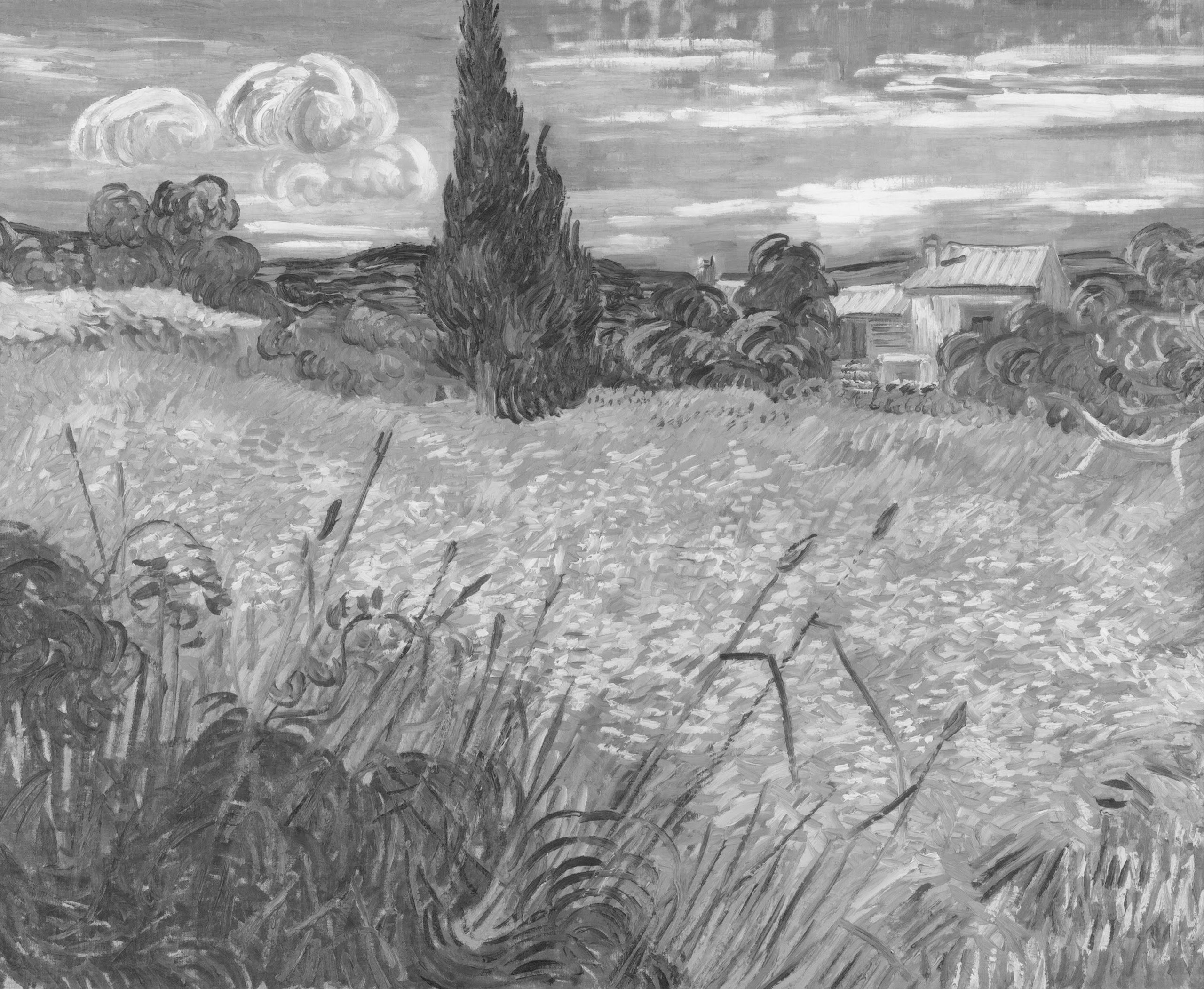
Yet a world without colour is one that forfeit’s crucial elements. While luminance provides the structure for a scene, colours allow us to see the scene more precisely. In the colour image above, it allows us to better differentiate the different greens of the grasses, and the blues of the sky. In the B&W image, the grasses are less distinct, the vibrancy in the green trees and bushes is absent, and there is very little differentiation between the colours of the sides and roof of the cottage. Of course we must always remember that colour is almost never seen exactly as it physically is. All colour perception is relative. The images below compare the luminance and chrominance information for the image above – the chrominance information is extracted from the HSB colour space, which incorporate the hue and saturation components. Note how it lacks the “structural” information which is bestowed by light and dark.


Is luminance more important than colour? In some ways yes, because of the way our eyes have evolved. Our eyes perceive light and dark as well as colour through rods and cones. Rods are very sensitive to light and dark (and help give us good vision in low light), whereas cones are responsible for colour information. But rods are more plentiful than cones. In the central fovea there may be about 20 times more rods (≈100-120 million) than cones (≈5-6 million). In reality, the details in what we perceive in a scene are carried mostly by the information we perceive about light and dark. So reality can be found in luminance alone, because even without colour we can still perceive what is in a scene (people with achromatopsia, which is a complete lack of colour, do exactly that).
But for most humans colour is an integral part of our vision, we cannot switch it off at will, in the same way that we engage a B&W mode in a camera. It allowed our early ancestors to see colourful ripe fruit more easily against a background of mostly green forest, and it allows us to appreciate the world around us.
Further reading:
Margaret Livingston, Light Vision, Harvard Medical Alumni Bulletin, pp.15-23 (Autumn, 2003)
 Crafting Pixels