There are a whole lot of contemporary super-fast lenses, but that is to be expected from modern optical technology. For example the Voigtländer 50mm f/1.2 Nokton E is still a simple 8 element lens, but contains two optical elements each with two aspherical surfaces, helping to reduce lens aberrations. The Nikon Nikkor Z 50mm f/1.2 on the other hand has 17 elements in 15 groups, with three aspherical and two low-dispersion elements (but at 150mm in length, and 1090g it is a true monster). These lenses are now commonplace, but what about their vintage counterparts?
By the mid 1950s, lenses with speeds of f/2 and f/1.4 were commonplace. Lenses with large apertures such as f/1.0 were also available for applications such as radiography and motion-pictures. Sub-f/1.4 lenses for the 35mm “miniature” cameras had also started to appear. The literature of the period, such as Popular Photography, wrote a series of articles over the years, investigating these new fast lenses. Many of these technology reviews were not damning, but neither were they an acclamation of a new era in photography.

The September 1955 issue included an article “The new superspeed lenses – how useful will they be”, by Bob Schwalberg [2]. Schwalberg describes the rumours that superspeed lenses with apertures of f/1.1 and f/1.2 were in the offing from three different Japanese manufacturers. He suggested that although an f/1.4 lens should mathematically pass 100% more light than an f/2 lens, the actual results are more like 50%. Using the pretext that actual light transmission is 50% of that indicated, he surmises that an f/1.1 lens would only be 30% faster than an f/1.4 lens, but maybe even less due to more elements, and an increased number of light absorbing light-to-air surfaces. These tests were made by comparing exposures at different apertures changing nothing else. Schwalberg concedes that the lenses would be good for use with colour film, however doubted whether the same could be said for black-and-white film. One of the reasons was the reduced depth-of-field, although he concedes it is no worse than for the f/1.4 but regardless both require very close focusing for sharp pictures.
Norman Rothschild described the Zunow 50mm f/1.1 lens in a 1956 article [4], putting the lens through a series of tests, and exploring whether the addition of new optical elements would effect the speed advantage of the lens. He used an exposure meter (Norwood Model A) taped to the back of a Leica M-3 to measure light-transmission of the Zunow, and two control lenses (f/2, f/1.8). The findings indicated that the readings for the f/1.1 proportionally higher than those for the f/2. He also performed a number of practical field tests. Colour photos made with the lens were found to be ”warm, or reddish, but not displeasingly so”. Rothschild questioned the practicality of the lens, with its shallow depth of field, but concluded that while focusing was challenging, it is “no more severe than a press photographer using an f/3.5 lens on a 4×5 camera”.
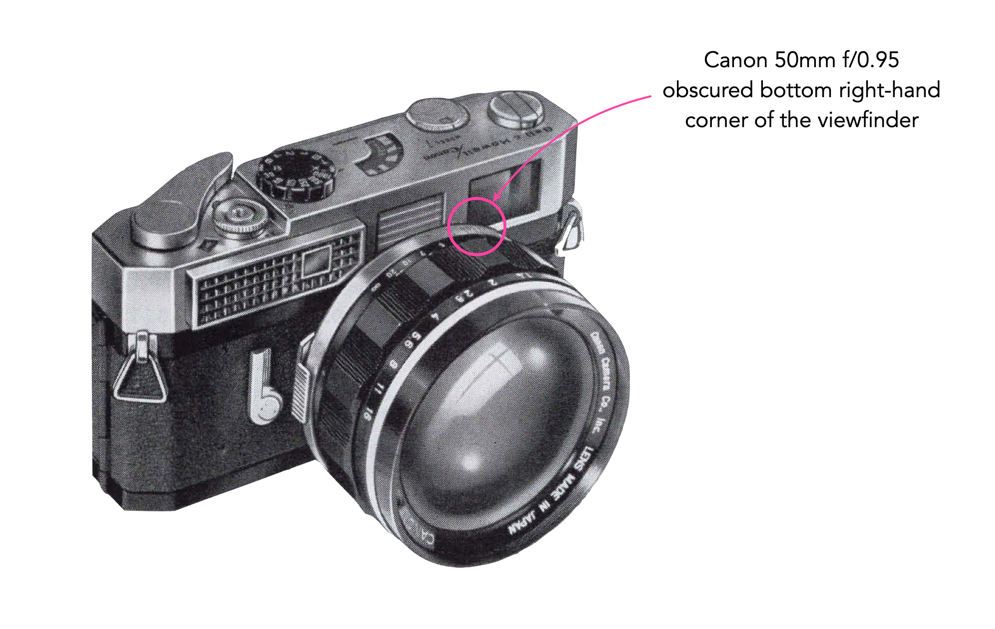
When asking why these lenses weren’t more popular during the period they were developed, there are likely a number of differing factors. Foremost was cost. Lenses such as 50mm f/1.2 may have tested the limits of both manufacturing processes, and price to consumer. Making lenses with apertures larger than this may have been an act of sheer folly, as is testament to the few that were manufactured. Development costs associated with these lenses were likely steep, as was the use of optical elements containing rare-earth metals, and ultra-precise manufacturing techniques. To all but the professional photographer, these lenses were prohibitively expensive (and still are). When these fast lenses started to appear there was as much skepticism than there was praise. In a follow up article in 1956, “Another look at superspeed camera lenses”, Bob Schwalberg made the following points [3]:
- The exposure gain obtained from f/1.1 and f/1.2 lenses was easier to obtain from additional development of f/1.4 and f/1.5 negatives.
- Apertures larger than f/2 were seldom used for B&W work, but would be advantageous in colour work.
- The reduced depth-of-field which limits the usefulness of f/1.4 and f/1.5 lenses at full aperture will further limit the usefulness of the f/1.1 and f/1.2 lenses.
- The lenses are large and heavy, sometimes obscuring the rangefinder and viewfinder windows.
- The lenses are “extraordinarily” expensive. A 50mm f/1.1 lens retailed for $3 more than a Leica M-3 with aa 50mm f/2 Summicron lens.
- Lens apertures greater than f/2 with a small amount of over-exposure can lead to drastic loss of definition and detail resolution. Tests shows that “at f/1.4 as little as 1/2 stop overexposure can kill sharpness”. Three times as much overexposure is required to produce the same ill-effects at f/2.
Schwalberg called it the “super-aperture problem”. He goes on to suggest that what was needed was not faster lenses, but better lenses, citing that film resolution was increasing to the point where lenses were not capable of producing.
In another Popular Photography article in 1956, it was suggested the ultimate value of f/1.1 and f/1.2 lenses was still a matter of conjecture [5]: “Speeds of f/1.4, f/1.5, and f/2, have long been with us and have proven extremely practical. Unless you are in the darkest, blackest, dingiest location, and unless every bit of shutter speed counts because of subject movement, it is highly advisable to limit black-and-white shooting to a maximum aperture of f/2.” The article cited a series of limiting factors that made photographers wary of the usefulness of sub f/2 lenses [5]:
- Depth of field – this only comes apparent at close distances, but a larger opening will result in a shallower DOF. A 50mm lens focused at 4ft has 3.5” of depth at f/1.5 and 4.75” at F/2. A smaller DOF will require more precision in focusing.
- The gain in light transmission is often less than can be expected. Light transmission is directly proportional to the square of the f-number. f/2 squares to 4, and f/1.4 to 1.96. Theoretically then, f/1.4 should transmit approximately 100% more light, however tests have shown that it is likely only 50-60%. The reasoning is that the more the diaphragm is opened, the more we depend upon light rays from the periphery of the lens. These rays enter at a steeper angle of incidence than those on the edges at smaller f-stops. There is therefore greater loss through internal reflection.
- The other issue is that apertures greater than f/2 require exacting levels of exposure. overexposure at f/1.4 can ruin crisp detail. Errors at f/2 are more forgiving.
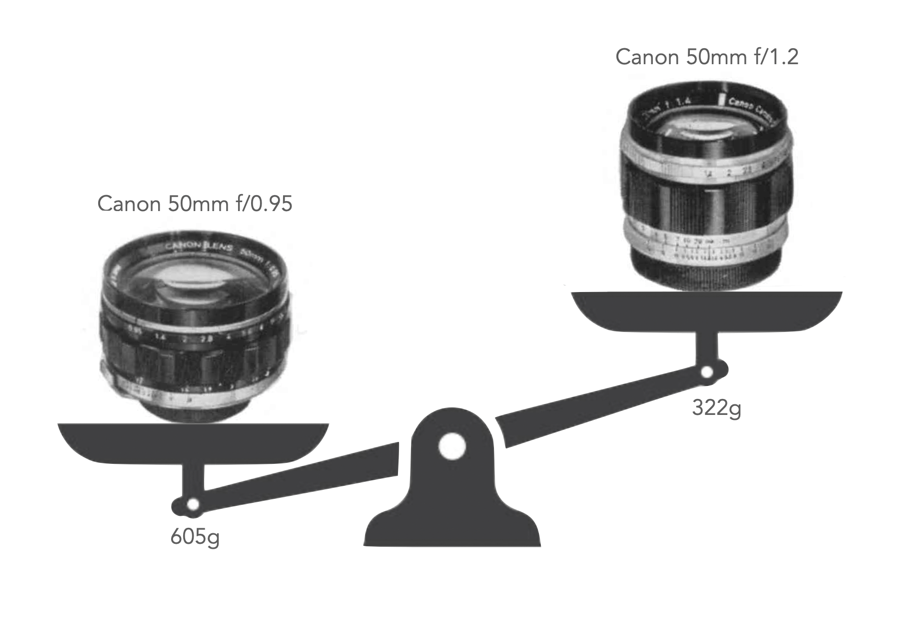
The other issue was weight – these lenses were heavy. The SMC Pentax 50mm f/1.2 (1975) was 385g, and had a maximum diameter of 65mm. The f/1.4 of the same era was only 266g, meaning the f/1.2 was a 45% increase in weight. When the Nikkor-N 50mm f/1.2 first appeared, its internal mount was problematic, with the mount not really able to support the weight of the lens, causing the mount to bend. In addition, the focusing wheel on the camera could not be used because it could not handle the weight of the lens. The weight of the lens was 425g, in comparison a comparable 50mm f/2 was around 200g.
There were many factors which contributed to the lack of interest in fast lenses. By the mid 1960s colour film was faster, and so there was less need for faster lenses. There were a number of f/1.2 options, but also many more options are f/1.4 at a much lower price point. So why bother purchasing a vintage sub-f/1.4 lens? One reason is for the character it provides, or for shooting in extreme low-light conditions. Why not to buy them? Mostly they are expensive.
Further reading:
- G.H. Smith, Camera Lenses: From box camera to digital (2006)
- Bob Schwalberg, “The new superspeed lenses – how useful will they be”, Popular Photography, 37(2), p.48 (September, 1955)
- Bob Schwalberg, “Another look at superspeed camera lenses”, Popular Photography (April, 1956)
- Norman Rothschild, “Meet the Zunow f/1.1”, Popular Photography, pp.126/128 (February, 1956)
- “The Versatile 50-mm Lens”, Popular Photography, 39(2) pp.40,41,84 (August, 1956)
 Crafting Pixels
Pingback: Why are superfast aperture lenses so big? | Crafting Pixels