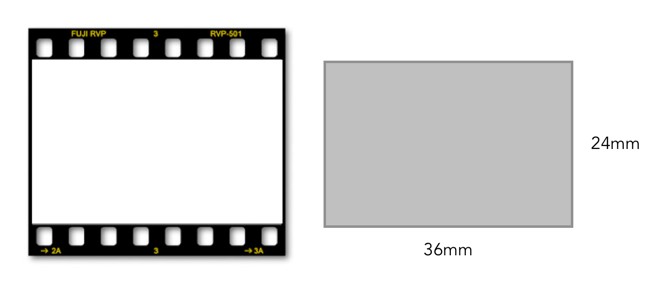
Now that we have looked at the origin of 35mm film cameras, let’s turn our attention to full-frame sensors. A full-frame sensor is so named because the sensor is 24mm×36mm in size, equivalent in size to a film frame in a film camera. Why are we basing new technology on old concepts? Mostly for posterity’s sake, because why fix something that isn’t broken? The 24mm×36mm size first appeared in the early 20th century, and eventually became the standard film “frame size”. When the transition to digital occurred, keeping the image size the same meant that photographers could easily transition the use of legacy lenses onto digital bodies. The 35mm format became the reference format. Full frame is now the largest consumer sensor format before medium format (like the Fujifilm GFX100).
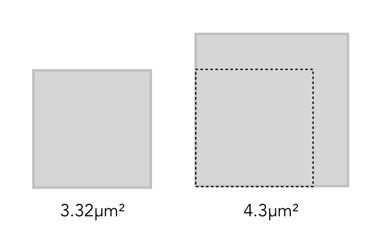
The size of a full-frame sensor has a significant impact on image quality. The large surface area means that more light can be gathered by the sensor, which is particularly beneficial in low-light conditions. The photosites often have a large pitch (more commonly referred to by manufacturers as the pixel pitch), it provides a broad dynamic range, and good low-light/high ISO performance. For example, the Leica SL2 (47.3MP) has a pixel pitch of 4.3μm, whereas the Olympus E-M1 (MII) with a MFT sensor has a pixel pitch of 3.32μm. When the area of a photosite is calculated, a photosite on the SL2 is 68% larger than one on the E-M1.
The downside of a full-frame sensor is that camera’s must be larger to accommodate the large sensor.Larger cameras mean heavier cameras.
 Crafting Pixels