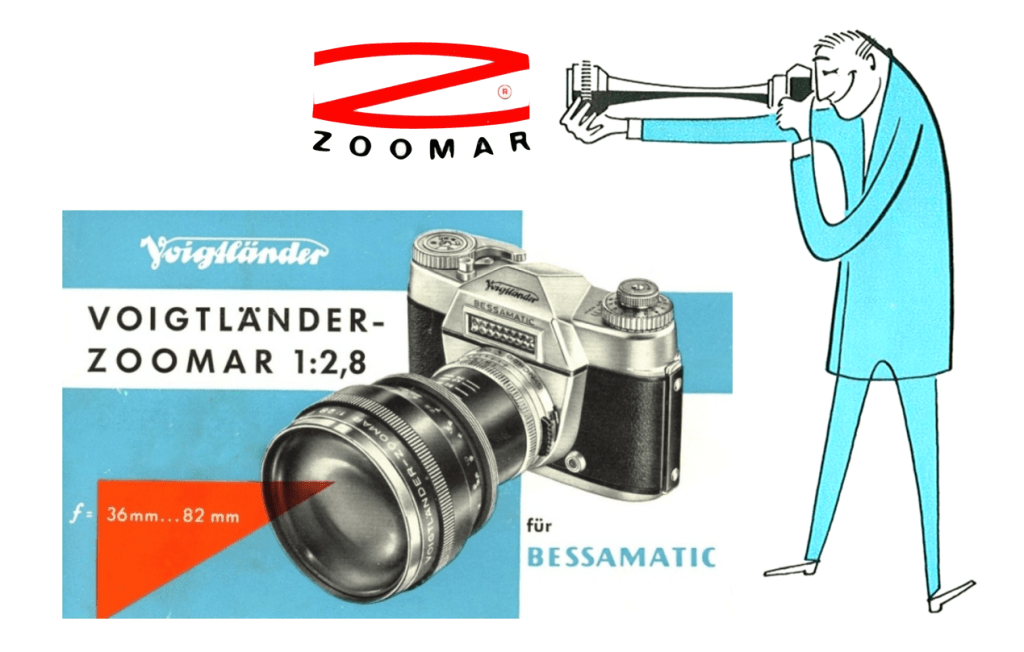
Historical accounts of who actually invented the zoom lens differ. But its adaptation to the SLR is down to one person – Frank Gerhard Back. He designed the first zoom lens for 35mm cameras – the Voightländer Zoomar. Before the Zoomar saw the light of day, designs with adjustable focal lengths were called varifocal lenses or rubber lenses.
“A great number of optical problems have been overcome in this lens. It is a splendid achievement. It zooms – what other still lens does?”
Look! A real zoom lens for your 35mm, Herbert Keppler, Modern Photography (May, 1959)
Back was born in Vienna, Austria in 1902. He attended the Technische Hochschule of Vienna where he received a masters in mechanical engineering in 1925, and a doctorate of science in 1931. From 1929 to 1938 he worked as a consulting engineer during which he was employed by Georg Wolfe, a manufacturer of endoscopes. In July 1939, he emigrated to the United States. After working for various companies in New York City, he started his own company in 1944, Research and Development Laboratory. In 1945 he started Zoomar Inc. where he developed and patented an optically-compensated zoom lens for 16mm television cameras (1948), and one for 35mm SLR cameras by 1959. From the late 1940s through to the 1970s, Back introduced new innovations for television, motion, picture, film photography, astronomical, and numerous other applications. On 25 October 1946, Back presented a new type of variable focal length lens to a convention of the Society of Motion Picture Engineers (SMPE) in Hollywood, California. The lens, sometimes known as the could zoom from 17 to 53mm, and contained 22 lens elements. It was 12” in length, weighed 790 grams and had an aperture range of f/2.9-f/22 [3].
Zoomar lenses disrupted the market for American television camera lenses, and likely were the catalyst in making zoom lenses ubiquitous in the industry. Back’s Zoomar lens had a substantial impact on both the motion picture, and television industries in the years following. It gradually made the “practice of “zooming” a more desirable, acceptable, and practical technique, in turn spurring demand for zoom lenses suitable for feature film use, with higher optical quality and greater zoom ranges. By 1954 a more compacts version of the “Zoomar 16” appeared – 5” in length, and weighing 570g it now had a zoom range of 25-75mm. It is not surprising that the concept would eventually spill over into the still camera industry.
In Back’s design, four of the lens’s 14 elements (the lenses in groups 2, 3, and 6 move linearly together to allow for focal length changes) move from 36mm to 82mm. A ×2.3 range from 36mm to 82mm allowed the lens to retain a reasonable speed of f/2.8, good image sharpness, and optical anomalies kept to a minimum (something earlier varifocal lenses could not achieve). The use of the word “zoom” likely derived from the Zoomar name. The lens used a push/pull mechanism to change focal length, whereby the change of focal length happens when the photographer moves the ring towards the mount or backwards.

Optically, the Zoomar 36-82 was a great breakthrough, made possible according to Dr. Back by new rare earth element glasses (Lanthanum) and computer aided optical designs. Back filed two patents in 1958 [6,7], one for optical design, and another for mechanics, likely at the same time production was already gearing up. Starting in 1959 the German optics firm Heinz Kilfitt would build the lens, under contract with Voigtländer for their Bessamatic SLR. The Voigtländer Zoomar was presented to the public on February 10, 1959 at the International Camera Show in Philadelphia (the same show that introduced the Nikon F and Canon Canonflex). Back would file another patent relating to an improved optical design in 1959 [8]. This optical design modified the rear lens elements, both in the type of element, and the material from which they were constructed.

By the late-1950s, Zoomar was to have some legal issues regarding its patent, fighting a patent battle with Paillard Products, the US subsidiary of Swiss company Paillard-Bolex, which had been importing French zoom lenses. In 1958 the New York Southern District Court ruled that Back’s patent overreached by appearing to cover all zoom lenses of any design. Zoomar eventually reduced its R&D of new lenses in favour of promoting foreign-made lenses – Back purchased Heinz Kilfitt in 1968 (catalog).
“The Voigtlander-Zoomar is the only Zoomar lens for still cameras. This model, with fully automatic diaphragm, is designed expressly for use with the Bessamatic Camera. A high-precision varifocal lens, in focus at all focal lengths from 36 to 82mm, it enables the photographer to shoot continuously at variable focal lengths without changing camera position.”
Description from the manufacturer.
The lens was produced from 1959-1968, with a total of only 15,000 units being built. Today the Zoomar 36-82 f/2.8 is often associated with the Voigtländer Bessamatic SLR. However the Zoomar was introduced from day one in both the DKL (Voigtländer) and Exakta mounts. Later it was also produced in other mounts, including the ALPA, and an M42 mount for the East German cameras like the Ikon Contax S. By the early 1960’s there were more zoom lens options, mostly in the telephoto zoom realm. None were anything special when compared to prime lenses, as they often had increased distortion and less contrast, but these were often overlooked because of the “newness” of the technology. It is still possible to find these lenses today, with prices in the range of C$700-1200 for lenses in reasonable condition.
✽ The Zoomar actually had a doppelganger – the Russian Zenit-6 camera came standard with a zoom lens called the Rubin-1. It wasn’t exactly the same, the focal length is shorter at 37-80mm and both had different zooming mechanisms.
Further reading:
- Hall, N., “Zoomar: Frank G. Back and the Postwar Television Zoom Lens”, Technology and Culture, 57(2), pp.353-379 (2016)
- Herbert Keppler, Bennett Sherman, “Zoom for you 35mm”, Modern Photography (May, 1959)
- Back, F.G., “The Zoomar Lens”, American Cinematographer, 28(3), p.87,109 (March, 1947)
- Back, F.G. et al., US Patent No.2,732,763, “Varifocal Lens Constructions and Devices”, assigned Jan.31, 1956
- Back, F.G., US Patent No.2,454,686, “Varifocal Lens for Cameras”, assigned Nov.23, 1948
- Back, F.G., US Patent No.2,913,957, “Varifocal Lens Assembly”, assigned Nov.24, 1959
- Back, F.G., US Patent No.2,902,901, “Reflex Camera Varifocal Lens”, assigned Sep.8, 1959
- Back, F.G., US Patent No.3,014,406, “Varifocal Lens Assembly for Still Camera Photography”, assigned Dec.26, 1961
- Roe, A.D., “The Zoomar Varifocal Lens For 16mm Cameras”, American Cinematographer, p.27,50 (January, 1954)
- Keppler’s Vault 94: The History of Zoom Lenses (2021)
 Crafting Pixels