Prime vs. zoom lenses − Help with choosing a lens

Trying to choose between a zoom and a prime lens can be challenging, mainly because they probably shouldn’t be compared in the first place. Basically they offer different outcomes. A prime is almost a lens specialized for a particular task, whereas a zoom can be more of a “jack-of-all-trades”. There are also different types of each of these lenses. There are expensive fast primes, and less-expensive primes with a slower maximum aperture. There are also native primes from the camera manufacturer, and third-party primes. The same criteria can be applied to zoom lenses. Table 1 summarizes some of the key differences between prime and zoom lenses.

characteristicprimezoom
price+ simple build, less expensive− complex build, more expensive
aperture+ brighter, wider aperture (faster)
e.g. f/1.2 to f/2
− darker, narrower aperture (slower)
sharpness+ sharper images, fewer optical deficiencies− less sharpness, some distortion
versatility− less versatile+ more versatile
size and weight+ lighter and more compact
− have to carry more lenses
− bulkier and heavier
+ need to carry fewer lenses
Table 1: Key differences between prime and zoom

A zoom provides a level of flexibility that a prime does not, but this comes with some trade-offs. The first thing a zoom lens typically gives up is speed, i.e. how wide the aperture opens up. Prime lenses on the other hand are fast, and some are super-fast. Note that prime lenses are nearly always smaller and lighter than zooms. Many things influence the size and weight of a lens including whether it is a pro-grade lens (often contain more glass), or whether it has a large maximum aperture (again requiring a bigger lens with more glass). Every lens has its pros and cons.
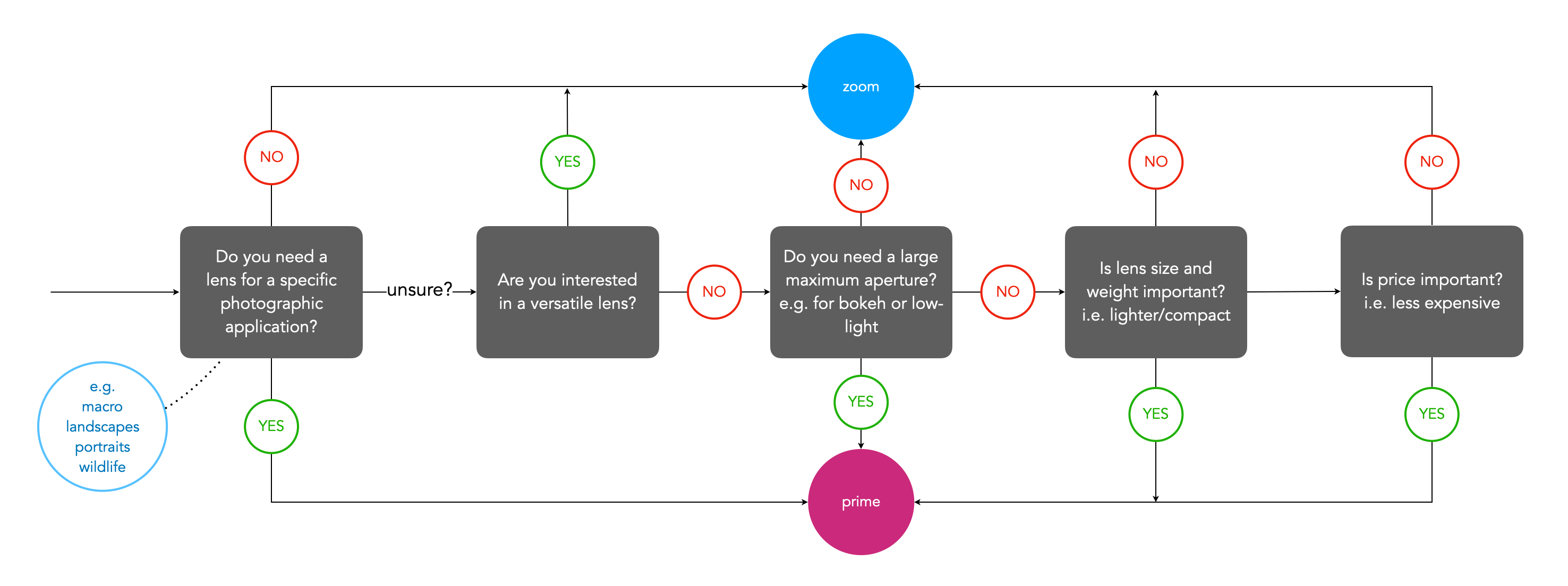
Fig.1: A very basic schema for choosing a prime or zoom lens

Despite the fact that prime lenses are often lauded for their specific nature, i.e. suited to one particular task, zoom lenses can also be categorized in this manner. For example someone might choose a 17-28mm full-frame lens for landscapes, providing some scope. In addition, although a good zoom lens may be more expensive than a prime, more prime lenses may be needed to equal the range of coverage, thereby leading to more cost. There are also some lenses that don’t work very well as a zoom, e.g. fish-eye lenses.

When selecting a prime lens it is often the case of deciding on an application, and then which lens meets all the criteria. For example, a trip to Iceland may warrant a wide-angle lens that is weatherproof (because the weather can change every 5 minutes in Iceland) − in this case something like a 24mm ultra-wide would be optimal. Alternatively, some photographers might opt for even a wider lens, e.g. 16/18mm due to the ‘largeness’ of the landscape. Choosing a zoom lens on the other hand can be a little more challenging. This is because there are often a variety of options. For example, choosing a 50mm prime means you get a 50mm lens, with perhaps the only variability being the speed (maximum aperture) of the lens. But there may be more than one option for choosing a particular zoom lens. Figure 2 shows a flowchart which considers some of the main factors to consider when choosing a zoom lens.
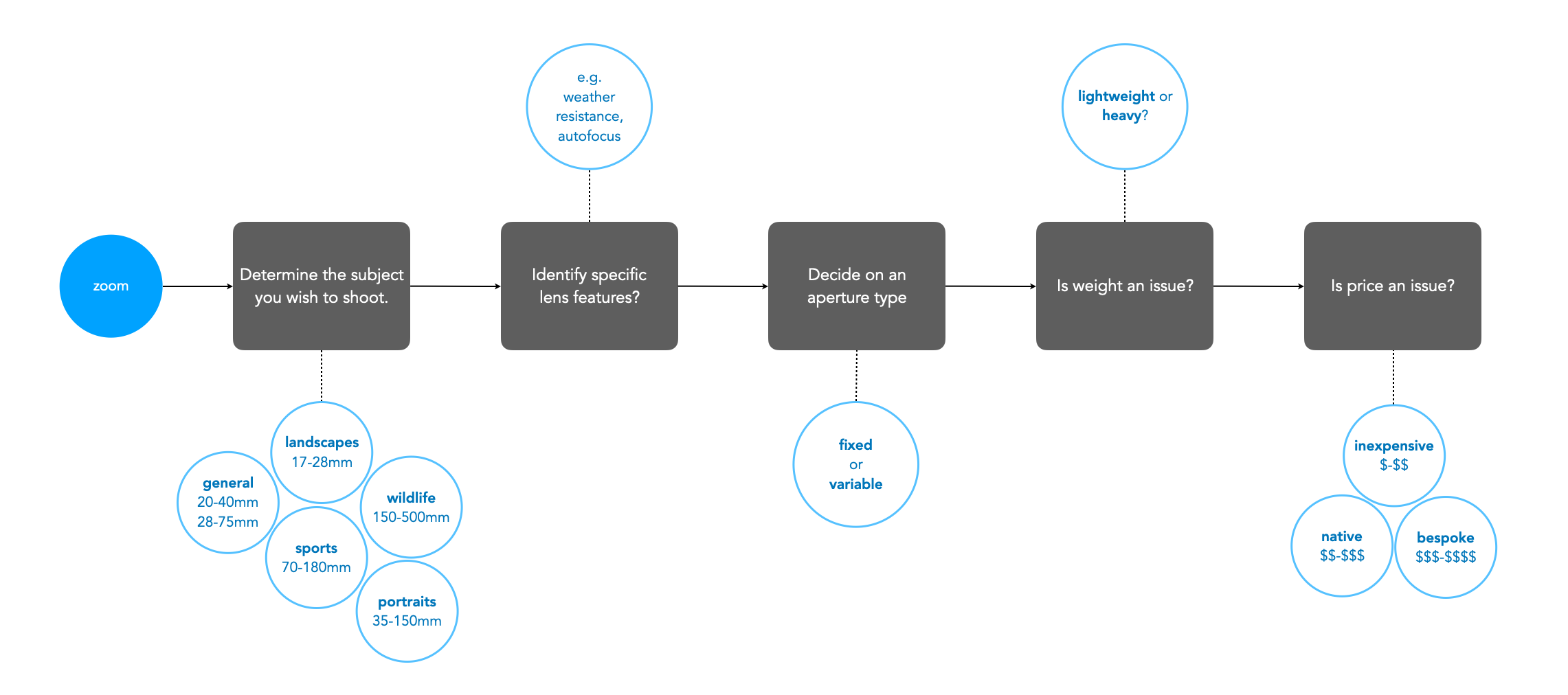
Fig.2: Factors to consider when choosing a zoom lens

Figure 3 shows an example of choosing a wide zoom lens for a Fuji-X camera (APS-C), using the above factors. There isn’t that much difference between the lenses with respect to AOV (angle-of-view), but as each factor is considered, more lenses are filtered out. At the end only three of the five lenses satisfy the criteria considered, and then it comes down to price. If we were choosing this for the trip to Iceland then we might want the greatest flexibility in focal lengths, for example the Fujifilm 10-24mm (FF equivalent 15-36mm). If maximum aperture is an issue, then either the Tamron or Sigma are fine alternatives.
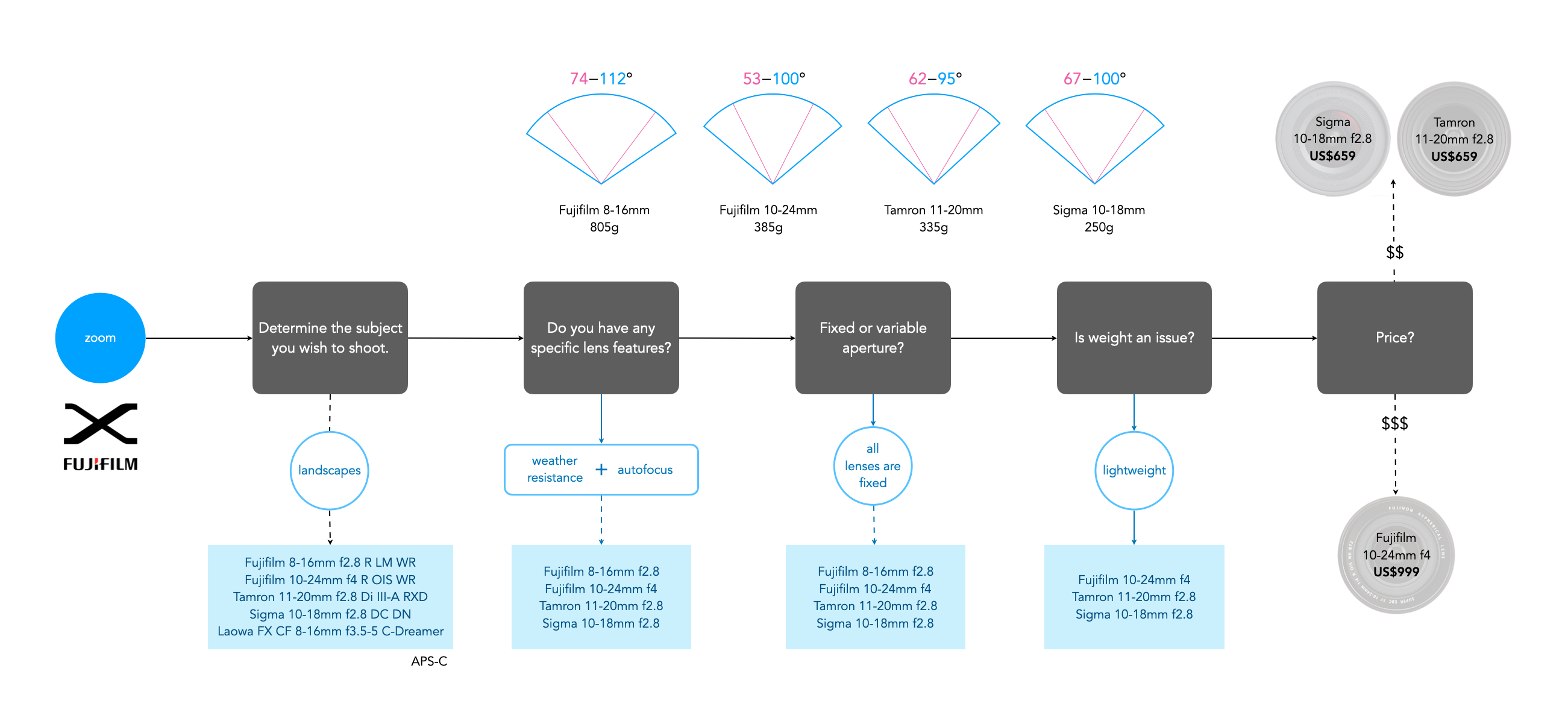
Fig.3: An example of choosing a Fuji (wide) zoom lens for landscape

There are some situations where one lens is just enough. Mountain enthusiast Jakub Cejpek talks about using the Fujifilm XF10-24mm/F4 on a mountain trek. He chose mirrorless for its ‘lightweight style’, and the 10-24mm lens for its versatility, knowing that changing lenses in impossible, ‘time is rare, and weather conditions are tough’.
Prime vs. zoom lenses − Is one better than the other?

One of the biggest dilemmas for novice photographers when choosing a digital lens is whether you buy a prime or a zoom? This is an age old debate, probably dating back to the 1970s when zoom lenses started to make real inroads into the SLR lens market. Back then zoom lenses were at a major disadvantage from a quality perspective, but over time they have improved in quality, and proliferated in quantity. Here we look at the major differences between the two.

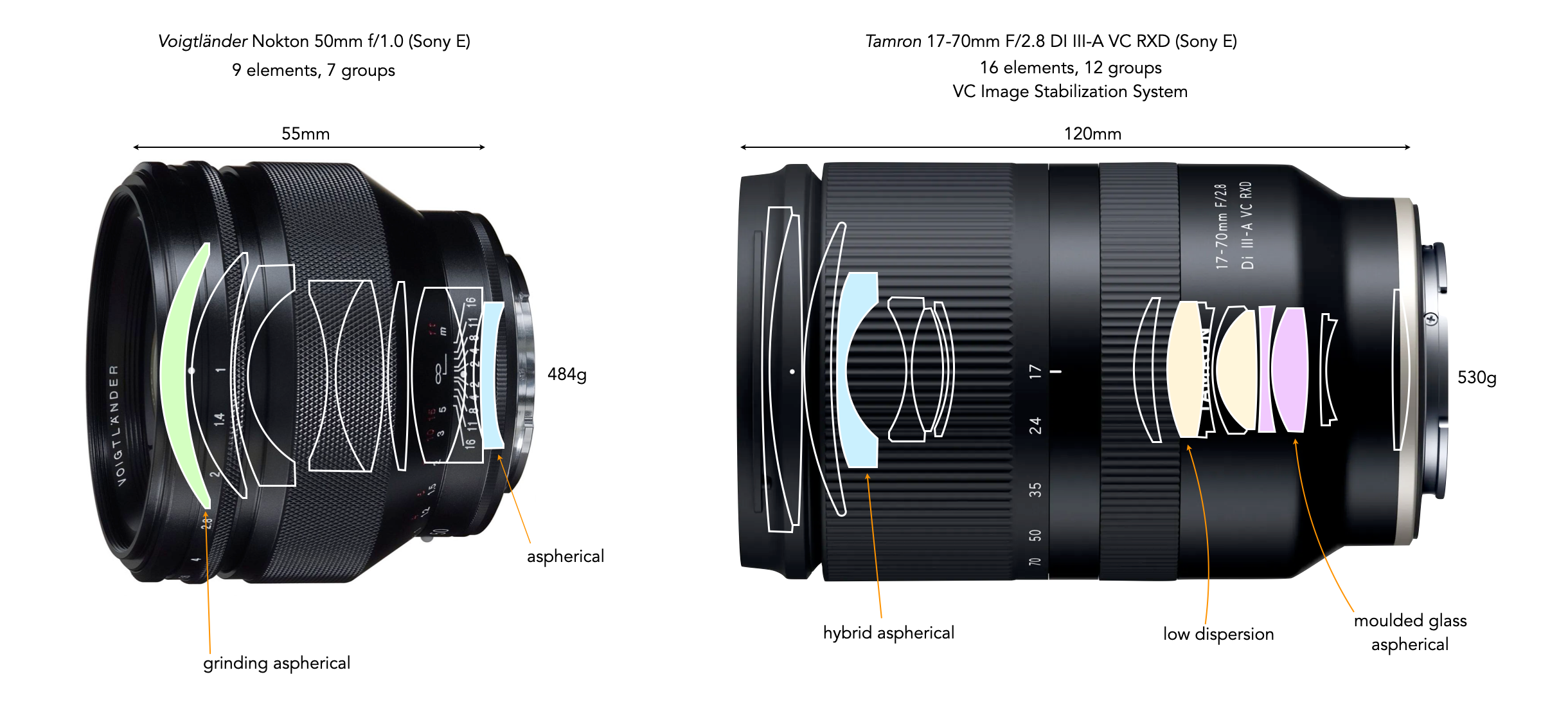
Fig.1: A comparison of a modern prime (50mm normal) versus a modern zoom lens (wide-to-short telephoto, 17-70mm), both full-frame.

Zoom lenses

A zoom lens is a lens designed with a variable focal length. This allows the lens to be modified to any focal length between the specified range, meaning the angle-of-view (AOV) of the lens will change with the focal length. For example 16-80mm means the lens is widest at 16mm, and at full zoom at 80mm. There are zoom lenses that are narrow in focus, e.g. wide-angle zooms where the zoom range covers wide-angle focal lengths, and there are others that are more broadly scoped, e.g. 17-300mm, covering wide-angle all the way through medium length telephoto. Some zooms have a fixed aperture, i.e. one maximum aperture, others have a variable aperture which changes with the focal length selected, e.g. a 28-60mm f/4-5.6 means that 28mm the aperture is f/4, while at 60mm the aperture is f/5.6.

Many cameras come standard with a kit lens which is typically a zoom. For example Fuji-X (APS-C) often pairs a 15-45mm zoom (f/3.5-5.6), with covers a horizontal AOV of 77.32° to 29.8° − wide angle to low-telephoto to cover from landscapes to portrait shots. Other Fuji cameras are paired with 16-80mm or even 18-120mm. Note that the downside to kit lens, is that they are typically of lower quality.

Pros:

  • Versatility − Zoom lenses offer a lot of flexibility, allowing the focal length to be changed on-the-fly (so there is no need to swap-out lenses). This makes them ideal for situations where there is a need to quickly adjust the framing.
  • Convenience − There is no need to carry multiple lenses to cover different focal lengths.
  • Discretion − A scene can be captured without having to get too close. Using one lens also means it may not be necessary to carry a camera bag.
  • Portability − A single zoom lens can replace 2-3 prime lenses. This means less weight to tote around, and less lens swapping, so although the zoom may weigh more, it may be less than the sum of primes.

Cons:

  • Optical quality − Zooms can sometimes be less sharp than primes because of their complex, variable nature. However the gap between the quality of zooms versus primes is narrowing. An expensive zoom is likely to have better optical quality than a cheap one.
  • Aperture − Professional zooms have a maximum aperture of around f/2.8, or even f/4, making them less than optimal for low-light situations, i.e. slow.
  • Price − Zoom lenses can be expensive, because the zoom mechanism and lens configuration can be complex. Kit zooms are cheap, the Fuji-X 15-45mm is around C$325. The Fuji-X 16-80mm is C$880. Wide zooms can be even more expensive with the Fuji 10-24mm going for C$1050.
  • Weight − Generally quality zooms can be heavier than primes because the lens body is physically larger, and there are more complex mechanisms inside, e.g. auto-focusing motors.
  • Lens selection − Some platforms do not offer that many zoom lenses. For example there are a lot of third-party lenses in the Fuji-X environment, however most are prime lenses (probably due to the lower cost). Apart from Fuji native zooms, the only real competitors are Sigma and Tamron.
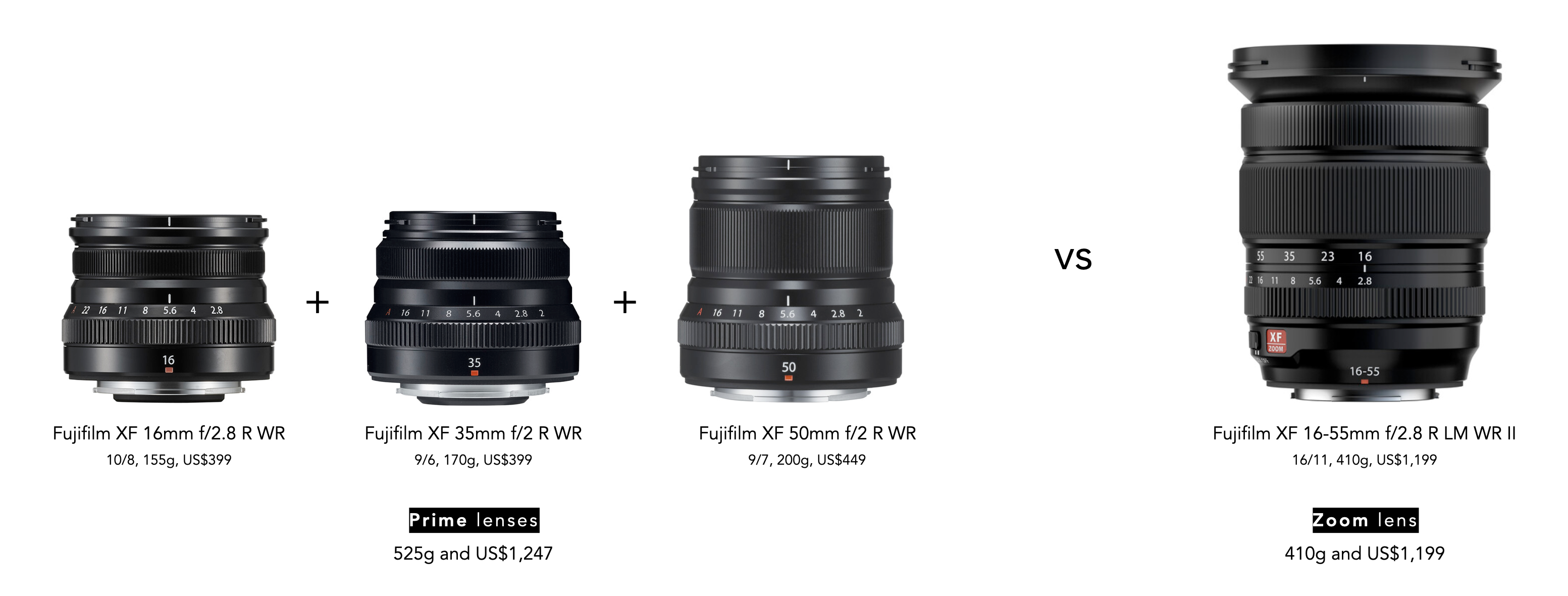
three prime lens compared to an equivalent zoom lens
Fig.2: A comparison of a 16-55mm zoom lens with three ‘equivalent’ prime lenses to covert the same range of focal lengths (note that the closest to a 55mm prime is a 56mm f/1.2 which puts it outside the bounds of comparison from the perspective of aperture).

Prime lenses

A prime lens is a lens with a fixed focal length, meaning it cannot change. It has an AOV that is set, so making an object fill more of the frame requires getting closer to the subject. For example a 16mm Fuji-X prime offers a horizontal AOV of 73.74°, no more, no less. So to enlarge a subject and make it fill more of the frame, the camera has to be moved physically closer to it. To make a subject fit a frame, the camera must be moved away. In terms of prime lenses, a wide angle might be 28mm, a normal lens 50mm, and a portrait lens 85mm (full frame). In comparison a 28-85mm zoom lens offers all these focal lengths (and many in between) in a single lens. Prime lenses are typically fast, with maximum apertures of f/1.8, f/1.4 or even f/1.2 (or faster).

Pros:

  • Optical quality − Prime lenses are focused on one focal length, and as such often have better optics. This includes having a better depth of field, sharpness, and rendered bokeh. Better optics = better image.
  • Aperture − Prime lenses are faster than zoom lenses, i.e. they have larger maximum apertures than zooms. They can have apertures as wide as f/0.95, but typically they are between f/1.2 and f/2.8. This makes them better in low-light situations, and helps them produce a shallower depth-of-field. This often negates the need for a flash or high ISOs that can introduce noise.
  • Focusing speed − Auto-focusing generally works a little faster on prime lenses.
  • Price − Prime lenses have fewer moving parts and as such can be less expensive. The caveat here are specialty lenses, superfast lenses e.g. f/1.2, and super-telephoto lenses. Prime lenses have the same range of cheap “kit” to expensive high-end lenses, but often it is possible to purchase a good prime for a reasonable cost. Note that superfast lenses can be significantly more expensive than their f/1.8 counterparts.
  • Compactness/Weight − Many normal prime lenses are generally lighter and more compact than zoom lenses.
  • Bokeh − Wide apertures provide a shallow depth of field, which makes primes ideal for taking portraits and artistic shots containing the coveted background blur known as bokeh.

Cons:

  • Limited versatility − Prime lenses only have one focal length, so it might be necessary to carry more than one lens to cover a gamut of scenarios. Adjusting a composition will require moving towards or away from the subject.
  • Inconvenience − With prime lenses it may be necessary to carry multiple lenses to cover different focal lengths. This impacts how much needs to be carried in the field.
  • Discretion − Carrying more than one lens might require changing lenses on-the-fly, because different lenses may be used for different scenes. A camera bag might be a requirement.
  • Portability − While a zoom lenses can replace a number of prime lenses, working only with primes may require carrying 2-3 lenses with different focal lengths. This means more weight to tote around, and more lens swapping.
  • Weight − There are circumstances where primes can be heavy, e.g. super-fast lenses often require more glass, which makes them heavier than other primes, and telephoto lenses can be larger and heavier than telephoto zoom lenses.

Choosing between a prime and a zoom lens really depends on photographic priorities, i.e. what is needed in a particular situation. Zoom lenses can be hard to use well for the inexperienced photographer − e.g. they often stay in one position, and zoom to capture everything, versus using a prime lens where you are forced to move in order to gain photographic perspective. Every optical design has its strengths and weaknesses, but as a prime lens is optimized for a single focal length in many cases it has a greater capacity for fewer weaknesses and more strengths. This may include characteristics such as: image quality (contrast, sharpness, distortion, flare control), colour aberrations, lens speed, size and weight, focusing ability, focus shift, etc.

Choosing lenses for travel

I previously covered choosing a camera for travel, now I thought I would provide some insight into choosing lenses for travel, in the context of an amateur photographer. There are many varied opinions on this travel photography, although I have to believe some come from photographers who aren’t really amateurs. This post speaks more to the traveller, who I consider distinctly different to the tourist. The tourist is a person who is just there to take photographs, with little interest in knowing the story behind the objects in the scene. They just care that they photographed the scene. The traveller is intrinsically interested in what they photograph. There are many forms of tourist ranging from the person who takes photos with an iPad to that annoying person who is fully decking out with a full-frame camera with the largest zoom lens available.

Travel photography, at least for the amateur, can suffer from what is commonly known as overpacking. You think you are going to need a bunch of lenses and accessories, and you end up with a bag overstuffed with gear. From my own experiences, you never end up using half of it. More important may be a couple of lenses for the large camera, and a secondary pocket-size camera, something like a Ricoh GR III. This ancillary camera is perfectly suited to street photography because it is designed to do just that, in a more discrete way (and offers macro as well). But back to the lenses. The reality is that you likely only need 1-2 lenses, or if you prefer zooms, a single lens.

The best travel combo is a normal and an ultra-wide lens

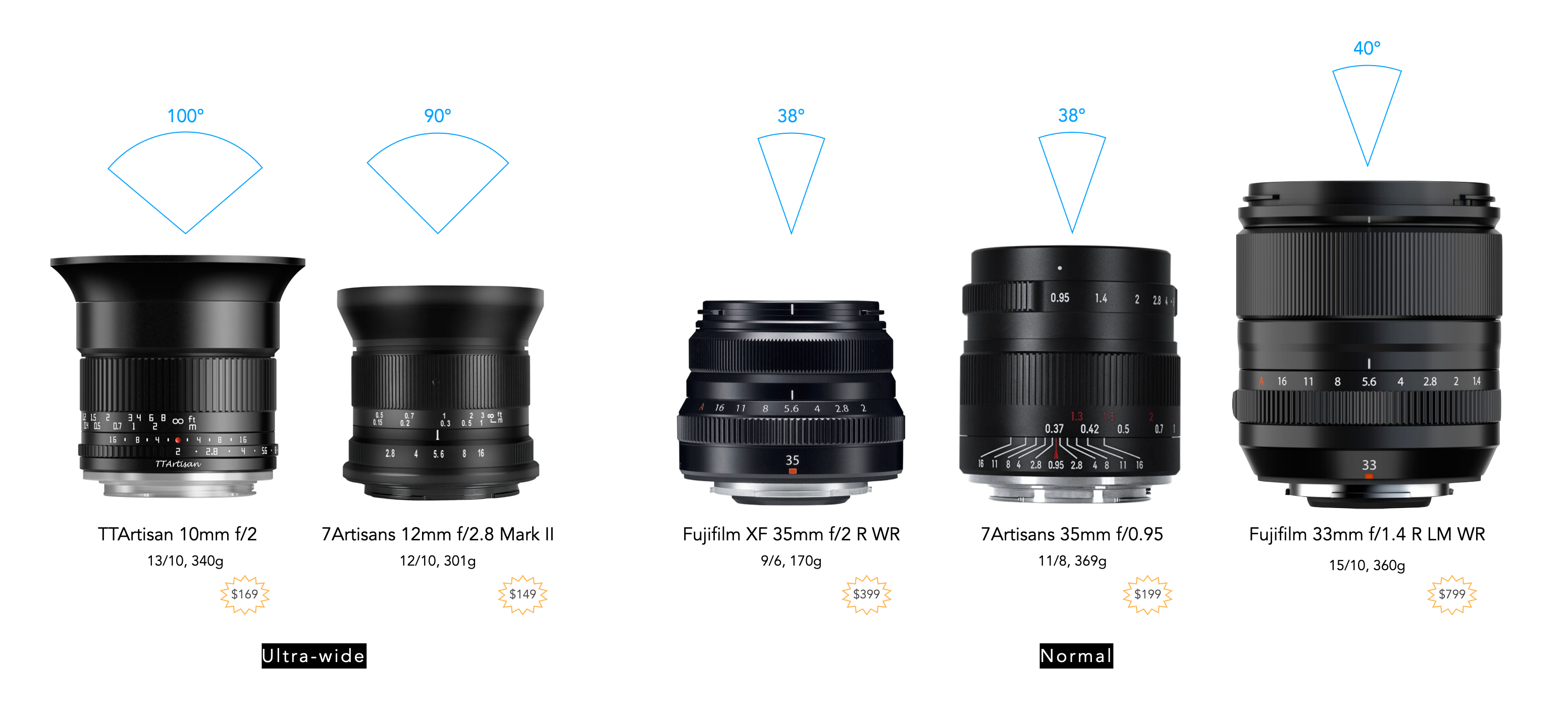
When you travel, you are trying to replicate in photographs what you see with your eyes. This means a normal lens, something in the range 40-55mm (or 26-36mm for APS-C), which provides roughly the same perspective as you see with your own eyes. A normal lens is good because it is inconspicuous, often quite compact, and quite adaptable to street photography. The faster normal’s also have the added benefit of performing well in low-light conditions, for example museums where flashes are often prohibited. For example with the Fuji-X system, a good choice might be a 35mm f/2 R WR, which provides a low-cost, weather-resistant normal lens (US$400, 170g), or the faster 33mm f/1.4 R LM WR (US$800, 360g).

Fig.1: Choices for ultra-wide and normal lenses (Fuji-X)

Travel general involves scenes that are expansive, whether that is natural landscapes, streetscapes or simply photographing in tight spaces. The best lenses replicating this immersive experience in photographic form is an ultra-wide-angle lens. There are many situations, especially in older cities, where an ultra-wide angle lens helps transform a simple street into a dramatic scene. This means lenses in the range of 15−20mm (10−13mm for APS-C). Some Fuji-X choices for normal and ultra-wide lenses are shown in Figure 1.

Here are some of the things to consider when choosing a lens for travel photography:

  • weather-resistance − Not every day is sunny when travelling, so having some protection against moisture and dust is a good idea.
  • auto-focus + manual focus − Auto-focus makes taking photography easier, especially as the window for taking a shot can be limited. It’s also nice to have some control over more artistic shots with the option of manual focus.
  • a reasonable large aperture, good for low-light − Nobody wants to lug a flash around when touring, as it can be somewhat invasive.
  • compact enough to fit in a pocket − For a secondary lens, it’s handy just top be able to fit it in a pocket, or small bag.

This isn’t the telephoto you’re looking for

Some will argue that a telephoto while travelling is a must-have, helping to capture scenes that are physically out of reach, I would argue the opposite. On most trips, telephoto lenses just aren’t needed. They might be great for a safari, but traipsing through the alps, or the streets of Rome, there is little need for a telephoto. There may be some shots you won’t get, particularly those in the distance, but frankly travel is about immersing yourself in the immediate surroundings. There wouldn’t be much point in taking a photo of a Roman statue from a distance.

A zoom lens for those who want a single lens

For those who prefer a single lens, then the answer might be a zoom lens. Firstly, avoid the superzoom lens – these are cover everything from wide to ultra-telephoto providing a broad range of focal lengths. These offer exceptional flexibility, but at the expense of being heavy, which can impact travel portability. In addition they often just aren’t wide enough. For example Tamron makes a 18-300mm lens for Fuji-X cameras (f/3.5-f/6.3), which covers everything really – in terms of FF this is 27-450mm. That’s a *lot* of lens. But the lens is 620g, which is heavy, well heavier than I would want to lug around everyday, and at f/3.5 it is kind-of slow. Besides which, based on the previous discussion, there is little need for a telephoto zoom when travelling.

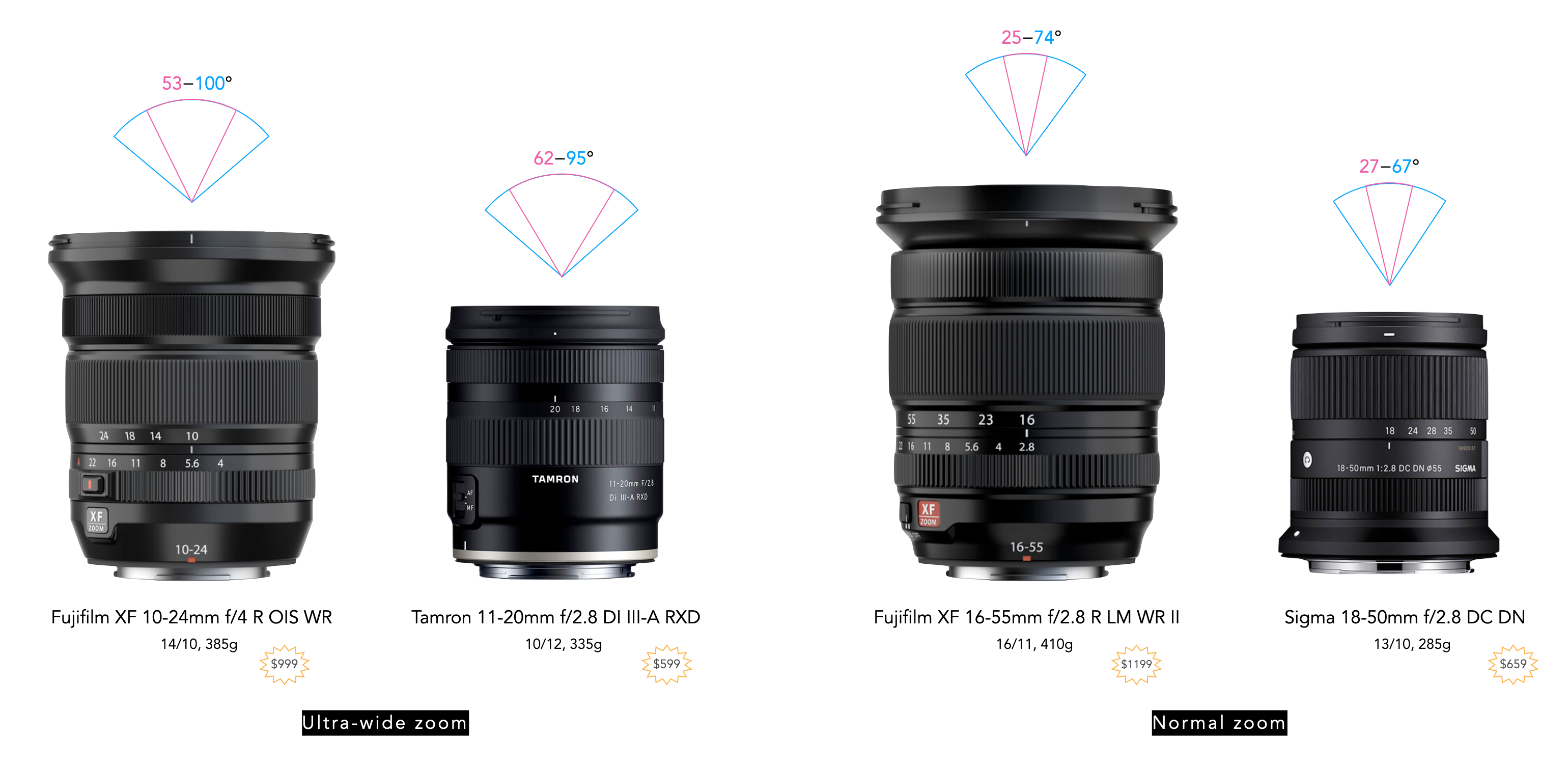
Fig.2: Choices for ultra-wide and normal zoom lenses (Fuji-X).

If you only want a zoom lens, stick to one which encompasses wide, normal, and perhaps portrait – for Fuji this would be something like a 16-55mm (24-82.5mm FF), considered by some to be the “Swiss Army Knife” of lenses. Or perhaps the lighter, less expensive Sigma 18-50mm (27-75mm FF). Figure 2 shows a series of potential zooms for Fuji-X, all of which are autofocus (generally for Fuji-X, the only autofocus lenses are restricted to Fujifilm, Sigma and Tamron lenses).

Artisanal lenses

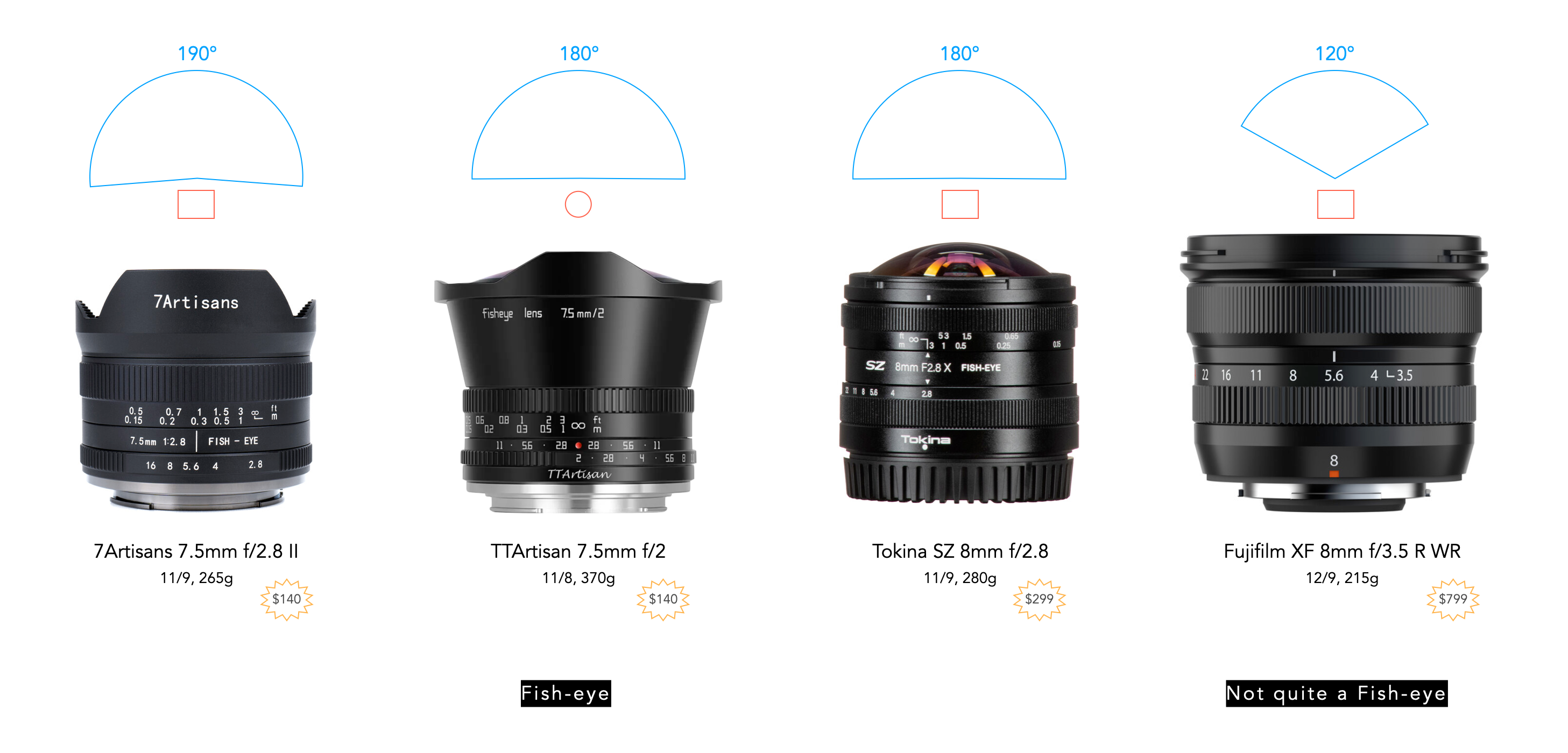
Another interesting lens to take along is a fish-eye lens, allowing for the creation of whimsical and fun travel photographs. A fish-eye is the wider alternative to the ultra-wide, and generally comes in a circular, or diagonal format. Both these formats generally exhibit some form of distortion, hence the reason they are usually used in a more artistic way. They are also perfect for photographing large, cavernous spaces, i.e. those whose grandeur would not be represented clearly by any other lens, e.g. cathedral ceilings. What about distortion? Consider it part of the art. Figure 3 shows some fish-eye choices for Fuji-X.

Fig.3: Choices for fish-eye lenses (Fuji-X)

The final choice?

In many cases you will end up using a single lens for 80-90% of the time. What that lens is, is really up to the needs of the photographer. What if you had to choose only one lens to take long on your travels? Some people photograph an entire trip entirely using a 35mm lens (APS-C 23mm), others may choose a versatile zoom. Or perhaps the best option is to compact zoom, and a wide aperture normal, e.g. 35mm f/1.4 (APS-C). A 35mm lens (23mm APS-C) is suitable for most landscapes, and covers most aspects of daily life encountered in street photography. For example the Fujifilm 23mm f/2 R WR is compact, lightweight, and has a horizontal AOV of 55°, which is reasonable. On the downside, low-light situations aren’t fantastic, and close-up shots can be soft. But it is weather resistant, less expensive than one of Fuji’s top lenses, and is fast to focus. Everything is a compromise.

Many people will push native lenses only, e.g. Fujifilm – it’s not necessary, there are many good 3rd party lenses, the only caveat being that many are manual focus only.

N.B. Prices are in US$, and AOV’s shown in the figures are always horizontal.

Further reading:

Zoomar – the first zoom lens for 35mm cameras

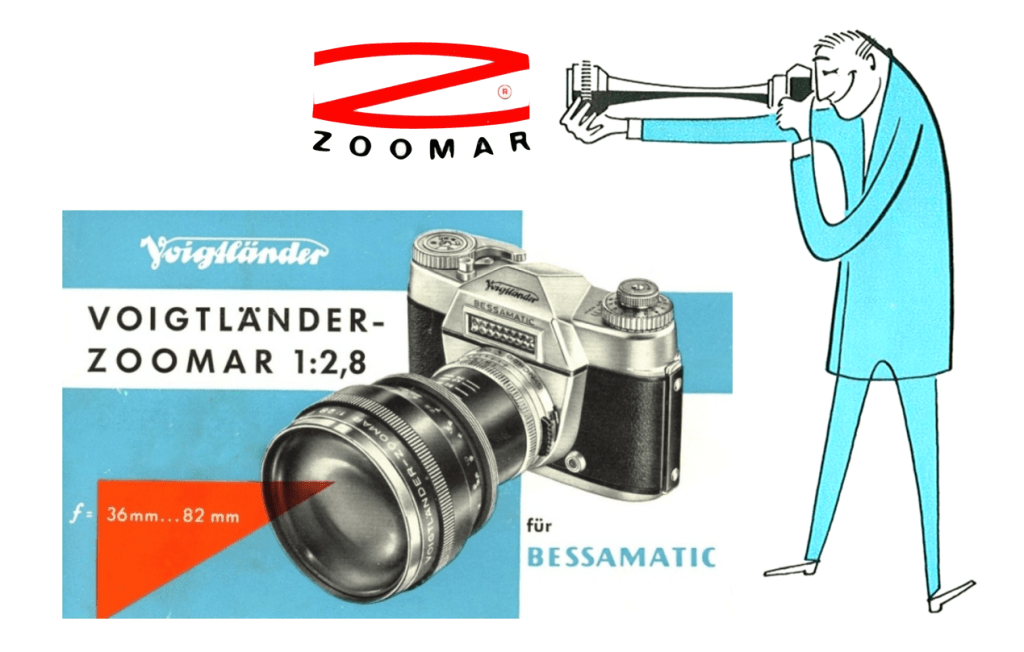
Historical accounts of who actually invented the zoom lens differ. But its adaptation to the SLR is down to one person – Frank Gerhard Back. He designed the first zoom lens for 35mm cameras – the Voightländer Zoomar. Before the Zoomar saw the light of day, designs with adjustable focal lengths were called varifocal lenses or rubber lenses.

“A great number of optical problems have been overcome in this lens. It is a splendid achievement. It zooms – what other still lens does?”

Look! A real zoom lens for your 35mm, Herbert Keppler, Modern Photography (May, 1959)

Back was born in Vienna, Austria in 1902. He attended the Technische Hochschule of Vienna where he received a masters in mechanical engineering in 1925, and a doctorate of science in 1931. From 1929 to 1938 he worked as a consulting engineer during which he was employed by Georg Wolfe, a manufacturer of endoscopes. In July 1939, he emigrated to the United States. After working for various companies in New York City, he started his own company in 1944, Research and Development Laboratory. In 1945 he started Zoomar Inc. where he developed and patented an optically-compensated zoom lens for 16mm television cameras (1948), and one for 35mm SLR cameras by 1959. From the late 1940s through to the 1970s, Back introduced new innovations for television, motion, picture, film photography, astronomical, and numerous other applications. On 25 October 1946, Back presented a new type of variable focal length lens to a convention of the Society of Motion Picture Engineers (SMPE) in Hollywood, California. The lens, sometimes known as the could zoom from 17 to 53mm, and contained 22 lens elements. It was 12” in length, weighed 790 grams and had an aperture range of f/2.9-f/22 [3].

Zoomar lenses disrupted the market for American television camera lenses, and likely were the catalyst in making zoom lenses ubiquitous in the industry. Back’s Zoomar lens had a substantial impact on both the motion picture, and television industries in the years following. It gradually made the “practice of “zooming” a more desirable, acceptable, and practical technique, in turn spurring demand for zoom lenses suitable for feature film use, with higher optical quality and greater zoom ranges. By 1954 a more compacts version of the “Zoomar 16” appeared – 5” in length, and weighing 570g it now had a zoom range of 25-75mm. It is not surprising that the concept would eventually spill over into the still camera industry.

In Back’s design, four of the lens’s 14 elements (the lenses in groups 2, 3, and 6 move linearly together to allow for focal length changes) move from 36mm to 82mm. A ×2.3 range from 36mm to 82mm allowed the lens to retain a reasonable speed of f/2.8, good image sharpness, and optical anomalies kept to a minimum (something earlier varifocal lenses could not achieve). The use of the word “zoom” likely derived from the Zoomar name. The lens used a push/pull mechanism to change focal length, whereby the change of focal length happens when the photographer moves the ring towards the mount or backwards.

Zoomar lens schematics (the lens diagram shows the 36mm and 82mm positions of the moving lens components).

Optically, the Zoomar 36-82 was a great breakthrough, made possible according to Dr. Back by new rare earth element glasses (Lanthanum) and computer aided optical designs. Back filed two patents in 1958 [6,7], one for optical design, and another for mechanics, likely at the same time production was already gearing up. Starting in 1959 the German optics firm Heinz Kilfitt would build the lens, under contract with Voigtländer for their Bessamatic SLR. The Voigtländer Zoomar was presented to the public on February 10, 1959 at the International Camera Show in Philadelphia (the same show that introduced the Nikon F and Canon Canonflex). Back would file another patent relating to an improved optical design in 1959 [8]. This optical design modified the rear lens elements, both in the type of element, and the material from which they were constructed.

The lens optical design in Patent No. US2902901

By the late-1950s, Zoomar was to have some legal issues regarding its patent, fighting a patent battle with Paillard Products, the US subsidiary of Swiss company Paillard-Bolex, which had been importing French zoom lenses. In 1958 the New York Southern District Court ruled that Back’s patent overreached by appearing to cover all zoom lenses of any design. Zoomar eventually reduced its R&D of new lenses in favour of promoting foreign-made lenses – Back purchased Heinz Kilfitt in 1968 (catalog).

The Voigtlander-Zoomar is the only Zoomar lens for still cameras. This model, with fully automatic diaphragm, is designed expressly for use with the Bessamatic Camera. A high-precision varifocal lens, in focus at all focal lengths from 36 to 82mm, it enables the photographer to shoot continuously at variable focal lengths without changing camera position.”

Description from the manufacturer.

The lens was produced from 1959-1968, with a total of only 15,000 units being built. Today the Zoomar 36-82 f/2.8 is often associated with the Voigtländer Bessamatic SLR. However the Zoomar was introduced from day one in both the DKL (Voigtländer) and Exakta mounts. Later it was also produced in other mounts, including the ALPA, and an M42 mount for the East German cameras like the Ikon Contax S. By the early 1960’s there were more zoom lens options, mostly in the telephoto zoom realm. None were anything special when compared to prime lenses, as they often had increased distortion and less contrast, but these were often overlooked because of the “newness” of the technology. It is still possible to find these lenses today, with prices in the range of C$700-1200 for lenses in reasonable condition.

✽ The Zoomar actually had a doppelganger – the Russian Zenit-6 camera came standard with a zoom lens called the Rubin-1. It wasn’t exactly the same, the focal length is shorter at 37-80mm and both had different zooming mechanisms.

Further reading:

  1. Hall, N., “Zoomar: Frank G. Back and the Postwar Television Zoom Lens”, Technology and Culture, 57(2), pp.353-379 (2016)
  2. Herbert Keppler, Bennett Sherman, “Zoom for you 35mm”, Modern Photography (May, 1959)
  3. Back, F.G., “The Zoomar Lens”, American Cinematographer, 28(3), p.87,109 (March, 1947)
  4. Back, F.G. et al., US Patent No.2,732,763, “Varifocal Lens Constructions and Devices”, assigned Jan.31, 1956
  5. Back, F.G., US Patent No.2,454,686, “Varifocal Lens for Cameras”, assigned Nov.23, 1948
  6. Back, F.G., US Patent No.2,913,957, “Varifocal Lens Assembly”, assigned Nov.24, 1959
  7. Back, F.G., US Patent No.2,902,901, “Reflex Camera Varifocal Lens”, assigned Sep.8, 1959
  8. Back, F.G., US Patent No.3,014,406, “Varifocal Lens Assembly for Still Camera Photography”, assigned Dec.26, 1961
  9. Roe, A.D., “The Zoomar Varifocal Lens For 16mm Cameras”, American Cinematographer, p.27,50 (January, 1954)
  10. Keppler’s Vault 94: The History of Zoom Lenses (2021)