Vintage lens makers – Zunow (Japan)

Zunow was a lens maker who dabbled in camera making. Their biggest claim to fame is arguably that they were the first to introduce an ultrafast 50mm lens for rangefinder cameras. Supposedly the meaning of Zunow derived from the Japanese word zunō meaning “brain” (although there was also a Zunow company producing bikes where it meant “genius”).

Suzuki Sakuta founded Teikoku Kōgaku Kenkyūjo (Imperial Optical Research Institute) circa 1930 and worked for other companies grinding lenses. In 1954, the company changed names to Teikoku Kogaku Kogyo Kabushiki Kaisha (Teikoku Optical Industry Corporation), and in 1956 it became Zunow Kōgaku Kōgyō K.K., or Zunow Optical Industry Co. Ltd..

Fig.1: Various lenses produced by Zunow

Zunow made a number of lenses for both rangefinder and SLR cameras, including slower 50mm lenses in f/1.3, and f/1.9, a 35mm f/1.7, and a 100mm f/2 lens. In 1953 they introduced a 5cm f/1.1 lens for rangefinder cameras, which at the time was the fastest lens available for any 35mm camera. The f/1.1 lens was not matched in speed until Nippon Kogaku introduced the Nikkor 50mm 1.1 in 1956. After this they started making lenses for other manufacturers, which weren’t as fast, but they were good quality lenses. For example the 35mm f/1.7 was a smidgen faster than the Nikkor 35mm f/1.8. The lenses were often used by other manufacturers as standard lenses. A good example is the Miranda T which came standard with a Zunow 50mm f/1.9 lens. There is some supposition that Zunow supplied the 5.8cm f/1.7 lens for the Yashica Pentamatic II when it appeared in 1960 [1].

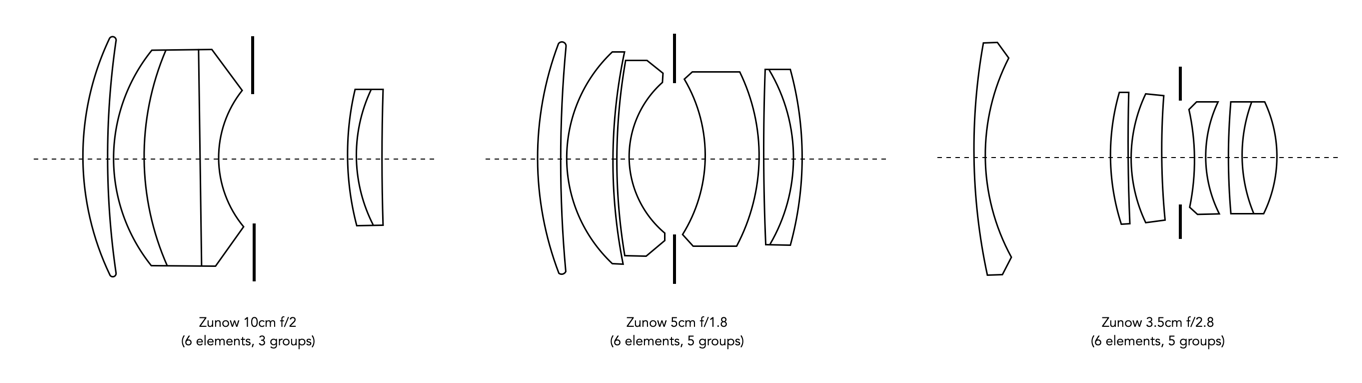
Fig.2: Lens configurations of various Zunow 35mm lenses

The first cine lens was a 5cm f/1.1 lens produced for American motion picture camera company Mitchell. The company also produced Zunow-Elmo Cine f/1.1 lenses for D-mount (8mm) in 13mm, 25mm, 38mm; and C-mount (16mm) 25mm, 38mm and 50mm.

Fig.3: Zunow lenses can be found on Neoca cameras, as fixed lenses with leaf shutters; and on Nikon rangefinders

The decline of Zunow was precipitated by the failure of its Zunow SLR in 1959, and by the bankruptcy of two of its customers – Arco in late 1960 and Neoca in January 1960. Zunow’s financial situation worsened, and rather than become a subsidiary of another company, the company was closed in 1961 [2]. In the same year, Suzuki Takeo founded a new company in partnership with Elmo (who Zunow had supplied lenses for) called Ace Optical who continued making lenses for 8mm and 16mm cine cameras, as well as other commercial lenses [2].

Besides the 5cm f/1.1, other lenses are available, especially in the Japanese market. The cine lenses seem to sell anywhere from US$200-1000. The 3.5cm f/1.7 rangefinder (L39) lens has sold for around US$3500. Typically they are found mostly on the Japanese market.

Fig.4: Zunow packaging and advertising

A list of lenses produced in 1957:

  • Rangefinders (Leica IIIf and M-3, Contax Canon, Nikon) : 35mm f/1.7, 50mm f/1.1, 50mm f/1.3, 50mm f/1.9, 100mm f/2.
  • 35mm SLR : 50mm f/1.9, 100mm f/2
  • 8mm cine : f/1.1 – 13mm, 25mm, 38mm
  • 16mm cine : f/1.1 – 25mm, 38mm, 50mm

Company name timeline:
1930 − Teikoku Kōgaku Kenkyūjo (Imperial Optical Research Institute)
1954 − Teikoku Kogaku Kogyo Kabushiki Kaisha or Teikoku Optical Industry Corporation
1956 − Zunow Kōgaku Kōgyō K.K., or Zunow Optical Industry Co., Ltd.
1961 − Company closes, re-envisioned as Ace Optical the same year

Notable lenses: Zunow 5cm f/1.1 (1953)

Note that there is still an unrelated company called Zunow in the north of Japan, which makes conversion lenses and filters (for cine cameras).

Further reading

  1. Was this beautiful lens, which was made exclusively for the Pentamatic II designed by Zunow Optical?, Chasing Classic Cameras with Chris (2017)
  2. Interview with Suzuki Takeo, CEO of Ace Optical (son of Zunow’s president), May 2006

Vintage lens makers – Dr. Weth Optik (Germany)

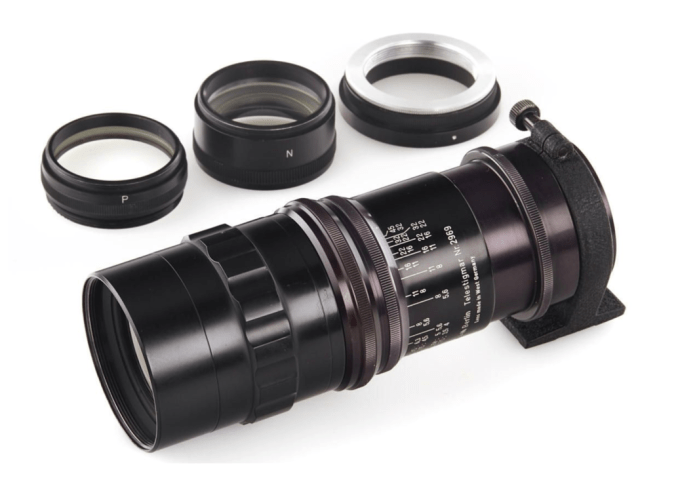
Dr. Max Weth Optik, was a German lens maker located in Berlin in the 1950s (West Germany). The company is best known for its Telestigmar multi focal lens set, first made in 1955 (sometimes known as Votar Telestigmar). This was a very unique 6-element lens, with the ability to configured in four different focal lengths, with four different apertures: 315mm f/6.3, 250mm f/5, 225mm f/4.5, and 175mm f/3.5. The lens was described in a 1957 article in Modern Photography [1]. The lens has three interchangeable components: N and P are negative and positive lenses, and Z an extension tube, i.e. spacer (the kit also included R, a close-focus extender). When one or two of these are combined with the front lens, V, the different focal lengths are obtained. For example P+V = 135mm. The article suggest that the best “critical sharpness” was obtained using N+P+V=225mm lens. The lens was made in mainly in M42, and Exakta mounts (and custom ALPA).

The Telestigmar multi focal lens

The rationale behind the lens was that it provided four telephoto lens without the weight of four telephoto’s. It was basically a prime lens with two ancillary rear elements and a spacer. The lens would ultimately be superseded by zoom lenses of similar focal range, i.e. 175-315mm. In 1957 the lens sold for US$220. The most recent prices online are around US$100-300.

Further reading:

  1. “The Amazing Tele-Lens of Dr. Weth”, Modern Photography, 21(10), pp.70,71,140 (Oct,1957)
  2. “The Magical Optic of Dr. Weth”, Peter Dechert (1992)

Optical Anomalies – Are air bubbles problematic?

Vintage lenses of a certain era often contain air bubbles, but this by no means suggests that they are of inferior quality. A 1940 article in Minicam Photography describes this as a fallacy [1]. It seems that in early cameras, some photographers may have been weary of such imperfections. In all likelihood there are like-minded individuals today.

“They may look like undesirable blemishes, but they are much more apparent visually than photographically.” [1]

In early glass manufacturing, air bubbles were practically impossible to eliminate. At the time the rationale provided was that bubbles formed when ingredients were melted together at temperatures of 2750°F to form glass. Even first-glass lenses contained some number of bubbles.

“In the manufacture of the famous Jena glass the various elements used must be heated for a given length of time and to a certain degree, the process being stopped at just the right moment whether all the air has been driven out or not. There is no alternative.” [2]

The article goes on to provide an example of a 6-inch, f/4.5 lens with a diameter of 32mm across the front lens [1]. They count 12 bubbles, on average 0.1mm in diameter. The lens has an area of 804mm², and the bubbles an area of 0.0942mm², making up 0.012% of the surface area. So only 0.012% of the light passing through the lens is impeded by the air bubbles. The outcome? Light interference caused by bubbles is negligible.

“The actual loss of light is inappreciable, and the presence of these bubbles, even if near the surface, has no effect whatever on the optical quality of the image.” [2]

“Air bubbles will be found in most high-class lenses and are a sign of quality rather than a defect, since at present it is impossible to make certain optical glasses absolutely bubble-free; their presence doesn’t affect the quality of the image in any way. [3]

In the literature for many modern optical glass manufacturers, e.g. Schott, there are caveats on bubbles (and inclusions). Basically bubbles in glass cannot be avoided due to complicated glass compositions and manufacturing processes. The melting of raw materials produces reactions which invariably form gas bubbles in the melt (typically carbonates or hydrogen-carbonates) [4]. These bubbles are removed in the refining process, when the temperature of the glass is increased, reducing the viscosity of the glass and allowing bubbles to move up through the melt and disappear. Some residual bubbles are still left from imperfect refining. However, it is actually quite rare to see bubbles in modern lenses.

So do they make a difference in vintage glass? According to much of the literature, not at all. Besides, vintage lenses are all about character – nobody is looking for a perfect image.

Further reading:

  1. “Fallacy: That “air” bubbles in a lens are a sign of inferior quality”, Minicam Photography, 3(8), pp.30-31 (1940)
  2. “The Crucible – Air-Bubbles in Lenses”, Photo-Era, 31(6) p.319 (1913)
  3. “Andreas Feininger on Lenses at Work”, Popular Photography, 18(3) p.124 (1946)
  4. TIE-28: Bubbles and Inclusions in Optical Glass, Schott Technical Information (2016)
  5. The Impact of Air Bubbles in the Optics of Old Lenses”, Jordi Fradera (2020)

The aesthetic appeal of mid-century vintage lenses

When you look at modern lenses, there isn’t much that sets them apart. They are usually pretty plain black cylinders, partially due to the consistency of modern lens design. The same could not be said of vintage lenses. Maybe this has something to do with the fact that many vintage lenses were made by companies that focused purely on lenses, and as such tried hard to differentiate their lenses from their competitors. For example a company like Meyer Optik Gorlitz manufactured lenses for cameras using the Exakta mount had to compete for the consumer spending with lenses from a myriad of other companies (at least 25-30).

Over time the appearance of lenses naturally changed, as new materials were introduced, often for the purpose of reducing the overall cost of lenses. For example, many early 35mm lenses had a shiny, chrome-like appearance. The earliest, pre-war lenses were often made of chrome-plated brass. As the Second World War progressed, shortages or re-direction of materials like brass led some manufacturers had begun to transition towards aluminum, which was both less expensive, easier to manufacture, and produced a lighter lens. While these early aluminum lenses were aesthetically pleasing there was little that differentiated them in a world where there was an increasing number of 3rd party lens manufacturers.

Fig.1: Evolution of the aluminum design of the Zeiss Jena Biotar 58mm f/2

When it first appeared as a lens material, aluminum was chic. The 1950s was the age of aluminum, which was a symbol of modernism. Many of the largest aluminum producers pursued new markets to absorb their increased wartime production capacity, used in everything from drink cans to kitchenware and Airstream trailers (there was also extra aluminum from scrapping of war surplus aircraft etc.). These aluminum lenses were initially clear-coated to reduce the likelihood of tarnishing, but eventually anodized to provide a robust black coating. Also in the 1950s, lens manufacturers to realize changing trends in lens design – buyers had moved away from the idea of pure practicality, and focused also on design. This wasn’t really surprising considering the broad scope of modernist design during this period – design tended to favour sleek and streamlined silhouettes. It is interesting to note that most of the aesthetically pleasing lenses of the post-1950 period originated from Germany.

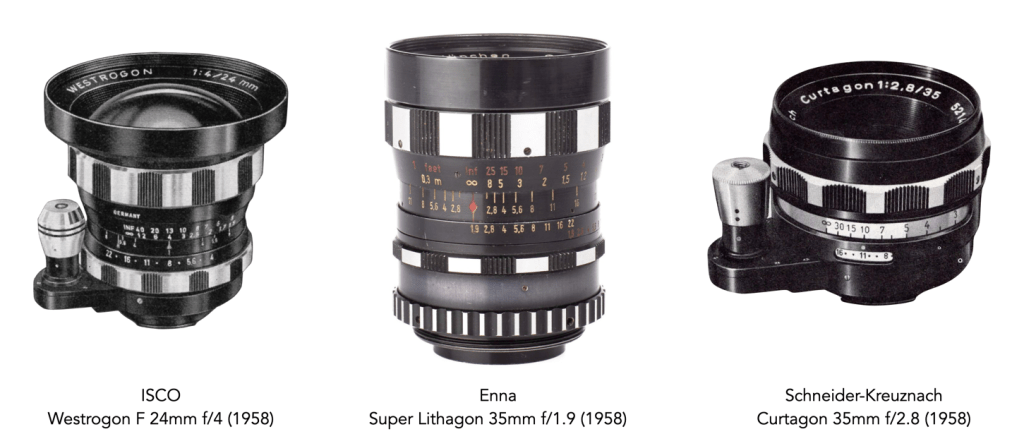
Fig.2: Every lens manufacturer had a different interpretation of both “berg-and-tal”, and the black-and-white “zebra” aesthetic

The first notable change was the gradual move towards what in German manufacturers called the “berg und tal” design, or rather “mountain and valley” design of the grips on a lens – usually knurled depressions milled into the surface of the ring (but also the opposite like the lenses of Steinheil where the depressions are smooth and the mountains are knurled). English-speaking regions often referred to this as a “knurled grip”. Appearing in the early 1950s, it was particularly common for focusing rings, making them more prominent, and likely more ergonomic, i.e. easier to grip. Some lenses started with the focusing ring, and eventually used the same design on the aperture ring. Prior to this most lenses used a simple straight knurl on the adjustment rings.

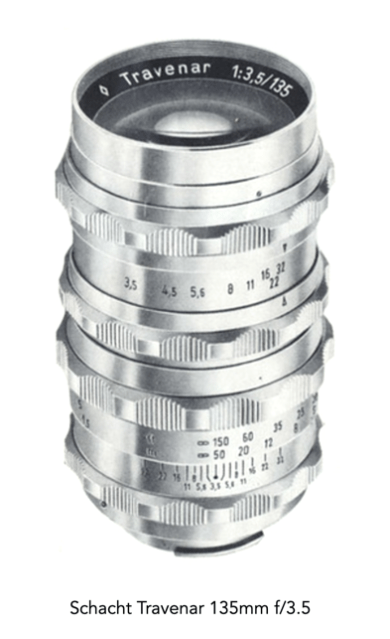
Towards the end of the 1950s, the pure-aluminum design transitioned to a combination of silver and black anodized aluminum. The lens bodies themselves were mostly black, with the “berg und tal” designs alternating between black and silver. This alternating pattern is what is colloquially known as “zebra” design. Many lens manufacturers utilized the zebra aesthetic in one form or another including Schacht, Enna, Steinheil, Schneider-Kreuznach, Meyer Optik, Rodenstock, ISCO etc..

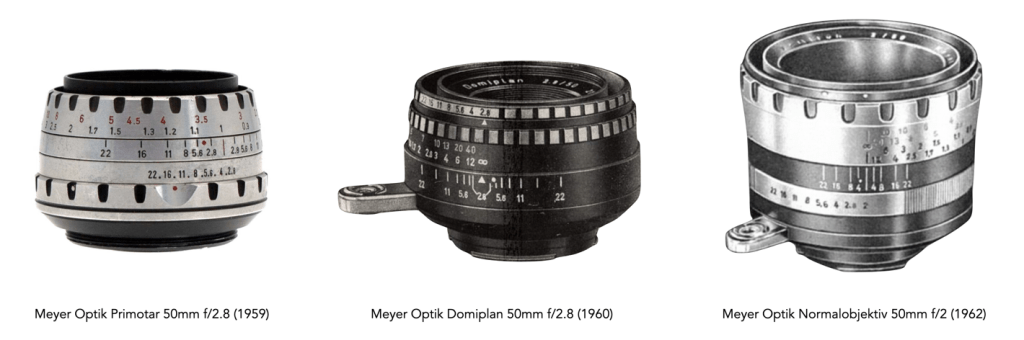
Fig.3: Meyer Optik had an interesting twist on the zebra design. There were very few of these lenses and they are very minimalistic in design.

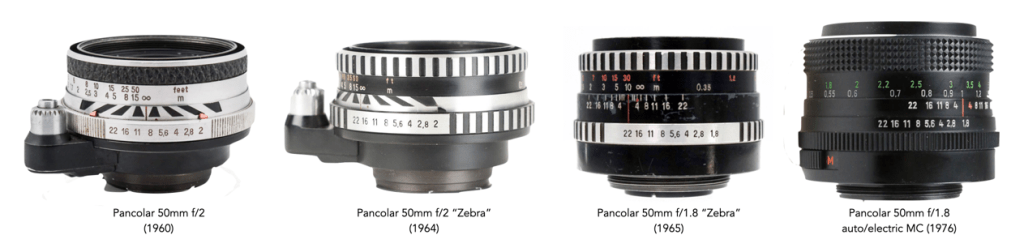
Zeiss probably produced the best known examples of the zebra aesthetic design with the Pancolar and Flektogon series of lenses. Although these lenses did not appear until the early 1960s, they bypassed the more prominent berg-und-tal in favour of a much subdued black-and-white knurled grip (which is also something Meyer Optik did with lenses like the Lydith 30mm). This design for both focusing and aperture rings replaced the rough textured rings of the earlier lenses. Some call these lenses the “Star Wars lens”. The Pancolar 50mm f/2 appeared ca. 1960 in the form of an f/2 lens with dual black-silver body encompassing a “converging-distance” depth of field range indicator, and either a textured or nubbed rubber focusing ring. This evolved a few years later to the classic “zebra” design, shortly before the release of the classic Pancolar 50mm f/1.8, which also sported the zebra design. By the 1970s, the Pancolar 50mm f/1.8 had morphed into a complete black configuration with a large rubber cross knurling focus grip and a finely knurled aperture ring.

Fig.4: Evolution of design aesthetics of the Zeiss Pancolar 50mm lens.

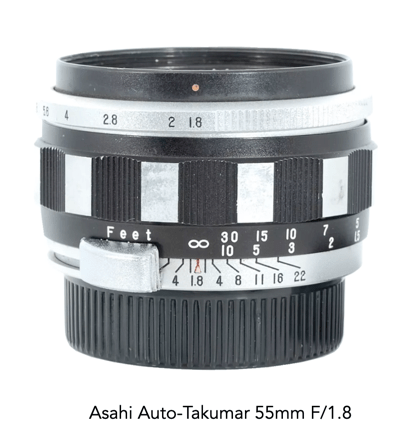
Japanese manufacturers transitioned from aluminum/chrome to black bypassing the zebra design. The one exception seems to be the Asahi Auto-Takumar 55mm F/1.8, which appeared in 1958, but is the sole example of zebra design (at least by Asahi). Japanese manufacturers did however embrace the berg-and-tal design.

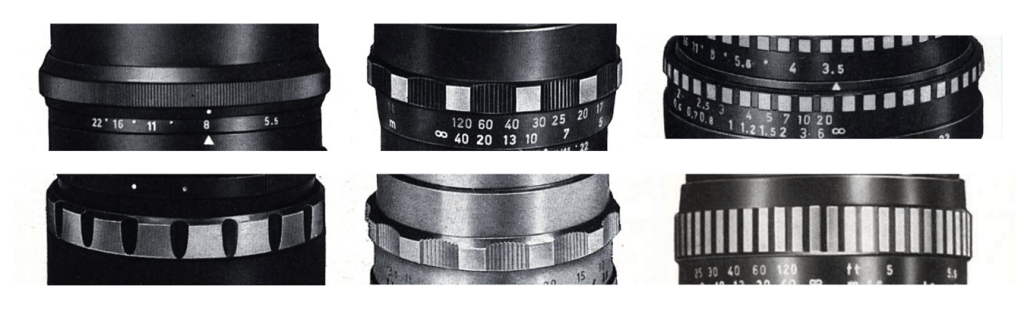
Fig.5: Some lens companies couldn’t settle on a design. Here we have differing focus ring designs from the same Meyer Optik catalog in the 1960s

By the mid-1960s many camera manufacturers were producing their own lenses, particularly in Japan. As such lenses became more consistent, with little need to compete with other lens manufacturers. There were still 3rd party lens manufacturers but their perspective was to concentrate more on the manufacture of inexpensive lenses. Most lenses transitioned to using standardized, nonchalant black aluminum lenses, with the onus being more on the quality of the optics. Grips transitioned from berg-und-tal to a flatter, square-grooved style, still using a in black/chrome contrast (which likely resulted in a cost saving). By the mid-1970s focus rings were provided with a ribbed rubber coating, still common today on some lenses.

Fig.6: Berg-und-tal overkill?
Fig.7: One of the few Japanese zebra lenses.

Today, the sleek aluminum lenses are sought after because of their “retro” appeal, as too are the zebra lenses.

Vintage lenses – What do lens markings mean?

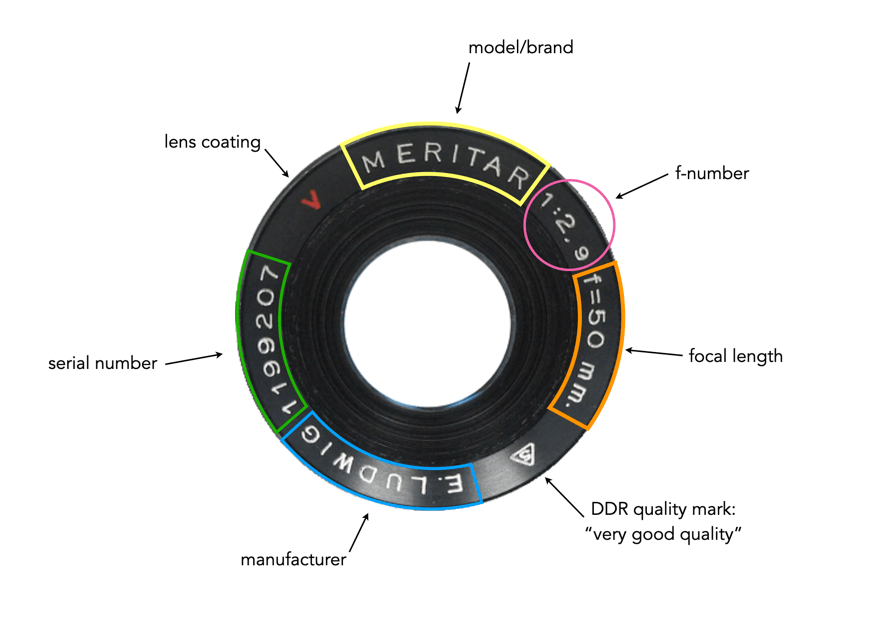
Vintage lenses are festooned with markings. There are the numbers related to focusing, and the f-stop values, but the details engraved upon the lens name plate will explain most things about the lens. This post will look at vintage lens markings by investigating a few examples. In general, most lenses have 5-6 markings: (i) lens model/brand; (ii) maximum aperture (speed); (iii) focal length, (iv) serial number; (v) company; and (vi) place of manufacture (these are shown in Figure 1 using colour coding to highlight). In addition there may be some symbols used to denote specialty characteristics such as lens coatings. These markings are usually found on the front of the lens on the rim sounding the first element. On lenses where there is no room on the front of the lens, the lens marking are usually found circumscribed around the outside of the lens.

Fig 1. The various markings on a lens (colour coded)

The first two items described are the manufacturer (or brand), and the type or name of the lens. In this case the manufacturer is E.Ludwig, and the type or name of the lens is a MERITAR. Most vintage lenses also provide the len’s serial number on the name plate – in this case 1199207. With come manufacturers the serial number helps track down information like where, and when it was manufactured. The most important information is the 1:2.9, which basically specifies the speed (maximum aperture) of the lens, here f/2.9. The last piece of information is f=50mm which specifies the focal length of the lens. On this particular lens there is also two additional symbols which specify lens coating and a quality mark.

Fig 2. Lens markings on various brands (same colour-coding as Fig.1, with the addition of red to denote place of manufacture)

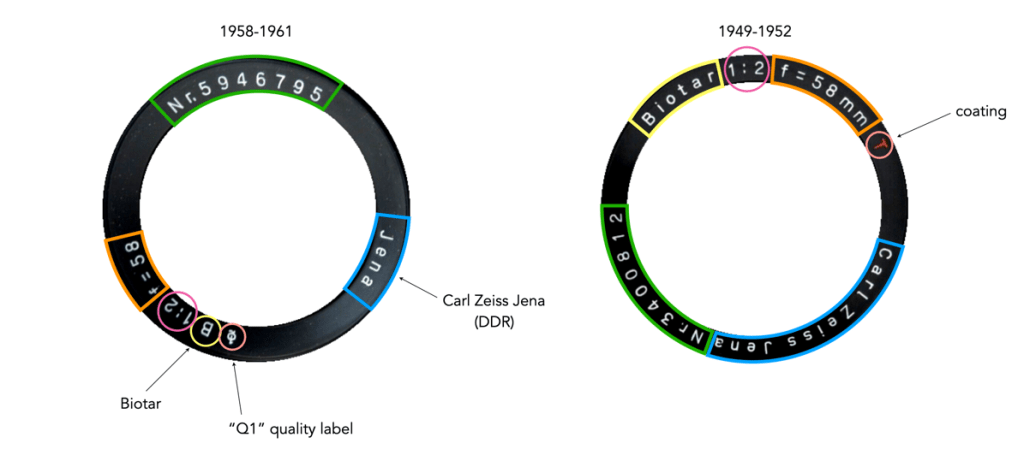
Figure 2 shows three more examples of lens markings from Kilfitt, Asahi, and Enna. Figure 3 shows lens markings from Zeiss Biotar 58mm f/2 lenses from two differing periods. The latter one has more cryptic lens marking – there is less info here because the lens was produced during the infamous Zeiss trademark dispute. Zeiss Jena in East Germany marked the Biotar lenses with a “B”, in order for them to be sold in the west.

Fig 3. Zeiss Biotar lenses from two differing periods

The focal length/aperture combination is the one thing that can be described in a number of different ways. The f-number is normally specified using a ratio, 1:x, rather than the f/ term. On some lenses the length and aperture are combined in the form aperture/focal length, e.g. 2.8/50. It’s actually somewhat rare to see f being used to specify maximum aperture, instead it is often used to signify focal length, e.g. f=58mm. Focal length is nearly always specified in metric, the only difference being that up until about 1950, many lenses were specified in centimetres, whereas afterwards the focal length became more standardized using millimetres. So an early lens might have been 5cm, versus the more standardized 50mm.

Fig 4. Specialized lens markings found on various German lenses.

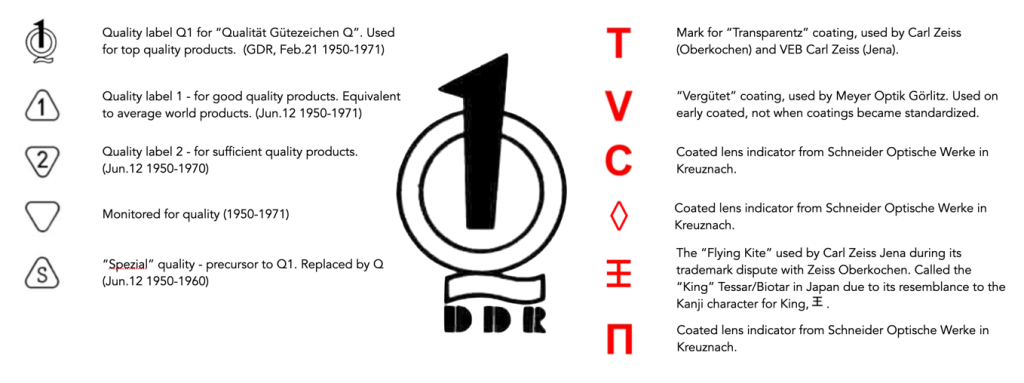
Sometimes vintage lenses also carry other markings. Sometimes instead of a brand name, there is a logo to signify a brand. This is common in vintage Russian lenses where the same lens could have been manufactured in more than one plant. Some lenses also have a number with the diameter symbol, ∅, which indicates the filter size of the lens in mm. Some lenses also use letters to signify the presence of lens coatings, e.g. Meyer Optik specified a lens coating using a red “V”, after the focal length (which means Vergütet = coating). Examples of specialized lens markings for German lenses is shown in Figure 5.

Fig 5. Types of specialized lens markings found on German lenses.

Choosing a vintage lens – buying FAQ

This FAQ covers more of the purchasing aspects of choosing a vintage lens, and is a follow-on to a post I did on buying cameras and lenses.

Is there a price list for vintage lenses somewhere?

Providing generic price information for a genre of lenses is extremely challenging. For example if someone asks what the price of a 50mm lens from manufacture X is, it really depends on a number of different factors: availability (or rarity), the current market, lens quality, speed, and even factors such as the mount type. For example the beloved Carl Zeiss 50mm Planar f/1.4 for a Contax/Yashica mount sells for C$400-600, whereas the same lens with an M42 mount is C$800-1200.

You can find some basic info on camera and lens prices attractive Collectiblend, however not all lenses are listed. There is no one encompassing place to find prices, yet sometimes eBay provides a good cross-section of the current market.

Why are some lenses so expensive?

Some lenses are expensive, either because the lens is rare, or has some attribute that makes it more expensive, or a review by someone with a lot of followers has pushed prices up. A good example is wide aperture lenses. If you are looking for a vintage f/1.0 lens, expect to pay a lot of money for it. For example a Leitz 50mm f/1 Noctilux-M lens is C$6-8K. A Canon 50mm f/1.2 rangefinder lens (LTM) will however only cost C$-400-800. Even a Helios 40, 85mm f/1.5 lens will fetch $500, even though it’s only real virtue is that it is considered the “Bokeh King”.

Why is there so much price variability?

The price of a lens depends on many factors, the same things that afflict super-fast lenses affect all lenses: rarity, quality of optical glass, manufacturer, lens quality, desirability. You will pay less for a 50mm f/2.8 than a f/1.4 and less for a Vivitar lens than a Pentax. Consider the following list of 50mm f/1.8 lenses, and their approximate market prices.

  • Vivitar M42 50mm f/1.8 − C$65-80
  • Asahi Takumar 50mm f/1.8 − C$80-120
  • Carl Zeiss Jena 50mm f/1.8 Pancolar − C$200-400
  • Meyer-Optik Görlitz 50mm f/1.8 Oreston − C$150-250
  • Carl Zeiss Planar 50mm f/1.8 − C$200-400 (M42 mount C$500-800)

Should I take a risk on a cheap item?

Sometimes there are sellers who are selling a piece of camera gear without knowing what they have, usually because it was part of an estate, and not something they normally deal with. If the item is cheap enough, there is likely very little risk, but if it seems too expensive, avoid it. This is especially true if the item is marked “rare”. A good reseller will mark the item as “untested”, or elaborate on the problems with the lens, e.g. sticky aperture, presence of fungus on the lens.

How do you know a lens will be in good condition?

You don’t, unless you buy from a reputable dealer. Someone who has been dealing in vintage photographic equipement for a long time, and sells a good amount of it will provide a good insight into a particular lens, including providing a quality rating.

If a lens physically looks good, it should be okay right?

Probably, but you just never really know. Unless a lens has some sort of provenance, it’s hard to know where it has spent its life, and what it was used for. Was it used by a photojournalist? Was it ever dropped? It is possible to drop a lens and see no external changes, yet it might cause minor misalignment of some internal working. Was it kept in cupboard in a damp room? So many possibilities. That’s the benefit of buying a lens in-person versus online.

How do I know if a shop is good?

This is tricky, but I suggest searching for reviews on the shop. There are a couple of online stores that have extremely bad ratings. Good shops will have an active social media presence, and often a physical store. The larger the store, the larger the amount, and scope of stock. Smaller stores tend to focus more on specialized or rare cameras/lenses. It pays to do some research.

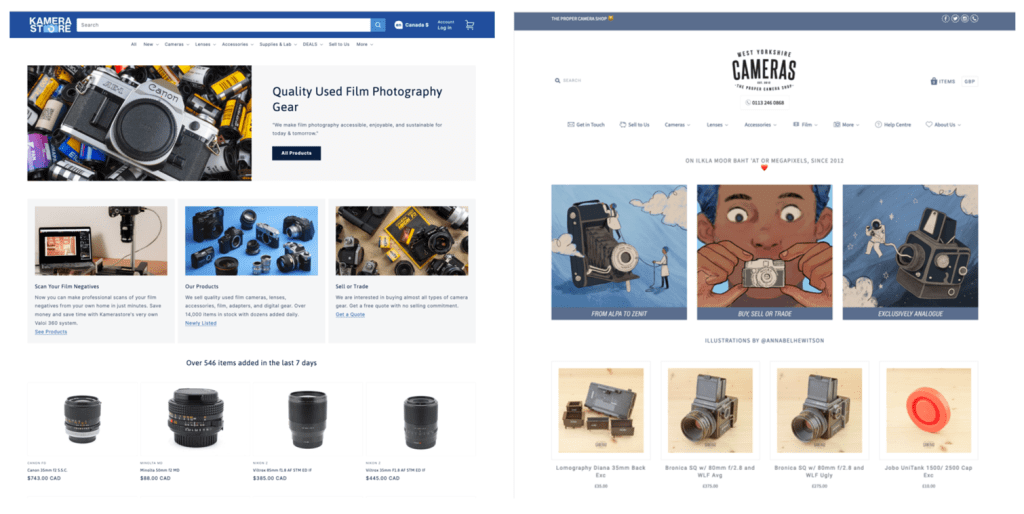
Two of the best vintage camera stores are Kamera Store (Finland), and West Yorkshire Cameras (UK). They both have quality vintage cameras and lenses, and provide exceptional customer service.

Are there red-flags for buying lenses online?

Yes – if a listing somewhere only has 1-2 images, and offers no real description, then stay well clear – unless of course it is a $1000 lens selling for $10, and even then you have to wonder what is wrong with it.

Is eBay any good?

Like anything, it really depends on the reseller. Some sell only camera gear, and have been doing it for a while, or have a physical shop and use eBay as their storefront. Always check the resellers ratings, and review comments.

There are a lot of lenses available on eBay from Japan – are they trustworthy?

In most circumstances yes. There are a lot of physical camera stores in Japan, so its no surprise that there are a lot of online stores. Japanese resellers are amongst the best around, because nearly all of them rate every aspect of a lens, cosmetic and functional. If something seems like a bargain it is likely because there are a lot of vintage cameras and lenses in Japan.

What should lens ratings include?

If we take the example of Japanese resellers, there are normally four categories: overall condition, appearance, optics, and functionality. Appearance deals with aesthetics of the lens, and indicates any defects present on the lens body, e.g. scratches or scuffs. Optics deals with the presence of absence of optical issues: haze, fungus, balsam separation, scratches, dust. Finally functionality deals with the operation of the lens, e.g. aperture stiffness.

Choosing a vintage lens – which brand?

In this post we’ll talk briefly about lens brands and manufacturers. When it comes to vintage analog lenses, people either choose a brand first, and then a focal length, or vice-versa. There are as many different brands as there are historic camera and lens manufacturers. Typically most vintage lenses come from East and West Germany, and Japan, largely because that is where the camera industry was focused. Choosing a brand can be a matter of personal interest, cost, or more often than not – popularity.

When looking at the type of vintage lens, you have to understand that there are different families of lenses, usually focused on a particular brand from a specific epoch. In order to choose a vintage lens it is important to obtain a basic understanding of the brand of interest – dates of manufacture, basic lens information (e.g. construction, materials, potential issues), and reviews. A particular 50mm lens from one manufacture may have evolved over many years, often with differing characteristics. For example the Asahi Super-Takumar 50mm f/1.4 appeared in 1964 as an 8-element lens, and evolved into a 7-element lens containing some elements which incorporated Thorium. It then became the Super-Multi-Coated Takumar, and finally the SMC Takumar. All have differing characteristics, although fundamentally they are all 50mm f/1.4 lenses.

These days there is quite a lot of digital material online, including scanned brochures, and lens reviews. The aim here is to just cover some of the more common manufacturers. Brands of lenses are generally divided into three major categories – (i) the core companies that produced cameras and lenses, (ii) companies with smaller 35mm impression, and (iii) independent companies that just produced lenses for many different manufacturers (not all camera makers produced lenses). To make it even more confusing, some camera companies rebranded lenses from other companies on their cameras. Many major manufacturers offered an extensive array of interchangeable lenses from extremely wide angle to mammoth telephoto lenses. In addition there were companies that specialize only in the development of lenses, including special purpose lenses.

Note that I have not included very small companies, e.g. Wrayflex, or companies who just produced cameras, and very few of their own lenses, e.g. ALPA (they used lenses from a number of manufacturers), Exakta (they only made/rebranded a couple of their lens as Exakta), or KW (makers of the Praktica line of cameras).

Landmark brand lenses

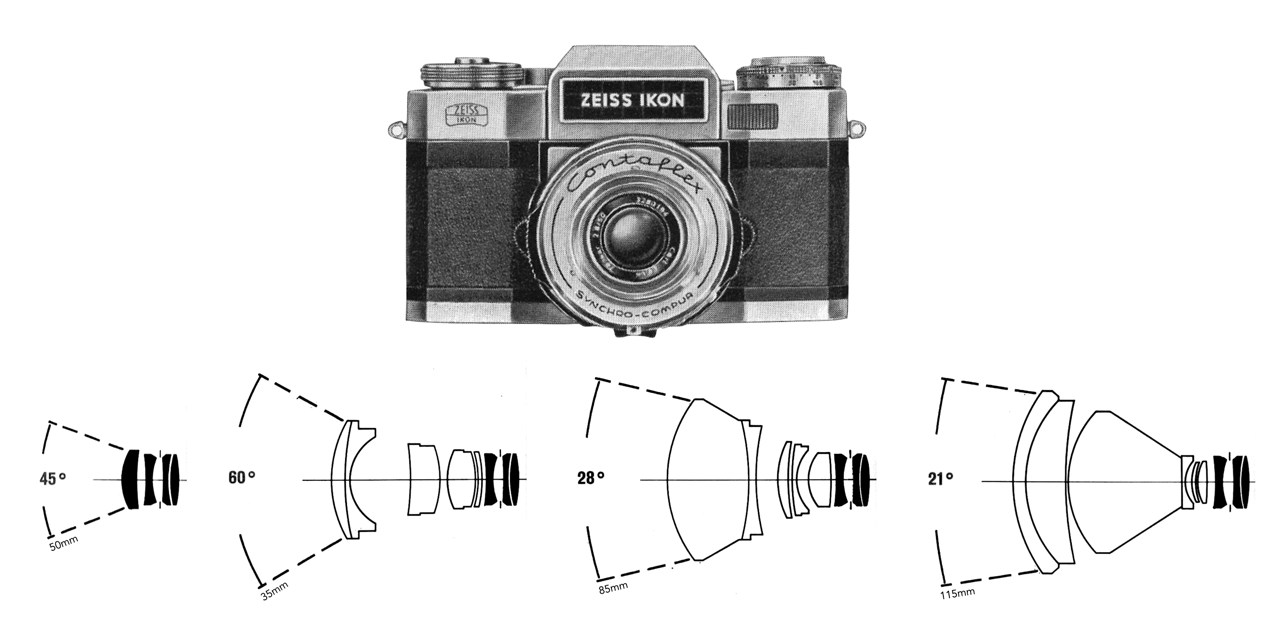
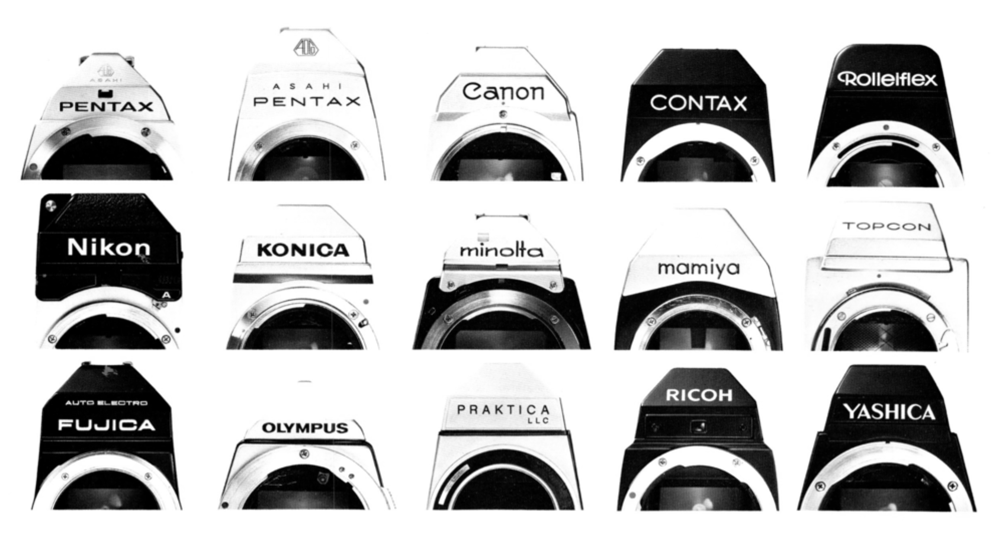
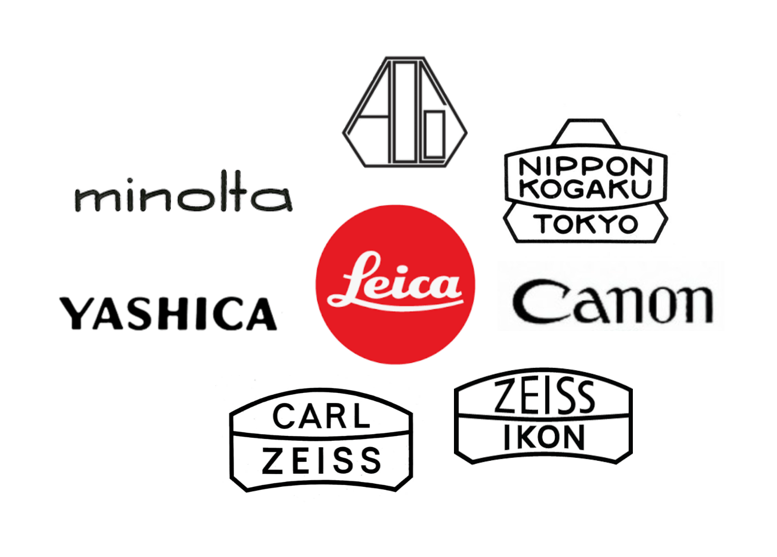
The first category involves milestone manufacturers who got into the 35mm game early, and focused heavily on SLRs. This means manufacturers like Asahi Pentax, Minolta, Yashica, Nikon, Canon, Leica, Zeiss Ikon, and Zeiss. These companies often may have started producing 35mm rangefinder cameras, and then transitioned to 35mm SLRs, and associated lenses (Asahi was the only one of these that did not produce a rangefinder camera). The exception here is Carl Zeiss, who did not make camera’s but was one of the largest optical lens manufacturers. They often designed a broad range of lenses to suit the needs of their cameras. These companies did not rely on 3rd party lens makers (although they did not prevent other companies making lenses for their cameras), and set the standard for many of the lens mounts used. Exakta, while manufacturing many cameras, and the bayonet-mount, designed few of their own lenses.

Second-tier brand lenses

Next are the companies that I consider second tier, i.e. they had a smaller footprint, made only SLRs or got into the game late. That’s not to say they didn’t make good lenses, but their lenses often don’t have the same character as the older lenses. They may have made cameras for other formats, or dabbled in the 35mm SLR market (because they thought they could compete), so the lenses available might just be an effect of short-lived cameras. This includes Konica, Fuji, Olympus, Topcon, Petri, Mamiya, Miranda, Ricoh, Rollei, Voigtländer. For example, Olympus did not introduce it’s first full-frame 35mm SLR, the Olympus OM-1 until 1972. Fuji first interchangeable lens SLR was the Fujica ST701 from 1970. Some of these manufacturers uses rebadged 3rd party lenses. For example Miranda initially used lenses from Zunow or Ofunar, and by the late 1950s had moved to Soligor.

Independent (i.e. 3rd party) brand lenses

The final level of brands are those companies who really just produced lenses. They essentially produced lenses for the cameras of other brands (or more commonly for specific camera mounts). They were 3rd party suppliers, and some were experts in lens design, having been in the business since the 19th century. This included a long list of German and Japanese companies, e.g. Meyer-Optik, Tokina, Soligor, Enna-Werk, Heinz Kilfitt, and Astro-Berlin. Some of these manufacturers produced a broad range of lenses for many different brands, while others produced specific types of lenses such a telephoto lenses. As they often focused solely on lenses, some of these manufacturers produced exceptionally good lenses.

Vintage lens makers – Astro-Berlin (Germany)

Astro-Optik is one of a number of German optical companies that flew under the radar, due to its speciality lenses. It was founded in 1922 as Astro-Gesellschaft Bielicke & Co and based in Neukölln, Berlin (which would become part of West-Berlin). The founders were William (Willy) F. Bielicke, Hugh Ivan Gramatzki and Otto (?). Gramatzki (1882-1957) was a successful amateur astronomer and astrophotographer who published in the journal Astronomische Nachrichten, and headed the local branch of “Berliner Astronomische Vereinigung” for a number of years. Gramatzki invented the Transfokator in 1928. Bielicke (1881-1945) a German-American optical designer was involved in the technical development of the lenses and was responsible for the “Tachar” and “Tachon” lenses.

The 1000mm lens

So it is then not surprising that Astro-Berlin’s product range included lenses suitable for astrophotography and astronomical photometry. After the war the company focused on its film technology (Astro-Kino, Astro-Kino Color) developing lenses that had long and extremely long focal lengths, sometimes called “optical heavy artillery”. The company ceased operations in 1991.

The company produced a multitude of lenses, many under the brand Astro-Berlin. Astro-Berlin is likely most famous for its long lenses for cinematography and photography. These lenses were very simple consisting of one (f/5, f/6.3) or two (f/2.3) achromatic doublets. The f/5 lenses for 35mm came in 300mm, 400mm, 500mm, and 640mm lengths. The 800mm f/5 lens was designed for medium 60×60mm format, and the 1000mm f/6.6 for 60×90mm format.

mm12515015020030030040050050064080010002000
f/2.32.31.83.53.5554.55556.310
Focal lengths (mm), and apertures of Astro lenses for 35mm/6×6 reflex mounts

In addition they produced quite fast lenses. In 1933 they introduced the Tachor f/0.95 which was available in various focal lengths. The 75mm version was suitable for an 18×24mm format (half-frame) but it was a large lens at 110mm in length with a frontal diameter of 81mm. The longest lens produced was possibly the 2000mm f/10 Astro Telastan. At times Astro also cooperated with the other Berlin optics manufacturers Piesker and Tewe.

Ads from Das Atelier des Photographen (1936)

These days, Astro-Berlin lenses are expensive on the secondhand market. For example the Astro Berlin Pan Tachar 100mm f/1.8 can sell for up to C$6000 depending on condition. However it is possible to find a 500mm f/5 lens for between C$900-1200.

Further reading:

Choosing a vintage lens – some tech FAQ

Not a definitive list, but one which covers a few of the “tech” issues. More will be added as I think of them.

Are all lenses built the same?

Most manufacturing companies provided a good, clean environment for constructing lenses. That’s not to say that there won’t be lousy copies of a particular lens, as well as outstanding copies, due to manufacturing tolerances. This is exacerbated in some lenses from the USSR, mostly because the same lens could be manufactured in a number of different factories, all with differing levels of quality (which during the period could be true of any company running multiple manufacturing locations).

Are vintage lenses radioactive?

There are some lenses that produce low-level radiation because they contain one or more optical elements made using Thorium. It was useful in lens design because it gave optical glass of the period a high refractive index, so fewer lens elements would be needed in a lens.

What sort of aberrations do vintage lenses produce?

No lens is perfect (not even modern ones). Lenses can suffer from soft edges, chromatic aberrations, and vignetting. But that’s not to say these things are negatives. Some vintage lenses can create the same sort of distortions that app filters do – using the lens aberrations.

Do vintage lens have coatings?

Lens coatings first appeared in the 1930s, yet many early vintage lenses only had a single layer coating and as such many lenses are susceptible to internal reflections and lens flare. Lens coatings were made from a variety of materials, including rare-earth elements. Lens coatings were primarily created to eliminate or reduce light reflections. Through the practical application of lens coatings, a significant reduction in the reflective index of the lens allowed for more complex optical designs to be constructed. The lack of coatings can add to a lenses’ character.

Are vintage lenses sharp?

Vintage lenses may not be as sharp as modern ones, but then again vintage lenses aren’t really about sharpness. Older lenses are often sharp in the centre, but decreasingly so as you move to the corners. Stopped down to f/8 many produce good results. The reduced sharpness is due to the use of fewer low-dispersion optics, fewer anti-reflective coatings, and the widespread use of spherical elements in lens construction. The use of low-dispersion glass and aspherical elements has lead to finer detail in modern lenses.

Does bokeh matter?

Does it? Look honestly, buying a lens just for its ability to produce “creamy” bokeh is fine, but you still have to have the right circumstances so the lens will produce bokeh. Bokeh certainly adds interest to a picture, but it’s not the be-all and end-all some people make it out to be.

Is faster better?

An f/1.2 lens is often (incorrectly) considered to be better than an f/1.4 lens, which is turn is better than a f/1.8 lens, while an f/3.5 lens is not even considered. This misconception is derived, in part, from the fact that large aperture lenses are more costly to design and manufacture. However a high cost is not necessarily associated with better quality when all aspects of lens performance are considered. Large aperture lenses do benefit from superior light-gathering power, good in low light situations – but how often is this needed? Large aperture settings also suffer from a very shallow depth-of-field.

Why do later lenses have so few aperture blades?

Lenses of the 1950s often had a lot of aperture blades, from a low of 8 to a high of 18-20. This means that the apertures produced in scenarios such as Bokeh are almost perfectly round. However with the introduction of fully automatic aperture in 1961, there was a need to reduce the operating resistence of the blades, hence many manufacturers chose to reduce the number of aperture blades to 6.

Can vintage lenses be stabilized?

Vintage lenses don’t come with built-in stabilization. This is not a problem with cameras that have in-body stabilization like Olympus, but can be an issue with those that rely on lens-based stabilization.

Do vintage lenses produce EXIF data?

Vintage lenses do not have an electronic connection, so that means the camera will only record metadata (EXIF) for images relative to camera settings like shutter speed, ISO, FPS, picture profiles, etc. However, no lens data will be included, such as f-stop, or focal length. The camera also won’t think there is a lens attached, so it is necessary to change the setting “Release without lens” to activate the shutter release. This can really hamper some people as it requires taking notes while out shooting, and it isn’t always practical – like when you are taking a few shots in sequence. With no lens specific information, the camera has little ability to correct for things like vignetting.

Vintage lenses – Why are telephoto lenses so cheap?

Go on to any vintage camera resellers website, and you will see that there are some lenses, notably telephoto lenses, that are inexpensive – I mean really cheap. Why? Doesn’t it require more material to make? Well, yes and no. They do have more metal (body), but the amount of glass is probably less than lenses with shorter focal lengths. Telephoto lenses generally have a very simple lens formulae, and so most of the added expense went into creating a large lens body. But that’s not really the problem.

Nearly all camera manufacturers provided an array of telephoto lenses. It’s a wonder they sold them all. For the reality is, then as now, telephoto lenses have a very narrow scope of use. The amateur photographer was likely only interested in the moderate telephotos, up until 135mm. The remaining lenses were the purvey of the professional photographer, and cinematographer. Who really needed a 300mm or 500mm lens, let alone 800mm? For example, in 1971, Asahi-Pentax sold 12 different Super-Takumar telephoto lenses:

  • Moderate : 85mm f/1.9 105mm f/2.8, 135mm f/2.5, 135mm f/3.5, 150mm f/4
  • Standard : 200mm f/5.6, 200mm f/4, 300mm f/6.3, 300mm f/4
  • Super : 400mm f/5.6, 500mm f/4.5, 1000mm f/8

The problem is that these telephoto lenses were only used for a narrow scope of use. Even a 300mm lens only has a horizontal AOV of only 10°. By the time you get down to 400mm it’s only 5°. Both are very low angles.

For the purpose of this discussion, let’s consider telephoto lenses above 120mm. That leaves three core categories: (i) the moderate telephoto’s around 135mm, (ii) the upper-end standards 200mm and 300mm, and the super-telephoto range > 300mm. Of the telephotos below 120mm, the most common are the 80-90mm lenses may be the most expensive of all telephotos, due to their popularity in portraiture work. Note that the prices quoted are for lenses in average to good condition, meaning that they are functional, yet may have minor optical issues, that won’t impact the quality of the image.

135mm

The most common lens in the moderate telephoto category is the 135mm, and there are a lot of them. Almost every lens manufacturer produced the 135mm as a “standard” telephoto lens. This may have been a legacy of rangefinder 25mm cameras which maxed out at 135mm (without the use of specialized devices). As such they are cheap because they are plentiful. The price only varies depending on manufacturer, lens speed, and mount (obscure mounts will reduce the price). If you search Kamerastore, you will find hundreds of 135mm lenses. A Soligor 135mm f/3.5 Tele-Auto (M42) can cost as little as C$60, whereas a Schneider-Kreuznach 135mm f/3.5 (M42) will only cost C$155. The rare exceptions seem to be lenses like the KMZ 135mm f/2.8 Tair-11, which sporting 20 aperture blades sells at about C$338.

Prices are also low because their use in as lenses on digital cameras is just not that popular, largely because once adapted to crop-sensors, a 135mm becomes a 200mm (APS-C) or 270mm (MFT) lens. Other reasons they aren’t popular include being slow, with an average aperture of f/2.8-4.0, and some lenses like the Meyer-Optik Görlitz Orestor 135mm f/2.8 are heavy, i.e. over 500g.

200/300mm

The “standard” telephoto range is often even cheaper relative to it’s size. A 200mm Asahi Super-Takumar f/4 usually sells for around C$200, the Jupiter 21M for C$175. Once you move higher than 200mm, prices seem to stabilize at around C$1 per mm of focal length. Here the higher prices indicate some historically significant lens. For example both a Meyer-Optik Görlitz 300mm f/4.5 Telemegor, or an early Pentax 300mm f/4 Takumar might be priced around C$400.

Super-telephoto

Again, these lenses can be cheap, even though they are not as abundant as smaller telephoto lenses. You can get an Asahi Super-Multi-Coated Takumar 400mm f/5.6 for around C$400. A Meyer-Optik Görlitz 400mm f5.5 Telemegor on the other hand might only cost C$200. The expensive 400mm lenses are often those with some history. For example a Kilfitt Fern-Kilar 400mm f/5.6 normally costs upwards for C$600-800 because it is a rarer lens, and due to its association with the film Rear Window.

The verdict? Telephoto lenses above 120mm can be fun to play with, but most people won’t use them that often. I think that is partially the reason why 135mm lenses are so cheap (and often in such good condition). People bought them to broaden their focal length choices, found they weren’t very practical, and relegated them to a cupboard somewhere. They weren’t that useful for everyday shots, and certainly too bulky to travel with. Eventually the market for them likely waned due to the growth of the zoom lens market. I would honestly avoid telephotos above 200mm unless you have a good use for the lens (and you choose a lens with good reviews). Longer lenses are fun to play around with, but may not exactly be that practical. Super telephotos are for the birds (literally).

P.S. There are also a lot of third-party lenses suppliers that produced telephoto lenses that are even cheaper than camera brands. For example Chinon, Sigma, Soligor, Tokina, Hanimex and Vivitar.