The Olympus E-1 was introduced in 2003, the first interchangeable lens camera designed specifically from the ground up to be digital. It would provide the beginning for what would become the “E-System”, containing the 4/3″, or “Four Thirds” sensor. The camera contained a 5-megapixel CCD sensor from Kodak. The 4/3″ sensor had a size of 17.3mm×13.0mm. The size of the film was akin to that of 110 film, with an aspect ratio of 3:2, which breaks from the traditional 35mm 4:3 format.
The E-1 had a magnesium-alloy body, which was solid, dense, and built like a proverbial tank. The camera is also weather-sealed, and offered a feature many through was revolutionary – a “Supersonic Wave Filter”, to clean off the dust on the imaging sensor. From a digital perspective, Olympus designed a lens mount that was wide in relation to the sensor or image-circle diagonal. This enabled the design of lenses to be such that they minimized the angle of light-ray incidence into the corners of the frame. Instead of starting from scratch, Canon, Konica-Minolta, Nikon and Pentax just took their film SLR mounts and installed smaller sensors in bodies based on their film models. The lens system was also designed from scratch.

The E-1, with its sensor smaller that the APS-C already available had both pros and cons. A smaller sensor meant lenses could be both physically smaller and lighter. A 50mm lens would be about the same size as other 50mm lenses, but with the crop-factor, it would actually be a 100mm lens. 4/3rd’s was an incredibly good system for telephoto’s because they were half the size and shape than their full-frame counterparts.
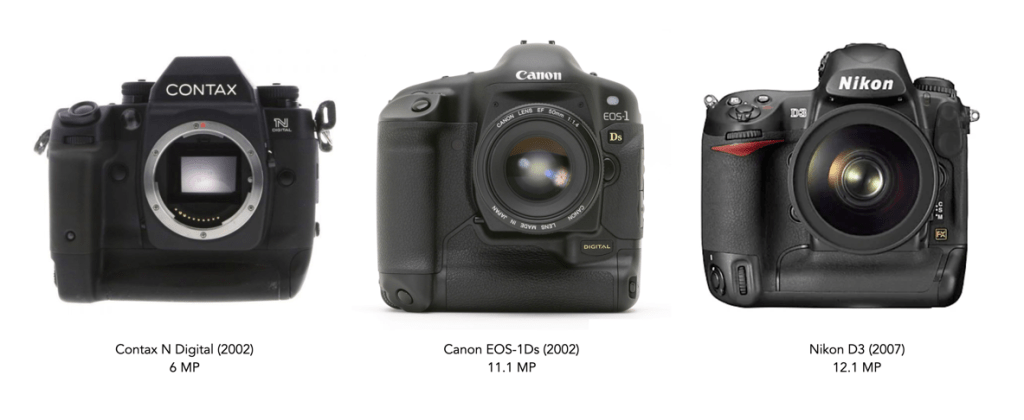
Although quite an innovative camera, it never really seemed to take off in a professional sense. It didn’t have continuous shooting or even the auto-focus speed needed for genres like sports photography. It also fell short on the megapixel side of things, as the Canon EOS-1Ds with its full-frame 11-magapixel sensor had already appeared in 2002. A year later in 2004, the Olympus E-300 had already bypassed the 5MP with 8MP, making the E-1 somewhat obsolete from a resolution viewpoint. The E-1’s photosite pitch was also smaller than most of its APS-C rivals sporting 6MP sensors.
Further Reading
- Olympus E-1 – Thomas Eisl
- Revisiting the past: the 2003 Olympus E-1 – Ming Thein (2014)
- A blast from the past: Robin Wong on the Olympus E-1 – Robin Wong (2018)
- Olympus E-1 – First Olympus DSLR, 5MP, Launched 17 Years Ago – Robin Wong (2020)
 Crafting Pixels