Cameras from the 1930s, especially early SLRs and Leica-type rangefinders may be some of the most sought after ones, but are they worth buying? Well perhaps if they are to used solely as part of a collection, because many may be too old for practical use.
Many of the cameras from this period, be they Leica’s, Contax’s or Exakta’s, are old – now anywhere from 85-95 years old. Although they were mostly handcrafted using solid materials, it’s crazy to think that their lifespan was expected to be 30 years, let along 90. For example the Kine Exakta was a huge design advance when it was introduced in 1936, but these SLRs are seldom that useful today. There is no guarantee that the cloth shutter has held up well to the many decades of use, and in all likelihood decades of little use. The machinery inside each camera, much like a classic mechanical watch, has likely been subjected to wear and tear, and infiltration of dust. Even if the shutter appears to work, there is no assurance that the shutter speeds will at all be accurate. A shutter typically relies on a complex system of gears, springs, curtains, and ribbons. Friction and lubrication are critical for accurate speeds, especially at faster shutter speeds. If not properly maintained, the shutter speeds can become inconsistent. Old cameras were extremely complex, and complexity never ages well.
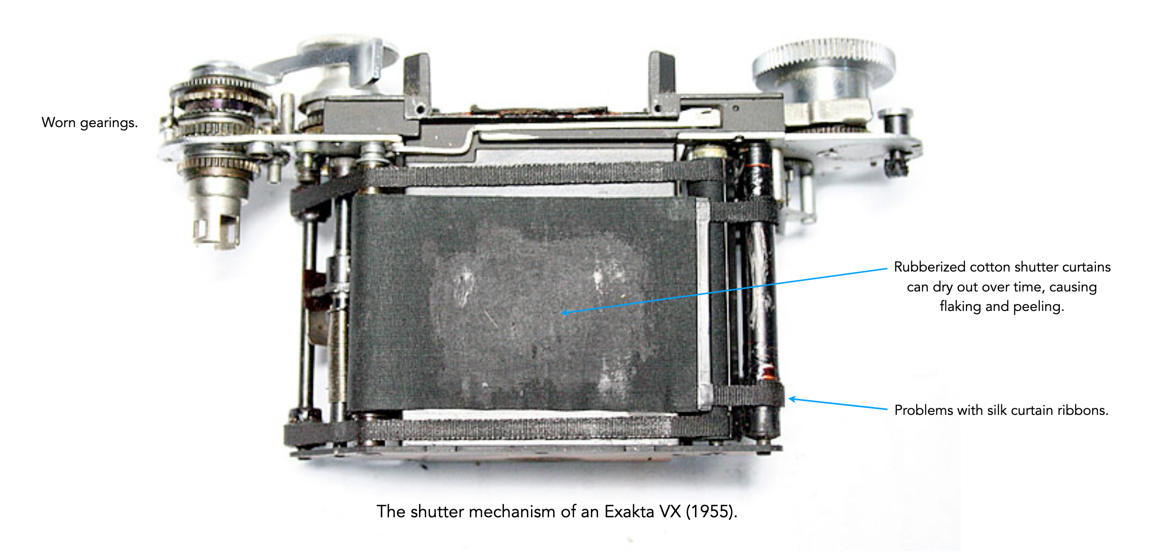
Personally, I think that buying a pre-war SLR should be regarded as being something of a lottery. Whereas it might have been easy to find someone to repair these cameras in the 1990s, this has become much harder. Parts are also hard to find, and often require a “donor” camera, but these cameras are old as well. I would suggest if you really want to buy one to use, that you also find a cheap “for parts” camera, although replacing a shutter curtain will require more than an “old” donor (cloth shutter curtains will degrade even in perfect storage conditions). And repairs won’t be cheap. An alternative might be buying old cameras from a very reputable store that deals in old cameras, and has vetted and possibly serviced the camera. Yes, it will be more expensive, however the hassle and cost of repairs may be even more.
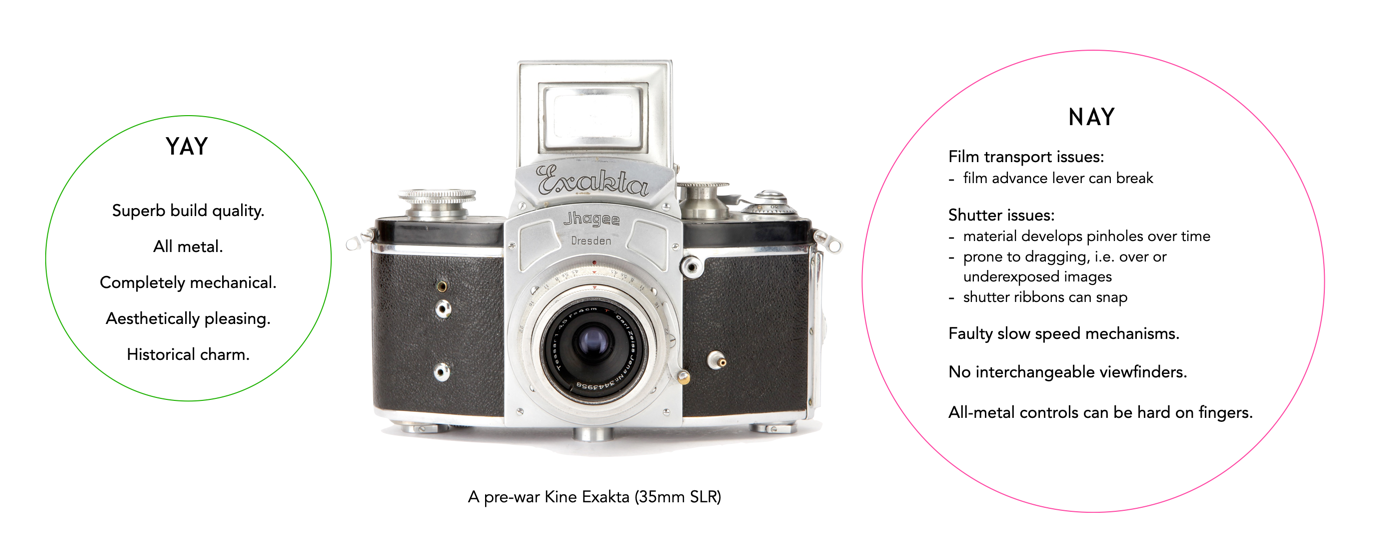
There are of course different “levels” of repairs. Shutter speeds that all test as working, but may be slow, with the worn mechanisms that cause the shutter curtain to stick, or operate at incorrect speeds. There may also be dusty viewfinders, dirty mirrors, and general aging of parts. Cloth shutter curtains may also have pinhole perforations or even tears, leading to light leaks. The shutter curtains of many of these early cameras were also controlled using silk ribbons, which are also prone to wear and tear over time. Shutter issues are more challenging to repair, because it is time consuming to strip a camera back to get at the shutter mechanism. Bottom-line, repairs are labour intensive and hence expensive.
Of course the war years may be even more dubious. Although cameras were produced in smaller amounts, there were caveats to this period. Firstly, shortages of raw materials, and in some cases of appropriately skilled technicians meant that cameras could have been produced below the standard of pre-war years. There was also a distinct lack of parts, so fixes to cameras were often made on an ad hoc basis.
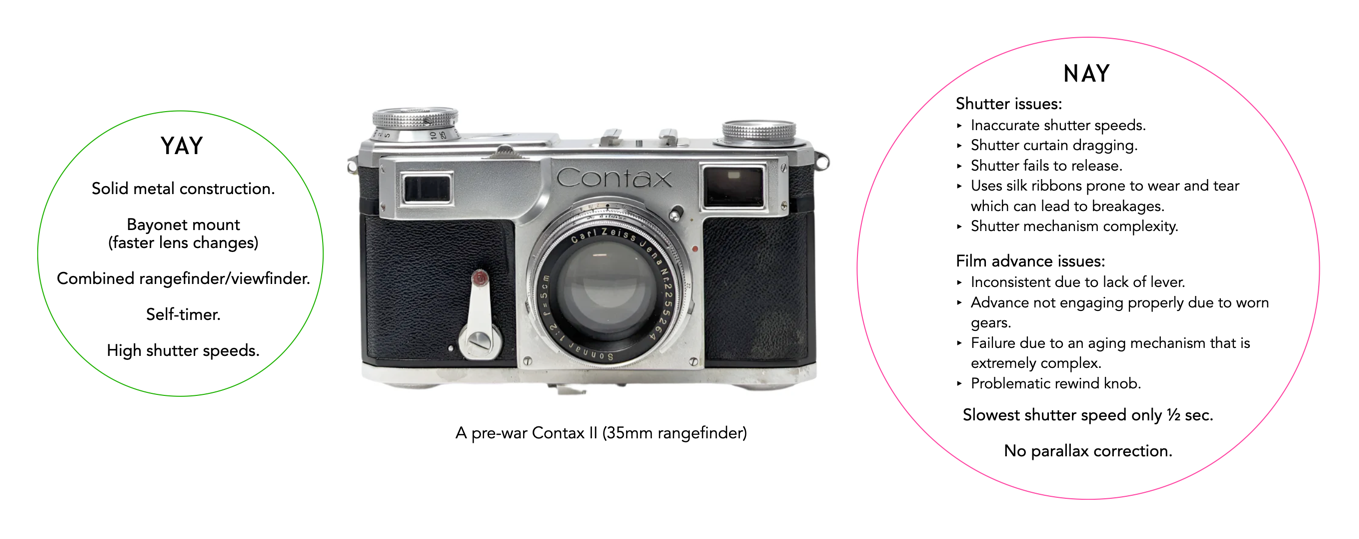
Reliable may be a questionable adjective when it comes to old things, especially old mechanical things. A camera can sit in its original box for 90 years, never opened and still age. It may be that even a “mint” condition camera will work for a few rolls of film and then stop dead in its tracks. Ivor Matanle, in his 1986 book Collecting and Using Classic Cameras, said this of pre-war Exaktas: ‘The pre-war Exaktas are attractive, but are now old and usually less reliable – a fact that is hardly surprising, in view of their complexity.’. If someone were interested in vintage cameras for practical use, I would steer the towards post-war cameras, and then in reality to those of the late 1950s, and 1960s – the quality is likely better, and they are a bit younger. If you buy a pre-war camera for use, then you have to live with the notion that at some point it may just become something to look at.
 Crafting Pixels