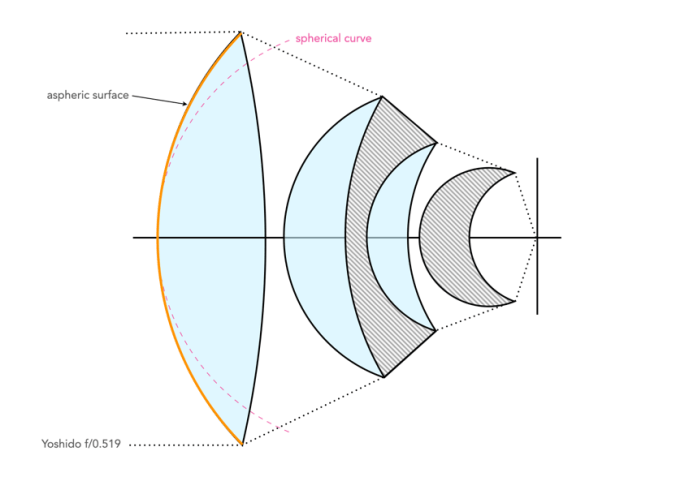
There is a lens described in a classified CIA briefing, which was never built [1]. The lens was designed by Shoroto Yoshido, a lens designer from the Sendai Science Laboratory, who supposedly achieved a relative aperture of f/0.519 using 5 elements. The lens only had one aspheric surface. But its design was somewhat crazy, the focal plane almost touches the the extremely curved rear lens. There is very little else written about this lens.
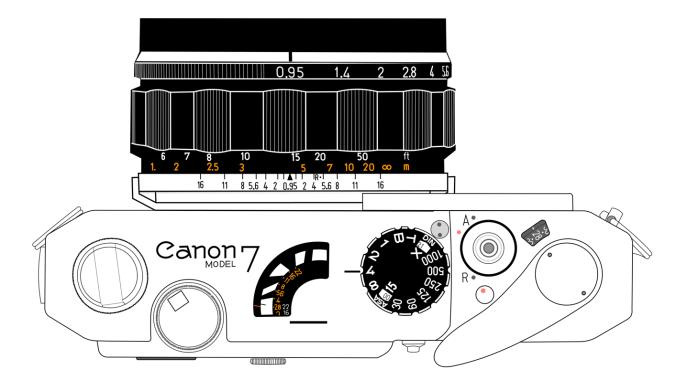
In August 1961, Canon released the 50mm f/0.95, designed as a standard lens for the Canon 7 rangefinder camera. At below f/1.0, it was the world’s fastest 35mm lens. It was created by lens designer Mukai Jirou, who also created several other rangefinder lenses for Canon (35mm f/1.5, 35mm f/1.8, 85mm f/1.8, and 100mm f/2). The Canon f/0.95 was often advertised attached to the Model 7, the first rangefinder Canon with four projected, parallax-compensating field frame lines.
Fig.1: The Canon 7 and the f/0.95
It was supposedly given the name “Dream Lens”, by British photojournalists, a term soon picked up by Canon’s astute marketing department (the exact source of the term is a mystery). The advertising generally touted the fact that it was “the world’s fastest lens, four times brighter than the human eye” (how this could be measured is questionable). In addition it was advertised as giving “least-flare edge-to-edge sharpness, and is ideally corrected for aberration”. Despite the hype, there are no reviews in photographic magazines of the period beyond a quick summary paragraph of the camera.
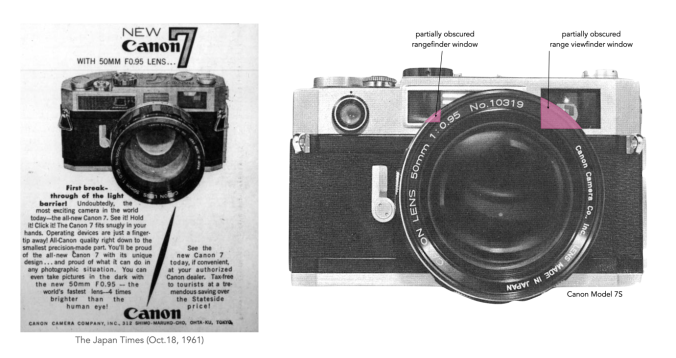
Fig.2: An ad for the Canon 7, and illustrating the obscured windows.
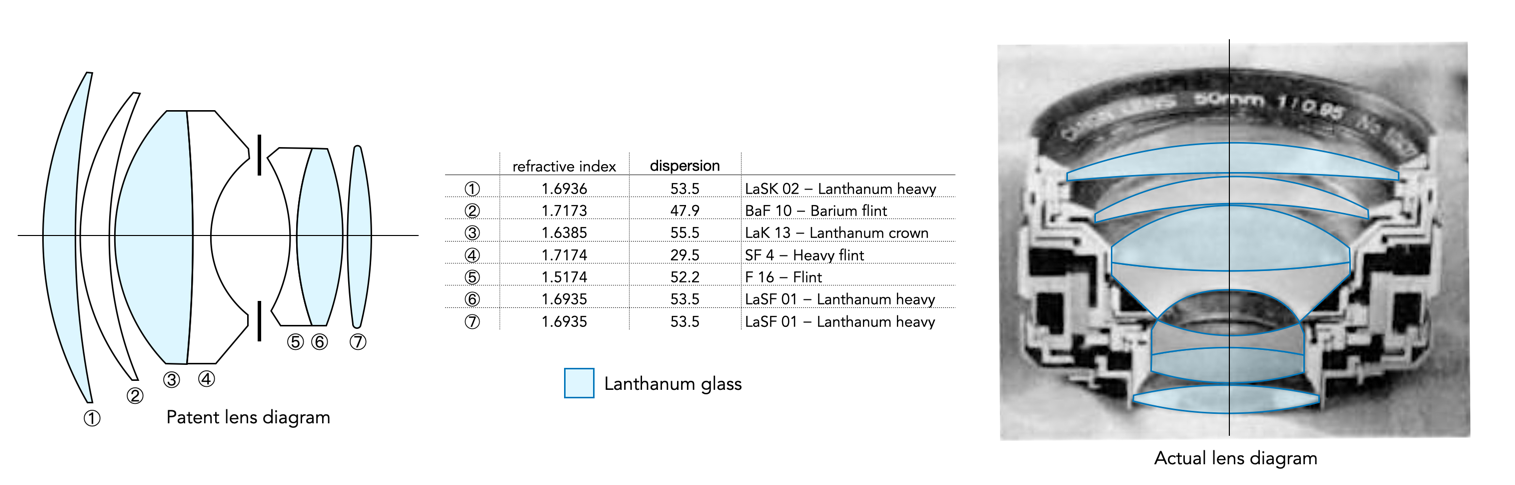
The lens incorporated rare-earth Lanthanum glass in four of the seven lens elements (there were no elements containing Thorium). However the entire lens design took some compromises. This chunky 605g, 79mm diameter lens was so large on the Canon 7 that it obscured a good part of the view in the bottom right-hand corner of the viewfinder, and partially obscured the field-of-view. However the rear lens element had to have about 10mm removed from the top to clear the interlocking roller associated with the rangefinder coupling mechanism, and a metal collar with four protruding feet had to be added to the back section to protect the rear element if the lens was placed on a flat surface with the front element facing up.
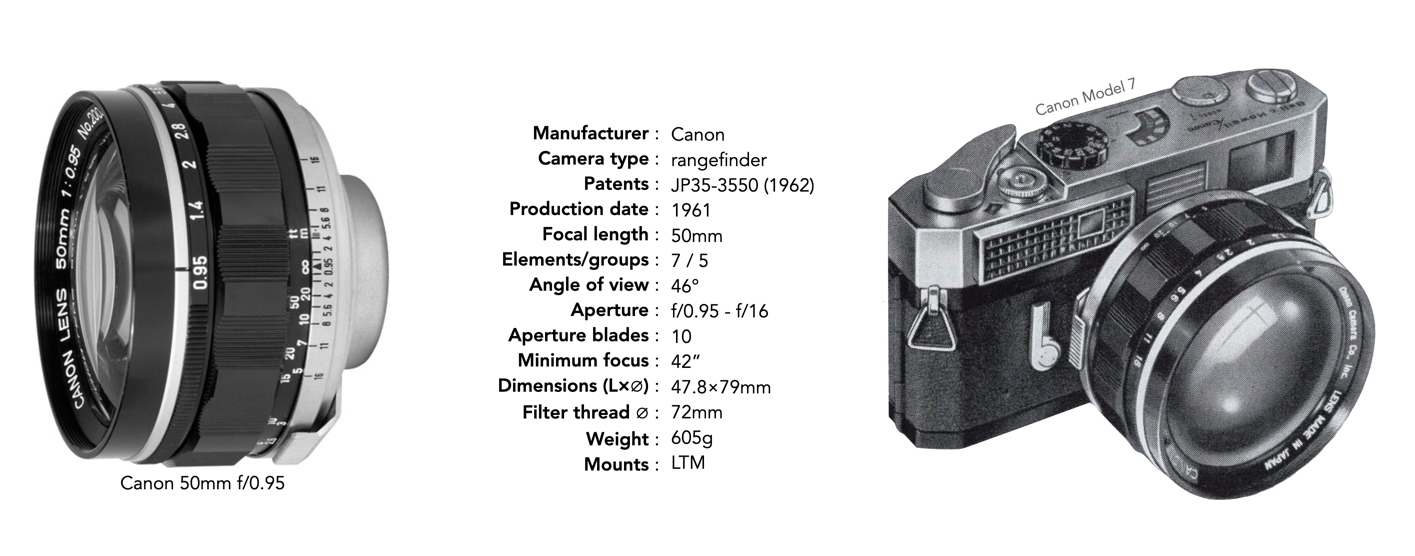
Fig.3: Lens specifications
It is Gauss type lens with 7 elements in 5 groups. In it is suggested that while there are many six-element Gaussian lenses, most suffer from some degree of oblique spherical aberration, with significant flare when used at maximum aperture.
There seems to be one Japanese patent of 1962, No.35-3550, [1] that may form the basis of this lens, although the lens diagram in the patent is not the same as that portrayed for the actual lens. The lens described also appears in a U.S. patent [2] where it is specified as an f/1.2 lens. The work has its underpinnings in an earlier Japanese patent, No.205,109 (Publication No.6,685/1953 corresponding to a US patent of 1954 [3]) which showed that spherical aberration could be reduced by selecting the appropriate arrangement of the refractive indices and radii of curvature at the cemented surfaces of each element. The purpose of the design was to create a lens that produced a high quality image.
How do users view the lens today? Overall it could be described as having a lot of vignetting, spherical aberration and quite a bit of softness [7]. Some suggest the soft-focus effect contributes to the lens’ ‘ethereal quality’, and the rendering has an impressionistic quality [4]. Some suggest that it isn’t very sharp wide open [7], having a ‘razor thin depth of field’ [7]. Bokeh is described as ‘Nisen-bokeh’ [5], and a ‘very retro, swirly’ bokeh [7].
Fig.4: Original lens diagram specifications from the Japanese patent [1], and the actual lens diagram (right)
Some 20,000 copies of this rangefinder-coupled lens were produced between May 1961 and September 1970. Between 1970 and 1984, Canon continued to manufacture a version of this lens for TV cameras and cinematography which had no rangefinder coupling. Of these, about 7,000 copies were produced. When released the lens cost 57,000 yen. The average yearly salary in Japan in 1961 was ¥294,000, so this lens was the equivalent of one-fifth of a years salary. In the US the Canon 7 was sold under the guise of Bell & Howell/Canon, and in 1962, with the body and lens retailing for $499.95, and the 50mm f/0.95 lens by itself for $320, with the f/1.2 at $210. To put this into context, $320 in 1962 is worth about $3430 today, and a Canon 7 with a f/0.95 lens in average condition sells for around this value. Lenses in mint condition are valued at around C$2200-5000.
Note: The lens is also often rehoused as a cine lens by companies such as Whitehouse Optics (the cost is €6,500, not including the cost of the optics).
The 1950s photographic industry in Japan was marked by a race to develop the fastest lens. In December 1950, Nippon Kogaku, maker of the Nikon, would introduce the Nikkor 50mm f/1.4, the fastest normal lens produced. But the victory was short lived, as in 1953 an even faster f/1.1 lens was introduced by a little known company – Zunow.
Fig.1: Literature in Japanese news announcing the f/1.1 lens
The development of the Zunow 5cm f/1.1 began in 1943 at the Teikoku Optical Co. to meet the high-speed optical needs of the Japanese Navy [2]. There was a requirement for a fast lens in low-level light situations such as aerial surveillance at dawn and dusk. The design was spearheaded by Sakuo Suzuki, and Michisaburo Hamano (NY Times, Nov.21 1953), and managed to produce three prototypes, but the factory was destroyed in a raid late in the war. It would take ten years to complete the lens. The first prototypes were completed in 1950, and the 50mm f/1.1 was Zunow released in 1953.
Fig.2: Lens diagram from the patent with associated optical glass types
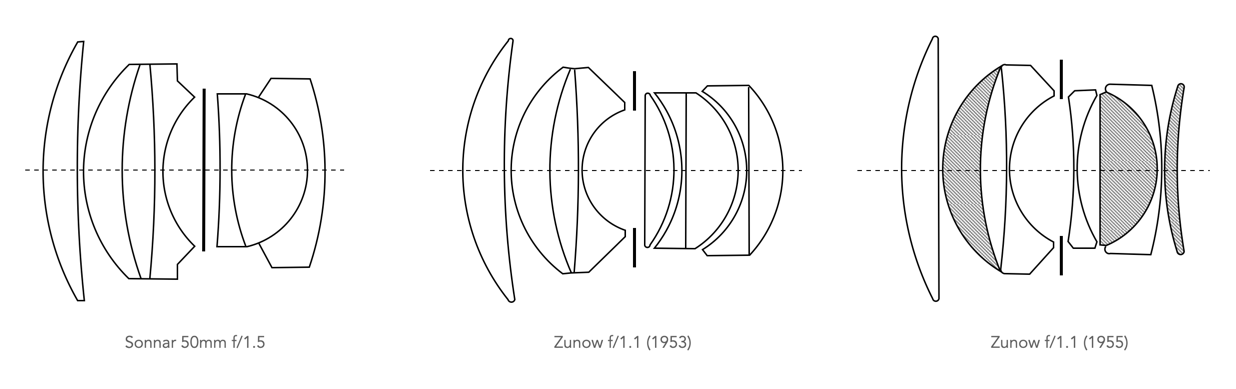
The patent for the Zunow f/1.1 lens [3] describes the lens as “an improved photographic objective suited for use with a camera that takes 36×24mm pictures”. The lens had a configuration of 9 elements in 5 groups, in a Sonnar-type design, likely derived from the Sonnar 50mm f/1.5. It was available in mounts for Contax, Nikon and Leica rangefinder cameras. The amazing thing about this lens is the fact that it was not constructed using any “rare earth” glasses.
Fig.3: Comparison of lens diagrams for Sonnar f/1.5, and the two versions of the Zunow f/1.1 (hatched lines indicate new glass) [2]
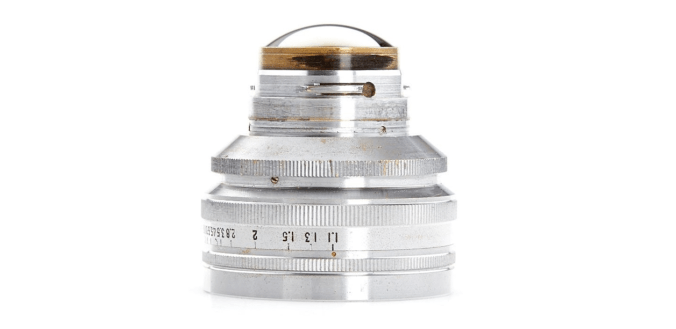
The original version earned the nickname “Ping-Pong ball” because it featured a rounded end. However it faced some issues, mostly when the aperture was wide open, e.g flare. Kenji Kunitomo and Yoshitatsu Fujioka would join the company to address these issues. This lead to the introduction of the Type 2 in 1955. The new design dealt with the protruding ball structure by redesigning the lens. It was transformed into a flat rear design with 8 elements in 5 groups, which also dealt with the flare and brightness issues when wide open. The lens elements featured a hardcoating on all air-glass surfaces to reduce internal reflections [7].
Fig.4: Specs for the original 1953 lens
Comments on the lens performance in The Truth About Superspeed Lenses (1957) [4]:
Performance: Vignetting at the widest aperture f/1.1, disappears completely at f/2.8. The lens is acceptably sharp at the centre of the negative. Detail is lost toward the edges and corners. Sharpest range is f/5.6 to f/11.
Comments: The Zunow lens mount may cut off the right corner of some camera viewfinder windows, blocking part of the image. It might be a good idea to use an accessory viewfinder with the Zunow. We found it an easy lens to focus quickly.
Fig.5: The “Ping-Pong ball” lens
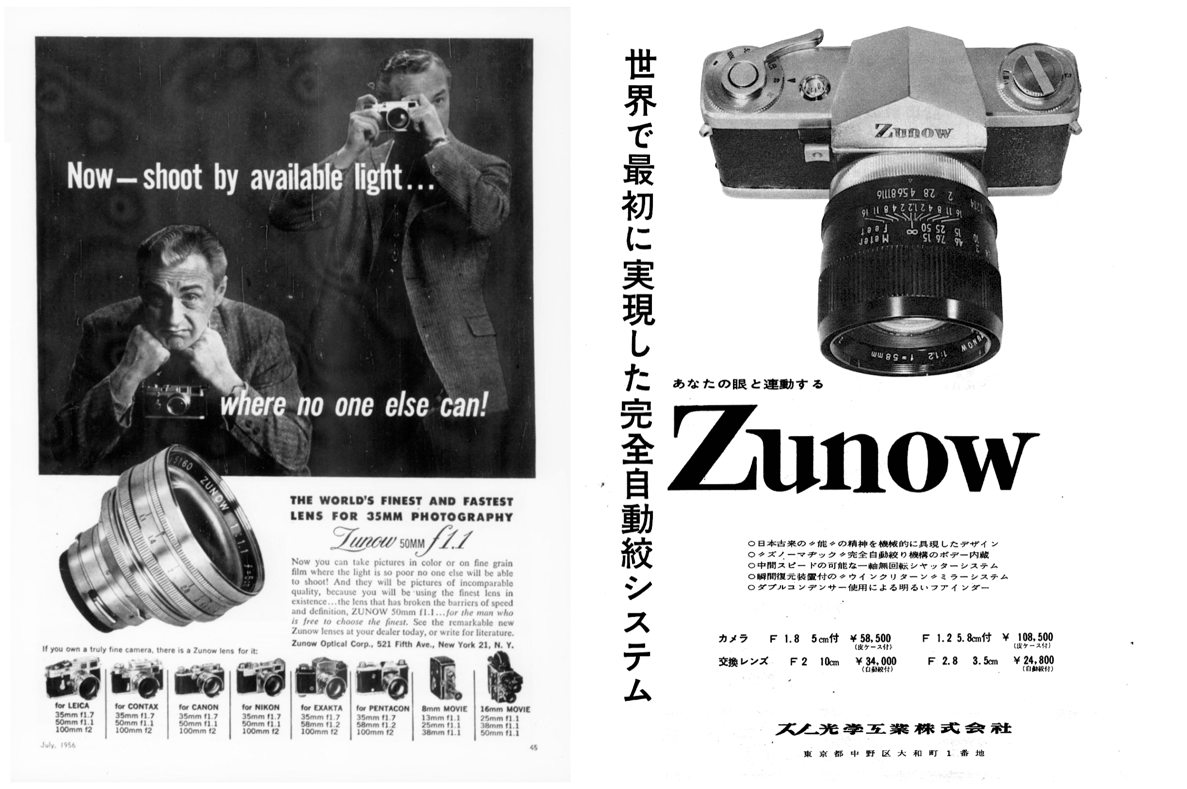
While the Zunow 50mm f/1.1 lens was the first ultrafast lens for rangefinders, there were few if any lenses of equal stature in the SLR realm. Ads at the same time showed a Zunow 58mm f/1.2 fast lens for Exakta and Pentacon SLR cameras. While very few have seen this lens in real life, and it does not appear to have been sold at any auctions in recent memory, there is a glimpse into what it looked like in the one of the ads for the Zunow camera shown in Figure 6. It was apparently a 7 element/5 group lens, of some expanded double-Gauss design [6]. The 58mm f/1.2 would have been the fastest lens offered by any camera manufacturer at that time for an SLR. In all likely so few were made that they today sit in private collections.
Fig.6: An ad for the 50mm f/1.1 lens, and a sneak peak at the 58mm f/1.2 in a Japanese ad for the Zunow SLR
Nevertheless, it would take Nippon Kogaku until early 1956 to match the Zunow lens in speed, introducing the Nikkor 50mm 1.1. Canon was not in the picture until the 50mm f/0.95 in 1961, and Leitz not until 1976 with the Noctalux 50mm f/1.0. The Zunow 50mm f/1.1 is today a vary rare lens. Sales are are US$5-10K, up to US$20K depending on condition, and mount. The price for this lens in 1956 was US$450, although it could be found for as low as US$300.
Fig.7: The Zunow SLR showing the 58mm f/1.2 lens, and its 7/5 configuration
Further reading:
Norman Rothschild, “Meet the Zunow f/1.1”, Popular Photography, pp.126/128, February (1956)
Kogoro Yamada, “Japanese Photographic Objectives for use with 35mm Cameras”, Photographic Science and Engineering, 2(1), pp.6-13 (1958)
U.S. Patent 2,715,354, Sakuta Suzuki et al., “Photographic Objective with Wide Relative Aperture”, August 16, (1955)
“The Truth About Superspeed Lenses”, Popular Photography, 21(10) pp.62-64 (1957)
After Canon and Nikon gave up on their sub-f/1.1 lenses, there was a lull for a while. In all possibility it was likely considered that film would just get so fast there would be little need for these light behemoths. But high ISO film was only introduced in the mid to late 1970s – Fujicolor 400 (1976), Kodakcolor 400 (1977). Indeed faster films begat faster lenses.
The Leitz 50mm Noctilux f/1 for Leica M cameras appeared in 1976, designed by Walter Mandler (1922-2005) and produced by Ernst Leitz Canada. It was a successor to the earlier Noctilux f/1.2. Bob Schwalberg reviewed the lens in 1976 [1]. His observation was that it had a high optical contrast and almost no flare at f/1, “outimaging” its compatriots the Noctilux f/1.2 and the Summilux f/1.4.
The lens was manufactured for a long time, from 1976-2007. The name Noctilux, was designated for three lenses with differing apertures:
Leitz Noctilux 50mm f/1.2 aspherical (1966-1976).
Leitz/Leica Noctilux-M 50mm f/1.0 (1976-2007).
Leica Noctilux 50mm f/0.95/50mm ASPH (2008- )
The lens was constructed using only spherical curvatures, as opposed to the f/1.2 which used two aspherical surfaces with a 6/4 design. The earlier design was likely changed because the aspherical lenses were too expensive to manufacture. The f/1 uses a modified Gauss design of seven elements in six groups with an “air-lens” between the second and third elements. The second and fifth elements were made using Noctilux 900403 glass. The 1st, 6th, and 7th elements were made with Lanthanum glass (LaK12, LaF21). The 900403 glass, developed at the Leitz Glass Laboratory had a higher zirconium oxide content giving it a refractive index of 1.9005 and a dispersion value of 40. (This glass had a melting point of 1600°C, and had to be cooled in a controlled manner over 10-12 days).
But it was no light lens. It was 63mm in diameter, and weighed about 600g. It still suffered from the one thing all ultrafast lenses suffer from – a narrow DOF (2” at 5 feet). When released it sold for US$855. They now routinely sell for C$8,000-11,000.
References:
Bob Schwalberg, “50-mm Noctilux f/1: Sharpest superspeed lens yet?”, Popular Photography, 78(2), pp. 80,81,105 (1976) Dominique Guebey Jungle, “Leitz Noctilux 50mm f:1.0”
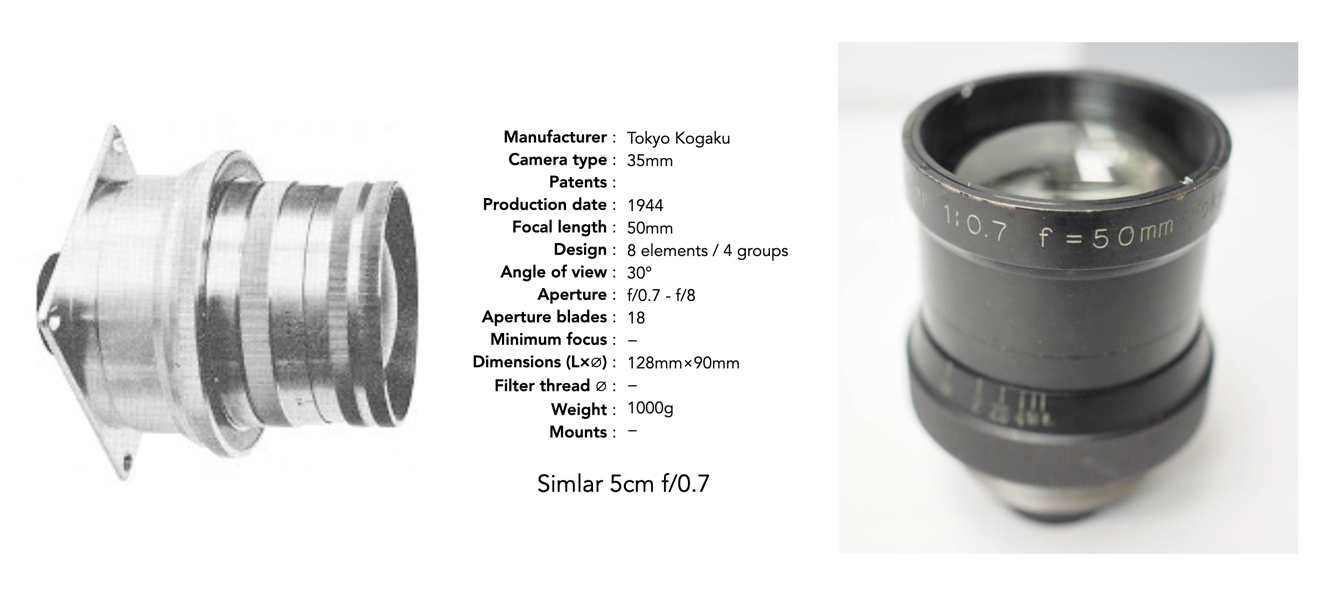
The Zeiss 50mm f/0.7 Planar was not the only f/0.7 lens of the period. There was also the Simlar 50mm f/0.7. The Simlar lenses were made by Tokyo Kogaku, which would eventually become Topcon (Japan). The original lens was designed by Maruyama Shūji. The story of the lens originates from the December 1951 issue of Asahi Camera [1]. It was ordered by the Japanese Army for use in nighttime reconnaissance photography, and was completed in 1944. Before it could be used for its intended purpose, the copies of the lens were claimed by the Aeronautical Engineering Institute of Tachikawa for X-ray medical photography. The article suggests ten copies were made by wars end, but their fate is unknown except for one lens kept by Maruyama Shūji.
A second, postwar version of the camera was produced in 1951 – the dimensions and the weight had both changed (123.7mm×105mm ∅, 2.5kg). Only three copies of the lens were made, of which two were supposedly used on a Antarctic expedition by the Mainichi Newspaper. The Trade and Industry of Japan publication from 1955 shows the lens.
The strange thing about the second series is that the weight of the lens changed from 1kg to 2.5kg, which is a substantial increase. I would beckon to suggest that the design of the original series was copied from either the wartime Zeiss objective, or perhaps the Herzberger objective. When the war was over, there was either issues with using the patent, or an inability to obtain the proper glass, adding extra weight. However there does not seem to be any surviving pictures of the second series.
For those interested, here is a link to another lens, the Simlar-F 180mm f/1.5 produced in 1942. It provides a sense of the aesthetics of the Simlar lenses.
Further reading:
Asahi Camera December 1951. “Toki no wadai: Hachi-nen mae ni Nihon de dekite ita F0.7 no renzu” (時の話題・八年前に日本で出来ていたF0.7のレンズ, Topic of the time: An f/0.7 lens made in Japan eight years ago). P.84.
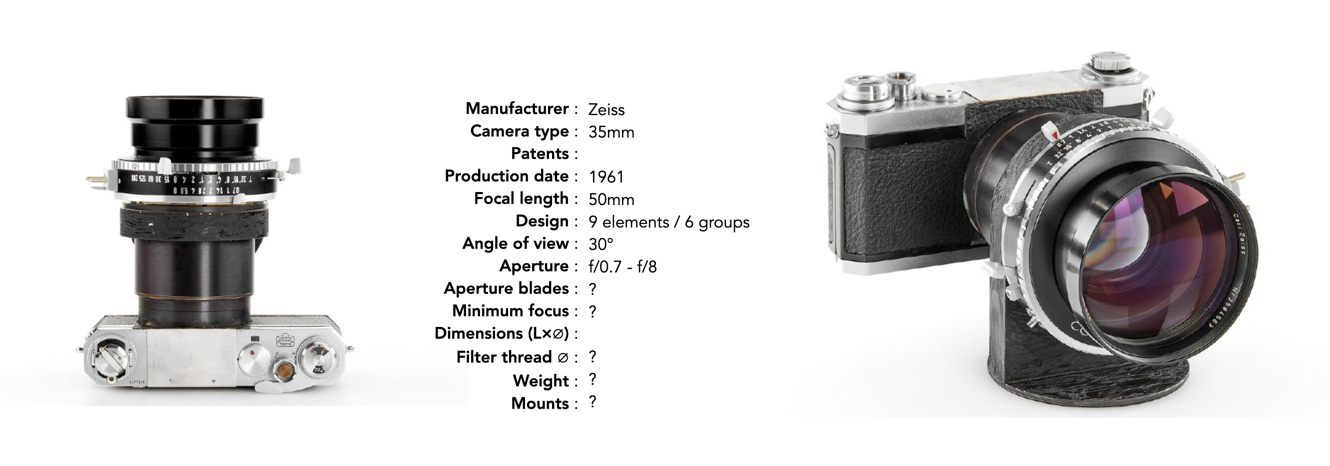
The quintessential vintage ultra-fast camera lens is the Zeiss Planar 50mm f/0.7. It was developed in 1961 for a specific purpose, namely to photograph the dark side of the moon during the NASA Apollo lunar missions. Only 10 lenses were built, one was kept by Zeiss, 6 went to NASA and 3 were sold to director Stanley Kubrick. Kubrick used the lenses to film scenes lit only by candlelight in the movie “Barry Lyndon” (1975).
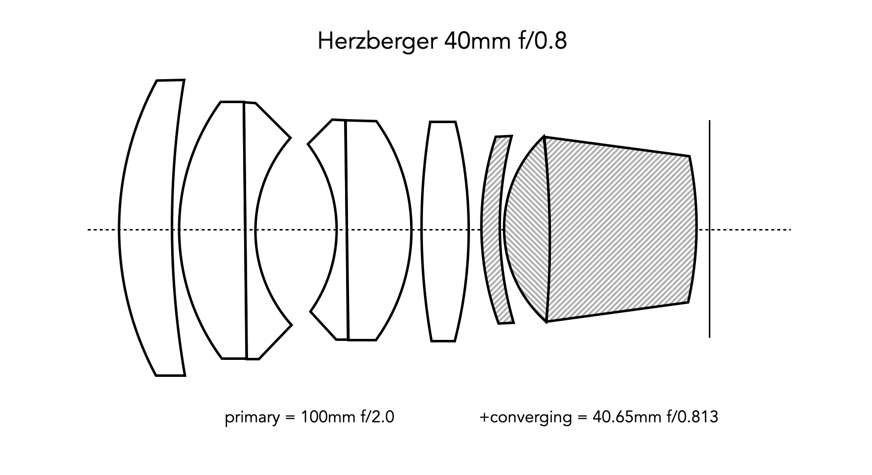
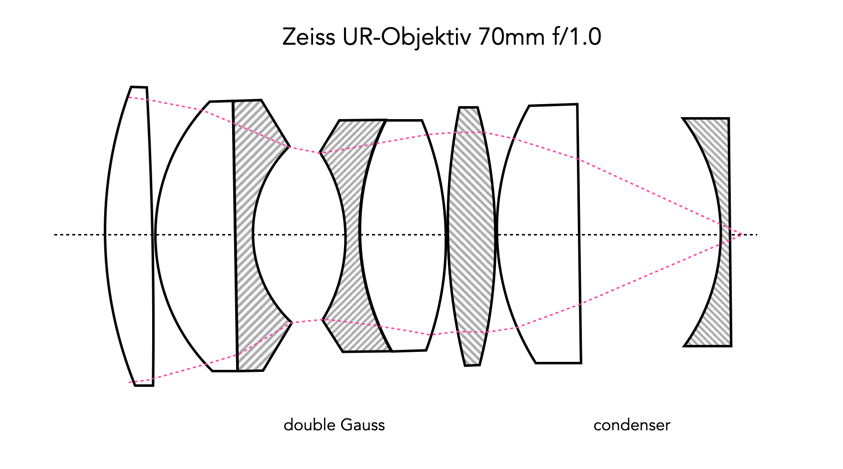
There is a similarity, at least in the double-Gauss optical design – it is essentially a Gauss front with two doublets glued together and a rear group which functioned as a condenser. (copies of optical diagram). The 50mm f/0.7 Planar was designed by Dr. Erhard Glatzel (1925-2002) and Hans Sauer. It is supposedly based on an f/0.8 lens designed by Maximilian Herzberger (1900-1982) for Kodak in 1937. Looking at the two schematics, they look quite similar. The idea is to take the 70mm f/1, and by adding a condenser, brute-force the lens into a 50mm f/0.7. The condenser actually shortens the focal length and condenses the light – in reality adding a ×0.7 teleconverter that gives 1 f-stop.
But this lens has an interesting backstory. According to Marco Cavina, who has done a lot of research into the origin of this lens (and others), the design of this lens was derived at least in part from lenses designed for the German war effort. During WW2, Zeiss Jena designed a series of lenses for infrared devices to be used for night vision in various weapons systems. One such lens was the Zeiss UR-Objektiv 70mm f/1.0. The design documents were apparently recovered during Operation Paperclip from the Zeiss Jena factory before the factory was occupied by the Soviets and then provided to the new Zeiss Oberkochen.
The design went through four prototypes before achieving the final configuration [1]. The final scheme was optimized on an IBM 7090, which had been in operation since the late 1950s. The lenses were used on a modified Hasselblad camera.
Glatzel, E., “New developments in the field of photographic objectives”, British Journal of Photography, 117, pp.426-443 (1970)







 Crafting Pixels