Vintage lens makers – Heinz Kilfitt (Germany)

If it were not for one particular point in time, Kilfitt may not be as well known a brand as it is. That event was the use of the Kilfitt Fern-Kilar f/5.6 400mm lens in Alfred Hitchcock’s 1954 movie “Rear Window”, where the lens, as well as the Exakta camera it was attached to, played a prominent role in the movie (in fact no other camera/lens combination likely ever had such a leading role).

Kilfitt was one of the most innovative lens makers of the 1950s. Born in Westphalia in 1898, Heinz Kilfitt had quite a pedigree for design. Before the war he had established his reputation designing the Robot I camera (24×24mm format), the first motorized camera, introduced in 1934. Rejected by Agfa and Kodak, Kilfitt partnered with Hans-Heinrich Berning to develop the camera. In 1939 Kilfitt sold his interests in the Robot to Berning. In Munich, Kilfitt acquired a small optical company, Werkstätte für Präzisionsoptik und Mechanik GmbH, where he began developing lenses for the like of 35mm systems.

The Kilfott lens used in Rear Window.

By the end of the war in 1945 Kilfitt had very little left, basically a run-down plant, and few workers. He started a camera repair shop for US army personnel, and by 1948 had started to manufacture precision lenses. Kilfitt devoted himself to what he considered an inherent problem with the photographic industry – the lack of lens mount universality. Every camera had to have its own set of lenses. This led him to introduce the “basic lens” system in 1949. In this system, each lens was supplied with a “short mount”, the rear of which had a male thread which accommodated a series of adapters [1]. Some for SLR, some for C-mount, or reflex housings.

Like many independent lens companies, Kilfitt produced a series of lenses which could be adapted to almost any camera by means of lens mounts. One of their core brands was Kilar.

While the company is famous for its telephoto lenses, it actually specialized in another area: macro. Early SLR lenses such as the Biotar 58mm f/2 were able to focus as close as 18 inches, which likely seemed quite amazing, considering the best a rangefinder could do was 60-100cm. Kilfitt thought he could do better, producing the world’s first 35mm macro lens, the 40mm f/2.8 Makro-Kilar in 1955 [3]. It would be what Norman Rothschild called the first “infinity-to-gnats’-eyeball” [2]. It was offered in two versions: one that focuses from ∞ to 10cm, with a reproduction of 1:2, and one that focused from ∞ to 5cm, with 1:1.

The early version of the Makro-Kilar, showing the Edixa-Reflex version.

Heinz Kilfitt also continued developing cameras. The Kilfitt-Reflex 6×6 appeared around 1952, a camera that had a new system for quickly changing lenses, a complex viewfinder and a swing-back mirror. It influenced the design of other 6×6 format cameras, e.g. Kowa 6. There was also the Mecaflex SLR, another 24×24mm camera produced from 1953-1958 (first by Metz Apparatefabrik, Fürth, Germany later by S.E.R.A.O. Monaco). It was constructed by Heinz Kilfitt, who also supplied the lenses (Kilfitt Kamerabau, Vaduz, Liechtenstein).

LensSmallest apertureAOVShortest focusWeight
40mm Makro-Kilar f/2.8f/2254°2-4″150g
90mm Makro-Kilar f/2.8f/2228°8″480g
135mm KILAR f/3.8f/3218°60″260g
150mm KILAR f/3.5f/2216°60″400g
300mm TELE-KILAR f/5.6f/32120″990g
300mm PAN-TELE-KILAR f/4f/3266″1930g
400mm FERN-KILAR f/4f/4530′1760g
400mm SPORT-FERN-KILAR f/4f/4516′2720g
600mm SPORT-FERN-KILAR f/5.6f/4535′4080g
The more commonly available Kilfitt lenses

When Heinz Kilfitt retired in 1968 he sold the company to Dr. Back, who operated it under the Zoomar name from its headquarters in Long Island, New York. Dr. Back designed the first production 35mm SLR zoom, the famous 36-82/2.8 Zoomar in 1959. The company eventually transitioned the brand to Zoomar-Kilfitt, and then merged it completely into Zoomar. By this stage the company was providing lenses for 12.84×17.12mm, 24×36mm and 56×56mm cameras. The most notable addition to the line-up was a Macro Zoomar 50-125mm f/4.

The lens selection provided by Zoomar-Kilfitt

Note that the Zoomar lenses are often cited as products of Kilfitt, however although some of them may have been produced in the Kilfitt factories, Zoomar was its own entity. Kilfitt was contracted to manufacture the groundbreaking 1960 Zoomar 36-82mm lens for Voigtländer.

The evolution of the Kilfitt brand logos

Notable lenses: FERN-KILAR 400mm f/4, Makro-Kilar 40mm f/2.8

Further reading:

  1. Norman Rothschild, “An updated view of the Kilfitt system”, The Camera Craftsman, 10(2), pp.10-15 (1964)
  2. Norman Rothschild, “The revolution in SLR lenses”, Popular Photography, (60(6), pp.90-91,130-131 (1967)
  3. Berkowitz, G., “New.. Makro Kilar Lens”, Popular Photography, pp.86-87,106,108 (Mar, 1955)
  4. Kilfitt Optik, Photo But More
  5. ROBOT – Who came up with the idea? Kilfitt or Berning? Two genealogists come together to new discoveries…, fotosaurier (2021) article in German

Vintage lens makers – Astro-Berlin (Germany)

Astro-Optik is one of a number of German optical companies that flew under the radar, due to its speciality lenses. It was founded in 1922 as Astro-Gesellschaft Bielicke & Co and based in Neukölln, Berlin (which would become part of West-Berlin). The founders were William (Willy) F. Bielicke, Hugh Ivan Gramatzki and Otto (?). Gramatzki (1882-1957) was a successful amateur astronomer and astrophotographer who published in the journal Astronomische Nachrichten, and headed the local branch of “Berliner Astronomische Vereinigung” for a number of years. Gramatzki invented the Transfokator in 1928. Bielicke (1881-1945) a German-American optical designer was involved in the technical development of the lenses and was responsible for the “Tachar” and “Tachon” lenses.

The 1000mm lens

So it is then not surprising that Astro-Berlin’s product range included lenses suitable for astrophotography and astronomical photometry. After the war the company focused on its film technology (Astro-Kino, Astro-Kino Color) developing lenses that had long and extremely long focal lengths, sometimes called “optical heavy artillery”. The company ceased operations in 1991.

The company produced a multitude of lenses, many under the brand Astro-Berlin. Astro-Berlin is likely most famous for its long lenses for cinematography and photography. These lenses were very simple consisting of one (f/5, f/6.3) or two (f/2.3) achromatic doublets. The f/5 lenses for 35mm came in 300mm, 400mm, 500mm, and 640mm lengths. The 800mm f/5 lens was designed for medium 60×60mm format, and the 1000mm f/6.6 for 60×90mm format.

mm12515015020030030040050050064080010002000
f/2.32.31.83.53.5554.55556.310
Focal lengths (mm), and apertures of Astro lenses for 35mm/6×6 reflex mounts

In addition they produced quite fast lenses. In 1933 they introduced the Tachor f/0.95 which was available in various focal lengths. The 75mm version was suitable for an 18×24mm format (half-frame) but it was a large lens at 110mm in length with a frontal diameter of 81mm. The longest lens produced was possibly the 2000mm f/10 Astro Telastan. At times Astro also cooperated with the other Berlin optics manufacturers Piesker and Tewe.

Ads from Das Atelier des Photographen (1936)

These days, Astro-Berlin lenses are expensive on the secondhand market. For example the Astro Berlin Pan Tachar 100mm f/1.8 can sell for up to C$6000 depending on condition. However it is possible to find a 500mm f/5 lens for between C$900-1200.

Further reading:

Vintage lenses – Why are telephoto lenses so cheap?

Go on to any vintage camera resellers website, and you will see that there are some lenses, notably telephoto lenses, that are inexpensive – I mean really cheap. Why? Doesn’t it require more material to make? Well, yes and no. They do have more metal (body), but the amount of glass is probably less than lenses with shorter focal lengths. Telephoto lenses generally have a very simple lens formulae, and so most of the added expense went into creating a large lens body. But that’s not really the problem.

Nearly all camera manufacturers provided an array of telephoto lenses. It’s a wonder they sold them all. For the reality is, then as now, telephoto lenses have a very narrow scope of use. The amateur photographer was likely only interested in the moderate telephotos, up until 135mm. The remaining lenses were the purvey of the professional photographer, and cinematographer. Who really needed a 300mm or 500mm lens, let alone 800mm? For example, in 1971, Asahi-Pentax sold 12 different Super-Takumar telephoto lenses:

  • Moderate : 85mm f/1.9 105mm f/2.8, 135mm f/2.5, 135mm f/3.5, 150mm f/4
  • Standard : 200mm f/5.6, 200mm f/4, 300mm f/6.3, 300mm f/4
  • Super : 400mm f/5.6, 500mm f/4.5, 1000mm f/8

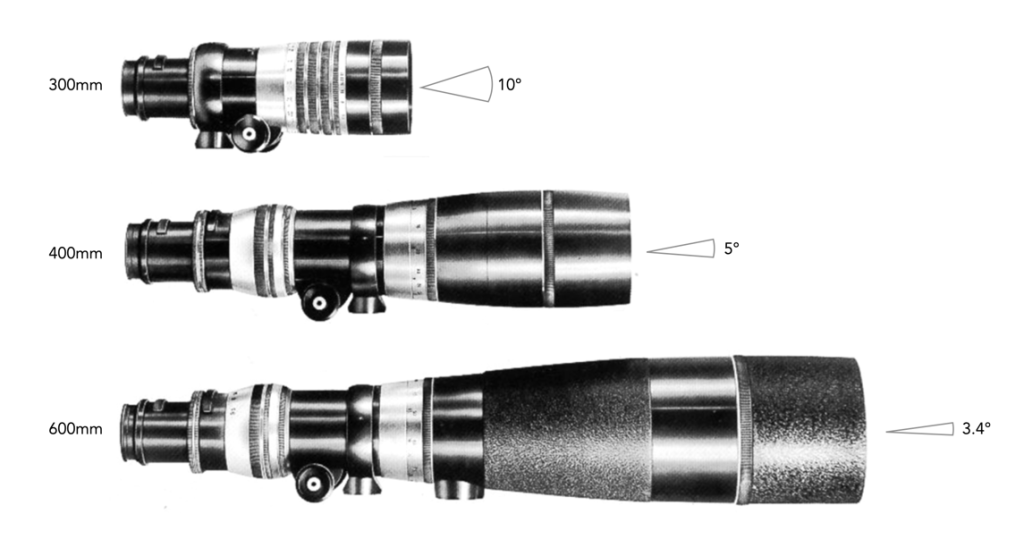
The problem is that these telephoto lenses were only used for a narrow scope of use. Even a 300mm lens only has a horizontal AOV of only 10°. By the time you get down to 400mm it’s only 5°. Both are very low angles.

For the purpose of this discussion, let’s consider telephoto lenses above 120mm. That leaves three core categories: (i) the moderate telephoto’s around 135mm, (ii) the upper-end standards 200mm and 300mm, and the super-telephoto range > 300mm. Of the telephotos below 120mm, the most common are the 80-90mm lenses may be the most expensive of all telephotos, due to their popularity in portraiture work. Note that the prices quoted are for lenses in average to good condition, meaning that they are functional, yet may have minor optical issues, that won’t impact the quality of the image.

135mm

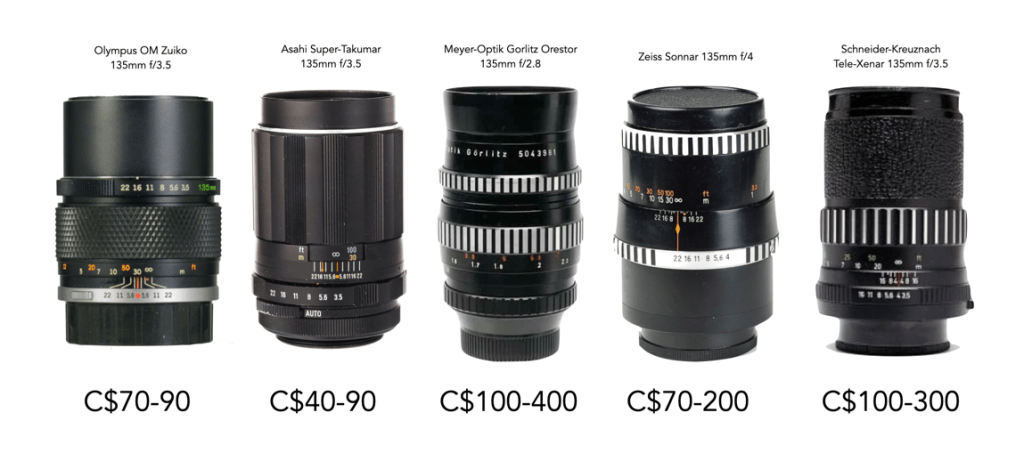
The most common lens in the moderate telephoto category is the 135mm, and there are a lot of them. Almost every lens manufacturer produced the 135mm as a “standard” telephoto lens. This may have been a legacy of rangefinder 25mm cameras which maxed out at 135mm (without the use of specialized devices). As such they are cheap because they are plentiful. The price only varies depending on manufacturer, lens speed, and mount (obscure mounts will reduce the price). If you search Kamerastore, you will find hundreds of 135mm lenses. A Soligor 135mm f/3.5 Tele-Auto (M42) can cost as little as C$60, whereas a Schneider-Kreuznach 135mm f/3.5 (M42) will only cost C$155. The rare exceptions seem to be lenses like the KMZ 135mm f/2.8 Tair-11, which sporting 20 aperture blades sells at about C$338.

Prices are also low because their use in as lenses on digital cameras is just not that popular, largely because once adapted to crop-sensors, a 135mm becomes a 200mm (APS-C) or 270mm (MFT) lens. Other reasons they aren’t popular include being slow, with an average aperture of f/2.8-4.0, and some lenses like the Meyer-Optik Görlitz Orestor 135mm f/2.8 are heavy, i.e. over 500g.

200/300mm

The “standard” telephoto range is often even cheaper relative to it’s size. A 200mm Asahi Super-Takumar f/4 usually sells for around C$200, the Jupiter 21M for C$175. Once you move higher than 200mm, prices seem to stabilize at around C$1 per mm of focal length. Here the higher prices indicate some historically significant lens. For example both a Meyer-Optik Görlitz 300mm f/4.5 Telemegor, or an early Pentax 300mm f/4 Takumar might be priced around C$400.

Super-telephoto

Again, these lenses can be cheap, even though they are not as abundant as smaller telephoto lenses. You can get an Asahi Super-Multi-Coated Takumar 400mm f/5.6 for around C$400. A Meyer-Optik Görlitz 400mm f5.5 Telemegor on the other hand might only cost C$200. The expensive 400mm lenses are often those with some history. For example a Kilfitt Fern-Kilar 400mm f/5.6 normally costs upwards for C$600-800 because it is a rarer lens, and due to its association with the film Rear Window.

The verdict? Telephoto lenses above 120mm can be fun to play with, but most people won’t use them that often. I think that is partially the reason why 135mm lenses are so cheap (and often in such good condition). People bought them to broaden their focal length choices, found they weren’t very practical, and relegated them to a cupboard somewhere. They weren’t that useful for everyday shots, and certainly too bulky to travel with. Eventually the market for them likely waned due to the growth of the zoom lens market. I would honestly avoid telephotos above 200mm unless you have a good use for the lens (and you choose a lens with good reviews). Longer lenses are fun to play around with, but may not exactly be that practical. Super telephotos are for the birds (literally).

P.S. There are also a lot of third-party lenses suppliers that produced telephoto lenses that are even cheaper than camera brands. For example Chinon, Sigma, Soligor, Tokina, Hanimex and Vivitar.