The origins of Asahi’s Takumar

In the days of film cameras, every company had it’s own way of “naming” cameras and lenses. This made it very easy to identify a lens. Asahi Pentax had the ubiquitous Takumar (TA-KOO-MA) name associated with its 35mm SLR and 6×7 lenses. The name would adorn the lenses from the period of the Asahiflex cameras with their M37 mount, through the M42 mount until 1975 when the switch to K-mount came with a change to the lens branding.

Asahi was founded by in 1919 by Kumao Kajiwara as Asahi Optical Joint Stock Co. Asahi began making film projection lenses in 1923, and by the early 1930s was producing camera lenses for the likes of future companies Minolta (1932), and Konica (1933). In 1937 with the installation of a military government in Japan, Asahi’s operations came under government control. By this time Kajiwara had passed away (it is not clear exactly when), and the business passed to his nephew Saburo Matsumoto (possibly 1936?). It was Matsumoto who had the vision of producing a compact reflex camera. In 1938 he bought a small factory in Tokyo and renamed it as Asahi Optical Co. Ltd.

It seems as though the lens series was named in honour of one of the founders brother, Takuma Kajiwara. There might have been the analogy that photography was a means of painting with light, and lenses were like an artists brushes. On a side note, the name Takuma in Japanese is an amalgam of “taku” meaning “expand, open, support”, and “ma” meaning “real, genuine”.
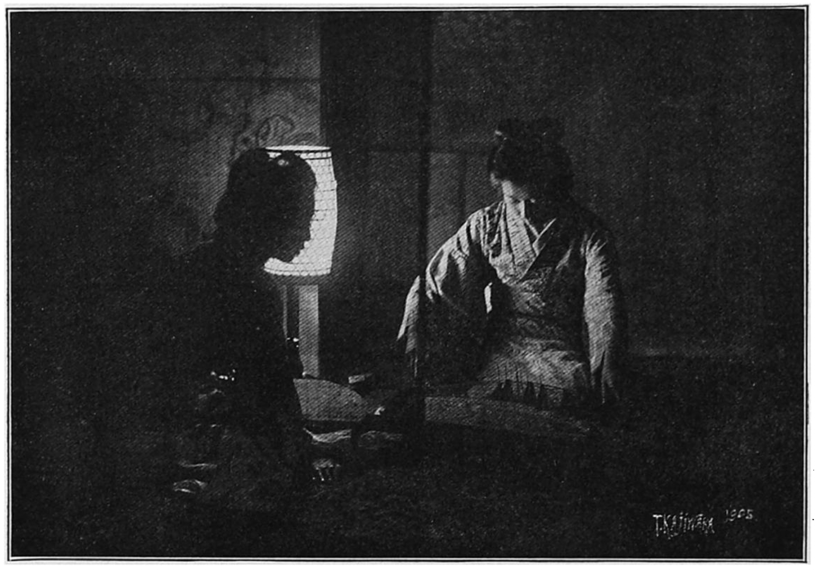
A photograph by Takuma titled “Domestic Life in Japan”, published in the September 1905 issue of Brush and Pencil (“St. Louis Art at the Portland Exposition” XVI(3), p.75).

Takuma Kajiwara (1876-1960) was a Japanese-American photographic artist and painter who specialize d in portraits. Born in Kyushi, Japan he was the third of five brothers in a Samurai family. Emigrating to America at the age of 17, he settled in Seattle, and became a photographer. He later moved to St.Louis and opened a portrait studio, turning from photography to painting. In 1935 he moved to New York. In 1951 he won the gold medal of honour for oils from the Allied Artists of America for his expressionist painting of the Garden of Eden titled “It All Happened in Six Days”. Takuma himself had an interest in cameras, patenting a camera in 1915 (Patent No. US1193392).

Note that it is really hard to determine the exact story due to the lack of accessible information.
Using vintage fisheye lenses on a crop-sensor

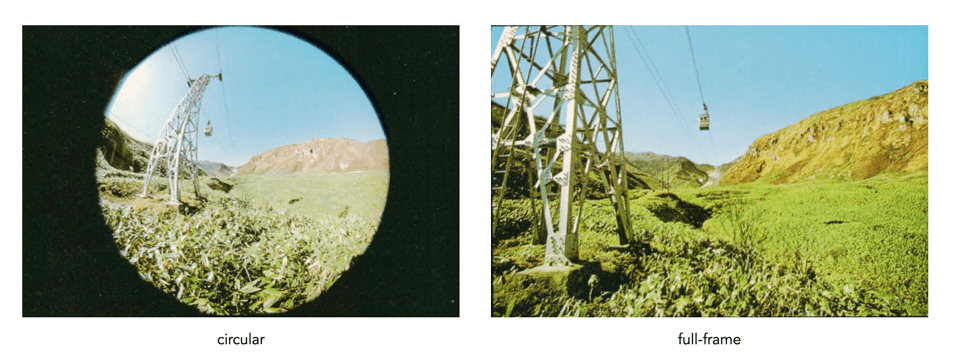
I love vintage lenses, and in the future, I will be posting much more on them. The question I want to look at here is the usefulness of vintage fish-eye lenses on crop sensors. Typically 35mm fisheye lenses are categorized into circular, and full-frame (or diagonal). A circular fisheye is typically in the range 8-10mm, with full-frame fisheye’s typically 15-17mm. The difference is shown in Figure 1.

Fig. 1: Circular 7.5mm versus full-frame 17mm

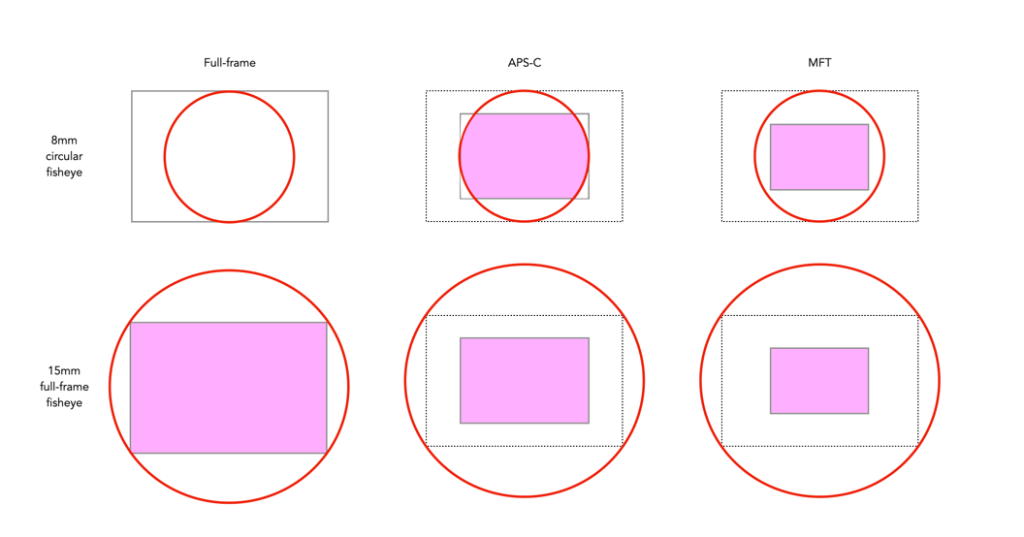
The problem arises with the fact that fish-eye lenses are different. So different that the projection itself can be one of a number of differing types, for example equidistant, and equisolid. That aside, using a fisheye lens on a crop-sensor format produces much different results. This of course has to do with the crop factor. An 8mm circular fisheye on a camera with an APS-C sensor will have an AOV (Angle-of-View) equivalent to a 12mm lens. A 15mm full-frame fisheye will similarly have an AOV equivalent of a 22.5mm lens. A camera with a MFT sensor will produce an even smaller image. The effect of crop-sensors on both circular and full-frame fisheye lenses is shown in Figure 2.

Fig.2: Picture areas in circular and full-frame fisheye lenses on full-frame, and crop-sensors

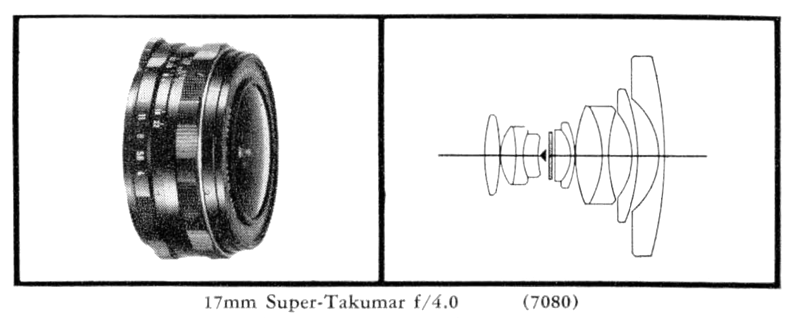
In particular, let’s look at the Asahi Super Takumar 17mm f/4 fish-eye lens. Produced from 1967-1971, in a couple of renditions, this lens has a 160° angle of view, in the diagonal, 130° in the horizontal. This is a popular vintage full-frame fisheye lens.

Fig.3: The Super-Takumar 17mm

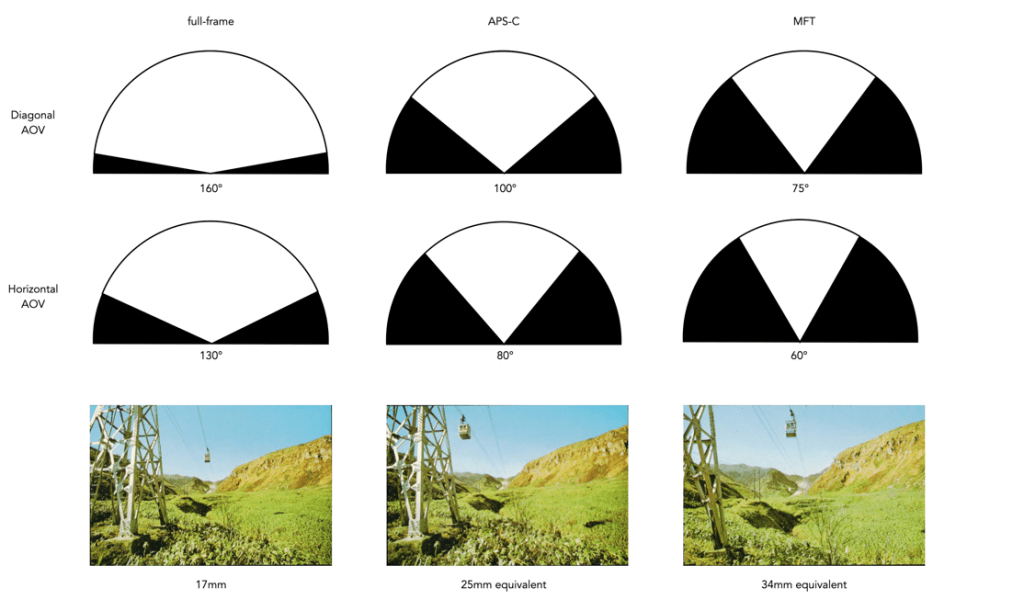
The effect of using this lens on a crop-sensor camera is shown in Figure 4. It effectively looses a lot of its fisheye-ness. In the case of an APS-C sensor, the 160° in the diagonal reduces to 100°, which is on the cusp of being an ultra-wide. When associated with a MFT sensor, the AOV reduces again to 75°, now a wide angle lens. Figure 4 also shows the horizontal AOV, which is easier to comprehend.

Fig.4: The Angle-of-View of the Super-Takumar 17mm of various sensors

The bottom line is, that a full-frame camera is the best place to use a vintage fish-eye lens. Using one on a crop-sensor will limit its “fisheye-ness”. Is it then worthwhile to purchase a 17mm Takumar? Sure if you want to play with the lens, experiment with it’s cool built-in filters (good for B&W), or are looking for a wide-angle lens equivalent, any sort of fisheye effect will never be achieved. In many circumstances, if you want a more pronounced fisheye effect on a crop-sensor, it may be better to use a modern fisheye instead.

NB: Some Asahi Pentax catalogs suggest the 17mm has an AOV of 160°, while others suggest 180°.