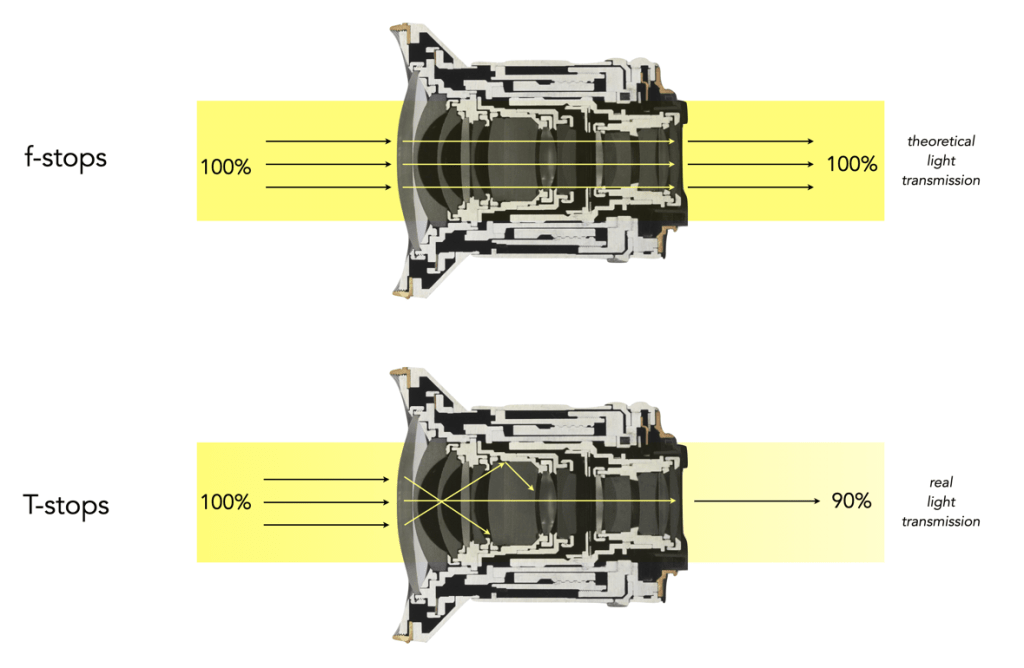
Lenses allow light to be focused on a film/sensor, but not all that incident light that enters a lens gets to the target. Some of this light is reflected or absorbed by the lens. For example, lens materials absorb a certain amount of the light that is incident on its surfaces and passing through the substrate. There are a number of factors that affect light transmission rates: glass quality, quality of coatings, optical construction, and number of lenses.
Light transmittance (LT) is the term for the actual amount of light that makes it to the film/sensor, i.e. the percentage of light that goes through an optical instrument, often expressed as the light transmission rate. What this means, is that a lens with a maximum aperture of f/1.2 could potentially transmit less light, which could be equivalent to say f/1.4 in terms of brightness. The latter number is what is often referred to as a “T-stop”, or Transmission-stop, which is basically an adjusted f-stop that takes into account this light loss. So an f-stop is essentially a “theoretical” measurement, whereas a t-stop is an actual measurement that is tested when the lens is calibrated.
In the classic book Applied Photographic Optics, Sidney Ray describes two lenses. The first is a 4-element Zeiss Tessar f/3.5, with six air-glass surfaces and one cemented surface with a total glass thickness of 24mm. It has measured transmittance’s of 0.717, 0.99 and 0.941 respectively, gave a total transmittance of 0.66, and a loss of 34%. The second is an 8-surface Zeiss Biotar f/1.5, with three cemented surfaces, and a 72mm thickness, with transmittance’s of 0.642, 0.97 and 0.80 gave a total transmittance of only 0.45, a loss of 55%. But these are vintage lenses.
In reality very few manufacturers describe the actual LT of their lenses, possibly because it would reflect somewhat negatively, especially as it relates to lens speed. You will find that the only lenses that cite T-stops consistently are cinematographic lenses. For example, the Fujinon MK18-55mm is a cinematic lens with a speed of T2.9, describing the amount of light that the camera sensor is truly receiving. The actual aperture in a classic sense is f/2.75.
 Crafting Pixels