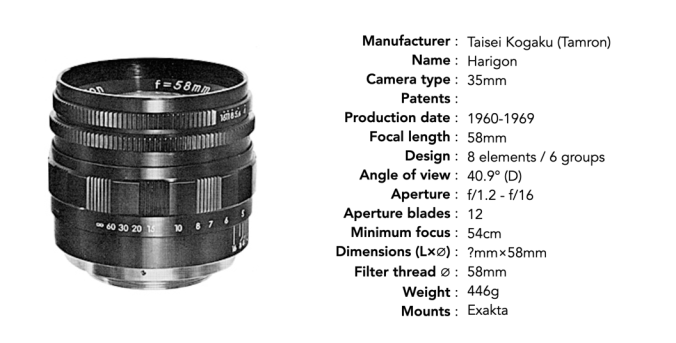
Not all fast lenses came from the lens giants. Other slipped under the radar. A good example is the Harigon 58mm f/1.2. It was made by Taika, which in reality was a export brand of Taisei Kōgaku Kōgyō K.K., the company which would later become Tamron (in all likelihood, Taika was a simpler and easier brand to remember than the company name). It was also sold as a Tamron lens.
The Harigon 58mm f/1.2
The lens was introduced in 1960, for the US market. The design was likely along the lines of the Zunow 5.8mm f/1.2, which is a itself is scarce as hen’s teeth.
Optical Science has produced this all-new Taika Rare Earth Lens, Eight hard coated complex elements of fabulous precision are responsible for its superb color correction and sharpness beyond reproach. The Taika Harigon has a dignified beauty – ebony black with colored engraved scales. A “Rolls Royce” in performance and appearance. You will be proud to own it, proud to show it and proud to exhibit its beautiful pictures.
Apparently it was available in Exakta mount, in addition to Praktica M42, and Miranda. In the early 1960s it was advertised as the standard lens on the Exa II camera for US$198.50 (from Seymour’s, NY). Interestingly the lens itself sold for US$169.50. By the time the Adapt-A-Matic Lenses appeared in the late 1960s, the 58mm lens had disappeared. There seem to be very few on the market today.
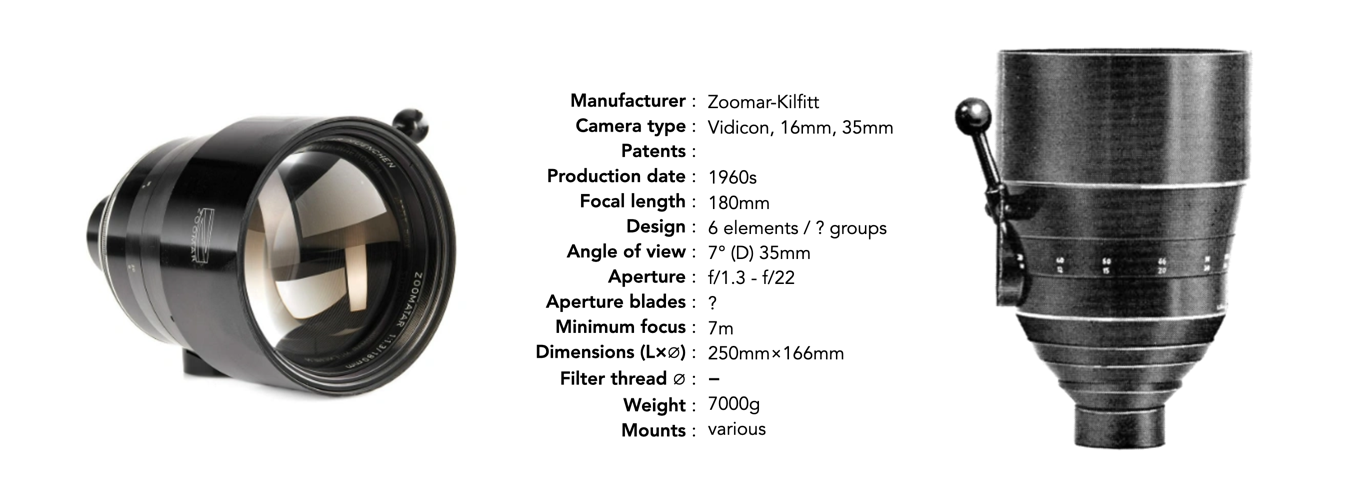
We now look at a fast telephoto lens – the Zoomatar 180mm f/1.3. This lens may have been a natural successor to the Grand-Kilar, the lens that seemingly never was. It was produced in the period after Zoomar Inc. took over Heinz Kilfitt. It is one of the fastest lenses above 100mm.
It was one of two super-fast telephoto lenses produced by Kilfitt in the 1960s, the other being the Zoomatar 75mm f/1.3. Both were intended for use in cinematography, with the 180mm also able to cover the 36×24mm area of normal SLRs. It seems like the 180mm lens was designed with the sole purpose to allow a maximum amount of light in, and it had the proportions to justify this – it was 250mm in length, had a diameter of 166mm, and weighed an astonishing 7kg – heavier than their Reflectar 1000mm f/8.
Kilfitt Zoomatar 180mm f/1.3
It has an optical scheme with six lenses, with a large difference between the diameter of the front (140mm) and rear (31mm) elements. Interestingly, because this lens was a cinematographic lenses, there is also some data on light transmission. Supposedly the light transmission was 80%, giving a T-stop of 1.5. Unlike the 75mm lens which was only supplied in C-mount, the 180mm lens came in various film formats (16mm and 35mm cine), in addition to 35mm. This means the angle-of-view could range from 3° on 16mm film to 7° on 35mm film. In 2011, one of these lenses sold on eBay for US$10,480.
Super Zoomatar 240mm f/1.2
Considering it sold in the mid-$2000’s in the 1970s, I don’t imagine many were actually manufactured (I have seen estimates of between 50-70). Zoomar did however create an even faster lens, relative to focal length – the Super Zoomatar 240mm f/1.2 – it was a behemoth at 11kg. It was originally developed for instrumentation cameras and for use with image intensifier tubes.
Not every fast vintage lens is a 50mm. Sometimes others are fast in relation to their focal length, like the Carl Zeiss BIotar 75mm f/1.5, considered by some to be the original ‘King of Bokeh’. The lens has a reputation for creating an incredible picture, which can be partially attributed to its ability to produce amazing bokeh, which was not exactly something that was mainstream in the mid-decades of the 20th century.
The Biotar lenses were designed in 1927 by Willi Merté (1889-1948) for cine cameras (Patent No. DE485,798). Merté continued developing the Biotar lenses, and in 1938 introduced the Biotar 75. Construction was complete by April 1938, and the lens went into production in February 1939. It was quite radical for the time, especially considering that all calculations for these systems were performed manually, i.e. by humans. It is often the reason very few of these lenses changed their specifications. The lens is a 6-element, 4-group, Double-Gauss optical design.
The first copies were made for cinematography, followed shortly after for Ihagee’s 35mm Kine Exakta. The advent of WWII meant that few lenses were sold, and those sales were likely restricted to lens enthusiasts who could afford them. Based on the available literature, it doesn’t seem like any were exported from Germany. In 1943, competition arrived in the form of the Leitz Summarex 85mm f/1.5. The design was a 7/6, but was prone to flaring, and heavier, at 700g to the Zeiss’s 500g. Post-war more competition in the German market resulted in the Meyer-Optik Görlitz Primoplan 75mm f/1.9; the Enna-Werke Ennaston-Lithagon 85mm f/1.5, and the Carl Zeiss Jena 85mm f/2 Sonnar. By the mid 1950s there was also competition originating from Japan.
“The ultra-light intensity of the 75mm ‘Night Lens’ ensures adequate exposures even under the most adverse lighting conditions, i.e. theatre, circus, cabaret, and night life. As this particular lens is more than three times as fast as the 2.8 lens, successful pictures can be obtained in towns and cities, illuminated only by normal street lighting.”
Exakta Varex IIa brochure, 1958
The three Biotar 75mm variants
There are three known variants of this lens. The first pre-war variant is known as the “skinny” Biotar 75. Introduced in 1938, this version has a thin, compact barrel. It was supposedly made of brass with a chrome-plated finish (although it is likely this changed to aluminum during the war). This lens were predominantly made for the EXA mount (not surprising considering the Exakta was the prominent 35mm SLR of the period). Early versions did not have an anti-reflection coating on the glass surface, which could cause flare when shooting against the light. Coatings, marked with a red “T”, began to be applied during the war (possibly for the military).
Carl Zeiss Jena Biotar 75mm f/1.5 Ver.1
After the war, Zeiss-Ikon was to release the Contax S, which used the M42 screw mount. Zeiss redesigned many of their lenses to take on the M42 mount. This resulted in the second version of the lens, produced between 1946 and 1952. This lens made use of lanthanum-containing Schott glass for its lens elements. This version was made in East Germany. Starting with this model, aluminum was used for the lens barrel to reduce weight. Additionally, the minimum aperture has been changed to allow up to f/22. In this variant, mounts for M42, Leica (L39), and Praktina were added, and it was compatible with at least five types of mounts, including those for Exakta and Contax. All have the “T” coating, although it may not be marked with a red “T”. Around 1950 markings were changed from 7.5cm to 75mm. The distance scale is a single one, which is very easy to read.
Carl Zeiss Jena Biotar 75mm f/1.5 Ver.2
The third version of the lens was produced from 1952-1968, as is known as the “fat” Biotar 75. This version has a solid barrel with a knurled/scalloped focus ring, a double distance scale, i.e. numbers on either side. The diaphragm is now preset, and the minimum aperture is back to f/16.
Carl Zeiss Jena Biotar 75mm f/1.5 Ver.3
The lens had various names over the 1950’s based on where it was sold. The lens was known as Nachtobjektiv Jena B (Night-lines Jena B), Zeiss-Biotar, “Jena B”, or just Biotar.
The lens is truly a pivotal design, it was not until new types of glass were designed, and the advent of computer-aided optical development that further progress could be achieved, ultimately leading to the Zeiss Pancolar 75mm f/1.4 in the mid-1960s. The 75mm lens itself would not really feature in the future of lenses, supplanted by the 80mm and 85mm focal lengths. Over its 30 years in existence, only roughly 20,000 copies were made. Supposedly they were made in very small batches (100-200) due to the nature of the lens – the optical elements required large pieces of flawless glass.
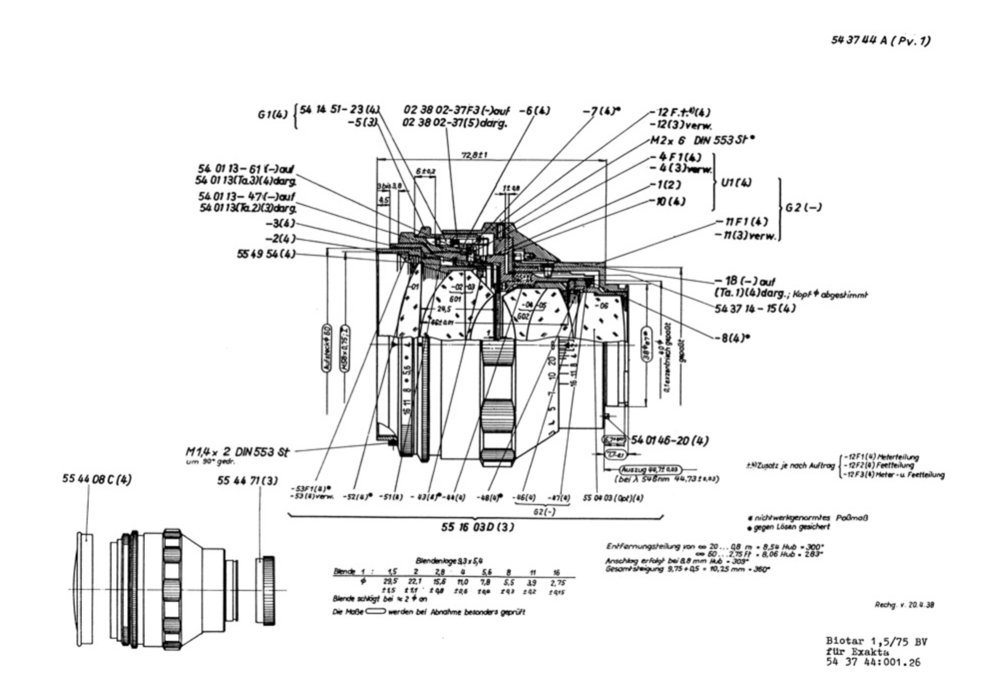
Zeiss specs for the “fat” version
In the early 1950s, the lens sold in the USA as a “high speed lens”, for around US$216, which is US$2,500 in 2023 based on inflation. In Germany in 1953, this lens sold for DM596 (which when converted was cheaper than in the USA (US$141). Today these lenses sell anywhere from US$2000-6000+ depending on condition, and variant. An alternative, which honestly costs a whole lot less, is the modern Biotar 75 f1.5 II, from Meyer Optik Görlitz (it sells for €1400, ca. C$2000).
NB: You can always tell when a Zeiss lens was manufactured from the serial number.
A 50mm lens is always a 50mm right? They are in terms of focal length, but shouldn’t they all have similar dimensions? So why are lenses with super/ultra-wide apertures sometimes so much larger, and hence so much more expensive?
If there has been one notable change in the evolution of lenses, it has been the gradual move towards larger (faster) apertures. The craze for superfast lenses began in Japan in the 1950s, with Fujinon introducing the first f/1.2 5cm lens in 1954. After the initial fervour, it seems like the need for these lenses with large apertures disappeared, only reappearing in the past decade while at the same time moving into the realm of sub-f/1 ultrafasts. There are many advantages to ultra wide aperture lenses, but basically fast lenses let in a lot of light, and more light is good. The simple reason why bigger aperture equals bigger lens is more often than not to do with the need for moreglass. It was no different with historical superfast lenses. The Canon 50mm f/0.95 which debuted in 1961 was 605g.
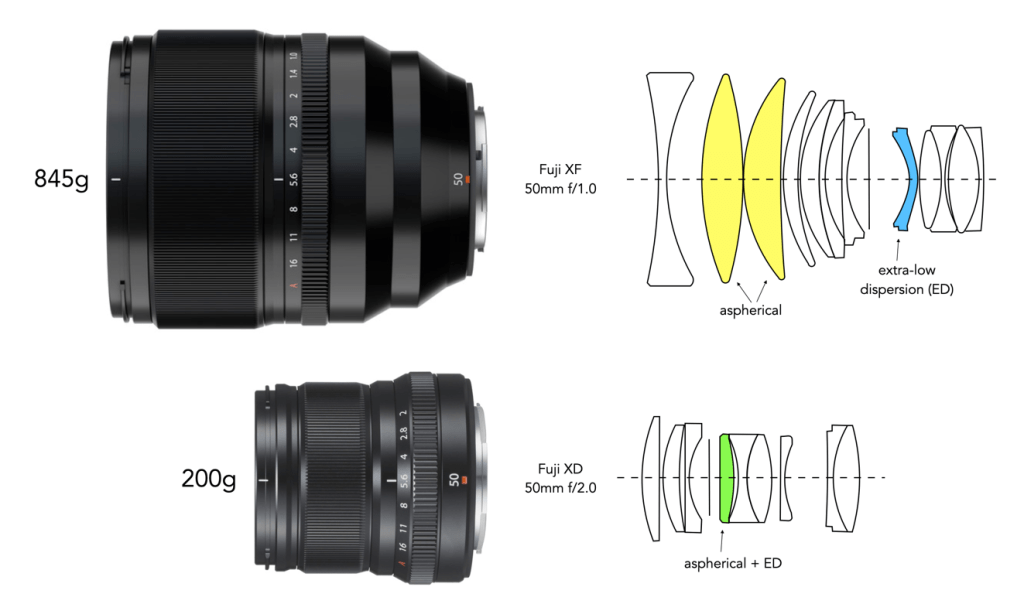
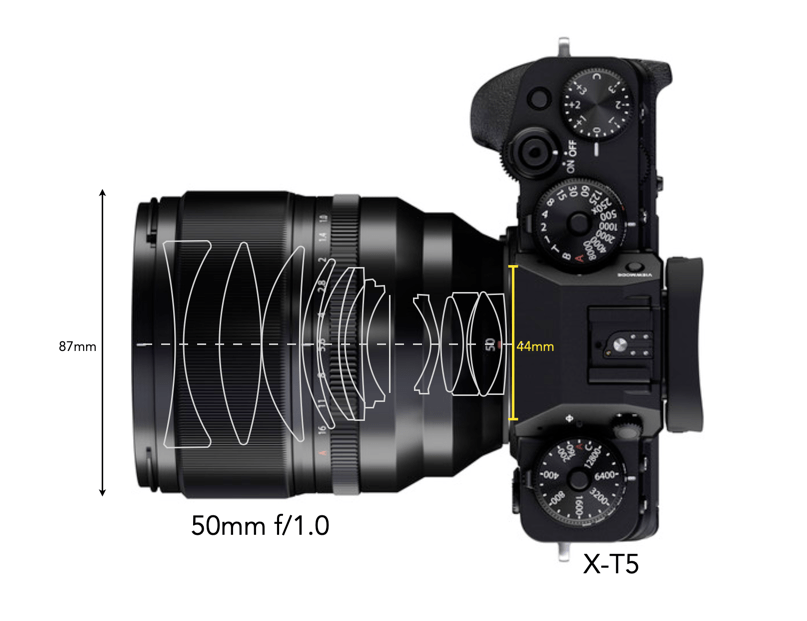
A comparison of the two Fujifilm 50mm lenses – f/1.0 versus f/2.0 showing the physical differences
Lenses are designed with the maximum aperture in mind. For example, a 50mm f/2.8 lens only needs an aperture with a maximum opening of 17.8mm (50/2.8), however a 50mm f/1.4 will need a maximum aperture opening of 35.7mm (note that these apertures are based on the diameter of the entrance pupil). For example consider the following two Fujifilm 50mm lenses – the “average” f/2.0 and the 2-stop faster f/1.0:
Fujifilm XF 50mm f/1.0 R WR – 845g, L103.5mm, ⌀87mm, 12/9 elements
Fujifilm XD 50mm f/2.0 R WR – 200g, L59mm, ⌀60mm, 9/6 elements
The f/1.0 is over four times as heavy as the f/2.0, and almost double the length. To get an f/2.0 on a 50mm lens you only need a 25mm aperture opening, however with a f/1.0 lens, you theoretically need a 50mm opening (aperture of the entrance pupil). Now some basic math of the surface area (SA) of an aperture circle will provide a SA of 491mm2 for the f/2.0, but a whopping 1963mm2 for the f/1.0, so roughly four times as much area which allows light to pass through fully open. Equating this to glass probably means that at least four times as much glass is needed for some of the elements in the f/1.0 lens. There is no way around this – large apertures need large glass. As the aperture of a lens increases, all of the lenses have to be scaled up to achieve the desired optical outcome.
The massive scale of the Fujifilm XF 50mm on a camera (the X-T5). The lens has a diameter of 87mm, and the inner opening of the mount is only 44mm.
Larger aperture lenses also have more specialized glass in them, like with aspheric and lowdispersion elements. But companies don’t just add more glass to make money – complex designs are supposed to overcome many of the limitations that are present in ultra-wide aperture lenses. Unlike their historical predecessors, modern superfast lenses have overcome many of the earlier lens deficiencies. For example in vintage superfast lenses, the lens wide-open was never as sharp as could be expected. Newer lens on the other hand are just as sharp wide open as they are stopped down to a smaller aperture.
Now not all super/ultra-wide aperture lenses are heavy and large. There are a number of 3rd-party lenses that are quite the opposite – reasonable size, and not too heavy (and invariably cheaper). But there is no such thing as a free lunch – there is always some sort of trade-off between price, size and optical quality. For example the Meike 50mm f/0.95 is only 420g, and it’s lens configuration is 7 elements in 5 groups. However fully open it is said to exhibit a good amount of chromatic aberration, some barrel distortion, and some vignetting. There is no perfect lens (but the Fuji f/1.0 comes pretty close).
✿ A fast lens is one with a wide maximum aperture. Superfast lenses are typically f/1.0-1.2, and ultrafast lenses are sub-f/1.0.
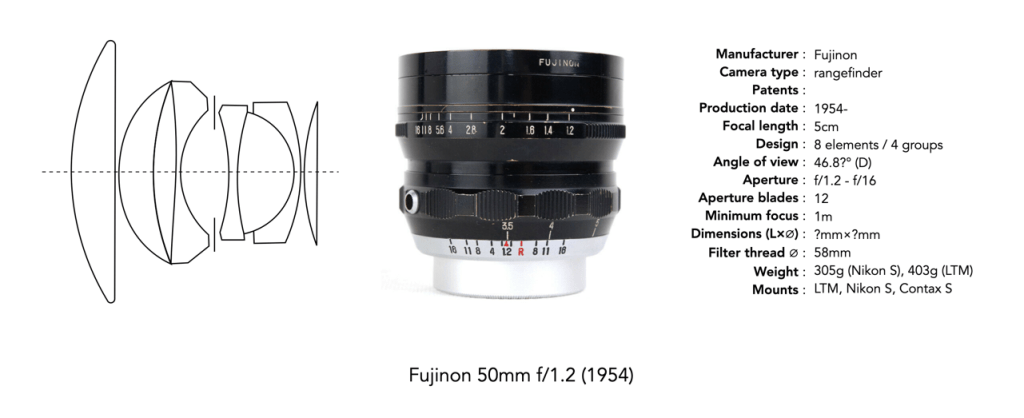
In the 1950s, the Japanese camera industry was at war, and the prize was super-fast lenses. There were several manufacturers involved in this race – Zunow, Nippon Kogaku, Konishiroku and Fujinon. Although the ultimate target was likely the German optical industry. The Fujinon 5cm f/1.2 was to appear in 1954. It was built in the Leica LTM screw mount (800 pieces), the Nikon S rangefinder mount (50 pieces) and the Contax S mount.
The lens was designed by Fuji designer Ryoichi Doi. The lens is said to have been based on the Solinon 5cm f/1.5, which was also designed by Doi and patented in 1948 (J#191,452). The lens was based on Sonnar design, and the next step was to push it to f/1.3 using conventional glass. This was followed by a prototype f/1.2 with 9 elements, and finally the production 8-element design. Six of the eight lens optics were high speed lenses. These lenses used four types of new types of glass with low refractive index and high dispersion, the aim being to minimize flare caused by aberrations and achieve high-contrast imaging. The lens was designed to ensure ample light reached the edges of the frame, having a front lens diameter was 51.5mm, and the rear lens diameter was 28mm.
A 1959 price list shows that this lens sold for US$299.50. Today the price of this lens is anywhere north of $20K. Too few were manufactured to make this lens the least bit affordable.



 Crafting Pixels