Superfast lenses – the original Noctilux 50mm f/1.2

When it was released in 1966, the Leica Noctilux 50mm f/1.2 was an altogether different animal. It was great at shooting in low light, expensive and difficult to make. That’s probably why less than 2000 were made. By the mid 1960s, there were a number of players in the sub-f/1.4 field, primarily for shooting in low light. Nikon, Canon, and Minolta all had f/1.2 lenses. Work on the use of aspherical elements in lenses began in the late 1950s.

The Noctilux 50mm f/1.2 was produced from 1966 until 1975, and was the worlds first lens to feature aspherical elements. The name Noctilux is a combination of Nocti, which is derived from the word nocturnal, while Lux is Latin for light.

“Even at f/1.2 the NOCTILUX produces so very little flare that strong light-sources are imaged with only minimum halo surround. Brightly back-lighted subjects, anathema to poorly corrected high-aperture lenses, have clear, accurate outlines.” [2]

This was supposedly the first Leitz lens to sacrifice some resolution in order to gain contrast. Bill Pierce who wrote a brief article on the new lens in 1967 remarked: “To the best of my knowledge, rather extensive in this tiny field, none previous to the Noctilux could deliver a clean, biting journalistic image at maximum aperture.” [1]

“Superior optical contrast due to high correction for coma and all other critical aberrations and due to freedom from internal reflections, make the NOCTILUX the ·ideal high-aperture lens for use with high-speed available-light films.” [2]

The first prototypes were made in April of 1964 Designed by Helmut Marx and Paul Sindel (Helmut Marx was Professor Max Berek’s successor as head of the photographic lens design in Wetzlar, and creator of the first Summicron 50 in 1953). The Noctilux 50mm f/1.2 was released in 1966. The Leica Noctilux 50mm f/1.2 is a 6-element Gauss variant with 4 members. It has two aspherical elements (front and rear) which were made on a specially built grinding machine that had to be operated manually. There was only one machine, and only one person capable of operating it (Gerd Bergmann), so many elements had to be discarded as rubbish.
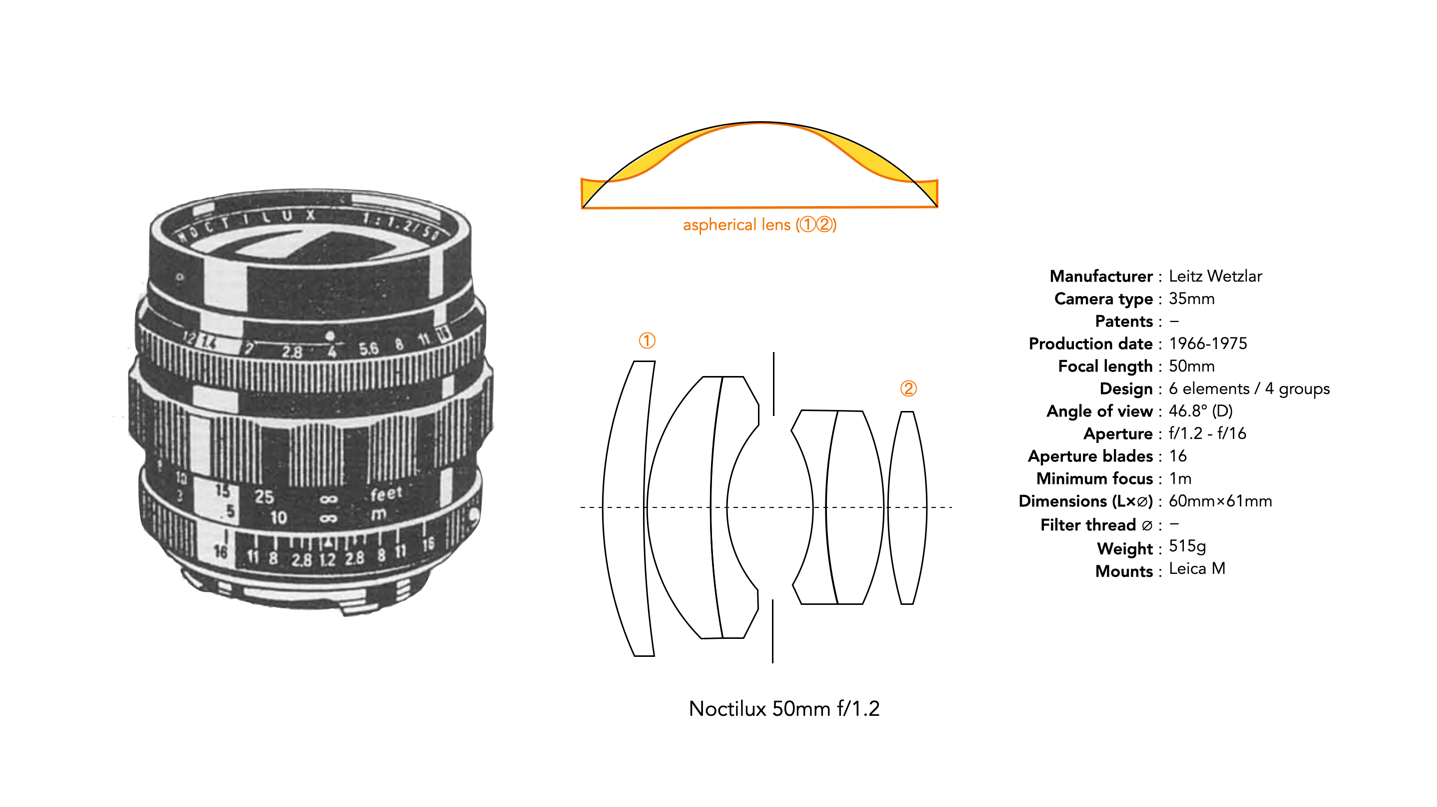
It was sometimes claimed to be the fastest production lens in the world, because other manufacturers lenses often proved to be slower than indicated. After the release in 1966 there was much research to produce an f/1 version of the lens with 3 Aspherical elements, but in 1970 the project was abandoned because the aspherical technology was in its infancy, and the production costs were immense. The f/1.2 lens remained in production until only 1975 with 1757 units produced. A new version of the lens, the Noctilux-M 50mm f/1.2 ASPH was released in 2021, with the construction only minimally changed. The new lens sells at US$7900, which is a bargain considering the old lens can sell for upwards of $US70,000.

References:

  1. Bill Pierce, “Because it was possible”, Popular Photography, 60(1), p.135-156 (1967)
  2. Leica brochure, “50mm NOCTILUX f/1.2

Further reading:

Why are vintage super-fast lenses so expensive?

In the 1940s, a lens speed of f/3.5 was quite normal, an f/2 very fast. The world first f/1.4 lens for a 35mm camera appeared in 1950, when Nikon released the NIKKOR-S 5cm f/1.4. That sparked a series of f/1.4 lenses from most manufacturers. But this wasn’t fast enough. In the world of vintage lenses, f/1.2 lenses are almost the holy grail. Fujinon was the first to introduce an f/1.2 5cm lens in 1954 for rangefinder cameras. Canon introduced a 50mm f/1.2 lens, for the Canon S series in 1956. Many manufacturers followed suit, producing one or more lenses in the decades to come. Japanese camera companies lead the way in super-fast normal lenses. Some milestones:

  • First f/1.2 lens (1954) – Fuji Fujinon 5cm f/1.2 (35mm rangefinder)
  • First f/1.2 for SLR (1962) – Canon Super-Canonmatic R 58mm f/1.2
  • First f/1.2 55mm lens (1965) – Nikon Nikkor-S Auto 55mm f/1.2
  • First f/1.2 50mm lens for SLR (1975) – Pentax SMC 50mm f/1.2
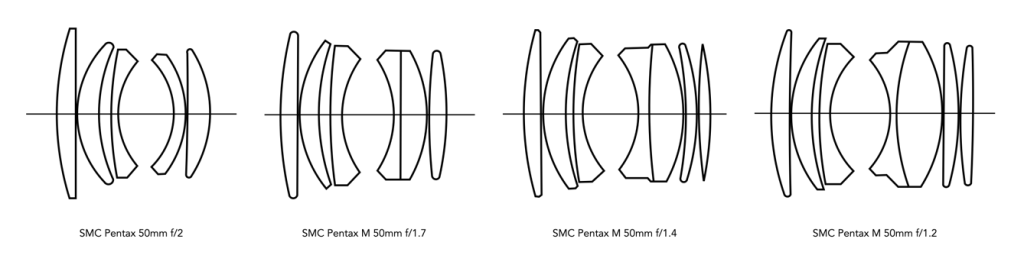
Fig.1: The ever increasing complexities of optical elements in lenses with large apertures from f/2 to f/1.2 (Asahi Pentax)

Aside from the fact that these f/1.2 lenses represent the pinnacle of wide-open lenses of the period, what makes them so expensive (both then and now)?

  • Rarity – Although a large number of manufacturers developed f/1.2 lenses, in may cases fewer were manufactured than slower lenses. For example, the Fujinon 5cm f/1.2 lens was made in limited amounts, less than 1000 by all accounts, but because of this ranges from $4000-20000.
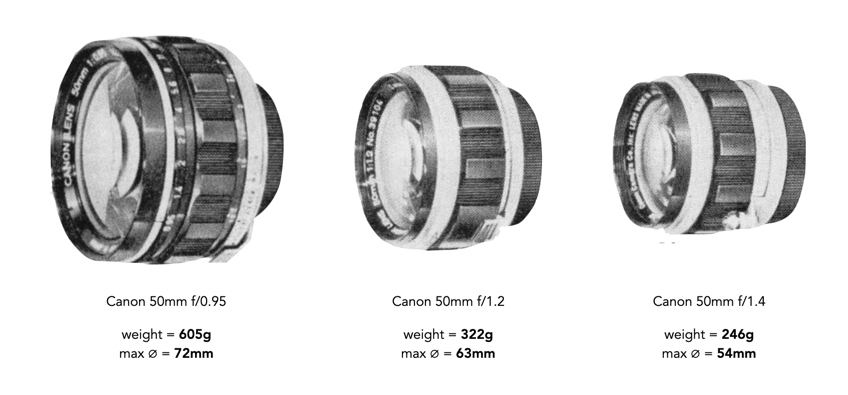
  • Larger glass – As the speed of a lens increased, so too did the size of its optical elements. An f/1.2 lens had much more glass than say an f/2.8, e.g. a 50mm f/2.8 lens would have an effective aperture of 25mm, while an f/1.2 50mm would have one of 41.7mm. This means the optical elements had to be much larger for an f/1.2 lens.
  • Better glass – Larger optical elements also mean they had to be of a higher quality, with less tolerance for defects such as bubbles. Some optical elements may have been made of rare-earth metals to improve optical qualities, and reduce aberrations.
  • More optical elements – As lenses got faster, more elements needed to be added to counter optical aberrations.
  • Inner mechanisms – Larger optical elements meant one of two things for the lens housing (i.e. barrel): (i) make it a lot larger, and therefore increase the size of all the components, or (ii) make it marginally larger, and reduce the size of the mechanisms within the lens, e.g. aperture control, so they become more compact.
  • Complex manufacturing – Specialized glass needed new processes to ensure high manufacturing tolerances, e.g. finer levels of polishing.
Fig.2: The ever increasing size and weight of lenses with large apertures (the Canon rangefinder series)

All these elements contributed to an increase in the cost of these “revolutionary” lenses. However, although we consider them expensive now, f/1.2 lenses were always expensive. In 1957, the Canon 50mm f/1.2 rangefinder lens sold for US$250, with the Fujinon 50mm f/1.2 at $299.50 [1]. The Canon 50mm f/1.8 on the other hand sold for $125, and a Canon V with a 50mm f/1.8 lens sold for $325. A 1970 Canon price [2] list provides a better perspective, with information for the lenses for the Canon 7/7s rangefinder. The slower 50mm lens sold for $55 (f/2.8), and $120 (f/1.8), while the f/1.4 sold for $160 and the f/1.2 for $220 (the f/0.95 was the most expensive at $320). SLR lenses were cheaper, although Canon did not make a 50mm f/1.2 (until 1980), it did make a 55mm f/1.2, which sold for $165.

Note that $220 in 2022 dollars is $1608. Today, some of these lenses fetch a good price, depending on condition. The Canon 50mm f/1.2 sells for around $400-600 based on condition. The series of f/1.2 lenses made by Tomioka Kogaku circa 1970 regularly sell for between C$800-1700.

The price of nostalgia.

Further reading:

  1. “Photographic Lenses”, Popular Photography 40(4), April, p.168 (1957)
  2. Canon Systems Equipment, Bell & Howell Co. March 1970