What about the other camera on Sister Boniface Mysteries?

Of course people are also going to ask about the second camera seen on Sister Boniface Mysteries… the one belonging to Ruth Penny, Editor-in-Chief of the Albion Bugle. What is clear is that it is an Asahi Pentax model, likely an S2, S3, or even an SV (again the “Asahi Pentax” label has been covered up, but the Asahi design is still present). The S2 was introduced in 1959, the S3 in 1961, or even the SV (1963). For the S2, the lens is likely the Auto-Takumar 55mm f/2, for the S3, the Auto-Takumar 55mm f/1.8. It’s hard to make an exact designation because the camera’s all have a similar form, and the specific type markings appear atop the camera near the film rewind lever.

Look… a Pentax!

The flash seems to be a Metz Mecablitz 101 from the late 1950s/early 1960s. Note that these cameras had different designations based on market: S designated cameras were for the Japanese and European markets, and H for the North American (NA) market (as Asahi Optical was represented in North America by Honeywell Corp). So the S2 was designated the H2 in the NA market.

What camera is used on Sister Boniface Mysteries?

In the first episode of Sister Boniface Mysteries (BritBox), we are introduced to Sister Boniface, a Catholic nun with a PhD in forensic science. Now part of her job as police scientific adviser involves taking photographs, obviously given the time period in the early 1960s, she uses a 35mm SLR camera – but what camera?

The camera is introduced in the first episode, “Unnatural Causes”.

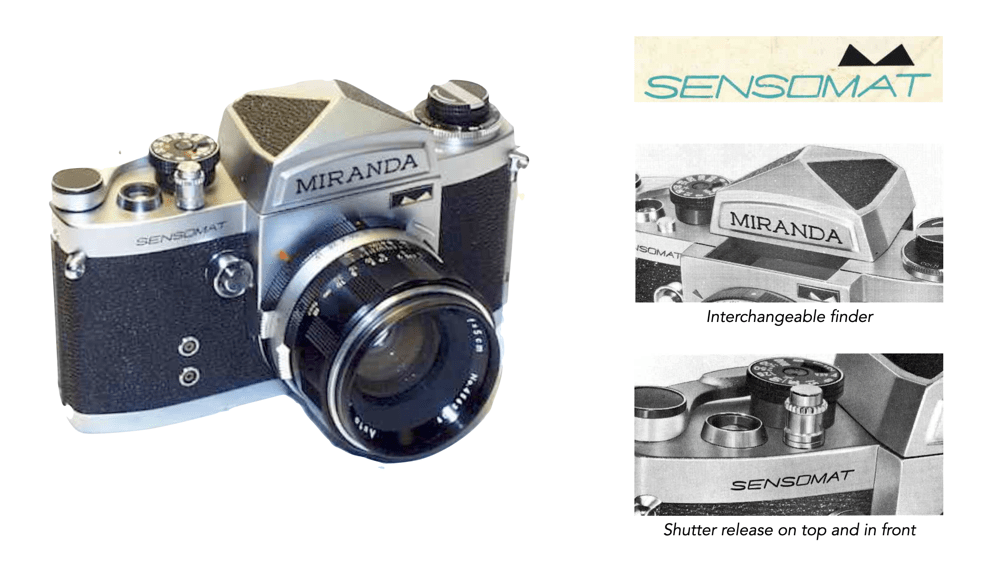
Well, it isn’t actually too hard to figure out the camera, despite the fact that the branding has been covered by black tape – the camera is from Japanese company Miranda, founded in 1947 and produced 35mm cameras from 1953 to 1976 (it was named Miranda Camera in 1957). During that period they introduced some 30 differing models nearly all with interchangeable pentaprism’s. The camera itself is a Miranda Sensomat, introduced in 1969. It was a budget camera, which had TTL CdS stop-down meter built-in the under mirror. The Sensomat range was produced from 1969-1974. The lens is likely the Auto-Miranda 50mm f/1.8, and the camera sold in 1969 for US$190 – it was advertised as being affordable.

The Miranda Sensomat

The interesting thing about the use of this camera is that the series is set in the early 1960s, and the camera was released in 1969, so there is some historical disparity. If one were choosing a Miranda camera of the period, a Miranda D might have been more appropriate. As to why the Miranda was chosen? Likely it was just a prop, it’s doubtful anyone thought about using a more historically significant camera for the period. Why cover up the brand? Likely due to not having to pay licensing fees, although it is unclear as to who currently owns the Miranda trademark.

Further reading: