Vintage lens makers – ISCO Göttingen (Germany)

ISCO was essentially an offshoot of Schneider. It was founded in 1936 with the name Jos. Schneider & Co., Optische Werke, Göttingen. The factory was constructed in Göttingen as a second production site on behalf of the Reich Ministry of Aviation. The site produced manufactured Schneider lenses, and during the war years they produced cameras for aerial reconnaissance (the Luftwaffe required fast lenses with exceptional resolution). Lenses included the high-speed Night Xenons with 125mm, 330mm, 400mm, and 500mm focal lengths. During WW2 they produced around 45,000 lenses for aerial cameras, the main supplier of the Luftwaffe.

Due to the nature of the war production, the plant was dismantled by the Allied powers at the end of the war. The company name was not allowed to be used until 1953, so the company operated under the name Optische Werke Göttingen. They initially produced lenses for cinematic projectors, with names like Kiptar and Super-Kiptar. In 1951 camera lenses were produced for the first time, initially as built-in lenses for various camera manufacturers, e.g. Apparate & Kamerabau, Balda, Bilora, Franka, Wirgin. These were triplets of 4-element lenses, such as Isconar and Westanar. From 1956 ISCO increased its designs for wide-screen projection, and included lenses for 8mm, 16mm and 35mm cine cameras.

An an example of a well known ISCO lens

The first lens for SLR cameras appeared in 1952, and was the Westar 50mm f/2.8. It was sold with Exa cameras in the US. This was followed by the Westagon 50mm f/2, and Westrocolor 50mm f/1.9. In 1958 ISCO designed the Westrogon 24mm f/4, the worlds first extreme wide-angle lens for SLR cameras, ahead of the Zeiss 20/25mm Flektogons. Lenses were produced under a number of names: Westar (50mm, 100mm), Westanar (50/85/135/150/180mm), Westagon (50mm), Westron (28/35mm), Westromat (35/135mm), Westrogon (24mm), Westrocolor (50mm), Isco-Mat (35/50/135mm), Iscotar (50mm), Isconar (50/80/100/135mm), Tele-Iscaron (135/180/400mm), Tele-Westanar (135/180mm), Isconar (90/100/135mm) and Iscorama.

With the decline of the German camera industry, the demand for SLR interchangeable lenses also decreased. ISCO shifted its production back to the field of projection lenses for film, narrow film and slides. In 2009 the name was changed to Schneider Kreuznach ISCO Division GmbH & Co. KG. The lenses now produced are full frame lens set for both anamorphic and spherical cine photography.

Further reading

Vintage lens makers – Schneider (Germany)

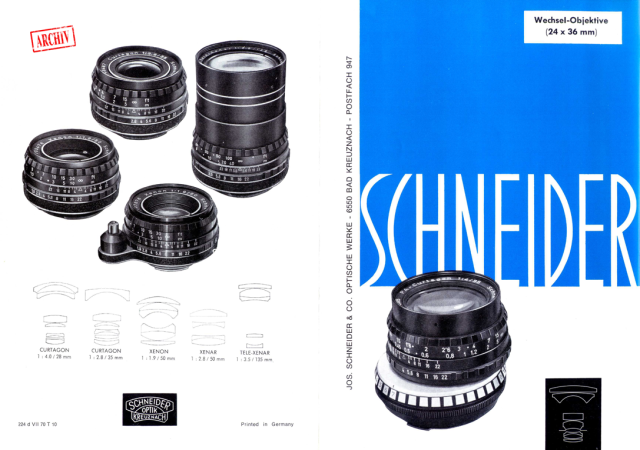
Joseph Schneider (1855-1933) founded Optische Anstalt Jos. Schneider & Co in Bad Kreuznach on January 18, 1913, and in 1922 changed its name to Jos. Schneider & Co., Optische Werke, Kreuznach. The chief designer was Albrecht Wilhelm Tronnier (1902-1982), who joined the company in 1924, and would eventually set up the sister company ISCO (throughout his life he accumulated 124 German patents). They produced a large series of lenses with early trademarks such as “Symmar”, “Componar” and “Isconar”, and “Xenar”. From 1919 they produced a Tessar clone, the “Xenar” in focal lengths from 75 to 480mm. In 1925 the famous “Xenon” was introduced, with focal lengths up to 80mm. The Xenon, is perhaps the company’s most famous lens, and is still being made today.

Schneider’s most famous lens?

In 1933 with the passing of Joseph Schneider, his son Josef August Schneider took over the company. In 1936 ISCO was formed as an offshoot of the company. Schneider was one of the lens suppliers to the first Exakta, the 4.5×6cm VP Exakta, providing the Xenar f/3.5, the Xenar f/2.9, and the Xenon f/2. The same lenses would find their way onto the first 35mm SLR, the Kine Exakta in 1936.

During WW2, Schneider had to supply the German Wehrmacht and was forced to manufacture Zeiss products. In the 1950s the company continued development of interchangeable SLR lenses, and supplied lenses to almost all German camera manufacturers. Lenses were made in mounts for Edixa-Mat, Pentax (M42), Praktica, Exakta, and Praktina. Lenses for film cameras were also produced, especially for the 8 and 16 mm narrow film cameras that were popular at the time. Also in the 1950s, the company was one of the first to use computers, the Zuse Z22 to perform lens calculations.

Schneider started developing zoom lenses from 1957, which led to the market launch of the Variogon 1:4/80-240 in 1964. At the end of 1967, Schneider introduced its first TV lens, the TV1 Variogon 2.1/18-200mm. NASA used Schneider lenses on its “Lunar Orbiter” space missions of the Apollo program from 1959 to 1976 and on the space shuttle flights since 1990. The first images of the Earth were taken using Schneider lenses with 45 and 75 mm focal lengths. The lunar orbiter probes also each had a Schneider “Xenotar” on board.

Due to changing economies, Schneider ran into economic difficulties and filed for bankruptcy in 1982. The company was subsequently re-founded by Heinrich Manderman and over the years, acquired the B+W filter factory and Rollei photo technology, among others. After German reunification, Manderman also became involved with Pentacon in Dresden and resumed production of the Exakta 66. The company still exists today, producing cinematic lenses and filters, industrial optical filters, industrial lenses (e.g. C-mount), and photo optics, most notably the B+W Filter brand.

Further reading: