While the pentaprism is well known, the mainstay of 35mm SLR cameras, the use of the porro prism is less so. The porro prism was invented in 1854, by Italian inventor Ignazio Porro (1801-1875). Its simplest form had one lens, where the image is inverted in the plane in which reflection takes place, but, as there are two reflections, there is no reversion. However porro prisms are never used singly, they are more commonly used in pairs – a double Porro prism, with the second prism being rotated 90° with respect to the first. The effect of this double-prism is an image which is rotated 180°.
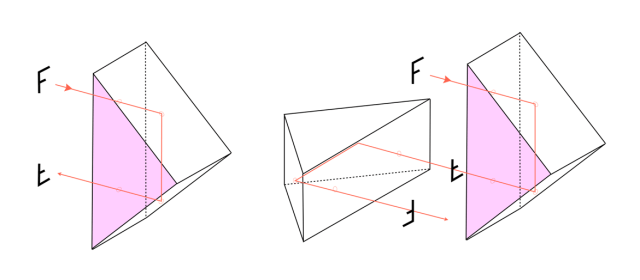
The double Porro prism is commonly used in binoculars, which manifests itself in the distinctive offset zig-zag shape of the binoculars. It has also been used in the construction of terrestrial telescopes since the second half of the 19th century. The greatest difference between a Porro prism and a regular pentaprism is that it bends light 90° in one reflection, whereas a pentaprism uses two reflections to bend light through the same angle.

In the 1930’s Zeiss Ikon had been working on a 35mm SLR camera with a straight-view viewfinder, and a true laterally correct image, roughly at the same time as work on the Syntax camera. On September 8, 1938, a German patent application was made, the existence of which can only be concluded with the help of a note in a Swiss patent, No. CH214,918 submitted on August 1939. It described a prism finder system, and from the drawings it is evident that one of the two prisms in the system was formed from a rectangular half-cube – the porro prism.
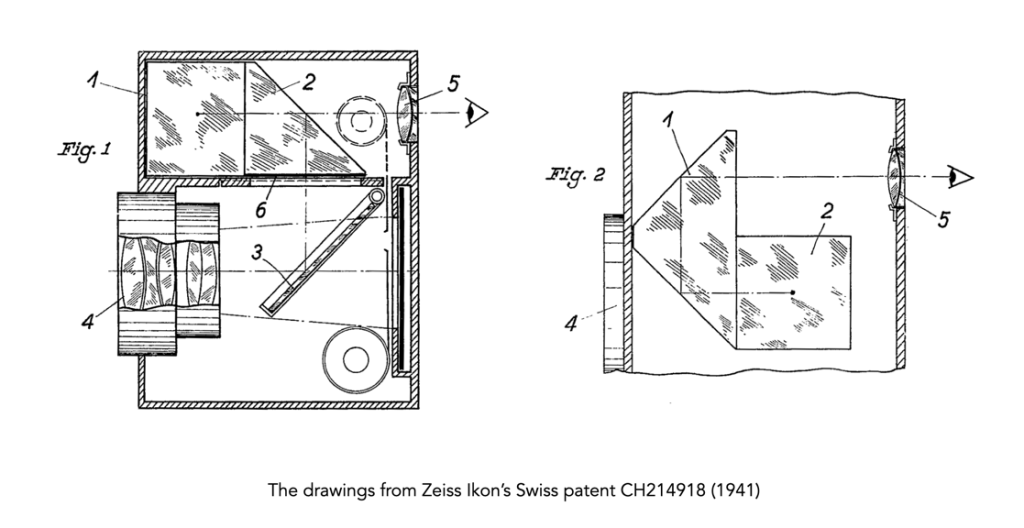
There are however some issues with the use of the prism in an SLR. It is somewhat undesirable if there is a long path for the light to travel between the focusing screen and the eyepiece. Naturally a telescope has a long focal length, and a narrow image angle-of-view (AOV), the exact opposite of an SLR viewfinder. What is wanted in an SLR viewfinder is an image with the highest possible magnification – the long light paths of the Porro system only allows a small magnification on the screen image. The viewfinder might then produce small, somewhat dark images. Porro prisms have therefore never really become established in camera construction.
The first production camera to use the Porro prism may have been the Duflex (DUlovits reFLEX), primarily because at the time the use of a pentaprism was deemed too expensive (the camera came to market in 1949). The most well known camera however is the Olympus PEN F, half-frame camera (and the Olympus E-300 digital camera, 2005). The path of light for the Olympus PEN is shown in Figure 4. Light enters through the lens, and is reflected to the left via the quick return mirror (A). The light is reflected upward by the prism (B), is turned to the right by the upper (semi-transparent) mirror (C), and passes through the three-piece eye lens for magnifying the image (D) (0.8×) before it is reflected backward by the eye prism (E), and reaches the photographers eyes.
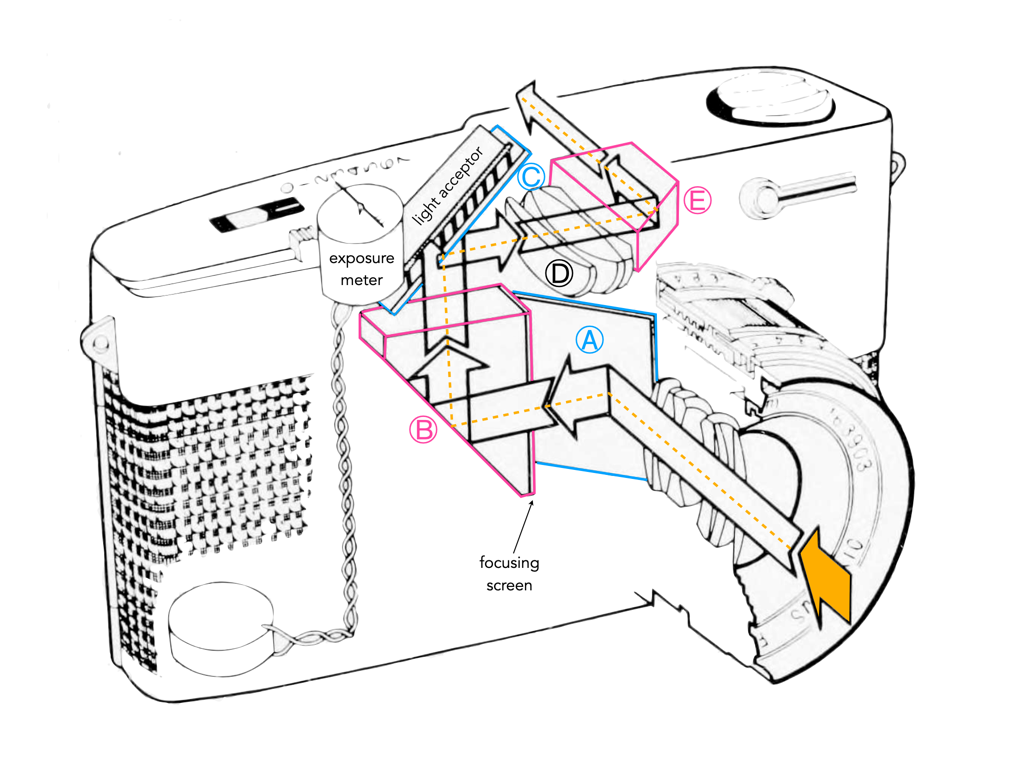
The camera had some of the same issues as cited above. A test report of the Olympus PEN FT, in Camera magazine in Oct/Nov 1967 concluded the following: “…bending the light as it does around four corners and through several lenses, does present a bit of a problem to the viewer – light is lost to the metering system and this makes for a slightly dim image at the operator’s end.”. There is a reason for this – as the light comes from the first prism and strikes the mirror, a certain amount of the light is absorbed by the “light acceptor” which is subsequently read by the meter and translated to the TTL number.
Note: The Porro prism from the Zeiss Ikon patent also exists in the US system, published as an Alien Property Custodian on May 4, 1943. It seems that a patent was applied for on November 16, 1939 under the title “View Finders”, with the author being Heinz Küppenbender.
 Crafting Pixels