Here I’m going to explain a bit more about the caveats of smartphone cameras in the form of a FAQ. I will add that for all their compactness, smartphone cameras produce incredible images, they just have the same limitations all small devices have.
Is the image quality as good as a dedicated digital camera?
Image quality is partially reliant on the size of photosites, the building blocks of digital images. The larger the photosite, the better it is for low-light conditions. Smartphones have relatively small sensors, and therefore are constrained by the size of their photosites. They still produce images with exceptional quality, but there is a reason people choose full-frame and medium sized sensors for professional work.
Regardless of what companies say, image quality on a smartphone will never be as good as those on a camera. The iPhone 14 Pro has a 1/1.28” sensor on the wide camera with a sensor area of 75mm2, and a pixel pitch of 1.22μm in 48MP mode (2.44μm in 12MP mode). Don’t get me wrong, the technology is amazing – squeezing a camera with a 7-element, 24mm focal length equivalent lens with optical sensor shift. But those pixels are small, and there is only so far you can scale up a 12MP image. In comparison, a 26MP APS-C camera sensor has photosites that have nearly four times the area of the 14 Pro, which means more light can be captured. It also has twice the number of photosites, more photosites amounts to better resolution.
Are lens elements made of plastic?
Cameras are all about the glass, or in the case of smartphones – plastic. Most smartphone cameras are comprised of lens elements made out of injection molded optical plastic. Now plastic lenses have been around for a long while, and they have benefits and drawbacks. There are many reasons for this, most notably the fact that plastic elements can be molded into much more extreme aspheric shapes, something not possible in optical glass (aspherical lenses are used in high-end optics to create sharper images and reduce or eliminate some types of optical imperfections). Plastic also allows for thinner lenses that have more complex flange geometries.
An example of a plastic 5-element smartphone lens.Made of injection-molded optical plastic, they are extremely cheap to produce.
Are lens apertures limited?
The aperture of a lens controls how much light makes its way through to the sensor, controlling things like depth-of-field (or how much of the scene is in focus). Smartphones that work well in low-light situations, without the use of a flash, have large apertures. The wide lens on the iPhone 14 Pro has an aperture of f/1.78, which allows for good low-light performance, but taken into context, an aperture of f/1.78 has the DOF equivalent of an f/6.1 aperture on a full-frame camera. That makes it hard to produce blurry effects naturally – they are usually added artificially in post-processing. These lenses are stuck with a single fixed aperture, providing limited control of exposure. It may seem like you can change the aperture, but apps that allow the aperture to be changed to increase the amount of background blur are really just adding a certain amount of artificial background blur. Camera lenses can change the aperture, and hence the depth of field, facilitating natural blur, i.e. bokeh.
Do smartphones create natural Bokeh?
Bokeh has to do with unfocused regions in an image, and relies heavily on a shallow depth-of-field. Many smartphones use wide-angle lenses, and as a result, have quite a large depth-of-field (DOF), the distance between the nearest and farthest elements in a scene that are in acceptably sharp focus. The available depth of field increases as the sensor size and lens focal length decrease, which is why smartphone photographs tend to have very large DOFs. Landscapes, everyday shots, even close-ups have very little out-of-focus. How is bokeh created? Through the power of algorithms. The iPhone uses both cameras to create a DOF-effect in Portrait Mode. It combines the photographs taken by the wide-angle and telephoto lenses, and after applying some computational magic, produces a blurred background. There is even a Depth Control feature which allows the bokeh, to be tailored, between an aperture of f/1.4 and f/16. But it is computationally created, and bokeh is a natural phenomena which occurs in part because of lens optics.
Are different lens focal lengths useful?
While these lenses are exceptionally designed for the small space they are required to inhabit, they can not really be compared to the larger glass available in dedicated cameras. Photography is about light, and smartphone lenses are extremely small and so don’t really let in the same amount of light. The 24mm equivalent wide angle lens of the iPhone 14 Pro has an actual focal length of 6.9mm (35mm equivalent), the 13mm is actually only 2.2mm, and the 77mm is only 9mm. Basically the focal lengths often used to described in lenses are in terms of their 35mm equivalents, likely to create better associations. For example a 77mm telephoto lens seems easier to understand than a 9mm telephoto.
To get a bit technical, this means the effective diameter of the entrance pupil (DEP) of the wide-angle 6.9mm lens with a max aperture of f/1.78 is 6.9/1.78 = 3.88mm. Comparing this to the equivalent 24mm full-frame lens, say the Sony FE 24mm f/1.4, and the DEP is 17.14mm, much larger. More area equals more light. Apart from the fixed aperture, and compactness of the lenses, there is another big issue. Smartphone lenses, regardless of how many of them are on a phone, can only cover a finite number of focal lengths. Cameras, especially those with interchangeable lenses, can use optical zoom lenses that cover a very broad range of focal lengths. For example the APS-C lens Fujifilm XF 18-135mm (f/3.5-5.6) covers the full-frame equivalent of 36 to 270mm.
Don’t believe the hype: a smartphone will never completely replace a traditional camera.
There is no doubt that smartphones have closed the gap on image quality, and they are popular for their convenience and ease-of-use. But they are not the same as digital cameras. Photography is a craft – it’s not just about capturing reality, which smartphones do really well. It’s about telling stories, and to do that you need some level of creative freedom, which is only available with a versatile camera. Cameras are ergonomically designed for taking photographs, that is their only job.
Cameras are a ubiquitous tool now, as everyone has one in the guise of a smartphone. In 2022 some 1.5 trillion photographs were taken, of which up to 90% originated from smartphones. The quality of the images produced by smartphone cameras is really very good, and why shouldn’t they be, as there is a crazy amount of technology that is incorporated into them. Smartphones of course have many functions, although I am increasingly convinced that their major roles are as a camera, a visual social media device, and a communications device that involves using the phone, or texting. I use mine as a translator with the Google Translate app because it conveniently takes a snapshot of the text I want to translate, and provides me with a quite accurate rendition of the text in English – useful because of the camera. A smartphone is inherently convenient, because it has a small form factor, and is convenient to travel with, allowing us to take pictures of whatever we want. It almost turns the phone into a form of visual record. Then of course there is social media like Instagram, which we use to take photos of things we like to share, like food. Where would we be without the smartphone camera?
However there are natural limits to the effectiveness of a smartphone camera. The first caveat is that while a smartphone is a jack-of-all-trades, a camera is dedicated to just one task – takingpictures. A camera is not a GPS, nor a social media device, nor a music player. But let’s look at some of the core issues. Smartphone cameras are small. As much as that plays as a strength to their overall usefulness, it is a deficit when it comes to being a platform for photography. There is only so much space in a smartphone, and the quality of the images produced is truly magical considering these constraints. The sensors are small, and are therefore limited in their versatility. Photography is all about light, and the more light that can be captured the better. To make up for their compactness, smartphones rely on software to improve the image quality of pictures that are captured.
The biggest elephant in the room with smartphone cameras may be image resolution. Most smartphones have restrained the megapixel count to around 12. The iPhone 14 Pro has a 48MP quad-sensor main camera, which seems quite spectacular, but in actuality the sensor defaults to 12MP – the quad-pixel sensor combines every four pixels into one large quad pixel. To create 48MP images ProRAW mode has to be activated, but the images produced are anywhere from 75-100MB in size. The 1/1.28” sensor is 10×7.5mm in size, giving it a crop-factor of 3.46. The crop-factor of APS-C is only 1.5 in comparison. Of course comparing a smartphone camera to a full-frame at the opposite end of the spectrum is hardly fair, they are really designed for different types of photographers.
There are situations where smartphone cameras perform extremely well, and there are others where they don’t. Convenience may be the key factor to their popularity. There is no need to worry about a memory card, and you always have a camera on you. But dig a little deeper, and for the photographer there are some issues. Foremost is the lens itself. It’s compact, small, has a fixed focal length, and usually made of plastic. They are usually good lenses, and continuously evolving, but you can never replicate the same quality as in a larger format camera lens – it just isn’t possible. Then how do smartphones produce images as good as those from full-frame cameras? The reason for the exceptional quality of photos from smartphones is the amalgam of post-processing that is achieved using fancy algorithms. Instagram filters are simple in comparison. Smartphone photo apps are full of “intelligent” computational photography algorithms capable of overcoming the limitations of small sensors and lenses. For example artifacts like geometric distortion, and vignetting, can be easily corrected in-situ. There are even high-end noise reduction algorithms to deal with the fact that smartphones contain small sensors with small photosites.
Then there are the physical things you can do with a camera, even a compact, that just aren’t possible with a smartphone. Case in point, focusing. I know most people never think twice about this because smartphone cameras auto-focus, but what if you don’t want that, what if you want to wrestle some control back? It’s hard. Even with apps like Halide, it isn’t exactly a trivial experience. Part of that has to do with the lack of tactile physical controls. It just isn’t the same trying to control some parameters using a touch-screen interface. There are other neat features on phones, to correct for various artifacts, or add artifacts, but it isn’t exactly easy trying to edit a photograph on a small screen. It’s hard to do things like play with DOF, or heaven forbid bokeh – the device just isn’t set up for that. I find phone cameras great for Instagram, or in situations where I need to copy a document – those apps are awesome. But otherwise, there is just something lacking. Smartphones cameras offer a record of events, places, and things. You can use them to take photos in places where cameras are shunned. In many ways they have created disposable images.
There are a myriad of articles pertaining to the death of cameras, but for true photographers, smartphone cameras will never be a replacement. The basic truth underpinning this is that regardless of the technology, smartphone cameras are limited by their form factor. Yes, smartphone cameras have high resolution, even 12MP is still impressive, but there are more components to the aesthetics of a photograph than just resolution. Even with some manufacturers breaking into uber-pixel smartphone camera, for example the Samsung Galaxy S23 Ultra can take 200MP images, but in reality these are often just more marketing hype than anything else. Yes, you can take a 200MP image, however perhaps not in low-light situations.
Now smartphone cameras can’t replace traditional cameras, but they can help augment your photography. I love my smartphone for the convenience it offers me, 12 megapixels, portability, basic in-app image processing, Instagram, and even being able to translate documents. Smartphones have completely automated photography, but one has to question what happened to the aesthetics of taking photographs? For photography is not just about recording events, it is about capturing a moment in time in such a way that it is memorable.
The term plastic is somewhat relative – it actually means any material that is moldable, shapable, ductile. At extremely high temperatures even rocks can become plastic. The most common use of the word is likely to describe a synthetic material made from a wide range of organic polymers. The first plastic made from synthetic materials was Bakelite, which was invented in 1907. It was used in the 1930s to make cameras such as the Kodak Baby Brownie, and Purma Special. Plastic materials such as methyl methacrylate, or acrylic (often better known by its trade names, e.g. Lucite, Plexiglas, Perspex), were developed in the 1920s, largely to make unbreakable eyeglasses.
There was little interest in the use of plastics as substitutes for optical glass until WW2. Many plastic materials were examined during the war period, but few were found to have the right optical characteristics for use in photographic lenses. After the war, research continued, and plastics replaced glass in a number of non-critical optical purposes. But in the realms of photography, few if any manufacturers gave up their dependence on glass, save perhaps for lenses in inexpensive box-cameras. In 1946 Andrew Hecht wrote an article on plastic lenses [1]. The first statement he made was “Plastic lenses are here, and they are here to stay…”. Hecht suggested they would only be economical in lenses of 2.5” or more in diameter. The article focuses on Thomas S. Curtis Laboratories, which produced thousands of lenses up to 18” in diameter for the US Army. These lenses were manufactured from large slabs produced in electric furnaces which is then cut, and shaped on lathes, ground and polished. The article seemed to focus on lenses for applications such as industrial magnifiers.
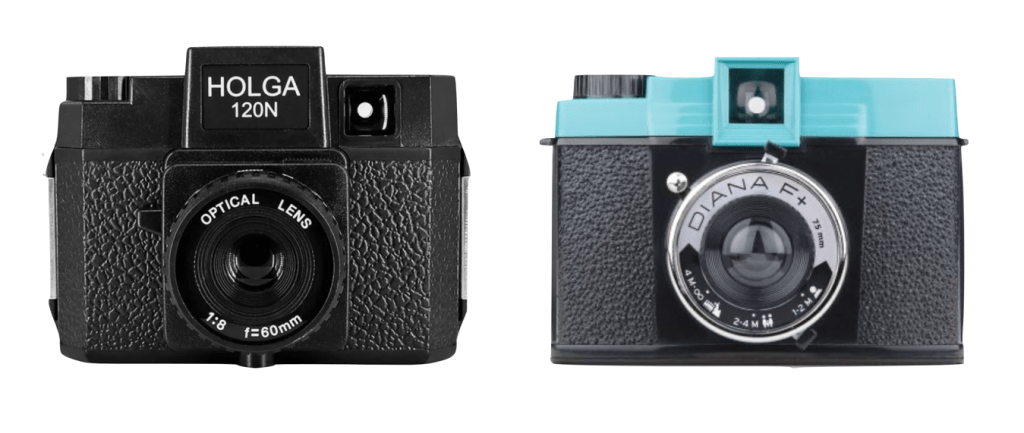
The HOLGA 120N and DIANA cameras with plastic lenses
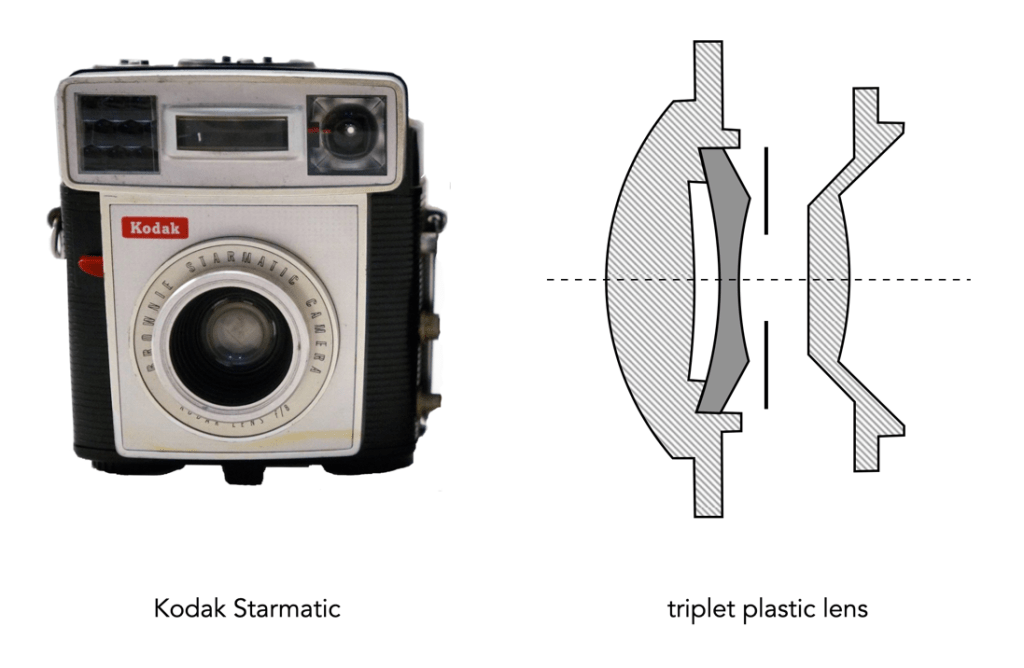
The 1950s saw a growing trend towards the idea of using plastics in cameras. In 1952 Kodak was experimenting with plastic viewfinders in its simple cameras, and by 1957 was making injection molded meniscus lenses for use in snapshot cameras. In 1959 it was using triplet lenses with an f/8 aperture in its Starmatic Brownie cameras. The March 1961 issue of Modern Plastics [2] had an article on plastic lenses, with a cover touting “Lenses – The Focus is on Plastics”. The article describes large plastic lenses made of acrylic, 4-30” in size, used in applications such as magnifiers and reflectors. The article described the many benefits of plastic lenses: reduced weight, more light transmission, impervious to thermal shock, and chip-proof. However of the varied applications it suggests the “prospects are not overly bright for injection molded methacrylate”, largely due to the refractive index. Doubts had already started to set in.
Lloyd Varden investigated plastic lenses in the August 1961 of Popular Photography [3]. He describes a long list of properties that glass had that made it superior to plastic: (i) range of refractive indexes, and dispersion values available, (ii) homogeneity, (iii) physical hardness, (iv) transparency, (v) selective absorption, i.e. absence of colour, (vi) light and atmospheric stability, (vii) freedom from excessive bubbles, (viii) thermal expansion, (ix) moisture absorption, (x) chemical reactivity and solubility, and economy in manufacturing. Unfortunately, plastics of the period could not match up to all these requirements. Plastics could have a high degree of transparency, a low selective absorption, and an absence of bubbles, but failed in other categories such as physical hardness, making them susceptible to scratches, or a high refractive index/low dispersive power.
In 1964 Leonard Lipton wrote Popular Photography article, again looking at plastic lenses: “Plastic Lenses: Good Enough!” [4], in which he said “we are already deep into the plastic lens revolution.” He estimated that in 1963 five million plastic lenses were manufactured, and good photographic objectives could be made up to f/8. He suggests that Kodak was reluctant to admit their inexpensive cameras contained plastic lenses, largely due to the perception that the public associated plastic with an inferior product. Kodak instead preferred to use the term “acrylic”. Many companies were at the time using plastic in products such as viewfinders, and slide viewers. Lipton’s article was a lengthly one, describing the virtues of plastic (over glass), how plastic has dealt with issues such as striation, and changes in temperature, the process of molding lenses, and their limitations.
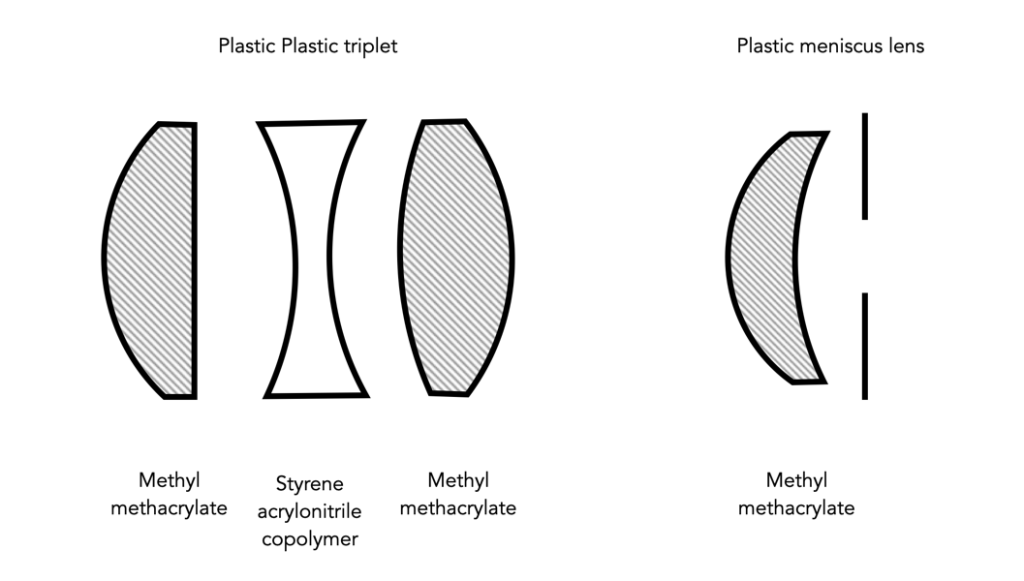
Plastic lenses are typically molded from polymers such as methyl methacrylate (MM), and styrene acrylonitrile copolymer (SAC). Optical glass is chemically nothing like optical grade plastic. Plastic has a definite molecular structure, whereas glass does not. Plastic is basically made from carbon, hydrogen and oxygen, whereas glass can contain a wide variety of materials, e.g. silicon dioxide, barium, boron, lead, and even thorium. The single biggest benefit of plastic is that it could be injection molded. Glass on the other hand, could not be injection molded as it would produce surface irregularities, which would then have to be ground and polished out (modern glass can be precision moulded). Injection molding allowed for complex shapes to be made easily, and inexpensively. Early plastic lenses suffered from something called “striation” whereby a lens has regions which with an index of refraction different from the rest of the lens, resulting in fuzzy pictures. It was caused by uneven cooling in the mold, but by the mid-60s this had been eliminated from lenses.
Plastics were said to suffer from defects, e.g. becoming pitted, or discoloured. However as they were usually used in simple, small lenses, this was hardly ever a real issue. Scratching (of the outer lens) was reduced through the use of plastics like Plexiglas V100, another acrylic which is very hard. The biggest issue with plastic lenses centred around the index of refraction (IR), which is a dimensionless number that indicates the light bending ability of a medium. The IR of plastics was (and is) rather low compared to optical glass. Acrylic has an IR of 1.49, and styrene acrylonitrile copolymer, 1.57. Compare this against modern glass of the period, at 1.52 to 1.89. Another problem was the fact that the IR of acrylics decreases as temperatures increases, changing the focus. Some plastic lenses were designed to automatically compensate for this. For example the plastic f/8 Cooke triplet, which used lens elements made from both acrylic and SAC. The focus of the acrylic elements (front and rear) increases, while the focus of the middle SAC lens decreases, balancing out any changes in focus.
The plastic lenses: Cooke triplet and the single lens
Lipton went a long way to describe the manufacturing benefits of plastic (and the drawbacks of optical glass) [4]. Optical glass is made by melting raw materials, which is processed when it cools into glass. Optical glass requires a number of steps including grinding, polishing, and testing, which made them expensive to manufacture. Plastic lenses on the other hand were simple to manufacture:
“Plastic lenses are made in air conditioned pressurized rooms, and in the case of Plexiglas or Lucite, the plastic, in powder form, is fed to a machine where it is heated and softened. It may be heated to a temperature of 400 to 500 degrees Fahrenheit. The softened plastic is then forced, under a pressure of at least 16,000 pounds per square inch, into a mold when it remains until it cools enough to retain the mold’s shape. The mold is then opened, and the lens is popped out, ready to be used as is, or assembled with other elements with no necessity for working to a finished size.”
Not that manufacturing optical plastics didn’t have its limitations. It was challenging to mold large diameter optical lenses, lenses with plane surfaces, and those with thick centres and thin edges. Lipton considered two stumbling blocks prohibiting the creation of high-speed 35mm lenses: low refractive indices, and the inability to mold large diameter lenses. In fact Dr. Rudolf Kingslake, director of optical design for Kodak, said of plastic objectives: “It’s the low indicies of refraction that are stopping us, it’s just a matter of substituting plastic for glass.”[4].
In 1972 Bob Schwalberg wrote an article describing why glass still reigned supreme [5]. He suggested SLR pentaprisms were a good candidate for conversion to acrylic which would reduce production costs. Schwalberg outlines five benefits:
Lower cost – Raw materials are cheaper, and less expensive to work.
Complete form freedom – Aspherical (non-spherical curvature) lenses are expensive to make in glass.
Exceptional clarity – Not all optical glass is perfectly colourless, the highest grades of optical plastics are quite colourless, and their clarity frequently superior.
Light weight – Plastic lenses are lighter.
High impact resistance – Glass is brittle, plastics are flexible.
and five counter-arguments:
Too limited range of optical specifications – i.e. The refractive index, and the dispersion. Refractive indexes for optical plastics are close to 1.5, optical glass ranges from 1.42 to 1.95.
Poor curve holdability – Accurate lens curvatures are critical for quality performance. Plastic lenses have poor curve conformity because of (3) below, and their inherent flexibility. Glass is stronger and more stable, it holds curvature much better in the face of external forces.
High temperature coefficients – The expansion and contraction of optical plastics is much greater than for optical glass. Muti-element plastic lenses have been developed with elements possessing opposing temperature coefficients. Unthinkable for precision camera lenses.
Clear plastics are hygroscopic – They absorb airborne moisture. Optical media must be isotropic, i.e. equal in all directions. The absorption of moisture destroys this homogeneity.
Low abrasion resistance – Plastics are softer and more prone to scratching than optical glass.
The Kodak Starmatic and its lens
Many of the cameras that use(d) plastic lenses are considered to be “toy” cameras. In 1959 Kodak introduced the Starmatic, the top of Kodak’s Brownie line. It had an 44mm f/8 three-element, plastic lens. The Lomography Diana appearing in the 1960s, and was made entirely of plastic (and in 1975 cost less than $2). The Polaroid Pronto Land camera (mid 1970s), also had a 116mm 3-element Polatriplet plastic lens. Most Holga cameras, had a 60mm f/8 plastic meniscus lens.
But the breakthroughs and sophisticated designs associated with plastic lenses never really materialized. In the end, low refractive indices, and the inability to successfully mold large diameter lenses may have been stumbling blocks to making 35mm lenses from plastic. There are some plastic optical materials [6] that have reached a refractive index of as high as 1.68, e.g. PolyEtherImide, but they often suffer from having a lower transmission rate (36-82% for PolyEtherImide, versus 92% for acrylic). Leica APO glass, on the other hand, has a refractive index of 1.9005.
Apart from their use in inexpensive cameras, there is another use of optical plastic, that is in hybridaspherics. A hybrid aspherical element is a lens element consisting of a glass base upon which plastic is glued, creating the desired aspheric shape. They are typically used in zoom lenses, e.g. the Nikon 28-70mm f/3.5-4.5 AF, first introduced in 1991. Companies like Tamron use hybrid aspherical lenses, likely to reduce the cost of the lenses. Lipton somewhat predicted this use in 1964 [4] when he suggested it would be difficult to grind an aspheric lens in optical glass, yet the manufacture of aspheric lenses in plastic would be no problem. Ironically, many smartphones have lenses which are actually plastic. This is not surprising considering the small size of the lenses required for mobile devices – it is less of a technological challenge, and hence costs less to manufacture (but as manufacturers don’t publish lens diagrams, it’s hard to know). For example the Leica lenses used in Huawei smartphones are plastic. Are there smartphones with glass elements? Sure, but they are usually quite expensive.
Ultimately the inability to derive high precision optics is one of the reasons we don’t see more plastic lenses. But there is another, human factor involved in companies shying away from the use of plastics – the perception of quality. Glass is more associated with quality that plastic, whereas plastic is considered “cheap”, and disposable. This is largely due to its use in inexpensive cameras, and the stigma attached to plastic itself.
Andrew B. Hecht, “And Now Plastic Lenses”, Popular Photography, 18(5) pp.72-74,128 (1946)
“Learn from Lenses”, Modern Plastics, 38(7), pp.90-93 (1961)
Lloyd E. Varden, “Plastic Lenses”, Popular Photography, 49(2) p.48,97,98 (August, 1961)
Leonard Lipton, “Plastic Lenses: Good Enough!”, Popular Photography, 55(2) p.44-45,100-101 (August, 1964)
Bob Schwalberg, “Plastic optics vs. glass, and why glass still reigns”, Popular Photography, 70(2) p.52,118 (1972)
Kingslake, R., Johnson, R.B., “The Work of the Lens Designer”, in Lens Design Fundamentals, 2nd ed. (2010)

 Crafting Pixels