Some people collect what others would consider to be the most horrendous cameras. But what are considered the worst? A camera can obviously be bad for any number of reasons. It might be unreliable, ugly, lack usability, too heavy, too light, crappy lenses or useless without batteries. Some were too complex, and challenging at the best of times. Others had that one feature that just didn’t work well, condemning a perfectly good camera. Incorporating a proprietary lens mount that nobody else used, or only offering half a dozen lenses also condemned a camera. But while a whole slew of cameras might fit the criteria, it is hard to list them because of subjective opinion. If a camera only lasted in a catalogue for one year, then in all likelihood even the manufacturer thought ill of it.
The only place that didn’t produce any bad cameras (or any good ones for that matter) was the Southern Hemisphere, where arguably very few cameras were ever made. The Japanese on the whole produced good cameras, with a few exceptions. One is a camera made by Japanese company Tokiwa Seiki K.K., which operated in the 1950s. There were a lot of start-up camera manufacturers during this period, all trying to cash in on the market… not all were successful at what they produced. They produced a number of 120, and a few 35mm SLRs, one of which was the Firstflex 35 (or any one of Soligor-35, Windsorflex-35 and Lafayette-35). Produced in 1955 it was a leaf-shutter SLR with a waist-level viewfinder and specialized bayonet mount. The second version of the camera (1958), had a pentaprism viewfinder and Exakta lens mount, but it had a shutter that doubled as a mirror, and only two speeds, 1/125s and B. Hardly at all useful. Its successor, the PLUSflex-35 added 1/60s.
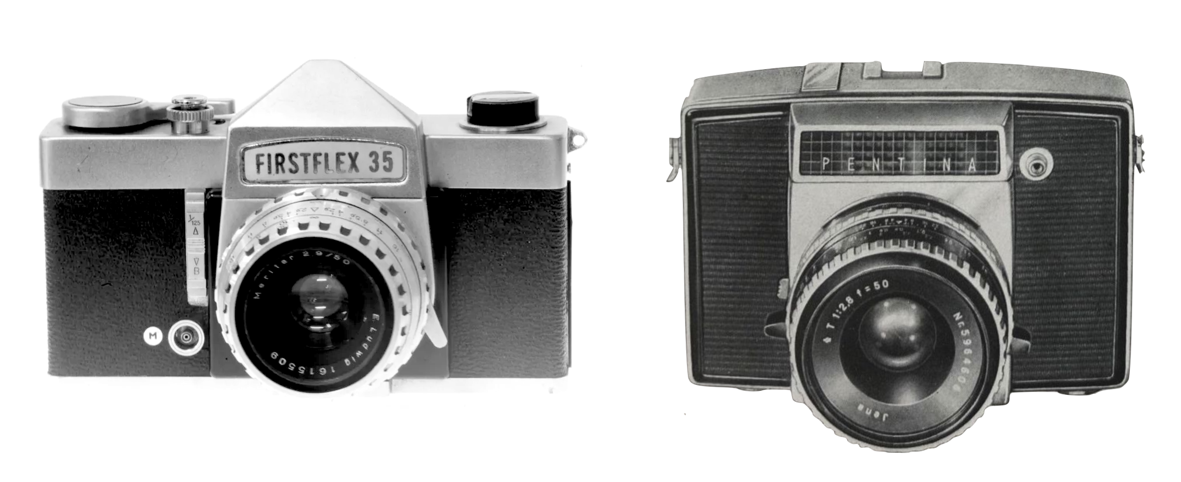
On the German side there is the Pentina, made by VEB Kamera- und Kinowerke Dresden in the 1960s. This camera used a leaf shutter which was a departure from the usual focal-plane shutter used in East Germany, and likely somewhat of a backwards step as East Germany lost its ability to produce high-end leaf shutters after the war (both companies of the leaf-shutter monopoly, Deckel and Gauthier were situated in West Germany), meaning they had to reinvent the technology. But the camera had a non-standard bayonet mount, a meagre choice of four lenses, and was extremely chunky looking as the designers had opted for ‘clean design’ with the camera enclosing the pentaprism, rather than exposing it with a roof-shaped top. According to various sources this camera could be summed up by the fact that they were hated by repairmen. The Pentina was, in the words of Kampermann on the Dutch blog Vintage-Photo, the result of ‘...megalomania, building something that had never been built before, extravagant in design and over-complicated in technical innovation’. The Pentina may have been the most extraordinary design of an SLR of the period, but its eccentric design may have lead to its short production period, with only 45,000 units were built between 1961 and 1965 with as many as seven variants.
Note that identifying the ‘worst’ SLR is a very individualistic endeavour. One person’s Dali is another ones Monet, so to speak.
Further reading:
- Pentina, zeissikonzeb.de
- “The Psychedelic Pentina“, Kampermann, Vintage-Photo.nl (Mar.23, 2023)
- “Pentacon Pentina M (1963)“, Mike Eckman (Mar.31, 2020)
 Crafting Pixels