Most large camera manufacturers don’t really make a lot of sub 20mm (FF eq.) lenses. Why? Mostly the cost involved, and likely the lack of sales potential – not many people want to spend a lot of money on a lens that provides a circular fisheye image. I mean these are fun lenses to play with, but in reality aren’t really that practical for everyday use. This may be why 3rd party manufacturers have taken up the mantra, producing low-cost, often reasonable quality sub-20mm lenses. Let’s look at some for Fuji-X.
Let’s divide this into two APS-C categories, the 9-13mm ultra-wide group, and the fisheye group <=8mm. Fisheye lenses can be further categorized into circular and full-frame fisheyes. With regard to focusing MF=manual, AF=auto. Angle-of-view is shown in degrees on the diagonal.
Fisheye lenses: 4-8mm (6-12mm FF)
7artisans Photoelectric 4mm f/2.8 Circular Fisheye (225°) MF US$149
Venus Optics Laowa 4mm f/2.8 Circular Fisheye (210°) MF US$199
Meike MK-6.5mm f/2 Circular Fisheye (190°) MF US$130
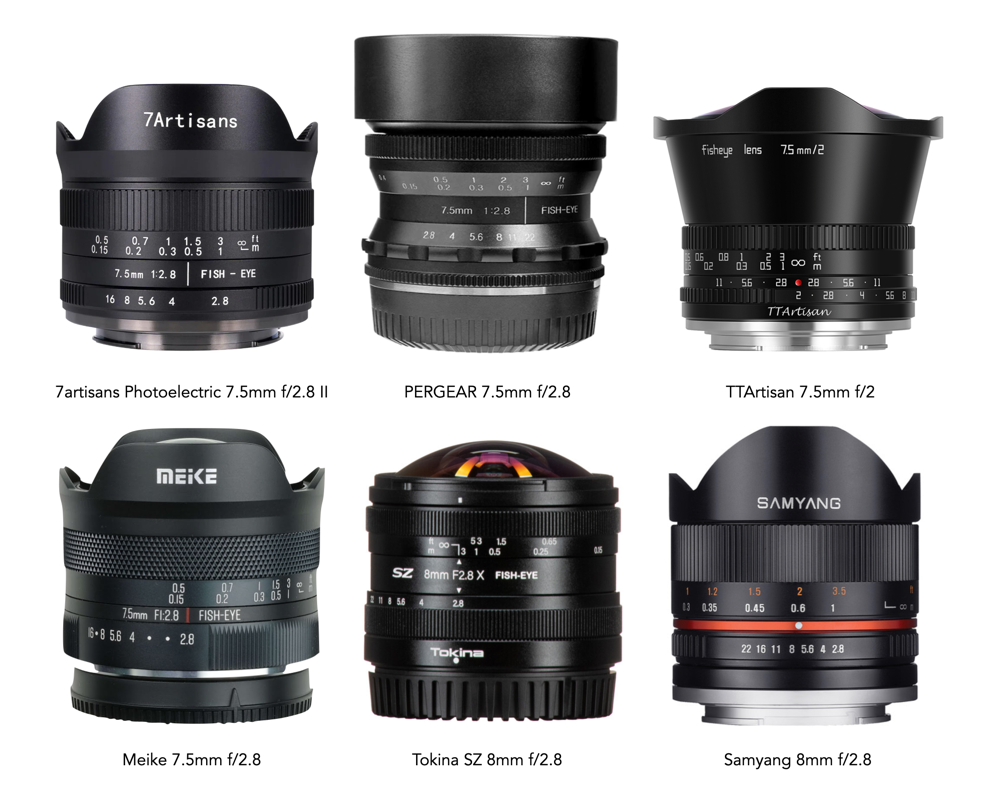
7artisans Photoelectric 7.5mm f/2.8 II Fisheye (190°) MF US$139
Pergear 7.5mm f/2.8 (179°) MF US$130
TTArtisan 7.5mm f/2 (190°) MF US$149
Meike 7.5mm f/2.8 Fisheye (180°) MF US$165
Tokina SZ 8mm f/2.8 (180°) MF US$299
Samyang 8mm f/2.8 Fisheye II (180°) MF US$299
Ultra-wide lenses: 9-12mm (13.5-18mm FF)
Venus Optics Laowa 9mm f/2.8 Zero-D (119°) MF US$399
Venus Optics Laowa 10mm f/4 Cookie (109°) MF US$299
Meike 10mm f/2 (107°) MF US$449
ZEISS Touit 12mm f/2.8 (99°) AF US$999
Samyang 12mm f/2.0 NCS CS (99°) MF US$399
7artisans Photoelectric 12mm f/2.8 (102°) MF US$149
Meike MK-12mm f/2.8 (99°) MF US$170
Pergear 12mm f/2 (97°) MF US$160
So which one to choose? It’s really hard to know. It really depends on what you want to do. All these lenses will have some sort of distortion, with the notable exception being the Laowa 9mm, which is described as “Zero-D”. The circular fisheye lenses are nice from an artistic point-of-view, but don’t have that many practical applications (well they are actually used in scientific applications such as assessing forest canopy cover).
Why are these lenses so cheap? Firstly nearly all of the inexpensive lenses, bar the Zeiss 12mm, are manual focus, because obviously incorporating auto-focus mechanisms into any lens is expensive. Another reason may be competition, but it may also be the notion that many of these focal lengths are more for use in an artisanal manner. If these lenses become too expensive, they push themselves out of the market. But inexpensive doesn’t mean a cheap lens. The Laowa 9mm has 15 elements in 10 groups, likely needed to reduce the lenses distortion – so it doesn’t lack good design. Is the Laowa glass inferior to that of Fuji? Possibly, but it’s impossible to tell.
Should you buy an ultra-wide, diagonal fisheye, or even a circular fisheye lens? Well, for the cost involved many of these lenses certainly won’t break the bank, and if you are interested in exploring some artistic photography then it may be a good fit. Which one? Well that’s a bit of a conundrum. Of the six 7.5-8mm lenses, it’s hard to know which is really the best. I would suggest checking out some online reviews, and see what people think of the various lenses.
 Crafting Pixels