Lenses are funny. Lenses with small focal lengths usually contain a lot of glass, conversely those with long focal lengths contain very little. Why is this the case? Shouldn’t telephoto lenses be filled with optical elements? The answer is no, and it’s because of the nature of how telephoto lenses, or in this case long-focus lenses, work – vintage telephoto lenses are not all built in the same way.
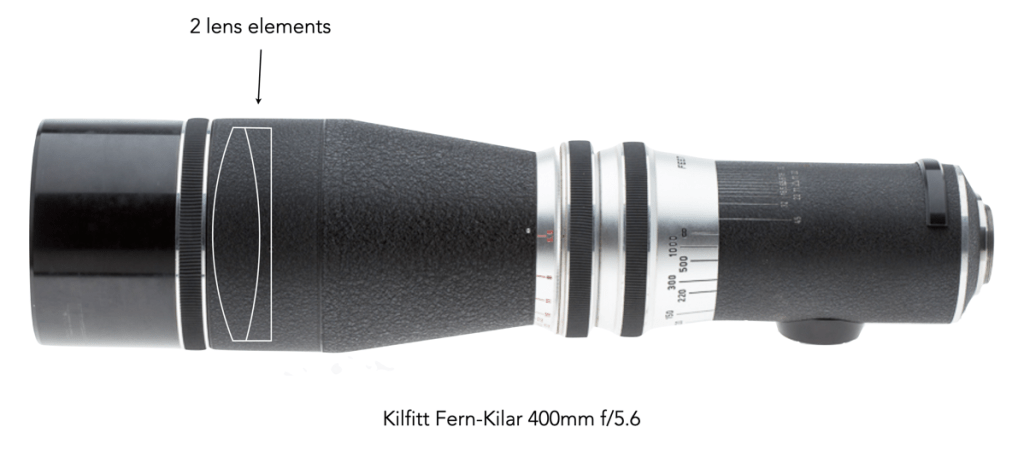
There are some vintage long-focus lenses that have a mere two elements – many of these lenses have extremely long focal lengths. These two-element lenses were often cemented together, positioned in front of the diaphragm, with very little in the way of anything else in the lens barrel. Simple lenses of the type are capable of excellent definition if the field is restricted to a few degrees from the axis and the aperture is not too great.
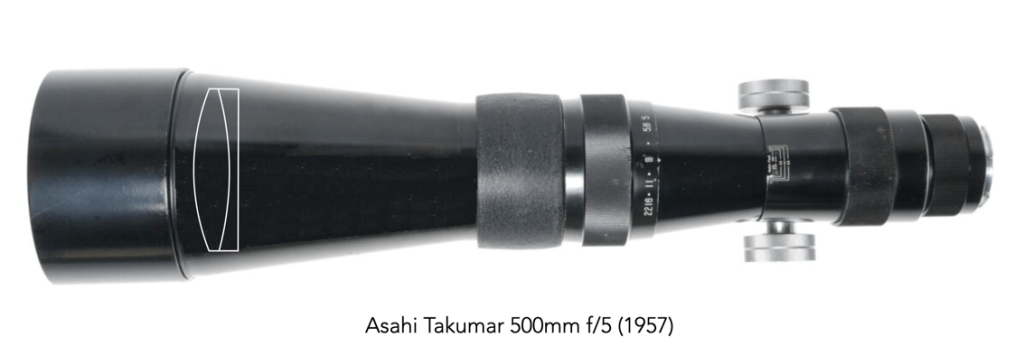
This type of 2-element lens was made by a number of different manufacturers:
- Astro-Gesellschaft (Berlin) − Astro-Fernbild 200-1000mm
- Kilfitt − Fern-Kilar (400mm f/5.6, 600mm f/5.6)
- Tewe − Telon (400mm, 500mm, 600mm, and 800mm)
- Komura − 800mm f/8
- Carl Zeiss Jena − Fernobjektiv 500mm f/8 (1934)
- Asahi − Asahi Takumar 500mm f/5 (1957)
- Canon − R Bellows 600mm F/5.6, 800mm f/8, 1000mm f/11 (1960)
 Crafting Pixels