Let’s continue with optical anomalies.
⑤ Fungus
A lens that has been stored in an inappropriate environment, i.e. one that is dark and humid, may provide the perfect conditions for the growth of fungus. Fungus takes the form of tendril or web-like structures on the surface of the lens. The fungus secretes an acid that etches a lenses’ multicoating. This sort of damage can be permanent, and hard to remove. Too much fungus will lower contrast, and way too much will give darker, fuzzier images as it blocks light. Fungus is bad news – avoid lenses with it, however small the “infection”.

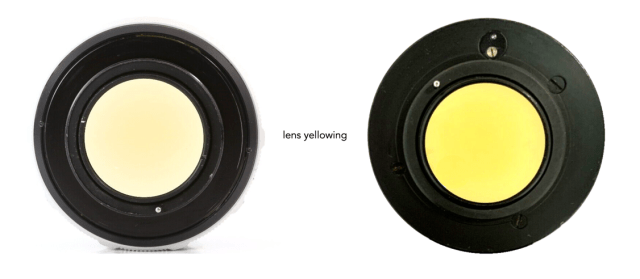
⑥ Yellowing
Coatings on lenses often yellow in time. Glass in general does not yellow, but lens coatings, or at least older ones do. This is also true of glass made with radioactive elements, e.g. Thorium, to reduce refraction.
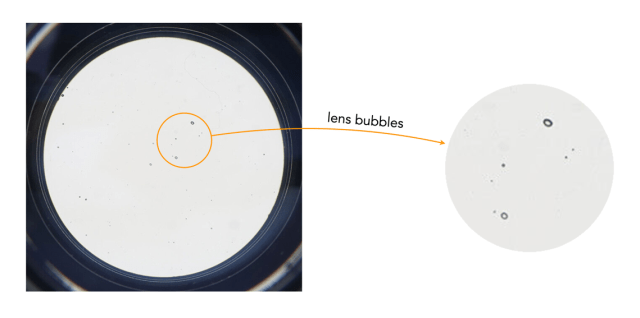
⑦ Bubbles
Some lenses pre-1970 had defects caused by the optical glass manufacturing process which left a few pin-prick sized air bubbles inside the glass. These bubbles may come from different sources, but in most cases the source is imperfect refining. They look like tiny dust specks when viewed with the naked eye, but if magnified, they are indeed bubbles.
⑧ Separation
Lens groups are most often held together with some type of glue. In modern lenses this is usually a UV-cured epoxy. Vintage lenses typically use epoxy, polyester, and urethane-based adhesives, and some pre-WW2 lenses use Canada balsam (basically a resin from balsam fir trees). The balsam was used because it has a refractive index that is similar to crown glass and is invisible when dry. Unfortunately, Canada balsam is not resistant to temperature extremes or solvents. A degradation of the adhesive will result in the lens delamination. This usually manifests itself as a multicoloured band or blobs around the edge of a lens with coatings, or a white band/blobs on lenses with few or no coatings (but it can also occur in the centre of a lens). A small amount of separation on the edges of a lens will likely have little effect on image quality. A large amount may cause a decrease in contrast, flare and ghosting, softer edges, loss of sharpness, and a difficulty in focusing.

Fixing anomalies
Is it possible to rectify these optical defects? The table below provides a quick guide, and later posts will explore some of these defects in more detail.
| Defect | Repairable? | Lens disassembly required? | Notes |
|---|---|---|---|
| scratches | maybe | no | It is hard to remove scratches, especially deep scratches, although fine scratches might be able to be buffed or polished out (some people suggest toothpaste). |
| haze/fog | yes | yes | It might be possible to use a cleaning solution to reduce or suppress the haze. |
| dust | yes | yes/no | Dust on external lens surfaces is easy to clean. Internal dust is harder because it requires lens disassembly. |
| blemishes | no | no | Multicoating damage cannot be repaired. |
| fungus | maybe | yes | It is possible to repair low levels of fungal infections, but it does require lens disassembly. Heavy fungal infections are not repairable. |
| yellowing | yes | no | Yellowing caused by the presence of Thorium can be reduced using UV lights. |
| bubbles | no | no | Intrinsic to the lens glass, consider it a feature of certain older lenses. |
| separation | no | yes | Separated lens groups are basically not fixable. Fixing these requires lens separation, re-centering and re-cementing. |
 Crafting Pixels