Ultrafast lenses – the Noctilux 50mm f/1

After Canon and Nikon gave up on their sub-f/1.1 lenses, there was a lull for a while. In all possibility it was likely considered that film would just get so fast there would be little need for these light behemoths. But high ISO film was only introduced in the mid to late 1970s – Fujicolor 400 (1976), Kodakcolor 400 (1977). Indeed faster films begat faster lenses.

The Leitz 50mm Noctilux f/1 for Leica M cameras appeared in 1976, designed by Walter Mandler (1922-2005) and produced by Ernst Leitz Canada. It was a successor to the earlier Noctilux f/1.2. Bob Schwalberg reviewed the lens in 1976 [1]. His observation was that it had a high optical contrast and almost no flare at f/1, “outimaging” its compatriots the Noctilux f/1.2 and the Summilux f/1.4.

The lens was manufactured for a long time, from 1976-2007. The name Noctilux, was designated for three lenses with differing apertures:

  • Leitz Noctilux 50mm f/1.2 aspherical (1966-1976).
  • Leitz/Leica Noctilux-M 50mm f/1.0 (1976-2007).
  • Leica Noctilux 50mm f/0.95/50mm ASPH (2008- )

The lens was constructed using only spherical curvatures, as opposed to the f/1.2 which used two aspherical surfaces with a 6/4 design. The earlier design was likely changed because the aspherical lenses were too expensive to manufacture. The f/1 uses a modified Gauss design of seven elements in six groups with an “air-lens” between the second and third elements. The second and fifth elements were made using Noctilux 900403 glass. The 1st, 6th, and 7th elements were made with Lanthanum glass (LaK12, LaF21). The 900403 glass, developed at the Leitz Glass Laboratory had a higher zirconium oxide content giving it a refractive index of 1.9005 and a dispersion value of 40. (This glass had a melting point of 1600°C, and had to be cooled in a controlled manner over 10-12 days).

But it was no light lens. It was 63mm in diameter, and weighed about 600g. It still suffered from the one thing all ultrafast lenses suffer from – a narrow DOF (2” at 5 feet). When released it sold for US$855. They now routinely sell for C$8,000-11,000.

References:

  1. Bob Schwalberg, “50-mm Noctilux f/1: Sharpest superspeed lens yet?”, Popular Photography, 78(2), pp. 80,81,105 (1976) Dominique Guebey Jungle, “Leitz Noctilux 50mm f:1.0”

Further reading:

The first 35mm lens

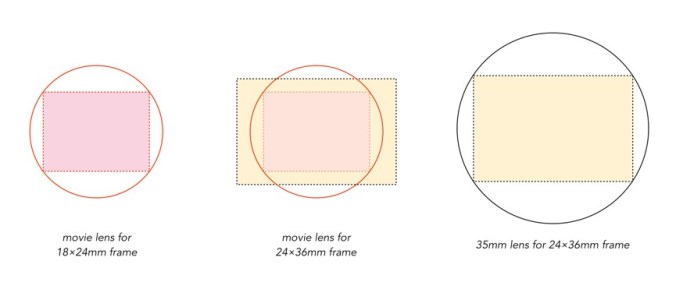
With the advent of 35mm film cameras came the need to design 35mm lenses. The first still cameras designed to use 35mm film inevitably used lenses modified from use on motion-picture cameras, or microscopes. This made sense when the 35mm cine-film used the 18×24mm frame format, however these lenses only covered part of a 24×36mm frame. The figure below shows frame coverage of a cine (movie) lens versus a 35mm lens.

Frame coverage of pre-35mm lenses

For instance the Tourist Multiple used a Bausch & Lomb Zeiss 4-element Tessar (50mm f / 3.5 lens), which was used on motion picture cameras.

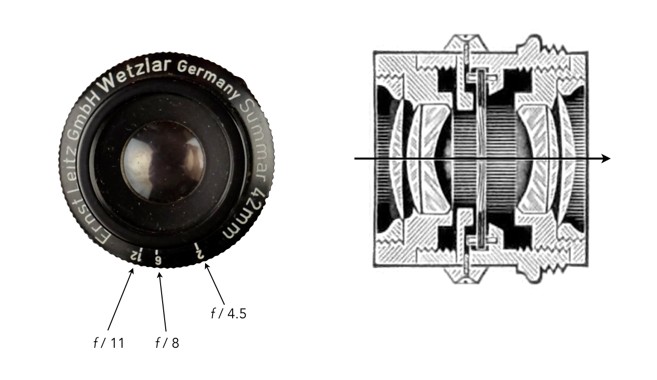
Leitz, founded in 1869, began as a company focused on the manufacture of microscopes, and other optical instruments. When work began on the Ur-Leica, Barnack and Berek tried a number of lenses. The simplest option was the 5cm f / 3.5 Zeiss Kino-Tessar movie camera lens. The problem is that the lens could not provide a light spot able to cover the 24×36mm frame format, as it was designed for a 18×24mm format. In addition it produced vignetting not suitable for a camera. The lens they ended up using was the 6-element 42mm f / 4.5 Leitz Mikro-Summar, in a classic double-Gauss formula. This lens had a number of shortcomings, including edge blurring, and a lack of contrast.

The Leitz Mikro-Summar (from 1907 catalog)

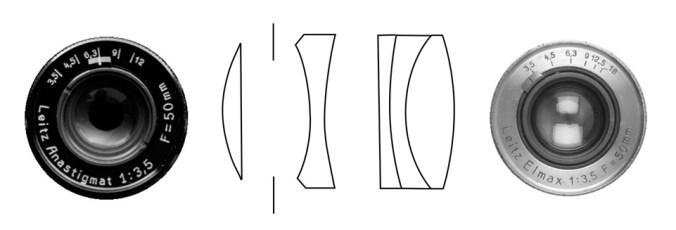
The design of a new 35mm lens was the responsibility of German physicist and mathematician, Max Berek (1886-1949). The first 35mm lens developed at Leica was a 50mm f/3.5 Anastigmat. Based on the “Cooke Triplet” lens design, it had 5 elements in 3 groups. The lens was later marginally redesigned, still containing 5 elements in 3 groups, and was given the name Elmax (The name is derived from Ernst Leitz and Max Berek.). These lenses were used on the pre-production Leica-0, of which 31 were manufactured from 1920-1925.

The Anastigmat / Elmax lenses

At that time, the calculation of such a lens was still very complex. Light beam paths from points near or away from the optical axis had to be calculated for three wavelengths and seven refractive surfaces, all by hand using logarithmic tables. Leitz was granted patent No. 343086 for the Anastigmat in 1920.

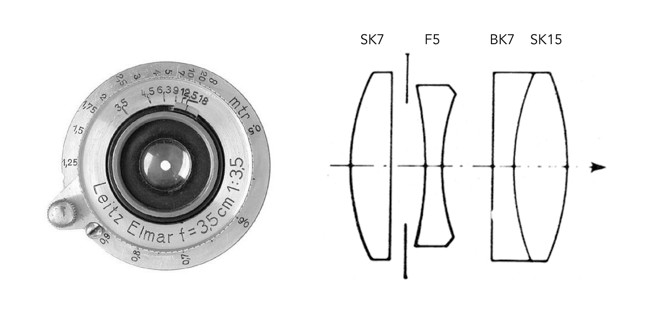
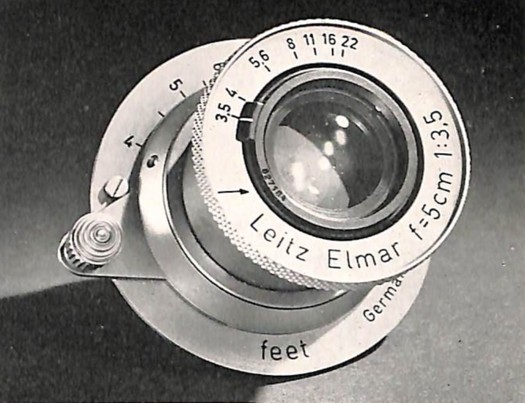
The first lens formula was difficult to build, so Berek changed the design to a triplet with the last element a cemented doublet, i.e., 4 elements in 3 groups. This lens was renamed Elmar, and was subsequently manufactured for decades (1925-1961). The lens was similar to a Tessar, except for the location of the diaphragm. On the Elmar the diaphragm was located between the first and second elements, rather than the rear two elements.

The Elmar lens

The first lenses which appeared were of the fixed type used on the Leica I. From 1930-1959, the Elmar was made in a screw mount, and an M (bayonet) mount from 1954-1961. From 1930-1932 the lenses were matched with one body, after which they became interchangeable (M39 mount). The lens would evolve to have a maximum aperture of f/2.8, and a minimum aperture of f/22. .

The Leica Elmar 50mm, with screw mount

Specifications: (Original)
50mm f / 3.5 Elmar lens
Angle of view: 45°
No. of elements: 4
Minimum focusing distance: 1.0m
Minimum aperture: 16
Aperture range: 3.5, 4.5, 6.3, 9, 12.5, 16
Weight: 92g

Here are some links to extra info on early Leica lenses: