Ernst Ludwig Optisches Werk Weixdorf Objektive was established in 1924 in Lausa near Dresden by Ernst Ludwig. The town of Lausa merged with the neighbour town of Weixdorf in 1938. Pre-war lenses are usually marked with Ludwig Lausa Dresden. The company made cameras for various types of cameras, e.g. 35mm viewfinders and SLRs. After the war, production resumed quickly, as the factory was undamaged, with Ernst Ludwig still at the helm.
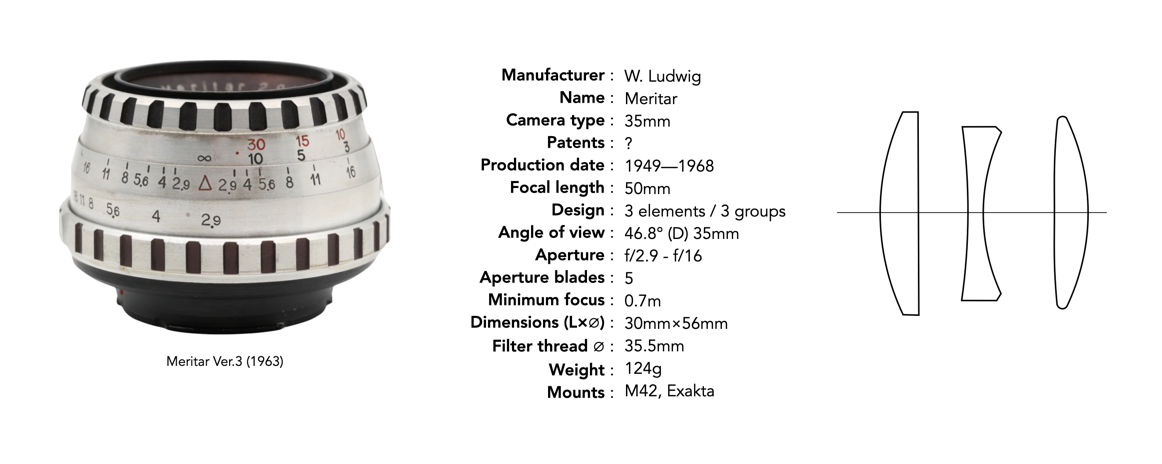
The company produced a number of different, inexpensive lenses, but is likely best known for the Meritar 50mm. With the introduction of the EXA camera in 1951, Ludwig became an original supplier, along with Carl Zeiss Jena, and Meyer Optik. The Meritar was a cheap lens using three air-spaced elements, i.e. the Cooke triplet. Lenses were produced with the Exakta mount for the Ihagee cameras, and some in the M42 mount. The Meritar 50mm f/2.9 was derived from the Victar could be manufactured inexpensively and therefore harmonized very well with the new, inexpensive Exa SLR. It was initially a manual lens, but eventually upgraded to preset diaphragm (1957).
The Meritar was a cheap lens. To put this into context, in the late 1950s the f/2.9 sold for 52 DM, whereas a basic Tessar 50mm f/2.8 was 139 DM, the Biotar 58mm f/2 305 DM. In fact the 3-lens Meritar was considered to be the cheapest lens outfitted on the EXA. In fact EXA + Meritar always offered the cheapest combination until production of these lenses ceased in the early 1970s. Although by 1961, there were eight standard choices for 50mm lenses for the EXA (II), all of but of which were faster.
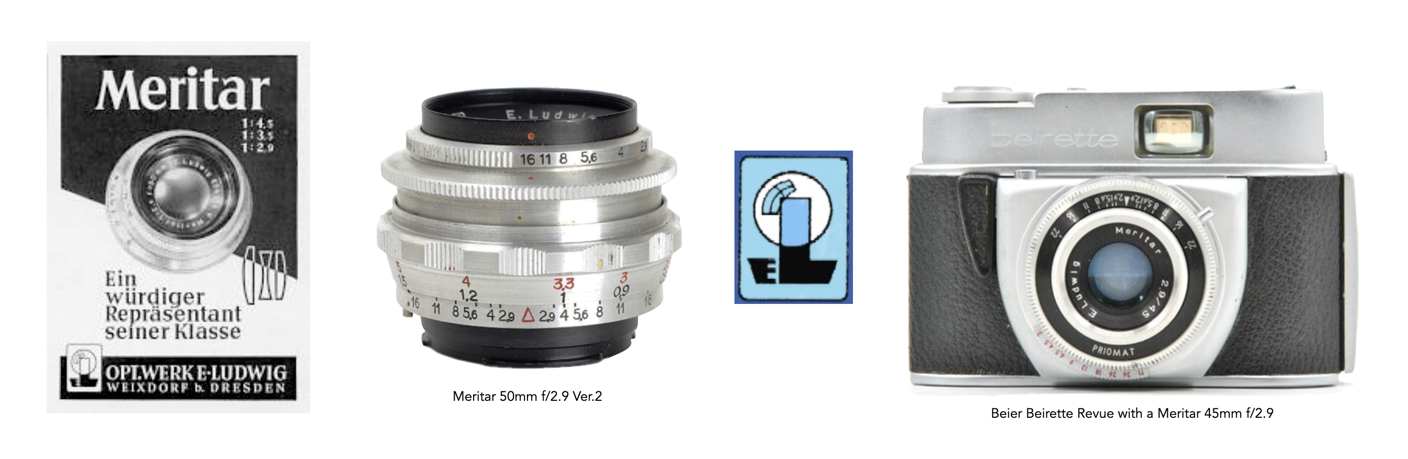
Prior to the Meritar series, the company produced other lenses including the Victar 5cm f/2.9 (Exakta, Praktiflex), Victar 75mm f/2.9 (Reflex-Korelle) and Peronar 50mm f/2.9 (Exakta). Victar and Meritar were also used in cameras with central shutters (Beier Precisa, Beirax). In 1959 the East German state ‘acquired’ a small stake in the company, with Ludwig still at the company until 1968. In 1972 the company became the state owned VEB Optisches Werk Weixdorf, and in 1980 it was absorbed by the VEB Pentacon.
Notable lenses: Meritar 50mm f/2.9;


 Crafting Pixels