Camera gear that amateur photographers should avoid

There is a lot of information about photography on the internet, and honestly for the beginner it can be overwhelming. The task of deciding on a digital camera is hard enough without content creators prattling on about things you probably don’t need. Here are a few pieces of gear to steer clear of – from the pure perspective of the amateur photographer.

Full-frame cameras − The ubiquitous dSLR, or “digital SLR” is an extension of 35mm film cameras, hence the reference to “full-frame” (sensors are 36×24mm). They have been the mainstay of professional photographers for the past two decades. But they are not something that an amateur photographer should even consider. They are large, heavy, and prohibitively expensive. The size alone makes them inconvenient for things like long-term travel. In an age of mirrorless cameras with good APS-C sensors they honestly just don’t make a lot of sense. Even the big manufacturers such as Nikon have shifted their emphasis away from dSLRs. There are situations where dSLRs are more of an advantage – low light, a larger sensor, wildlife an sports photographer, none of which are really the concern of the amateur photographer.
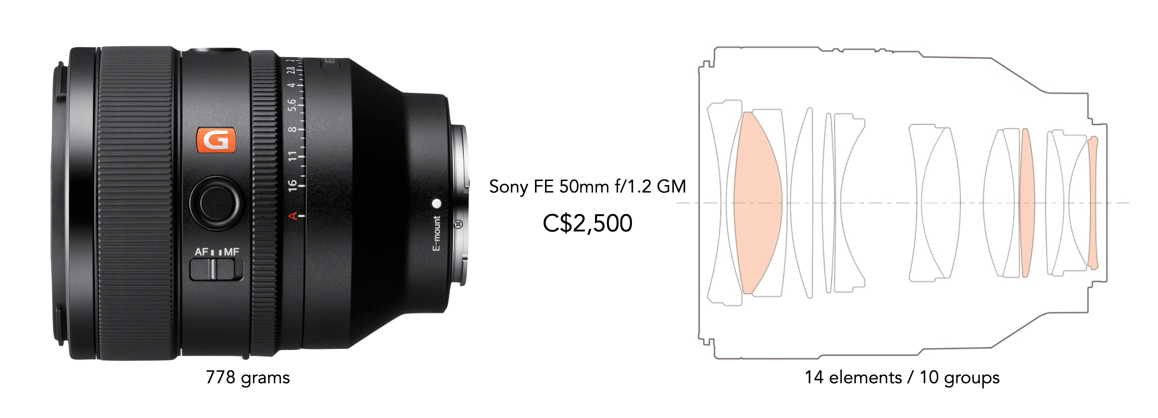
This Sony 50mm lens is fast, but it is too much lens for the beginner

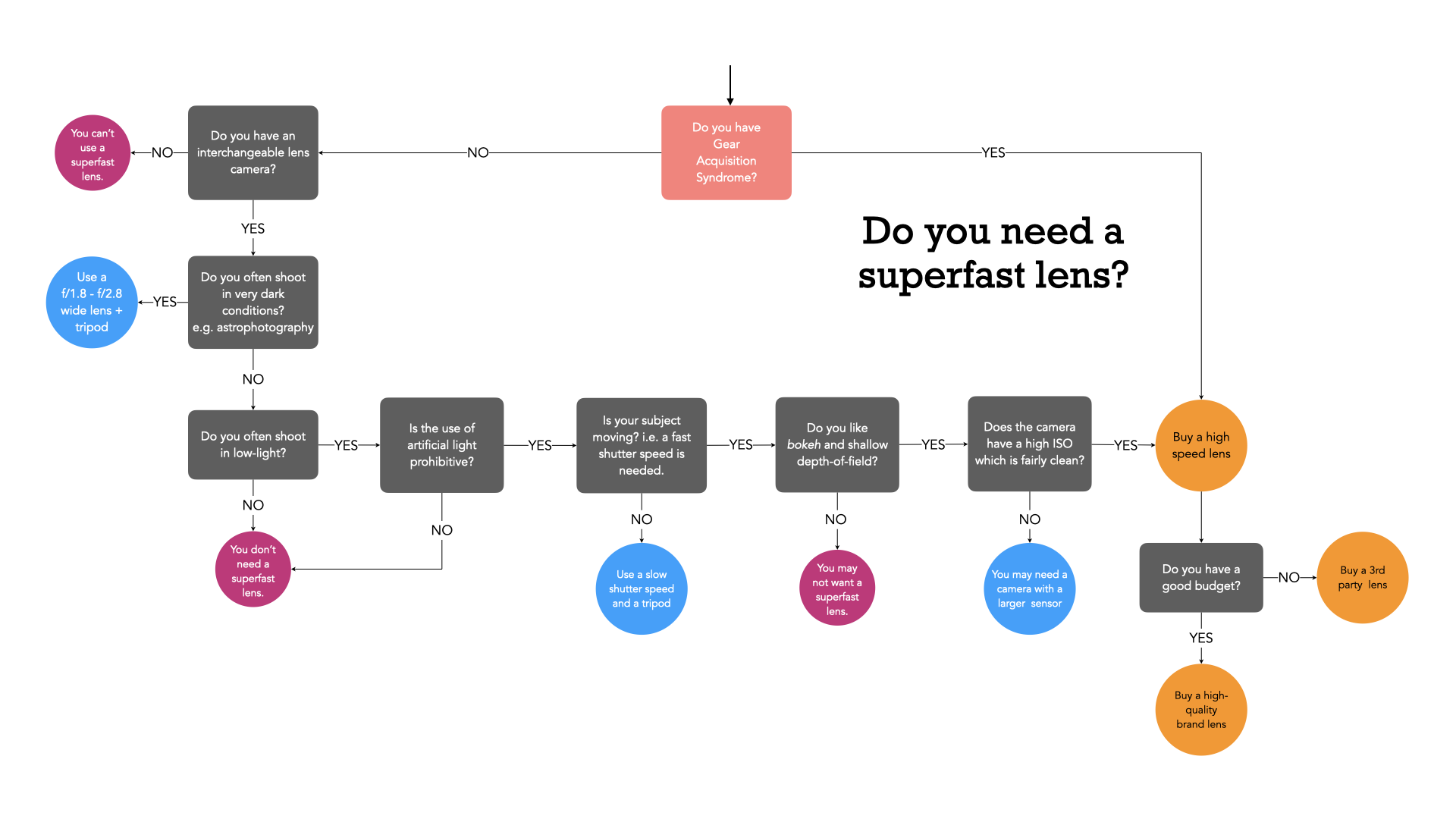
Fast lenses − What is a fast lens? I would probably categorize it as a lens with a speed faster than f/1.8 up to f/1.2. They contain a lot of glass, are heavy, and expensive. But frankly most people don’t need these lenses. They are perfect for people who shoot a lot at night, or in low-light settings, but slower lenses can also be used in these scenarios. (I wrote a whole post on whether you Should you buy a superfast lens?, and Are modern ultrafast lenses useful?)

Super telephoto zooms − The zooms offer focal lengths like 100-500mm, and are very versatile, just not for the beginner. It’s tempting to consider, but not actually that useful unless you have a specific need, i.e. sports and wildlife photography. In many cases it is just too much zoom. For example landscape photography doesn’t always gel well with focal lengths beyond say 200mm, because there is a tendency to loose perspective, which is the whole point of many landscapes. The other problems are pretty obvious – size and weight. Of course here there is another benefit of mirrorless APS-C cameras, smaller zooms. The Tamron 150-500mm lens for Fuji-X seems amazing (225-750mm eq.), but it contains 25 elements, and weighs 1.71kg – try lugging that around for an extended period!
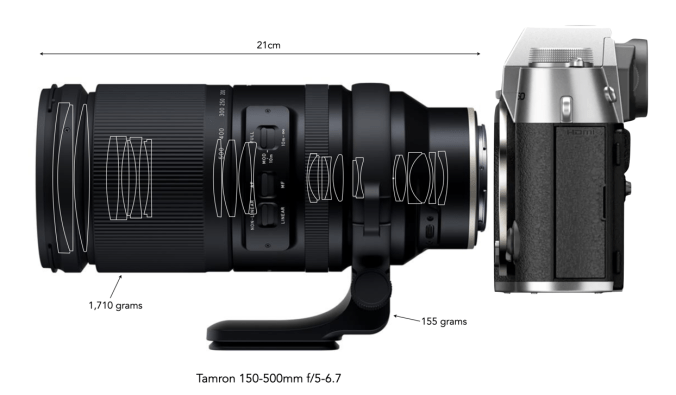
The Tamron 150-500mm super telephoto zoom – a behemoth for amateurs

Filters − There are a lot of really good filters which do things like reduce glare, and unwanted reflections, and correct or enhance colours. For example polarizing filters are useful when shooting landscapes in sunny locales, they darken skies, and make colours stand out more. Neutral density filters reduce light hitting the sensor, but doesn’t affect image colours. But it may be best to focus on taking good photographs, and conquering exposure before adding filters into the fray. P.S. UV filters are basically pointless because most sensors aggressively filter UV light. Save the filters for when you gain a little experience.

Tripods − Most people do not need a tripod. They are super useful for taking stills at home, or when you need to use a super-slow shutter speed, but otherwise they are a bit of a door-stop. They are not at all useful for travel, and overall just aren’t worth the effort. The only ones that can be somewhat useful are the mini variety such as the Manfrotto PIXI (but honestly avoid the Gorilla-type flexible tripods).

Camera body upgrades − Avoid the trap of upgrading your camera body every 1-2 years. A camera body should last a good amount of years, so there really is no need to consistently upgrade. If you are at the point of considering which camera to buy, save some money and buy an older version of the camera. The reality is that technology has plateaued somewhat in digital cameras, and there isn’t going to be much difference between two or three generations of a camera (except the price). Advanced features aren’t that useful if you are still grappling with the basics.

A light meter − If you have a film camera, then a light meter might be a must. But in the case of digital cameras, having a dedicated light meter may not be necessary. Good ones are expensive, and take up room. It’s easier to trust the light meter in the camera, or for film cameras use a light meter app such as Light Meter Ultra.

Lenses you don’t need − It’s hard not to want all the lenses that photographers review online. They look cool, and it would be fun to play with them right? Especially the myriad of inexpensive lenses now on offer. But here’s the thing, most of them you won’t use on a regular basis. Fish-eye lenses are a good example. They are fun and creative because they provide an ultra-wide view of the world. But the caveat is that reasonably priced ones are typically manual focus, and there are very few applications (unless it is a rectilinear fish-eye). There is probably a good reason that manufacturers like Fuji don’t have any fish-eye lenses.

Photography can get to be an expensive hobby, and buying things you don’t need can be a slippery slope. Many of these things I learned the hard way. Buying lenses that I thought I would need, but ended up sitting on a shelf. Think of it this way – every piece of gear that you buy should solve a problem of some sort, but not just a 1-2 instances, a problem you encounter a lot. If you are really interested in a lens, then try and rent the lens before buying to actually see if it is as useful as you think.

Ultimately a new lens or any other gear doesn’t replace the need for knowledge and experience, or frankly will it help you do something if you don’t really know what you are doing.

Vintage lenses – Why did early fast SLR lenses have focal lengths of 55mm and 58mm (and not 50mm)?

Vintage “normal” lenses most often range from 40mm to 58mm, although the greatest number of theses lenses fall in the range 50-58mm. A lens which satisfies the ideal of being “normal” has a focal length close to the diagonal of the film format. So, 24×36mm = 43mm. 35mm is an exception to this rule – when Oskar Barnack developed the original Leica he fitted it with a 50mm Elmax to ensure the most could be done with the small negative area. From that, the 50mm became the ubiquitous standard. With the proliferation of 35mm single lens reflex (SLR) cameras, manufacturers in the early years tended to fit 55-58mm lenses. But why was this the norm instead of 50mm?

There are a variety of reasons. Let’s start at the beginning.

When Ihagee (Dresden) released the worlds first 35mm SLR in 1936 it had a series of standard lenses, but basically there were two categories: the slow 5.0cm lenses which ranged from f/2.8 to f/3.5 (e.g. Tessar, Xenar), and the marginally faster, 5.0cm/5.8cm f/1.9-2.0 lenses, e.g. the 5.8cm f/2 Biotar (developed for the Exakta). The first post-war Exakta did not appear until 1949, the Exakta II, along with a cornucopia of standard lenses from numerous manufacturers, but the fastest 50mm lens was still the Zeiss Tessar f/2.8.

The “… to 60-mm…” was included in the normal-lens category only because such lenses are frequently supplied as standard optics on single-lens reflexes. The reason is that in many cases the designers have found it easier to meet the special requirements of through-the-lens focusing by going to a slightly longer focal lens. Fifty-eight mm is the most common choice.

Bob Schwalberg, “Interchangeable lenses by the carload”, Popular Photography, pp.36-38,197 (May, 1956)

The 35mm SLR experienced a rapid increase in popularity among amateur photographers in the 1950s, especially after manufacturers realized that the installation of a prism viewfinder made handling this type of camera much easier. With this came the need for faster lenses, for two reasons – the ability to take pictures in poor lighting conditions, and a brighter viewfinder image makes it easier to focus. Lens such as the Biotar 58mm f/2 were considered to have a long focal length – to the amateur this was less than favourable, because they would get less coverage than 50mm. Over the course of the 1950s, manufacturers worked on new lens configurations to increase the speed of 50mm lenses, however 55mm and 58mm lenses still maintained the edge in terms of speed.

Fig.1: The two fastest pre-1950 35mm normal SLR lenses. Note the angle-of-view (horizontal) between 50mm and 58mm is not that different.

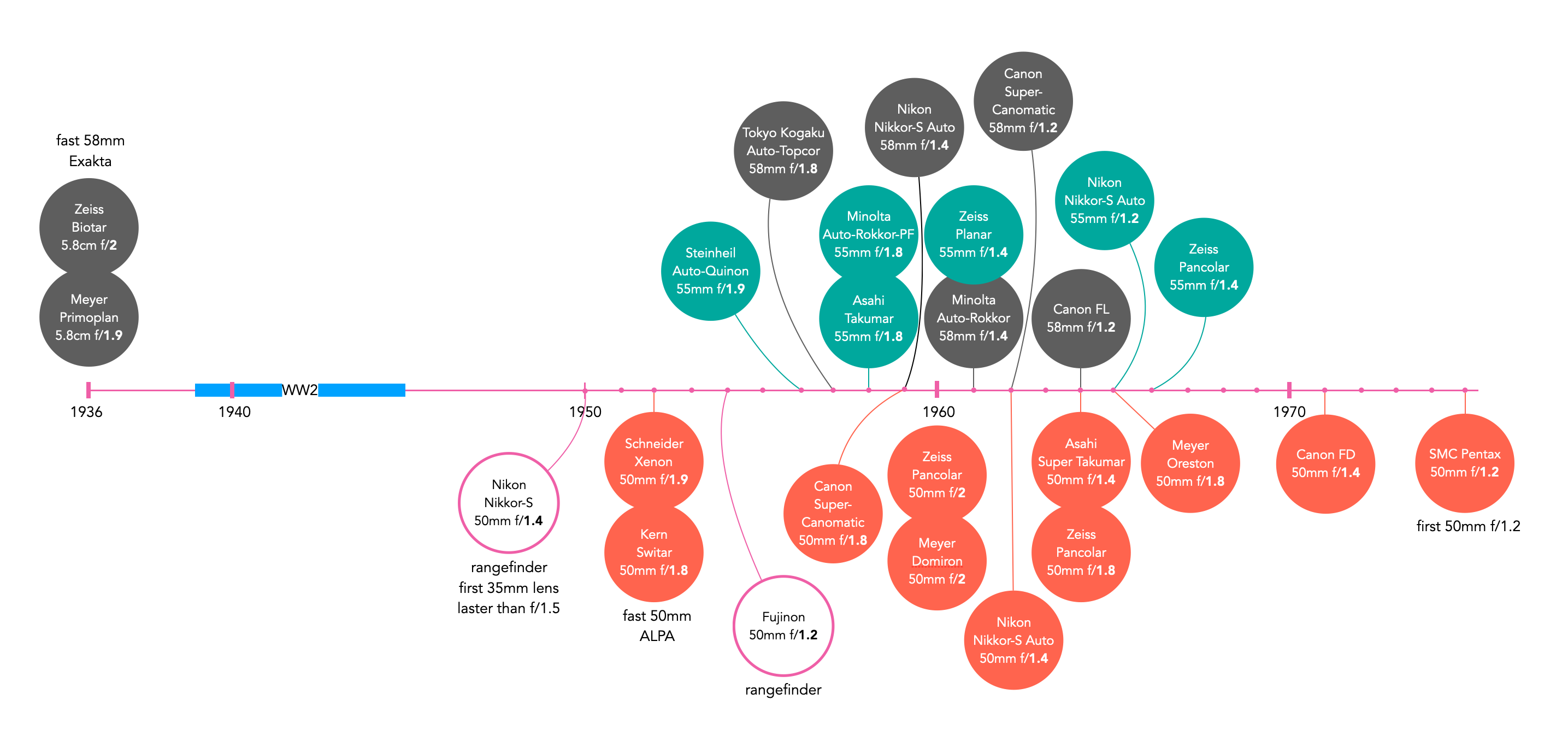
The original Asahi Takumar lenses which evolved with the 1952 Asahiflex (M37 mount), only included a single 50mm lens, with a speed of f/3.5. Both the 55mm (f/2.2) and 58mm (f/2.2,2.4) lenses had faster speeds. The 58mm f/2.4 in 1954, which became the standard lens for the Asahiflex II. The Auto Takumar’s focused on 55mm lenses with both f/1.8 and f/2.0 lenses. It was not until the Super-Takumar’s appeared in 1964, that the fast 50mm became more normal, with the f/1.4 lens. Canon didn’t produce much in the way of fast SLR lenses until the FL series lenses, introduced for the Canon FX, and FP, which debuted in 1964. Here there was a fast 50mm f/1.4, yet the f/1.2 lenses were still in 55mm and 58mm. In truth, even 50mm lenses faster then f/1.8 did not appear in Japan until the mid-1960s. many of the super-fast 50mm lenses were developed for rangefinder cameras, and never extended to SLRs.

The post-war German 50mm lenses did not really get much faster than f/1.8. This is in part because although the competition in Japan spurned a lens “speed-war”, the same was not true in Germany. The fastest lenses of the early 1950s was still the Biotar 58mm f/2, and Meyer Primoplan 58mm f/1.9. By 1960, at least for the Exakta Varex there was now a 50mm f/2 in the guise of the Zeiss Pancolar. By 1962 Exakta brochures had sidelined the Biotar 58mm, in favour of the Meyer Optik Domiron 50mm f/2. The Japanese had however established f/1.8 as the standard speed for a 50mm. The Zeiss Pancolar 50mm f/1.8 is an extremely good lens, but did not appear until 1964. Similarly the Görlitz Oreston 50mm f/1.8 did not appear until 1965. One of the reasons these “average” speed lens were produced is volume. The production of Praktica cameras in the mid-1960s reached 100,000 units per year, all of which needed a standard lens. It was all about economics.

Fig.2: Speed milestones in 55/58mm and 50mm lenses. Note that while a 50mm f/1.2 lens for rangefinder cameras existed as early as 1954, it would not be until 1975 that one appeared for 35mm SLRs. (note that the diagram may not represent every possible lens)

It was not the same in the world of 35mm rangefinder cameras. There was already a fast pre-war lens, the Zeiss Sonnar 50mm f/1.5 (7 elements/3 groups). The original Sonnar was designed with six elements in three groups, which would allow a maximum of an f/2 aperture. In 1931, a redesign with a new formula was developed with seven elements in three groups, allowing a maximum aperture of f/1.5. But the problem with the Sonnar design was that for shorter focal lengths, e.g. 50mm, it had a short back-focal-distance (BFD) which although being an advantage in rangefinder cameras, made them incompatible with most SLR cameras due to the space taken up the (retracting) mirror (which increases the flange focal distance). The set-up is illustrated in Figures 3 and 4. In Figure 3, the lens is shown how it would normally appear in a Contax rangefinder camera. However if the same lens were used in a 35mm Exakta (Figure 4), there would be an issue because the BFD would be too short because of the increase length of the flange focal distance, which is due to the clearance needed by the mirror.

Fig.3: Lens to film on a Sonnar 50mm f/1.5 lens attached to a 35mm Contax rangefinder
Fig 4: Lens to film on a Sonnar 50mm f/1.5 lens superimposed on a 35mm SLR.

This illustrates the biggest problem with making a fast 50mm lens was the fact that the addition of a mirror in the SLR meant that lenses had to be further from the film plane, requiring a redesign of the optical formula of the lenses. The easier solution was to marginally increase the focal length.

Trying to adapt the Sonnar design to 50mm was probably cost prohibitive as well. The Sonnar’s had large glass elements with massive core thickness, which required very thick sheets of raw glass, and they had strongly spherical lens surfaces. The latter issue lead to more issues when cementing lenses together, i.e. it was time consuming and required great precision. The Tessar 50mm’s on the other hand could be produced much more efficiently which made them less expensive to produce. The only real Sonnar design for SLRs was produced by Asahi, the Takumar 58mm f/2 from 1956 (6 elements/4 groups).

Partly to more easily provide clearance, for the moving mirror, and partly to produce a larger viewing image, the post-pentaprism wave of SLRs got off to a slow start in the early fifties with 58-mm standard lenses. Since physiological factors dictate an eyepiece of approximately 58mm focus, the choice of this focal length for the normal lens gave a 1-1, fully life-sized viewing image.

Bob Schwalberg, “The shifty fifty”, Popular Photography, pp.73-75,118,119 (Sep., 1970)

Some of the reasons were likely simpler than all that. When Carl Zeiss released the Contax S, the world’s first 35mm production SLR camera with an eye-level prism viewfinder and exchangeable lenses in 1949, the camera came with the Biotar 58mm f/2 as the kit lens. The popularity of the Biotar, spurned others to adopt a similar lens design. One of the reasons the Biotar had a large following was because it was felt that it provided a deeper and more three-dimensional image. There were many Biotar types of lenses, but at 58 mm the image in the prism finder had approximately the same scale as one viewed with a naked eye. Last but not least, as we have seen in a previous post, 58mm approximates the 30° central symbol recognition of the HVS, which means it quite nicely fits into the scope of focused human vision.

Aside from mechanical issues, there may have been other more aesthetic reasons for the 55mm/58mm lens frenzy. There is an experiential rule that says a portrait lens for half-body portrait should be about 1.5 times the focal length of a “normal” lens (2 times for head-shots). If we take the normal range to be about 40-55mm, this would make an appropriate lens about 60-82.5mm. So a 58mm lens is quite close to the minimum for half-body portraits. No surprise that the upper bound is also close to 85mm, a favourite with portrait photographers. Why did this matter? Because of the large market for amateur photographers in the 1950s who were interested in taking pictures of family etc.

The trend of 55/58mm lenses had reversed itself by the mid-1960s, with 50mm lenses becoming faster likely due to the advent of faster glass, and better optical formulae.

Should you buy a superfast lens?

A superfast lens, is one with a very large aperture, say f/1.2 to f/1.0 (whereas an ultrafast is typically sub-f/1.0). The craze for super-fast lenses began in Japan in the 1950s, with the Zunow 50mm f/1.1 appearing in 1953. There was a lull in the latter decades of the 20th century, but the last ten years has seen a resurgence of these uber-fast f/1.2 and larger aperture lenses. There is always a lot of hype about these lenses – they are expensive, and supposedly offer some sort of nirvanic photographic experience. The question is, should you spend the money to indulge in super-fastness? First let’s look at some aspects of super-fast lenses that make them attractive.

Do you need a superfast lens” ?

The faster the lens is, the more light it lets in

The larger the aperture, the more light that is let into the lens, and in photography, light is good. Moving from a f/1.8 to a f/1.2 lens provides 1.17 stops more light (where one stop doubles the light). For example a 50mm lens with a speed of f/1.8 has an effective aperture of 606mm2. Another 50mm lens with a speed of f/1.2 has an effective aperture of 1363mm2.

If we consider shooting at f/1.8 versus f/1.2, the larger aperture will mean the ability to shoot at faster shutter speeds – if we assume a constant ISO, then increasing the aperture by 1.17 stops means the difference between shooting at 1/500 at f/1.8 and 1/1250 at f/1.2. The second thing is that assuming the shutter speed is fixed, you can shoot at a lower ISO setting – e.g. at a shutter speed of 1/500 it means it means an ISO difference between 400 and 160. However modern sensors work really well at high ISO settings, so perhaps the advantage of a fast lens isn’t as critical?

Faster lenses produce better aesthetics

If it’s one thing that large aperture lenses are good at, it’s aesthetics. This is because the lower the f-number, the shallower the depth of field (DOF). Shallow DOF means a blurrier background, and theoretically better bokeh. However bokeh is a natural phenomena, and relies on the optical nature of the lens, the scene, the type of light, and distance to subject. In addition, a shallow DOF also means less of the image is in focus. It’s a double-edged sword.

Not all that glitters is gold

Of course super-fast lenses are not perfect. They have three things going against them – they are large, heavy, and expensive. They are large and heavy because of the increased amount of glass, and in auto-focus lenses, a larger focusing mechanism is required to deal with the extra glass. I have talked previously about why vintage super-fast lenses were so expensive, and in reality the same basic reasons can be attributed to super-fast digital lenses. For example the Fujifilm XF 50mm f/1.0 R WR lens sells for C$2,000, and is a whopping 845g in weight, almost dwarfing any Fuji camera it is attached to. The other issue with super-fast lenses has always been that they aren’t really that sharp until they are stopped down somewhat. The Fuji 50mm f/1.0 reviews well, but even then some reviewers note that it isn’t that sharp until stopped down to f/2.8 or smaller. But reviews are subjective, and so you really have to test the lens to see if it fits your needs.

Brand or third-party lens?

There is also the dilemma of which super/ultra fast lens to buy. There are a lot of 3rd-party lens manufacturers that produce these lenses at a reasonable cost. I mean you can buy the Meike 50mm f/0.95 for about C$400, or the TTArtisan 50mm f/1.2 for about C$140. The Meike actually gets really good reviews. The reality is that 3rd-party lenses offer a good quality for the price, even better than could be found on the vintage market. Of course the Fuji 50mm f/1.0 is in a class of its own, offering autofocus for a f/1.0 (most lenses of this speed are manual focus), and exceptional bokeh.

So should you buy a super-fast lens? Well, perhaps it boils down to whether you really need more light? This may mean you shoot a lot in low-light conditions, or in a case of the Fuji 50mm f/1.0, a superlative lens for portraiture. For a further foray into these lenses, check out “Are modern ultrafast lenses useful?“.

✿ The number of stops difference between two apertures A and B can be calculated by first finding C=A/B. The number of stops difference is then log(C)/log(sqrt(2)). So the difference between f/1.8 and f/1.2 is 1.17 stops.

The fastest vintage 50mm lenses ever made – light gathering behemoths

Some of the most interesting vintage lenses are the sub-f/1.2 lenses, of which there are very few. In the 1950s Japanese lens makers wanted to push the envelope, racing to construct the fastest lenses possible. There were four contenders: the Zunow 50mm f/1.1, the Nippon Kogaku’s Nikkor-N.C 50mm f/1.1, Konishiroku (Konica’s predecessor) Hexanon 60mm f/1.2 and the Fujinon 50mm f1.2 LTM. This spurned research which led to the development of the Canon 50mm f/0.95 (1961), which at the time was the largest aperture of any cameras lens in the world. The other, which did not appear until 1976 was the Leitz (Canada) Noctilux-M 50mm f/1.0.

(Note that these lenses were made for 35mm rangefinder cameras.)

Why were these lenses developed?

The most obvious reason was the race to produce fast lenses. An article in the February 1956 issue of Popular Photography sheds more light on the issue. The article, titled “Meet the Zunow f/1.1” [1], by Norman Rothschild, described the virtues of the Zunow lens (more on that below), and concluded with one of the reasons these lenses were of interest, namely that it opened up new areas for the “available-light man”, i.e. the person who wanted to use only natural light, especially with slow colour films. This makes sense, as Kodachrome had an ASA speed of 10, and Type A’s speed was ASA 16. Even Kodachrome II released in 1961 only had a speed of 25 ISO. Conversely, black and white film of the period was much faster: Kodak Super-XX was 200 ISO, and Ilford FP3 was 125 ISO. Ilford HPS, introduced in 1954 pushed the ISO to 800. The newer Ektachrome and Anscochrome colour films were rated at ASA 32. In the patent for the Zunow f/1.1 lens [3], the authors claimed that objectives with apertures wider than f/1.4 were in more demand. In reality, the race to make even faster lenses was little different to the race to get to the moon.

Zunow 50mm f/1.1

The first of the sub-5/1.2 lenses was the Zunow 50mm f/1.1. Teikoku Kōgaku Kenkyūjo was founded by Suzuki Sakuta circa 1930 and worked for other companies grinding lenses. The company started working on fast lens around 1948, with the first prototypes completed in 1950, and the 50mm f/1.1 Zunow released in 1953. It made a number of lenses for rangefinder cameras, including slower 50mm lenses in f/1.3, and f/1.9, a f/1.7 35mm, and a 100mm f/2 lenses. In 1956 it became the Zunow Kōgaku Kōgyō K.K., or Zunow Optical Industry Co., Ltd., but closed its doors in early 1961. During the last years the company designed a couple of camera’s including a prototype of a Leica copy, the Teica, and the Zunow SLR, the first 35mm SLR camera with auto diaphragm, instant-return mirror, and bayonet mount interchangeable lenses (only about 500 were ever produced).

The Zunow 50mm f/1.1 was derived from the Sonnar-type f/1.5 lens. The patent for the Zunow f/1.1 lens [3] describes the lens as “an improved photographic objective suited for use with a camera that takes 36×24mm pictures”. Many of these fast lenses were actually manufactured for the cine industry. For example the company produced Zunow-Elmo Cine f/1.1 lenses for D-mount in 38mm and 6.5mm (and these lenses are reasonably priced, circa US$500, however not very useful for 35mm). The Zunow 50mm f/1.1 is today a vary rare lens. Sales are are US$5-10K depending on condition. The price for this lens in 1956 was US$450.

  • 1953 – Zunow f/1.1 5cm, Leica M39 mount/Nikon S, 9 elements in 5 groups.
  • 1955 – Zunow f/1.1 50mm, Leica M39 mount/Nikon S, 8 elements in 5 groups.

Nikkor-N 50mm f/1.1

Hot on the heals of Zunow was the Nikkor-N 5cm f/1.1 developed by Nippon Kogaku. Introduced in 1956, it was the second sub-f/1.2 lens produced. The lens was designed by Saburo Murakami, who received a patent for it in 1958 [5]. While the Zunow was an extension of the Sonnar-type lens, the Nikkor lens was of a gaussian type. It was also made using an optical glass made using the rare earth element Lanthanum in three of its optical elements. The lens was made in three differing mounts: the original internal Nikon mount (for use on Nikon S2, SP/S3 cameras), the external Nikon mount, and the Leica M39 mount. The original lens mount was an internal mount, and the heavy weight of the lens (425g) could damage the focusing mount, so it was redesigned in 1959 with an external mount. The lens had a gigantic lens hood with cut-outs for setting the focus with the rangefinder through the viewfinder.

  • 1956 – Nikon Nikkor-N[.C] 50mm f/1.1, Leica screw mount/Nikon S, 9 elements in 6 groups (Nikon, 1200 units; M39, 300 units)
  • 1959 – Nikon Nikkor-N 50mm f/1.1, Leica screw mount/Nikon S, 9 elements in 6 groups (1800 units)

A 1959 price list shows that this lens sold for US$299.50. Today the price of this lens is anywhere in the range $5-10K. Too few were manufactured to make this lens the least bit affordable. Nippon Kogaku also supposedly developed an experimental f/1.0 lens for the Nikon S, but it never went into production.

Canon 50mm f/0.95

In August 1961, Canon released the 50mm f/0.95, designed as a standard lens for the Canon 7 rangefinder camera. It was the world’s fastest lens. The Canon f/0.95 was often advertised attached to the Model 7 camera – the Canon “dream” lens. The advertising generally touted the fact that it was “the world’s fastest lens, four times brighter than the human eye” (how this could be measured is questionable). It is Gauss type lens with 7 elements in 5 groups. The lens was so large on the Canon 7 that it obscured a good part of the view in the bottom right-hand corner of the viewfinder, and partially obscured the field-of-view.

In a 1970 Canon price list, the 50mm f/0.95 rangefinder lens sold for $320, with the f/1.2 at $220. To put this into context, $320 in 1970 is worth about $2320 today, and a Canon 7 with a f/0.95 lens in average condition sells for around this value. Lenses in mint condition are valued at around $5K.

The verdict?

So why did these lenses not catch on? Cost for one. While f/1.2 lenses were expensive, faster lenses were even more expensive. For specialist applications, the development of these lenses likely made sense, but for the average photographer likely not. There were a number of articles circa 1950 in magazines like Poplular Photography which seemed to downplay their value, which likely contributed to their decline. It is notable that by the the early 1960s, Nikon stopped advertising its 50mm f/1.1 lens, and never produced another sub-f/1.2 lens. By the late 1960s even Canon had ceased production of the f/0.95.

There were probably more sub f/1.2 lenses created for non-photographic applications, in many different focal lengths. For example x-ray machines (Leitz 50mm f/0.75), D-mount film cameras (e.g. Kern Switar 13mm f/0.9), C-mount for film, medical and scientific imaging (e.g. Angenieux 35mm f/0.95), and aerial photography lenses (e.g. Zeiss Planar 50mm f/0.7). Not until recently have super-fast lenses once again appeared, likely because they are technologically better lenses, made much cheaper than they ever could have been in the 1950s and 60s.

References:

  1. Norman Rothschild, “Meet the Zunow f/1.1”, Popular Photography, pp.126/128, February (1956)
  2. Kogoro Yamada, “Japanese photographic objectives for use with 35mm cameras”, Photographic Science and Engineering 2(1), p.6-13 (1958)
  3. U.S. Patent 2,715,354, Sakuta Suzuki et al., “Photographic Objective with Wide Relative Aperture”, August 16, (1955)
  4. Hagiya Takeshi, Zunō kamera tanjō: Sengo kokusan kamera jū monogatari (The birth of the Zunow camera: Ten stories of postwar Japanese camera makers) Japanese only (1999)
  5. U.S. Patent 2,828,671, “Wide Aperture Photographic Objectives”, April 1, 1958.

Further reading: