Choosing a vintage SLR camera – technical FAQ

This FAQ deals more with the “tech” side of things. Vintage cameras are mostly mechanical, i.e. they are filled with gears and doohickeys of all sorts.

How complex are vintage cameras?

Quite complex, at least from a mechanical perspective. The earlier rangefinders may have been somewhat less complex, but as cameras attained more features, the mechanical complexity increased. They are a world away from the early plate cameras with very moving parts. In some respects electronically controlled cameras can often have simpler designs.

Which brands are most dependable?

This is really hard to pinpoint. You really have to go off reliability, popularity, and reviews. Every manufacturer created good SLRs, and ones that were less that stellar. The less dependable cameras are often those that have known mechanical issues, obscure mechanisms (e.g. “new” shutter mechanisms, or materials that just didn’t work), or have poor usability. If this question is asked on some forum, everyone will have a different answer.

Which brands to avoid?

I don’t like to pigeonhole brands, but for the novice I would honestly avoid East German and Russian SLRs. There should be a lot of these cameras, but in reality there often aren’t, perhaps because they haven’t stood the test of time. The exception is the manual Ihagee Exakta cameras, which generally are quite good from a mechanical viewpoint.

What’s the most important technical issue with vintage cameras?

Arguably the most critical things have to do with the shutter. Shutters are generally constructed of light-tight cloth, metal, or plastic curtains, all of which can be damaged. Does the shutter actually work properly on all shutter speeds, i.e. does it open and close, and not get hung up somewhere? In some cameras the shutter will work fine for fast speeds and perhaps get hung up on one or two of the slower speeds. You can usually test this by opening up the back of the camera and checking the shutter at each speed setting. More critical may be whether or not the shutter speeds are accurate. Again some may be, others may not be.

Are batteries an issue?

There are vintage cameras that use batteries, mostly those that use meters of some sort, or contain electronics. Some vintage cameras use Mercury-oxide batteries which are a problem, because sometimes can’t often be satisfactorily replaced (they were banned in the late 1990s). Also, sometimes even when you find a battery, aging electronics can lead to issues. I have a Minolta X11 (specified to use S76 1.5V “silver-oxide” batteries) which works well, except for one thing – the batteries drain really quickly. This was a quick fix though, only add the batteries when the camera is actually being used.

Are SLR cameras repairable?

Yes, but these days it is sometimes hard to find people that fix them, and it can be expensive. Some repair specialists just remedy specific camera brands. It is also an issue of how readily parts are available – if you have a camera where a lot were made, (say 500,000) it is obviously easier to find donor cameras to provide parts than it is a vintage camera where very few were made. A film camera CLA (Clean, Lube, Adjust) can cost anywhere from C$150-300. In some cases it may be preferable to pay more for a certified camera rather than go through the hassle of repairing an inexpensive one.
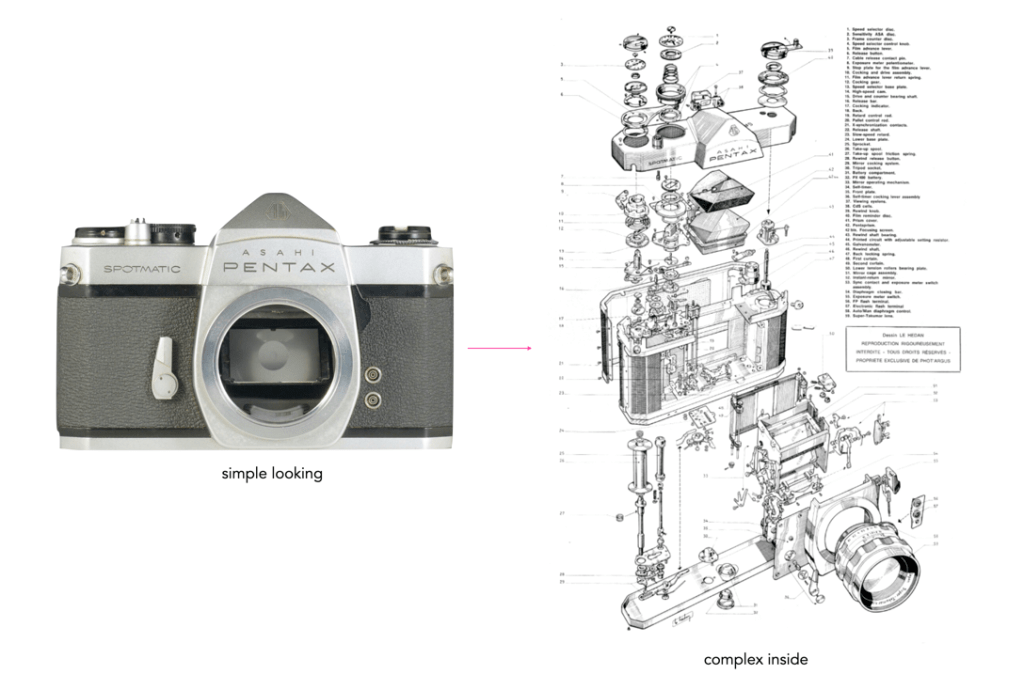
Manual cameras are pretty complex inside (Asahi Spotmatic, 1964)

Can I fix a camera myself?

Hmmm… yes and no. Let me put it into context. If a camera is cheap you could try and fix it, depending of course on the complexity of the issue. To do this, you need to have the right tools, and probably a camera manual. The problem is that sometimes the sheer age (50-80 years) can mean things are seized up, and un-seizing can sometimes lead to things breaking. I would honestly not go down that path (having tried fixing something simple, it just broke something else). It takes a lot of patience and quite a bit of knowledge to pull things apart and put them back together in working order. Even manual cameras are complex – the innards are a haven of interwoven mechanical things. Open a camera at your own peril.

Are light meters an issue?

Invariably yes. Some of the meters, like the early selenium meters can often work quite well, whereas the Cadmium Sulfide (CdS) meters may not work as well. Sometimes cameras will be advertised as “meter not functioning”. Sometimes due to age, the light meter may not be that accurate anyway, so it might be best to use an external light meter, or even a digital one.

Are there issues with electronic 35mm SLRs?

Yes, electronics don’t always stand the test of time well. Electronics tend to be adverse towards moisture, and dust, which will find their way into a camera and cause issues. It may be possible to find (or even manufacture) mechanical part replacements, electronics are another thing altogether. That being said, electronic cameras are usually quite reliable.
Choosing a vintage SLR camera – some FAQ

This past covers more aspects of buying a vintage camera in FAQ form. When it comes to 35mm interchangeable-lens cameras there are two categories: rangefinder and single-lens-reflex (SLR). This FAQ is concerned with SLRs because they became the dominant form of SLR camera found on the used market.

What are the best vintage cameras?

Identifying the best vintage camera is very much a subjective thing. Unlike lenses though, which are often chosen for the aesthetic appeal they impart upon photographs, cameras are all about functionality. All cameras really serve the same purpose, as a vessel to hold the lens, and film, and control the process of taking a photo. So the best vintage cameras are often those that achieve this in a way that doesn’t compromise functionality. They should be simple to use, aesthetically pleasing, ergonomic, and don’t suffer from a series of maladies, e.g. shutters that could imminently fail, poor engineering or manufacture etc.

Which camera types are best?

It really depends on what sort of features are required, and perhaps what sort of lens mount (not all lens mounts are inter-compatible, and it is hard to find adapters for film cameras). Do you want fully manual, semi-automatic, or fully electronic? Do you want a built-in light meter (which is tricky because many don’t work anymore)? Then you have to figure out which ones are problematic from some functional viewpoint, e.g. problems with shutters, or flaky electronics. For example Olympus made 14 major models of manual focus SLR in the period 1972 until 2002, and two automatic models. The OM-707 was an auto-only camera, and somewhat of a disaster from a usability perspective. The Olympus OM-4Ti (1986-2002) is considered by many to be best film SLRs money can buy.

What is the most versatile camera mount?

In reality, M42 is likely the most common lens mount, at least up until the early 1970s. There were a lot of lenses made for this mount from a myriad of manufacturers. There were also a bunch of cameras that used it as the mount. Next in line might be the Exakta mount.

Can film cameras use lenses from other brands?

Unlike mirrorless digital cameras, which have a short focal flange distance, allowing for adapters to suit a bunch of 35mm film lenses, the same is not true for film cameras. Some cameras can use lenses with other mounts, many can’t. For example the Minolta cameras with an SR-mount can use M42 mount lenses, because the flange distance on the camera (43.50mm) is less than that of the lens, allowing an adapter to convert the M42 to SR-flange (MD,MC) – however the opposite is not true.

Do some people buy cameras because they are aesthetically pleasing?

Yes. Some people love how cameras look, even if they don’t function that well. Form over function is a real thing for some people, of course beauty is always in the eye of the beholder.

Why were some SLRs unsuccessful?

Sometimes cameras didn’t sell that well, and as a result weren’t that successful. This was usually down to poor choices in the design of the camera. A good example is Rollei which had its own bayonet mount lens system known as the QBM – proprietary lens mounts means a smaller choice of lenses. Poor usability, or finicky mechanical features often lead photographers to abandon a camera. Sometimes it can be poor aesthetics, as with the case of the Minolta Maxxum 7000, although to be honest requiring photographers to dump all their lenses in favour of a new system with autofocus, probably wasn’t the best idea.

What about brands?

There are three major categories of vintage camera manufacturers. The first are landmark manufacturers who got into the game early, and focused heavily on SLRs. They likely had a start in 35mm rangefinder cameras. This means manufacturers like Exakta, Asahi-Pentax, Nikon, and Canon. Pentax is the only one of the three that did not produce rangefinder cameras. Next are the companies that are second tier, i.e. they had a smaller footprint, made only SLRs or got into the game late. This includes Konica, Minolta, Fuji, Olympus, Topcon, Yashica, Petri, Mamiya, Miranda, Ricoh, Zeiss Ikon, KW, ALPA. Lastly are the companies who didn’t really do a great job with 35mm SLR – Leica, Rollei, Voigtländer. Each manufacturer produced both good and mediocre cameras, and so it really requires some investigation into the right brand.

Are Japanese SLRs better than German ones?

In all probability, yes. There are undoubtedly some good German SLRs, mostly from East Germany, produced in the 1950s and 1960s. West Germany really didn’t produce that many successful SLRs. Both countries struggled to produce SLRs that could compete with the ones produced by Japanese manufacturers. There are a few good German SLRs, e.g. the Contax S2, but the reality is there is likely better Japanese cameras that are way cheaper.

Should I buy a camera made in East Germany?

With the exception of Exakta cameras, many post-war Eastern bloc cameras suffer from lower standards of engineering, reliability, and in some cases poorer usability than West German and Japanese cameras. When they were new, this was less of an issue because these cameras were often sold for dramatically lower prices. However aging cameras can be fraught with issues. Check the reliability of any camera you are interested in.

Why are there so many Eastern-bloc cameras?

Cold hard currency. The communist-bloc countries needed currency, and one was to achieve that was to produce goods to sell in the west. Banking on Germany’s pre-war reputation for producing photographic equipment, this was a very lucrative option. Dresden, which ended up in East Germany, was once the European epicentre of photographic innovation. The cameras were often sold cheaply, thanks in part to Eastern-bloc government subsidies.

What’s are the best East German SLRs?

Anything in the Exakta range, or perhaps a Praktina, or Praktica IV.

What about the weird brand SLRS?

Oh, you’re talking about the small independent brands?

  • Rectaflex (Italy, 1949) – over-engineered, heavy yet reliable, these cameras are expensive only because of their rarity.
  • Alpa (Switzerland, 1942) – exacting, well-built cameras. Some models such as the 6c are extremely good cameras, although some are susceptible to shutter issues. Expensive, but provides a unique character, and high level of quality.
  • Wrayflex (England, 1950) – the only commercially successful, English made SLR.
  • Edixa Reflex (West Germany, mid 1950s) – moderate quality cameras made by Wirgin (Weidbaden), these cameras rarely operate for very long.

Why are there so few cameras not made in Germany or Japan?

This is in part due to a lack of interest in developing their photographic sectors. While the allies poached a lot of high-tech workers from Germany, particularly from the armaments sector, they didn’t relocate any photographic expertise, except from the Russian occupied zone in Germany to the US zone. The boom in SLRs which occurred in the 1950s was driven by cheap cameras and lenses coming out of East Germany, and the growth of the photographic sector in Japan. Countries like the US, UK, and France could not compete, or just didn’t have the ability to get into a market that was dominated pre-war by Germany.

What’s does “mint” mean?

This is a term used by some resellers to indicate that a camera is in near perfect condition, almost like it came out of the factory last week. In many cases it likely means the camera sat in its box, and was never used (if it comes with the box and instructions, even better). However just because it’s mint doesn’t always mean that everything will function the same as it did when it came out of the factory 60 years ago. Materials still may degrade, grease solidifies, and gears seize up.

What about electronically-controlled 35mm SLRs?

This is often a choice for people who don’t want to deal with a fully manual camera. This means any 35mm SLR where electronics aid in calculating things like exposure. This could range from something like an aperture-priority-only camera to an autofocus equipped, completely automatic SLR. The only problem with these cameras can be aging electronics. If the electronics stop working, you basically have a paper weight. Choose a camera that is well reviewed and barely ever gets negative reviews. Note that manual cameras often had light meters, but that doesn’t make them electronic cameras (a camera with a light meter can generally be used even if the light meter doesn’t work.)

Choosing a vintage lens – some tech FAQ

Not a definitive list, but one which covers a few of the “tech” issues. More will be added as I think of them.

Are all lenses built the same?

Most manufacturing companies provided a good, clean environment for constructing lenses. That’s not to say that there won’t be lousy copies of a particular lens, as well as outstanding copies, due to manufacturing tolerances. This is exacerbated in some lenses from the USSR, mostly because the same lens could be manufactured in a number of different factories, all with differing levels of quality (which during the period could be true of any company running multiple manufacturing locations).

Are vintage lenses radioactive?

There are some lenses that produce low-level radiation because they contain one or more optical elements made using Thorium. It was useful in lens design because it gave optical glass of the period a high refractive index, so fewer lens elements would be needed in a lens.

What sort of aberrations do vintage lenses produce?

No lens is perfect (not even modern ones). Lenses can suffer from soft edges, chromatic aberrations, and vignetting. But that’s not to say these things are negatives. Some vintage lenses can create the same sort of distortions that app filters do – using the lens aberrations.

Do vintage lens have coatings?

Lens coatings first appeared in the 1930s, yet many early vintage lenses only had a single layer coating and as such many lenses are susceptible to internal reflections and lens flare. Lens coatings were made from a variety of materials, including rare-earth elements. Lens coatings were primarily created to eliminate or reduce light reflections. Through the practical application of lens coatings, a significant reduction in the reflective index of the lens allowed for more complex optical designs to be constructed. The lack of coatings can add to a lenses’ character.

Are vintage lenses sharp?

Vintage lenses may not be as sharp as modern ones, but then again vintage lenses aren’t really about sharpness. Older lenses are often sharp in the centre, but decreasingly so as you move to the corners. Stopped down to f/8 many produce good results. The reduced sharpness is due to the use of fewer low-dispersion optics, fewer anti-reflective coatings, and the widespread use of spherical elements in lens construction. The use of low-dispersion glass and aspherical elements has lead to finer detail in modern lenses.

Does bokeh matter?

Does it? Look honestly, buying a lens just for its ability to produce “creamy” bokeh is fine, but you still have to have the right circumstances so the lens will produce bokeh. Bokeh certainly adds interest to a picture, but it’s not the be-all and end-all some people make it out to be.

Is faster better?

An f/1.2 lens is often (incorrectly) considered to be better than an f/1.4 lens, which is turn is better than a f/1.8 lens, while an f/3.5 lens is not even considered. This misconception is derived, in part, from the fact that large aperture lenses are more costly to design and manufacture. However a high cost is not necessarily associated with better quality when all aspects of lens performance are considered. Large aperture lenses do benefit from superior light-gathering power, good in low light situations – but how often is this needed? Large aperture settings also suffer from a very shallow depth-of-field.

Why do later lenses have so few aperture blades?

Lenses of the 1950s often had a lot of aperture blades, from a low of 8 to a high of 18-20. This means that the apertures produced in scenarios such as Bokeh are almost perfectly round. However with the introduction of fully automatic aperture in 1961, there was a need to reduce the operating resistence of the blades, hence many manufacturers chose to reduce the number of aperture blades to 6.

Can vintage lenses be stabilized?

Vintage lenses don’t come with built-in stabilization. This is not a problem with cameras that have in-body stabilization like Olympus, but can be an issue with those that rely on lens-based stabilization.

Do vintage lenses produce EXIF data?

Vintage lenses do not have an electronic connection, so that means the camera will only record metadata (EXIF) for images relative to camera settings like shutter speed, ISO, FPS, picture profiles, etc. However, no lens data will be included, such as f-stop, or focal length. The camera also won’t think there is a lens attached, so it is necessary to change the setting “Release without lens” to activate the shutter release. This can really hamper some people as it requires taking notes while out shooting, and it isn’t always practical – like when you are taking a few shots in sequence. With no lens specific information, the camera has little ability to correct for things like vignetting.

Vintage lenses – some general FAQ

Here are some questions relating to vintage lenses, things that people might like to know before they dive into the world of vintage lenses (and how to choose them).

Can any vintage lens be used on a digital camera?

Just about. Most mirrorless full-frame and crop-sensor cameras can be used with vintage lenses, but there are some lenses which don’t work, either because they have a strange lens-mount, or the lens itself projects too far beyond the mount into the camera.

Are vintage lenses affordable?

Vintage lenses were once quite inexpensive, but as more people discover them, some are increasing in price – well the popular ones are. That being said, they are still often cheaper than modern glass, especially the faster lenses. For example, the Super-Multi-Coated Takumar 50mm f/1.4 sells for around C$100-150. The 8-element version of the lens, the Super-Takumar, in good condition usually sells for C$300-500 (which is still pretty affordable). The most affordable vintage lenses, are often those mass-produced kit-lenses that don’t get a second look at. Leica lenses are nearly always expensive.

What is the best vintage lens?

There is really no such thing, because the inherent character of a lens is very subjective. Many people swear by the Carl Zeiss Jena lenses, others prefer the Asahi Pentax Takumar series, and yet others gravitate towards Nikon. There are a lot of “best vintage lenses” lists out there, but it is best to look at reviews of people who use a lot of vintage lenses. For example Zenography, Simon’s utak, or Mark Holtze all have great vintage lens reviews on their respective YouTube channels.

Is there such a thing as a perfect vintage lens?

No, even the most sought-after lenses can have limitations. For example the 8-element Takumar 50mm f/1.4 does not outperform other legacy lenses in certain situations. It can be quite soft when the lens is shot wide open in some circumstances, and is a heavy lens. Yet people are still charmed by the lens because it does a really good job with colour rendering. It produces warm colours with very little vignetting. The Takumar lenses also have good ergonomics.

What about vintage zooms?

Some people like them, others don’t. The reality is that there are many really good, well-built early zoom lenses out there, and because they are often so underrated, they are really quite inexpensive.

Aren’t newer lenses better?

Newer lenses are more technologically savvy, and the glass is likely to be near perfect (although truthfully there is no such thing as a perfect lens). Modern lenses built for digital cameras try very hard to remove abnormalities, which is the very reason most people gravitate towards vintage lenses. Modern lenses are also inherently more complex. For example the Olympus Zuiko 25mm f1.2 Pro (MFT 50mm FF equivalent) has 19 lens elements in 14 groups, including low dispersion, high-refractive, and aspherical elements. The vintage equivalent, the Olympus OM Zuiko AUTO-S 50mm f1.2 has 7 elements in 6 groups. Vintage lenses often use a very simple optical designs that have been around for a hundred years. Do you really need a lens with 15 lens elements, or will 6 do?

Are all vintage lenses manual?

Practically all vintage lenses require manual focus, and manually setting the aperture. Manual focusing is slower than autofocus, but most mirrorless cameras provide tools, e.g. focus peaking, to help with the process of manual focusing. Manual focus lenses might not be an optimal choice for activities such as travel involving fast-paced tourism, but it brings you closer to understanding the subtleties how a camera-lens combination works.

Is there a good range of focal lengths?

Brands aside, there is usually a good selection of focal lengths available. The most common focal length is 50mm, because of it’s “normal” status, and the fact that it came as the standard “kit” lens on most cameras. After that there is a good range of wide-angles (28mm, 35mm), and short telephotos (85-135mm). Ultra-wide angle lenses are rarer, yet there seems to be a wide range of telephotos (possibly because they aren’t as popular).

What about the build quality of lenses?

Many of these lenses were built tough. They featured solidly build body’s with aluminum lens barrels and stainless steel mounts. Without a bunch of electronic and motors inside to facilitate things like auto-focus, vintage lenses can often be quite compact, and light. They are robust, easy to fix, and lack the complex electronics of modern lenses (meaning they will last for decades).

How does adapting a vintage lens to a crop-sensor affect it?

Most vintage lenses were designed for 35mm film cameras, and their equivalent is full-frame digital cameras. So a vintage lens put on a crop-sensor camera will behave the same way as any other lens on a crop sensor, i.e. its angle-of-view will be modified. For example you could choose any vintage 50mm lens, and when added to an APS-C camera it would behave like a 75mm lens in “full-frame equivalency”. Used on a camera with a MFT sensor, it would behave like a 100mm FF equivalent.

Can vintage lenses be used to create retro-looking images?

Possibly, it really all depends on the type of lens, and the type of digital camera it is used upon. There are many more variables involved with using digital cameras, as opposed to film cameras. It is possible to try and replicate the “look” of old photos, but digital cameras will not replicate film 100%.

Where is the best place to buy vintage lenses?

I have covered this in a separate post. I also maintain a list of “Where to buy what”.