Are lens descriptors getting too complicated?

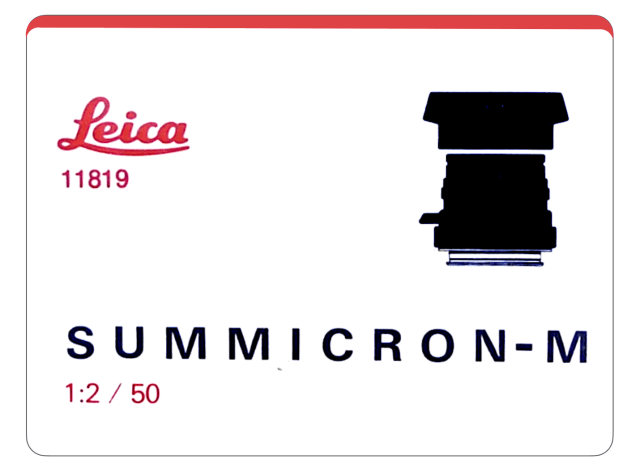
Lens descriptors, those one-liners that describe the characteristics of a lens use to be simpler. Consider the older Leica lens box shown below. A brand, a lens name, aperture, focal length, and a lens profile. But then maybe lenses were simpler? I guess they could have festooned the descriptor with lens coatings, and other fancy acronyms describing interesting lens features, but they didn’t, probably because whoever was in charge of marketing realized that lens descriptors need to be simple.
Many companies now give their lenses such complex descriptors it’s easy for people to get confused. Often the difference between two generations of a lens is the addition of another acronym on the newer lens. Take Fujifilm lenses as an example. I love Fujifilm lenses, but their names are a bit of a mouthful… to the extent that Fujifilm actually includes a section in their brochures called ‘Lens Names Explained‘. Here is an example of a Fujifilm lens descriptor:
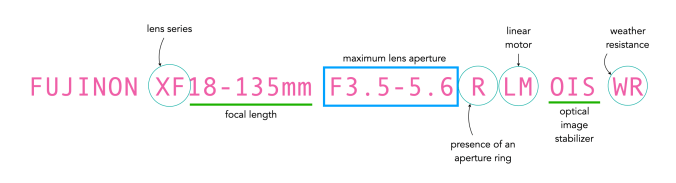
There is a lot of information in this label, mostly describing the characteristics of the lens, such as weather-resistance, the type of motor driving the focusing mechanism, and whether the lens has a physical aperture ring or not. Most companies that produce lenses seem to have some sort of guide to explain their terminology. Canon provides ‘How to read a lens name‘ where they talk about lens mount, focal length and aperture (the easiest things to explain), and then a myriad of abbreviations to explain technology: L (Luxury), DO (diffractive optics), DS (defocus smoothing coating), IS (image stabilization), and focusing motor (USM/Nano USM/STM/Macro). or perhaps Sony’s ‘Lens terminology‘?

For the average user, it’s just too much information. Can things be improved? Yes − by simplifying naming conventions, i.e. removing the acronyms and abbreviations. Put them somewhere else, because most people in the first instance are interested in ① focal length, ② maximum aperture, and perhaps ③ weather resistance (and let’s be honest, price). I’m not even sure it matters if the acknowledgement of aspherical lens elements is necessary, or even the type of focusing motor. The only people that likely care are professional photographers. I mean most lenses have pages contains their specs that people will read, so is there any point to including so much detail in a lens descriptor? Perhaps try and create some industry standard symbols. For example using a symbol to denote weather resistance, e.g. ☔︎.

Below is a much simpler description of a Leica lens. Mostly just the basics, although I don’t really know why they include the fact the lens contains aspherical elements (ASPH)?
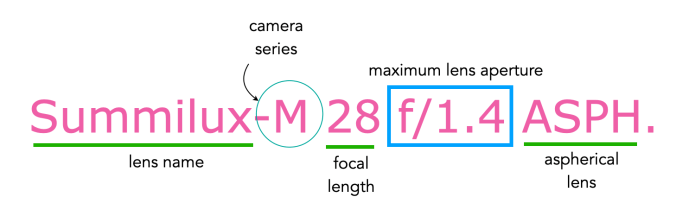
Although I always thought that in the age of different sensor sizes, it might be better to forgo the focal length, and replace it with the lenses angle-of-view (the horizontal one that is, not the nonsensical diagonal one). So for the example lens above (for full frame) this would be 65°. This would also avoid the whole issue with designating lenses, e.g. crop-sensor. Maybe the issue is also that lenses really don’t have ‘names’ anymore, well except for maybe Leica and Zeiss.

I understand, digital lenses are way more complex than their historical counterparts, and companies are continuously adding new features. But where does it end? Do we add lens elements/group data to the descriptor? What about lens coatings? The presence of ASPH already shows some creep of internal technology onto the side of a lens box. How important is it to know that a lens has aspherical elements? Do we also need to signify the existence pf extra-low dispersion glass?

I get it, it’s all about selling the lens, but the more complicated a lens descriptor is, the more questions that have to be asked.
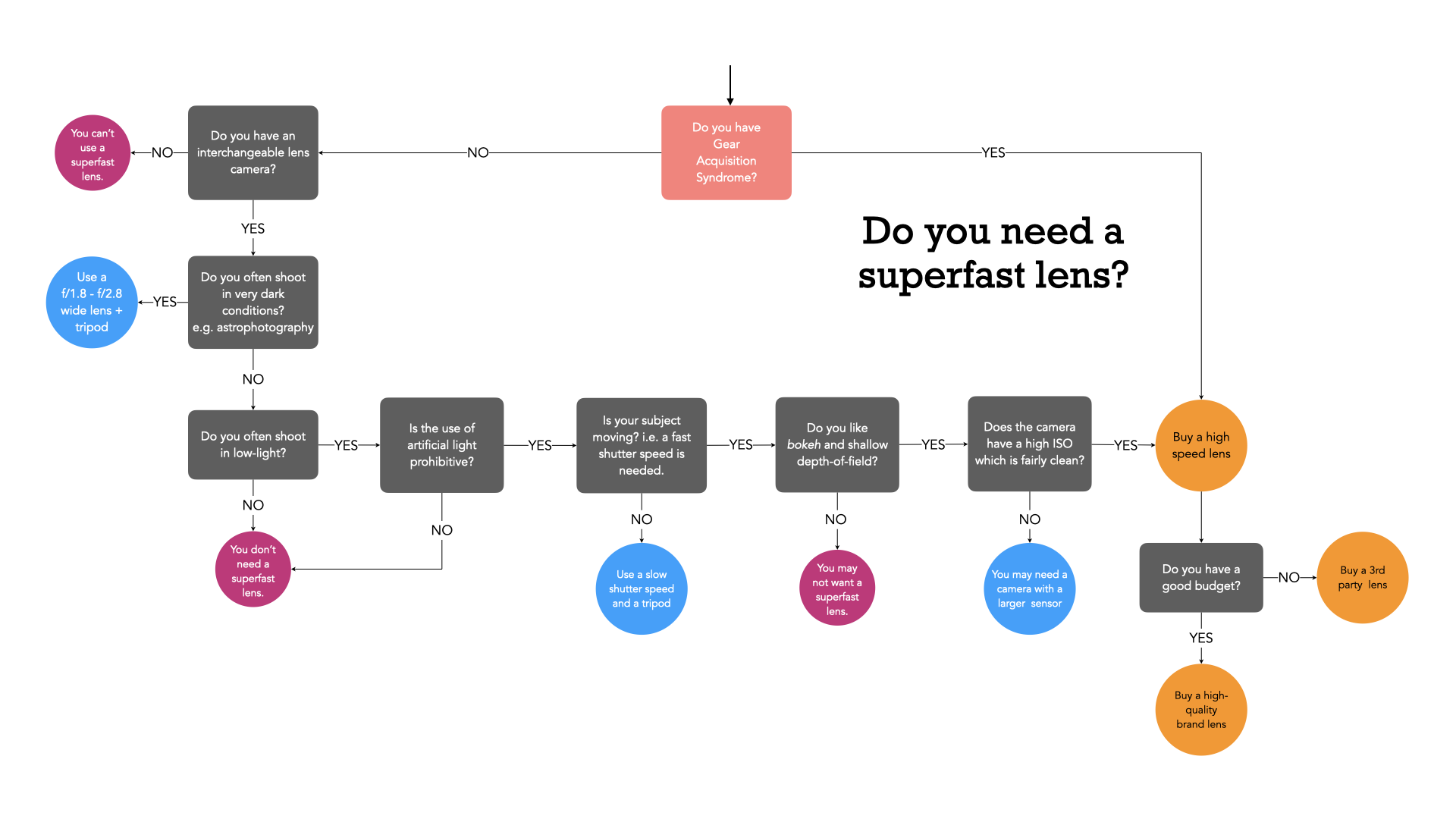
Should you buy a superfast lens?

A superfast lens, is one with a very large aperture, say f/1.2 to f/1.0 (whereas an ultrafast is typically sub-f/1.0). The craze for super-fast lenses began in Japan in the 1950s, with the Zunow 50mm f/1.1 appearing in 1953. There was a lull in the latter decades of the 20th century, but the last ten years has seen a resurgence of these uber-fast f/1.2 and larger aperture lenses. There is always a lot of hype about these lenses – they are expensive, and supposedly offer some sort of nirvanic photographic experience. The question is, should you spend the money to indulge in super-fastness? First let’s look at some aspects of super-fast lenses that make them attractive.

Do you need a superfast lens” ?

The faster the lens is, the more light it lets in

The larger the aperture, the more light that is let into the lens, and in photography, light is good. Moving from a f/1.8 to a f/1.2 lens provides 1.17 stops more light (where one stop doubles the light). For example a 50mm lens with a speed of f/1.8 has an effective aperture of 606mm2. Another 50mm lens with a speed of f/1.2 has an effective aperture of 1363mm2.

If we consider shooting at f/1.8 versus f/1.2, the larger aperture will mean the ability to shoot at faster shutter speeds – if we assume a constant ISO, then increasing the aperture by 1.17 stops means the difference between shooting at 1/500 at f/1.8 and 1/1250 at f/1.2. The second thing is that assuming the shutter speed is fixed, you can shoot at a lower ISO setting – e.g. at a shutter speed of 1/500 it means it means an ISO difference between 400 and 160. However modern sensors work really well at high ISO settings, so perhaps the advantage of a fast lens isn’t as critical?

Faster lenses produce better aesthetics

If it’s one thing that large aperture lenses are good at, it’s aesthetics. This is because the lower the f-number, the shallower the depth of field (DOF). Shallow DOF means a blurrier background, and theoretically better bokeh. However bokeh is a natural phenomena, and relies on the optical nature of the lens, the scene, the type of light, and distance to subject. In addition, a shallow DOF also means less of the image is in focus. It’s a double-edged sword.

Not all that glitters is gold

Of course super-fast lenses are not perfect. They have three things going against them – they are large, heavy, and expensive. They are large and heavy because of the increased amount of glass, and in auto-focus lenses, a larger focusing mechanism is required to deal with the extra glass. I have talked previously about why vintage super-fast lenses were so expensive, and in reality the same basic reasons can be attributed to super-fast digital lenses. For example the Fujifilm XF 50mm f/1.0 R WR lens sells for C$2,000, and is a whopping 845g in weight, almost dwarfing any Fuji camera it is attached to. The other issue with super-fast lenses has always been that they aren’t really that sharp until they are stopped down somewhat. The Fuji 50mm f/1.0 reviews well, but even then some reviewers note that it isn’t that sharp until stopped down to f/2.8 or smaller. But reviews are subjective, and so you really have to test the lens to see if it fits your needs.

Brand or third-party lens?

There is also the dilemma of which super/ultra fast lens to buy. There are a lot of 3rd-party lens manufacturers that produce these lenses at a reasonable cost. I mean you can buy the Meike 50mm f/0.95 for about C$400, or the TTArtisan 50mm f/1.2 for about C$140. The Meike actually gets really good reviews. The reality is that 3rd-party lenses offer a good quality for the price, even better than could be found on the vintage market. Of course the Fuji 50mm f/1.0 is in a class of its own, offering autofocus for a f/1.0 (most lenses of this speed are manual focus), and exceptional bokeh.

So should you buy a super-fast lens? Well, perhaps it boils down to whether you really need more light? This may mean you shoot a lot in low-light conditions, or in a case of the Fuji 50mm f/1.0, a superlative lens for portraiture. For a further foray into these lenses, check out “Are modern ultrafast lenses useful?“.

✿ The number of stops difference between two apertures A and B can be calculated by first finding C=A/B. The number of stops difference is then log(C)/log(sqrt(2)). So the difference between f/1.8 and f/1.2 is 1.17 stops.