The term “crop-sensor” has become a bit nonsensical

The term “crop-sensor” doesn’t make much sense anymore, if it ever did. I understand why it evolved, because a term was needed to collectively describe smaller-than-35mm sized sensors (crop means to clip or prune, i.e. make smaller). That is, if it’s not 36×24mm in size it’s a crop-sensor. However it’s also sometimes used to describe medium-format sensors, even though they are larger than 36×24mm. In reality non-35mm sensors do provide an image which is “cropped” in terms of comparison with a full-frame sensor, but taken in isolation they are sensors unto themselves.
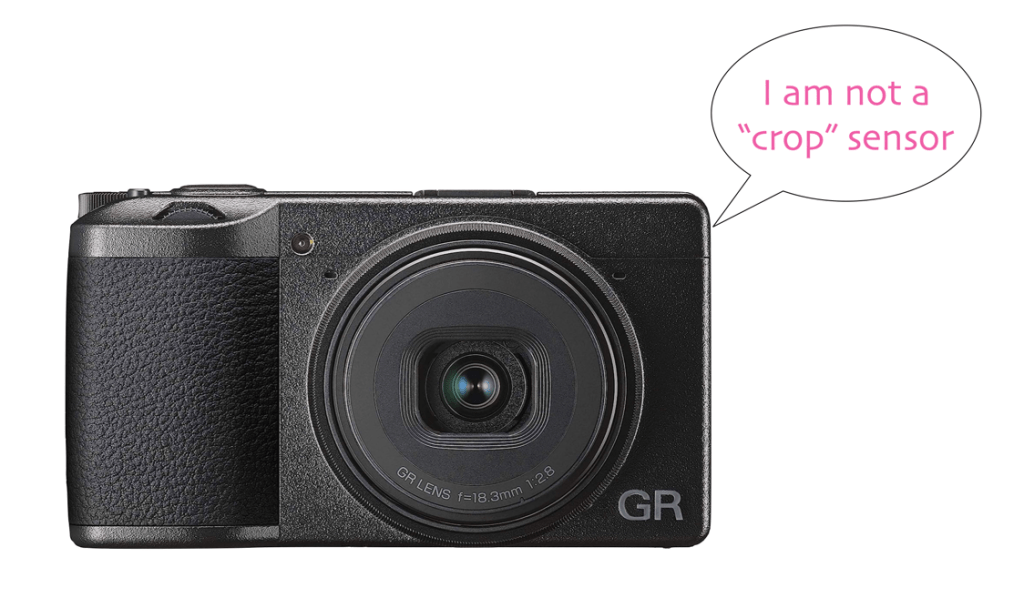
The problem lies with the notion that 36×24mm constitutes a “full-frame”, which only exists as such because manufacturers decided to continue using the concept from 35mm film SLR’s. It is true that 35mm was the core film standard for decades, but that was constrained largely by the power of 35mm film. Even half-frame cameras (18×24mm, basically APS-C size) used the same 35mm film. In the digital realm there are no constraints on a physical medium, yet we are still wholly focused on 36×24mm.

Remember, there were sub-full-frame sensors before the first true 36×24mm sensor appeared. Full-frame evolved in part because it made it easier to transition film-based lenses to digital. In all likelihood in the early days there were advantages to full-frame over its smaller brethren, however two decades later we live in a different world. “Crop” sensors should no longer be treated as sub-par players in the camera world. Yet it is this full-frame mantra that sees people ignore the benefits of smaller sensors. Yes, there are benefits to full-frame sensors, but there are also inherent drawbacks. It is the same with the concept of equivalency. We say a 33mm APS-C lens is “equivalent” to a 50mm full-frame. But why? Because some people started the trend of relating everything back to what is essentially a 35mm film format. But does there even need to be a connection between different sensors?
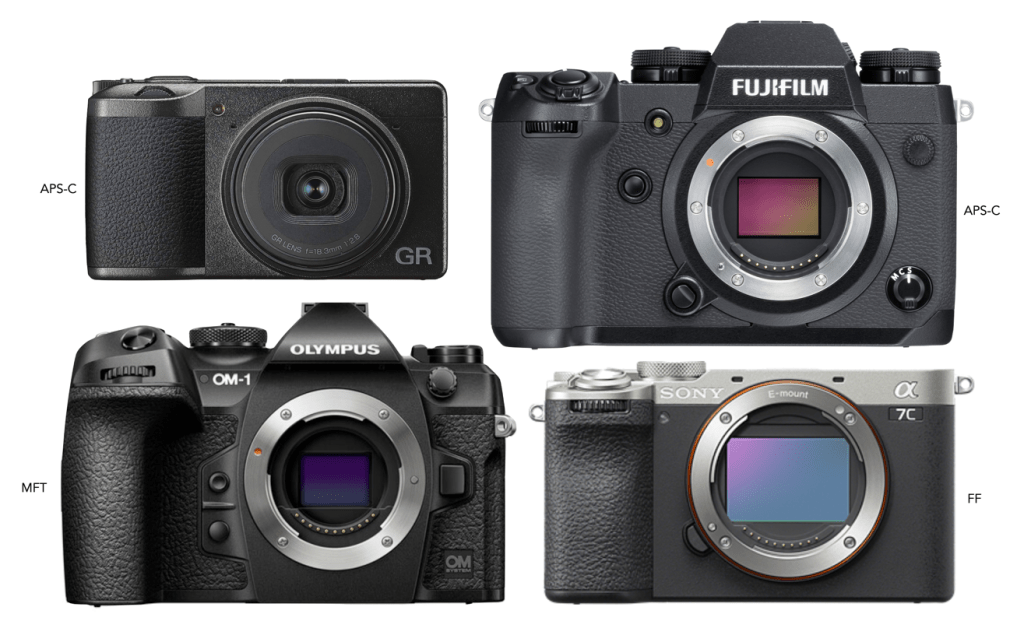
Image showing all APS-C, micro-four thirds  and full-frame cameras.
Sensor equality
What about some sensor equality?

The reason “crop” sensors have continued to evolve is because they are much cheaper to produce, and being smaller, the cameras themselves have a reduced footprint. Lenses also require less glass, making them lighter, and less expensive to manufacture. Maybe instead of using “crop-sensor”, we should just acknowledge the sensors exactly as they are: Medium, APS-C, and MFT, and change full-frame to be “35mm” format instead. So when someone talks about a 35mm sensor, they are effectively talking about a full-frame. All it takes is a little education.
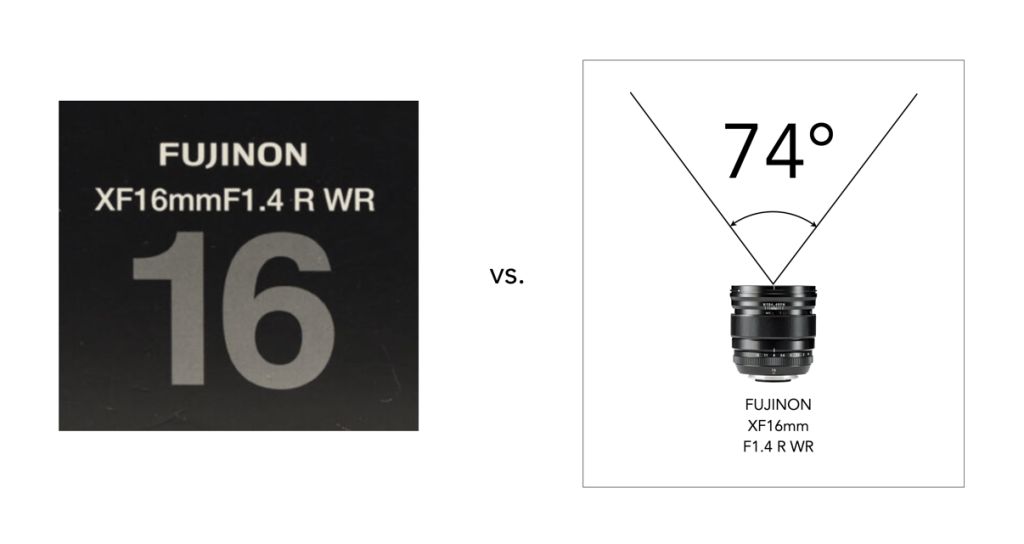
Old versus smarter advertising which puts the emphasis on the angle-of-view. In this case an Fuji APS-C lens – rather than focusing on 16mm, it focuses instead on the horizontal AOV, i.e. 74 degrees. It could also designate that the lens is a wide angle lens.

Using the term-crop sensor also does more harm than good, because it results in more terms: equivalency and crop-factor which are used in the context of focal length, AOV, and even ISO. People get easily confused and then think that a lens with a focal length of 50mm on an APS-C camera is not the same as one on a FF camera. Focal lengths don’t change, a lens that is 50mm is always 50mm. What changes is the Angle-of-View (AOV). A larger sensor gives a wider AOV, whereas a smaller sensor gives a narrower AOV. So while the 50mm lens on the FF camera has a horizontal AOV of 39.6°, the one on the APS-C camera sees only 27°.

It would be easier not to have to talk about a sensor in terms of another sensor. But even though terms like “crop-sensor” and “crop-factor” are nonsensical, in all likelihood the industry won’t change the way they perceive non-35mm sensors anytime soon. I have previously described how we could alleviate the term crop-factor as it relates to lenses, identifying lenses based on their AOV rather than purely by their focal length. This works because nearly all lenses are designed for a particular sensor, i.e. you’re not going to buy a MFT lens for an APS-C camera.
The whole full-frame “equivalence” thing

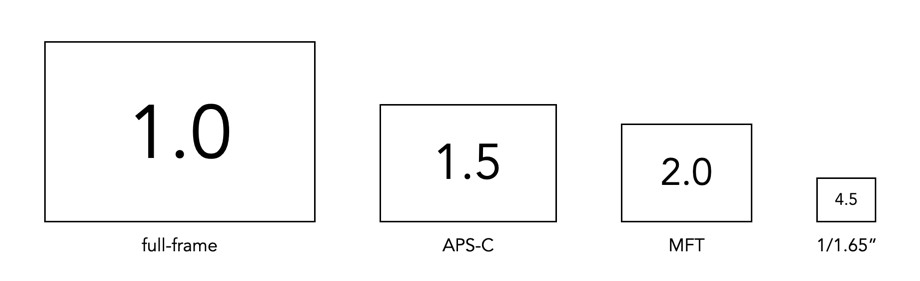
There is a lot of talk on the internet about the “equivalency” of crop-sensors relative to full-frame sensors – often in an attempt to somehow rationalize things in the context of the ubiquitous 35mm film frame size (36×24mm). Usually equivalence involves the use of the cringe-worthy “crop-factor”, which is just a numeric value which compares the dimensions of one sensor against those of another. For example a camera with an APS-C sensor, e.g. Fuji-X, has a sensor size of 23.5×15.6mm which when compared with a full-frame (FF) sensor gives a crop-factor of approximately 1.5. The crop-factor is calculated by dividing the diagonal of the FF sensor by that of the crop-sensor, in the case of the example 43.42/28.21 = 1.53.

Fig.1: Relative sensor sizes and associated crop-factors.

Easy right? But this only really only matters if you want to know what the full-frame equivalent of a crop-sensor lens is. For example a 35mm lens has an angle of view of rough 37° (horizontal). If you want to compare this to a full-frame lens, you can multiply this by the crop-factor for APS-C sensors, so 35×1.5≈52.5mm. So an APS-C 35mm lens has a full-frame equivalency of 52.5mm which can be rounded to 50mm, the closest full-frame equivalent lens. Another reason equivalency might be important is perhaps you want to take similar looking photographs with two different cameras, i.e. two cameras with differing sensor sizes.

But these are the only real contexts where it is important – regardless of the sensor size, if you are not interested in comparing the sensor to that of a full-frame camera, equivalencies don’t matter. But what does equivalence mean? Well it has a number of contexts. Firstly there is the most commonly used situation – focal-length equivalence. This is most commonly used to relate how a lens attached to a crop-sensor camera behaves in terms of a full-frame sensor. It can be derived using the following equation:

Equivalent-FL = focal-length × crop-factor

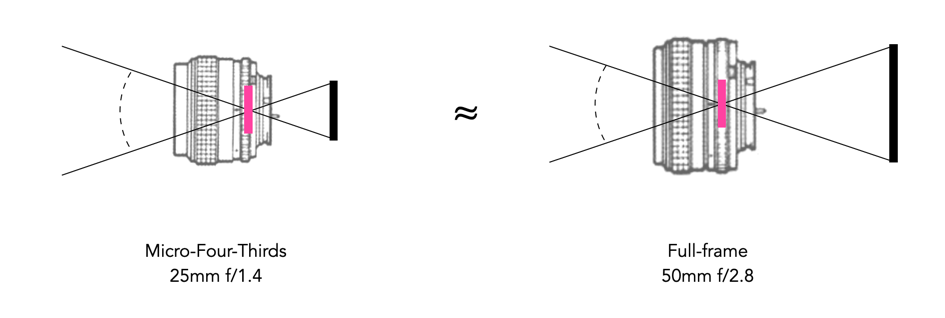
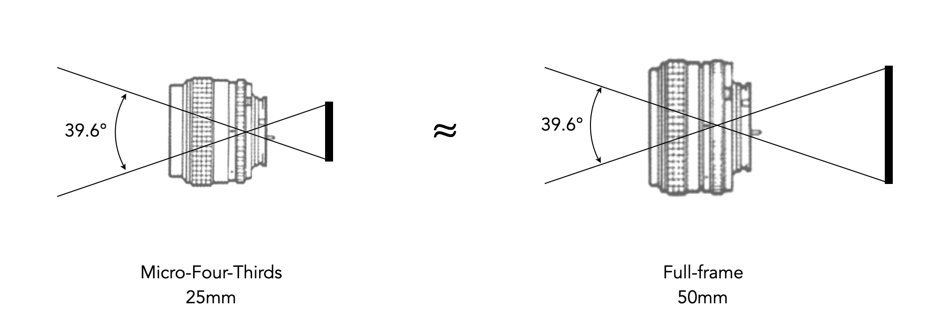
The crop-factor in any case is more of a differential-factor which can be used to compare lenses on different sized sensors. Figure 2 illustrates two different systems with different sensor sizes, with two lenses that have an identical angle of view. To achieve the same angle of view on differently sized sensors, a different focal length is needed. A 25mm lens on a MFT sensor with a crop-factor of 2.0 gives the equivalent angle of view as a 50mm lens on a full-frame sensor.

Fig.2: Focal-length equivalence (AOV) between a Micro-Four-Thirds, and a full-frame sensor.

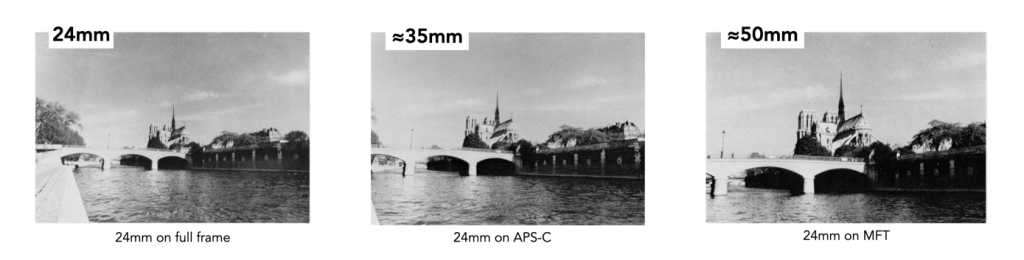
Focal length equivalency really just describes how a lens will behave on different sized sensors, with respect to angle-of-view (AOV). For example the image below illustrates the AOV photograph obtained when using a 24mm lens on three different sensors. A 24mm lens used on an APS-C sensor would produce an image equivalent to a full-frame 35mm lens, and the same lens used on a MFT sensor would produce an image equivalent to a full-frame 50mm lens.

Fig.3: The view of a 24mm lens on three different sensors.

When comparing a crop-sensor camera directly against a FF camera, in the context of reproducing a particular photograph, two other equivalencies come into play. The first is aperture equivalence. An aperture is just the size of the hole in the lens diaphragm that allows light to pass through. For example an aperture of f/1.4 on a 50mm lens means a maximum aperture size of 50mm/1.4 = 35.7mm. A 25mm f/1.8 MFT lens will not be equivalent to a 50mm f/1.8mm FF lens because the hole on the FF lens would be larger. To make the lenses equivalent from the perspective of aperture requires multiplying the aperture value by a crop factor:

Equivalent-Aperture = f-number × crop-factor

Figure 4 illustrates this – a 25mm lens used at f/1.4 on a MFT camera would be equivalent to using a 50mm with an aperture of f/2.8 on a full-frame camera.

Fig.4: Aperture equivalence between a 25mm MFT lens, and a 50mm full-frame lens.

The second is ISO equivalence, with a slightly more complication equation:

Equivalent-ISO = ISO × crop-factor²

Therefore a 35mm APS-C lens at f/5.6 and 800 ISO would be equivalent to a 50mm full frame lens at f/8 and 1800 ISO. Below is a sample set of equivalencies:

           Focal Length / F-stop = Aperture ∅ (ISO)
       MFT (×2.0): 25mm / f/2.8 = 8.9mm (200)
     APS-C (×1.5): 35mm / f/3.9 = 8.9mm (355)
Full-frame (×1.0): 50mm / f/5.6 = 8.9mm (800)
      6×6 (×0.55): 90mm / f/10.0 = 9.0mm (2600)

Confused? Yes, and so are many people. None of this is really that important, except to understand how a lens behaves will be different depending on the size of the sensor in the camera it is used on. Sometimes, focal-length equivalence isn’t even possible. There are full-frame lenses that just don’t have a cropped equivalent. For example a Sigma 14mm f/1.8 would need an APS-C equivalent of 9mm f/1.2, or a MFT equivalent of 7mm f/0.9. The bottom line is that if you only photography using a camera with an APS-C sensor, then how a 50mm lens behaves on that camera should be all that matters.